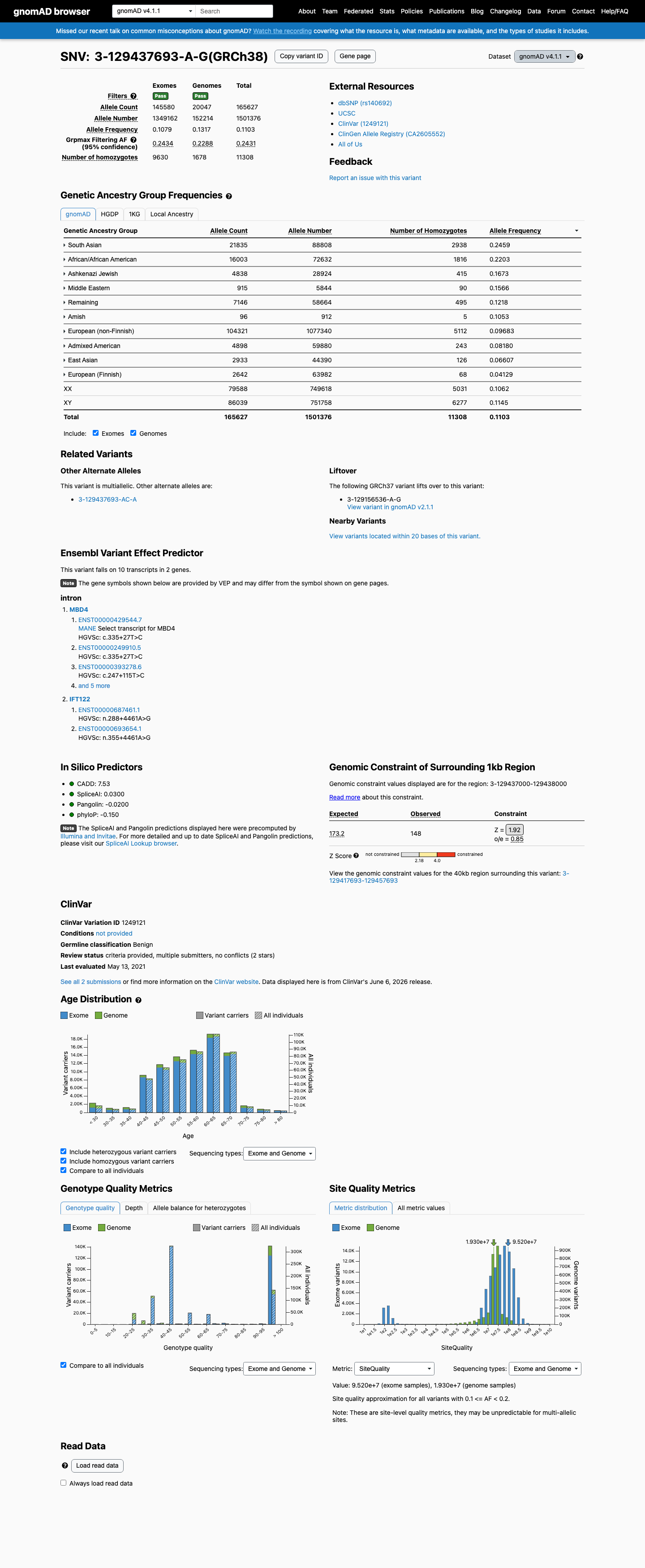
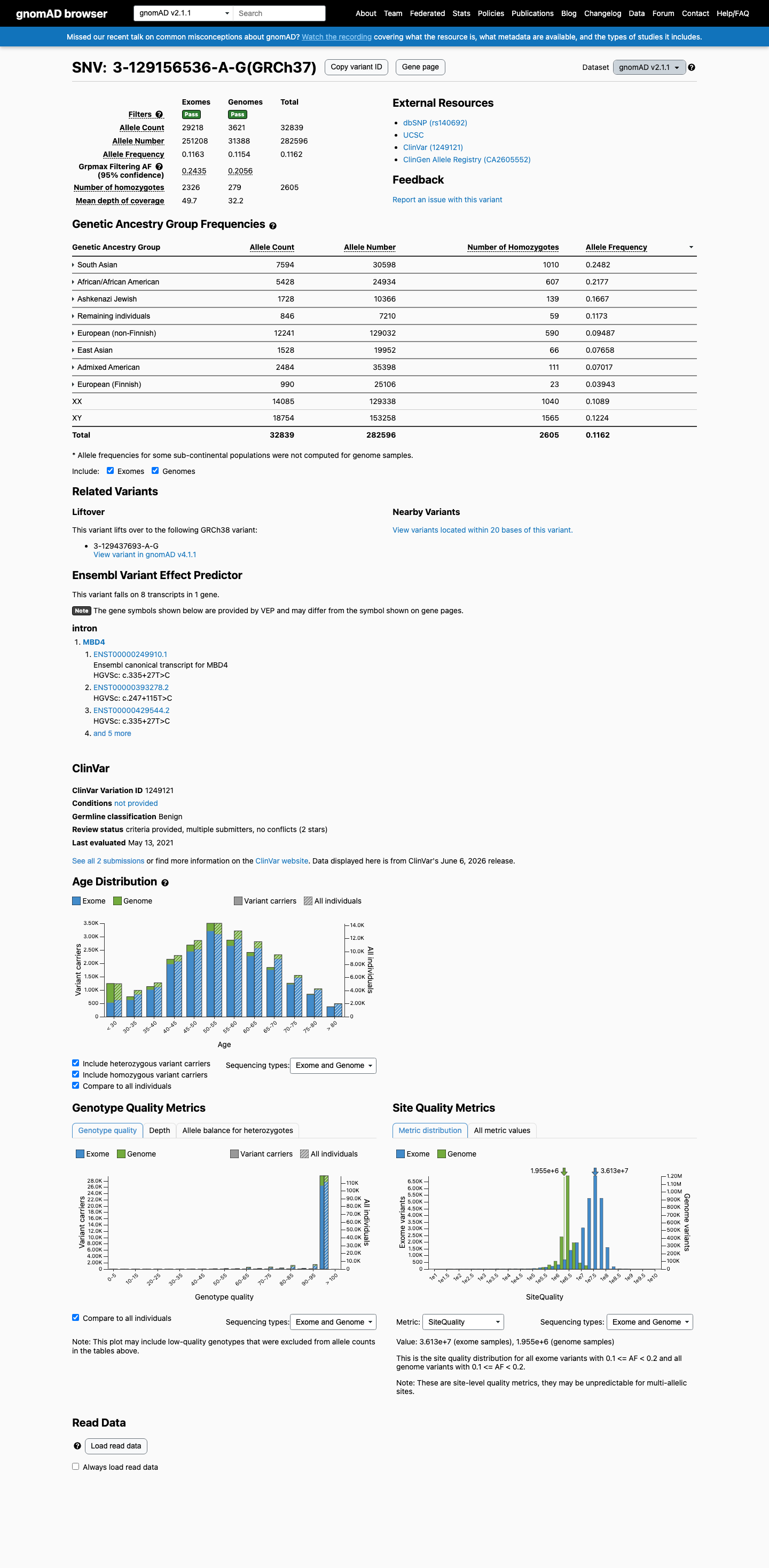
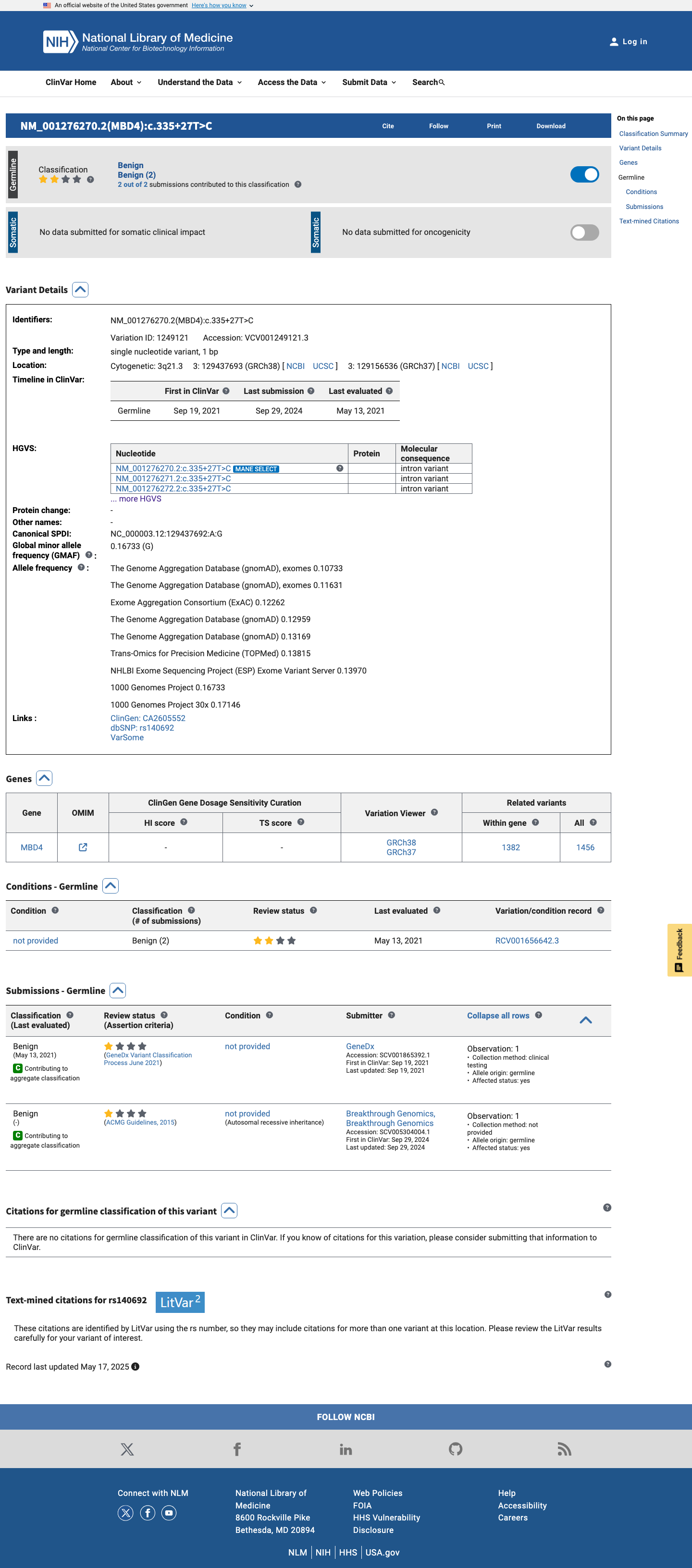
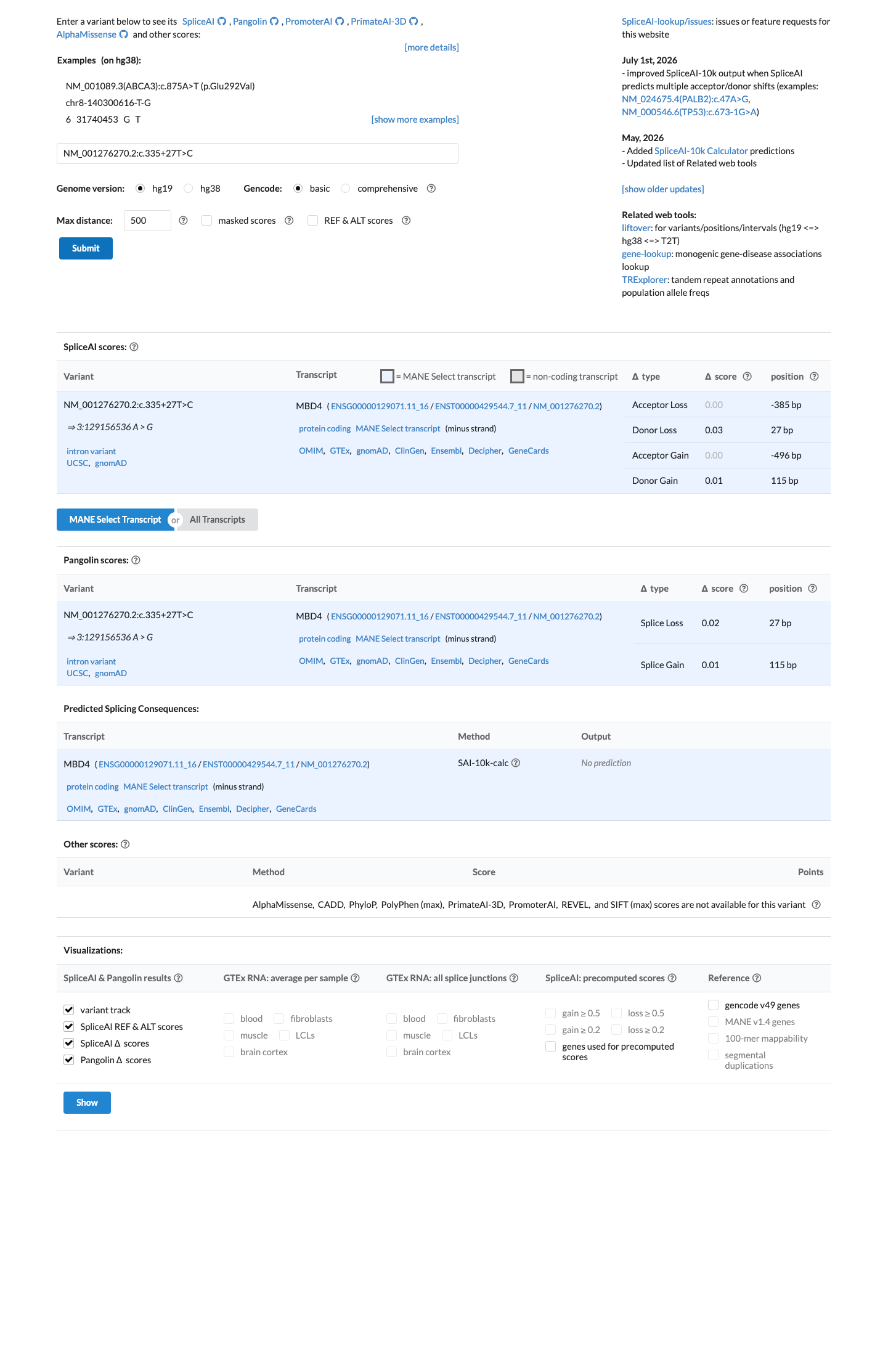
NM_001276270.2:c.335+27T>C is a common intronic variant with an allele frequency of 11.6% in gnomAD v2.1 (32,839/282,596 alleles, 2,605 homozygotes) and 11.0% in gnomAD v4.1 (165,627/1,501,376 alleles, 11,308 homozygotes), far exceeding the 1% threshold for stand-alone benign (BA1).1 The variant has been reported as Benign in ClinVar (ClinVar ID 1249121) by a clinical laboratory using criteria-based assessment.2 SpliceAI predicts no splicing impact (max delta score = 0.00), consistent with a deep intronic variant that does not disrupt normal mRNA processing (BP4, BP7).3 The variant has been observed in homozygous state in 2,605 individuals in gnomAD v2.1 and 11,308 in gnomAD v4.1, demonstrating that homozygosity is tolerated at population scale (BS2).4 Based on BA1 alone, this variant meets stand-alone benign criteria and is classified as Benign per the ACMG/AMP 2015 combining rules regardless of any other criterion.5
Final classification
Benign
BA1BS1BS2BP4BP7
MBD4
c.335+27T>C
p.?
missense
This variant
NM_001276270.2:c.335+27T>C is a common intronic variant with an allele frequency of 11.6% in gnomAD v2.1 (32,839/282,596 alleles, 2,605 homozygotes) and 11.0% in gnomAD v4.1 (165,627/1,501,376 alleles, 11,308 homozygotes), far exceeding the 1% threshold for stand-alone benign (BA1).
gene-specific framework lacked a usable explicit final combination framework, so generic ACMG/AMP 2015 final-combination rules were applied as fallback; applied criteria: BA1 stand-alone benign, BS1 strong benign, BS2 strong benign, BP4 supporting benign, BP7 supporting benign; combination = 1 stand-alone benign + 2 strong benign + 2 supporting benign, which maps to Benign.
Classification rationale
BA1BS1BS2BP4BP7
Benign
MBD4 c.335+27T>C
missense
BA1 + BS1 + BS2 + BP4 + BP7
→
Benign
LYFE Sciences is an AI system, and it can make mistakes. Criteria
may be applied incorrectly, sources may be misread, and a confident-looking
classification can still be wrong. Double-check every criterion and
its underlying evidence before relying on any call.
Gene diagram
· NM_001276270.2 · variants mapped to exon structure
MBD4
NM_001276270.2
Fetching transcript structure from UCSC…
Applied criteria · 5 applied · 14 assessed
MetEvidence satisfies this criterion.
Not metEvaluated against available evidence; threshold not reached.
Not assessedApplies in principle, but no evidence was found to evaluate it.
N/ADoesn't apply to this variant type.
Applied · 5
Strength
Supporting
Moderate
Strong
Very strong
BA1
stand-alone
Benign
This variant is present in gnomAD v2.1 at 11.6% (32,839/282,596 alleles, 2,605 homozygotes) and gnomAD v4.1 at 11.0% (165,627/1,501,376 alleles, 11,308 homozygotes). The grpmax filtering allele frequency is 24.3%. These frequencies far exceed the 1% BA1 threshold, establishing this variant as a common benign polymorphism.
gnomAD v2.1: AF=11.62%2605 homozygotes
BS1
strong
Benign
This variant is present at 11.6% in gnomAD v2.1, far exceeding the 0.3% BS1 threshold. Allele frequency is more than 38-fold above the cutoff across multiple populations, including South Asian (24.8%), African/African American (21.8%), and Ashkenazi Jewish (16.7%).
gnomAD v2.1 AF=11.6%exceeding 0.3% BS1 threshold. Elevated across all populations.
BS2
strong
Benign
This variant has been observed in 2,605 homozygotes in gnomAD v2.1 and 11,308 homozygotes in gnomAD v4.1. Homozygosity for this variant is tolerated at population scale, inconsistent with a fully penetrant Mendelian disorder.
2605 homozygotes in gnomAD v2.111
BP4
supporting
Benign
SpliceAI predicts no splicing impact (max delta score = 0.00) for this intronic variant. No donor gain, donor loss, acceptor gain, or acceptor loss is predicted. Computational evidence supports a benign interpretation.
SpliceAI max delta = 0.00: no donor gaindonor lossacceptor gain
BP7
supporting
Benign
This is an intronic variant (c.335+27T>C) at a position not within the canonical splice consensus. SpliceAI predicts no splicing impact (max delta = 0.00). No evidence suggests this variant disrupts splicing, consistent with BP7.
c.335+27T>C is an intronic variant outside the canonical splice consensus. SpliceAI max delta = 0.00 confirms no predicted splice disruption.
Assessed · not applied
· 14 not met · 0 not assessed
Pathogenic
PS2
No de novo observation data available for this variant.
PS3
No variant-specific functional data available.
PS4
This variant is present at 11.6% allele frequency in gnomAD v2.1 with 2,605 homozygotes; case enrichment cannot be established for a variant of this frequency in the general population.
PM2
This variant is present in gnomAD v2.1 at 11.6% (32,839/282,596 alleles) and gnomAD v4.1 at 11.0% (165,627/1,501,376 alleles), far exceeding the <0.1% threshold for PM2.
PM6
No de novo observation data available for this variant.
PP1
No cosegregation data available for this variant.
PP3
SpliceAI predicts no splicing impact (max delta score = 0.00).
PP4
No patient phenotype data available to evaluate whether the variant explains a specific clinical presentation.
PP5
ClinVar reports this variant as Benign, not Pathogenic.
Benign
BS3
No functional studies demonstrating no deleterious effect are available for this variant.
BS4
No family segregation data available to assess non-segregation with disease.
BP2
No specific data on observation in trans with a pathogenic variant were identified in the case materials.
BP5
No data available indicating an alternate molecular basis for disease in individuals carrying this variant.
BP6
ClinVar reports this variant as Benign (ClinVar ID 1249121), but the review status is 'criteria provided, single submitter' — not a 3-star expert panel classification.
N/A · 9
PVS1 · PS1 · PM1 · PM3 · PM4 · PM5 · PP2 · BP1 · BP3
Research & evidence
Population frequency · supports benign
gnomAD v4.1
gnomAD v2.1
v4.1
This variant is present in gnomAD v4.1 (AF= 0.110317; MAF= 11.03168%, 165627/1501376 alleles, homozygotes = 11308) and has highest observed frequency in the South Asian population (AF= 0.245867; MAF= 24.58675%, 21835/88808 alleles, homozygotes = 2938); grpmax FAF= 0.243137.
v2.1
This variant is present in gnomAD v2.1 (AF= 0.116205; MAF= 11.62048%, 32839/282596 alleles, homozygotes = 2605) and has highest observed frequency in the South Asian population (AF= 0.248186; MAF= 24.81862%, 7594/30598 alleles, homozygotes = 1010); grpmax FAF= 0.24352.
🇨🇦 CA
This variant is present in gnomAD-Canada v1.0 (AF= 0.12480990658266349, 2298/18412 alleles, homozygotes = 167).
Allele frequency by ancestry
three datasets · side by side
gnomAD v4.1
11%
· 165627 / 1,501,376
11308 hom · FAF 24%
11308 hom · FAF 24%
South Asian 21835 / 88,808 |
25% 2938 hom |
African/African American 16003 / 72,632 |
22% 1816 hom |
Ashkenazi Jewish 4838 / 28,924 |
17% 415 hom |
Middle Eastern 915 / 5,844 |
16% 90 hom |
Remaining individuals 7146 / 58,664 |
12% 495 hom |
Amish 96 / 912 |
11% 5 hom |
European (non-Finnish) 104321 / 1,077,340 |
9.7% 5112 hom |
Admixed American 4898 / 59,880 |
8.2% 243 hom |
East Asian 2933 / 44,390 |
6.6% 126 hom |
European (Finnish) 2642 / 63,982 |
4.1% 68 hom |
gnomAD v2.1
12%
· 32839 / 282,596
2605 hom · FAF 24%
2605 hom · FAF 24%
South Asian 7594 / 30,598 |
25% 1010 hom |
African/African American 5428 / 24,934 |
22% 607 hom |
Ashkenazi Jewish 1728 / 10,366 |
17% 139 hom |
Remaining individuals 846 / 7,210 |
12% 59 hom |
European (non-Finnish) 12241 / 129,032 |
9.5% 590 hom |
East Asian 1528 / 19,952 |
7.7% 66 hom |
Admixed American 2484 / 35,398 |
7% 111 hom |
European (Finnish) 990 / 25,106 |
3.9% 23 hom |
gnomAD Canada 🇨🇦
12%
· 2298 / 18,412
167 hom · FAF 24%
167 hom · FAF 24%
indel · split
South Asian 360 / 1,360 |
26% 39 hom |
African/African American 233 / 1,020 |
23% 30 hom |
Middle Eastern 24 / 144 |
17% |
Remaining individuals 183 / 1,136 |
16% 13 hom |
Ashkenazi Jewish 121 / 832 |
15% 14 hom |
East Asian 138 / 1,338 |
10% 11 hom |
European (non-Finnish) 1158 / 11,736 |
9.9% 57 hom |
Latino/Admixed American 81 / 838 |
9.7% 3 hom |
+ 1 not observed (European (Finnish))
ClinVar
This variant has been reported in ClinVar as Benign (1 clinical laboratory). (ClinVarID = 1249121)
In silico
SpliceAI predicts no significant splice impact for this variant (max delta score = 0.00).
Functional
No data
No calibrated functional assay or RNA evidence was identified for this variant.
COSMIC
Somatic evidence
COSMIC
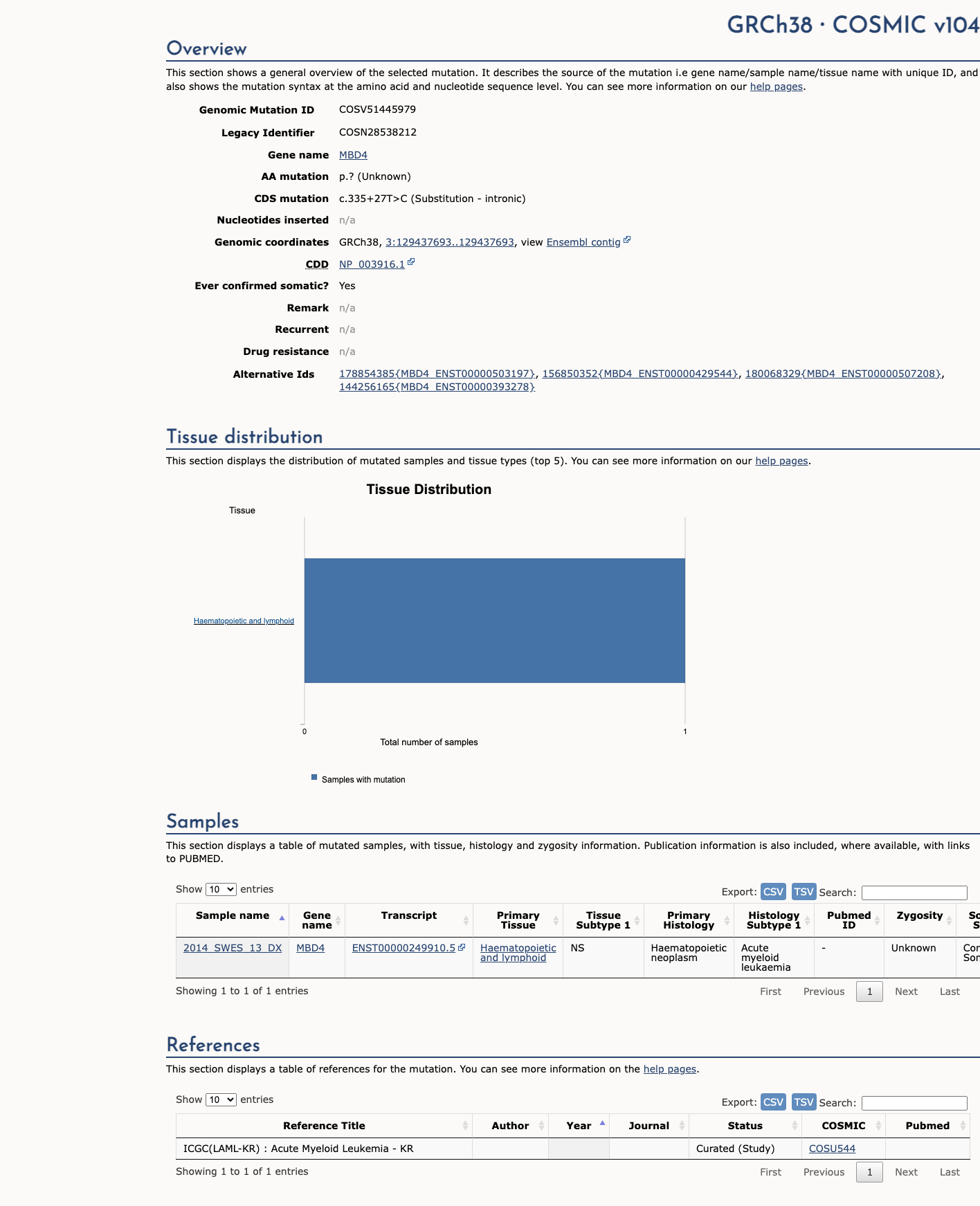
This variant has previously been reported in somatic cancers (COSMIC; COSV51445979, n = 1 times).
Hotspots
This variant does not lie in a statistically significant cancer hotspot.
Sources & reference links
Triaged references · 1 PMID not cited in assessment
25741868 ↗
Standards and guidelines for the interpretation of sequence variants: a joint consensus recommendation of the American College of Medical Genetics and Genomics and the Association for Molecular Pathology.
CLINVAR