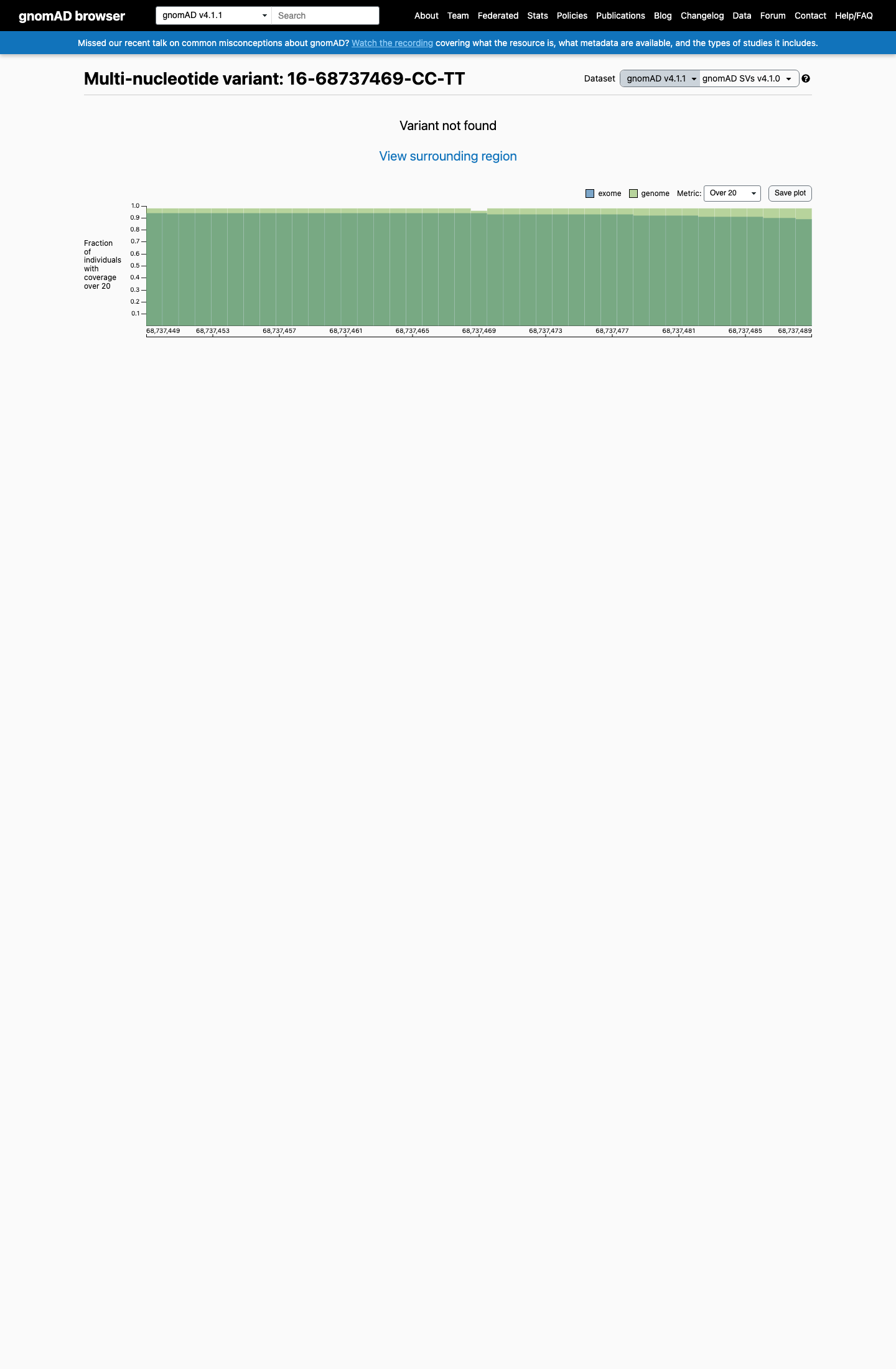
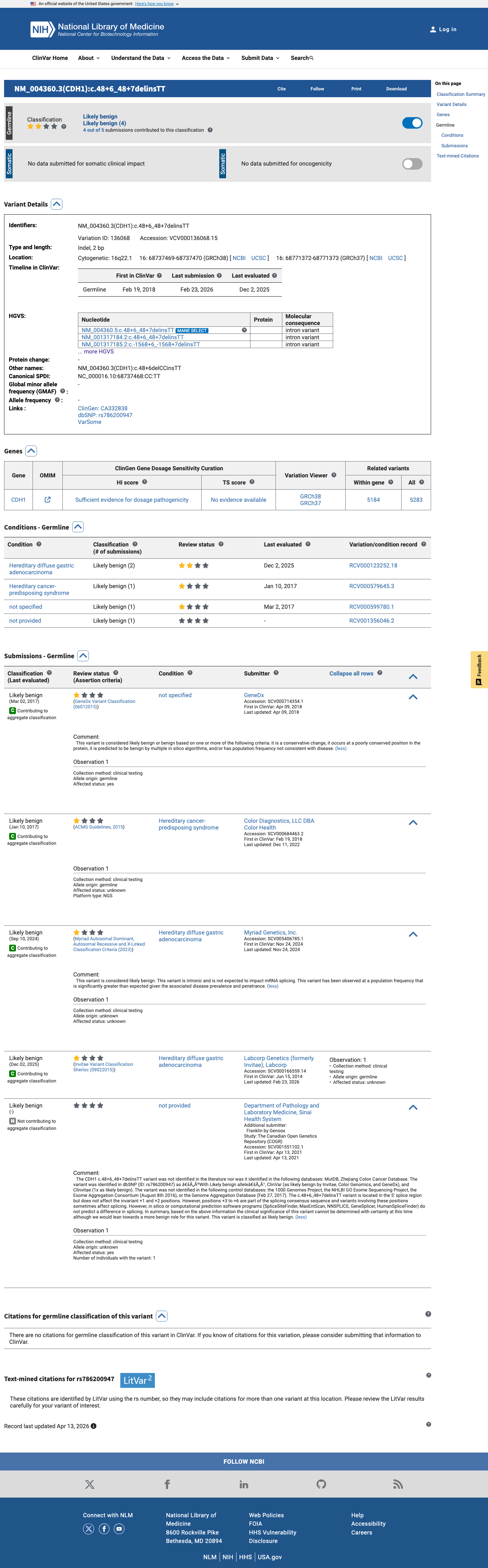
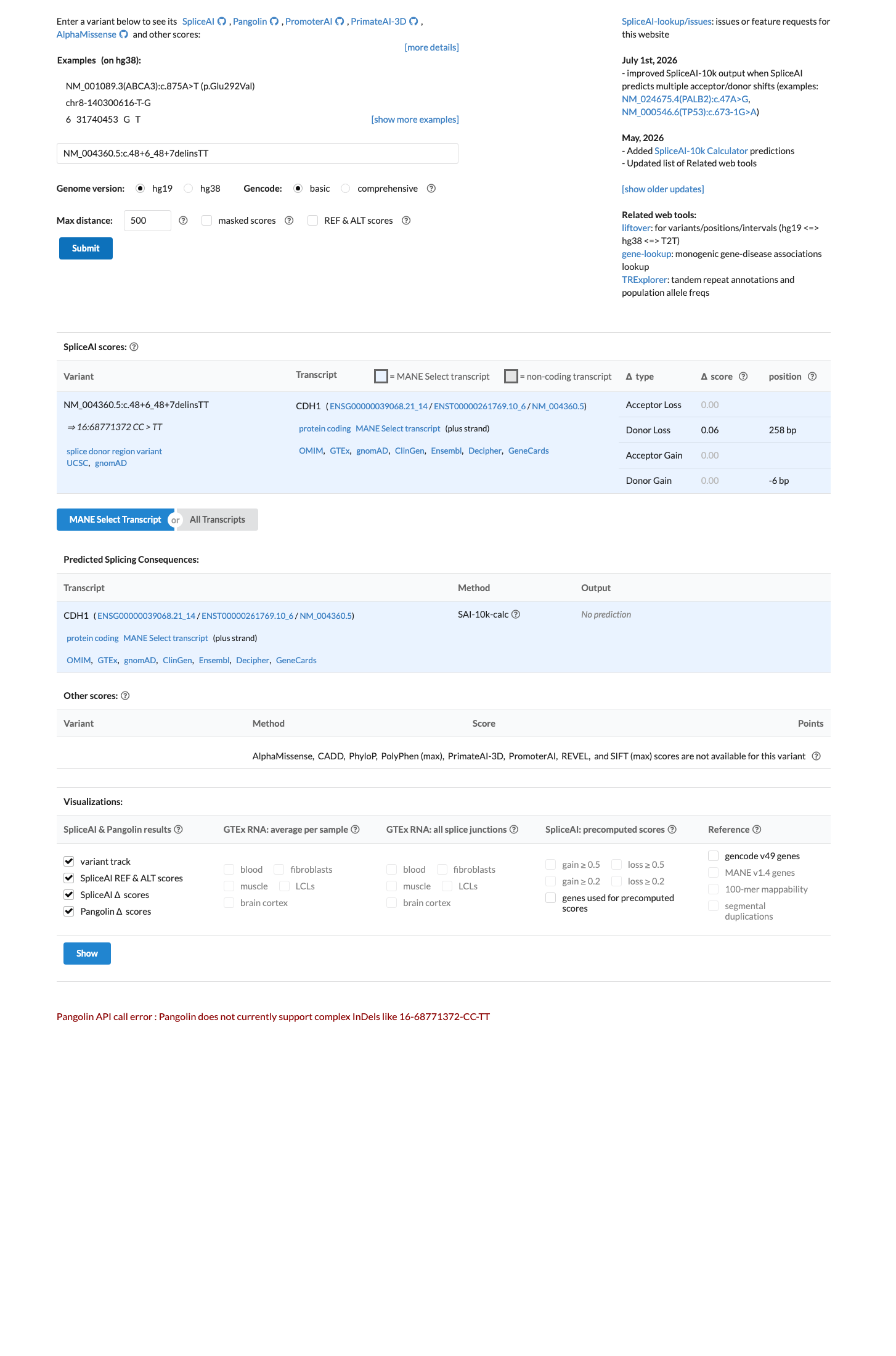
NM_004360.5:c.48+6_48+7delinsTT is an intronic variant affecting positions +6 and +7 of CDH1 intron 1, outside the canonical splice consensus sequence.1 This variant is absent from gnomAD v2.1 and v4.1 population databases, meeting the CDH1 VCEP PM2_Supporting criterion (≤1 in 100,000 alleles).2 SpliceAI predicts no significant splice impact (max delta score 0.06). However, only SpliceAI data is available among the seven splicing predictors specified by the CDH1 VCEP, which is insufficient to meet PP3 or BP4 thresholds requiring at least three concordant predictors.3 No RNA functional studies, de novo occurrence data, case-control data, co-segregation data, or family studies meeting HDGC criteria were identified for this variant.4 This variant has been reported in ClinVar as Likely benign (VariationID 136068) with a 1-star review status (criteria provided, single submitter). The ClinVar-associated publications are clinical practice guidelines and policy statements that do not provide variant-specific evidence.5 With only PM2_Supporting met and no other pathogenic or benign criteria satisfied, this variant is classified as a Variant of Uncertain Significance under the CDH1 VCEP framework (v3.1). The ClinVar Likely benign classification has low evidentiary weight (1-star) and cannot independently drive a benign classification.6
Final classification
VUS
PM2
CDH1
c.48+6_48+7delinsTT
p.?
missense
This variant
NM_004360.5:c.48+6_48+7delinsTT is an intronic variant affecting positions +6 and +7 of CDH1 intron 1, outside the canonical splice consensus sequence.
ClinGen CDH1 Expert Panel Specifications to the ACMG/AMP Variant Interpretation Guidelines Version 3.1 v3.1 lacked a usable explicit final combination framework, so generic ACMG/AMP 2015 final-combination rules were applied as fallback; applied criteria: PM2 supporting; combination = 1 supporting, which maps to VUS.
Classification rationale
PM2
VUS
CDH1 c.48+6_48+7delinsTT
missense
PM2
→
VUS
LYFE Sciences is an AI system, and it can make mistakes. Criteria
may be applied incorrectly, sources may be misread, and a confident-looking
classification can still be wrong. Double-check every criterion and
its underlying evidence before relying on any call.
Gene diagram
· NM_004360.5 · variants mapped to exon structure
CDH1
NM_004360.5
Fetching transcript structure from UCSC…
Applied criteria · 1 applied · 16 assessed
MetEvidence satisfies this criterion.
Not metEvaluated against available evidence; threshold not reached.
Not assessedApplies in principle, but no evidence was found to evaluate it.
N/ADoesn't apply to this variant type.
Applied · 1
Strength
Supporting
Moderate
Strong
Very strong
PM2
supporting
Pathogenic
NM_004360.5:c.48+6_48+7delinsTT is absent from gnomAD v2.1, v4.1, and gnomAD-Canada v1.0, meeting the CDH1 VCEP PM2_Supporting criterion (≤1 in 100,000 alleles). The VCEP specifies PM2 at supporting strength with the requirement that coverage of CDH1 in the population database be at least 30x.
Absent from gnomAD v2.1 (0 alleles)Absent from gnomAD v4.1 (0 alleles)Absent from gnomAD-Canada v1.0 (0 alleles)
Assessed · not applied
· 16 not met · 0 not assessed
Pathogenic
PVS1
NM_004360.5:c.48+6_48+7delinsTT is an intronic variant at positions +6 and +7 of intron 1, outside the canonical splice consensus (±1, ±2).
PS2
No de novo occurrence data identified for NM_004360.5:c.48+6_48+7delinsTT.
PS3
The CDH1 VCEP PS3 criterion requires RNA assay data demonstrating abnormal transcripts (out-of-frame for strong, in-frame for moderate).
PS4
The CDH1 VCEP PS4 criterion requires families meeting HDGC criteria (1 family = supporting, 2-3 = moderate, 4-15 = strong, ≥16 = very strong).
PM6
The CDH1 VCEP PM6 criterion requires patients meeting HDGC individual phenotype criteria without parental confirmation.
PP1
No co-segregation data is available for NM_004360.5:c.48+6_48+7delinsTT.
PP3
The CDH1 VCEP PP3 criterion requires at least three in silico splicing predictors in agreement (SpliceAI, MaxEntScan, SSF, GeneSplicer, HSF, TraP, varSEAK) for supporting strength, or a well-characterized variant at the same splice site with similar/worse predictions for moderate.
Benign
BA1
The CDH1 VCEP BA1 criterion requires a MAF cutoff of 0.2%.
BS1
The CDH1 VCEP BS1 criterion requires a MAF cutoff of 0.1%.
BS2
The CDH1 VCEP BS2 requires the variant to be seen in ≥10 individuals without GC, DGC, SRC tumors, or LBC with families not suggestive of HDGC (strong), or ≥3 individuals (supporting).
BS3
The CDH1 VCEP BS3 criterion requires functional RNA studies demonstrating no impact on transcript composition and is restricted to synonymous, intronic, or non-coding variants.
BS4
No segregation data is available for NM_004360.5:c.48+6_48+7delinsTT to evaluate lack of segregation among affected family members.
BP2
The CDH1 VCEP BP2 requires observation of the variant in trans with a known pathogenic variant (strong) or in cis/unknown phase with a pathogenic variant, or in the homozygous state in gnomAD (supporting).
BP4
The CDH1 VCEP BP4 criterion requires at least three in silico splicing predictors in agreement (SpliceAI, MaxEntScan, SSF, GeneSplicer, HSF, TraP, varSEAK) suggesting no impact.
BP5
The CDH1 VCEP BP5 criterion applies when a pathogenic/likely pathogenic variant is identified in an alternate gene known to cause HDGC (currently only CTNNA1).
BP7
The CDH1 VCEP BP7 criterion applies to synonymous and intronic variants at or beyond +7 to -21 locations.
N/A · 11
PS1 · PM1 · PM3 · PM4 · PM5 · PP2 · PP4 · PP5 · BP1 · BP3 · BP6
Research & evidence
Population frequency
gnomAD v4.1

gnomAD v2.1
v4.1
Absent from gnomAD v4.1.
v2.1
Absent from gnomAD v2.1.
🇨🇦 CA
Absent from gnomAD-Canada v1.0.
Allele frequency by ancestry
three datasets · side by side
gnomAD v4.1
Absent
· 0 / ?
0 hom
0 hom
Not observed in any ancestry group.
gnomAD v2.1
Absent
· 0 / ?
0 hom
0 hom
Not observed in any ancestry group.
gnomAD Canada 🇨🇦
Absent
· 0 / ?
0 hom
0 hom
Not observed in any ancestry group.
ClinVar
This variant has been reported in ClinVar as Likely benign (5 clinical laboratories). (ClinVarID = 136068)
In silico
SpliceAI predicts no significant splice impact for this variant (max delta score = 0.06).
Functional
No data
No calibrated functional assay or RNA evidence was identified for this variant.

COSMIC
Somatic evidence
COSMIC
This variant has not previously been reported in somatic cancers (COSMIC).
Hotspots
This variant does not lie in a statistically significant cancer hotspot.
Sources & reference links
Triaged references · 7 PMIDs not cited in assessment
25741868 ↗
Standards and guidelines for the interpretation of sequence variants: a joint consensus recommendation of the American College of Medical Genetics and Genomics and the Association for Molecular Pathology.
CLINVAR
20065170 ↗
American Society of Clinical Oncology policy statement update: genetic and genomic testing for cancer susceptibility.
CLINVAR
25394175 ↗
A practice guideline from the American College of Medical Genetics and Genomics and the National Society of Genetic Counselors: referral indications for cancer predisposition assessment.
CLINVAR
26324357 ↗
American Society of Clinical Oncology Policy Statement Update: Genetic and Genomic Testing for Cancer Susceptibility.
CLINVAR
28492532 ↗
Sherloc: a comprehensive refinement of the ACMG-AMP variant classification criteria.
CLINVAR