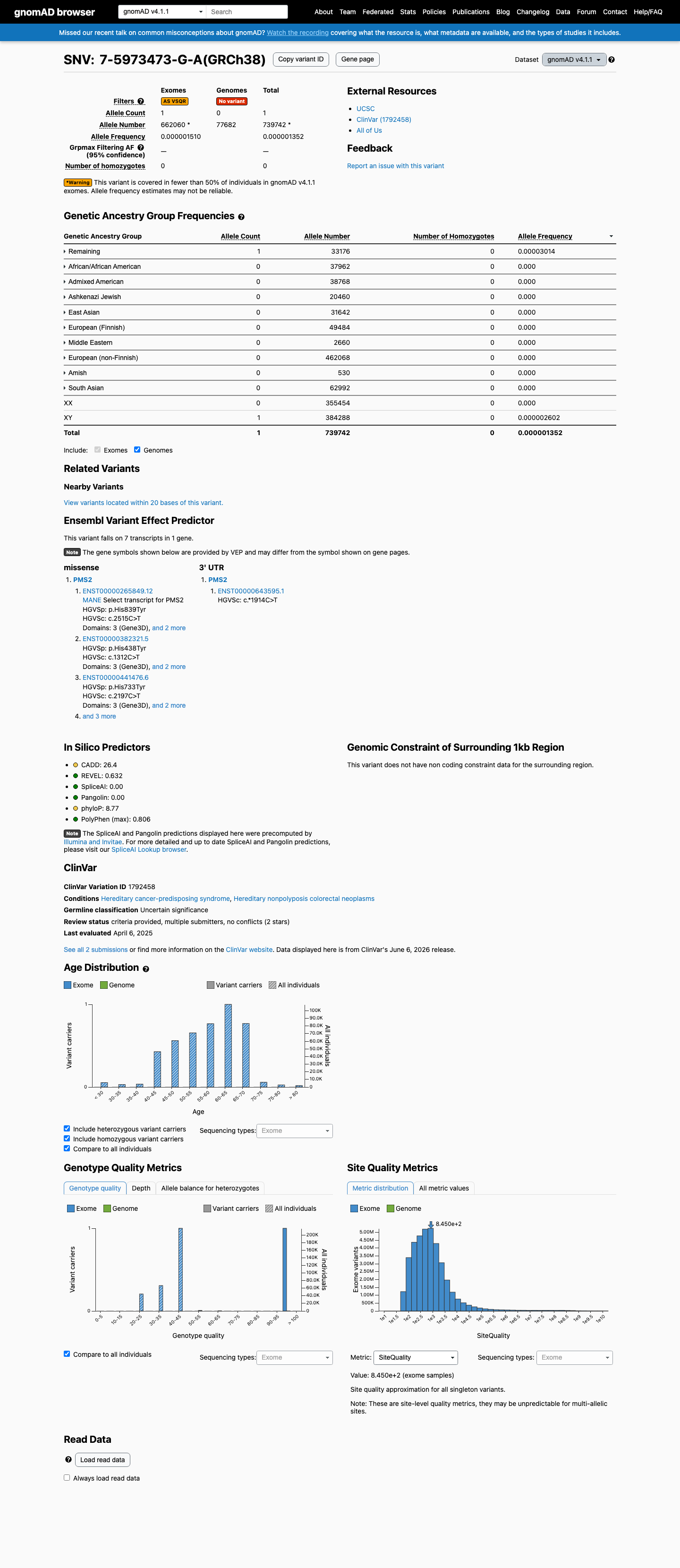
NM_000535.7:c.2515C>T (p.His839Tyr) is a missense variant in PMS2 exon 15. It is extremely rare in population databases (gnomAD v4.1: 1/739,742 alleles, AF=1.35e-06), meeting PM2_Supporting under the InSiGHT PMS2 VCEP specification.1 In silico predictions are indeterminate: HCI prior probability is 0.514, which falls between the VCEP PP3 (>0.68) and BP4 (<0.11) thresholds. SpliceAI predicts no splicing impact (max delta=0.00).2 No variant-specific functional data, segregation data, de novo observations, or tumor pathology data are available. This variant has been reported in ClinVar as Uncertain significance by two clinical laboratories (VariationID: 1792458, criteria provided, single submitter).3 With only PM2_Supporting met and no benign criteria met, this variant is classified as Uncertain Significance under the InSiGHT PMS2 VCEP v2.0 framework.4
Final classification
VUS
PM2
PMS2
c.2515C>T
p.His839Tyr
missense
This variant
NM_000535.7:c.2515C>T (p.His839Tyr) is a missense variant in PMS2 exon 15. It is extremely rare in population databases (gnomAD v4.1: 1/739,742 alleles, AF=1.35e-06), meeting PM2_Supporting under the InSiGHT PMS2 VCEP specification.
ClinGen InSiGHT Hereditary Colorectal Cancer/Polyposis Expert Panel Specifications to the ACMG/AMP Variant Interpretation Guidelines for PMS2 Version 2.0 v2.0 criteria-combination framework was evaluated deterministically with applied criteria: PM2 supporting; no rule matched the adjudicated criteria.
Classification rationale
PM2
VUS
PMS2 c.2515C>T
missense
PM2
→
VUS
LYFE Sciences is an AI system, and it can make mistakes. Criteria
may be applied incorrectly, sources may be misread, and a confident-looking
classification can still be wrong. Double-check every criterion and
its underlying evidence before relying on any call.
Gene diagram
· NM_000535.7 · variants mapped to exon structure
PMS2
NM_000535.7
Fetching transcript structure from UCSC…
Applied criteria · 1 applied · 14 assessed
MetEvidence satisfies this criterion.
Not metEvaluated against available evidence; threshold not reached.
Not assessedApplies in principle, but no evidence was found to evaluate it.
N/ADoesn't apply to this variant type.
Applied · 1
Strength
Supporting
Moderate
Strong
Very strong
PM2
supporting
Pathogenic
Extremely rare in gnomAD v4.1 (1/739,742 alleles; AF=1.35e-06), below the VCEP PM2 threshold of <0.00002 (<1 in 50,000 alleles). Absent from gnomAD v2.1 and gnomAD-Canada.
gnomAD v4.1: 1/739742 allelesAF=1.35e-06
Assessed · not applied
· 6 not met · 8 not assessed
Pathogenic
PS1
No alternative nucleotide change encoding the same H839Y amino acid change has been established as Pathogenic by this VCEP.
PS2
No de novo data available for this variant.
PS3
No variant-specific functional data available.
PM5
No different missense change at codon 839 has been classified as Pathogenic or Likely Pathogenic by this VCEP.
PP1
No co-segregation data available.
PP3
HCI prior probability for c.2515C>T is 0.514, which does not meet VCEP PP3 thresholds (>0.68 for supporting, >0.81 for moderate).
PP4
No patient phenotype, tumor MSI/IHC, or family history data available.
Benign
BA1
gnomAD v4 allele frequency (AF=1.35e-06) is far below the VCEP BA1 threshold of ≥0.0028 (0.28%).
BS1
gnomAD v4 allele frequency (AF=1.35e-06) is below the VCEP BS1 threshold of ≥0.00028 (0.028%).
BS2
No co-occurrence or phase data available.
BS3
No variant-specific functional data demonstrating normal protein function.
BS4
No co-segregation data available.
BP4
HCI prior probability 0.514 exceeds the VCEP BP4 threshold of <0.11.
BP5
No tumor data available.
N/A · 13
PVS1 · PS4 · PM1 · PM3 · PM4 · PM6 · PP2 · PP5 · BP1 · BP2 · BP3 · BP6 · BP7
Research & evidence
Population frequency
gnomAD v4.1
gnomAD v2.1
v4.1
This variant is present in gnomAD v4.1 (AF= 1.35182e-06; MAF= 0.00014%, 1/739742 alleles, homozygotes = 0) and has highest observed frequency in the Remaining individuals population (AF= 3.01423e-05; MAF= 0.00301%, 1/33176 alleles, homozygotes = 0).
v2.1
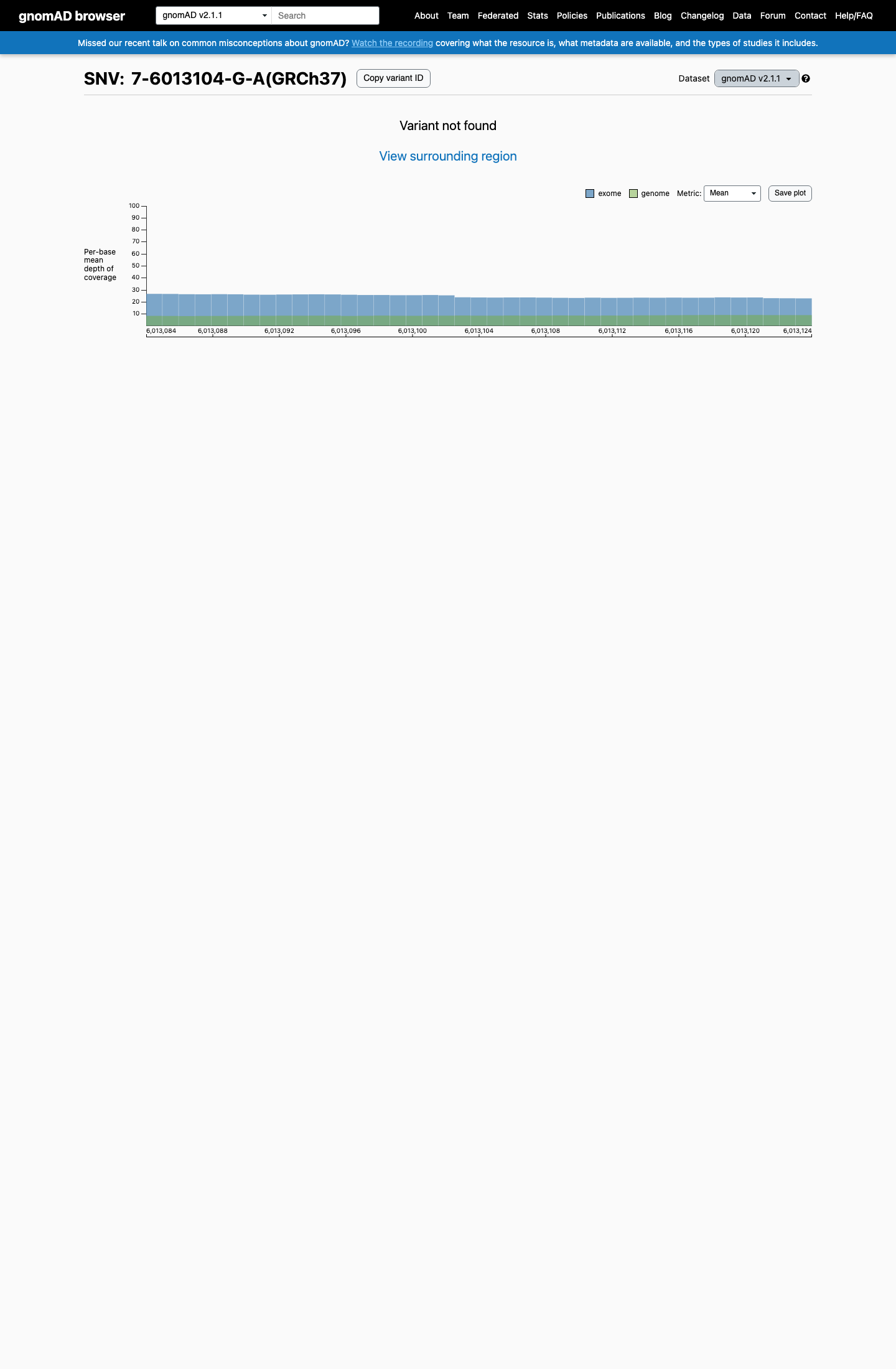
Absent from gnomAD v2.1.
🇨🇦 CA
Absent from gnomAD-Canada v1.0.
Allele frequency by ancestry
three datasets · side by side
gnomAD v4.1
0.00014%
· 1 / 739,742
0 hom
0 hom
Remaining individuals 1 / 33,176 |
0.003% |
+ 9 not observed (Admixed American, European (Finnish), Amish, East Asian, Middle Eastern, South Asian, Ashkenazi Jewish, African/African American, European (non-Finnish))
gnomAD v2.1
Absent
· 0 / ?
0 hom
0 hom
Not observed in any ancestry group.
gnomAD Canada 🇨🇦
Absent
· 0 / ?
0 hom
0 hom
Not observed in any ancestry group.
ClinVar
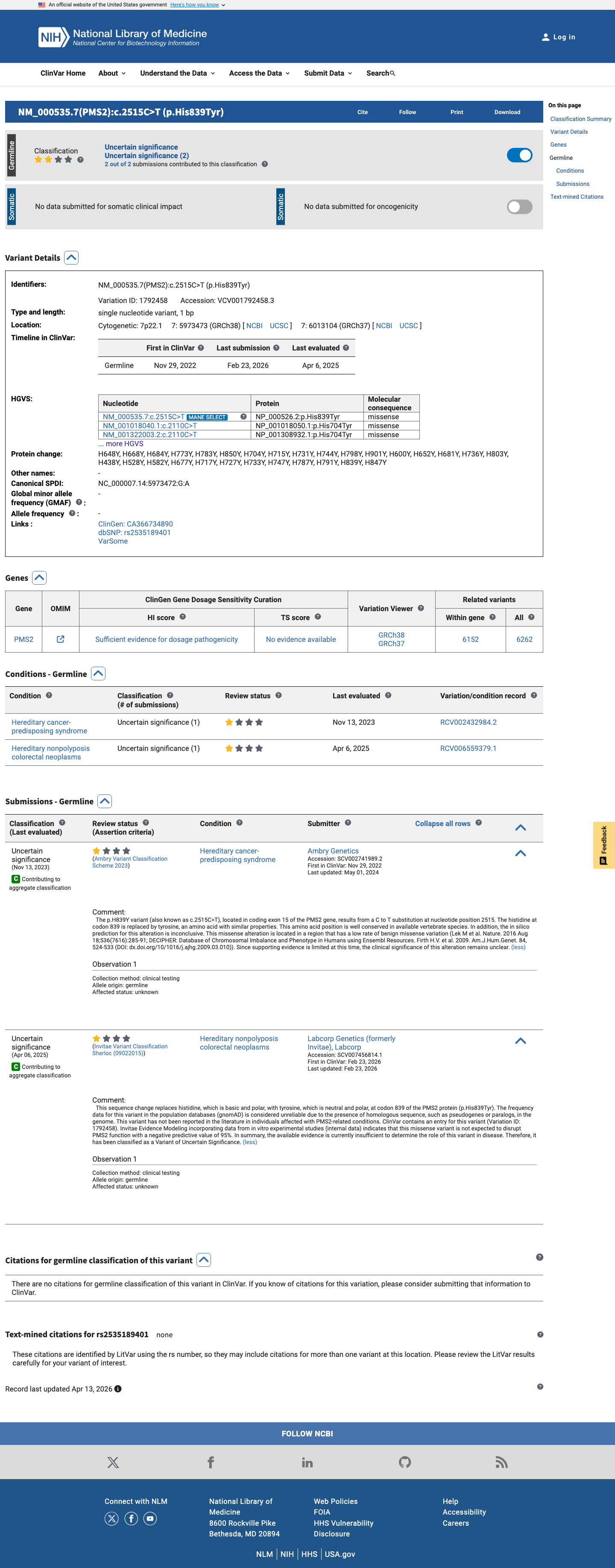
This variant has been reported in ClinVar as Uncertain significance (2 clinical laboratories). (ClinVarID = 1792458)

In silico
SpliceAI predicts no significant splice impact for this variant (max delta score = 0.00). REVEL score = 0.632. BayesDel score = 0.0217699. HCI prior probability for pathogenicity = 0.514. MAPP score = 10.36. Custom PP2 score = 0.927.
Functional
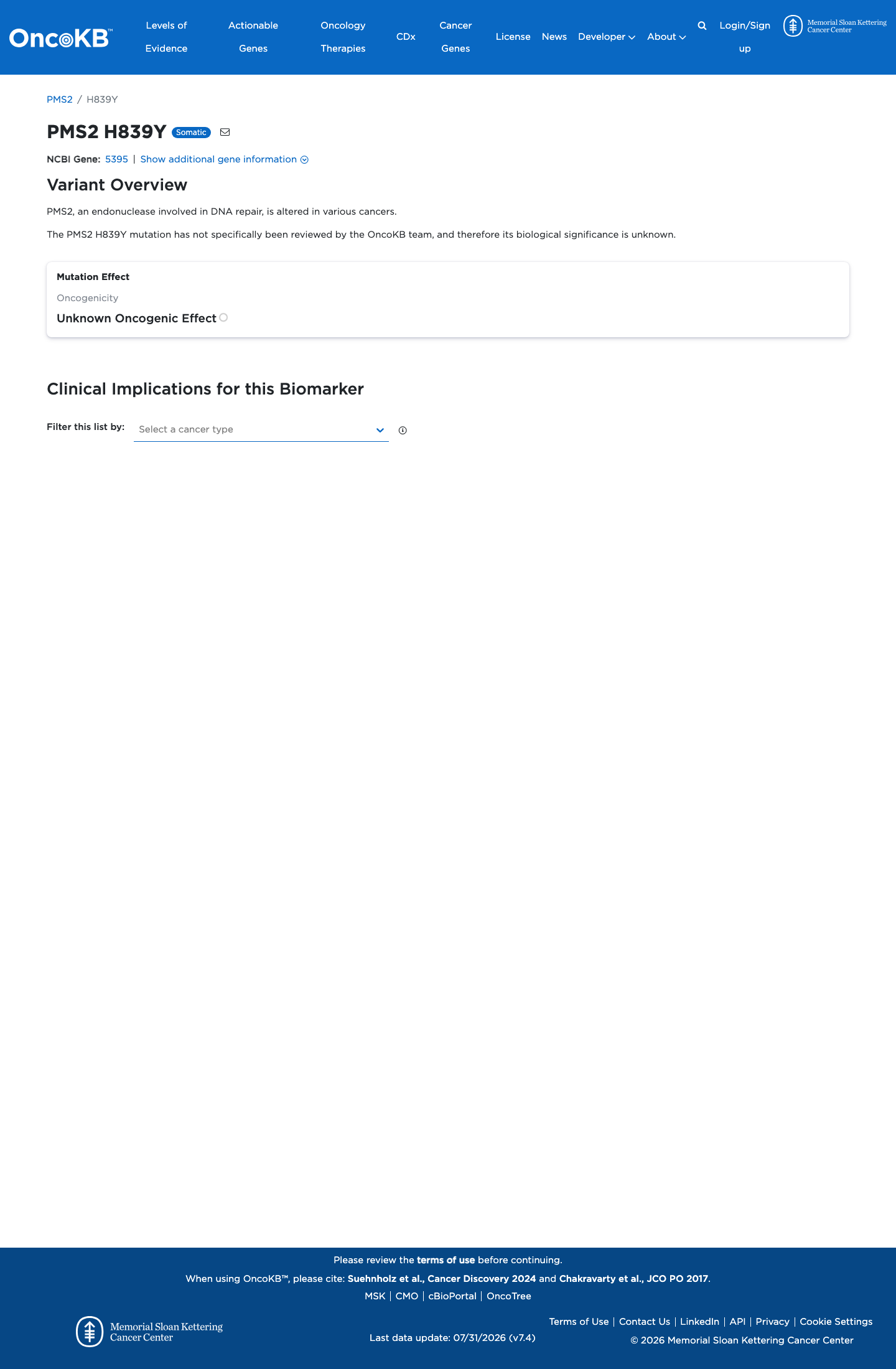
Unknown Oncogenic Effect
OncoKB did not identify variant-specific reviewed functional evidence for this variant; gene-level curated context is available for reviewer follow-up. PMS2, an endonuclease involved in DNA repair, is altered in various cancers.

COSMIC

Cancer hotspots
Somatic evidence
Not in COSMIC / hotspots
COSMIC
This variant does not lie in a statistically significant hotspot. This variant has not previously been reported in somatic cancers (COSMIC).
Hotspots
This variant does not lie in a statistically significant hotspot.
Sources & reference links
9Sources
Triaged references · 1 PMID not cited in assessment
25394175 ↗
A practice guideline from the American College of Medical Genetics and Genomics and the National Society of Genetic Counselors: referral indications for cancer predisposition assessment.
CLINVAR