Analysis in progress
Initialising…
0%
complete
This report is still being assembled — sections appear as each stage finishes. It isn't final yet.
MBD4
Final classification
VUS
MBD4 c.1231_1234del · p.Arg411GlyfsTer79
MBD4

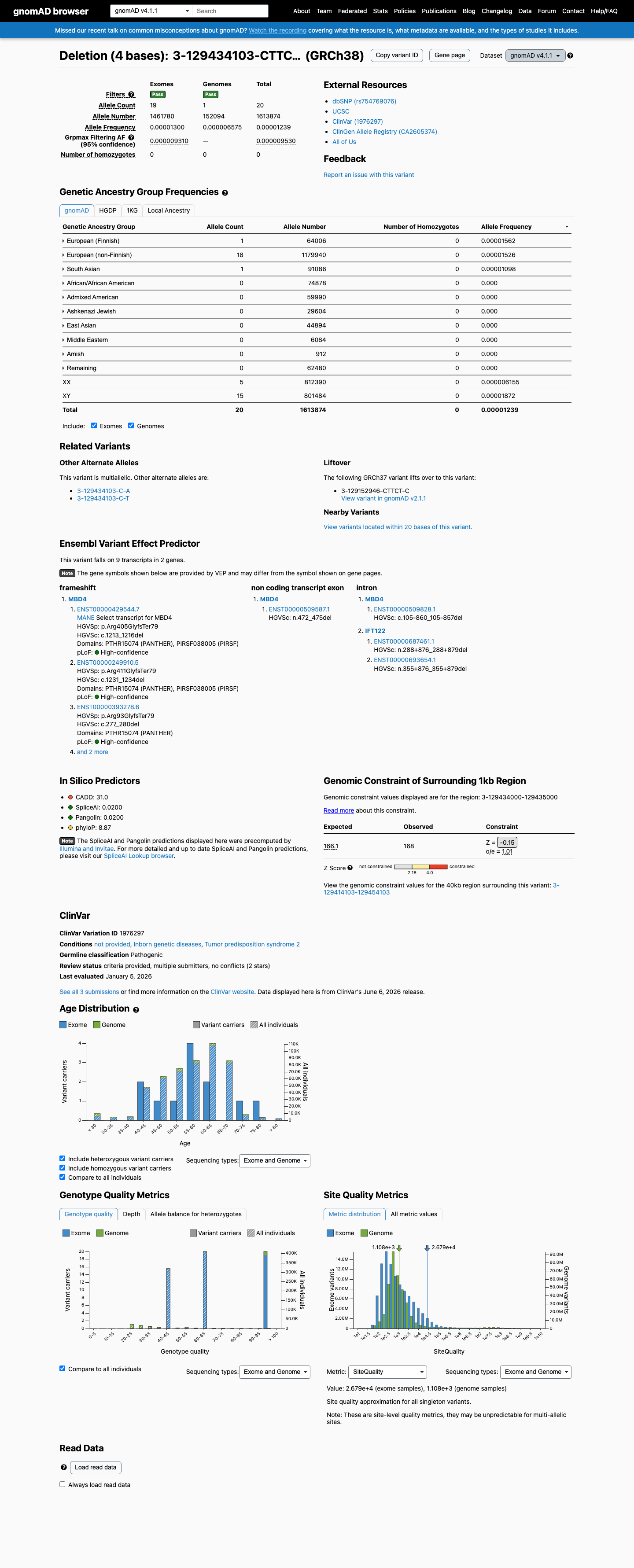
PM2 (Supporting): gnomAD allele frequency 0.00124-0.00159%, far below the 0.1% threshold, with zero homozygotes.

Gene
MBD4
Transcript
NM_003925.3
HGVS · transcript:coding
NM_003925.3:c.1231_1234del
Consequence
N/A
GRCh38
chr3:129434103 CTTCT>C
GRCh37
chr3:129152946 CTTCT>C
Basis No ClinGen or custom gene-specific framework exists for MBD4, so generic ACMG/AMP 2015 rules applied; with only PM2 (supporting) met, no combination threshold is reached and the variant is classified as VUS.
No ClinGen or custom gene-specific framework exists for MBD4, so generic ACMG/AMP 2015 rules applied; with only PM2 (supporting) met, no combination threshold is reached and the variant is classified as VUS.
Classification rationale
PM2 VUS
MBD4 c.1231_1234del

PM2 (Supporting): gnomAD allele frequency 0.00124-0.00159%, far below the 0.1% threshold, with zero homozygotes. Overall: VUS — the single supporting criterion (PM2) does not meet any ACMG/AMP 2015 Pathogenic, Likely Pathogenic, Benign, or Likely Benign combination threshold.

PM2 VUS
Gene diagram · NM_003925.3 · variants mapped to exon structure
MBD4 NM_003925.3
Fetching transcript structure from UCSC…
Applied criteria · 1 applied · 19 assessed
Applied · 1
Strength Supporting Moderate Strong Very strong
PM2 supporting Pathogenic
Met (supporting): gnomAD allele frequency 0.00124-0.00159% is far below the 0.1% threshold, with zero homozygotes.
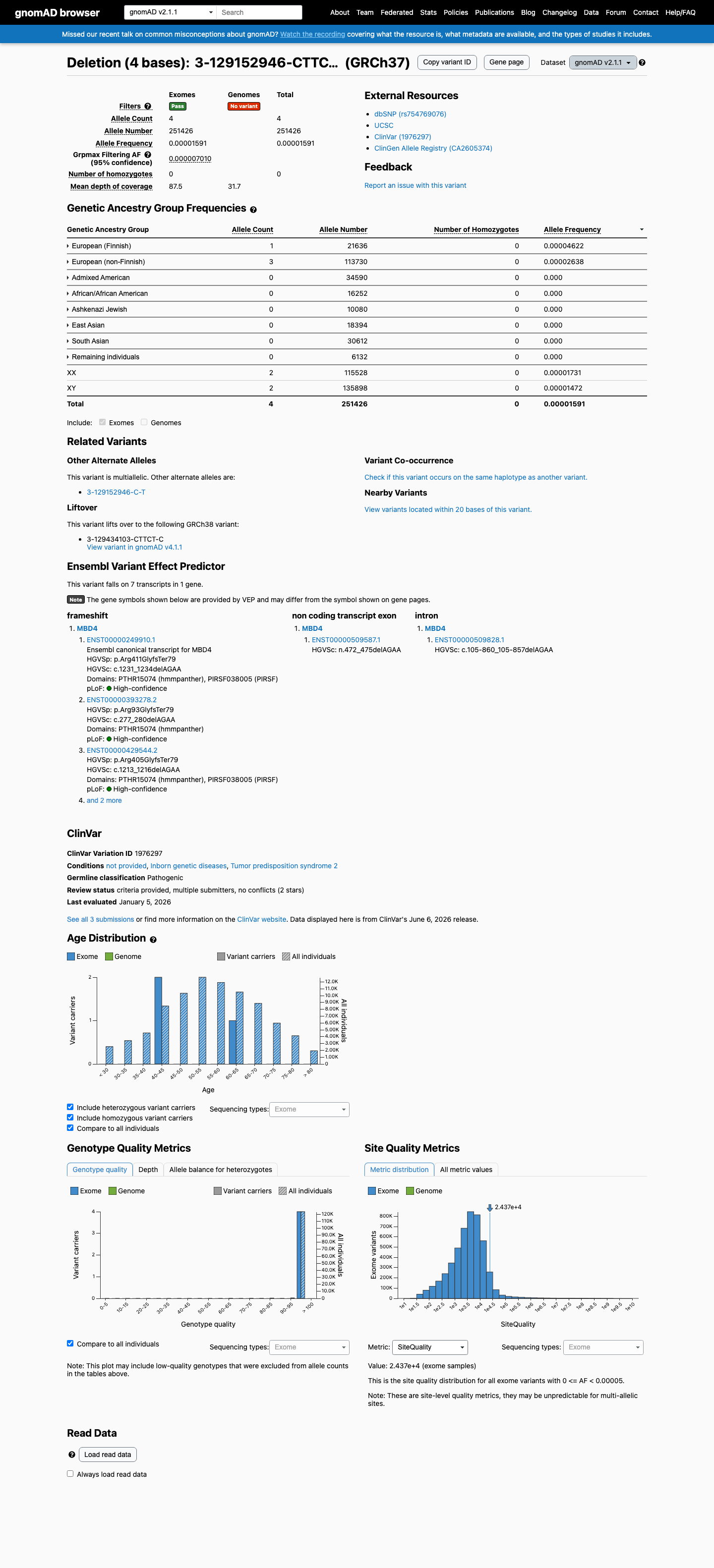
gnomAD v2.1: AF 1.59093e-05 (0.00159%, 4/251426), 0 homozygotes, grpmax FAF 7.01e-06gnomAD v4.1: AF 1.23925e-05 (0.00124%, 20/1613874), 0 homozygotes, joint grpmax FAF 9.53e-06gnomAD v4.1 highest subpopulation FIN AF 1.56235e-05; gnomAD v2.1 highest subpopulation NFE_SEU AF 1.73883e-04 (0.0174%)
Assessed · not applied
Pathogenic
PVS1 Insufficient evidence was available to assess PVS1 (loss-of-function mechanism).
PS2 Not assessed: no proband, family-history, or parental-testing data were available to evaluate a de novo occurrence.
PS3 Not assessed: no validated functional assay of this exact variant was available; functional data concern other MBD4 truncations only.
PS4 Not met: no case-control or prevalence study reports this exact variant, and gene-level disease association does not qualify.
PM3 Not met: no source documents this variant in trans with a pathogenic variant, and no homozygotes are observed.
PM6 Not assessed: no de novo occurrence of this variant is documented, and no proband data exist to assess one.
PP1 Not assessed: no family segregation data exist for this variant; segregation of other MBD4 alleles does not apply.
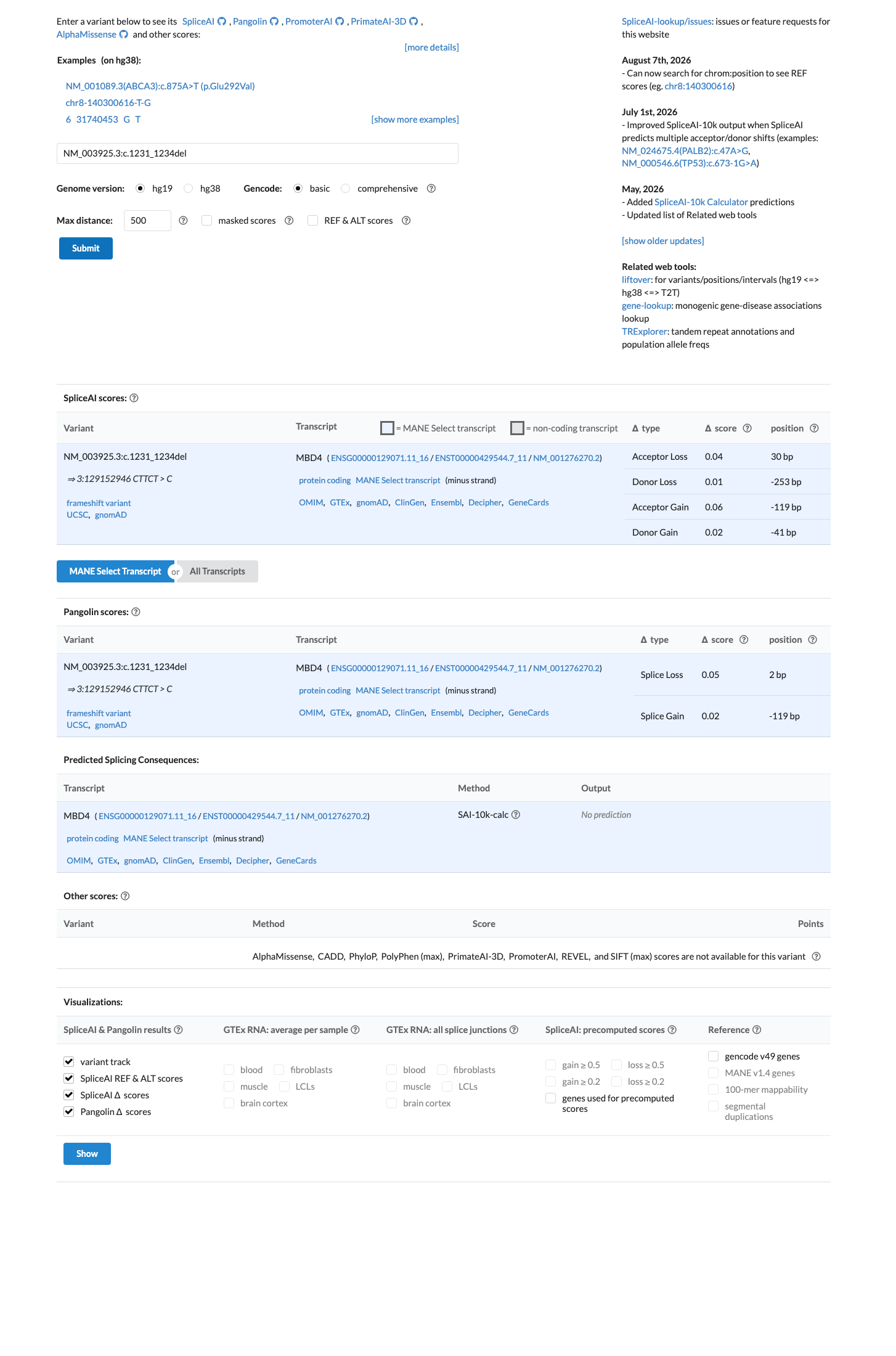
PP3 Not met: SpliceAI max delta 0.06 is below the 0.2 splice-disruption threshold, and missense scores do not apply to a frameshift.
PP4 Not assessed: no proband phenotype or family-history information was available to judge phenotype specificity.
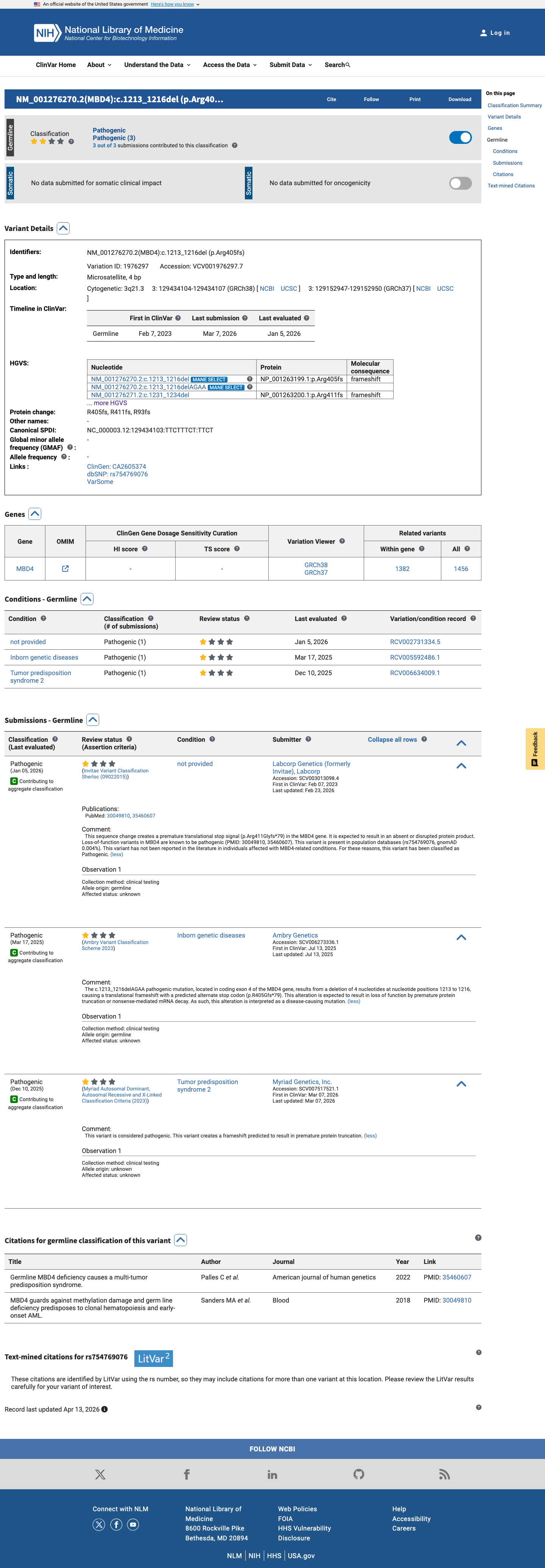
PP5 Not met: no ClinGen expert-panel classification exists; three clinical-laboratory Pathogenic submissions do not trigger PP5.
Benign
BA1 Not met: the highest allele frequency, 0.0174%, is far below the 1% BA1 threshold.
BS1 Not met: the highest allele frequency, 0.0174%, is about 17-fold below the 0.3% BS1 threshold.
BS2 Not met: zero homozygotes are observed in gnomAD v2.1 and v4.1, covering over 930,000 individuals.
BS3 Not met: no functional study shows preserved function, and all evidence points to loss of the glycosylase catalytic domain.
BS4 Not assessed: no family testing data exist to demonstrate non-segregation with disease.
BP2 Not met: MBD4 deficiency is recessive, and no source reports this variant in cis with a pathogenic variant.
BP4 Not met: the frameshift definitively alters the protein regardless of the low SpliceAI score (max delta 0.06).
BP5 Not met: no alternative molecular cause is documented in the available clinical information.
BP6 Not met: no expert-panel benign classification exists; ClinVar submissions classify the variant Pathogenic.
N/A · 8 PS1 · PM1 · PM4 · PM5 · PP2 · BP1 · BP3 · BP7
Research & evidence
Population frequency
gnomAD v4.1 screenshot
gnomAD v4.1
gnomAD v2.1 screenshot
gnomAD v2.1
v4.1
This variant is present in gnomAD v4.1 (AF= 1.23925e-05; MAF= 0.00124%, 20/1613874 alleles, homozygotes = 0) and has highest observed frequency in the European (Finnish) population (AF= 1.56235e-05; MAF= 0.00156%, 1/64006 alleles, homozygotes = 0); grpmax FAF= 9.53e-06.
v2.1
This variant is present in gnomAD v2.1 (AF= 1.59093e-05; MAF= 0.00159%, 4/251426 alleles, homozygotes = 0) and has highest observed frequency in the European (Finnish) population (AF= 4.62193e-05; MAF= 0.00462%, 1/21636 alleles, homozygotes = 0); grpmax FAF= 7.01e-06.
🇨🇦 CA
Absent from gnomAD-Canada v1.0.
Allele frequency by ancestry
three datasets · side by side
gnomAD v4.1
0.0012% · 20 / 1,613,874
0 hom · FAF 0.00095%
European (Finnish)
1 / 64,006
0.0016%
European (non-Finnish)
18 / 1,179,940
0.0015%
South Asian
1 / 91,086
0.0011%
+ 7 not observed (Remaining individuals, Admixed American, Amish, East Asian, Middle Eastern, Ashkenazi Jewish, African/African American)
gnomAD v2.1
0.0016% · 4 / 251,426
0 hom · FAF 0.0007%
European (Finnish)
1 / 21,636
0.0046%
European (non-Finnish)
3 / 113,730
0.0026%
+ 6 not observed (African/African American, Admixed American, Ashkenazi Jewish, East Asian, Remaining individuals, South Asian)
gnomAD Canada 🇨🇦
Absent · 0 / ?
0 hom
Not observed in any ancestry group.
ClinVar screenshot
ClinVar
This variant has been reported in ClinVar as Pathogenic (3 clinical laboratories). (ClinVarID = 1976297)
SpliceAI screenshot
In silico
SpliceAI predicts no significant splice impact for this variant (max delta score = 0.06).
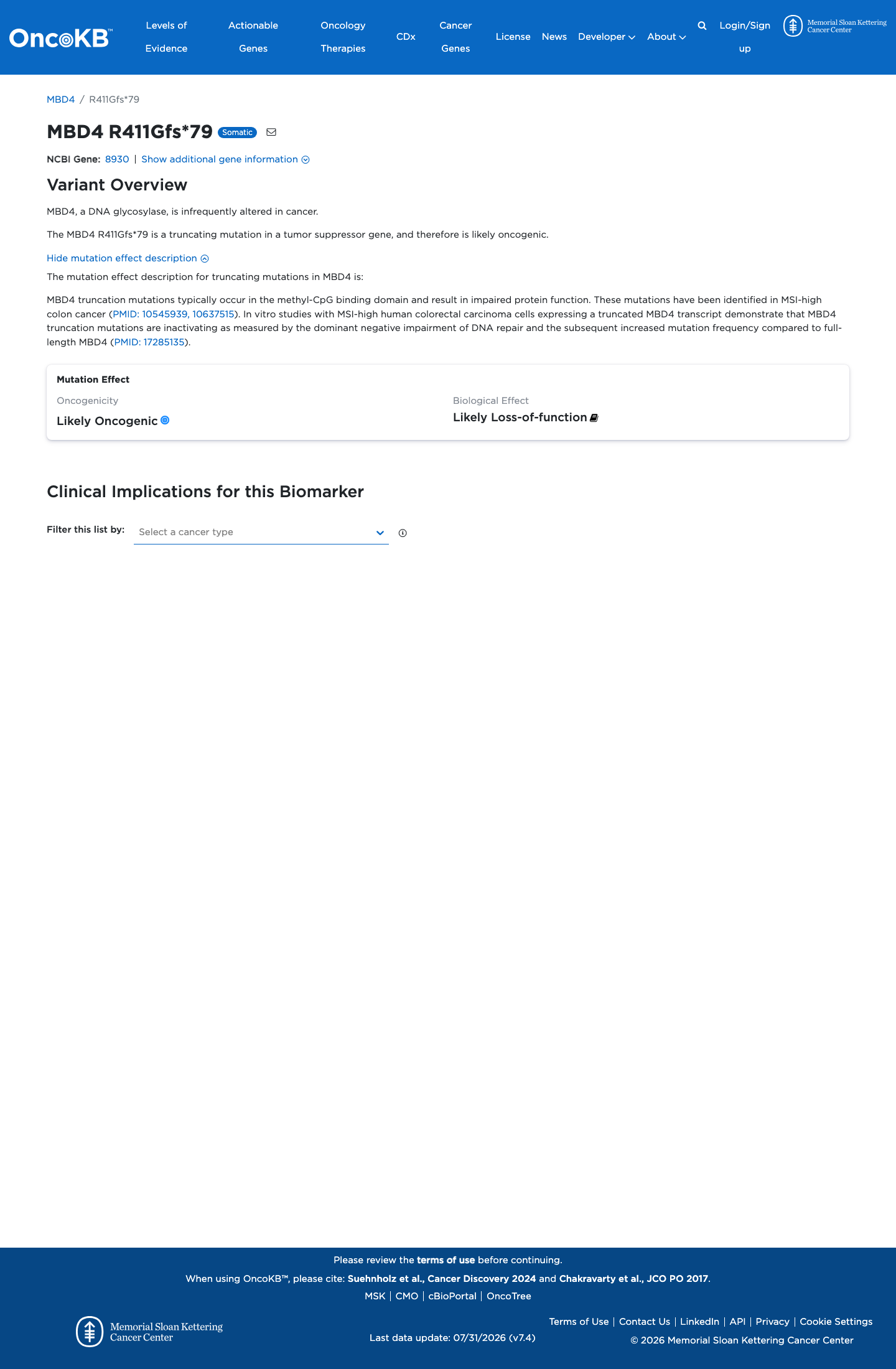
Functional / OncoKB screenshot
Functional Likely Oncogenic
OncoKB identified variant-specific curated literature and context relevant to functional review; biological-effect context: Likely Loss-of-function; curated oncogenicity label: Likely Oncogenic.
OncoKB ↗
COSMIC screenshot
COSMIC
Cancer hotspots screenshot
Cancer hotspots
Somatic evidence Not in COSMIC / hotspots
COSMIC
This variant does not lie in a statistically significant hotspot. This variant has not previously been reported in somatic cancers (COSMIC).
Hotspots
This variant does not lie in a statistically significant hotspot.
Literature · how each cited paper was used
1papers cited
Each card is an audit: what was searched, what was found, whether it names the variant, which criteria it fed, and why. 9 further PMIDs triaged but not cited — see Sources & References.
Rule & framework references · cited for criterion definitions, not variant evidence
35460607 ↗ Germline MBD4 deficiency causes a multi-tumor predisposition syndrome.
Sources & reference links
8Sources
ClinVar
gnomAD v2.1
gnomAD v4.1
gnomAD-Canada
SpliceAI
OncoKB
COSMIC
Cancer hotspots
Triaged references · 9 PMIDs not cited in assessment
10545939 ↗ The DNA repair gene MBD4 (MED1) is mutated in human carcinomas with microsatellite instability. ONCOKB
10637515 ↗ Somatic frameshift mutations in the MBD4 gene of sporadic colon cancers with mismatch repair deficiency. ONCOKB
17285135 ↗ A human cancer-associated truncation of MBD4 causes dominant negative impairment of DNA repair in colon cancer cells. ONCOKB
25626707 ↗ Whole-genome sequencing in newborn screening? A statement on the continued importance of targeted approaches in newborn screening programmes. CLINVAR
30049810 ↗ MBD4 guards against methylation damage and germ line deficiency predisposes to clonal hematopoiesis and early-onset AML. CLINVAR
22947299 ↗ Specific guidelines for assessing and improving the methodological quality of economic evaluations of newborn screening. CLINVAR
23037933 ↗ Including the initial newborn screening bloodspot collection device serial number on birth certificates: basis and recommendations from the Secretary of Health and Human Services' Advisory Committee on Heritable Disorders in Newborns and Children. CLINVAR
23881473 ↗ Newborn screening: education, consent, and the residual blood spot. The position of the national society of genetic counselors. CLINVAR
24394680 ↗ Parental permission for pilot newborn screening research: guidelines from the NBSTRN. CLINVAR