Analysis in progress
Initialising…
0%
complete
This report is still being assembled — sections appear as each stage finishes. It isn't final yet.
MLH1
Final classification
Pathogenic
MLH1 c.676C>T · p.Arg226Ter
MLH1

PVS1 (Very Strong): nonsense p.(Arg226Ter) introduces a premature stop at codon 226, before the InSiGHT codon-753 boundary, predicted to trigger nonsense-mediated decay.

Gene
MLH1
Transcript
NM_000249.3
HGVS · transcript:coding
NM_000249.3:c.676C>T
Consequence
N/A
GRCh38
chr3:37012098 C>T
GRCh37
chr3:37053589 C>T
Basis Pathogenic: PVS1 very strong (nonsense p.Arg226Ter before the codon-753 boundary) combined with two moderate criteria (PM3, PP4) satisfies InSiGHT combination Rule 2. The call does not depend on the review-flagged PM3 and PP4; PVS1 plus PM2 and PP5 alone also satisfy Rule 4.
Pathogenic: PVS1 very strong (nonsense p.Arg226Ter before the codon-753 boundary) combined with two moderate criteria (PM3, PP4) satisfies InSiGHT combination Rule 2. The call does not depend on the review-flagged PM3 and PP4; PVS1 plus PM2 and PP5 alone also satisfy Rule 4.
Classification rationale
PVS1PM2PM3PP4PP5 Pathogenic
MLH1 c.676C>T

PVS1 (Very Strong): nonsense p.(Arg226Ter) introduces a premature stop at codon 226, before the InSiGHT codon-753 boundary, predicted to trigger nonsense-mediated decay. PM2 (Supporting): gnomAD v4.1 allele frequency 6.23e-07 (1/1,605,126), more than 30-fold below the 0.00002 threshold. PM3 (Moderate): homozygous CMMRD-affected carriers place the variant in trans with an identical known-pathogenic allele. PP4 (Moderate): two independent MSI-H colorectal tumors show loss of MLH1 expression consistent with the variant. PP5 (Supporting): the InSiGHT expert panel classified the exact variant Pathogenic (ClinVar 3-star). Overall: Pathogenic per InSiGHT MLH1 v2.0 combination Rule 2 (PVS1 very strong plus two moderate criteria), independently confirmed by Rule 4 (PVS1 plus two supporting criteria).

PVS1 + PM2 + PM3 + PP4 + PP5 Pathogenic
Gene diagram · NM_000249.3 · variants mapped to exon structure
MLH1 NM_000249.3
Fetching transcript structure from UCSC…
Applied criteria · 5 applied · 11 assessed
Applied · 5
Strength Supporting Moderate Strong Very strong
PVS1 very strong Pathogenic
Met (Very Strong): nonsense p.(Arg226Ter) creates a premature stop at codon 226, well before the InSiGHT codon-753 boundary, predicted to trigger nonsense-mediated decay.
cspecpvs1_gene_contextpvs1_variant_assessment
PM2 supporting Pathogenic
Met (Supporting): gnomAD v4.1 allele frequency 6.23e-07 (1/1,605,126 alleles), more than 30-fold below the 0.00002 threshold, with zero homozygotes.
gnomAD v4.1 total AF 6.23e-07 < 0.00002 threshold; 0 homozygotes; max subpopulation AF 8.53e-07 (NFE)gnomAD v2.1 total AF 3.98e-06 corroborates extreme raritygnomAD-Canada v1.0: absent
PM3 moderate review Pathogenic
Met (Moderate): homozygous carriers affected with CMMRD place the variant in trans with an identical known-pathogenic allele (1.0 point). Flagged for human review: the homozygous-carrier source (PMID 17889038) could not be independently verified.
ClinVar variation 17087 submission descriptions (SCV004840892 All of Us; SCV002580789 MGZ) documenting homozygous carriers affected with CMMRDgnomAD v4.1 AF 6.23004e-07 (1/1605126 alleles, 0 homozygotes) confirming the VCEP PM2_supporting gate (<0.00002) required before applying PM3 to MLH1 variantsInSiGHT MLH1 VCEP v2.0 PM3 instructionsToUse point rules (P/LP in trans = 1.0 point; phase unknown = 0.5 points; strength thresholds)
PP4 moderate review Pathogenic
Met (Moderate): two independent MSI-H colorectal tumors with loss of MLH1 expression in carriers of this exact variant; three are required for Strong.
PMID:11343035PMID:16216036
PP5 supporting Pathogenic
Met (Supporting): the InSiGHT expert panel classified the exact variant Pathogenic (ClinVar 3-star submission).
clinvarClinVar expert panel classification
Assessed · not applied
Pathogenic
PS2 Not met: no de novo occurrence is documented; the only family with parental testing shows the variant was inherited from the affected mother.
PS3 Not met: no VCEP-approved calibrated functional assay was performed for this variant; available IVTT and IHC data are qualitative and not scoreable.
PP1 Not assessed: co-segregation is directionally positive in the one reported pedigree, but the ages needed for a defensible segregation likelihood ratio are unreported.
PP3 Not met: SpliceAI max delta 0.09 vs the 0.2 splice-defect threshold, and the HCI missense path does not apply to a nonsense variant.
Benign
BA1 Not met: gnomAD v4.1 allele frequency 6.23e-07, more than 1000-fold below the 0.001 (0.1%) BA1 threshold.
BS1 Not met: allele frequency 6.23e-07 is far below the 0.0001 (0.01%) BS1 floor, with zero homozygotes.
BS2 Not met: no phase-confirmed trans co-occurrence with a known pathogenic variant in a later-onset colorectal cancer patient exists.
BS3 Not met: no calibrated functional assay was performed, and the documented protein truncation and MLH1 loss contradict proficient function.
BS4 Not met: no affected non-carrier was found; both tested affected relatives carry the variant, consistent with co-segregation.
BP5 Not met: both documented carrier tumors are MSI-H with MLH1 loss, the opposite of the benign tumor-phenotype direction BP5 requires.
BP6 Not met: the only expert-panel submission classifies the variant Pathogenic, not Benign.
N/A · 12 PS1 · PS4 · PM1 · PM4 · PM5 · PM6 · PP2 · BP1 · BP2 · BP3 · BP4 · BP7
Research & evidence
Population frequency · supports pathogenic
gnomAD v4.1 screenshot
gnomAD v4.1
gnomAD v2.1 screenshot
gnomAD v2.1
v4.1
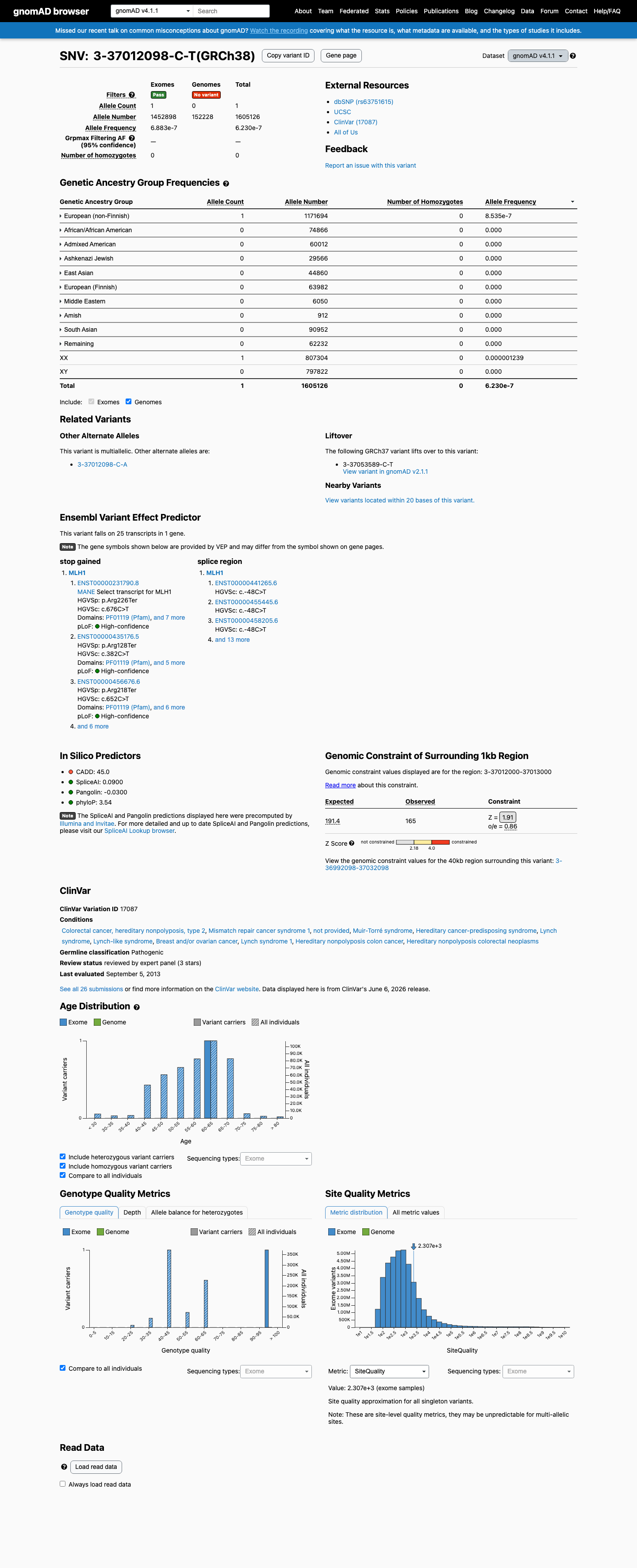
This variant is present in gnomAD v4.1 (AF= 6.23004e-07; MAF= 0.00006%, 1/1605126 alleles, homozygotes = 0) and has highest observed frequency in the European (non-Finnish) population (AF= 8.53465e-07; MAF= 0.00009%, 1/1171694 alleles, homozygotes = 0).
v2.1
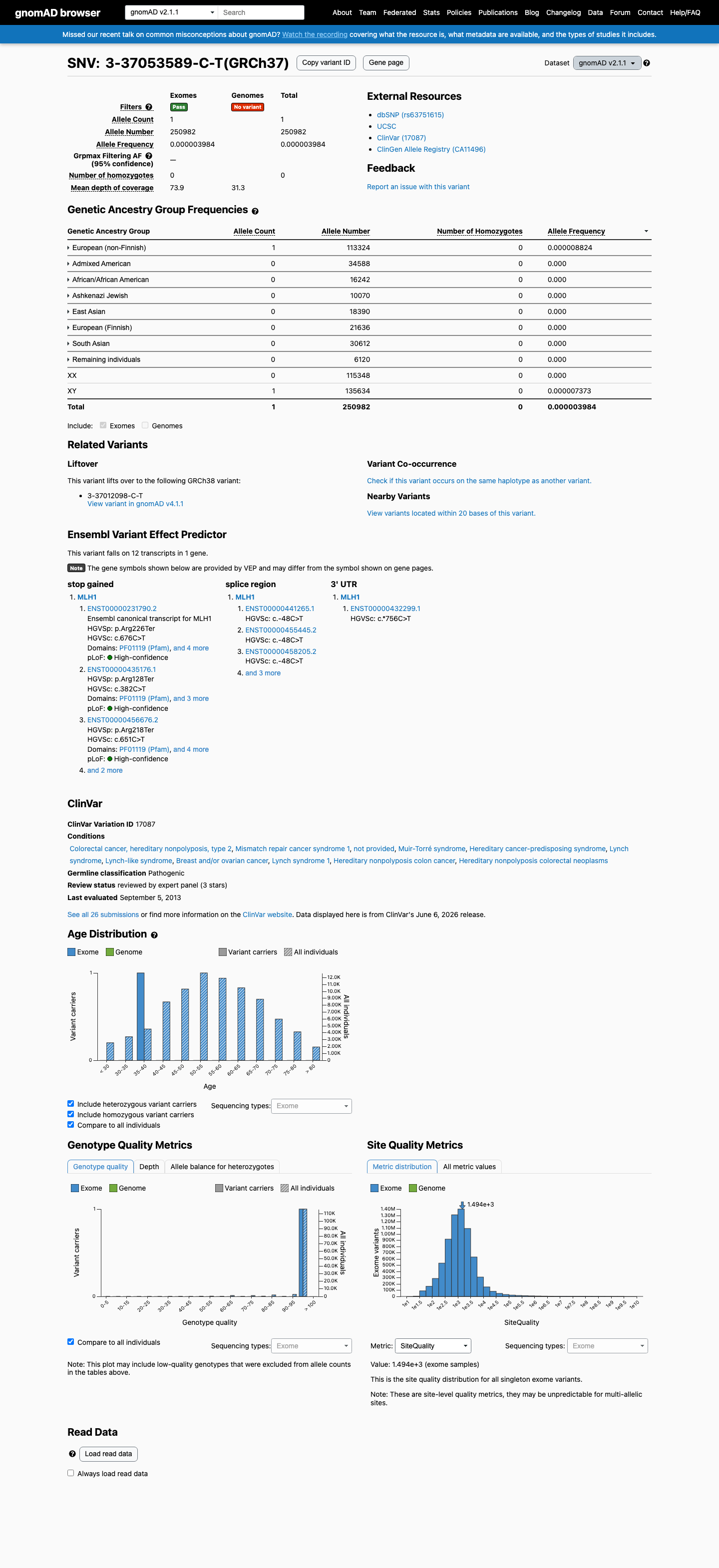
This variant is present in gnomAD v2.1 (AF= 3.98435e-06; MAF= 0.00040%, 1/250982 alleles, homozygotes = 0) and has highest observed frequency in the European (non-Finnish) population (AF= 8.82426e-06; MAF= 0.00088%, 1/113324 alleles, homozygotes = 0).
🇨🇦 CA
Absent from gnomAD-Canada v1.0.
Allele frequency by ancestry
three datasets · side by side
gnomAD v4.1
6.2e-05% · 1 / 1,605,126
0 hom
European (non-Finnish)
1 / 1,171,694
8.5e-05%
+ 9 not observed (Remaining individuals, Admixed American, European (Finnish), Amish, East Asian, Middle Eastern, South Asian, Ashkenazi Jewish, African/African American)
gnomAD v2.1
0.0004% · 1 / 250,982
0 hom
European (non-Finnish)
1 / 113,324
0.00088%
+ 7 not observed (African/African American, Admixed American, Ashkenazi Jewish, East Asian, European (Finnish), Remaining individuals, South Asian)
gnomAD Canada 🇨🇦
Absent · 0 / ?
0 hom
Not observed in any ancestry group.
ClinVar screenshot
ClinVar
This variant has been reported in ClinVar as Pathogenic (20 clinical laboratories) and as Uncertain significance (1 clinical laboratory) and as Pathogenic by International Society for Gastrointestinal Hereditary Tumours (InSiGHT) (expert panel). (ClinVarID = 17087)
SpliceAI screenshot
In silico
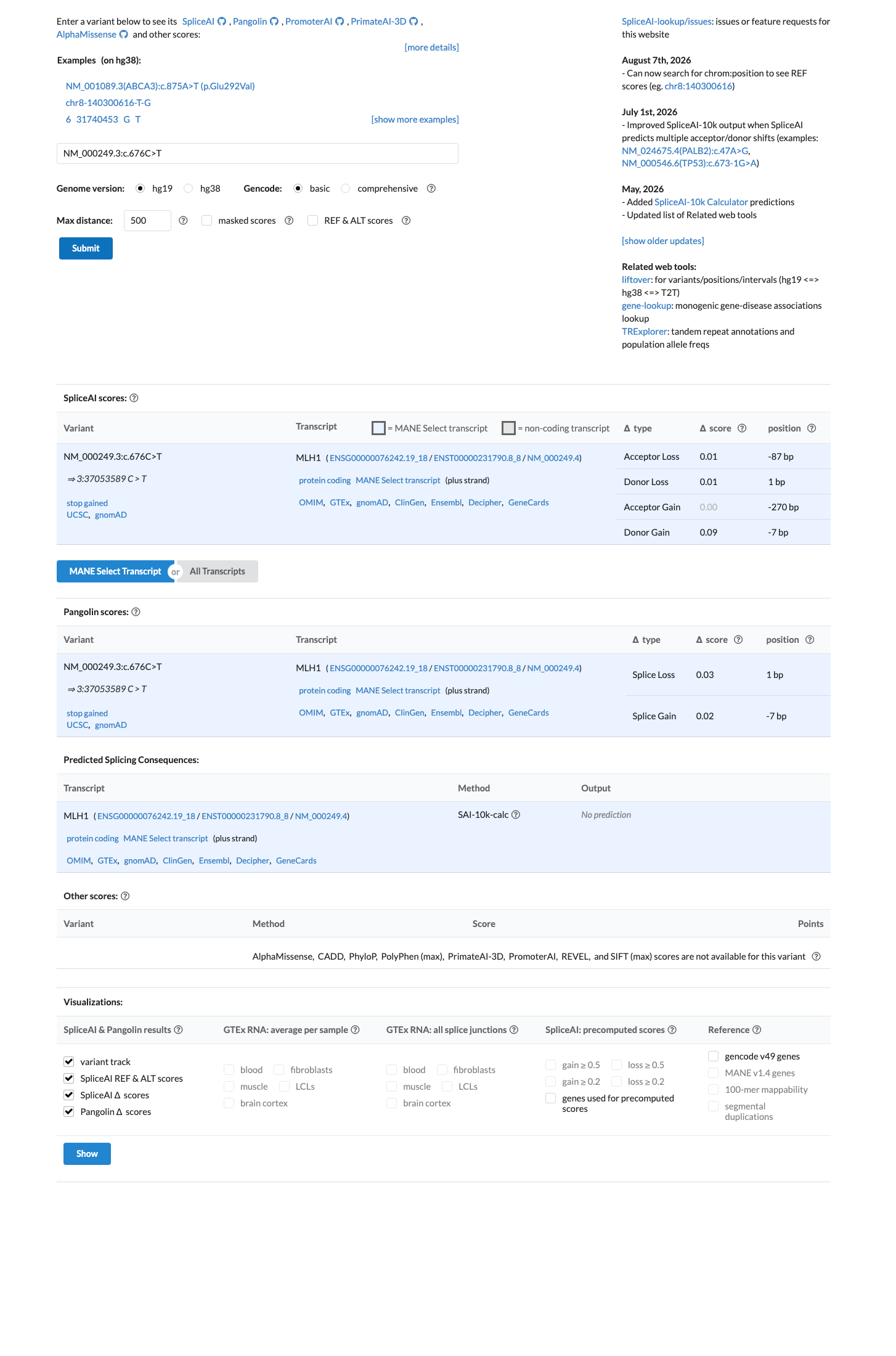
SpliceAI predicts no significant splice impact for this variant (max delta score = 0.09). BayesDel score = 0.66.
Functional / OncoKB screenshot
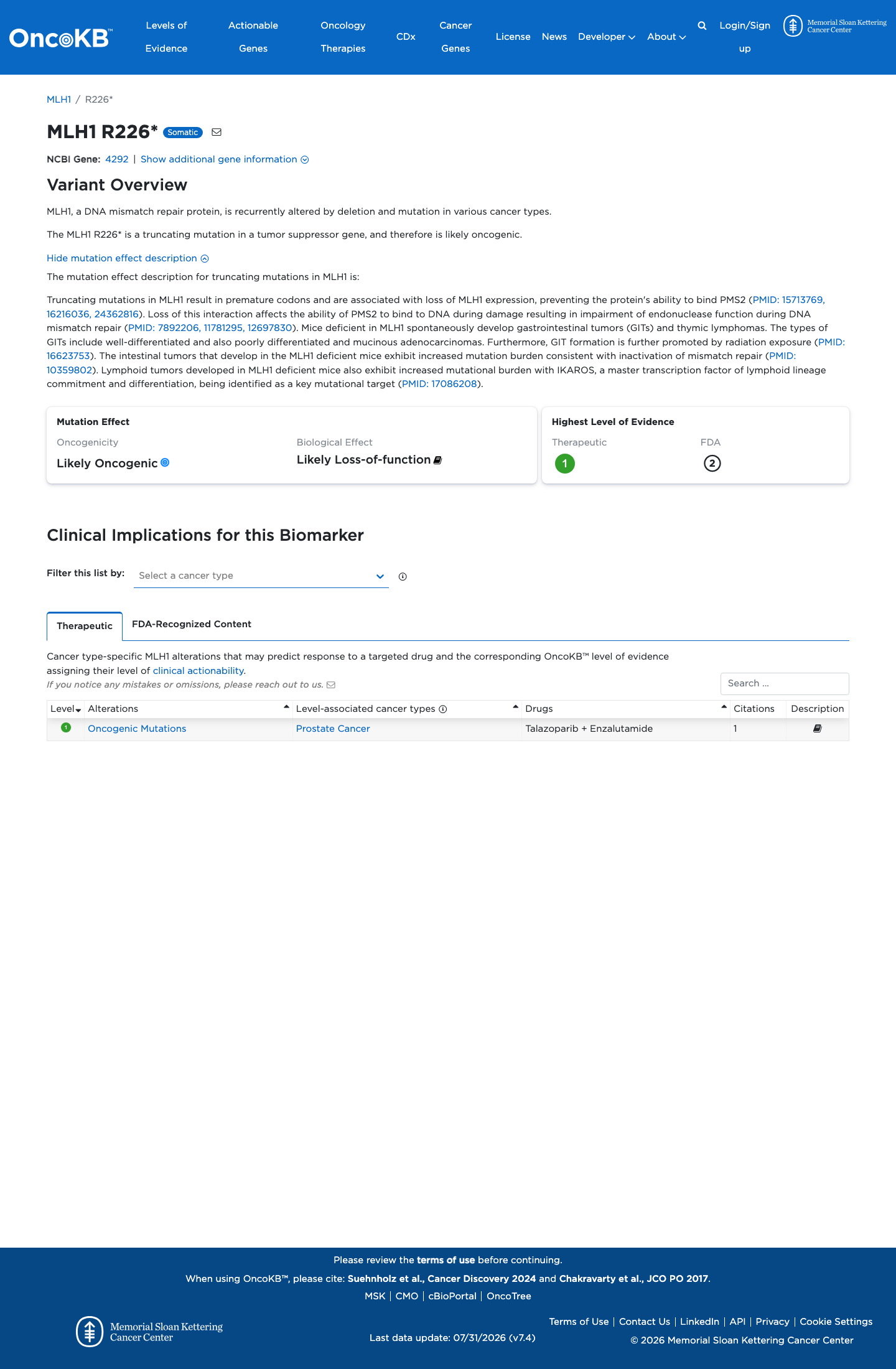
Functional Likely Oncogenic
OncoKB identified variant-specific curated literature and context relevant to functional review; biological-effect context: Likely Loss-of-function; curated oncogenicity label: Likely Oncogenic.
OncoKB ↗
COSMIC screenshot
COSMIC
Cancer hotspots screenshot
Cancer hotspots
Somatic evidence Not in COSMIC / hotspots
COSMIC
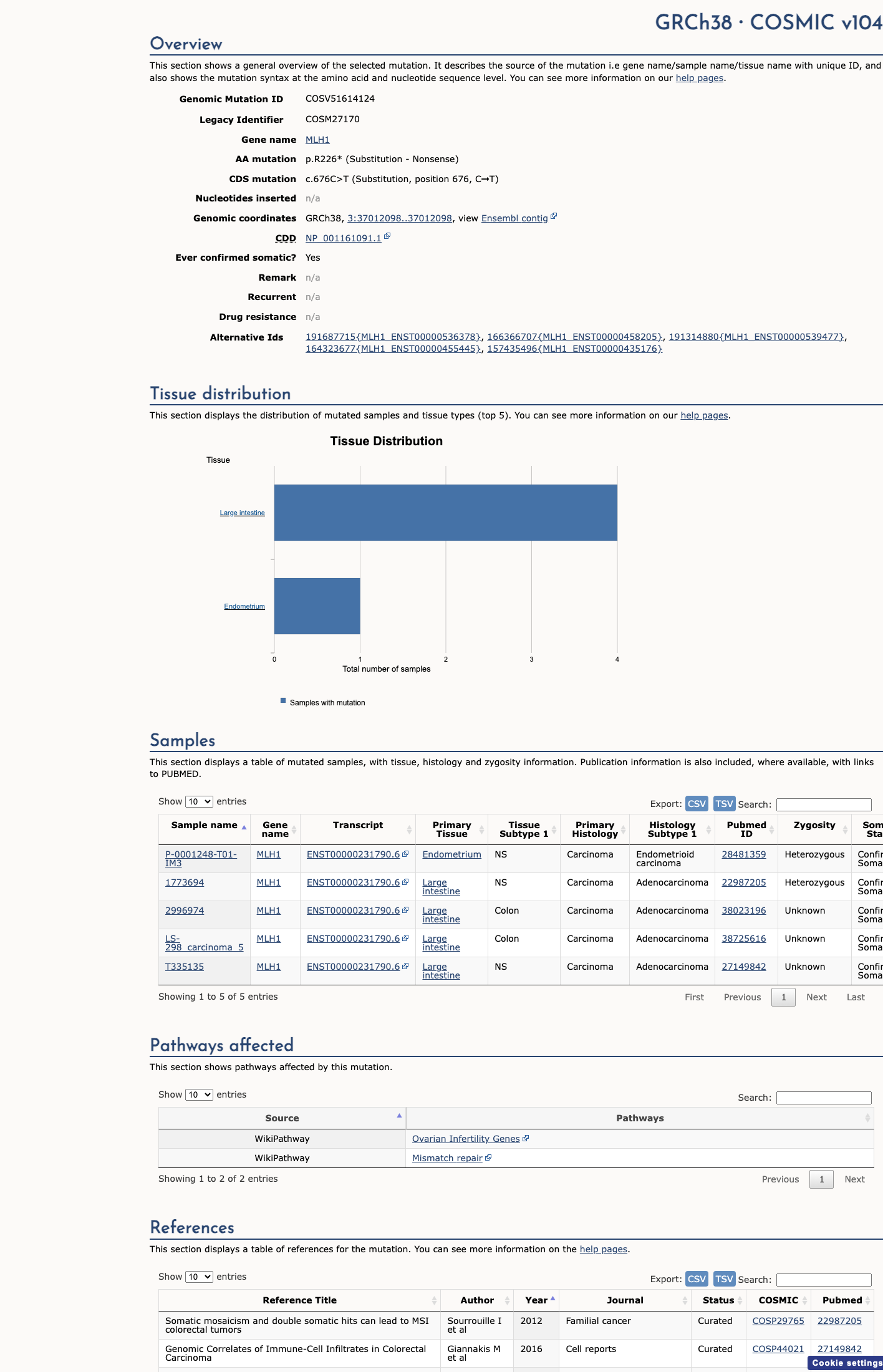
This variant does not lie in a statistically significant hotspot. This variant has previously been reported in somatic cancers (COSMIC; COSV51614124, n = 5 times).
Hotspots
This variant does not lie in a statistically significant hotspot.
Literature · how each cited paper was used
3papers cited
Each card is an audit: what was searched, what was found, whether it names the variant, which criteria it fed, and why. 4 further PMIDs triaged but not cited — see Sources & References.
Evaluation of enzymatic mutation detectiontrade mark in hereditary nonpolyposis colorectal cancer.
Searched
676C>T676
Found
Evaluation of the sensitivity of the Enzymatic Mutation Detection (EMD) assay for mutation screening in HNPCC. The exact variant c.676C>T is listed in Table 1 (exon 8, sample 002842) among known germline MLH1 mutations analyzed as assay-validation samples, with the original description attributed to Moslein et al., 1996. The paper corroborates that c.676C>T is a recognized germline MLH1 mutation in the HNPCC mutation literature but does not itself provide functional or phenotypic data for the variant.
Variant
✓ Names this variant — characterised directly
Applied to
PVS1 very strong
Corroborates that c.676C>T is a known germline MLH1 mutation (exon 8) previously described in HNPCC families (Moslein et al., 1996), consistent with its recognition as a truncating pathogenic variant; used as confirmatory context for the PVS1 nonsense consequence.
PM3 moderate
PP4 moderate
8 | 002842 | 676C>T | Moslein et al., 1996
Location Table 1 (Samples Analyzed With EMD That Are Not Currently Listed in the HNPCC Mutation Database, With Either Novel Alterations or Mutations Already Described in Other Families), exon 8 row.  ·  Context Evaluation of Enzymatic Mutation Detection (EMD) assay sensitivity in hereditary nonpolyposis colorectal cancer; genomic DNA from known or suspected HNPCC patients; alterations confirmed by automated direct sequencing (ABI BigDye Terminator).  ·  full text
Germline characterization of early-aged onset of hereditary non-polyposis colorectal cancer.
Searched
c.676C>Tp.Arg226Ter676codon 226Arg226
Found
Germline characterization of a virulent HNPCC kindred (Amsterdam Criteria) with adolescent-onset colorectal cancer. The paper documents the exact variant of interest: a germline C to T transition at base pair 676, codon 226, in exon 8 of hMLH1, predicted to change arginine to a stop codon (p.Arg226Ter). The mutation was found in the 14-year-old proband, his mother, and an asymptomatic younger brother; the proband's sigmoid adenocarcinoma showed high-frequency microsatellite instability and loss of hMLH1 immunostaining (bi-allelic inactivation). In vitro transcription-translation (IVTT) of proband mRNA demonstrated a truncated hMLH1 protein in the exons 1-12 segment, indicating the stop codon (not the splice-donor proximity at 2 bp from the 3' end of exon 8) is the predominant mechanism of hMLH1 inactivation.
Variant
✓ Names this variant — characterised directly
Applied to
PVS1 very strong
Directly documents the exact germline nonsense variant c.676C>T (p.Arg226Ter) in MLH1 exon 8 and provides IVTT evidence of a truncated hMLH1 protein, supporting that the PTC at codon 226 is the functional consequence triggering the VCEP PVS1 nonsense rule.
PM3 moderate
PP4 moderate
One independent CRC (sigmoid adenocarcinoma) that is MSI-H by the standard NCI 5-marker panel with loss of hMLH1 expression in a germline carrier of the exact variant - satisfies the InSiGHT PP4 tumor-phenotype clause (methylation exclusion not documented in this 2001 report)
IVTT analysis of the proband revealed a truncation of the hMLH1 protein in the first segment, which is encoded by exons 1 through 12, suggesting that the stop codon, and not altered splicing, is the predominant mode of hMLH1 inactivation in this family.
Location Results (Genomic Sequencing/IVTT) and Discussion, J Pediatr 2001;138:629-35, pp. 631-632; abstract states 'A germline mutation was identified at nucleotide 676 (codon 226) of the hMLH1 gene. The C to T transition created a nonsense mutation, truncating the hMLH1 protein.'  ·  Context Single HNPCC kindred fitting Amsterdam Criteria; genomic DNA sequencing of hMLH1 and hMSH2 in family members; IVTT (in vitro transcription-translation) of proband-derived mRNA; microsatellite instability and immunohistochemistry analysis of tumor tissue.  ·  full text
Tumours from MSH2 mutation carriers show loss of MSH2 expression but many tumours from MLH1 mutation carriers exhibit weak positive MLH1 staining.
Searched
c.676C>Tc.676R226R226Xcodon 226
Found
This IHC/microsatellite study of tumors from MMR mutation carriers includes a table listing germline MLH1 variants with predicted protein consequence; the row for MLH1 c.676C>T (exon 8) gives protein change R226X and classifies it as 'Truncating'. This independently confirms the exact index variant and its nonsense/truncating consequence class, supporting the determination that codon-residue-domain criteria (PS1/PM5) targeting missense changes do not apply.
Variant
✓ Names this variant — characterised directly
Applied to
PM3 moderate
PP4 moderate
Second independent MSI-H CRC tumor with loss of nuclear MLH1 expression (normal MSH2) in a carrier of the exact variant - together with PMID:11343035 supports PP4 at Moderate (2 independent tumors)
MLH1 c.676C > T 8 R226X Truncating
Location Results table listing MLH1 variants with predicted consequence (columns: gene, variant, exon, protein, consequence class), row for c.676C>T  ·  Context Immunohistochemistry and microsatellite analysis of tumors from MSH2 and MLH1 germline mutation carriers; table summarizes MLH1 germline variants and their predicted protein consequences.  ·  full text
Sources & reference links
9Sources
CSpec VCEP
ClinVar
gnomAD v2.1
gnomAD v4.1
gnomAD-Canada
SpliceAI
OncoKB
COSMIC
Cancer hotspots
Triaged references · 4 PMIDs not cited in assessment
15713769 ↗ Conversion analysis for mutation detection in MLH1 and MSH2 in patients with colorectal cancer. ONCOKB
10359802 ↗ Different mutator phenotypes in Mlh1- versus Pms2-deficient mice. ONCOKB
11781295 ↗ Functional analysis of hMLH1 variants and HNPCC-related mutations using a human expression system. ONCOKB
12697830 ↗ Dimerization of MLH1 and PMS2 limits nuclear localization of MutLalpha. ONCOKB