Back
NM_020975.5:c.2895G>T
p.Lys965Asn · RET
ACMG/AMP
0%
complete
Final classification
VUS
PM2BP4
RET
c.2895G>T
p.Lys965Asn
missense

RET encodes a receptor tyrosine kinase that, when activated by GDNF-family ligands, triggers signaling pathways involved in cell growth, differentiation, migration, and survival, and is essential for development of the nervous system and neural crest-derived tissues. Germline changes in RET cause Hirschsprung disease, congenital central hypoventilation syndrome, and the inherited cancer syndromes multiple endocrine neoplasia type 2A and 2B and familial medullary thyroid carcinoma. In cancer, RET is a proto-oncogene that can be turned on by point mutations or gene rearrangements, driving malignancies such as medullary and papillary thyroid carcinoma, lung adenocarcinoma, and chronic myelomonocytic leukemia, and abnormal RET activity has also been linked to invasion and metastasis in pancreatic cancer and to endocrine therapy resistance in breast cancer.

This variant

Germline RET missense variants cause the inherited cancer syndromes MEN2A, MEN2B, and familial medullary thyroid carcinoma, placing this exon 17 missense in a disease-relevant gene. It remains a VUS because, although absent from population databases, no pathogenic comparator, functional study, or clinical case data establishes its effect.

Transcript
NM_020975.5
HGVS · transcript:coding
NM_020975.5:c.2895G>T
GRCh38
chr10:43123764 G>T
GRCh37
chr10:43619212 G>T
VUS: only PM2 (supporting) and BP4 (supporting) were met — one pathogenic-supporting plus one benign-supporting satisfies no combination rule.
Classification rationale
PM2 BP4 VUS
RET c.2895G>T missense

PM2 (Supporting): absent from gnomAD v2.1, v4.1, and Canada (AF 0), below the <0.1% threshold. BP4 (Supporting): SpliceAI max delta 0.00 and BayesDel −0.186 predict no impact on the gene product. VUS: PM2 + BP4 (one supporting each) satisfies no Pathogenic, Likely Pathogenic, Benign, or Likely Benign rule in the generic ACMG/AMP 2015 combination table.

PM2 + BP4 VUS
LYFE Sciences is an AI system, and it can make mistakes. Criteria may be applied incorrectly, sources may be misread, and a confident-looking classification can still be wrong. Double-check every criterion and its underlying evidence before relying on any call.
Gene diagram · NM_020975.5 · variants mapped to exon structure
RET NM_020975.5
Fetching transcript structure from UCSC…
Applied criteria · 2 applied · 21 assessed
MetEvidence satisfies this criterion.
Not metEvaluated against available evidence; threshold not reached.
Not assessedApplies in principle, but no evidence was found to evaluate it.
N/ADoesn't apply to this variant type.
Applied · 2
Strength Supporting Moderate Strong Very strong
PM2 supporting Pathogenic
Met (supporting): absent from gnomAD v2.1, v4.1, and Canada (AF 0), below the <0.1% threshold.
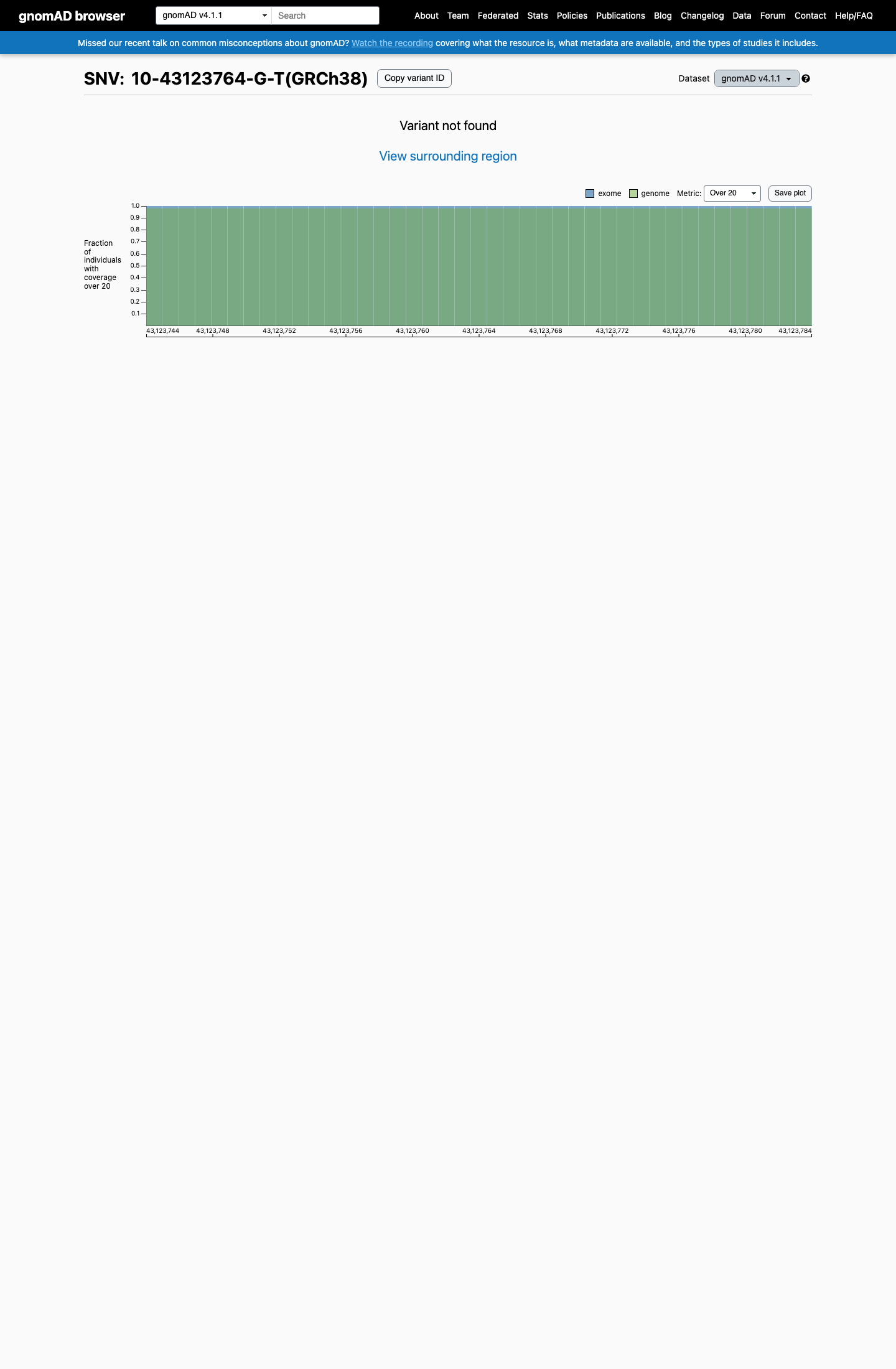
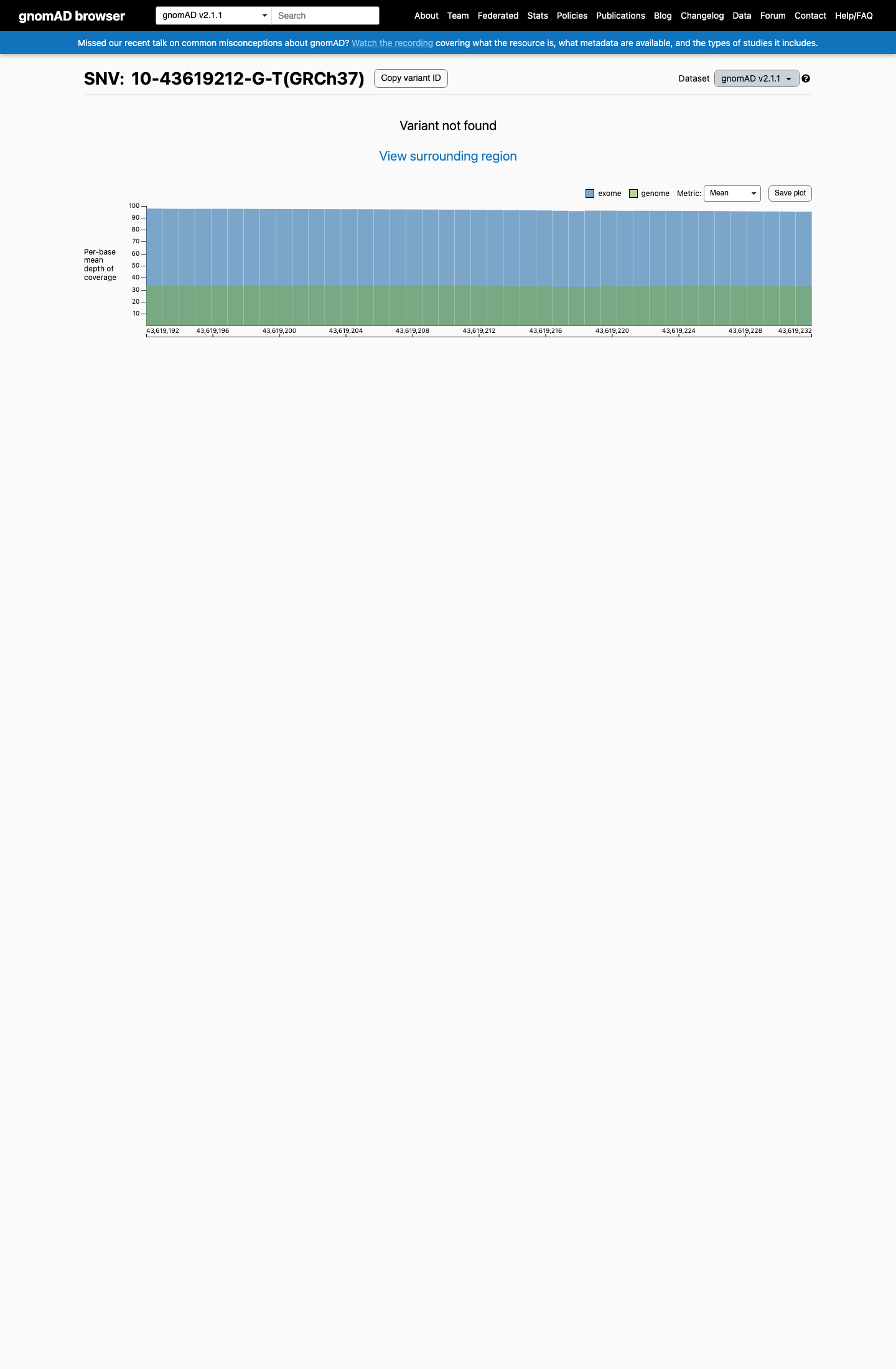
Absent from gnomAD v2.1 (exome)Absent from gnomAD v4.1 (exome)Absent from gnomAD-Canada v1.0 (HostSeq genomes); AC=0, AN=0, AF=0.0, hom=0
BP4 supporting Benign
Met (supporting): SpliceAI max delta 0.00 and BayesDel −0.186 both predict no impact (REVEL 0.529 indeterminate).
SpliceAI max delta = 0.00 (< 0.1): no predicted splice impact (BP4 splicing sub-path)BayesDel noAF score = -0.186199: predicted tolerated/benign (BP4 missense sub-path)REVEL v1.3 score = 0.529: intermediate, no call (not conflicting)
Assessed · not applied · 10 not met · 11 not assessed
Pathogenic
PS1 Not met: no established pathogenic variant produces the same p.Lys965Asn change; the only ClinVar entry is a 1-star VUS.
PS2 Not assessed: no de novo occurrence or parental testing for this variant is recorded in any source.
PS3 Not assessed: no functional studies exist; OncoKB reports no variant-specific evidence and COSMIC lacks the variant.
PS4 Not assessed: no case-control or case-series data exist for this variant in any retrieved source.
PM1 Not met: residue 965 shows no statistically significant cancer hotspot and no curated critical-domain annotation.
PM5 Not met: no pathogenic alternate missense at residue 965; the screen found zero same-residue candidates.
PM6 Not assessed: no de novo occurrence or parental genotypes are reported for this variant.
PP1 Not assessed: no co-segregation data — no affected relatives, pedigree, or segregation counts available.
PP2 Not assessed: missense is a known RET disease mechanism, but no gene-level benign-missense-rate data was available.
PP3 Not met: no in silico tool predicts damage — SpliceAI 0.00, BayesDel −0.186, REVEL 0.529 intermediate.
PP4 Not assessed: no proband phenotype or family history information was available for this variant.
PP5 Not met: no ClinVar expert-panel pathogenic assertion; the sole submission is a non-expert 1-star VUS.
Benign
BA1 Not met: absent from gnomAD (AF 0), far below the >1% general-population threshold.
BS1 Not met: allele frequency 0 does not exceed the expected frequency for this rare dominant disorder.
BS2 Not met: no observations in healthy controls — variant absent from gnomAD with no homozygous carriers.
BS3 Not assessed: no functional studies demonstrating a lack of damaging effect exist for this variant.
BS4 Not assessed: no family segregation data — no affected relatives tested or pedigree provided.
BP1 Not met: activating missense variants are an established RET disease mechanism, so missense cannot be assumed benign.
BP2 Not assessed: no in-trans or in-cis observation with a pathogenic variant is documented for this variant.
BP5 Not assessed: no reported case of this variant with an alternate molecular basis for disease.
BP6 Not met: no ClinVar expert-panel benign assertion; the sole submission is a non-expert 1-star VUS.
N/A · 5 PVS1 · PM3 · PM4 · BP3 · BP7
Research & evidence
Population frequency
gnomAD v4.1 screenshot
gnomAD v4.1
gnomAD v2.1 screenshot
gnomAD v2.1
v4.1
Absent from gnomAD v4.1.
v2.1
Absent from gnomAD v2.1.
🇨🇦 CA
Absent from gnomAD-Canada v1.0.
Allele frequency by ancestry
three datasets · side by side
gnomAD v4.1
Absent · 0 / ?
0 hom
Not observed in any ancestry group.
gnomAD v2.1
Absent · 0 / ?
0 hom
Not observed in any ancestry group.
gnomAD Canada 🇨🇦
Absent · 0 / ?
0 hom
Not observed in any ancestry group.
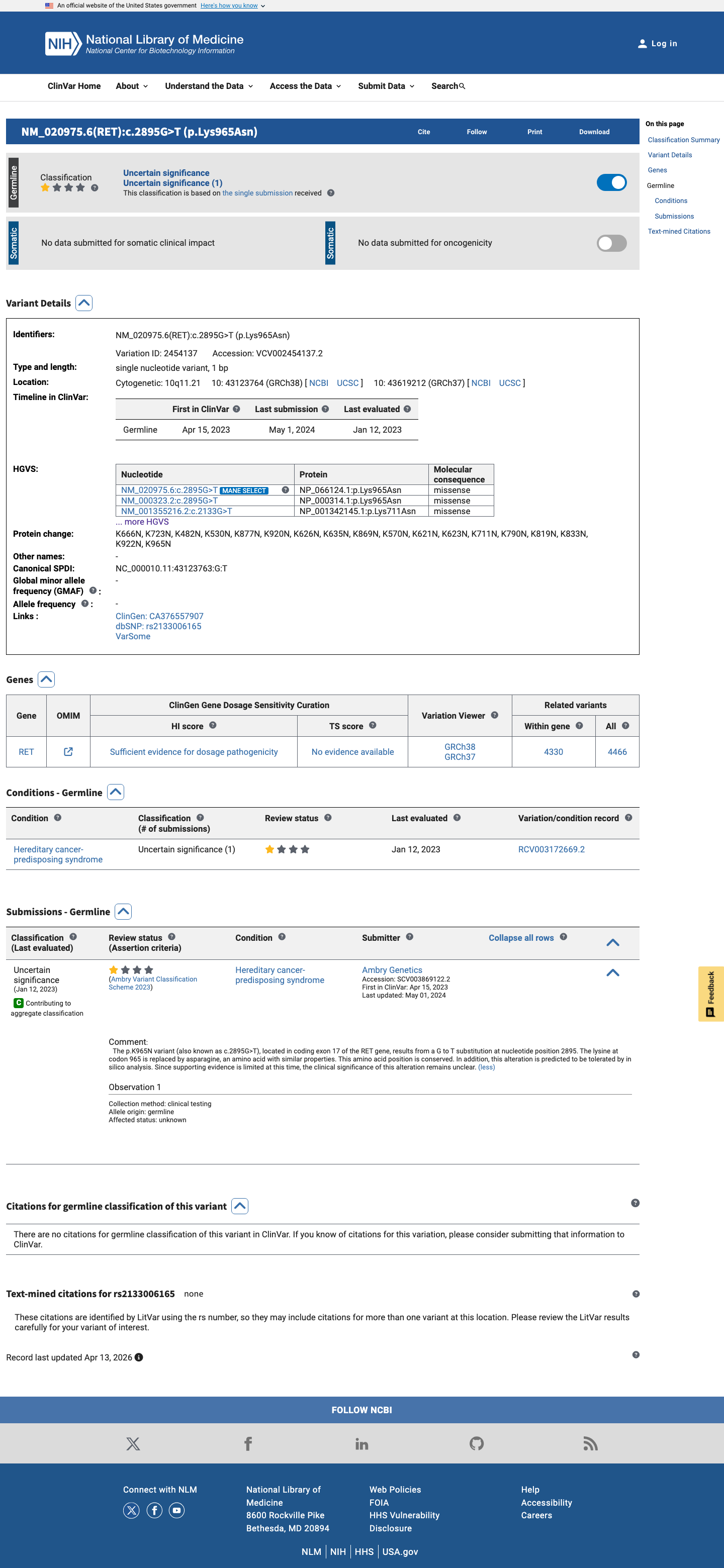
ClinVar screenshot
ClinVar
This variant has been reported in ClinVar as Uncertain significance (1 clinical laboratory). (ClinVarID = 2454137)
SpliceAI screenshot
In silico
SpliceAI predicts no significant splice impact for this variant (max delta score = 0.00). REVEL score = 0.529. BayesDel score = -0.186199.
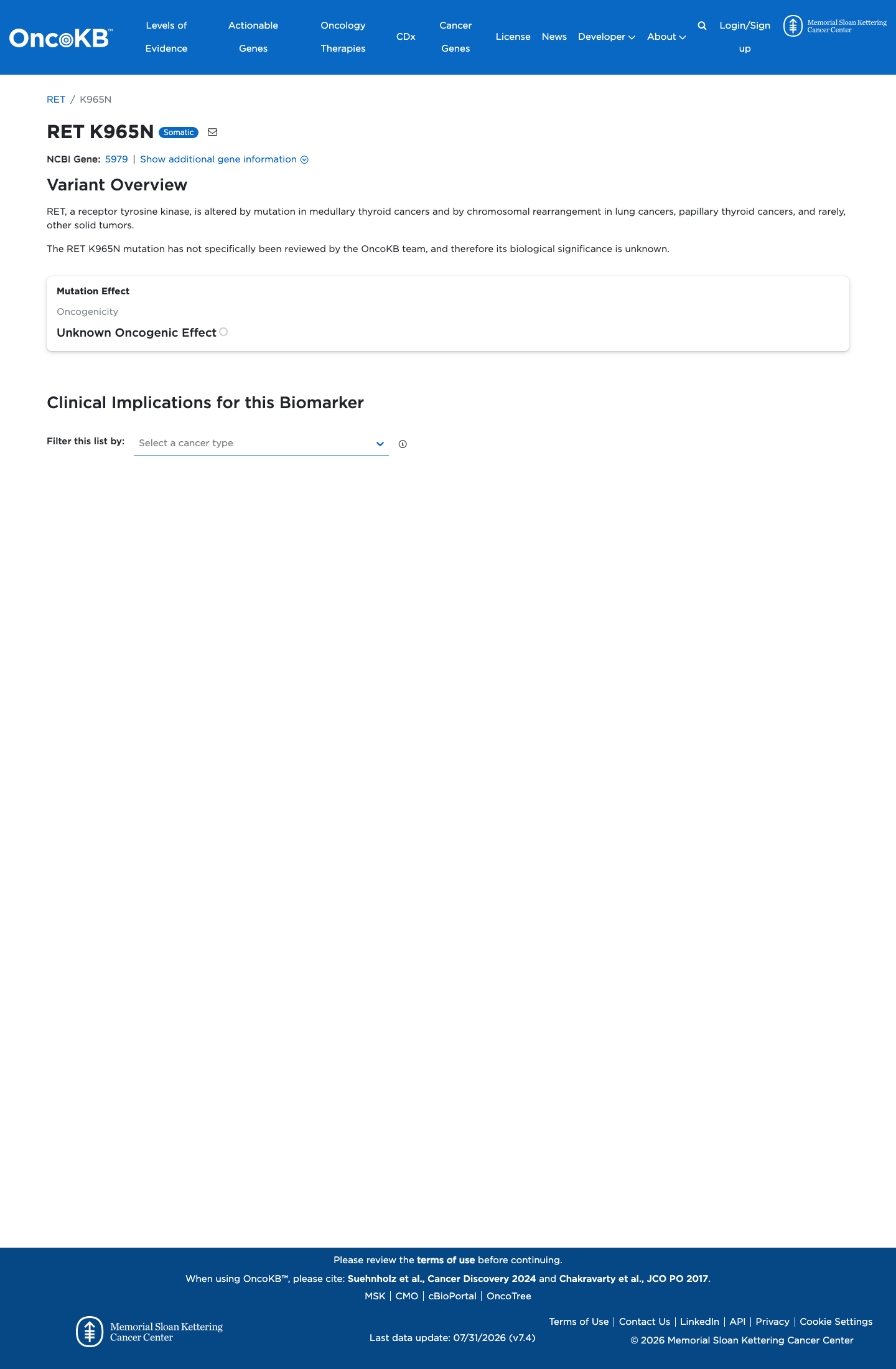
Functional / OncoKB screenshot
Functional Unknown Oncogenic Effect
OncoKB did not identify variant-specific reviewed functional evidence for this variant; gene-level curated context is available for reviewer follow-up. RET, a receptor tyrosine kinase, is altered by mutation in medullary thyroid cancers and by chromosomal rearrangement in lung cancers, papillary thyro
OncoKB ↗
COSMIC screenshot
COSMIC
Cancer hotspots screenshot
Cancer hotspots
Somatic evidence Not in COSMIC / hotspots
COSMIC
This variant does not lie in a statistically significant hotspot. This variant has not previously been reported in somatic cancers (COSMIC).
Hotspots
This variant does not lie in a statistically significant hotspot.
Sources & reference links
8Sources
ClinVar
gnomAD v2.1
gnomAD v4.1
gnomAD-Canada
SpliceAI
OncoKB
COSMIC
Cancer hotspots
Triaged references · 1 PMID not cited in assessment
25394175 ↗ A practice guideline from the American College of Medical Genetics and Genomics and the National Society of Genetic Counselors: referral indications for cancer predisposition assessment. CLINVAR