Back
NM_033360.3:c.250A>G
p.Ile84Val · KRAS
0%
complete
Final classification
VUS
BP4
KRAS
c.250A>G
p.Ile84Val
missense

KRAS encodes a small GTPase in the RAS family that cycles between active and inactive states to regulate cell growth and signaling through pathways such as MAPK/ERK and PI3K/AKT/mTOR. Activating changes in KRAS are common drivers of many cancers, including pancreatic, colorectal, and lung cancers, where they promote uncontrolled cell proliferation. Germline alterations in KRAS also cause developmental disorders such as Noonan syndrome and cardio-facio-cutaneous syndrome, which carry an increased predisposition to cancer.

This variant

KRAS missense changes can activate RAS/MAPK signaling, driving cancers and RASopathy disorders such as Noonan syndrome and cardio-facio-cutaneous syndrome. At VUS, c.250A>G (p.Ile84Val) carries only a weak benign computational signal (REVEL 0.294) with no functional or clinical data, so it cannot yet be determined whether it alters KRAS function or contributes to disease.

Transcript
NM_033360.3
HGVS · transcript:coding
NM_033360.3:c.250A>G
GRCh38
chr12:25227274 T>C
GRCh37
chr12:25380208 T>C
Variant of Uncertain Significance: only BP4 (Supporting) is met (REVEL 0.294 <= 0.3); no Pathogenic, Likely Pathogenic, Benign, or Likely Benign combination rule is satisfied.
Classification rationale
BP4 VUS
KRAS c.250A>G missense

BP4 (Supporting): REVEL 0.294 meets the VCEP pre-assigned <=0.3 threshold for missense variants. Overall classification: VUS - only BP4 (Supporting) is applied, so no VCEP combination rule for Pathogenic, Likely Pathogenic, Benign, or Likely Benign is satisfied.

BP4 VUS
LYFE Sciences is an AI system, and it can make mistakes. Criteria may be applied incorrectly, sources may be misread, and a confident-looking classification can still be wrong. Double-check every criterion and its underlying evidence before relying on any call.
Gene diagram · NM_033360.3 · variants mapped to exon structure
KRAS NM_033360.3
Fetching transcript structure from UCSC…
Applied criteria · 1 applied · 21 assessed
MetEvidence satisfies this criterion.
Not metEvaluated against available evidence; threshold not reached.
Not assessedApplies in principle, but no evidence was found to evaluate it.
N/ADoesn't apply to this variant type.
Applied · 1
Strength Supporting Moderate Strong Very strong
BP4 supporting Benign
Met (Supporting): REVEL 0.294 meets the VCEP pre-assigned <=0.3 BP4 threshold for missense variants.
REVEL score 0.294 (source: revel, local REVEL v1.3 lookup) satisfies VCEP KRAS v2.3 BP4 threshold REVEL <= 0.3 (threshold source: ClinGen RASopathy VCEP KRAS v2.3, cspec doc 643243114) - 0.294 <= 0.3, BP4 met at Supporting.SpliceAI max delta score 0.04 (source: spliceai) predicts no significant splice impact; consistent with BP4 but not counted as an independent code.BayesDel score -0.119893 (source: bayesdel) not applied: no verified published threshold available to this pipeline, treated as insufficiently calibrated.
Assessed · not applied · 8 not met · 13 not assessed
Pathogenic
PS1 Not assessed: insufficient evidence was available to evaluate this criterion.
PS2 Not assessed: no confirmed de novo observation (no parental testing or confirmation), so zero points under the VCEP de novo rule.
PS3 Not assessed: no VCEP-approved functional assay result (RAS/MEK/ERK activation) exists for this exact variant.
PS4 Not assessed: no case-control or proband-cohort enrichment data exists; the single gnomAD allele (AF 6.2e-07) provides no enrichment signal.
PM1 Not assessed: insufficient evidence was available to evaluate this criterion.
PM2 Not met: the variant is present in gnomAD v4.1 as a single South Asian exome allele (AF 6.2e-07), failing the VCEP absent-from-controls requirement.
PM4 Not met: the change is missense (p.Ile84Val) with no protein length change - the 189-amino-acid protein is unchanged.
PM5 Not assessed: insufficient evidence was available to evaluate this criterion.
PM6 Not assessed: no de novo occurrence is reported with or without parental confirmation, so the VCEP point rule cannot be scored.
PP1 Not assessed: no segregation data - zero informative meioses versus the >=3 required for Supporting.
PP2 Not assessed: insufficient evidence was available to evaluate this criterion.
PP3 Not met: REVEL 0.294 versus the VCEP >=0.7 threshold for missense variants.
PP5 Not met: no ClinVar expert-panel Pathogenic/Likely pathogenic classification exists - only two laboratory VUS submissions (GeneDx, Labcorp).
Benign
BA1 Not met: gnomAD v4.1 AF 6.2e-07 (0.00006%) versus the >=0.05% BA1 threshold - roughly 800x below.
BS1 Not met: gnomAD v4.1 AF 6.2e-07 versus the >=0.025% BS1 threshold - roughly 400x below.
BS2 Not met: no homozygous carriers in any population database; the single heterozygous carrier is not healthy-adult BS2 evidence.
BS4 Not assessed: no affected individual tested and found not to carry the variant - not even one non-segregation meiosis exists.
BP1 Not assessed: insufficient evidence was available to evaluate this criterion.
BP2 Not assessed: no proband or family observations exist (no phase, co-occurrence, or carrier data), so zero VCEP points can be scored.
BP5 Not assessed: no case-level evidence of an alternate molecular basis for disease in a carrier of this variant.
BP6 Not met: no ClinVar expert-panel Benign/Likely benign classification exists - only two laboratory VUS submissions.
N/A · 6 PVS1 · PM3 · PP4 · BS3 · BP3 · BP7
Research & evidence
Population frequency
gnomAD v4.1 screenshot
gnomAD v4.1
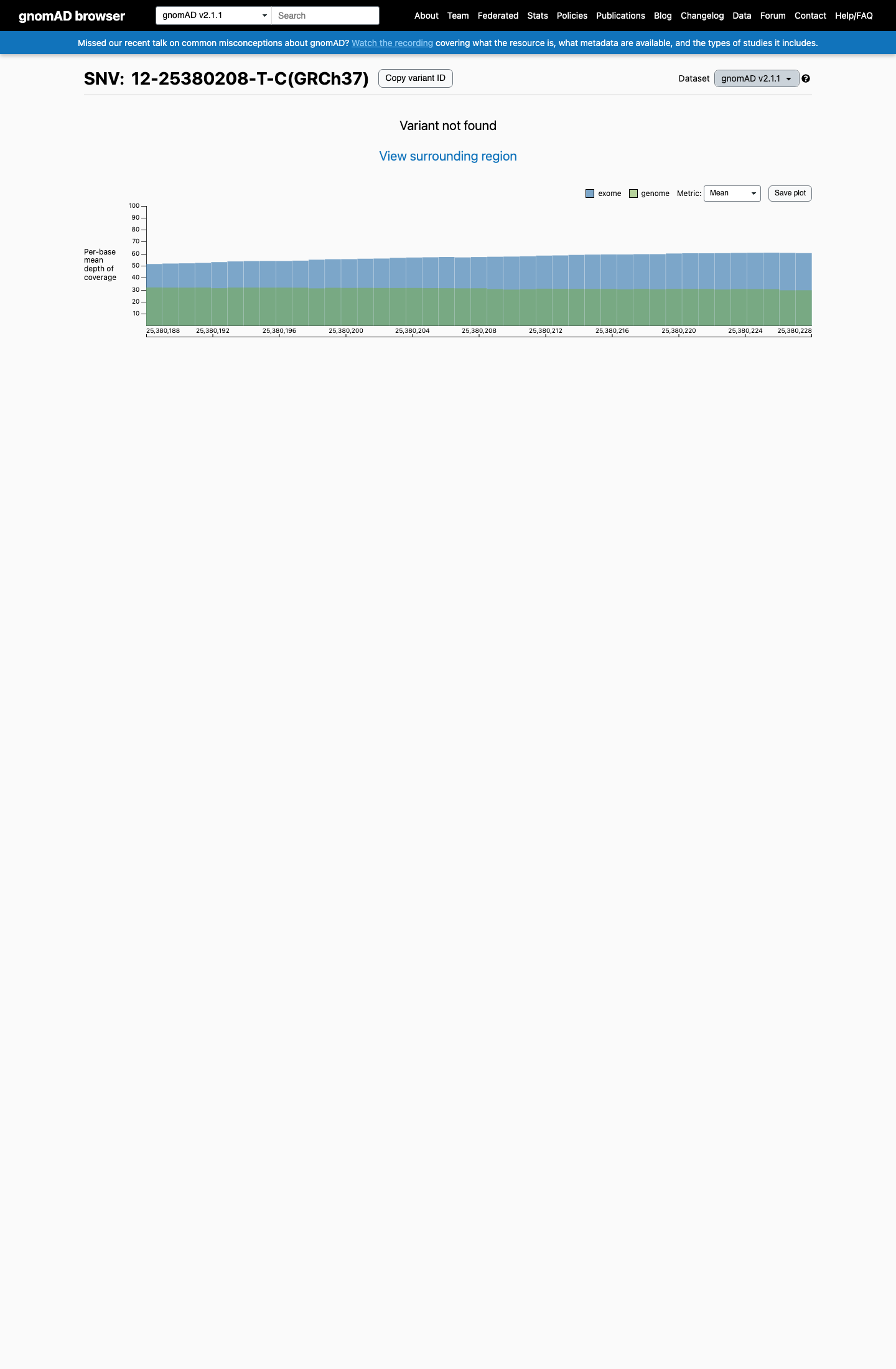
gnomAD v2.1 screenshot
gnomAD v2.1
v4.1
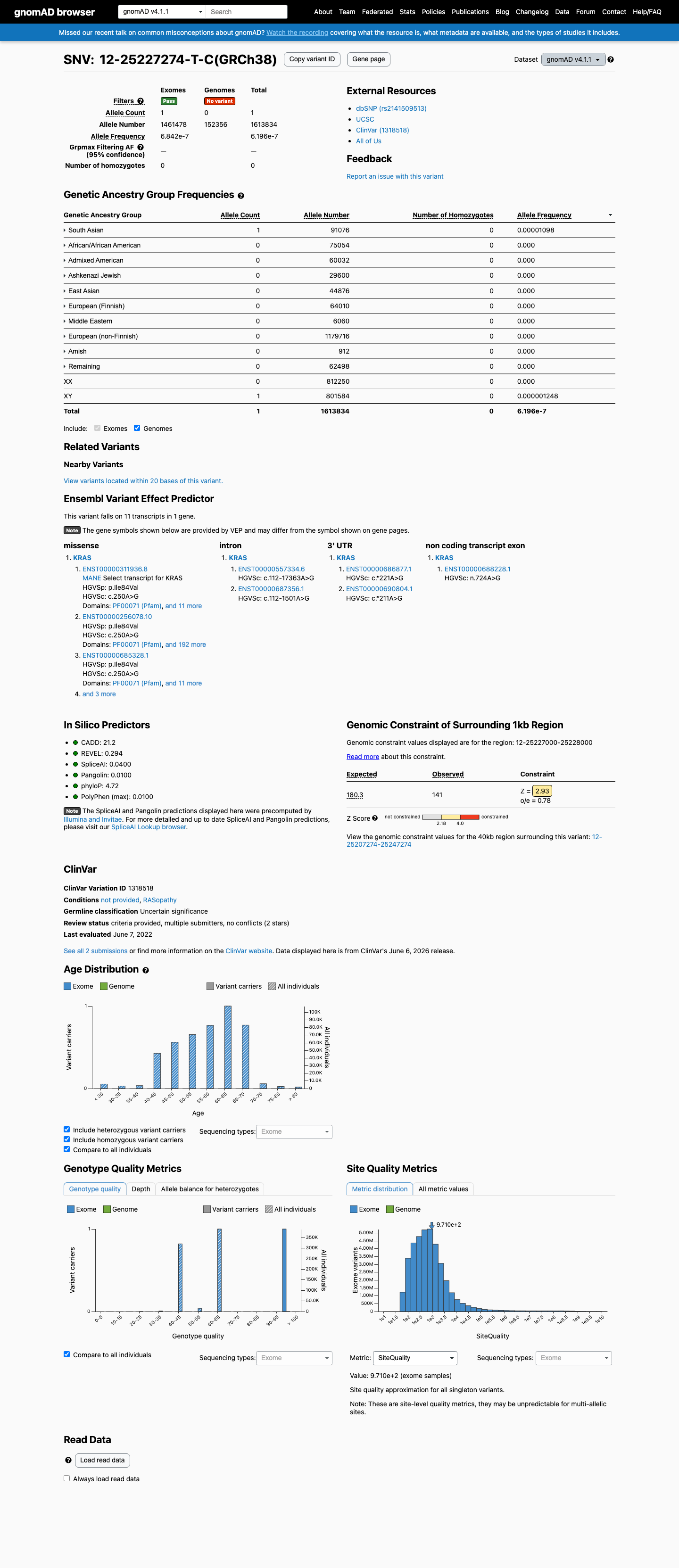
This variant is present in gnomAD v4.1 (AF= 6.19642e-07; MAF= 0.00006%, 1/1613834 alleles, homozygotes = 0) and has highest observed frequency in the South Asian population (AF= 1.09798e-05; MAF= 0.00110%, 1/91076 alleles, homozygotes = 0).
v2.1
Absent from gnomAD v2.1.
🇨🇦 CA
Absent from gnomAD-Canada v1.0.
Allele frequency by ancestry
three datasets · side by side
gnomAD v4.1
6.2e-05% · 1 / 1,613,834
0 hom
South Asian
1 / 91,076
0.0011%
+ 9 not observed (Remaining individuals, Admixed American, European (Finnish), Amish, East Asian, Middle Eastern, Ashkenazi Jewish, African/African American, European (non-Finnish))
gnomAD v2.1
Absent · 0 / ?
0 hom
Not observed in any ancestry group.
gnomAD Canada 🇨🇦
Absent · 0 / ?
0 hom
Not observed in any ancestry group.
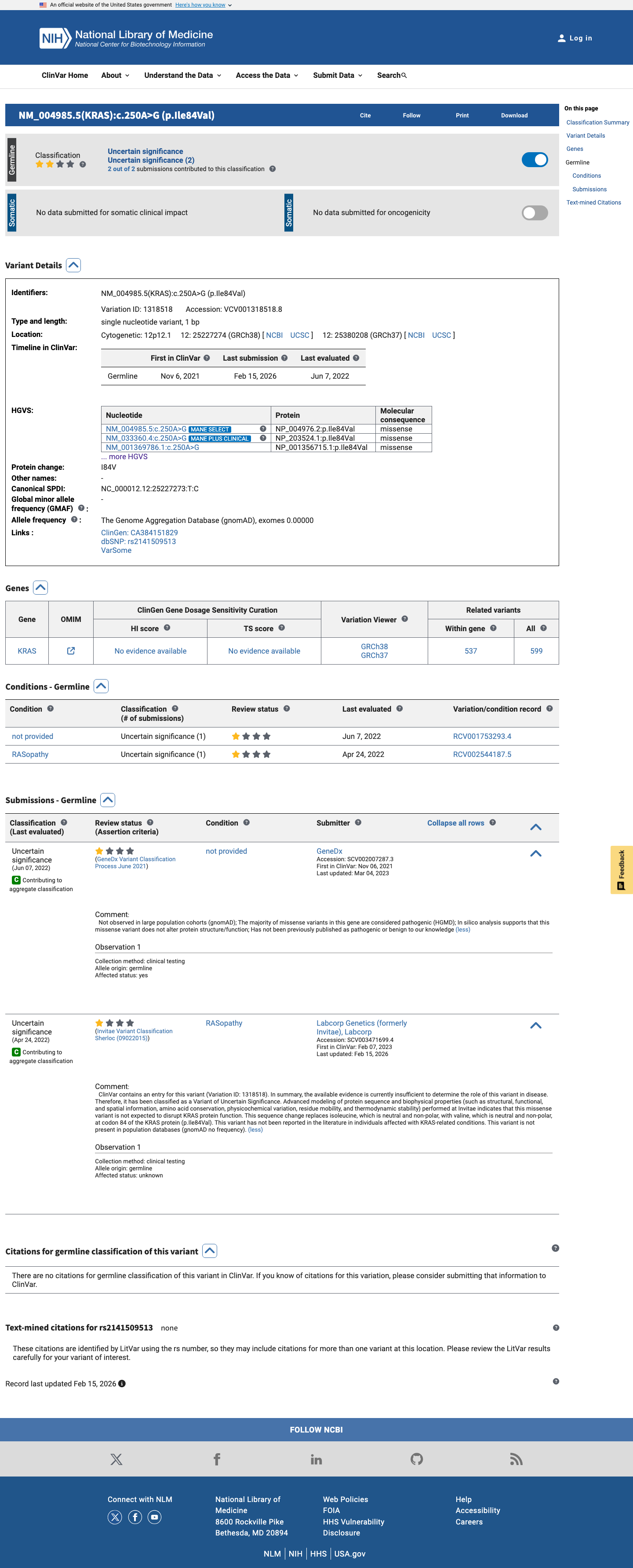
ClinVar screenshot
ClinVar
This variant has been reported in ClinVar as Uncertain significance (2 clinical laboratories). (ClinVarID = 1318518)
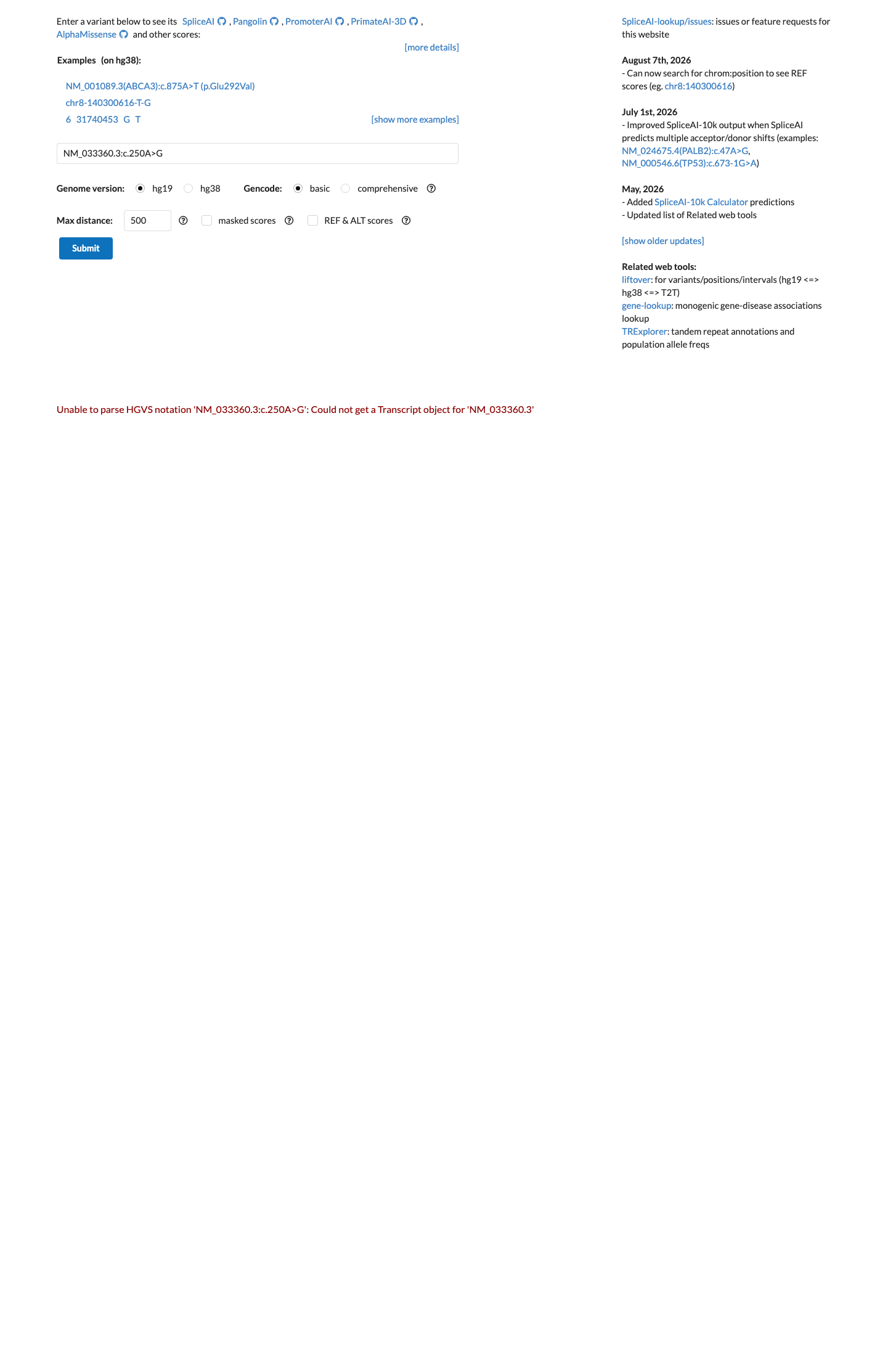
SpliceAI screenshot
In silico
SpliceAI predicts no significant splice impact for this variant (max delta score = 0.04). REVEL score = 0.294. BayesDel score = -0.119893.
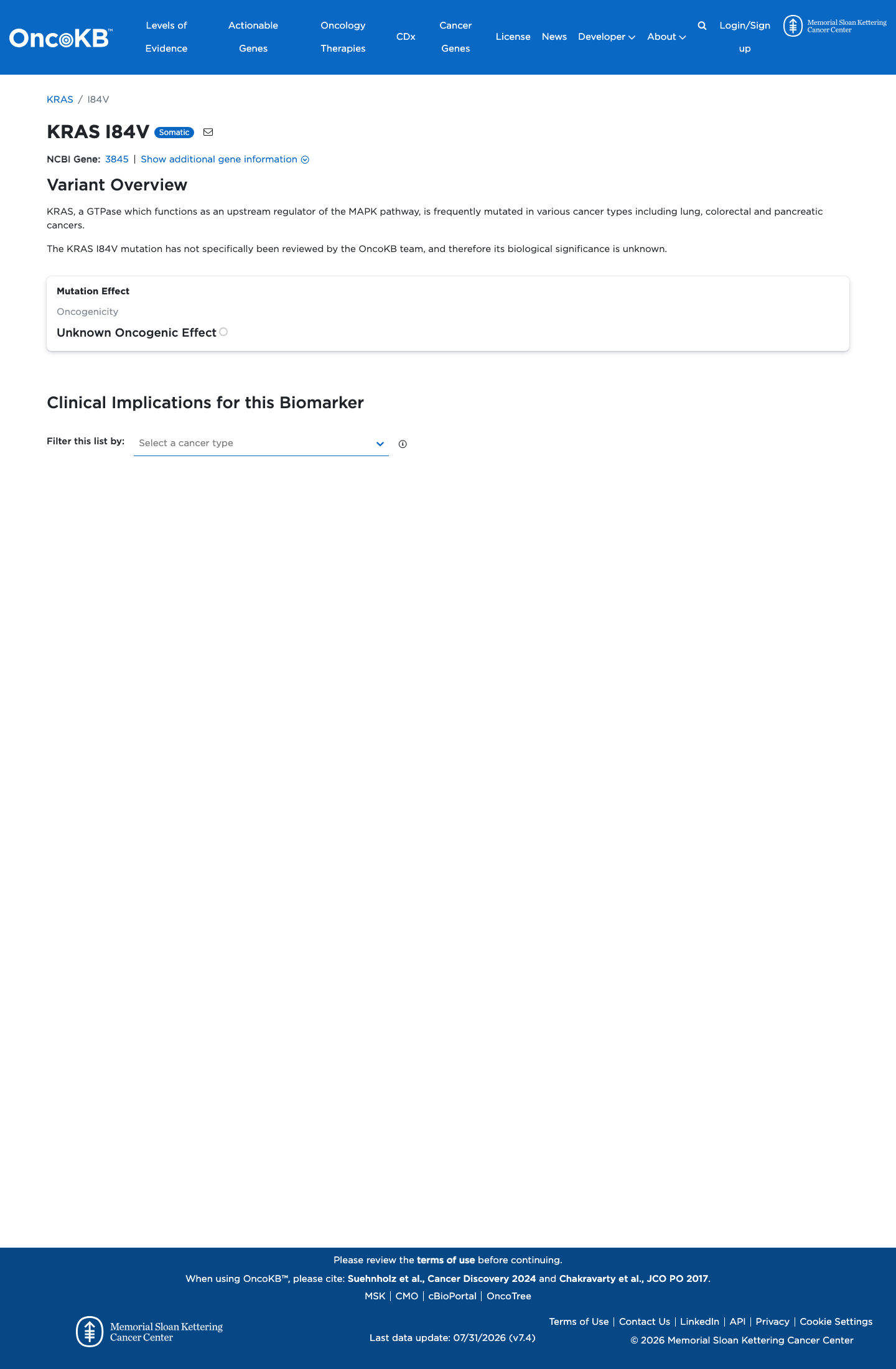
Functional / OncoKB screenshot
Functional Unknown Oncogenic Effect
OncoKB did not identify variant-specific reviewed functional evidence for this variant; gene-level curated context is available for reviewer follow-up. KRAS, a GTPase which functions as an upstream regulator of the MAPK pathway, is frequently mutated in various cancer types including lung, colorectal
OncoKB ↗
COSMIC screenshot
COSMIC
Cancer hotspots screenshot
Cancer hotspots
Somatic evidence Not in COSMIC / hotspots
COSMIC
This variant does not lie in a statistically significant hotspot. This variant has not previously been reported in somatic cancers (COSMIC).
Hotspots
This variant does not lie in a statistically significant hotspot.
Literature · how each cited paper was used
1papers cited
Each card is an audit: what was searched, what was found, whether it names the variant, which criteria it fed, and why.
Rule & framework references · cited for criterion definitions, not variant evidence
28492532 ↗ Sherloc: a comprehensive refinement of the ACMG-AMP variant classification criteria.
Sources & reference links
9Sources
CSpec VCEP
ClinVar
gnomAD v2.1
gnomAD v4.1
gnomAD-Canada
SpliceAI
OncoKB
COSMIC
Cancer hotspots