This variant was interpreted by pipeline
7.1.0.
The current version is
8.0.0.
Re-running queues a fresh interpretation; the result replaces this page when complete.
Re-runs are not free. Blank = draws on today's public interpretation allowance.
With a code = uses 1 of that code's uses.
IDH2 encodes a mitochondrial NADP(+)-dependent isocitrate dehydrogenase that catalyzes the oxidative decarboxylation of isocitrate to 2-oxoglutarate (alpha-ketoglutarate) in the tricarboxylic acid (TCA) cycle, where it supports cell metabolism and energy production. Cancer-associated alterations in its catalytic site confer a gain-of-function neomorphic activity that converts alpha-ketoglutarate into the oncometabolite D-2-hydroxyglutarate, which promotes tumor development by inhibiting enzymes involved in DNA and histone demethylation, adaptation to hypoxia, and collagen maturation. As an oncogene, IDH2 is associated with hematologic malignancies, particularly acute myeloid leukemia, as well as solid tumors such as gliomas and cholangiocarcinomas.
This variant
IDH2 is an established oncogene whose cancer-driving alterations are gain-of-function missense changes at catalytic residues R140 and R172, while germline loss-of-function causes D-2-hydroxyglutaric aciduria type 2. This variant, p.Ala174Thr, sits adjacent to — but not within — the R172 hotspot and has no clinical, functional, or case-control evidence of an effect. It is therefore a VUS: the gene is clearly disease-relevant, but this specific change currently has no evidence for or against pathogenicity.
Transcript
NM_002168.3
HGVS · transcript:coding
NM_002168.3:c.520G>A
GRCh38
chr15:90088601 C>T
GRCh37
chr15:90631833 C>T
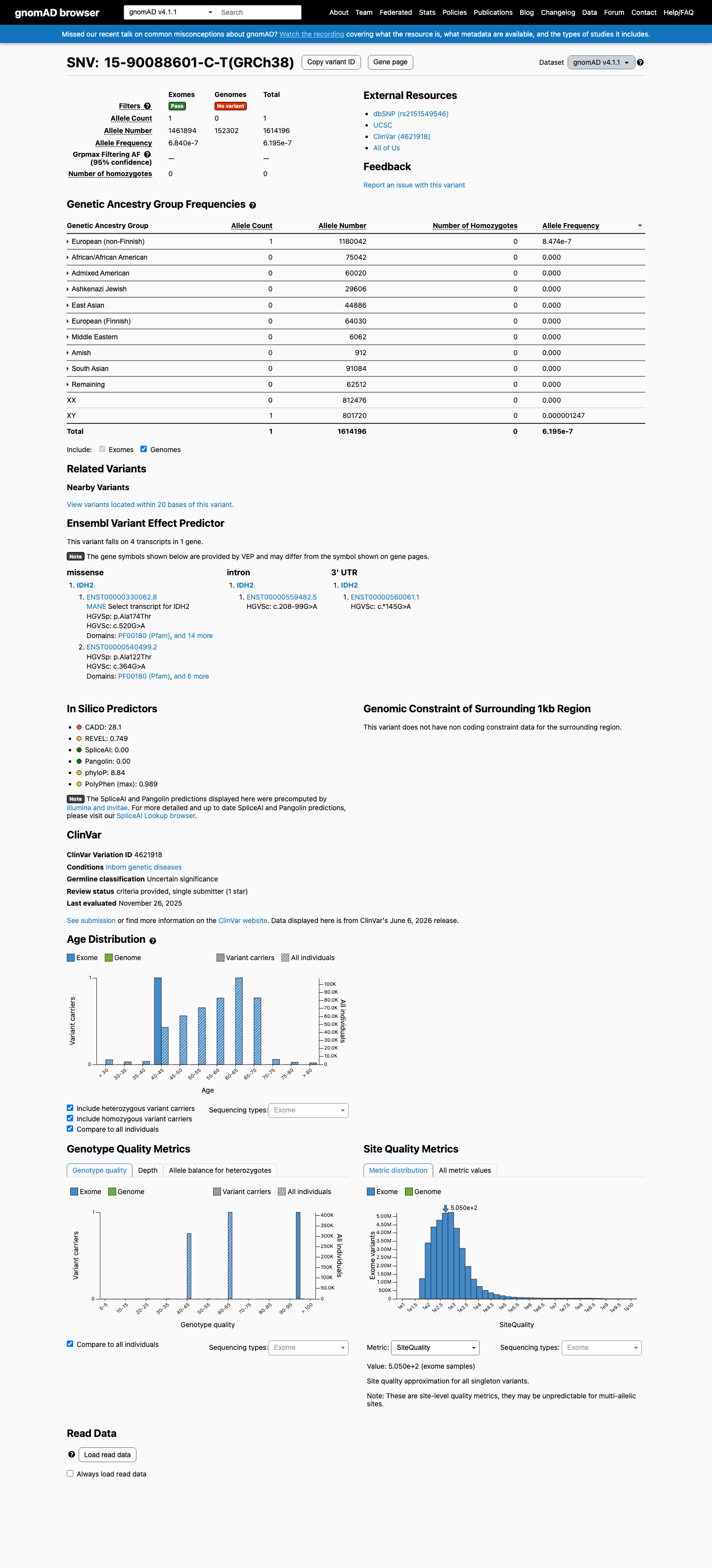
VUS: no IDH2 ClinGen/VCEP framework exists, so generic ACMG/AMP 2015 rules applied; the sole met criterion — PM2 (supporting), gnomAD AF 6.2e-07 — satisfies no combination threshold.
Classification rationale
PM2VUS
IDH2 c.520G>Amissense
PM2 (Supporting): absent from gnomAD v2.1 and gnomAD-Canada, with a single allele in 1,614,196 (AF 6.2e-07), far below the 0.1% low-frequency threshold. Overall classification: Variant of Uncertain Significance — a single supporting criterion satisfies no pathogenic or benign combination threshold under the generic ACMG/AMP 2015 rules.
PM2→VUS
LYFE Sciences is an AI system, and it can make mistakes. Criteria
may be applied incorrectly, sources may be misread, and a confident-looking
classification can still be wrong. Double-check every criterion and
its underlying evidence before relying on any call.
Gene diagram
· NM_002168.3 · variants mapped to exon structure
IDH2NM_002168.3
Fetching transcript structure from UCSC…
Exons
—
Transcript span
—
Strand
—
Variants mapped
—
Source
UCSC ncbiRefSeqCurated
All variants in IDH2—click a row to locate it on the plot · use the link column to open its page
Protein
Location
Classification
Link
Applied criteria · 1 applied · 22 assessed
MetEvidence satisfies this criterion.
Not metEvaluated against available evidence; threshold not reached.
Not assessedApplies in principle, but no evidence was found to evaluate it.
N/ADoesn't apply to this variant type.
Applied · 1
Strength Supporting Moderate Strong Very strong
✓
PM2supportingPathogenic
Met (supporting): absent from gnomAD v2.1 and gnomAD-Canada, with a single allele in 1,614,196 (AF 6.2e-07) — far below the 0.1% PM2 threshold.
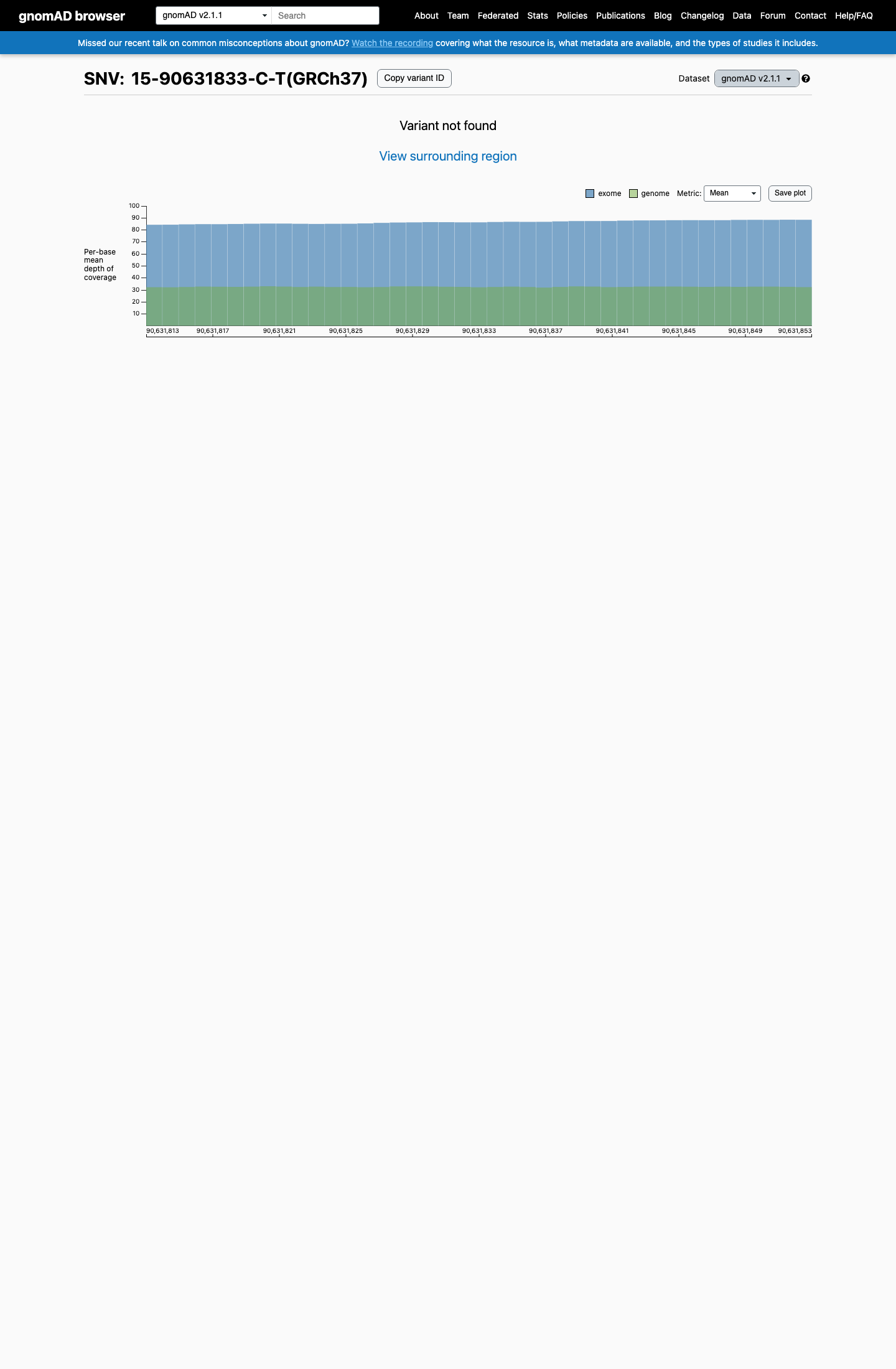
gnomAD v4.1: total AF 6.195e-07 (MAF 0.00006%), 1/1,614,196 alleles, 0 homozygotes; best subpopulation NFE AF 8.474e-07 — below non-VCEP PM2 threshold of <0.1%.gnomAD v2.1: variant absent (0 alleles).gnomAD-Canada v1.0: variant absent.
Assessed · not applied
· 13 not met · 9 not assessed
Pathogenic
PS1Not met: no different-nucleotide change producing p.Ala174Thr with a pathogenic assertion exists in ClinVar or the literature.
PS2Not assessed: no proband-parent trio or parental testing data were available to evaluate a de novo origin.
PS3Not assessed: no functional studies of this variant (enzyme, cellular, or animal assays) were available.
PS4Not met: no case-control enrichment evidence exists; the variant is essentially absent from population controls (gnomAD AF 6.2e-07).
PM1Not met: residue 174 is not a hotspot; IDH2's established hotspots are catalytic residues R140 and R172.
PM3Not met: no observation of this variant in trans with a pathogenic IDH2 variant was available.
PM5Not assessed: no pathogenic alternate missense at residue 174 was identified, so a different-missense comparator could not be confirmed.
PM6Not assessed: no de novo occurrence or parental testing is documented for this variant.
PP1Not assessed: no family segregation or pedigree data were available.
PP2Not assessed: no gene-level missense constraint metric (gnomAD Z-score) was available to evaluate PP2.
PP3Not met: REVEL 0.749 is below the calibrated 0.773 PP3-supporting threshold.
PP4Not assessed: no proband phenotype or family history data were available to evaluate phenotype specificity.
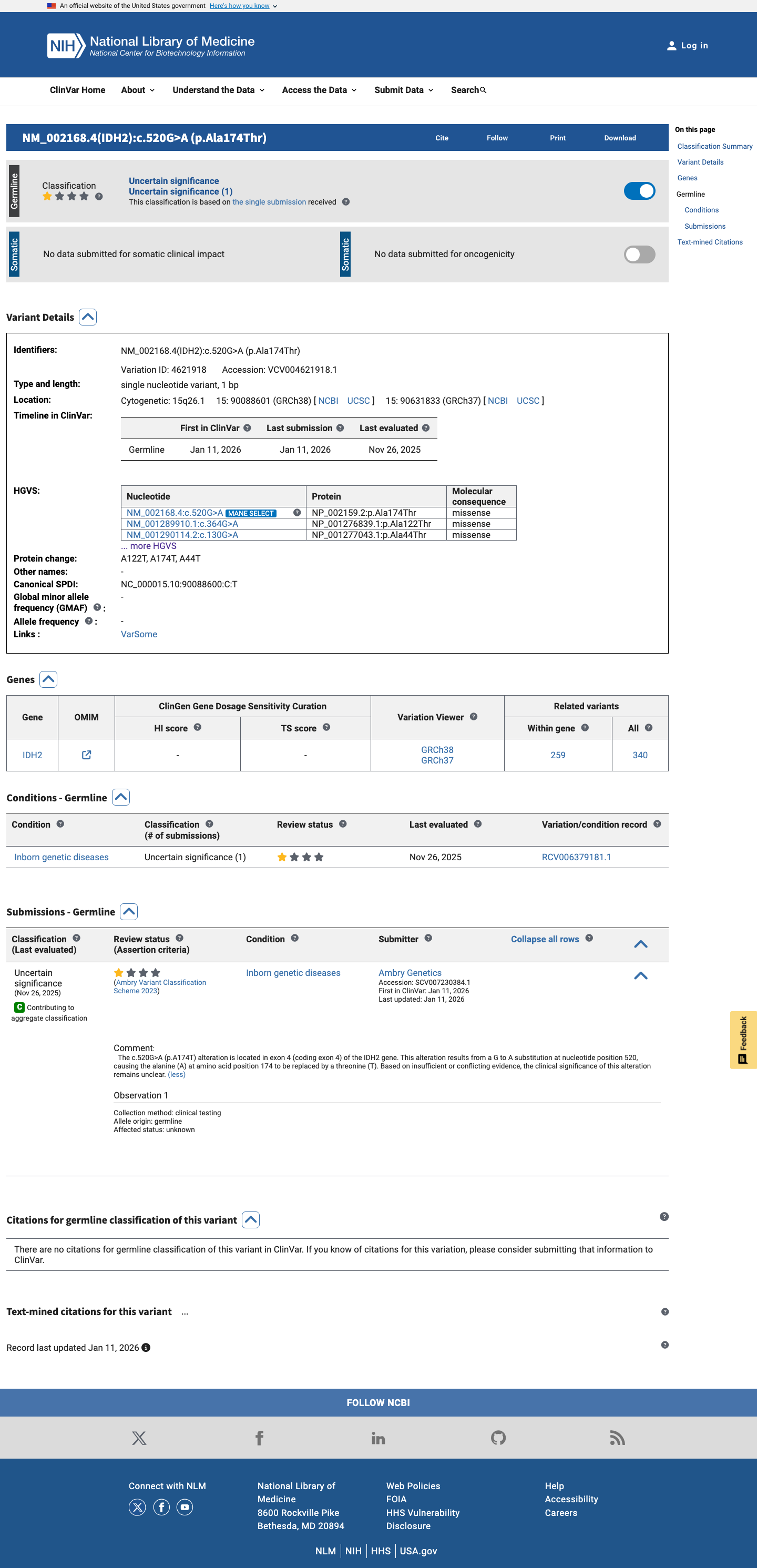
PP5Not met: ClinVar holds only a single-submitter laboratory VUS, with no expert-panel pathogenic classification.
Benign
BA1Not met: gnomAD AF 6.2e-07 is roughly five orders of magnitude below the >1% BA1 threshold.
BS1Not met: gnomAD AF 6.2e-07 is orders of magnitude below the >0.3% BS1 threshold.
BS2Not met: zero homozygotes observed across 1,614,196 gnomAD v4.1 alleles.
BS3Not assessed: no functional studies demonstrating absence of a damaging effect were available.
BS4Not assessed: no family or segregation evidence showing non-segregation was available.
BP2Not met: no observation in trans or cis with a pathogenic IDH2 variant was available.
BP4Not met: REVEL 0.749 far exceeds the calibrated 0.128 BP4-supporting threshold.
BP5Not met: no reported case carries this variant with an alternate molecular basis for disease.
BP6Not met: ClinVar holds only a single-submitter laboratory VUS, with no expert-panel benign classification.
N/A · 5PVS1 · PM4 · BP1 · BP3 · BP7
Research & evidence
Population frequency
gnomAD v4.1
gnomAD v2.1
v4.1
This variant is present in gnomAD v4.1 (AF= 6.19503e-07; MAF= 0.00006%, 1/1614196 alleles, homozygotes = 0) and has highest observed frequency in the European (non-Finnish) population (AF= 8.47427e-07; MAF= 0.00008%, 1/1180042 alleles, homozygotes = 0).
v2.1
Absent from gnomAD v2.1.
🇨🇦 CA
Absent from gnomAD-Canada v1.0.
Allele frequency by ancestry
three datasets · side by side
gnomAD v4.1
6.2e-05%
· 1 / 1,614,196
0 hom
European (non-Finnish)
1 / 1,180,042
8.5e-05%
+ 9 not observed (Remaining individuals, Admixed American, European (Finnish), Amish, East Asian, Middle Eastern, South Asian, Ashkenazi Jewish, African/African American)
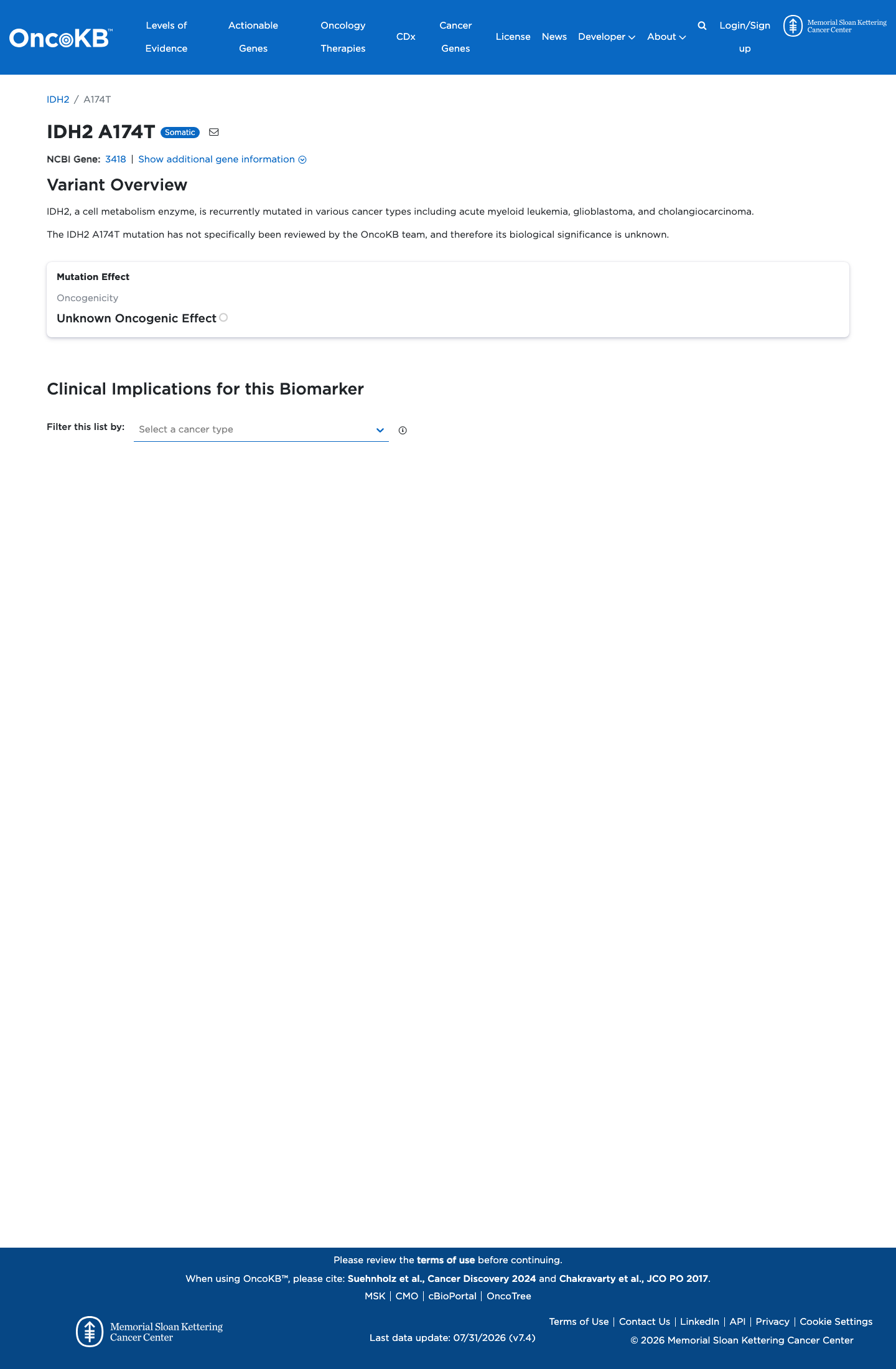
OncoKB did not identify variant-specific reviewed functional evidence for this variant; gene-level curated context is available for reviewer follow-up. IDH2, a cell metabolism enzyme, is recurrently mutated in various cancer types including acute myeloid leukemia, glioblastoma, and cholangiocarcinoma.
Triaged references · 5 PMIDs not cited in assessment
25626707 ↗Whole-genome sequencing in newborn screening? A statement on the continued importance of targeted approaches in newborn screening programmes.CLINVAR
25730230 ↗Expanded carrier screening in reproductive medicine-points to consider: a joint statement of the American College of Medical Genetics and Genomics, American College of Obstetricians and Gynecologists, National Society of Genetic Counselors, Perinatal Quality Foundation, and Society for Maternal-Fetal Medicine.CLINVAR
23169492 ↗The perspective from EASAC and FEAM on direct-to-consumer genetic testing for health-related purposes.CLINVAR
22947299 ↗Specific guidelines for assessing and improving the methodological quality of economic evaluations of newborn screening.CLINVAR
23881473 ↗Newborn screening: education, consent, and the residual blood spot. The position of the national society of genetic counselors.CLINVAR