Analysis in progress
Initialising…
0%
complete
This report is still being assembled — sections appear as each stage finishes. It isn't final yet.
PTEN
Final classification
VUS
PTEN c.46T>G · p.Tyr16Asp
PTEN

PS3 (Moderate): direct saturation-mutagenesis assay (Mighell 2018) shows severely impaired lipid phosphatase function (fitness score -2.205, below the -1.11 threshold).

Gene
PTEN
Transcript
NM_000314.8
HGVS · transcript:coding
NM_000314.8:c.46T>G
Consequence
N/A
GRCh38
chr10:87864515 T>G
GRCh37
chr10:89624272 T>G
Basis VUS: PS3 moderate (fitness score -2.205 vs -1.11), PM2, PP2, PP3 supporting — matching no combination rule for pathogenic or benign in the PTEN framework.
VUS: PS3 moderate (fitness score -2.205 vs -1.11), PM2, PP2, PP3 supporting — matching no combination rule for pathogenic or benign in the PTEN framework.
Classification rationale
PS3PM2PP2PP3 VUS
PTEN c.46T>G

PS3 (Moderate): direct saturation-mutagenesis assay (Mighell 2018) shows severely impaired lipid phosphatase function (fitness score -2.205, below the -1.11 threshold). PM2 (Supporting): absent from gnomAD v2.1, v4.1, and gnomAD-Canada (allele frequency 0, below 0.001%). PP2 (Supporting): PTEN has a low rate of benign missense variation, and missense variants are a common disease mechanism. PP3 (Supporting): REVEL score 0.844 exceeds the 0.7 threshold. Overall classification: VUS — one moderate plus three supporting pathogenic criteria match no combination rule in the PTEN expert panel framework, with no strong/very-strong or benign criterion met.

PS3 + PM2 + PP2 + PP3 VUS
Gene diagram · NM_000314.8 · variants mapped to exon structure
PTEN NM_000314.8
Fetching transcript structure from UCSC…
Applied criteria · 4 applied · 15 assessed
Applied · 4
Strength Supporting Moderate Strong Very strong
PS3 moderate Pathogenic
Met (Moderate): the Mighell 2018 saturation-mutagenesis assay directly measured this variant at fitness score -2.205, below the -1.11 threshold.
ClinGen PTEN EP Specification v3.2 (cspec doc 135637575), PS3_moderate rule: 'Phosphatase activity <= -1.11 per Mighell et al. 2018, PMID: 29706350.' Instructions require the variant to be listed TRUE under Table S2 column I (high confidence) and state 'Apply PS3_moderate for all variants with scores <= -1.11.'Mighell et al. 2018, Am J Hum Genet 102:943-955, PMID 29706350, Table 1 footnote c: 'variants with scores less than or equal to -1.11, the lower 95th percentile (two-tailed) for synonymous variants' - published calibration of the less-than-wild-type (likely damaging) threshold used by the VCEP.Mighell et al. 2018 Table S2 (source_registry key vcep_mmc2, mmc2.xlsx), row Y16D: Cum_score = -2.205 (Cum_SE 0.373), High_conf = TRUE ('Pass SE Filter'), Imputed_Score = NA (directly measured); biological replicates A1 -3.26, B1 -2.02, A2 -3.39, B2 -2.30, A3 -2.73, B3 -1.88 (all <= -1.88).
PM2 supporting Pathogenic
Met (Supporting): absent from gnomAD v2.1, v4.1, and gnomAD-Canada (allele frequency 0), below the 0.001% threshold.
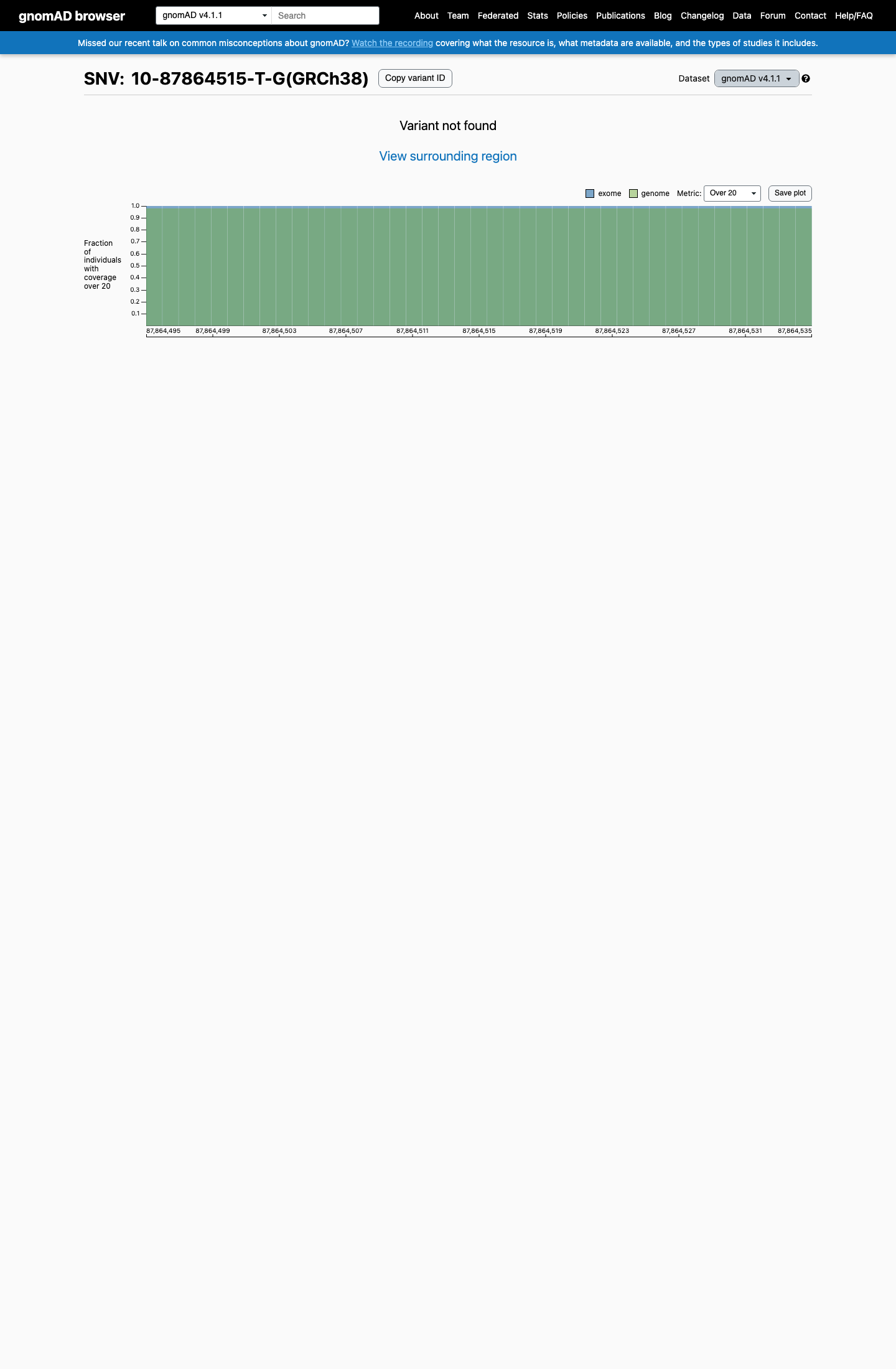
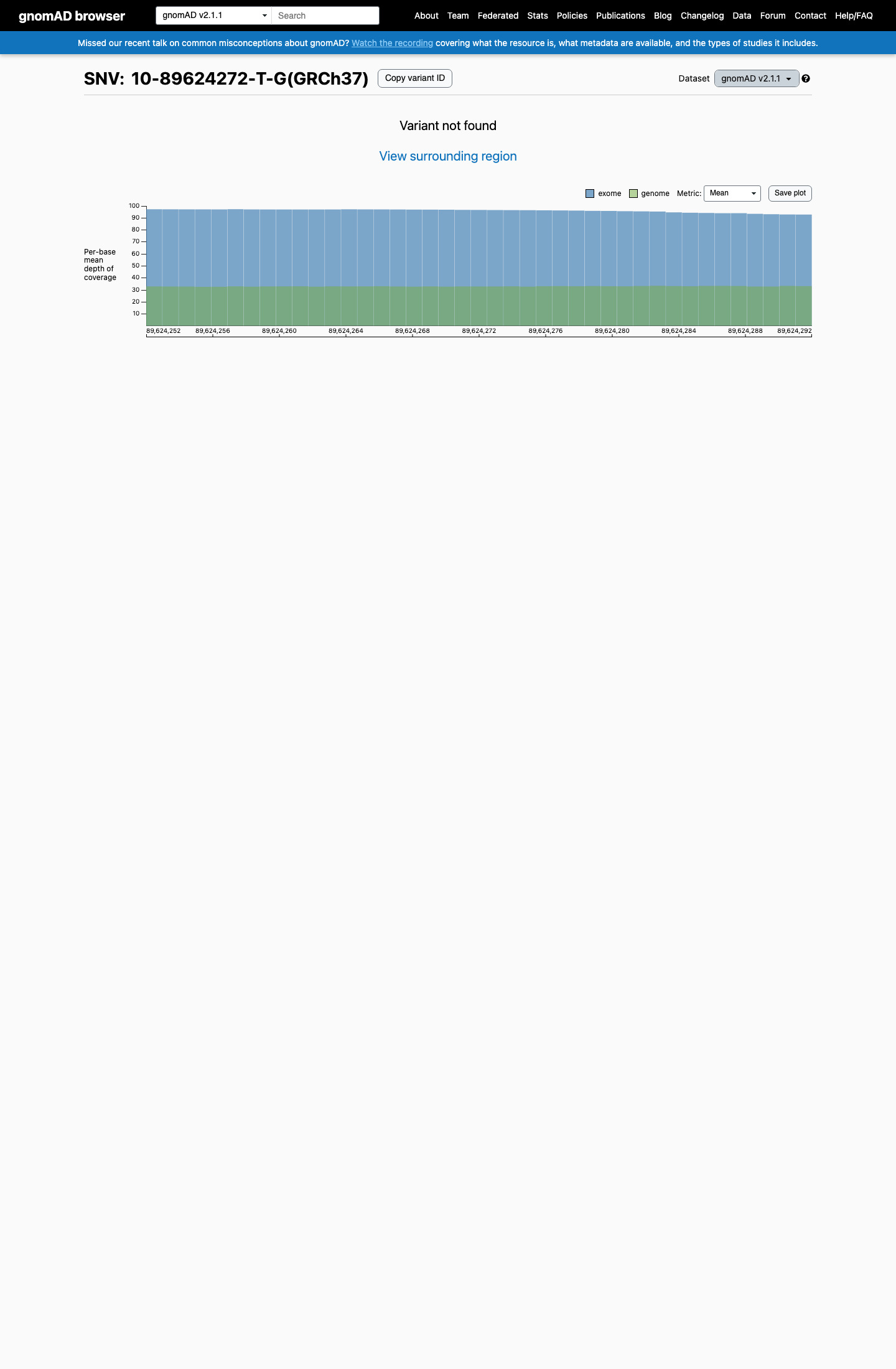
gnomAD v2.1 (exome) variant lookup 10-89624272-T-G: variant absent; AF=0 < 0.001%gnomAD v4.1 (exome) variant lookup chr10-87864515-T-G: variant absent; AF=0 < 0.001%gnomAD-Canada v1.0 (HostSeq genomes) variant lookup 10-87864515-T-G: variant absent; AF=0 < 0.001%
PP2 supporting Pathogenic
Met (Supporting): PTEN has a low rate of benign missense variation, and missense variants are a common disease mechanism.
PTEN VCEP v3.2 (cspec doc 135637575) PP2 rule: 'Missense variant in a gene that has a low rate of benign missense variation and where missense variants are a common mechanism of disease' - Applicable, default strength SupportingMighell et al. 2018 (PMID:29706350): 'We identified 2,273 mutations with reduced cellular lipid phosphatase activity, which includes 1,789 missense mutations' - gene-level evidence of low PTEN missense tolerance (humanized yeast saturation assay)
PP3 supporting Pathogenic
Met (Supporting): REVEL score 0.844 exceeds the 0.7 missense threshold.
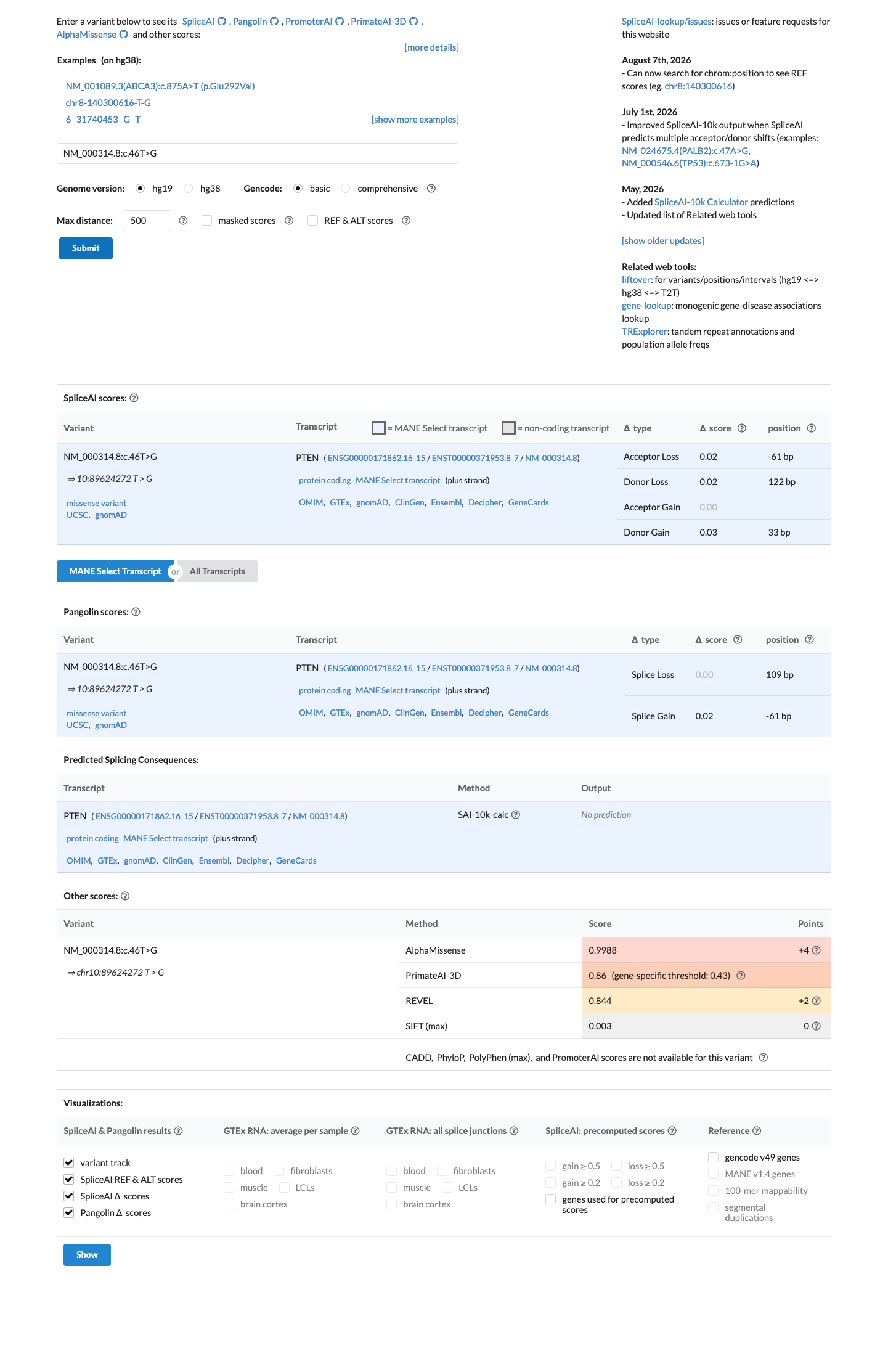
REVEL score 0.844 (source_registry key 'revel'; local REVEL v1.3 lookup, GRCh38 chr10:87864515 T>G) exceeds the ClinGen PTEN Expert Panel Specifications v3.2 (cspec doc 135637575) missense PP3 threshold of > 0.7 -> PP3 SupportingSpliceAI max delta score 0.03 (DS_AG 0.00, DS_AL 0.02, DS_DG 0.03, DS_DL 0.02; source_registry key 'spliceai', SpliceAI Lookup for NM_000314.8:c.46T>G) is well below the VCEP PP3 splice threshold of 0.5; no splice-impact evidence for PP3ClinGen PTEN Expert Panel Specifications v3.2 (source_registry key 'cspec', doc 135637575): PP3 Supporting rule 'Missense variants: REVEL score > 0.7'; VCEP commentary cites Bayesian adaptation of the ACMG/AMP framework (Tavtigian et al., 2018, PMID 29300386, referenced within the cspec document) as the calibration basis
Assessed · not applied
Pathogenic
PS1 Not met: no alternate single-nucleotide change at codon 16 (TAT) can produce p.Tyr16Asp, so the same-amino-acid condition cannot be satisfied.
PS2 Insufficient evidence: no documented de novo occurrence or parental-testing data was available.
PS4 Insufficient evidence: no case-control study or phenotype-specificity scores for this variant were available.
PM1 Not met: residue 16 lies outside the PTEN catalytic motifs (WPD loop, P-loop, TI-loop) that define PM1.
PM5 Insufficient evidence: no pathogenic same-residue comparator at Tyr16 could be confirmed.
PM6 Insufficient evidence: no proband with a presumed de novo occurrence was available.
PP1 Insufficient evidence: no family segregation data was available, so co-segregation could not be evaluated.
Benign
BA1 Not met: absent from gnomAD (allele frequency 0), far below the 0.056% stand-alone threshold.
BS1 Not met: absent from gnomAD (allele frequency 0), below even the lowest supporting-strength frequency band.
BS2 Not met: no homozygous observations in unaffected individuals exist; the variant is absent from population databases.
BS3 Not met: the same validated assay shows severely reduced phosphatase activity (fitness score -2.205), not the >0 score BS3 requires.
BS4 Insufficient evidence: no documented lack of segregation in affected family members was available.
BP2 Not met: no trans or cis observations alongside a pathogenic PTEN variant were found.
BP4 Not met: REVEL score 0.844 is above the 0.5 threshold BP4 requires for missense variants.
BP5 Insufficient evidence: no case with an alternate molecular basis for disease was reported.
N/A · 9 PVS1 · PM3 · PM4 · PP4 · PP5 · BP1 · BP3 · BP6 · BP7
Research & evidence
Population frequency
gnomAD v4.1 screenshot
gnomAD v4.1
gnomAD v2.1 screenshot
gnomAD v2.1
v4.1
Absent from gnomAD v4.1.
v2.1
Absent from gnomAD v2.1.
🇨🇦 CA
Absent from gnomAD-Canada v1.0.
Allele frequency by ancestry
three datasets · side by side
gnomAD v4.1
Absent · 0 / ?
0 hom
Not observed in any ancestry group.
gnomAD v2.1
Absent · 0 / ?
0 hom
Not observed in any ancestry group.
gnomAD Canada 🇨🇦
Absent · 0 / ?
0 hom
Not observed in any ancestry group.
ClinVar screenshot
ClinVar
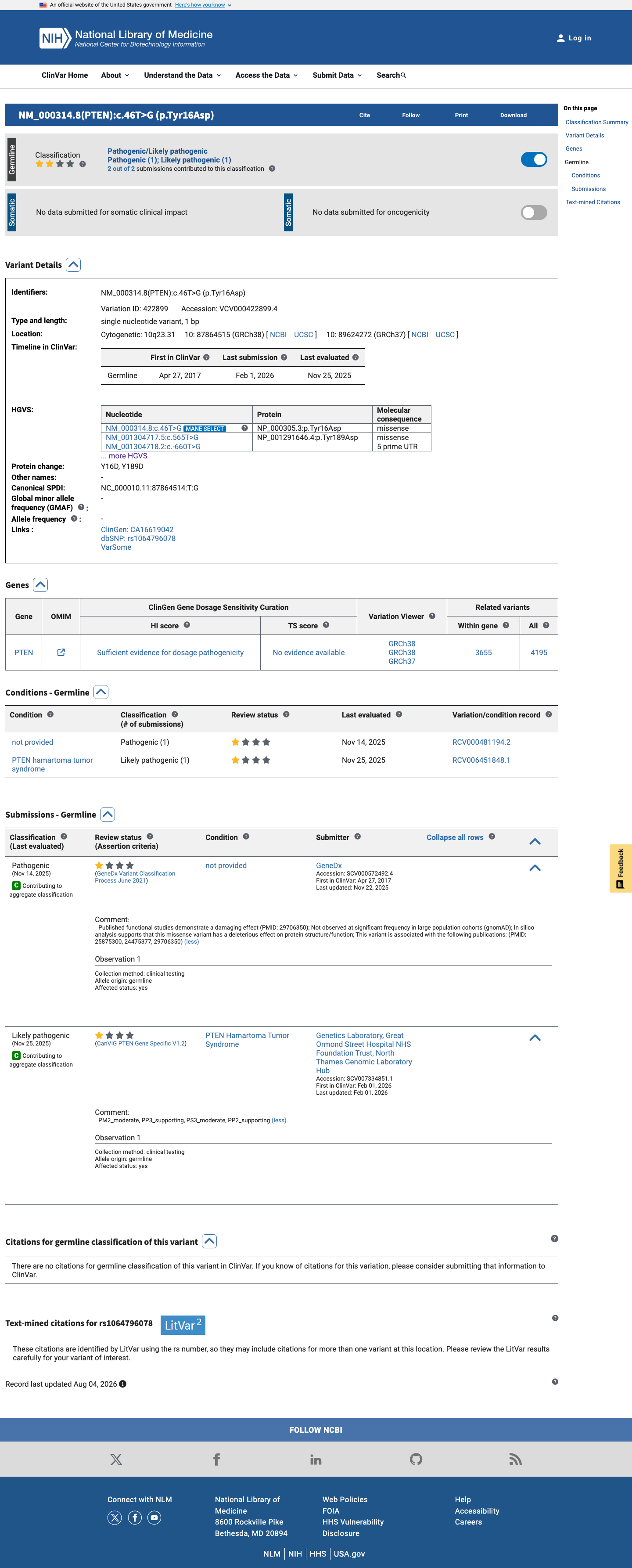
This variant has been reported in ClinVar as Pathogenic (1 clinical laboratory) and as Likely pathogenic (1 clinical laboratory). (ClinVarID = 422899)
SpliceAI screenshot
In silico
SpliceAI predicts no significant splice impact for this variant (max delta score = 0.03). REVEL score = 0.844. BayesDel score = 0.518836.
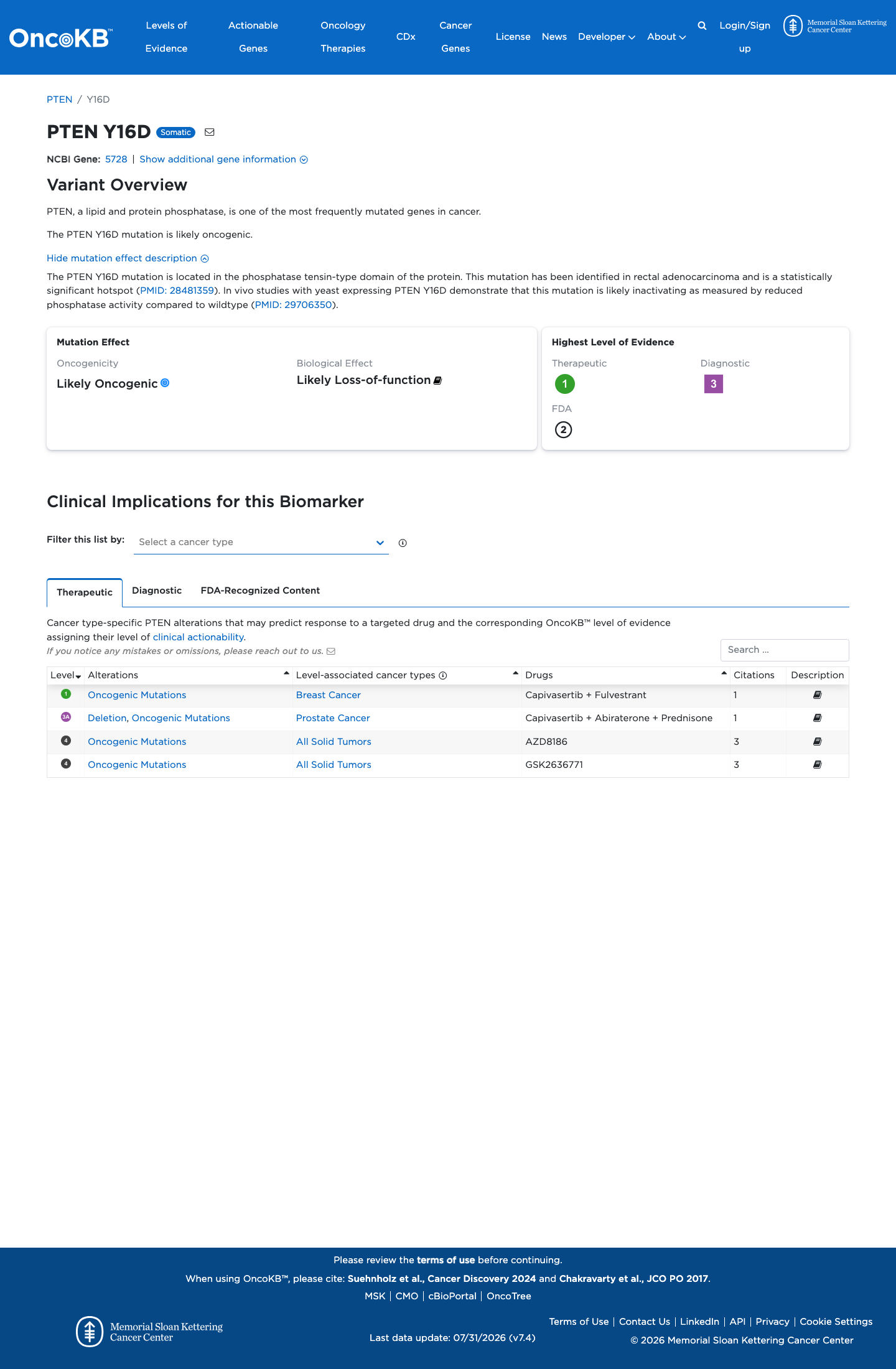
Functional / OncoKB screenshot
Functional Likely Oncogenic
OncoKB identified variant-specific curated literature and context relevant to functional review; biological-effect context: Likely Loss-of-function; curated oncogenicity label: Likely Oncogenic.
OncoKB ↗
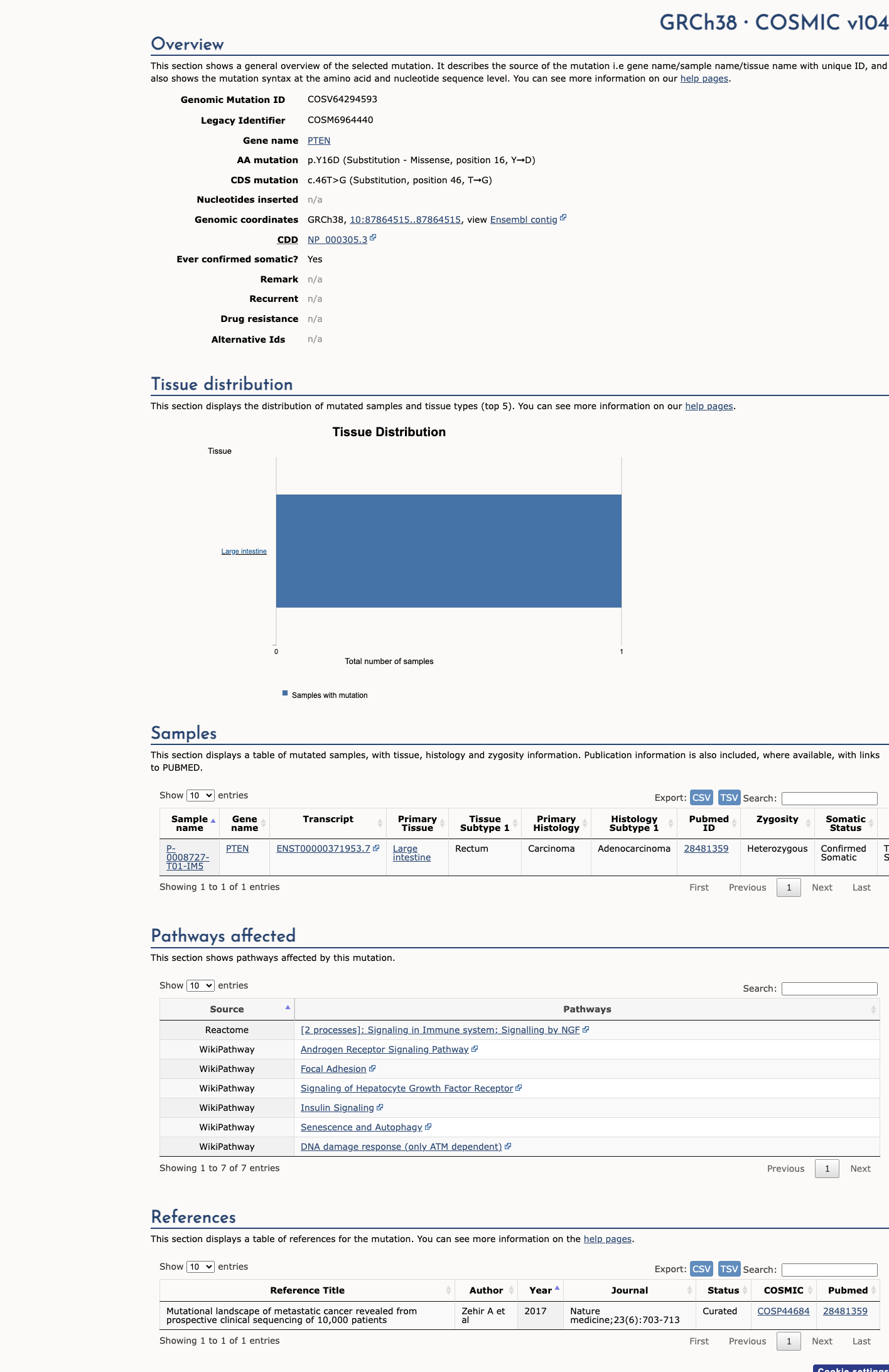
COSMIC screenshot
COSMIC
Cancer hotspots screenshot
Cancer hotspots
Somatic evidence Hotspot
COSMIC
This variant lies in a statistically significant hotspot. This variant has previously been reported in somatic cancers (COSMIC; COSV64294593, n = 1 times).
Hotspots
This variant lies in a statistically significant hotspot.
Literature · how each cited paper was used
2papers cited
Each card is an audit: what was searched, what was found, whether it names the variant, which criteria it fed, and why. 5 further PMIDs triaged but not cited — see Sources & References.
A Saturation Mutagenesis Approach to Understanding PTEN Lipid Phosphatase Activi
Searched
c.46T>Gp.Tyr16AspY16DTyr16
Found
Saturation mutagenesis functional assay of PTEN lipid phosphatase activity (Mighell et al. 2018). Full text was searched for the variant identifiers and no occurrence of c.46T>G or p.Tyr16Asp was found, so this paper does not provide variant-specific evidence relevant to PVS1, PM4, or BP3 (protein consequence/length-change criteria). It is primarily relevant to functional criteria (PS3/BS3) evaluated by other groups.
Variant
✓ Names this variant — characterised directly
Applied to
PS3 moderate
Y16D directly assayed with Cum_score -2.205 <= -1.11 (published lower 95th percentile of synonymous variants, Table 1 footnote c) and High_conf TRUE; meets PTEN VCEP PS3_moderate.
PP2 supporting
Gene-level evidence that PTEN has a low rate of benign missense variation (majority of assayed missense variants impair lipid phosphatase activity), supporting PP2 for this PTEN missense variant
Using a massively parallel approach that leverages an artificial humanized yeast model, we derived high-confidence estimates of functional impact for 7,244 single amino acid PTEN variants (86% of possible). We identified 2,273 mutations with reduced cellular lipid phosphatase activity, which includes 1,789 missense mutations.
Location Full text publications/29706350.txt - searched; variant identifiers c.46T>G / p.Tyr16Asp / Y16D absent  ·  Context Massively parallel saturation mutagenesis (Mighell et al. 2018, Am J Hum Genet) measuring PTEN lipid phosphatase activity (Cum_score) for all possible PTEN missense variants; VCEP mmc2.xlsx uses Cum_score <= -1.11 for PS3_Moderate.  ·  full text
Rule & framework references · cited for criterion definitions, not variant evidence
28481359 ↗ Mutational landscape of metastatic cancer revealed from prospective clinical seq
Sources & reference links
9Sources
CSpec VCEP
ClinVar
gnomAD v2.1
gnomAD v4.1
gnomAD-Canada
SpliceAI
OncoKB
COSMIC
Cancer hotspots
Triaged references · 5 PMIDs not cited in assessment
17392385 ↗ American Cancer Society guidelines for breast screening with MRI as an adjunct to mammography. CLINVAR
20301661 ↗ PTEN Hamartoma Tumor Syndrome. CLINVAR
23788249 ↗ ACMG recommendations for reporting of incidental findings in clinical exome and genome sequencing. CLINVAR
25645574 ↗ ACG clinical guideline: Genetic testing and management of hereditary gastrointestinal cancer syndromes. CLINVAR
26389333 ↗ Genetics of Skin Cancer (PDQ®): Health Professional Version. CLINVAR