Analysis in progress
Initialising…
0%
complete
This report is still being assembled — sections appear as each stage finishes. It isn't final yet.
PTEN
Final classification
VUS
PTEN c.209T>G · p.Leu70Arg
PTEN

PS3 (Moderate): Mighell 2018 saturation-mutagenesis cumulative fitness score -4.645 for p.Leu70Arg is far below the -1.11 threshold, indicating severe loss of lipid phosphatase activity.

Gene
PTEN
Transcript
NM_000314.8
HGVS · transcript:coding
NM_000314.8:c.209T>G
Consequence
N/A
GRCh38
chr10:87925557 T>G
GRCh37
chr10:89685314 T>G
Basis VUS: only 1 Moderate (PS3) and 2 Supporting (PM2, PP3) criteria are met, below every Pathogenic/Likely Pathogenic combination threshold, and no benign rule applies.
VUS: only 1 Moderate (PS3) and 2 Supporting (PM2, PP3) criteria are met, below every Pathogenic/Likely Pathogenic combination threshold, and no benign rule applies.
Classification rationale
PS3PM2PP3 VUS
PTEN c.209T>G

PS3 (Moderate): Mighell 2018 saturation-mutagenesis cumulative fitness score -4.645 for p.Leu70Arg is far below the -1.11 threshold, indicating severe loss of lipid phosphatase activity. PM2 (Supporting): variant is entirely absent (AF = 0) from gnomAD v2.1, v4.1, and gnomAD-Canada. PP3 (Supporting): REVEL 0.985 exceeds the VCEP cutoff of 0.7, predicting a deleterious missense effect. Overall: VUS - the combination of 1 Moderate (PS3) and 2 Supporting (PM2, PP3) criteria meets no PTEN VCEP Pathogenic/Likely Pathogenic rule, and no benign rule applies.

PS3 + PM2 + PP3 VUS
Gene diagram · NM_000314.8 · variants mapped to exon structure
PTEN NM_000314.8
Fetching transcript structure from UCSC…
Applied criteria · 3 applied · 17 assessed
Applied · 3
Strength Supporting Moderate Strong Very strong
PS3 moderate Pathogenic
Met (Moderate): Mighell 2018 saturation-mutagenesis assay gives cumulative fitness score -4.645, far below the -1.11 PS3_Moderate threshold, indicating severe loss of lipid phosphatase activity.
PTEN VCEP v3.2 PS3 rule (cspec doc 135637575): PS3_Moderate when 'Phosphatase activity ≤ -1.11 per Mighell et al. 2018, PMID: 29706350'.mmc2.xlsx Table S2 row L70R: Cum_score = -4.645, Cum_SE = 0.449, High_conf = True (Pass SE Filter), Imputed_score = NA (directly measured). Cum_score -4.645 ≤ -1.11, so the variant meets the VCEP PS3_Moderate threshold.PMID:29706350 Table 1 footnote c: 'Total < WT: less than wild-type; variants with scores less than or equal to −1.11, the lower 95th percentile (two-tailed) for synonymous variants.' Confirms score scale and threshold semantics.
PM2 supporting Pathogenic
Met (Supporting): variant is entirely absent (AF = 0) from gnomAD v2.1, v4.1, and gnomAD-Canada.
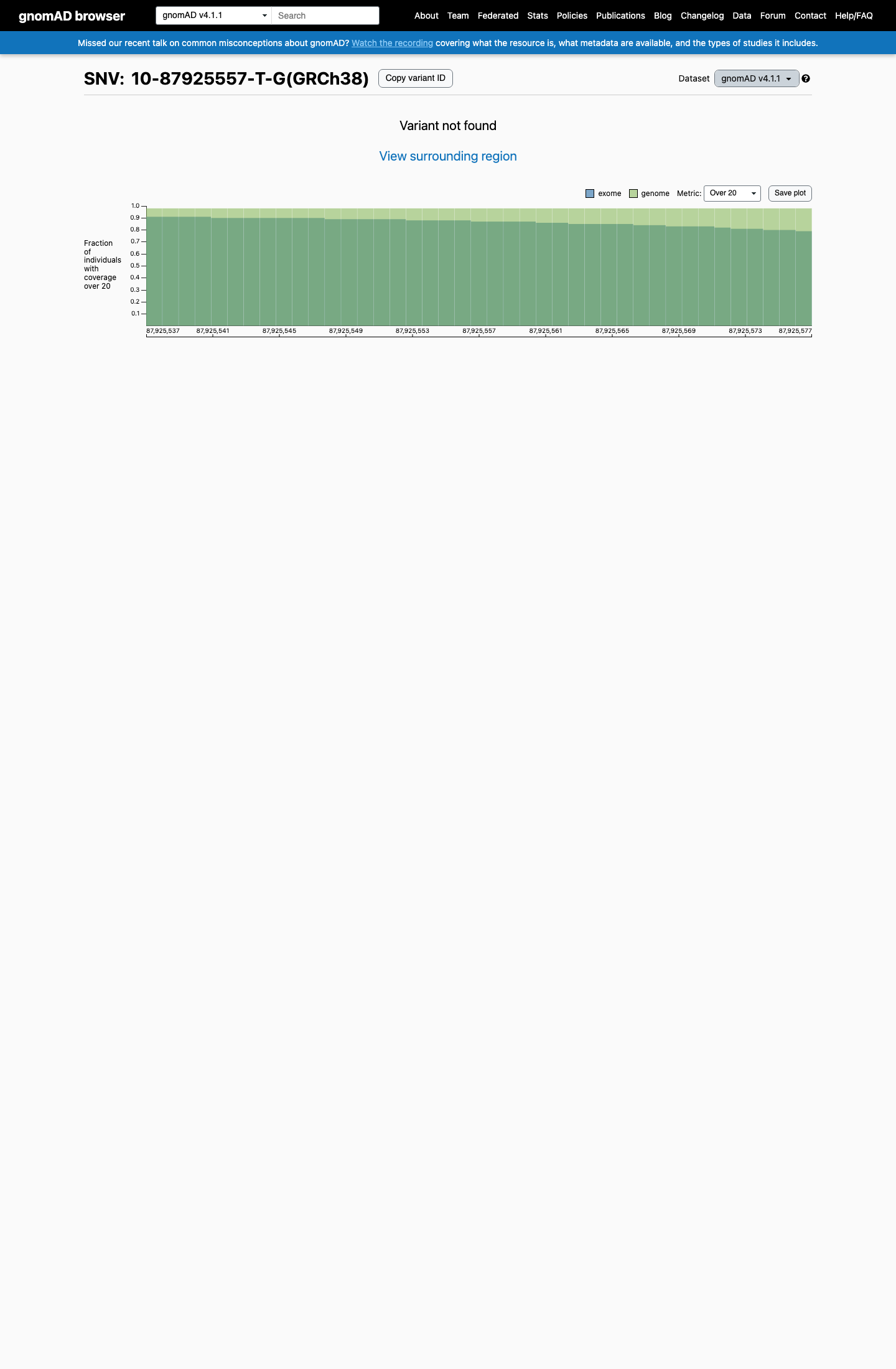
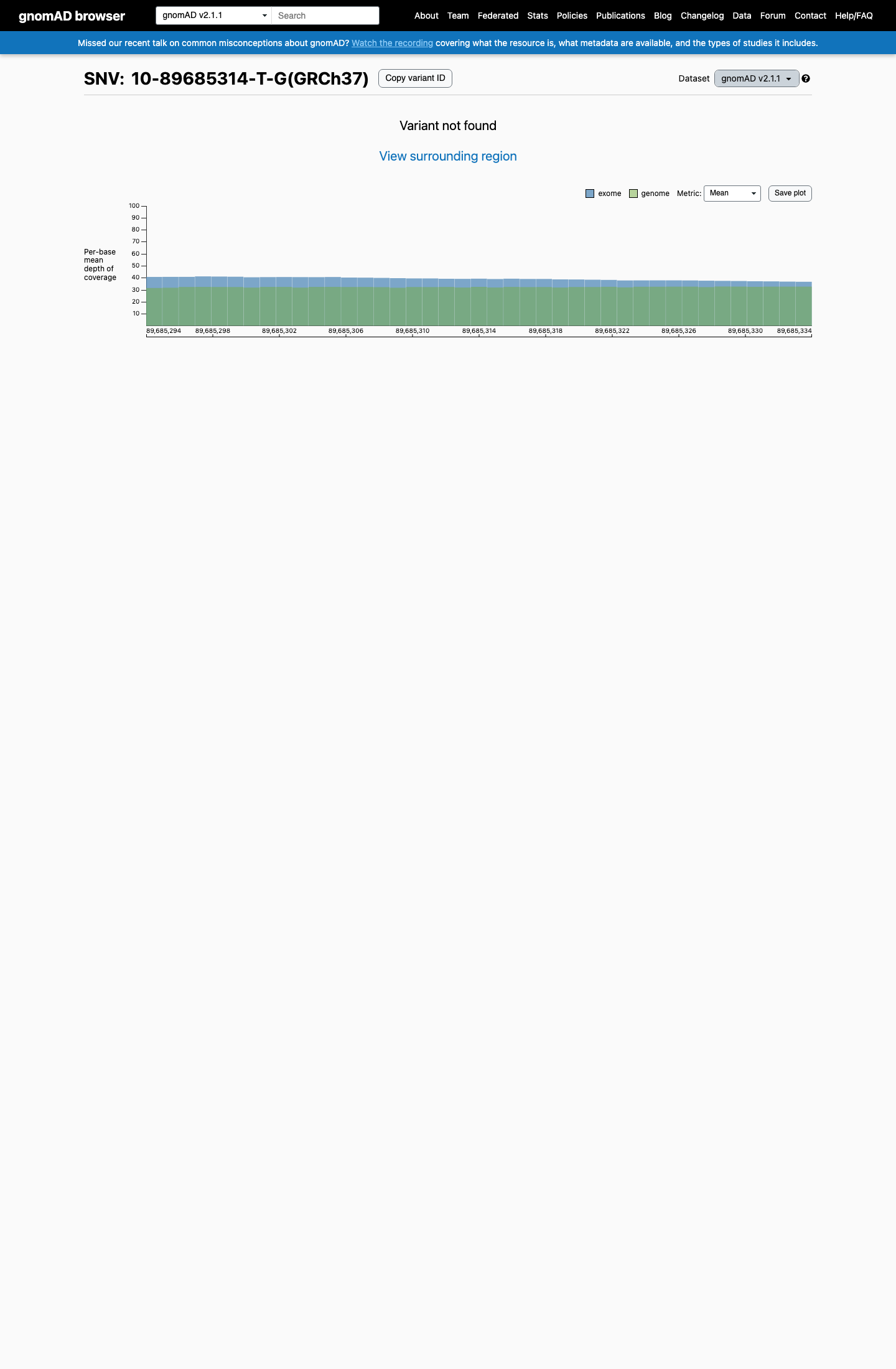
gnomAD v2.1 exome lookup (10-89685314-T-G, GRCh37): variant absent (AF = 0)gnomAD v4.1 exome lookup (chr10-87925557-T-G, GRCh38): variant absent (AF = 0)gnomAD-Canada v1.0 (HostSeq genomes) lookup: variant absent (AF = 0)
PP3 supporting Pathogenic
Met (Supporting): REVEL score 0.985 exceeds the VCEP cutoff of 0.7, strongly predicting a deleterious missense effect.
REVEL v1.3 local lookup (source_registry key 'revel'): REVEL score 0.985 for NM_000314.8:c.209T>G (p.Leu70Arg).ClinGen PTEN Expert Panel Specifications to the ACMG/AMP Variant Interpretation Guidelines for PTEN Version 3.2 (cspec doc 135637575): PP3 rule for missense variants = 'REVEL score > 0.7', default strength Pathogenic Supporting.Pejaver et al. 2022, Am J Hum Genet, PMID 36413997, Table 2: SVI-calibrated REVEL PP3_Strong threshold >= 0.965; score 0.985 exceeds it (corroborating only; VCEP strength applied).
Assessed · not applied
Pathogenic
PS1 Not assessed: insufficient evidence was available to determine whether p.Leu70Arg matches a known pathogenic variant at the same residue.
PS2 Not assessed: no confirmed or assumed de novo occurrence, parental testing, or family history data was documented.
PS4 Not assessed: no case-control study or proband phenotype/specificity scores were available.
PM1 Not assessed: insufficient evidence was available to evaluate whether Leu70 lies in a PM1-defined mutational hotspot.
PM5 Not assessed: insufficient evidence was available to determine whether a known pathogenic variant alters the same residue.
PM6 Not assessed: no assumed de novo occurrence or parental testing data was documented.
PP1 Not assessed: no co-segregation or meiosis data was available.
PP2 Not assessed: insufficient evidence was available to evaluate the gene's missense variation burden.
Benign
BA1 Not met: allele frequency is 0 in gnomAD, far below the >0.056% BA1 threshold.
BS1 Not met: allele frequency is 0 in gnomAD, below even the lowest 0.00043% BS1 band.
BS2 Not met: no homozygous observations exist - the variant is absent from gnomAD.
BS3 Not met: functional data show the opposite - a fitness score of -4.645 indicates severely reduced phosphatase activity, not >0 as BS3 requires.
BS4 Not assessed: no family data demonstrating lack of segregation was available.
BP1 Not assessed: insufficient evidence was available to evaluate the variant's frequency in affected individuals.
BP2 Not met: no trans or cis observations with a pathogenic PTEN variant were documented.
BP4 Not met: REVEL 0.985 is above the <0.5 BP4 threshold.
BP5 Not assessed: no cases with an alternate molecular basis for disease were documented.
N/A · 8 PVS1 · PM3 · PM4 · PP4 · PP5 · BP3 · BP6 · BP7
Research & evidence
Population frequency
gnomAD v4.1 screenshot
gnomAD v4.1
gnomAD v2.1 screenshot
gnomAD v2.1
v4.1
Absent from gnomAD v4.1.
v2.1
Absent from gnomAD v2.1.
🇨🇦 CA
Absent from gnomAD-Canada v1.0.
Allele frequency by ancestry
three datasets · side by side
gnomAD v4.1
Absent · 0 / ?
0 hom
Not observed in any ancestry group.
gnomAD v2.1
Absent · 0 / ?
0 hom
Not observed in any ancestry group.
gnomAD Canada 🇨🇦
Absent · 0 / ?
0 hom
Not observed in any ancestry group.
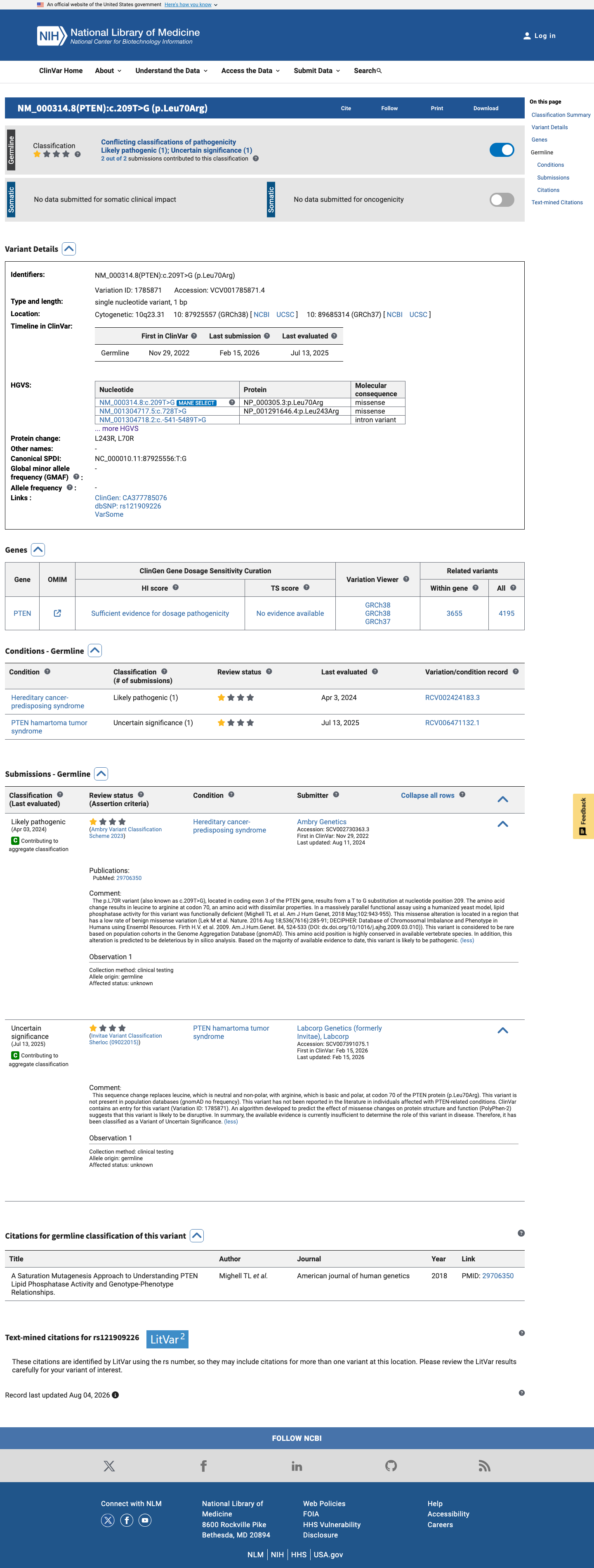
ClinVar screenshot
ClinVar
This variant has been reported in ClinVar as Likely pathogenic (1 clinical laboratory) and as Uncertain significance (1 clinical laboratory). (ClinVarID = 1785871)
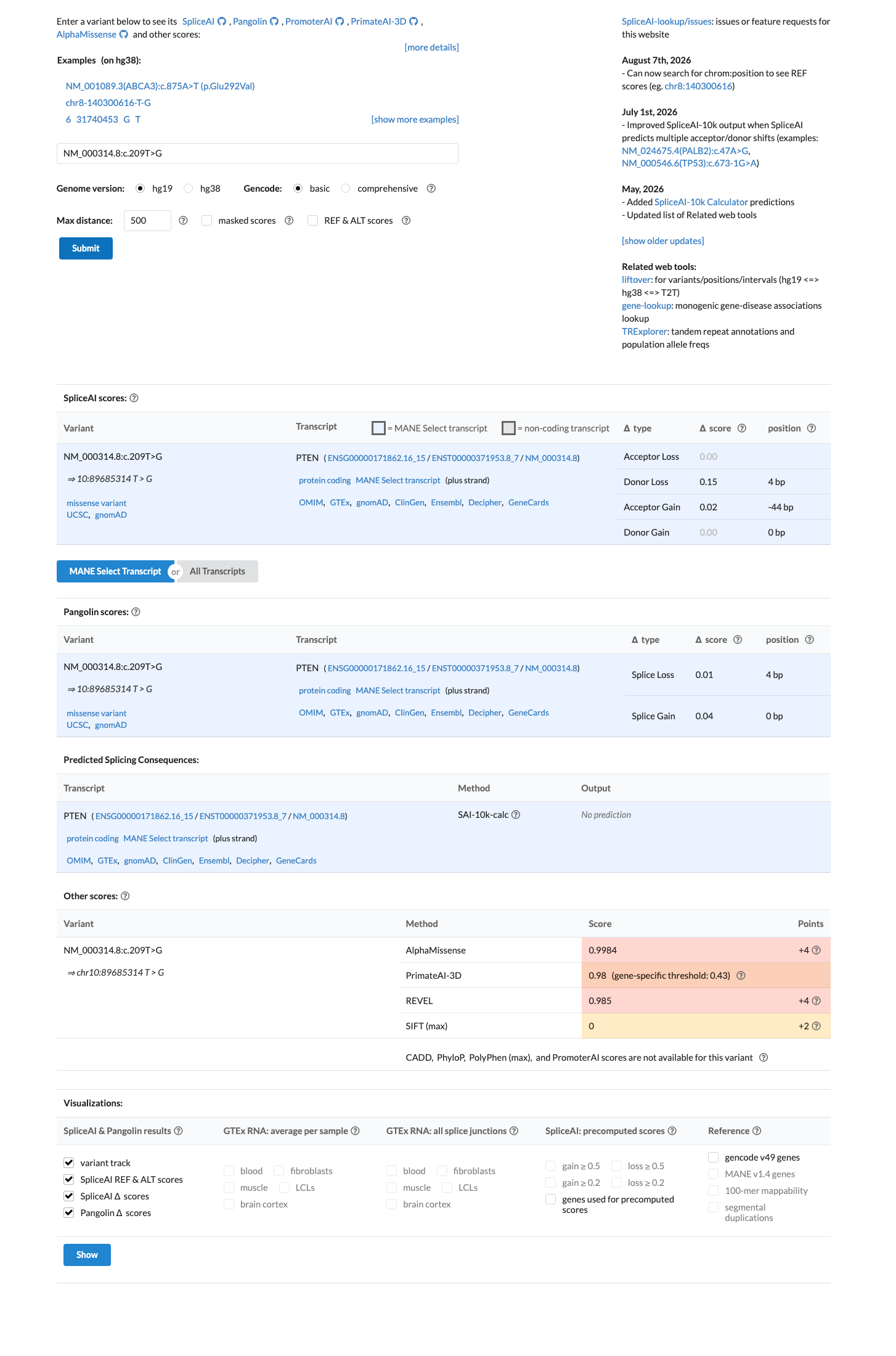
SpliceAI screenshot
In silico
SpliceAI predicts no significant splice impact for this variant (max delta score = 0.15). REVEL score = 0.985. BayesDel score = 0.595825.
Functional / OncoKB screenshot
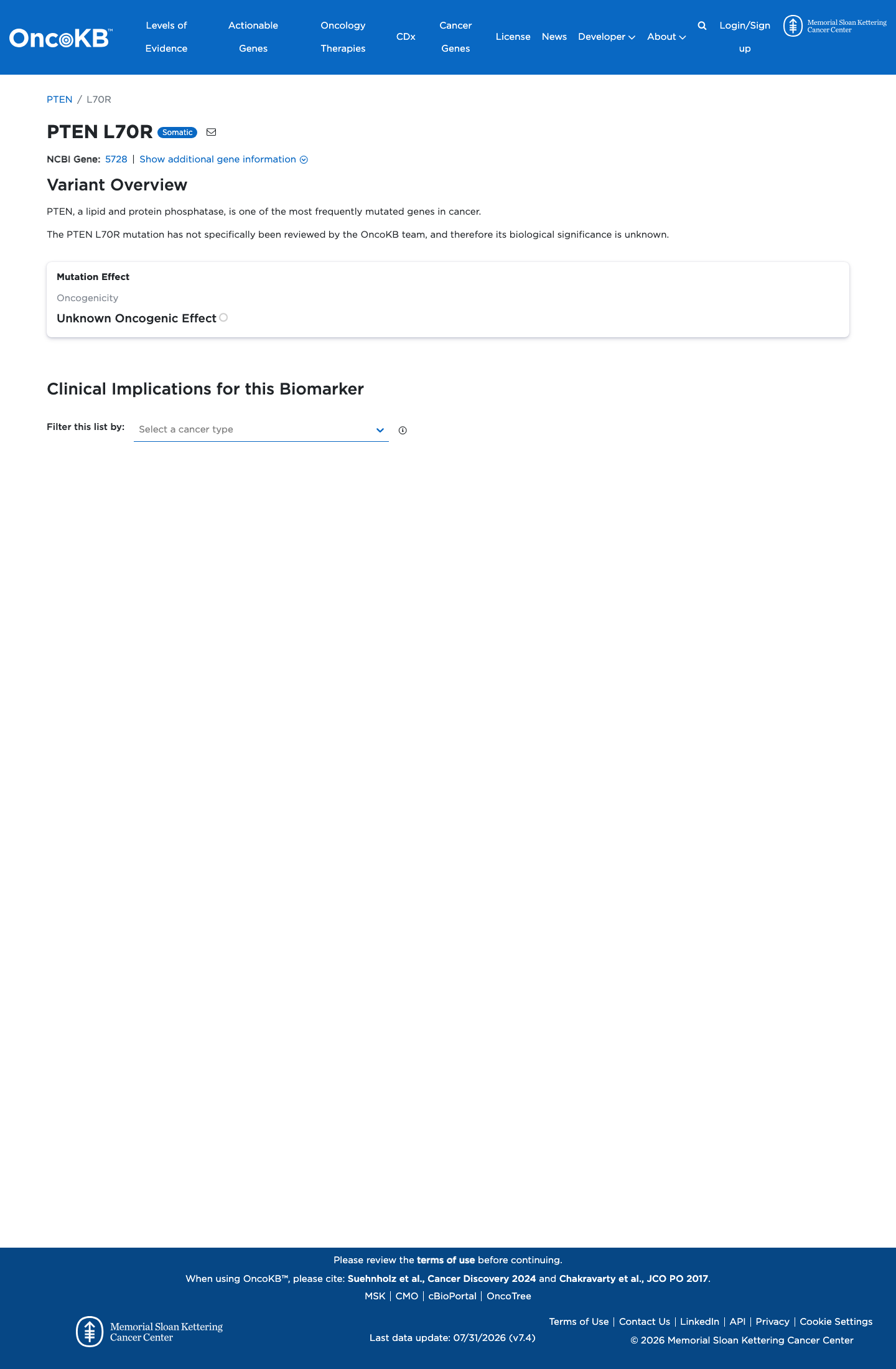
Functional Unknown Oncogenic Effect
OncoKB did not identify variant-specific reviewed functional evidence for this variant; gene-level curated context is available for reviewer follow-up. PTEN, a lipid and protein phosphatase, is one of the most frequently mutated genes in cancer.
OncoKB ↗
COSMIC screenshot
COSMIC
Cancer hotspots screenshot
Cancer hotspots
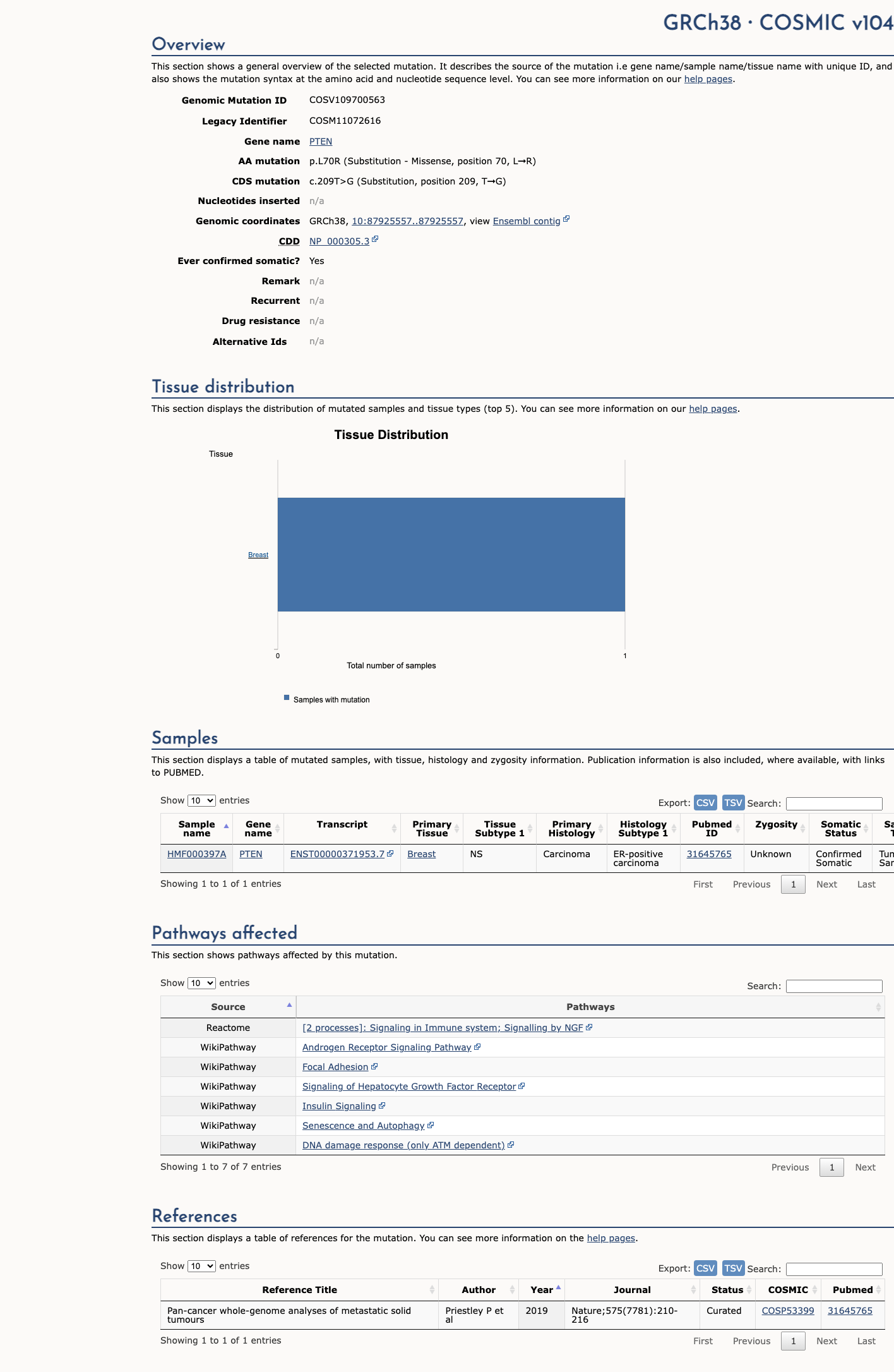
Somatic evidence Not in COSMIC / hotspots
COSMIC
This variant does not lie in a statistically significant hotspot. This variant has previously been reported in somatic cancers (COSMIC; COSV109700563, n = 1 times).
Hotspots
This variant does not lie in a statistically significant hotspot.
Literature · how each cited paper was used
1papers cited
Each card is an audit: what was searched, what was found, whether it names the variant, which criteria it fed, and why. 6 further PMIDs triaged but not cited — see Sources & References.
Rule & framework references · cited for criterion definitions, not variant evidence
29706350 ↗ A Saturation Mutagenesis Approach to Understanding PTEN Lipid Phosphatase Activity and Genotype-Phenotype Relationships.
Sources & reference links
9Sources
CSpec VCEP
ClinVar
gnomAD v2.1
gnomAD v4.1
gnomAD-Canada
SpliceAI
OncoKB
COSMIC
Cancer hotspots
Triaged references · 6 PMIDs not cited in assessment
17392385 ↗ American Cancer Society guidelines for breast screening with MRI as an adjunct to mammography. CLINVAR
20301661 ↗ PTEN Hamartoma Tumor Syndrome. CLINVAR
25394175 ↗ A practice guideline from the American College of Medical Genetics and Genomics CLINVAR
25645574 ↗ ACG clinical guideline: Genetic testing and management of hereditary gastrointestinal cancer syndromes. CLINVAR
26389333 ↗ Genetics of Skin Cancer (PDQ®): Health Professional Version. CLINVAR
28492532 ↗ Sherloc: a comprehensive refinement of the ACMG-AMP variant classification crite CLINVAR