Analysis in progress
Initialising…
0%
complete
This report is still being assembled — sections appear as each stage finishes. It isn't final yet.
POLE
Final classification
VUS
POLE c.2284C>T · p.Arg762Trp
POLE

PM2 (Supporting): gnomAD allele frequency 0.0008% (v2.1) and 0.00043% (v4.1) with zero homozygotes, well below the 0.1% population-frequency threshold.

Gene
POLE
Transcript
NM_006231.4
HGVS · transcript:coding
NM_006231.4:c.2284C>T
Consequence
N/A
GRCh38
chr12:132667538 G>A
GRCh37
chr12:133244124 G>A
Basis VUS: only PM2 (Supporting) is met - gnomAD allele frequency 0.0008% (v2.1) with zero homozygotes - and that satisfies no pathogenic, likely-pathogenic, or benign combination under the ACMG/AMP 2015 rules. Flagged for human review: an unverifiable functional-study assertion and an incomplete same-residue variant search could change the call.
VUS: only PM2 (Supporting) is met - gnomAD allele frequency 0.0008% (v2.1) with zero homozygotes - and that satisfies no pathogenic, likely-pathogenic, or benign combination under the ACMG/AMP 2015 rules. Flagged for human review: an unverifiable functional-study assertion and an incomplete same-residue variant search could change the call.
Classification rationale
PM2 VUS
POLE c.2284C>T

PM2 (Supporting): gnomAD allele frequency 0.0008% (v2.1) and 0.00043% (v4.1) with zero homozygotes, well below the 0.1% population-frequency threshold. With only PM2 (Supporting) met, no ACMG/AMP 2015 pathogenic, likely-pathogenic, or benign combination is satisfied, yielding Uncertain Significance (VUS).

PM2 VUS
Gene diagram · NM_006231.4 · variants mapped to exon structure
POLE NM_006231.4
Fetching transcript structure from UCSC…
Applied criteria · 1 applied · 23 assessed
Applied · 1
Strength Supporting Moderate Strong Very strong
PM2 supporting Pathogenic
Met (Supporting): gnomAD allele frequency 0.0008% (v2.1) and 0.00043% (v4.1) with zero homozygotes, below the 0.1% PM2 threshold.
gnomAD v2.1 AF 7.95469e-06 (0.0008%, 2/251,424, 0 homozygotes) - below the PM2 threshold of AF <0.1% for non-VCEP gnomAD (maximum credible AF framework, Whiffin et al. 2017, PMID 28518168; PM2 'absent/extremely low frequency' definition, Richards et al. 2015, PMID 25741868)gnomAD v4.1 AF 4.33737e-06 (0.00043%, 7/1,613,882, 0 homozygotes), grpmax FAF 1.83e-06 (0.00018%) - below the PM2 threshold of AF <0.1% (Whiffin et al. 2017, PMID 28518168; Richards et al. 2015, PMID 25741868)PM2 applied at Supporting strength per ClinGen SVI general recommendation weighting PM2 as supporting evidence, consistent with the Bayesian calibration of ACMG/AMP criterion weights (Tavtigian et al. 2018, PMID 29565419)
Assessed · not applied
Pathogenic
PS1 Not met: no source establishes any Arg762 substitution as pathogenic, and no alternative nucleotide change at this codon produces Trp.
PS2 Not assessed: no proband-parent trio or de novo occurrence data were available.
PS3 Not assessed: no functional assay evidence for this variant was available.
PS4 Not met: the variant is absent from the framework's recurrent-variant table and has only a single somatic COSMIC occurrence (n=1), which is not recurrence.
PM1 Not met: Arg762 lies outside the framework's exonuclease-domain hotspot region (residues 286-459) and in none of its hotspot lists.
PM3 Not assessed: no phase, pedigree, or proband genotype data were available to evaluate a trans arrangement.
PM5 Not assessed: no pathogenic comparator missense at Arg762 was identified; the required same-residue survey is pending human review.
PM6 Not assessed: no evidence of a de novo occurrence, with or without confirmed parentage, was available.
PP1 Not assessed: no family segregation data were available.
PP2 Not assessed: no gene-level missense constraint metric (e.g., gnomAD Z-score) was available to establish a low rate of benign missense variation.
PP3 Not met: REVEL 0.552 falls in the indeterminate range (PP3 requires >=0.932), and SpliceAI max delta 0.00 shows no splice impact.
PP4 Not assessed: no proband phenotype or family-history data were available to establish phenotype specificity.
PP5 Not met: ClinVar lists only Uncertain significance from three clinical laboratories, with no expert-panel pathogenic classification.
Benign
BA1 Not met: the highest observed allele frequency is 0.00327%, versus the >1% BA1 threshold.
BS1 Not met: the highest allele frequency, 0.00327%, is about 100-fold below the >0.3% BS1 threshold.
BS2 Not met: no homozygotes and only 7 ultra-rare heterozygous carriers in 1.6 million gnomAD alleles, contrary to BS2's expected healthy-adult enrichment.
BS3 Not assessed: no functional assay evidence showing a lack of damaging effect was available.
BS4 Not assessed: no segregation data were available to test for lack of segregation in affected family members.
BP1 Not met: POLE disease is driven by missense rather than truncating variants, so a missense change cannot receive BP1.
BP2 Not assessed: no phase data relative to another variant were available.
BP4 Not met: REVEL 0.552 is far above the <=0.016 BP4 threshold, and SpliceAI shows no splice impact.
BP5 Not assessed: no case-level data on an alternate molecular basis of disease were available.
BP6 Not met: no expert-panel Benign/Likely benign classification exists; ClinVar shows only Uncertain significance.
N/A · 4 PVS1 · PM4 · BP3 · BP7
Research & evidence
Population frequency
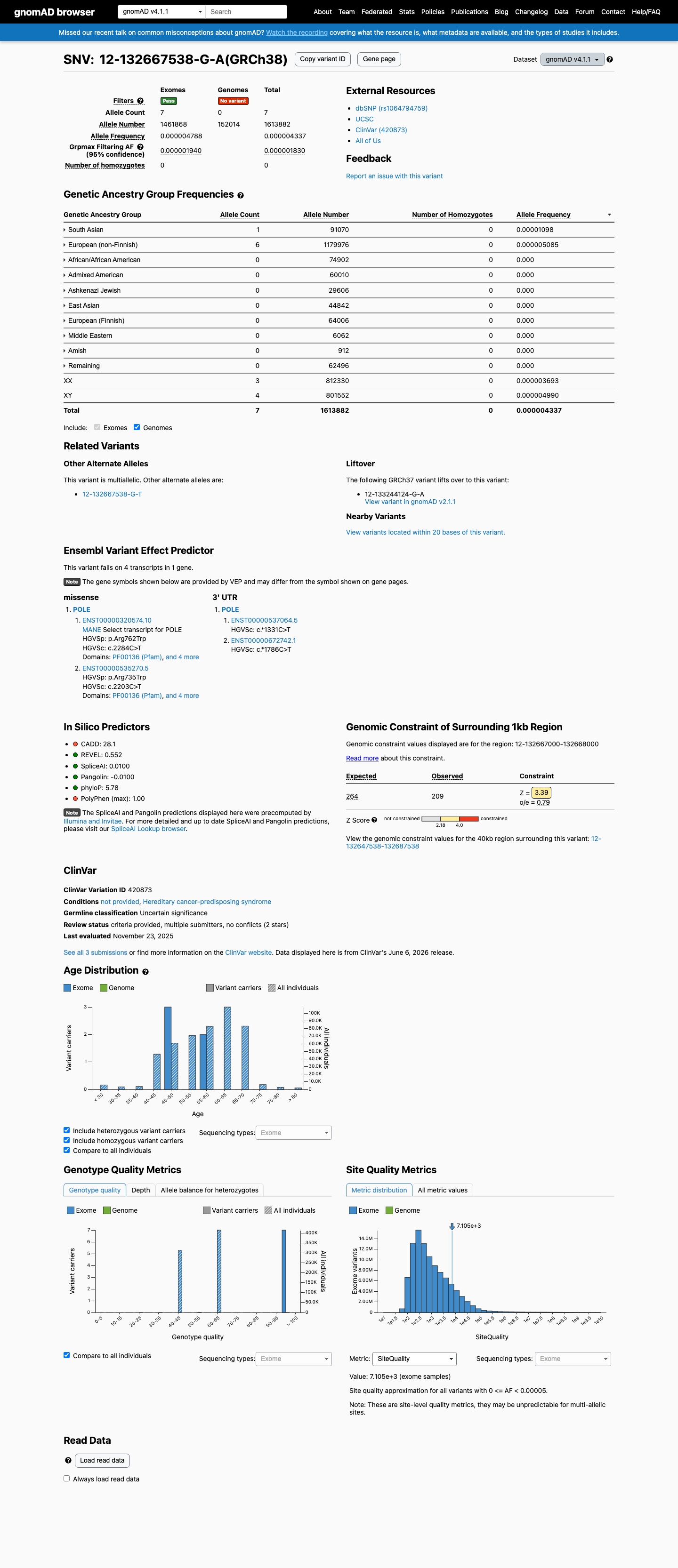
gnomAD v4.1 screenshot
gnomAD v4.1
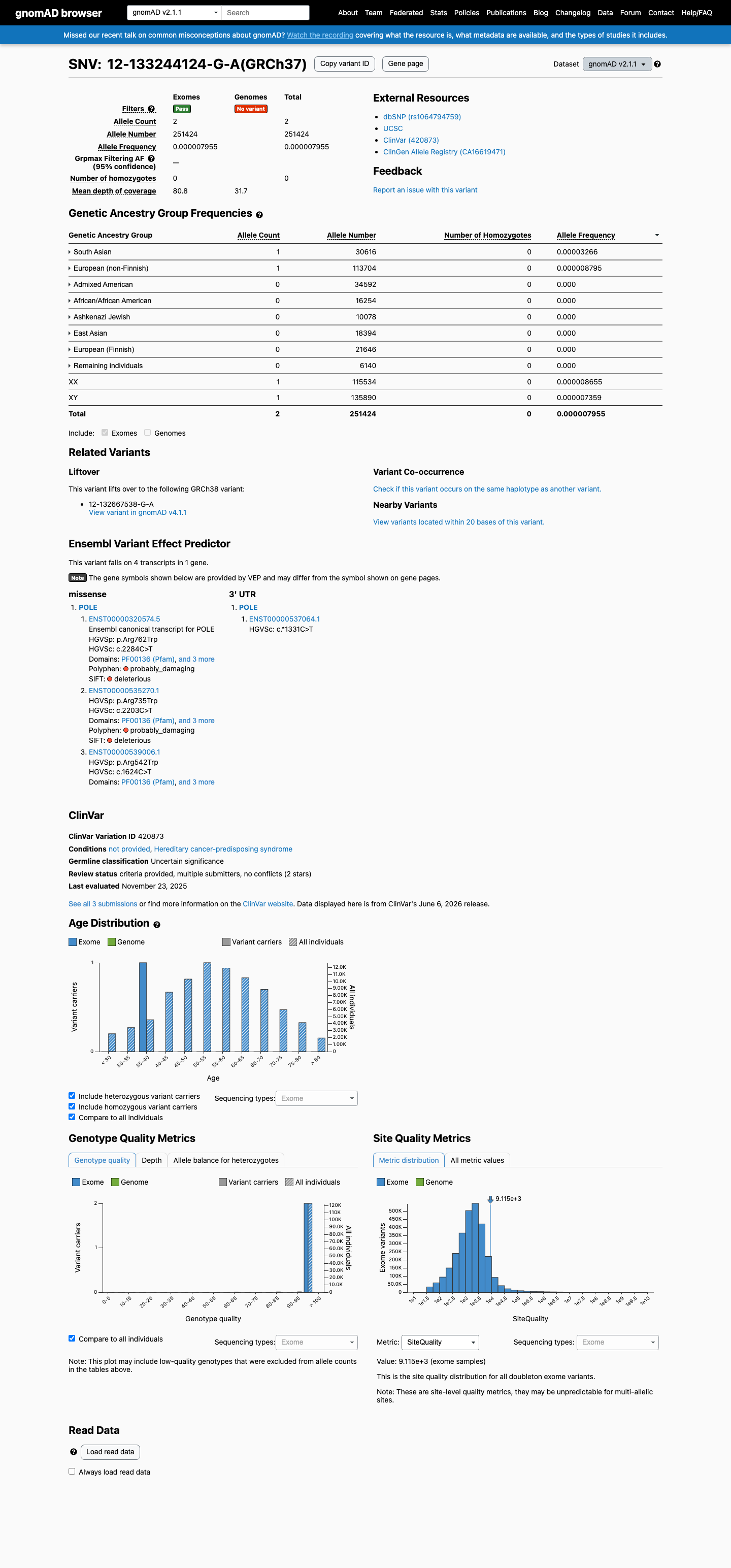
gnomAD v2.1 screenshot
gnomAD v2.1
v4.1
This variant is present in gnomAD v4.1 (AF= 4.33737e-06; MAF= 0.00043%, 7/1613882 alleles, homozygotes = 0) and has highest observed frequency in the South Asian population (AF= 1.09806e-05; MAF= 0.00110%, 1/91070 alleles, homozygotes = 0); grpmax FAF= 1.83e-06.
v2.1
This variant is present in gnomAD v2.1 (AF= 7.95469e-06; MAF= 0.00080%, 2/251424 alleles, homozygotes = 0) and has highest observed frequency in the South Asian population (AF= 3.26627e-05; MAF= 0.00327%, 1/30616 alleles, homozygotes = 0).
🇨🇦 CA
Absent from gnomAD-Canada v1.0.
Allele frequency by ancestry
three datasets · side by side
gnomAD v4.1
0.00043% · 7 / 1,613,882
0 hom · FAF 0.00018%
South Asian
1 / 91,070
0.0011%
European (non-Finnish)
6 / 1,179,976
0.00051%
+ 8 not observed (Remaining individuals, Admixed American, European (Finnish), Amish, East Asian, Middle Eastern, Ashkenazi Jewish, African/African American)
gnomAD v2.1
0.0008% · 2 / 251,424
0 hom
South Asian
1 / 30,616
0.0033%
European (non-Finnish)
1 / 113,704
0.00088%
+ 6 not observed (African/African American, Admixed American, Ashkenazi Jewish, East Asian, European (Finnish), Remaining individuals)
gnomAD Canada 🇨🇦
Absent · 0 / ?
0 hom
Not observed in any ancestry group.
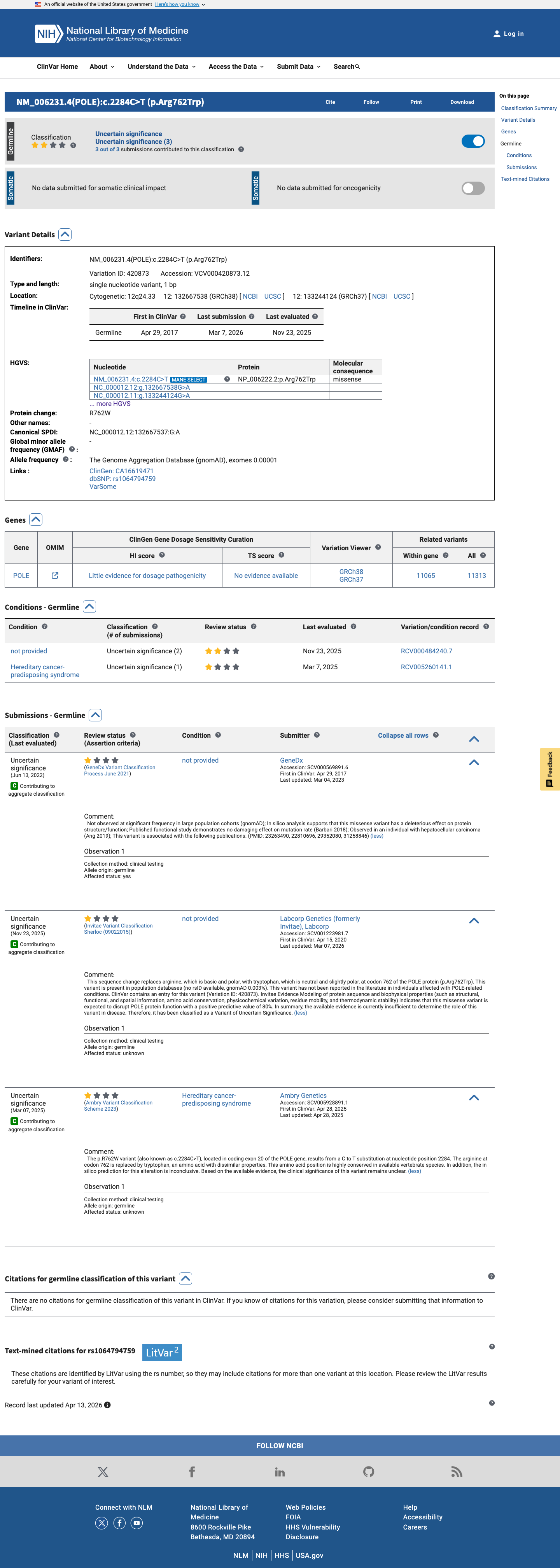
ClinVar screenshot
ClinVar
This variant has been reported in ClinVar as Uncertain significance (3 clinical laboratories). (ClinVarID = 420873)
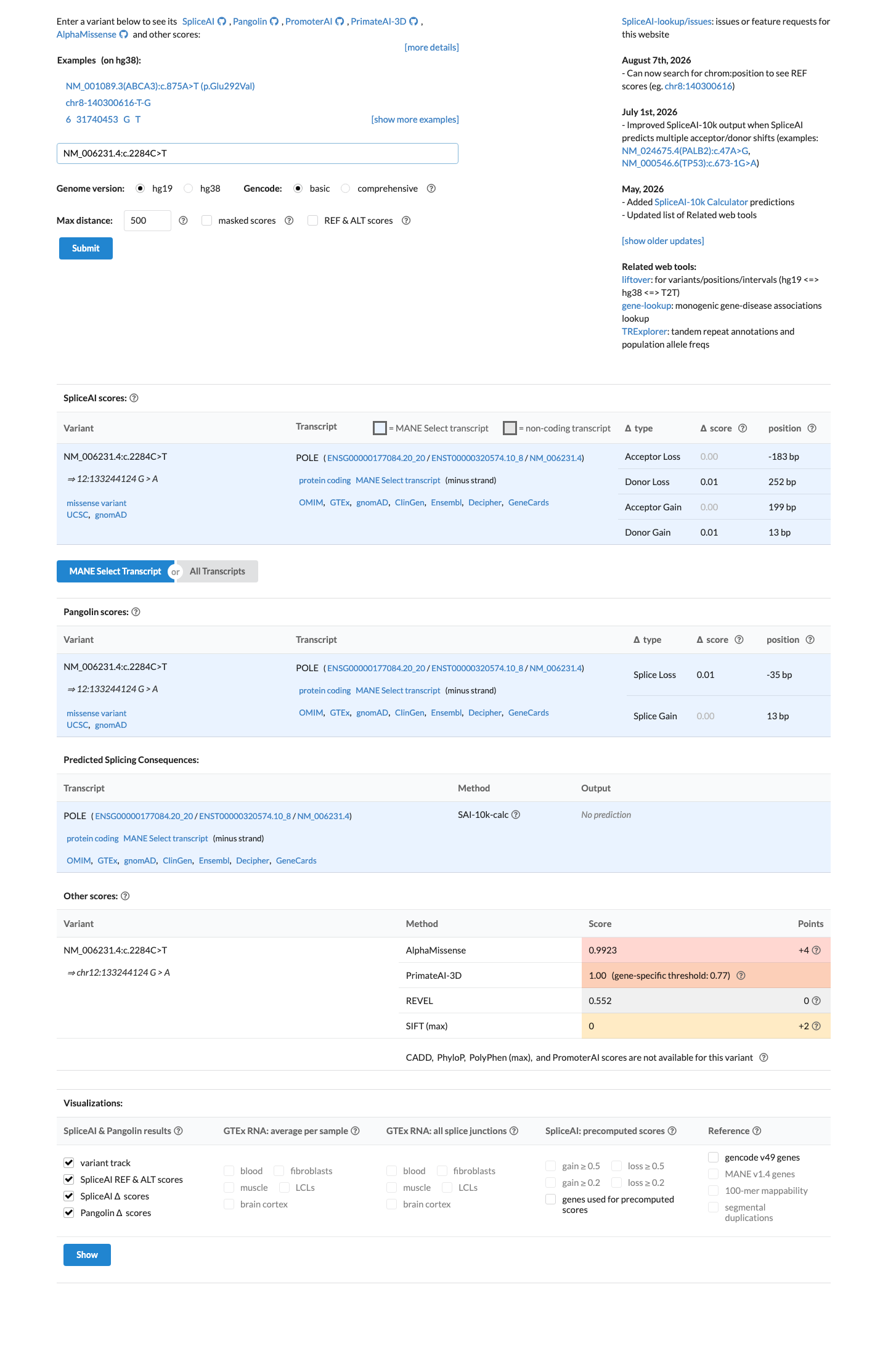
SpliceAI screenshot
In silico
SpliceAI predicts no significant splice impact for this variant (max delta score = 0.00). REVEL score = 0.552. BayesDel score = 0.0522946.
Functional / OncoKB screenshot
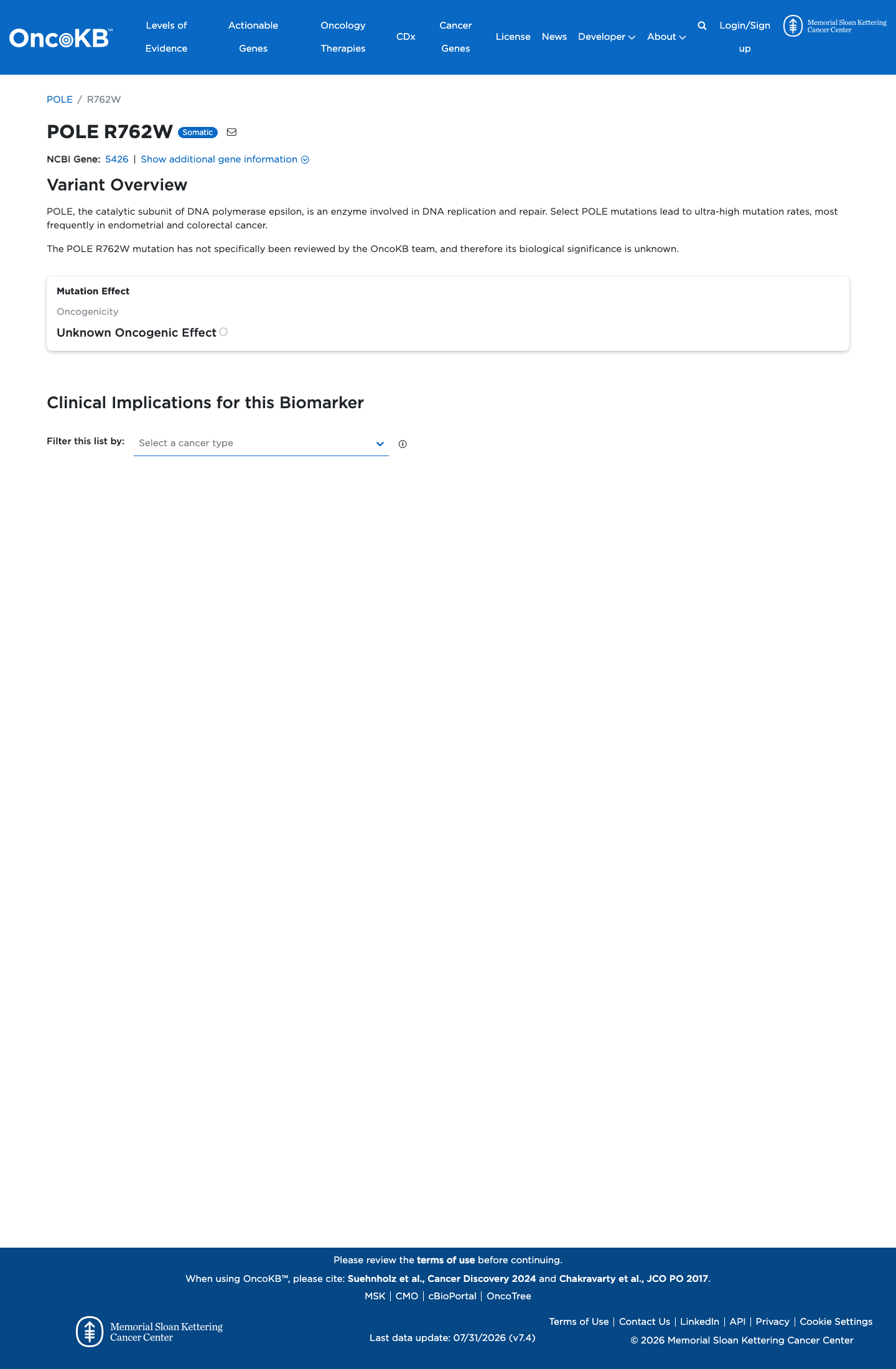
Functional Unknown Oncogenic Effect
OncoKB did not identify variant-specific reviewed functional evidence for this variant; gene-level curated context is available for reviewer follow-up. POLE, the catalytic subunit of DNA polymerase epsilon, is an enzyme involved in DNA replication and repair. Select POLE mutations lead to ultra-high m
OncoKB ↗
COSMIC screenshot
COSMIC
Cancer hotspots screenshot
Cancer hotspots
Somatic evidence Not in COSMIC / hotspots
COSMIC
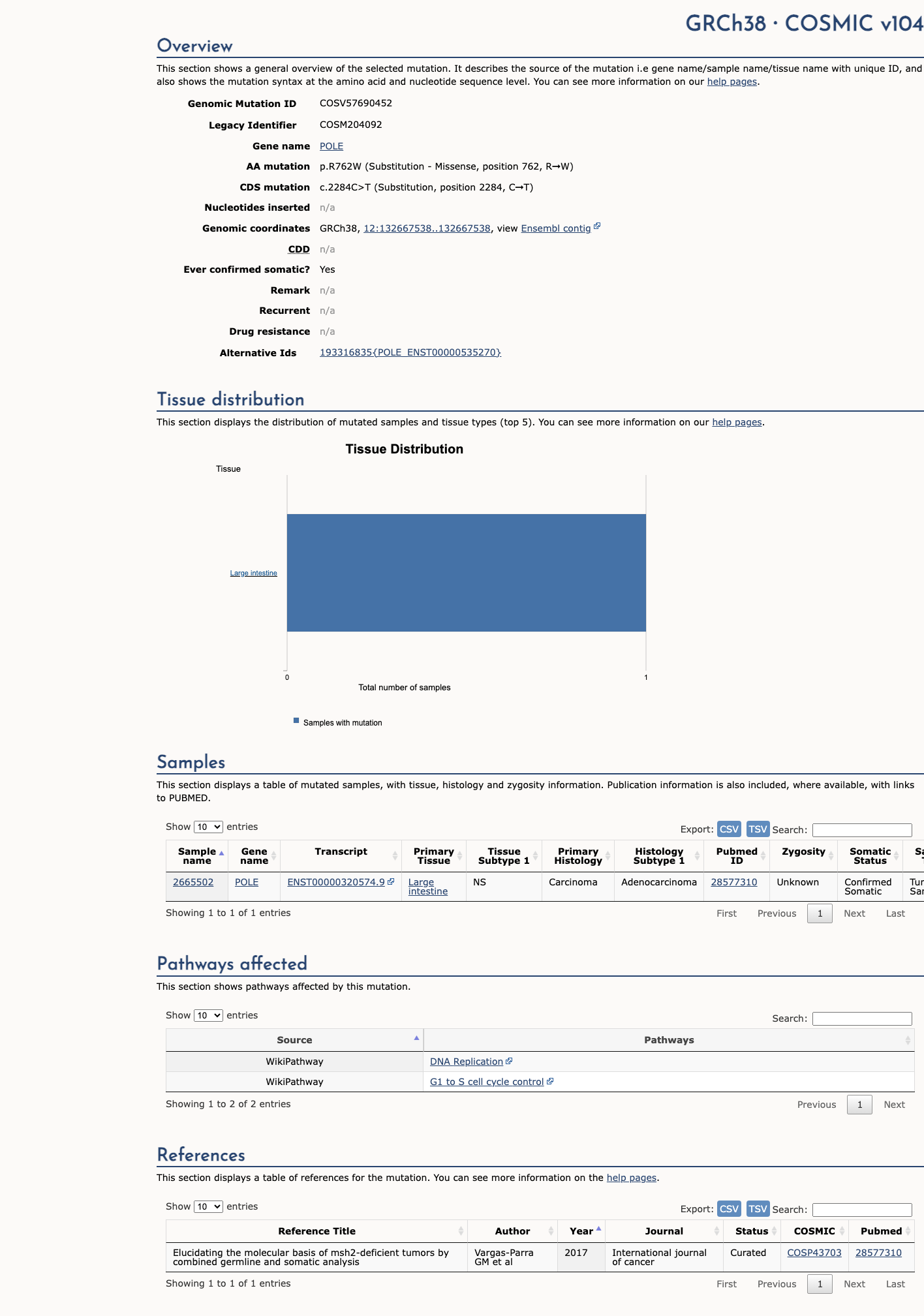
This variant does not lie in a statistically significant hotspot. This variant has previously been reported in somatic cancers (COSMIC; COSV57690452, n = 1 times).
Hotspots
This variant does not lie in a statistically significant hotspot.
Sources & reference links
8Sources
ClinVar
gnomAD v2.1
gnomAD v4.1
gnomAD-Canada
SpliceAI
OncoKB
COSMIC
Cancer hotspots
Triaged references · 2 PMIDs not cited in assessment
25394175 ↗ A practice guideline from the American College of Medical Genetics and Genomics and the National Society of Genetic Counselors: referral indications for cancer predisposition assessment. CLINVAR
28492532 ↗ Sherloc: a comprehensive refinement of the ACMG-AMP variant classification criteria. CLINVAR