Back
NM_002944.2:c.6068A>T
p.Tyr2023Phe · ROS1
ACMG/AMP
0%
complete
Final classification
VUS
PM2
ROS1
c.6068A>T
p.Tyr2023Phe
missense

ROS1 encodes a transmembrane receptor protein with intracellular tyrosine kinase activity, belonging to the sevenless subfamily of tyrosine kinase insulin receptor genes. It is a proto-oncogene highly expressed in a variety of tumor cell lines and may normally function as a growth or differentiation factor receptor, though its physiological role and ligand in humans are not yet known. ROS1 gene rearrangements that retain the kinase domain are implicated in several human epithelial cancers, most commonly non-small cell lung cancer, as well as cholangiocarcinoma, ovarian carcinoma, gastric carcinoma, and angiosarcoma, and are thought to drive tumor development through constitutive kinase activation.

This variant

ROS1 is a proto-oncogene whose kinase-domain rearrangements drive several cancers, most commonly non-small cell lung cancer. This missense variant (p.Tyr2023Phe), located in the tyrosine kinase region, is absent from population databases and has no reported clinical or functional evidence, so its contribution to ROS1-related cancer risk is currently uncertain (VUS).

Transcript
NM_002944.2
HGVS · transcript:coding
NM_002944.2:c.6068A>T
GRCh38
chr6:117317210 T>A
GRCh37
chr6:117638373 T>A
VUS: with no ROS1 CSPEC/VCEP, the generic ACMG/AMP 2015 framework applies; the only met criterion, PM2 (Supporting, AF = 0 in gnomAD v2.1, v4.1, and gnomAD-Canada v1.0), satisfies no combination rule.
Classification rationale
PM2 VUS
ROS1 c.6068A>T missense

PM2 (Supporting): absent (AF = 0) from gnomAD v2.1 exomes, gnomAD v4.1 exomes, and gnomAD-Canada v1.0 genomes, three independent population datasets. VUS: a single Supporting PM2 satisfies no ACMG/AMP 2015 combination rule for Pathogenic, Likely Pathogenic, Benign, or Likely Benign.

PM2 → VUS
LYFE Sciences is an AI system, and it can make mistakes. Criteria may be applied incorrectly, sources may be misread, and a confident-looking classification can still be wrong. Double-check every criterion and its underlying evidence before relying on any call.
Gene diagram · NM_002944.2 · variants mapped to exon structure
ROS1 NM_002944.2
Fetching transcript structure from UCSC…
Applied criteria · 1 applied · 22 assessed
MetEvidence satisfies this criterion.
Not metEvaluated against available evidence; threshold not reached.
Not assessedApplies in principle, but no evidence was found to evaluate it.
N/ADoesn't apply to this variant type.
Applied · 1
Strength Supporting Moderate Strong Very strong
PM2 supporting Pathogenic
Met (Supporting): absent (AF = 0) from gnomAD v2.1, gnomAD v4.1, and gnomAD-Canada v1.0, three independent population datasets. Per-position coverage at this site could not be independently verified.
gnomAD v2.1 variant page 6-117638373-T-A: absent (search_status 'absent')gnomAD v4.1 variant page 6-117317210-T-A: absent (search_status 'absent')gnomAD-Canada v1.0 (HostSeq genomes) API lookup 6-117317210-T-A: absent
Assessed · not applied · 9 not met · 13 not assessed
Pathogenic
PS1 Not assessed: no ClinVar record or literature reports exist, so no same-amino-acid pathogenic comparator (p.Tyr2023Phe) was available.
PS2 Not assessed: no proband phenotype, family history, or parental genotyping data were available to evaluate a de novo origin.
PS3 Not assessed: no functional studies exist for this variant; OncoKB reports unknown oncogenic effect.
PS4 Not assessed: no case-control or cohort allele-frequency comparison exists for this variant.
PM1 Not met: no statistically significant hotspot at ROS1 Y2023, and no curated ROS1 domain map supports this position.
PM5 Not assessed: no pathogenic variant at the same residue (p.Tyr2023) was identified for comparison.
PM6 Not assessed: no de novo occurrence or parental testing results were reported for this variant.
PP1 Not assessed: no pedigree or family segregation data exist for this variant.
PP2 Not assessed: no ROS1 missense-constraint data (e.g., gnomAD Z-score) were available.
PP3 Not met: SpliceAI max delta 0.01 predicts no splice impact, and REVEL 0.52 is uninformative (below 0.773, above 0.016).
PP4 Not assessed: no carrier phenotype or clinical case description was available for this variant.
PP5 Not met: this variant has no ClinVar record, so no expert-panel pathogenic classification exists to support PP5.
Benign
BA1 Not met: allele frequency is 0 in all queried population databases, far below the >5% BA1 threshold.
BS1 Not met: absent (AF = 0) from population databases, so the frequency cannot exceed any disease-consistent threshold.
BS2 Not met: no healthy-adult carriers of this variant were observed in any population cohort.
BS3 Not assessed: no functional studies demonstrating a benign effect on protein function or splicing exist.
BS4 Not assessed: no family segregation testing data exist for this variant.
BP1 Not met: ROS1 disease is not limited to truncating variants; non-truncating alterations are disease-relevant.
BP2 Not assessed: no allele-phase (trans/cis) observation with a pathogenic variant exists for this variant.
BP4 Not met: only SpliceAI (max delta 0.01) supports no impact, and REVEL 0.52 is uninformative, so the multiple-lines requirement fails.
BP5 Not assessed: no proband-level data exist to evaluate an alternative molecular basis for disease.
BP6 Not met: this variant has no ClinVar record, so no expert-panel benign classification exists to support BP6.
N/A · 5 PVS1 · PM3 · PM4 · BP3 · BP7
Research & evidence
Population frequency
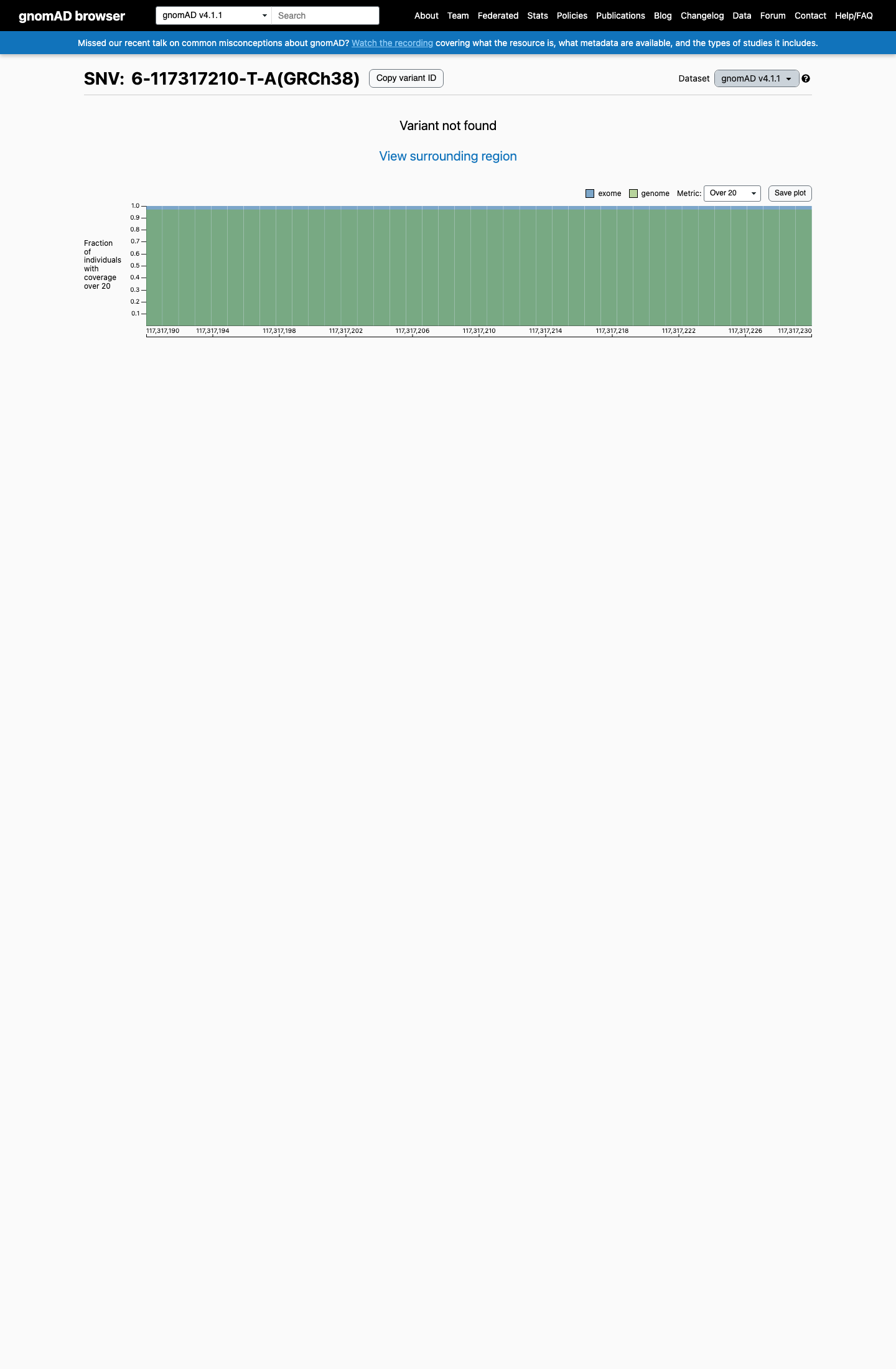
gnomAD v4.1 screenshot
gnomAD v4.1
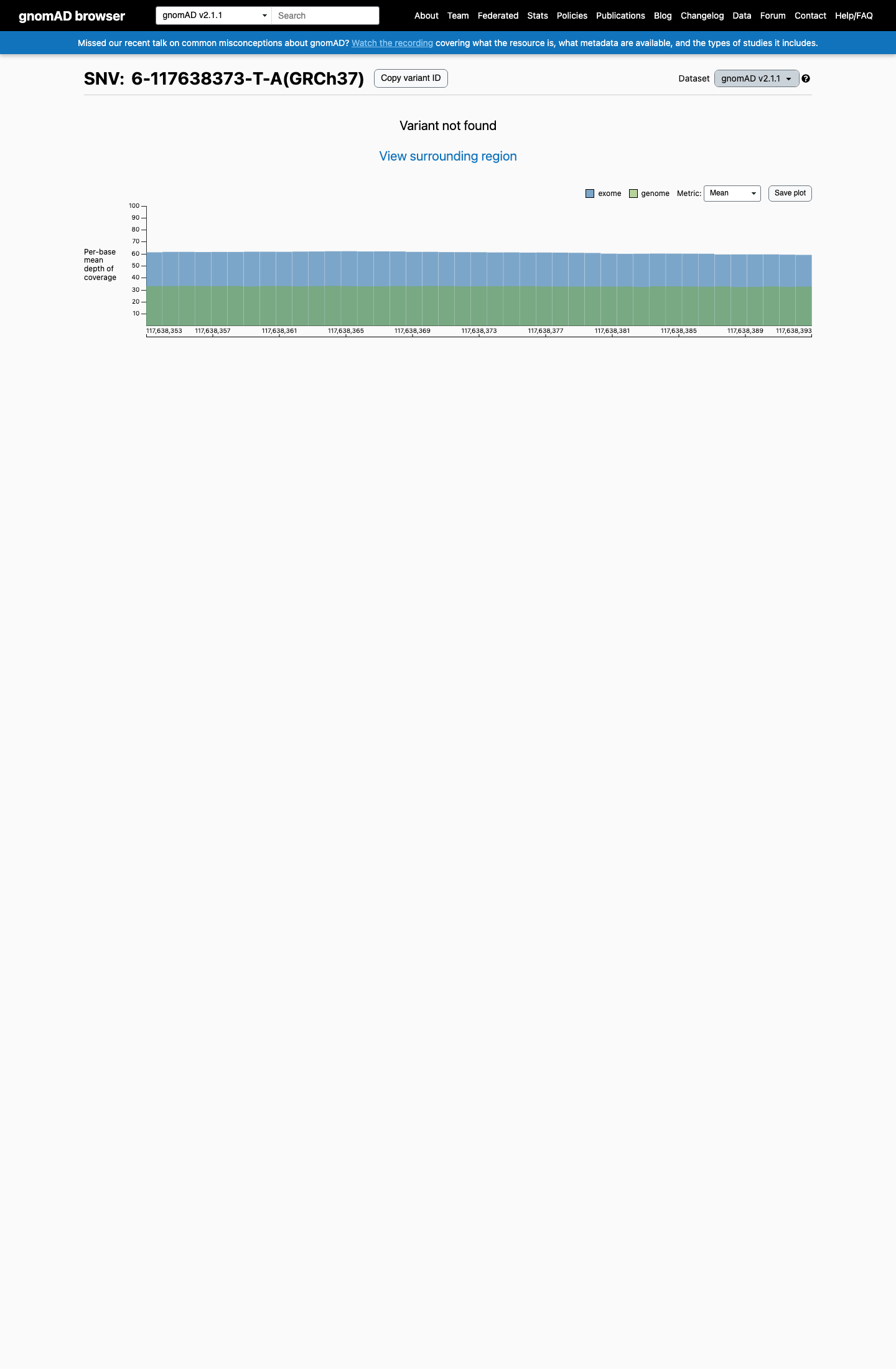
gnomAD v2.1 screenshot
gnomAD v2.1
v4.1
Absent from gnomAD v4.1.
v2.1
Absent from gnomAD v2.1.
🇨🇦 CA
Absent from gnomAD-Canada v1.0.
Allele frequency by ancestry
three datasets · side by side
gnomAD v4.1
Absent · 0 / ?
0 hom
Not observed in any ancestry group.
gnomAD v2.1
Absent · 0 / ?
0 hom
Not observed in any ancestry group.
gnomAD Canada 🇨🇦
Absent · 0 / ?
0 hom
Not observed in any ancestry group.
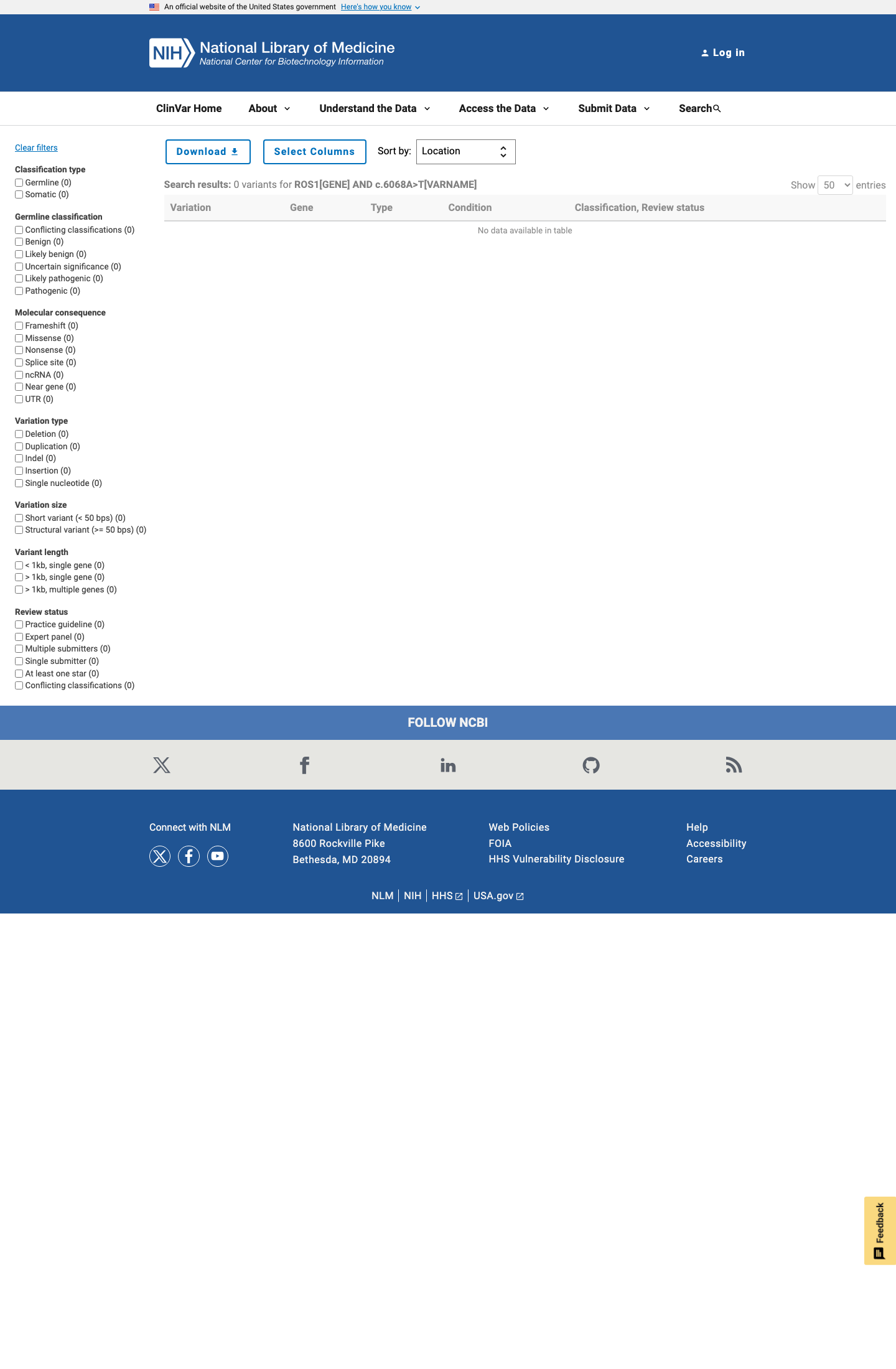
ClinVar screenshot
ClinVar
This variant is absent from ClinVar.
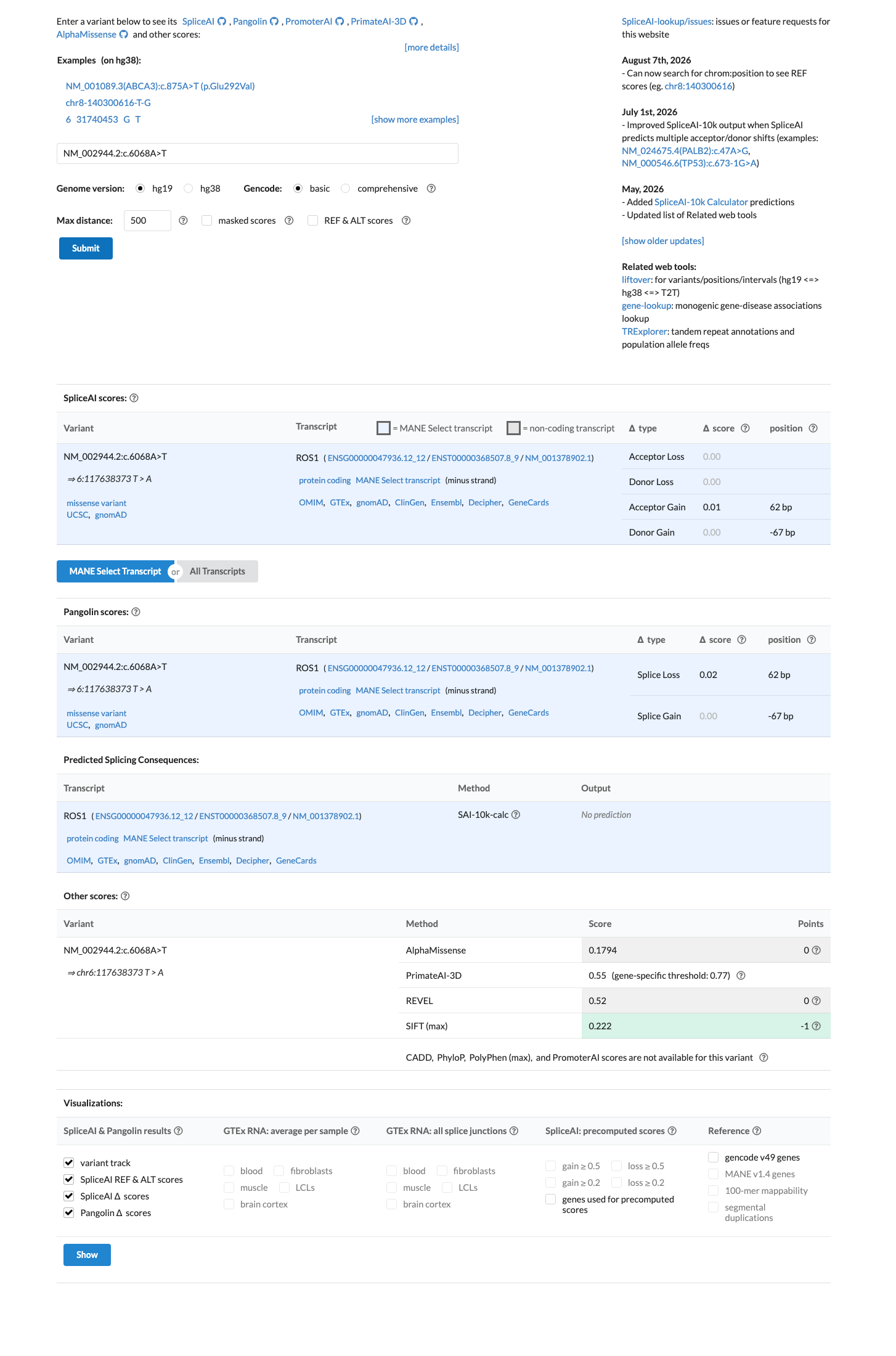
SpliceAI screenshot
In silico
SpliceAI predicts no significant splice impact for this variant (max delta score = 0.01). REVEL score = 0.52. BayesDel score = -0.119347.
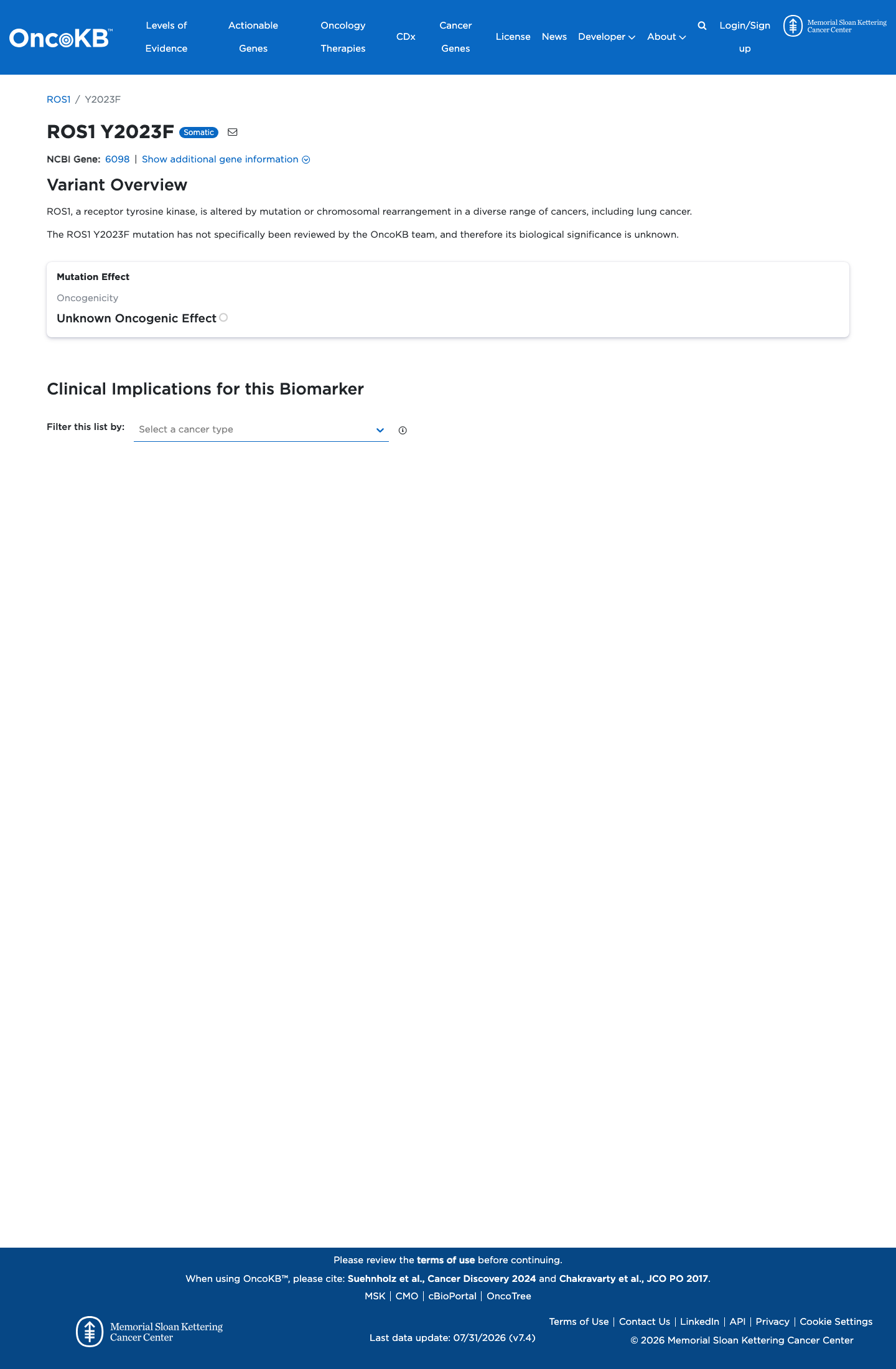
Functional / OncoKB screenshot
Functional Unknown Oncogenic Effect
OncoKB did not identify variant-specific reviewed functional evidence for this variant; gene-level curated context is available for reviewer follow-up. ROS1, a receptor tyrosine kinase, is altered by mutation or chromosomal rearrangement in a diverse range of cancers, including lung cancer.
OncoKB ↗
COSMIC screenshot
COSMIC
Cancer hotspots screenshot
Cancer hotspots
Somatic evidence Not in COSMIC / hotspots
COSMIC
This variant does not lie in a statistically significant hotspot. This variant has not previously been reported in somatic cancers (COSMIC).
Hotspots
This variant does not lie in a statistically significant hotspot.
Sources & reference links
8Sources
ClinVar
gnomAD v2.1
gnomAD v4.1
gnomAD-Canada
SpliceAI
OncoKB
COSMIC
Cancer hotspots