Analysis in progress
Initialising…
0%
complete
This report is still being assembled — sections appear as each stage finishes. It isn't final yet.
ATM
Final classification
Pathogenic
ATM c.4231del · p.Ser1411AlafsTer40
ATM

PVS1 (Very Strong): out-of-frame deletion creating premature stop p.(Ser1411AlafsTer40), predicted to trigger nonsense-mediated decay.

Gene
ATM
Transcript
NM_000051.4
HGVS · transcript:coding
NM_000051.4:c.4231del
Consequence
N/A
GRCh38
chr11:108289094 CA>C
GRCh37
chr11:108159821 CA>C
Basis Pathogenic: PVS1 very strong plus PM2 and PM5 supporting satisfy VCEP Rule4 (one very strong with two supporting), with no benign criteria met.
Pathogenic: PVS1 very strong plus PM2 and PM5 supporting satisfy VCEP Rule4 (one very strong with two supporting), with no benign criteria met.
Classification rationale
PVS1PM2PM5 Pathogenic
ATM c.4231del

PVS1 (Very Strong): out-of-frame deletion creating premature stop p.(Ser1411AlafsTer40), predicted to trigger nonsense-mediated decay. PM2 (Supporting): absent from gnomAD v4.1 (AF=0), below the VCEP <=0.001% threshold. PM5 (Supporting): premature stop at residue ~1450, upstream of the p.Arg3047 truncation cutoff. Final: Pathogenic, via VCEP Rule4 — PVS1 very strong combined with PM2 and PM5 supporting.

PVS1 + PM2 + PM5 Pathogenic
Gene diagram · NM_000051.4 · variants mapped to exon structure
ATM NM_000051.4
Fetching transcript structure from UCSC…
Applied criteria · 3 applied · 10 assessed
Applied · 3
Strength Supporting Moderate Strong Very strong
PVS1 very strong Pathogenic
Met at Very Strong: out-of-frame deletion creating premature stop p.(Ser1411AlafsTer40), predicted to trigger nonsense-mediated decay.
vcep_atm_pvs1_1_5: ClinGen HBOP ATM VCEP v1.5 PVS1 decision guide - defines null variants (incl. frameshift), LOF mechanism, constitutive exons, p.R3047 as most C-terminal pathogenic residue, FATKIN/HEAT domain notes for NMD-escaping variants.cspec: ATM VCEP v1.5 CSPEC ruleset - PVS1 default Very Strong, 'Use ATM PVS1 Decision Tree'.pvs1_generic_framework: ClinGen SVI PVS1 recommendations (Abou Tayoun et al. 2018, PMID 30192042; PMC6185798) - NMD criterion applied here: a PTC more than ~50-55 nt upstream of the final exon-exon junction is predicted to trigger NMD; this PTC (codon 1450, exon 29 of 63) satisfies that rule.
PM2 supporting Pathogenic
Met at Supporting: completely absent from gnomAD v4.1 (AF=0), below the VCEP <=0.001% frequency threshold.
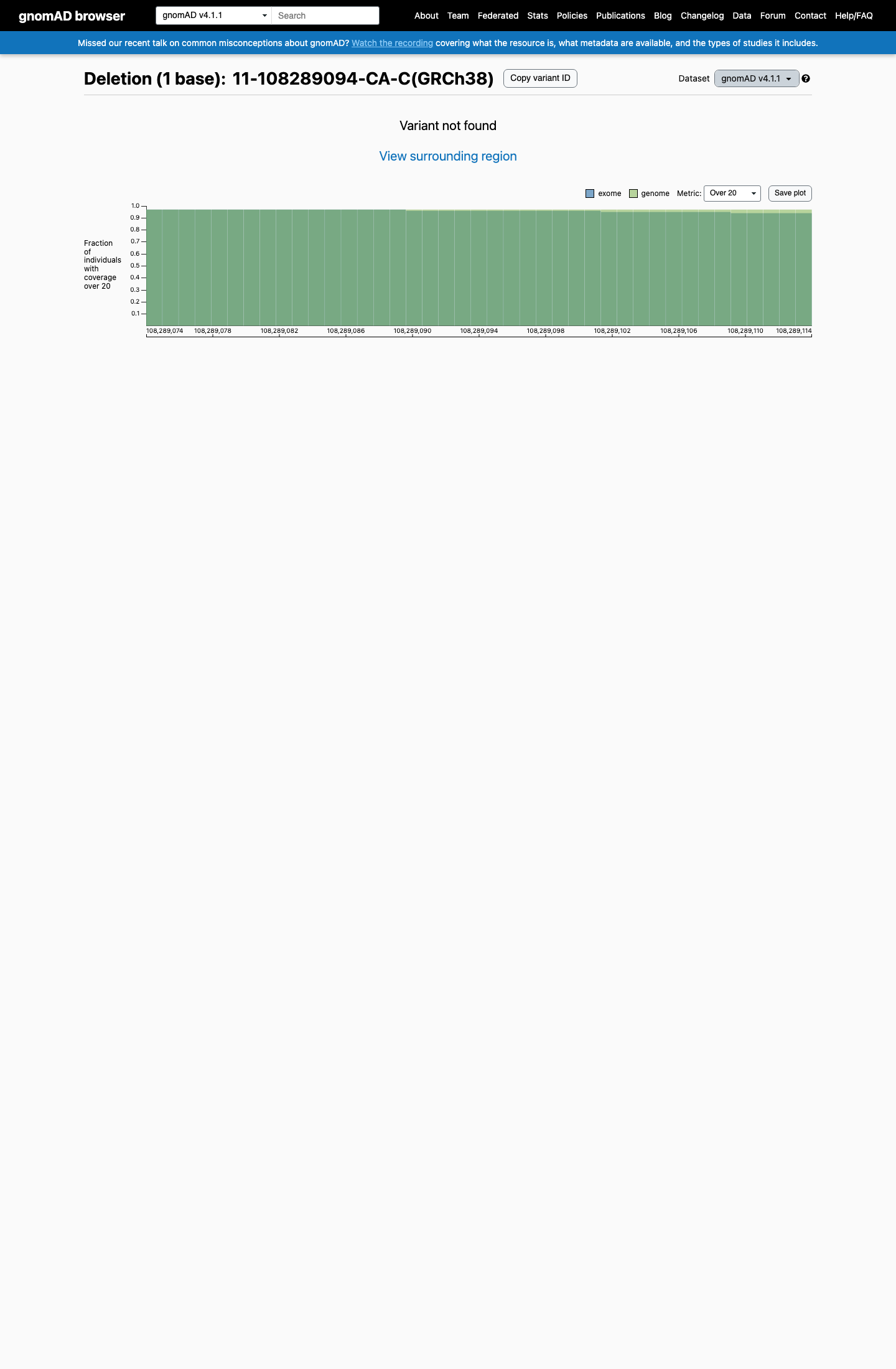
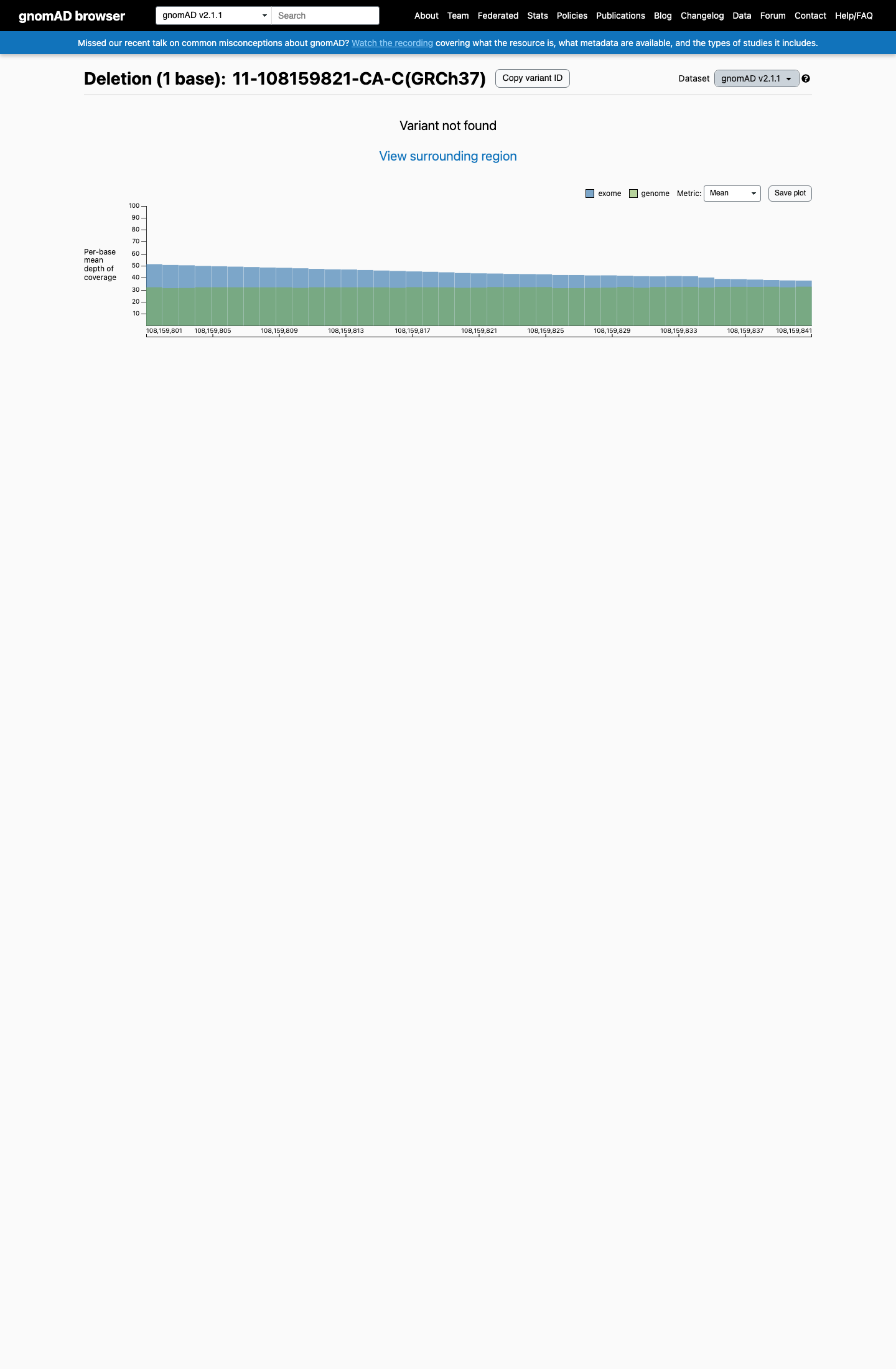
gnomAD v4.1 direct variant lookup for chr11-108289094-CA-C (dataset gnomad_r4) returned absent -> AF 0, satisfies VCEP frequency <=0.001%gnomAD v2.1 direct variant lookup for 11-108159821-CA-C (dataset gnomad_r2_1) returned absent (corroborating rarity)gnomAD-Canada v1.0 lookup for 11-108289094-CA-C returned absent (corroborating rarity)
PM5 supporting Pathogenic
Met at Supporting: premature stop at residue ~1450, upstream of the p.Arg3047 truncation cutoff for pathogenic ATM variants.
cspec: ATM VCEP v1.5 PM5 entry — Supporting rule 'Apply to frameshifting or truncating variants with premature termination codons upstream of p.Arg3047'; instructions 'Use as PM5_Supporting (not moderate)', 'Do not use for missense changes'; PVS1 entry — 'The most 3'/C-Terminal residue considered to be pathogenic is p.R3047'pvs1_variant_assessment: variant consequence scaffold — consequence_class 'frameshift', protein NP_000042.3:p.(S1411Afs*40), confirming the frameshift class used for the rulepm5_candidates: pipeline candidate-collection artifact confirming PM5 mode 'truncation_cutoff_gene_specific' and zero same-residue (classic missense) comparator candidates; the PM5 call itself is grounded in the CSPEC rule text and variant consequence, not in this artifact's 'not_applicable' recommendation (which refers to classic same-residue missense PM5 search)
Assessed · not applied
Pathogenic
PS3 Not assessed: insufficient evidence was available, as no VCEP-approved functional assay is documented to have tested c.4231del.
PS4 Not assessed: no case-control study of this exact variant was available, so no odds ratio or p-value could be computed.
PM3 Not assessed: no proband-level data (zygosity, phase, or phenotype) existed for c.4231del, so no PM3 points could be scored.
PP1 Not assessed: no family or segregation data for c.4231del were available.
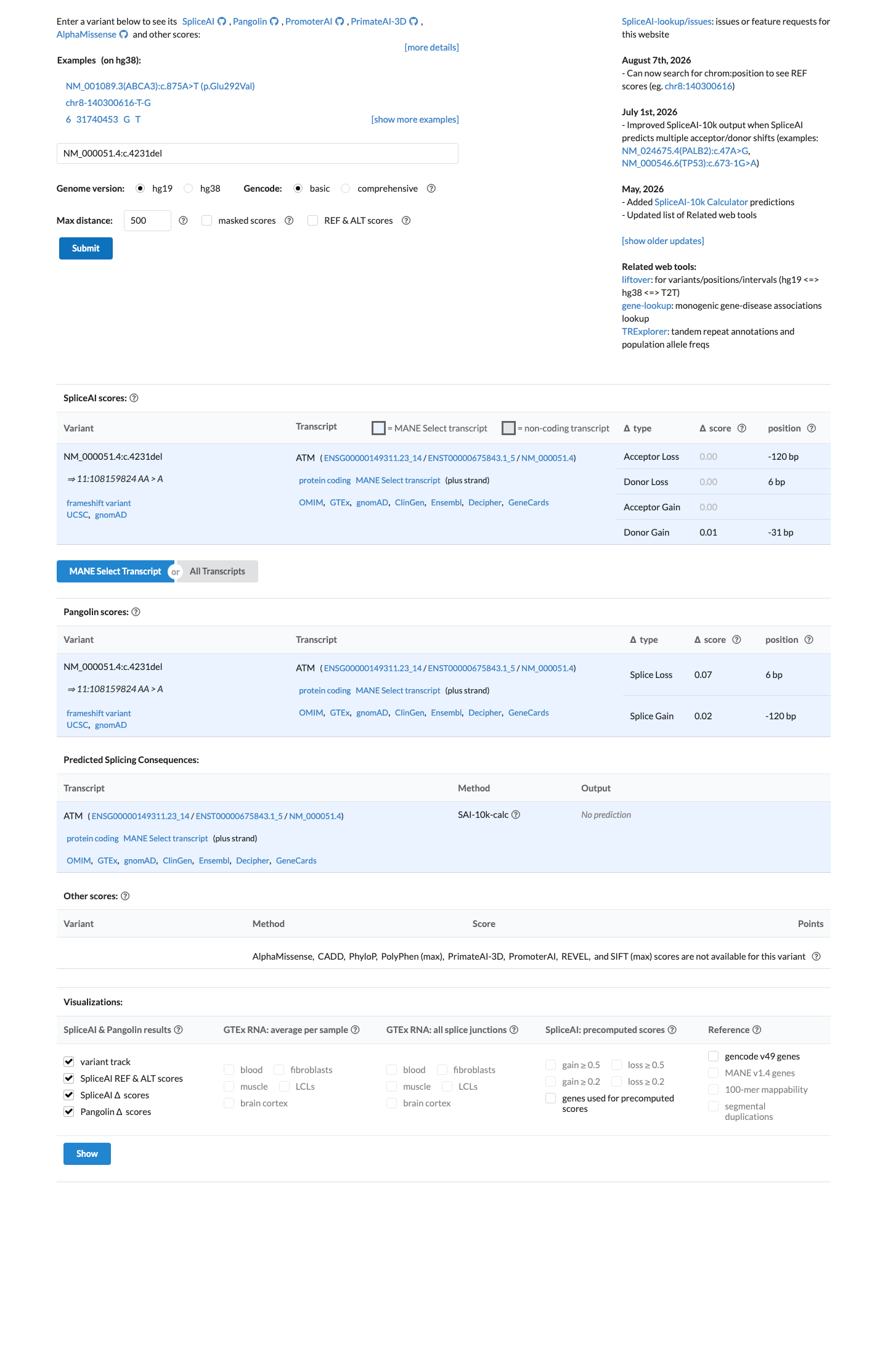
PP3 Not met: SpliceAI max delta 0.01, far below the >=0.2 VCEP threshold.
Benign
BA1 Not met: absent from gnomAD v4.1 (AF=0), far below the >0.5% BA1 threshold.
BS1 Not met: absent from gnomAD v4.1 (AF=0), below the >0.05% BS1 threshold.
BS3 Not assessed: insufficient evidence was available, as no rescue or complementation assay data for c.4231del exist.
BP2 Not assessed: no unaffected-carrier observations with phase information for c.4231del were available.
BP4 Not met: a clean SpliceAI score (max delta 0.01) does not negate the variant's established frameshift truncation effect.
N/A · 15 PS1 · PS2 · PM1 · PM4 · PM6 · PP2 · PP4 · PP5 · BS2 · BS4 · BP1 · BP3 · BP5 · BP6 · BP7
Research & evidence
Population frequency · supports pathogenic
gnomAD v4.1 screenshot
gnomAD v4.1
gnomAD v2.1 screenshot
gnomAD v2.1
v4.1
Absent from gnomAD v4.1.
v2.1
Absent from gnomAD v2.1.
🇨🇦 CA
Absent from gnomAD-Canada v1.0.
Allele frequency by ancestry
three datasets · side by side
gnomAD v4.1
Absent · 0 / ?
0 hom
Not observed in any ancestry group.
gnomAD v2.1
Absent · 0 / ?
0 hom
Not observed in any ancestry group.
gnomAD Canada 🇨🇦
Absent · 0 / ?
0 hom
Not observed in any ancestry group.
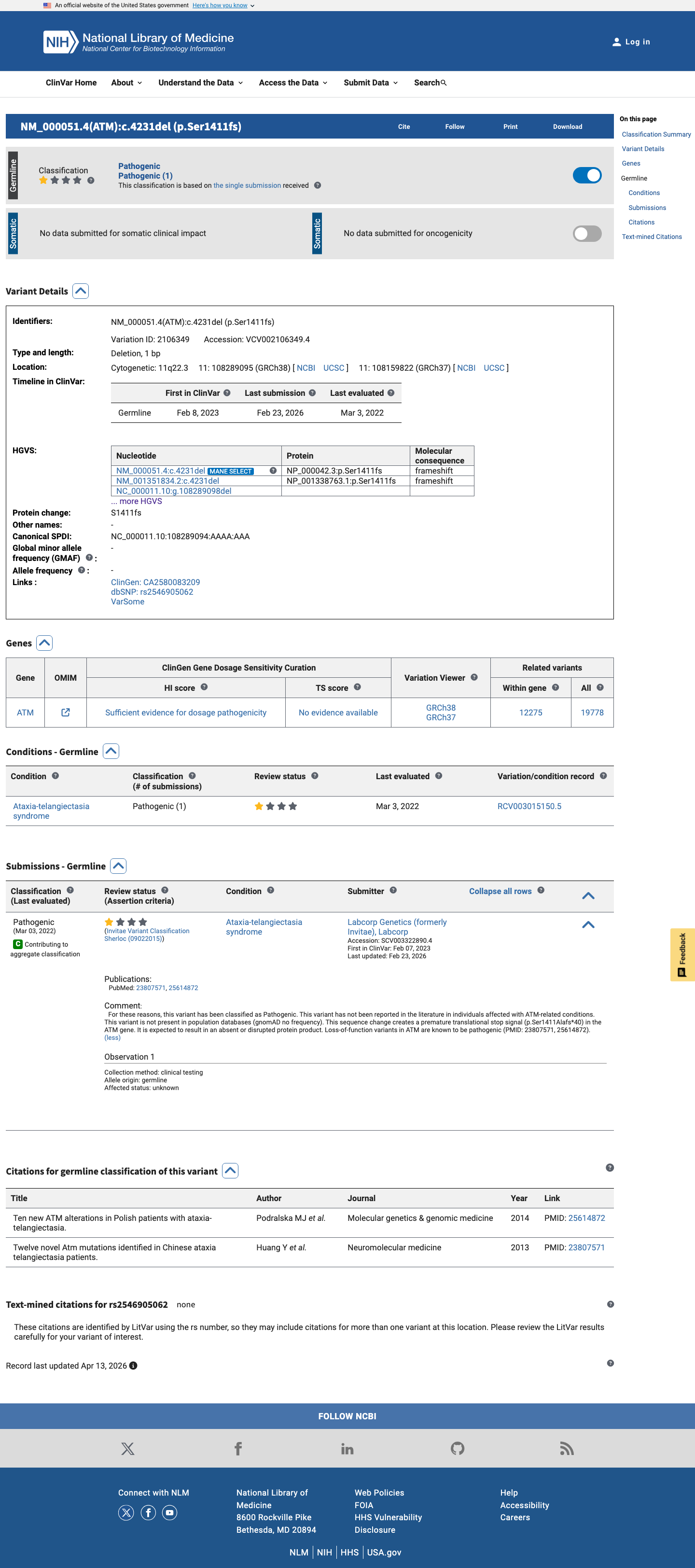
ClinVar screenshot
ClinVar
This variant has been reported in ClinVar as Pathogenic (1 clinical laboratory). (ClinVarID = 2106349)
SpliceAI screenshot
In silico
SpliceAI predicts no significant splice impact for this variant (max delta score = 0.01).
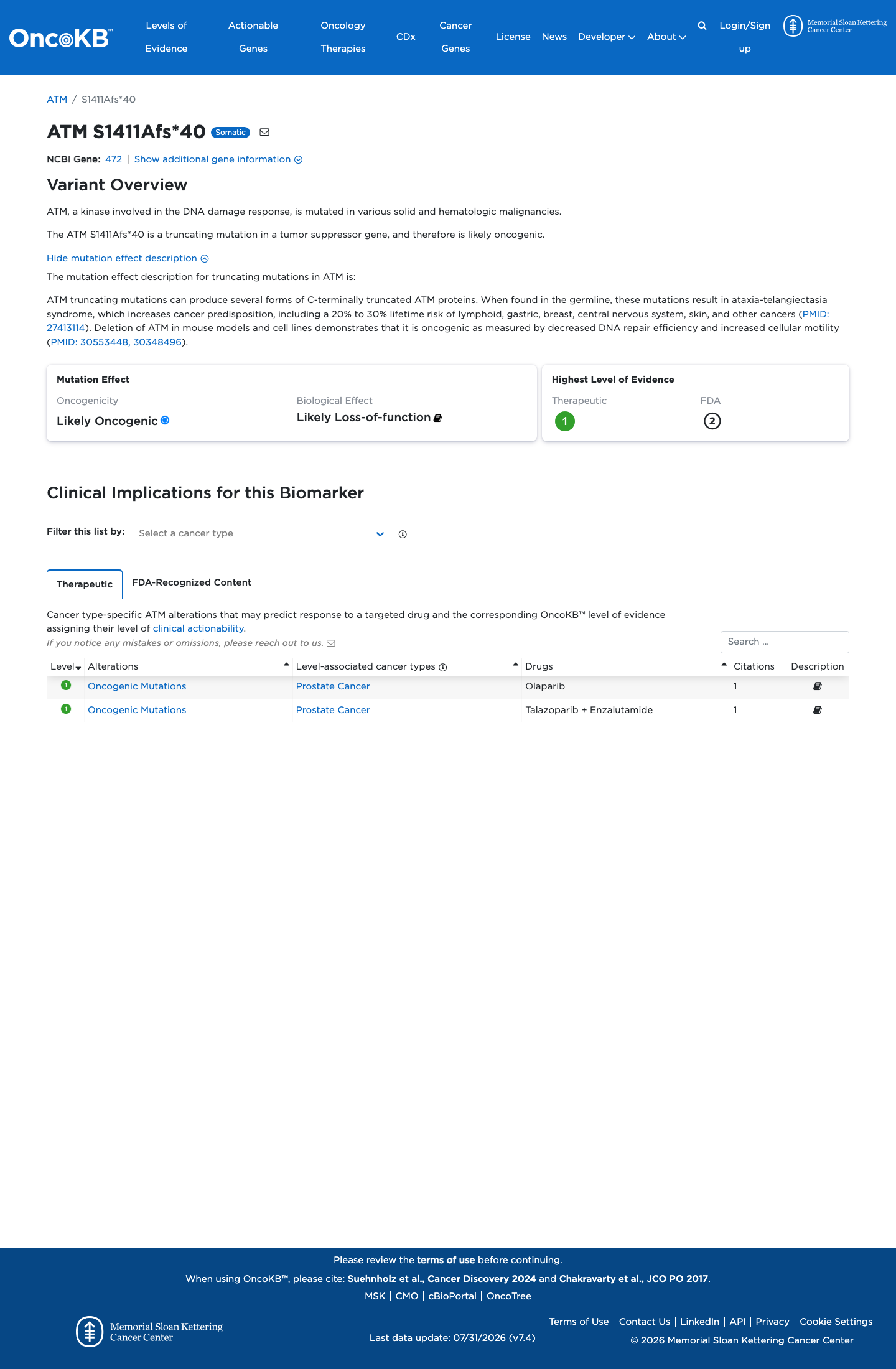
Functional / OncoKB screenshot
Functional Likely Oncogenic
OncoKB identified variant-specific curated literature and context relevant to functional review; biological-effect context: Likely Loss-of-function; curated oncogenicity label: Likely Oncogenic.
OncoKB ↗
COSMIC screenshot
COSMIC
Cancer hotspots screenshot
Cancer hotspots
Somatic evidence Not in COSMIC / hotspots
COSMIC
This variant does not lie in a statistically significant hotspot. This variant has not previously been reported in somatic cancers (COSMIC).
Hotspots
This variant does not lie in a statistically significant hotspot.
Literature · how each cited paper was used
2papers cited
Each card is an audit: what was searched, what was found, whether it names the variant, which criteria it fed, and why. 7 further PMIDs triaged but not cited — see Sources & References.
Rule & framework references · cited for criterion definitions, not variant evidence
23807571 ↗ Twelve novel Atm mutations identified in Chinese ataxia telangiectasia patients.
25614872 ↗ Ten new ATM alterations in Polish patients with ataxia-telangiectasia.
Sources & reference links
9Sources
CSpec VCEP
ClinVar
gnomAD v2.1
gnomAD v4.1
gnomAD-Canada
SpliceAI
OncoKB
COSMIC
Cancer hotspots
Triaged references · 7 PMIDs not cited in assessment
27413114 ↗ ATM Mutations in Cancer: Therapeutic Implications. ONCOKB
30348496 ↗ Inactive Atm abrogates DSB repair in mouse cerebellum more than does Atm loss, without causing a neurological phenotype. ONCOKB
30553448 ↗ Loss of ATM positively regulates Rac1 activity and cellular migration through oxidative stress. ONCOKB
20301317 ↗ Hereditary Ataxia Overview. CLINVAR
20301790 ↗ Ataxia-Telangiectasia. CLINVAR
24418350 ↗ EFNS/ENS Consensus on the diagnosis and management of chronic ataxias in adulthood. CLINVAR
20050888 ↗ EFNS guidelines on the molecular diagnosis of ataxias and spastic paraplegias. CLINVAR