Back
NM_001040108.2:c.3455G>A
p.Arg1152His · MLH3
ACMG/AMP
0%
complete
Final classification
VUS
PM2
MLH3
c.3455G>A
p.Arg1152His
missense

MLH3 is a member of the MutL-homolog family of DNA mismatch repair genes. It partners with other family members, notably MLH1, to form a complex that detects and repairs errors in DNA during replication, safeguarding genomic stability and preventing microsatellite instability, and it also helps promote meiotic crossover. Germline mutations in MLH3 are associated with hereditary nonpolyposis colorectal cancer type 7 (HNPCC7), and inactivating changes in the gene have also been found in endometrial and gastric cancers. Loss of MLH3 function increases susceptibility to tumors such as gastrointestinal cancers, indicating that it acts as a tumor suppressor.

This variant

MLH3 is a DNA mismatch-repair gene whose inactivation predisposes to gastrointestinal tumors, so a rare missense change like p.Arg1152His warrants scrutiny as a potential loss-of-function candidate. However, this variant remains a Variant of Uncertain Significance: its very low population frequency is the only supportive evidence, with no functional, segregation, or case data demonstrating an effect on MLH3's tumor-suppressor function.

Transcript
NM_001040108.2
HGVS · transcript:coding
NM_001040108.2:c.3455G>A
GRCh38
chr14:75041625 C>T
GRCh37
chr14:75508328 C>T
Variant of Uncertain Significance: only PM2 was met (supporting; gnomAD v4.1 AF 0.0128%, 0 homozygotes), which reaches no pathogenic or benign threshold under generic ACMG/AMP 2015 rules.
Classification rationale
PM2 VUS
MLH3 c.3455G>A missense

PM2 (Supporting): extremely low population frequency — gnomAD v4.1 total AF 0.0128% (206/1,612,008 alleles), 0 homozygotes, absent from gnomAD-Canada — below the 0.1% calibration. Synthesis: with a single supporting criterion and no other pathogenic or benign evidence, the variant is classified as Variant of Uncertain Significance under generic ACMG/AMP 2015 combination rules.

PM2 → VUS
LYFE Sciences is an AI system, and it can make mistakes. Criteria may be applied incorrectly, sources may be misread, and a confident-looking classification can still be wrong. Double-check every criterion and its underlying evidence before relying on any call.
Gene diagram · NM_001040108.2 · variants mapped to exon structure
MLH3 NM_001040108.2
Fetching transcript structure from UCSC…
Applied criteria · 1 applied · 23 assessed
MetEvidence satisfies this criterion.
Not metEvaluated against available evidence; threshold not reached.
Not assessedApplies in principle, but no evidence was found to evaluate it.
N/ADoesn't apply to this variant type.
Applied · 1
Strength Supporting Moderate Strong Very strong
PM2 supporting Pathogenic
Met (supporting): gnomAD v4.1 total allele frequency 0.0128% (206/1,612,008 alleles), 0 homozygotes, below the 0.1% threshold.
gnomad_v4: gnomAD v4.1 total AF = 0.0001278 (0.01278%, 206/1,612,008 alleles), 0 homozygotes, grpmax FAF = 0.00014369 (0.01437%); below the local non-VCEP PM2 calibration of <0.1% (PMID:25741868 defines PM2 as absent or extremely low frequency, with extremely low frequency if recessive).gnomad_v2: gnomAD v2.1 total AF = 6.36e-05 (0.00636%, 16/251,476 alleles), 0 homozygotes; independently confirms extremely low frequency.gnomad_canada: variant absent from gnomAD-Canada v1.0 (HostSeq Canadian general-population genomes), consistent with extremely low population frequency.
Assessed · not applied · 9 not met · 14 not assessed
Pathogenic
PS1 Not met: no pathogenic variant producing the same amino-acid change p.Arg1152His is established; the only ClinVar record for it is Uncertain significance.
PS2 Not assessed: no proband phenotype or parental testing results were available to evaluate a de novo origin.
PS3 Not assessed: no functional studies of this variant exist; OncoKB lists no variant-specific functional evidence for R1152H.
PS4 Not assessed: no case-control study, case series, or affected-proband allele counts for this variant were available.
PM1 Not met: the variant is not in a statistically significant mutational hotspot, and no domain annotation places residue 1152 in a critical functional domain.
PM3 Not assessed: no observation of the variant in trans with a pathogenic MLH3 variant exists; phase data are lacking.
PM5 Not assessed: no different missense change at Arg1152 with a pathogenic classification was identified to serve as the required comparator.
PM6 Not assessed: no parental testing or de novo assertion data were available.
PP1 Not assessed: no pedigree or segregation data were available to evaluate cosegregation with disease.
PP2 Not assessed: no missense-constraint data for MLH3 were available, and evidence favors loss-of-function rather than missense as the disease mechanism.
PP3 Not met: SpliceAI max delta 0.06 and REVEL 0.361 both fall below their calibrated pathogenic thresholds.
PP4 Not assessed: no confirmed proband phenotype or family history was available.
PP5 Not met: no ClinVar expert-panel (VCEP) pathogenic classification exists for this exact variant; all six submissions are Uncertain significance.
Benign
BA1 Not met: highest observed allele frequency is 0.0163% (gnomAD v4.1 NFE), about 60-fold below the 1% stand-alone benign threshold.
BS1 Not met: highest observed allele frequency 0.0163% is below, not above, the expected disease allele frequency of ~0.17%.
BS2 Not met: zero homozygotes in gnomAD v2.1/v4.1, and Lynch-type cancer risk is not fully penetrant at an early age, so the healthy-adult requirement is not satisfied.
BS3 Not assessed: no functional studies demonstrate normal function; in-silico predictions alone do not qualify as such evidence.
BS4 Not assessed: no family or segregation data exist to demonstrate lack of segregation.
BP1 Not assessed: available evidence does not confirm that MLH3 disease is primarily caused by truncating variants.
BP2 Not assessed: no cis/trans observation with a pathogenic variant exists, and a fully dominant MLH3 mechanism is not established.
BP4 Not met: only one computational line supports no impact (SpliceAI max delta 0.06); REVEL 0.361 exceeds the 0.016 BP4 threshold.
BP5 Not assessed: no proband-level molecular data were available to evaluate an alternate molecular basis for disease.
BP6 Not met: no ClinVar expert-panel benign classification exists for this exact variant; all submissions are Uncertain significance.
N/A · 4 PVS1 · PM4 · BP3 · BP7
Research & evidence
Population frequency
gnomAD v4.1 screenshot
gnomAD v4.1
gnomAD v2.1 screenshot
gnomAD v2.1
v4.1
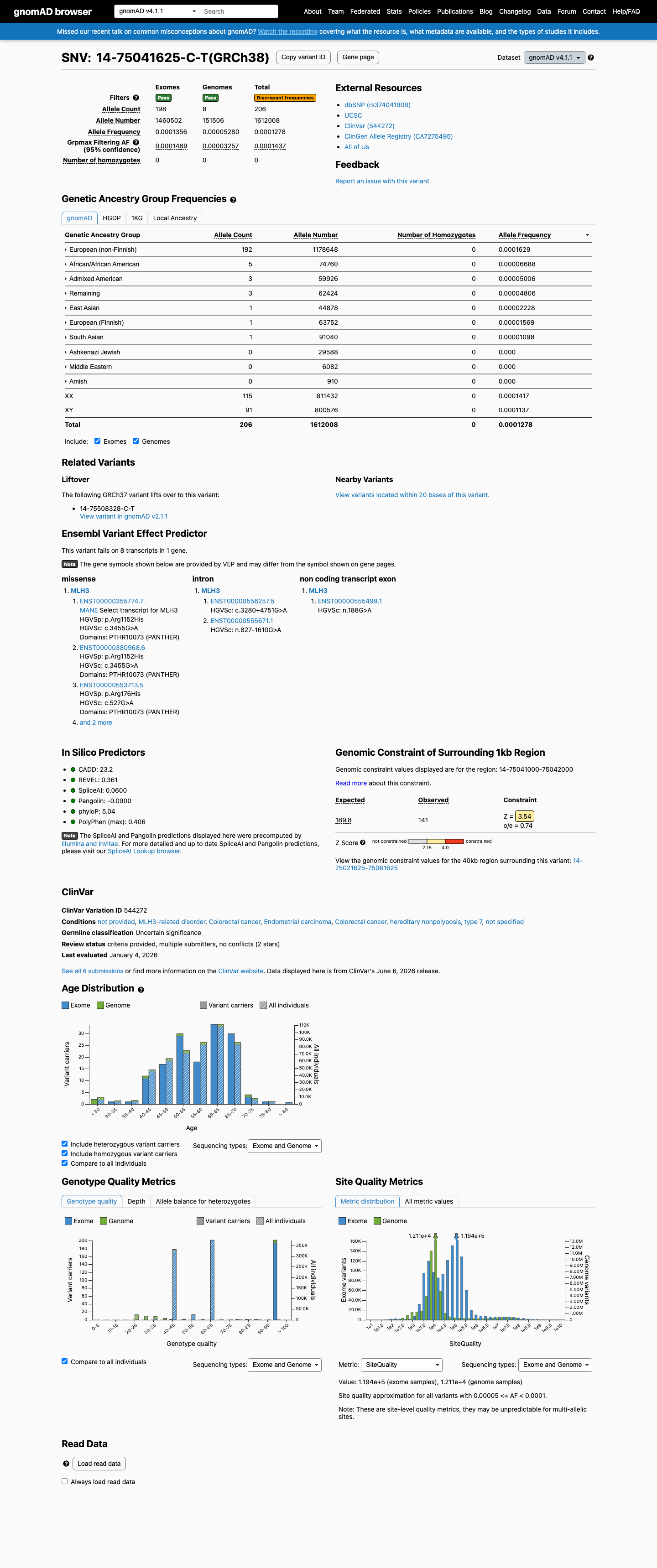
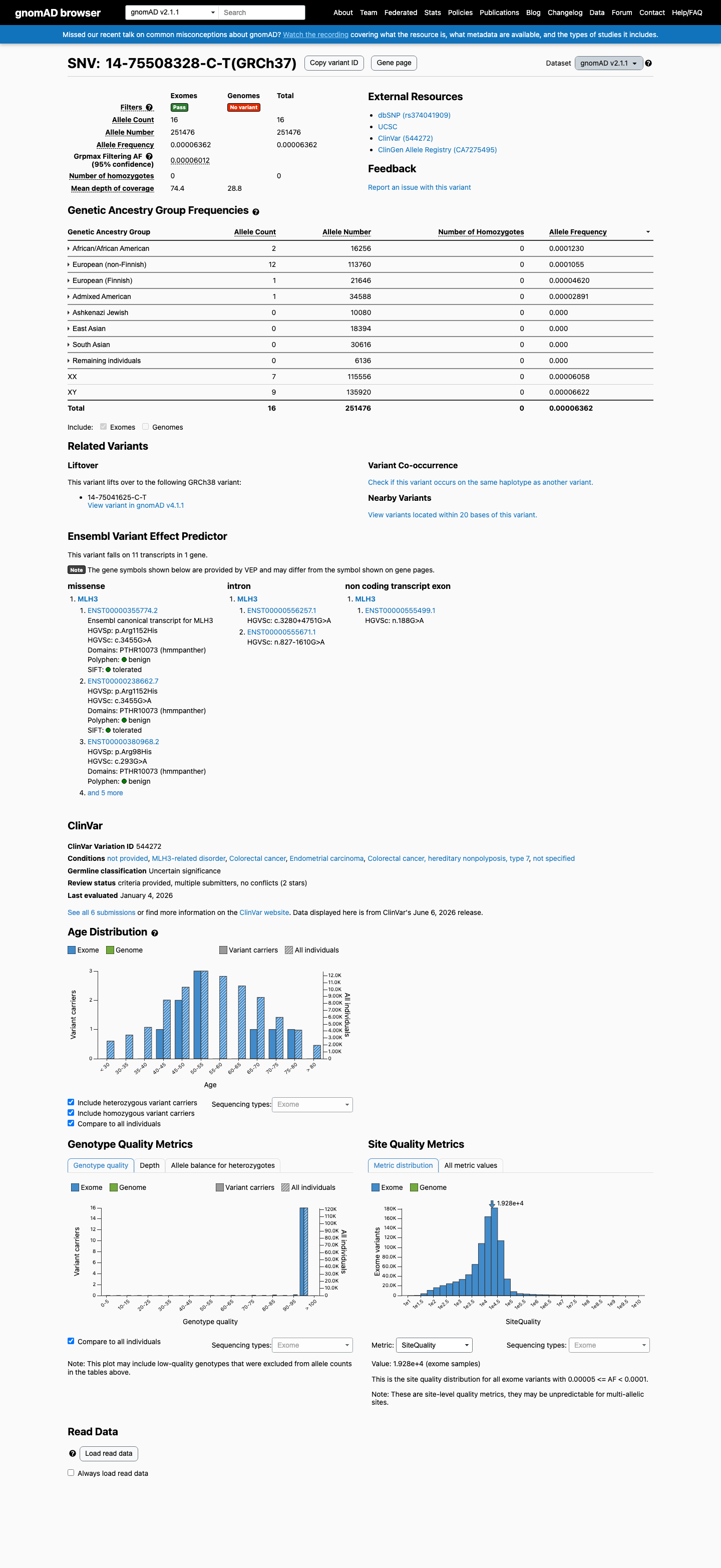
This variant is present in gnomAD v4.1 (AF= 0.000127791; MAF= 0.01278%, 206/1612008 alleles, homozygotes = 0) and has highest observed frequency in the European (non-Finnish) population (AF= 0.000162899; MAF= 0.01629%, 192/1178648 alleles, homozygotes = 0); grpmax FAF= 0.00014369.
v2.1
This variant is present in gnomAD v2.1 (AF= 6.36244e-05; MAF= 0.00636%, 16/251476 alleles, homozygotes = 0) and has highest observed frequency in the African/African American population (AF= 0.000123031; MAF= 0.01230%, 2/16256 alleles, homozygotes = 0); grpmax FAF= 6.012e-05.
🇨🇦 CA
Absent from gnomAD-Canada v1.0.
Allele frequency by ancestry
three datasets · side by side
gnomAD v4.1
0.013% · 206 / 1,612,008
0 hom · FAF 0.014%
European (non-Finnish)
192 / 1,178,648
0.016%
African/African American
5 / 74,760
0.0067%
Admixed American
3 / 59,926
0.005%
Remaining individuals
3 / 62,424
0.0048%
East Asian
1 / 44,878
0.0022%
European (Finnish)
1 / 63,752
0.0016%
South Asian
1 / 91,040
0.0011%
+ 3 not observed (Amish, Middle Eastern, Ashkenazi Jewish)
gnomAD v2.1
0.0064% · 16 / 251,476
0 hom · FAF 0.006%
African/African American
2 / 16,256
0.012%
European (non-Finnish)
12 / 113,760
0.011%
European (Finnish)
1 / 21,646
0.0046%
Admixed American
1 / 34,588
0.0029%
+ 4 not observed (Ashkenazi Jewish, East Asian, Remaining individuals, South Asian)
gnomAD Canada 🇨🇦
Absent · 0 / ?
0 hom
Not observed in any ancestry group.
ClinVar screenshot
ClinVar
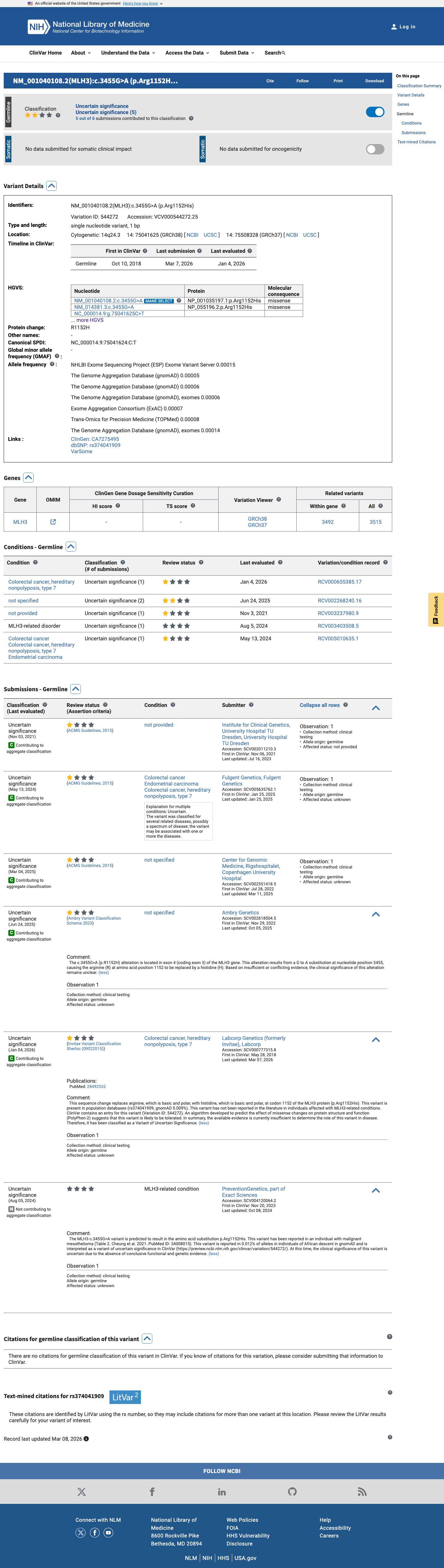
This variant has been reported in ClinVar as Uncertain significance (6 clinical laboratories). (ClinVarID = 544272)
SpliceAI screenshot
In silico
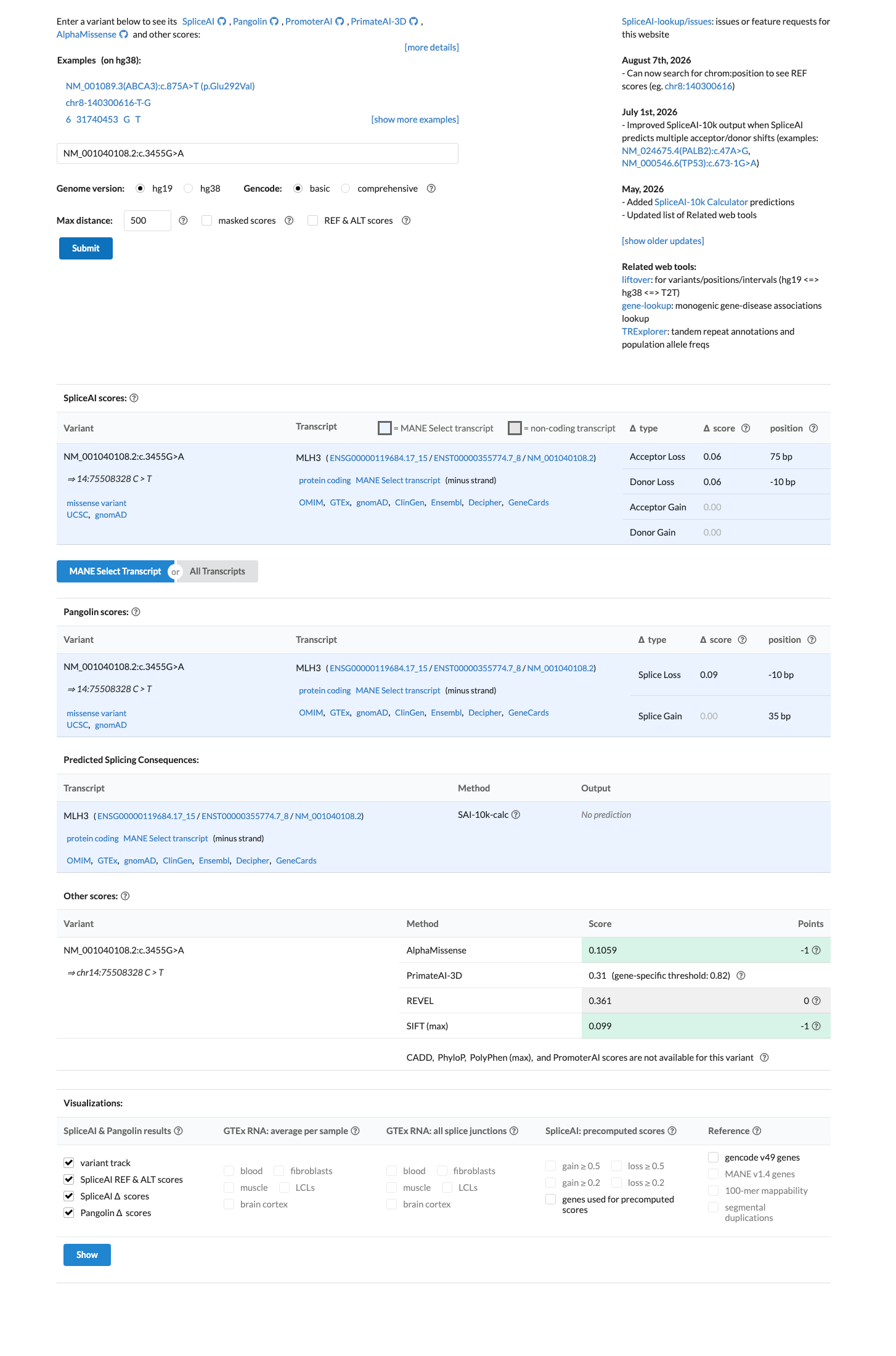
SpliceAI predicts no significant splice impact for this variant (max delta score = 0.06). REVEL score = 0.361. BayesDel score = -0.112721.
Functional / OncoKB screenshot
Functional Unknown Oncogenic Effect
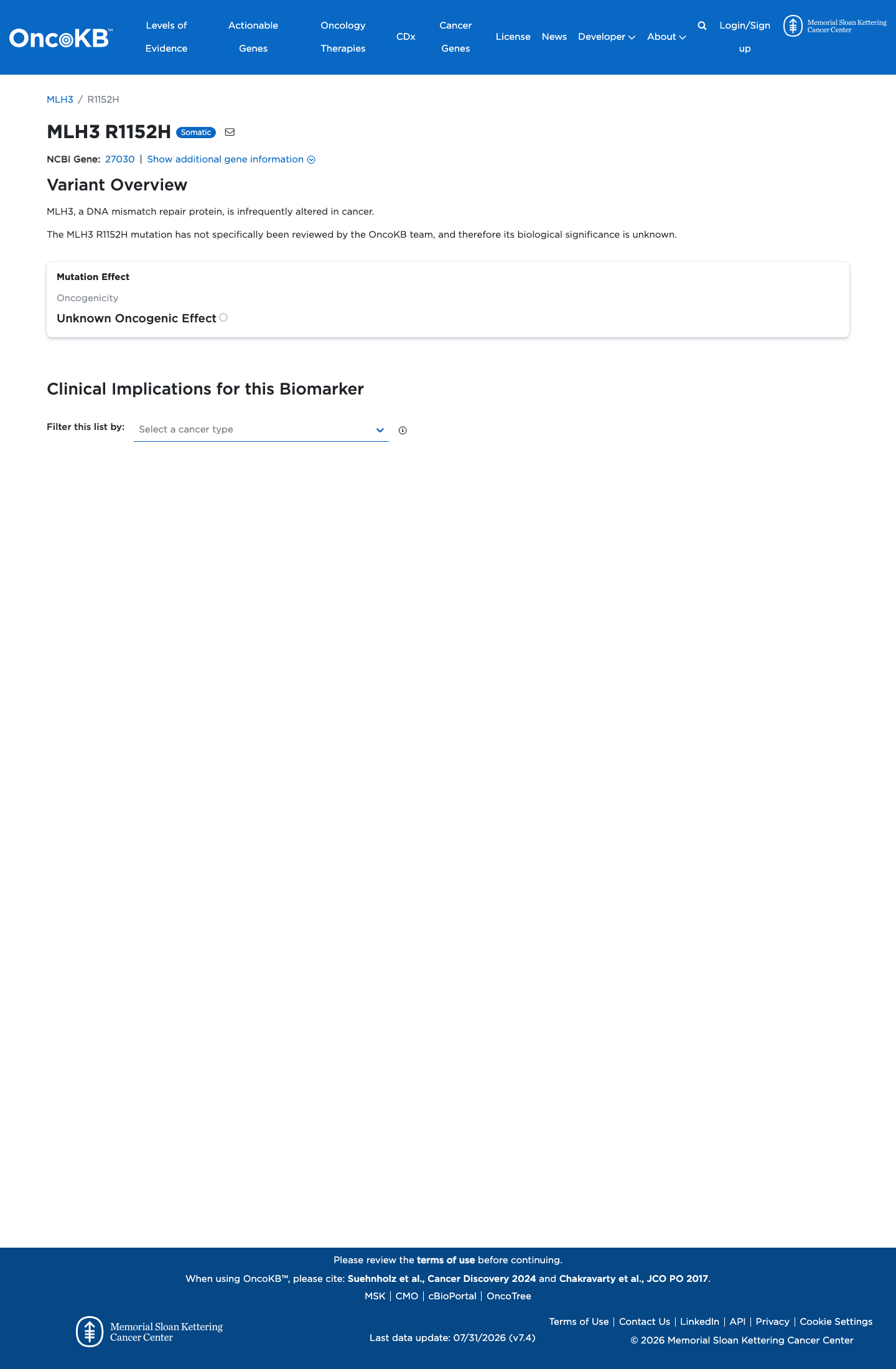
OncoKB did not identify variant-specific reviewed functional evidence for this variant; gene-level curated context is available for reviewer follow-up. MLH3, a DNA mismatch repair protein, is infrequently altered in cancer.
OncoKB ↗
COSMIC screenshot
COSMIC
Cancer hotspots screenshot
Cancer hotspots
Somatic evidence Not in COSMIC / hotspots
COSMIC
This variant does not lie in a statistically significant hotspot. This variant has not previously been reported in somatic cancers (COSMIC).
Hotspots
This variant does not lie in a statistically significant hotspot.
Literature · how each cited paper was used
2papers cited
Each card is an audit: what was searched, what was found, whether it names the variant, which criteria it fed, and why. 4 further PMIDs triaged but not cited — see Sources & references.
Rule & framework references · cited for criterion definitions, not variant evidence
25741868 ↗ Standards and guidelines for the interpretation of sequence variants: a joint consensus recommendation of the American College of Medical Genetics and Genomics and the Association for Molecular Pathology.
34043773 ↗ European guidelines from the EHTG and ESCP for Lynch syndrome: an updated third edition of the Mallorca guidelines based on gene and gender.
Sources & reference links
8Sources
ClinVar
gnomAD v2.1
gnomAD v4.1
gnomAD-Canada
SpliceAI
OncoKB
COSMIC
Cancer hotspots
Triaged references · 4 PMIDs not cited in assessment
20301390 ↗ Lynch Syndrome. CLINVAR
33451724 ↗ Endometrial cancer: A society of gynecologic oncology evidence-based review and recommendations, part II. CLINVAR
33516529 ↗ Endometrial cancer: A society of gynecologic oncology evidence-based review and recommendations. CLINVAR
24929052 ↗ Endometrial cancer: a review and current management strategies: part II. CLINVAR