Analysis in progress
Initialising…
0%
complete
This report is still being assembled — sections appear as each stage finishes. It isn't final yet.
POLE
Final classification
VUS
POLE c.331-30G>A · p.?
POLE

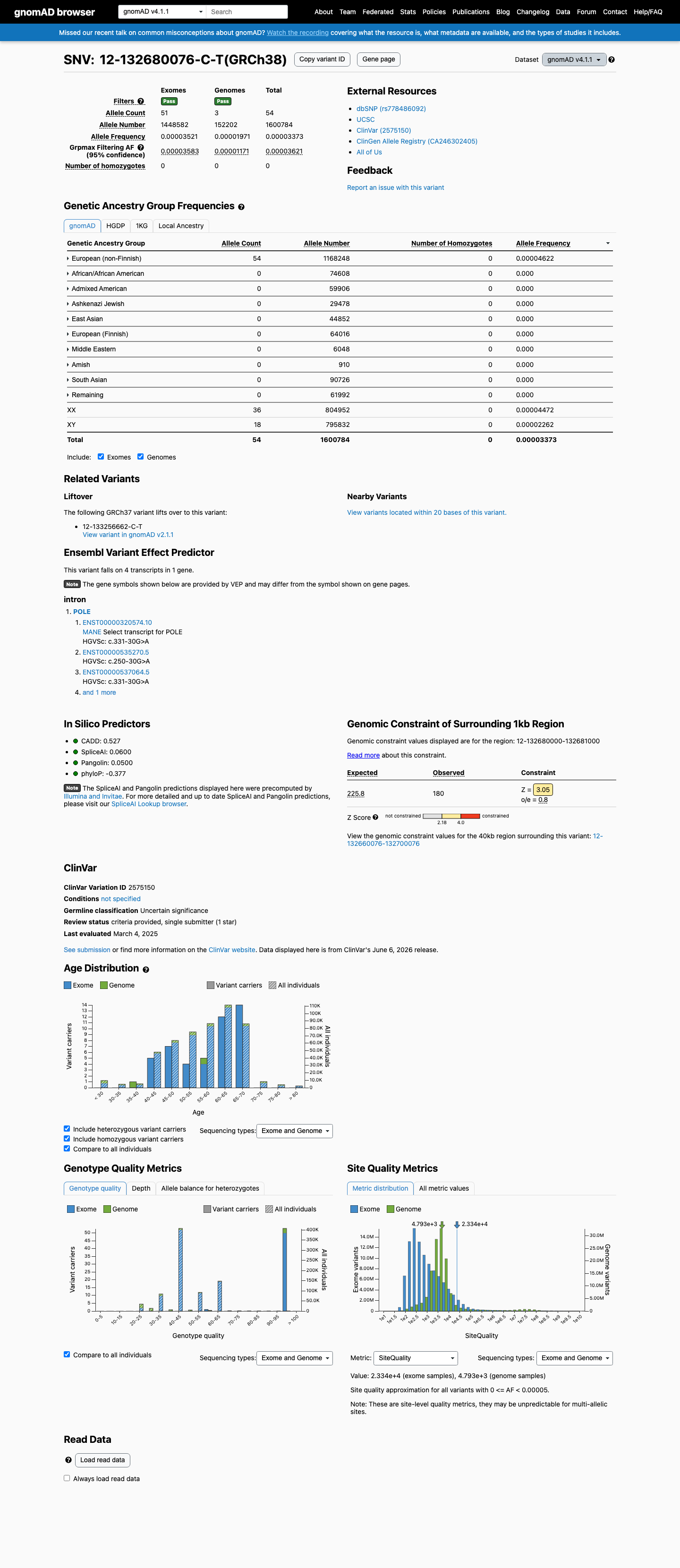
PM2 (Supporting): extremely low population frequency — gnomAD v4.1 AF 0.0034% with zero homozygotes in ~1.6 million alleles (flagged for human review: not literally absent, 54 carriers).

Gene
POLE
Transcript
NM_006231.4
HGVS · transcript:coding
NM_006231.4:c.331-30G>A
Consequence
N/A
GRCh38
chr12:132680076 C>T
GRCh37
chr12:133256662 C>T
Basis VUS: the tally — one supporting pathogenic (PM2) plus one supporting benign (BP4, SpliceAI max delta 0.06) — matches no Pathogenic, Likely Pathogenic, Benign, or Likely Benign combination rule.
VUS: the tally — one supporting pathogenic (PM2) plus one supporting benign (BP4, SpliceAI max delta 0.06) — matches no Pathogenic, Likely Pathogenic, Benign, or Likely Benign combination rule.
Classification rationale
PM2 BP4 VUS
POLE c.331-30G>A

PM2 (Supporting): extremely low population frequency — gnomAD v4.1 AF 0.0034% with zero homozygotes in ~1.6 million alleles (flagged for human review: not literally absent, 54 carriers). BP4 (Supporting): SpliceAI max delta 0.06, below the <0.1 threshold, predicting no effect on splicing. Overall classification: VUS — one supporting pathogenic (PM2) plus one supporting benign (BP4) criterion matches no Pathogenic, Likely Pathogenic, Benign, or Likely Benign combination rule.

PM2 + BP4 VUS
Gene diagram · NM_006231.4 · variants mapped to exon structure
POLE NM_006231.4
Fetching transcript structure from UCSC…
Applied criteria · 2 applied · 19 assessed
Applied · 2
Strength Supporting Moderate Strong Very strong
PM2 supporting review Pathogenic
Met (supporting): gnomAD v4.1 allele frequency 0.0034% with zero homozygotes in ~1.6 million alleles, an extremely low frequency. Flagged for human review: the variant is not literally absent from gnomAD (54 carriers), so this relies on the extremely-low-frequency reading.
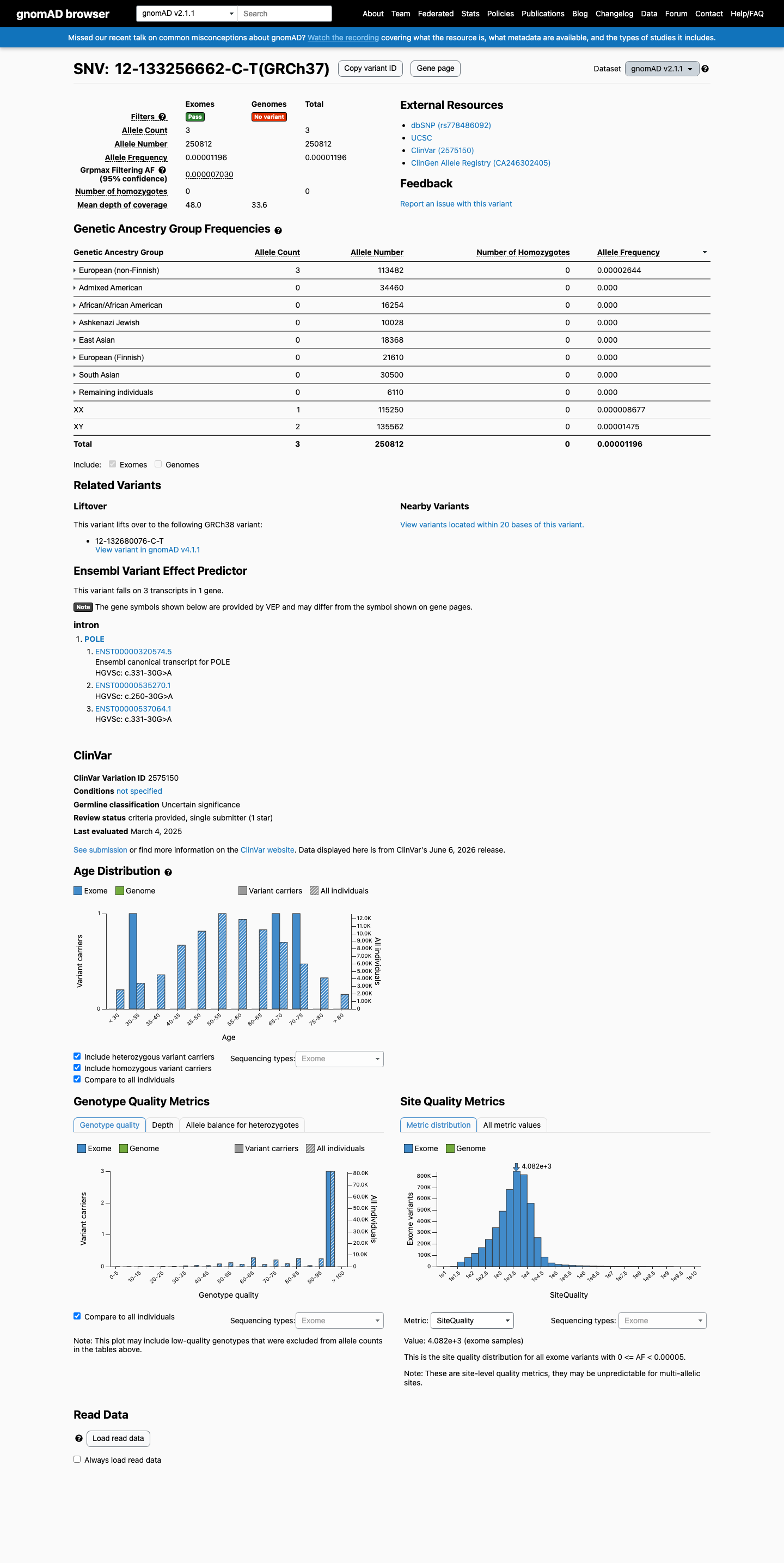
gnomAD v4.1 AF = 3.37335e-05 (0.00337%), 54/1,600,784 alleles, 0 homozygotes; grpmax FAF = 3.621e-05 (source: gnomad_v4)gnomAD v2.1 AF = 1.19612e-05 (0.00120%), 3/250,812 alleles, 0 homozygotes (source: gnomad_v2)Variant absent from gnomAD-Canada v1.0 (source: gnomad_canada)
BP4 supporting Benign
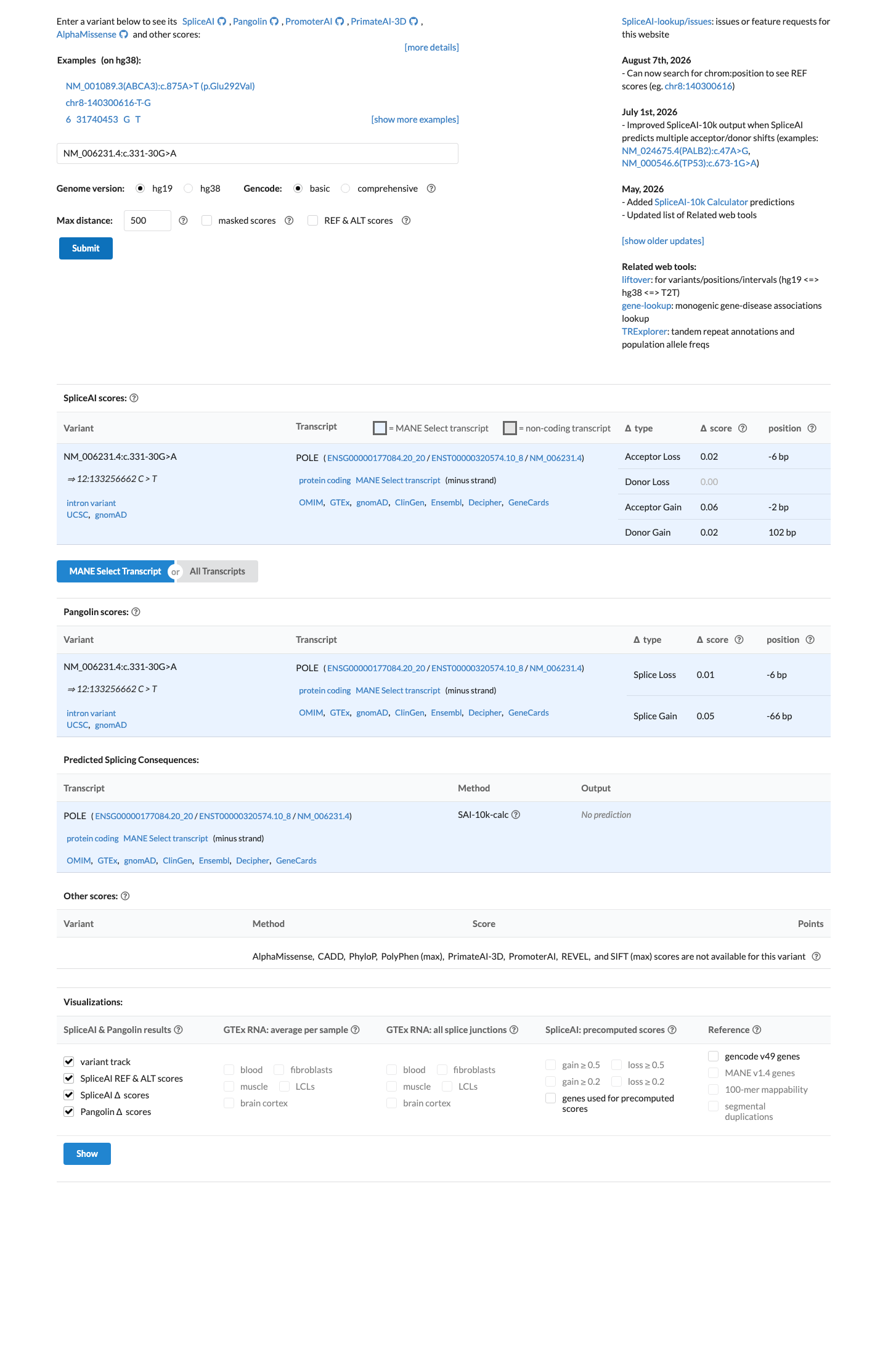
Met (supporting): SpliceAI max delta 0.06 is below the <0.1 BP4 threshold, predicting no impact on splicing.
SpliceAI max delta 0.06 < 0.1, the BP4 threshold for intronic variants (SVI Splicing Subgroup thresholds per Walker et al. 2023, PMID 37352859) -> BP4 (supporting)Generic in-silico calibration (generic_acmg_combination_rules): for intronic, synonymous, or non-canonical-splice-position variants use SpliceAI only; SpliceAI max delta < 0.1 -> BP4 (supporting); max delta 0.06 falls in this range, not the [0.1, 0.2] gray zoneACMG/AMP 2015 BP4 definition, PMID 25741868: 'Multiple lines of computational evidence suggest no impact on gene or gene product (conservation, evolutionary, splicing, etc.)' - governing definition; the generic calibration designates SpliceAI as the splice predictor for intronic variants
Assessed · not applied
Pathogenic
PVS1 Not met: intronic variant with no null-variant mechanism and SpliceAI max delta 0.06, below any splice-disruption evidence threshold.
PS2 Not assessed: no de novo observation, parental testing, or identity confirmation data exist for this variant.
PS3 Not assessed: no variant-specific functional studies (RNA, minigene, or enzyme-activity assays) were available.
PS4 Not assessed: insufficient case-level evidence was available to evaluate this criterion.
PM3 Not assessed: no proband or family genotype data exist to determine trans configuration with a pathogenic POLE variant.
PM6 Not assessed: no parental samples or family-history evidence of de novo occurrence was available.
PP1 Not assessed: no affected family members have been genotyped, so no segregation data exist for this variant.
PP3 Not met: SpliceAI max delta 0.06 is below the >0.2 PP3 threshold, predicting no splice impact.
PP4 Not assessed: insufficient evidence was available to evaluate this criterion.
PP5 Not assessed: the only ClinVar record is a 1-star single-submitter VUS, not a reputable-source pathogenic rating.
Benign
BA1 Not met: highest observed allele frequency 0.0046% (gnomAD v4.1 non-Finnish European) is ~1000-fold below the 5% BA1 threshold.
BS1 Not met: observed allele frequency (max 0.0046%) is orders of magnitude below any frequency expected for these rare POLE disorders.
BS2 Not met: zero homozygotes in ~1.85 million alleles, and the adult-onset POLE phenotype does not meet the early full-penetrance requirement.
BS3 Not assessed: no mRNA-level functional studies (patient RNA or minigene splicing assays) were available for this variant.
BS4 Not assessed: no family studies exist to document lack of segregation in affected members.
BP1 Not met: variant is intronic, and POLE's established disease mechanism is missense, not primarily truncating.
BP2 Not assessed: no cis/trans phase determination with a pathogenic POLE variant was available.
BP5 Not assessed: insufficient evidence was available to evaluate this criterion.
BP6 Not assessed: the only ClinVar record is a 1-star single-submitter VUS, providing no reputable-source benign rating.
N/A · 7 PS1 · PM1 · PM4 · PM5 · PP2 · BP3 · BP7
Research & evidence
Population frequency
gnomAD v4.1 screenshot
gnomAD v4.1
gnomAD v2.1 screenshot
gnomAD v2.1
v4.1
This variant is present in gnomAD v4.1 (AF= 3.37335e-05; MAF= 0.00337%, 54/1600784 alleles, homozygotes = 0) and has highest observed frequency in the European (non-Finnish) population (AF= 4.62231e-05; MAF= 0.00462%, 54/1168248 alleles, homozygotes = 0); grpmax FAF= 3.621e-05.
v2.1
This variant is present in gnomAD v2.1 (AF= 1.19612e-05; MAF= 0.00120%, 3/250812 alleles, homozygotes = 0) and has highest observed frequency in the European (non-Finnish) population (AF= 2.64359e-05; MAF= 0.00264%, 3/113482 alleles, homozygotes = 0); grpmax FAF= 7.03e-06.
🇨🇦 CA
Absent from gnomAD-Canada v1.0.
Allele frequency by ancestry
three datasets · side by side
gnomAD v4.1
0.0034% · 54 / 1,600,784
0 hom · FAF 0.0036%
European (non-Finnish)
54 / 1,168,248
0.0046%
+ 9 not observed (Remaining individuals, Admixed American, European (Finnish), Amish, East Asian, Middle Eastern, South Asian, Ashkenazi Jewish, African/African American)
gnomAD v2.1
0.0012% · 3 / 250,812
0 hom · FAF 0.0007%
European (non-Finnish)
3 / 113,482
0.0026%
+ 7 not observed (African/African American, Admixed American, Ashkenazi Jewish, East Asian, European (Finnish), Remaining individuals, South Asian)
gnomAD Canada 🇨🇦
Absent · 0 / ?
0 hom
Not observed in any ancestry group.
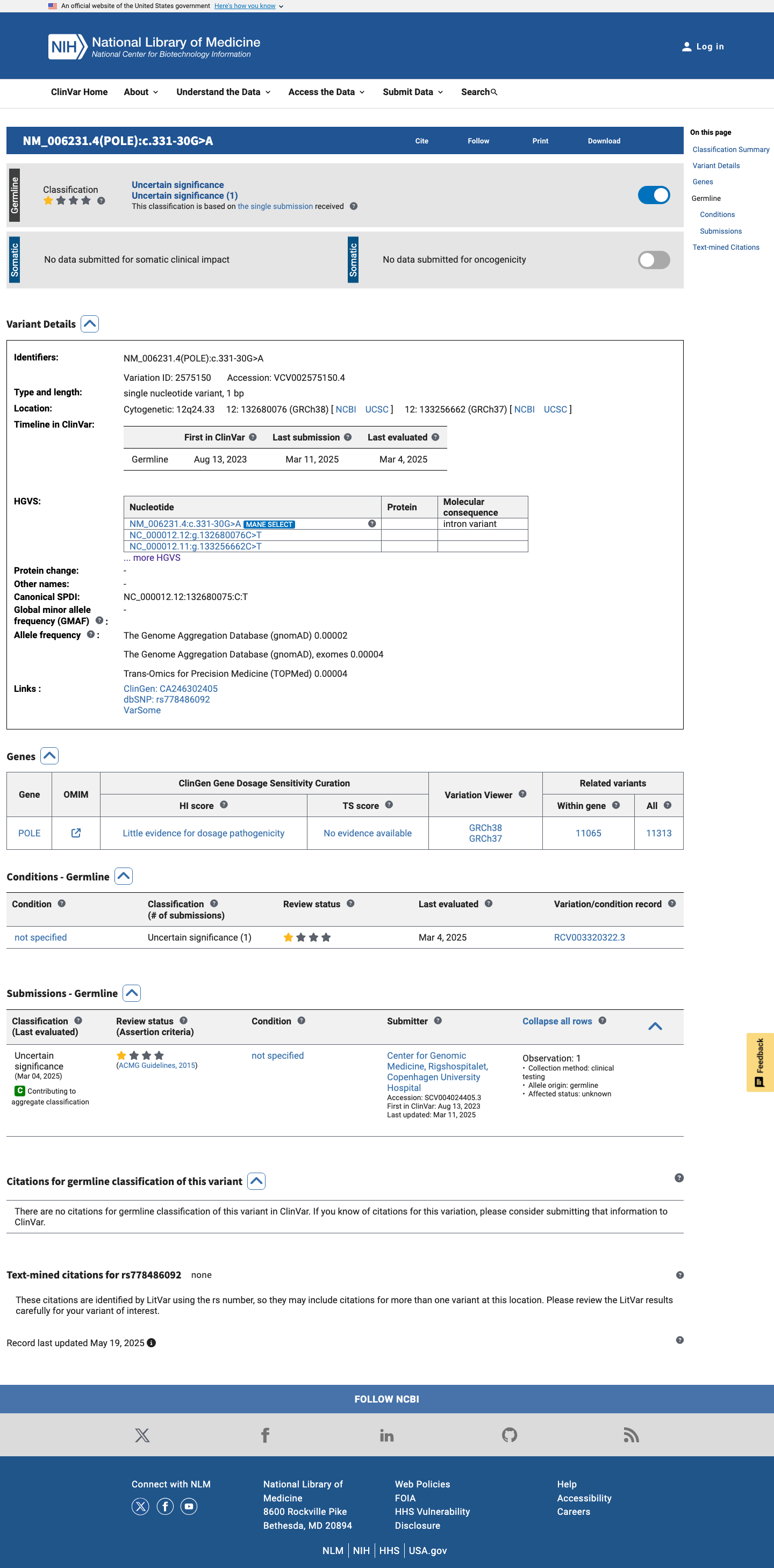
ClinVar screenshot
ClinVar
This variant has been reported in ClinVar as Uncertain significance (1 clinical laboratory). (ClinVarID = 2575150)
SpliceAI screenshot
In silico
SpliceAI predicts no significant splice impact for this variant (max delta score = 0.06).
Functional No data
No calibrated functional assay or RNA evidence was identified for this variant.
OncoKB ↗
COSMIC screenshot
COSMIC
Somatic evidence
COSMIC
This variant has not previously been reported in somatic cancers (COSMIC).
Hotspots
This variant does not lie in a statistically significant cancer hotspot.
COSMIC ↗
Literature · how each cited paper was used
1papers cited
Each card is an audit: what was searched, what was found, whether it names the variant, which criteria it fed, and why.
Rule & framework references · cited for criterion definitions, not variant evidence
25741868 ↗ Standards and guidelines for the interpretation of sequence variants: a joint consensus recommendation of the American College of Medical Genetics and Genomics and the Association for Molecular Pathology.
Sources & reference links
7Sources
ClinVar
gnomAD v2.1
gnomAD v4.1
gnomAD-Canada
SpliceAI
OncoKB
COSMIC