Back
NM_058216.3:c.187A>T
p.Ile63Phe · RAD51C
0%
complete
Final classification
VUS
PM2BP4
RAD51C
c.187A>T
p.Ile63Phe

RAD51C encodes a member of the RAD51 recombinase family that is central to repairing double-stranded DNA breaks via homologous recombination, helping assemble RAD51 filaments and resolve Holliday junctions. Mutations in this gene cause Fanconi anemia complementation group O, and germline mutations increase susceptibility to ovarian cancer and possibly breast cancer. RAD51C acts as a tumor suppressor: it is infrequently mutated in human cancers, but its expression is reduced in a subset of breast tumors, and it resides in a region of chromosome 17 that is frequently amplified in breast cancer.

This variant

RAD51C is a homologous-recombination DNA-repair tumor suppressor whose germline variants raise ovarian cancer susceptibility and cause Fanconi anemia complementation group O. This missense change, p.(Ile63Phe), remains a variant of uncertain significance: it is absent from large population databases yet computationally benign-leaning, and no functional, segregation, or case data establish whether it impairs RAD51C's DNA-repair function.

Transcript
NM_058216.3
HGVS · transcript:coding
NM_058216.3:c.187A>T
GRCh38
chr17:58694972 A>T
GRCh37
chr17:56772333 A>T
VUS: the applied criteria PM2 (supporting) and BP4 (supporting) conflict - one pathogenic-direction, one benign-direction - satisfying no ACMG/AMP combination rule.
Classification rationale
PM2 BP4 VUS
RAD51C c.187A>T

PM2 (Supporting): absent from gnomAD v2.1 and v4.1 (~856k exomes combined), allele frequency 0. BP4 (Supporting): REVEL 0.084 falls in the SVI-calibrated benign-leaning interval (0.016-0.183). VUS: PM2 (pathogenic direction) and BP4 (benign direction) conflict at supporting strength, satisfying no ACMG/AMP combination rule.

PM2 + BP4 → VUS
LYFE Sciences is an AI system, and it can make mistakes. Criteria may be applied incorrectly, sources may be misread, and a confident-looking classification can still be wrong. Double-check every criterion and its underlying evidence before relying on any call.
Gene diagram · NM_058216.3 · variants mapped to exon structure
RAD51C NM_058216.3
Fetching transcript structure from UCSC…
Applied criteria · 2 applied · 22 assessed
MetEvidence satisfies this criterion.
Not metEvaluated against available evidence; threshold not reached.
Not assessedApplies in principle, but no evidence was found to evaluate it.
N/ADoesn't apply to this variant type.
Applied · 2
Strength Supporting Moderate Strong Very strong
PM2 supporting Pathogenic
Met (supporting): absent from gnomAD v2.1 (~125.7k exomes) and v4.1 (~730.9k exomes), allele frequency 0.
gnomAD v2.1 (exome, ~125.7k individuals): variant 17-56772333-A-T absent (search_status 'absent', found=false, AF=0) (registry key: gnomad_v2).gnomAD v4.1 (exome, ~730.9k individuals): variant chr17-58694972-A-T absent (search_status 'absent', found=false, AF=0) (registry key: gnomad_v4).Generic ACMG/AMP 2015 PM2: absent in large population cohorts (or extremely low frequency if recessive) (Richards et al. 2015, PMID 25741868); local non-VCEP operating threshold PM2 <0.1% (registry key: generic_acmg_combination_rules). Absence (AF=0) satisfies PM2.
BP4 supporting Benign
Met (supporting): REVEL 0.084 falls in the SVI-calibrated BP4 interval (0.016-0.183), strongly benign-leaning.
REVEL score 0.084 falls within the ClinGen SVI-calibrated REVEL BP4 moderate interval (0.016 < score <= 0.183; Pejaver et al. 2022, Am J Hum Genet, PMID 36413997, Table 2); BP4 applied at supporting strength per the governing generic ACMG/AMP fallback framework (Richards et al. 2015, PMID 25741868), which caps PP3/BP4 at supporting.BayesDel noAF score -0.3387 falls within the SVI-calibrated BayesDel BP4 supporting interval (-0.36 < score <= -0.18; Pejaver et al. 2022, PMID 36413997, Table 2); concordant with BP4 but not counted as a separate line (single-tool framework for missense).SpliceAI max delta 0.01, below the 0.2 splice-altering threshold (Jaganathan et al. 2019, Cell, PMID 30661751); concordant with no splice impact, but the splice path does not independently govern for a missense variant; not counted as a separate line.
Assessed · not applied · 11 not met · 11 not assessed
Pathogenic
PS1 Not met: no established pathogenic variant producing the same amino acid change p.(Ile63Phe) is documented.
PS2 Not assessed: no proband or parental genotype data were available to evaluate a de novo occurrence.
PS3 Not assessed: no functional assay evidence for p.(Ile63Phe) was identified in any consulted source.
PS4 Not assessed: no case-control or case-series data exist for this exact variant.
PM1 Not met: residue 63 is not a documented cancer hotspot, and no functional-domain annotation was available.
PM3 Not assessed: no biallelic or in-trans observation of c.187A>T with a pathogenic RAD51C variant is documented.
PM5 Not met: no pathogenic missense variant at a different amino acid at residue 63 is documented.
PM6 Not assessed: no de novo occurrence is reported and no proband or parental genotype data exist.
PP1 Not assessed: no segregation data exist for c.187A>T - no affected family members were genotyped.
PP2 Not met: missense is not a common mechanism of RAD51C disease, which is predominantly loss-of-function.
PP3 Not met: REVEL 0.084 is far below the >=0.644 threshold for a damaging prediction.
PP4 Not assessed: no proband phenotype or family-history information is available for any carrier.
PP5 Not met: no ClinVar expert-panel pathogenic classification exists; only a single-laboratory Benign assertion.
Benign
BA1 Not met: allele frequency is 0 (absent from gnomAD), far below the >1% BA1 threshold.
BS1 Not met: allele frequency is 0, far below the >0.3% BS1 threshold.
BS2 Not met: no healthy-adult or control observation exists; zero carriers among ~856k gnomAD exomes.
BS3 Not assessed: no well-established functional study of p.(Ile63Phe) is available.
BS4 Not assessed: no affected family members were genotyped, so non-segregation cannot be evaluated.
BP1 Not met: missense variants are an established disease mechanism in RAD51C, so BP1's truncating-only precondition fails.
BP2 Not assessed: no cis/trans phase observation relative to a pathogenic RAD51C variant exists.
BP5 Not assessed: no case data exist to evaluate an alternative molecular cause of disease.
BP6 Not met: the Benign label is from a single laboratory, not a ClinVar expert panel, so BP6's precondition fails.
N/A · 4 PVS1 · PM4 · BP3 · BP7
Research & evidence
Population frequency
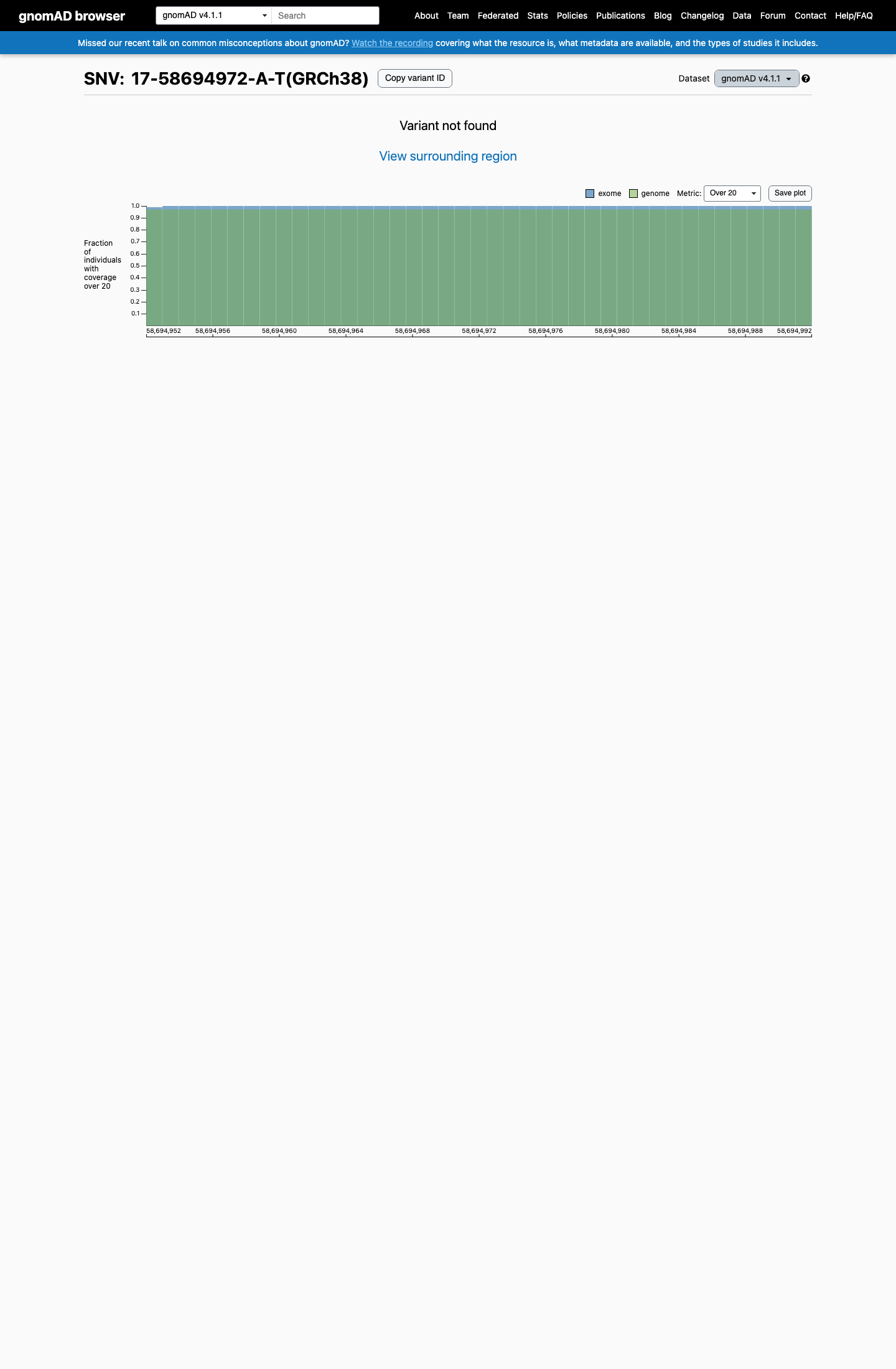
gnomAD v4.1 screenshot
gnomAD v4.1
gnomAD v2.1 screenshot
gnomAD v2.1
v4.1
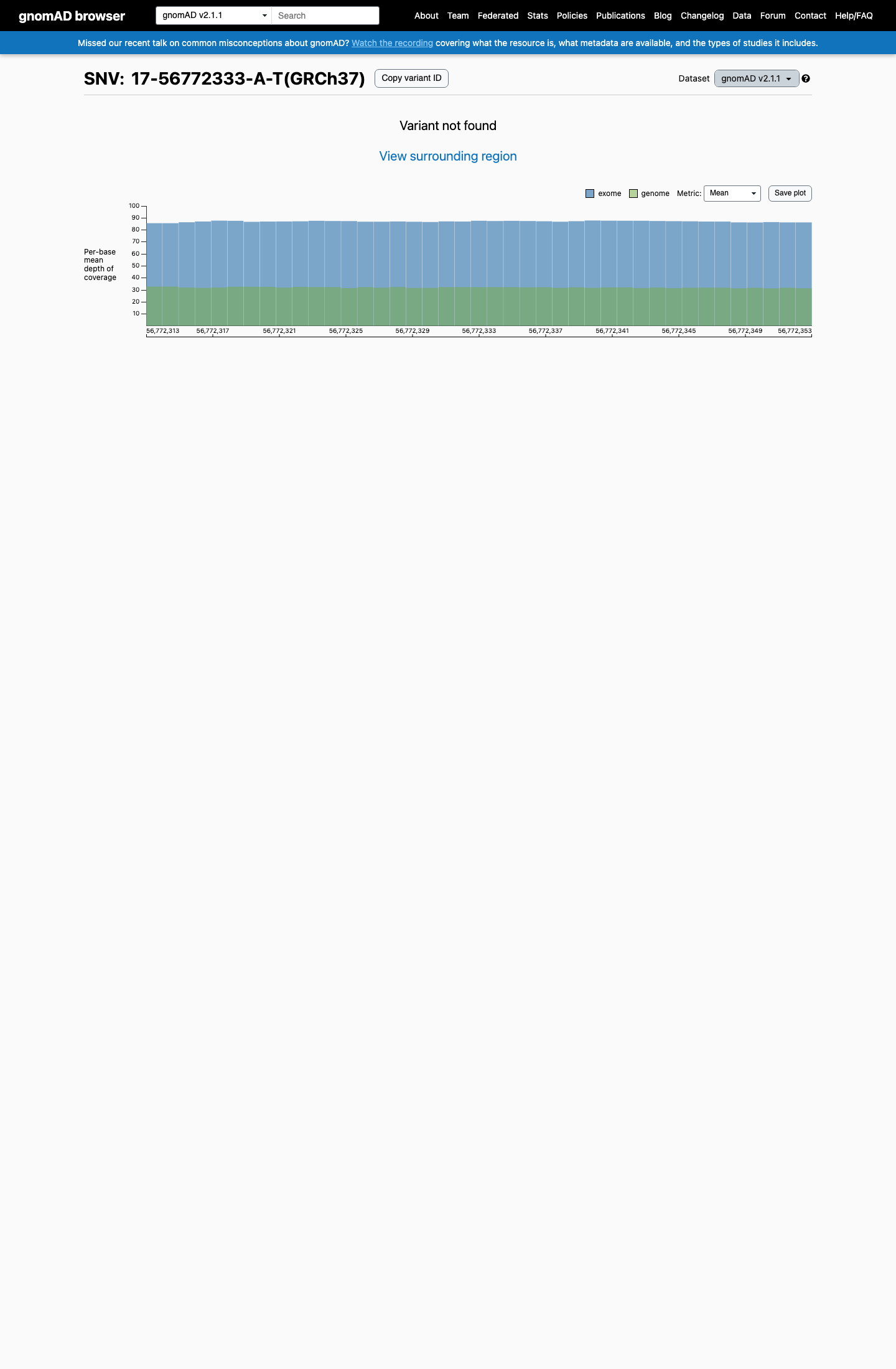
Absent from gnomAD v4.1.
v2.1
Absent from gnomAD v2.1.
🇨🇦 CA
Not available in gnomAD-Canada v1.0.
Allele frequency by ancestry
three datasets · side by side
gnomAD v4.1
Absent · 0 / ?
0 hom
Not observed in any ancestry group.
gnomAD v2.1
Absent · 0 / ?
0 hom
Not observed in any ancestry group.
gnomAD Canada 🇨🇦
Absent · 0 / ?
0 hom
Not observed in any ancestry group.
ClinVar screenshot
ClinVar
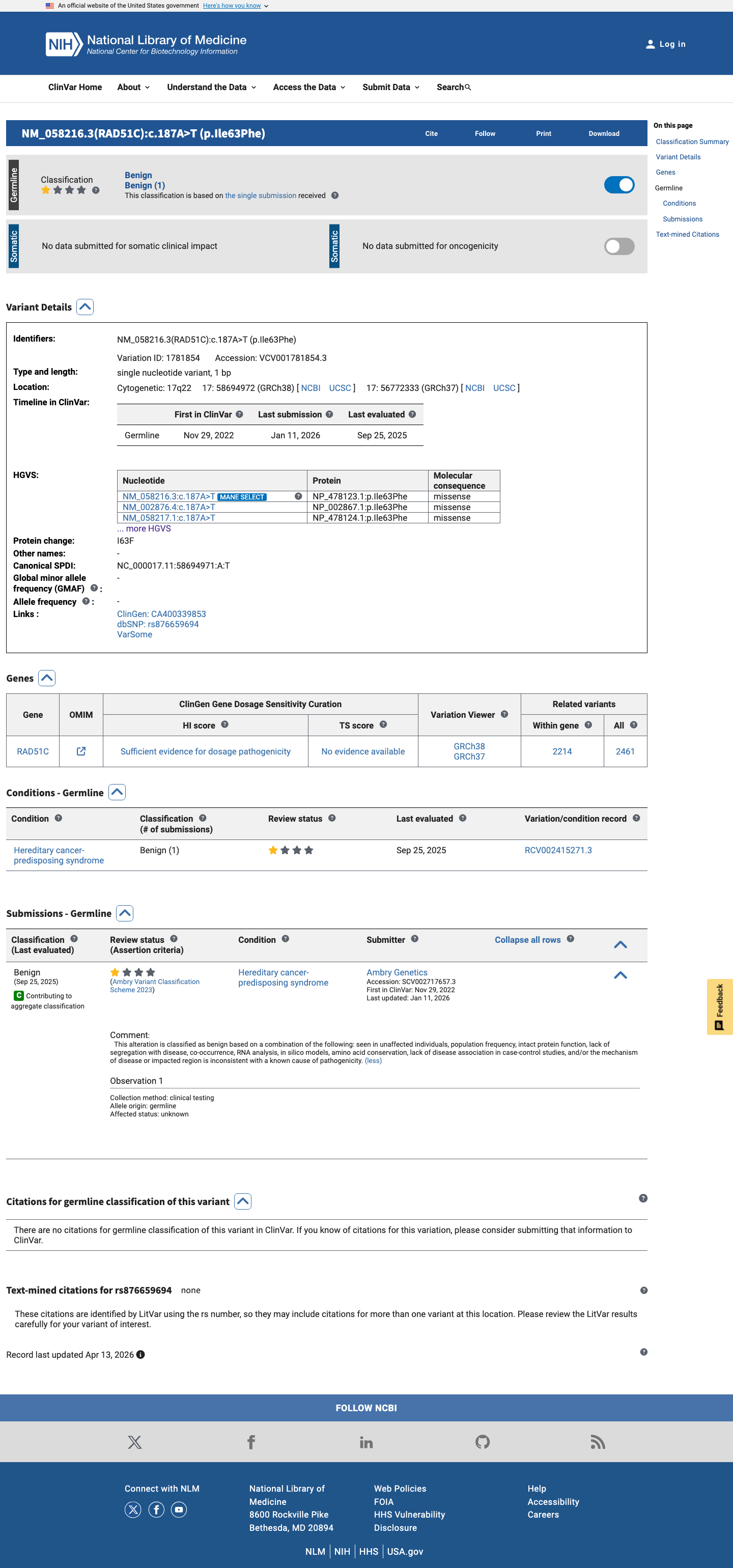
This variant has been reported in ClinVar as Benign (1 clinical laboratory). (ClinVarID = 1781854)
SpliceAI screenshot
In silico
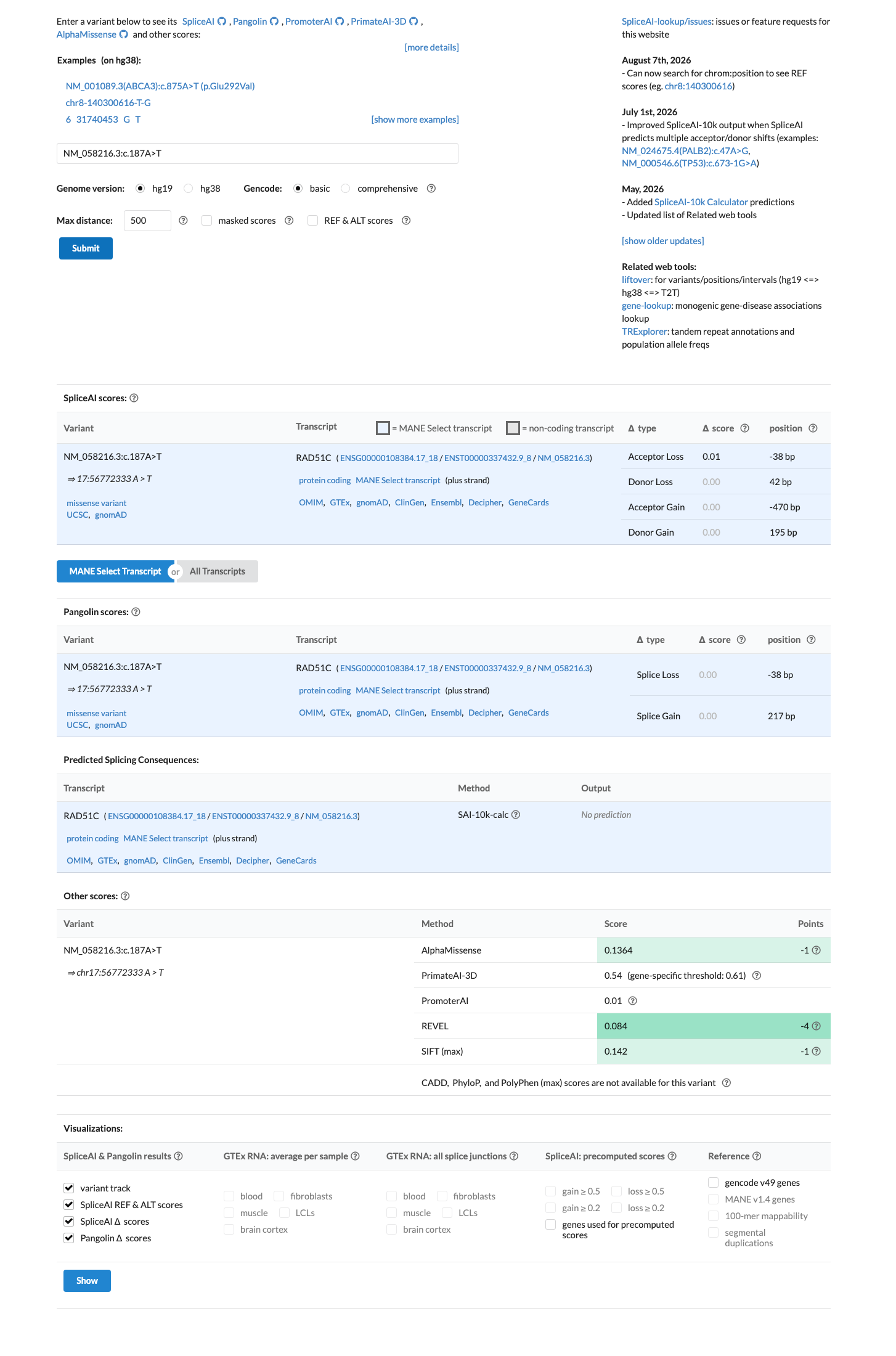
SpliceAI predicts no significant splice impact for this variant (max delta score = 0.01). REVEL score = 0.084. BayesDel score = -0.338738.
Functional / OncoKB screenshot
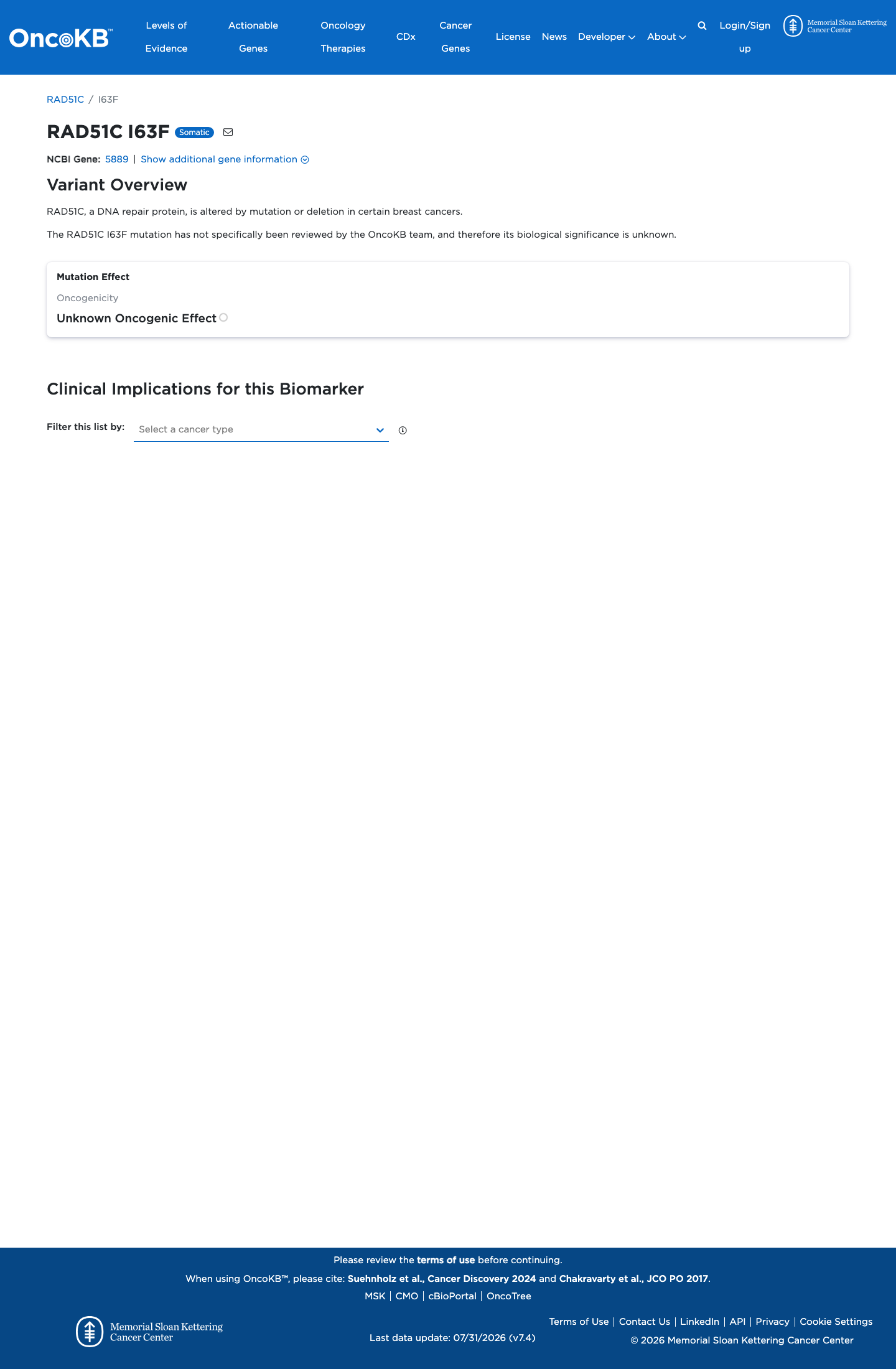
Functional Unknown Oncogenic Effect
OncoKB did not identify variant-specific reviewed functional evidence for this variant; gene-level curated context is available for reviewer follow-up. RAD51C, a DNA repair protein, is altered by mutation or deletion in certain breast cancers.
OncoKB ↗
COSMIC screenshot
COSMIC
Cancer hotspots screenshot
Cancer hotspots
Somatic evidence Not in COSMIC / hotspots
COSMIC
This variant does not lie in a statistically significant hotspot. This variant has not previously been reported in somatic cancers (COSMIC).
Hotspots
This variant does not lie in a statistically significant hotspot.
Literature · how each cited paper was used
1papers cited
Each card is an audit: what was searched, what was found, whether it names the variant, which criteria it fed, and why.
Rule & framework references · cited for criterion definitions, not variant evidence
25394175 ↗ A practice guideline from the American College of Medical Genetics and Genomics and the National Society of Genetic Counselors: referral indications for cancer predisposition assessment.
Sources & reference links
9Sources
CSpec VCEP
ClinVar
gnomAD v2.1
gnomAD v4.1
gnomAD-Canada
SpliceAI
OncoKB
COSMIC
Cancer hotspots