Analysis in progress
Initialising…
0%
complete
This report is still being assembled — sections appear as each stage finishes. It isn't final yet.
MSH3
Final classification
VUS
MSH3 c.2041C>T · p.Pro681Ser
MSH3

BP1 (Supporting): MSH3 germline disease is driven by truncating variants, and no pathogenic missense in MSH3 is established, so this missense change is consistent with a benign role.

Gene
MSH3
Transcript
NM_002439.5
HGVS · transcript:coding
NM_002439.5:c.2041C>T
Consequence
N/A
GRCh38
chr5:80768077 C>T
GRCh37
chr5:80063896 C>T
Basis Under generic ACMG/AMP 2015 rules (no MSH3 VCEP exists), the only met criterion is BP1 at supporting strength, which alone is insufficient for Benign or Likely Benign, so the variant is a VUS.
Under generic ACMG/AMP 2015 rules (no MSH3 VCEP exists), the only met criterion is BP1 at supporting strength, which alone is insufficient for Benign or Likely Benign, so the variant is a VUS.
Classification rationale
BP1 VUS
MSH3 c.2041C>T

BP1 (Supporting): MSH3 germline disease is driven by truncating variants, and no pathogenic missense in MSH3 is established, so this missense change is consistent with a benign role. Classification: VUS — a single supporting benign criterion does not reach the Benign (BA1 alone, or 2 BS) or Likely Benign (1 BS + 1 BP, or 2 BP) combination thresholds under generic ACMG/AMP 2015.

BP1 VUS
Gene diagram · NM_002439.5 · variants mapped to exon structure
MSH3 NM_002439.5
Fetching transcript structure from UCSC…
Applied criteria · 1 applied · 23 assessed
Applied · 1
Strength Supporting Moderate Strong Very strong
BP1 supporting review Benign
Met (supporting): MSH3 disease is truncation-mediated with no established pathogenic missense, so this missense favors a benign role. Flagged for human review: the pathogenic MSH3 missense spectrum is small and no VCEP governs this gene.
pvs1_gene_context.json: MSH3 germline disease mechanism is loss-of-function (biallelic FAP4); lof_mechanism_supported=truegene_context_MSH3.json: MSH3 acts as a tumor suppressor; inherited mutations associated with autosomal recessive FAP, minimal evidence for Lynch-syndrome rolePMID:11470537 (Ohmiya et al. 2001): hMSH3 frameshift mutations in the (A)8 tract are the recurrent secondary-mutator alterations; biallelic frameshift mutations found in tumors; only one germline missense (p.Pro681Ser) detected and not established pathogenic
Assessed · not applied
Pathogenic
PS1 Not met: the same change, p.(Pro681Ser), appears in the literature and ClinVar, but no source establishes it as pathogenic.
PS2 Not assessed: no proband-parent trio or parental-testing data exists for this variant in any source.
PS3 Not assessed: no functional study of this variant exists; a ClinVar submitter states none have been performed.
PS4 Not met: the single carrier in 199 cases (0.5%) does not exceed the 0.229% population frequency, so no enrichment is demonstrated.
PM1 Not met: despite a conserved ATPase-region location, 7 gnomAD v4.1 homozygotes show benign variation at this exact residue.
PM2 Not met: the highest population allele frequency (0.229% in gnomAD v4.1) exceeds the 0.1% PM2 threshold.
PM3 Not assessed: no source provides phase or second-allele data showing the variant in trans with a pathogenic MSH3 variant.
PM5 Not assessed: no alternate missense change at codon 681 with an established pathogenic classification was identified.
PM6 Not assessed: no de novo or assumed-de-novo occurrence is reported in ClinVar or the variant-bearing publications.
PP1 Not assessed: no affected relatives of any carrier have been genotyped, so co-segregation cannot be evaluated.
PP2 Not met: MSH3 is missense-tolerant (this variant has 7 gnomAD v4.1 homozygotes), and disease is loss-of-function mediated, not missense-driven.
PP3 Not met: REVEL 0.496 falls below the 0.773 PP3 supporting threshold, and SpliceAI 0.03 predicts no splice impact.
PP4 Not assessed: no documented proband phenotype or family history is available to evaluate.
PP5 Not met: ClinVar VCV000656200 has zero expert-panel submissions, and PP5 requires an exact-variant expert-panel pathogenic classification.
Benign
BA1 Not met: the highest allele frequency (0.229%) is far below the 5% BA1 stand-alone threshold.
BS1 Not met: the highest allele frequency (0.229%) falls below the 0.3% BS1 operating threshold.
BS2 Not met: although 7 gnomAD v4.1 homozygotes exist, MSH3 polyposis is adult-onset and incompletely penetrant, failing BS2's early-age full-penetrance requirement.
BS3 Not assessed: no functional assay of this variant exists; population frequency and in silico scores cannot substitute.
BS4 Not assessed: no affected family member of any carrier has been genotyped, so lack of segregation cannot be shown.
BP2 Not assessed: no phase data exists to show the variant in cis or trans with a pathogenic variant.
BP4 Not met: REVEL 0.496 exceeds the 0.016 BP4 threshold, leaving SpliceAI 0.03 as the only benign-direction line.
BP5 Not assessed: no co-occurring pathogenic variant in another gene is documented, and no proband genotype data exists.
BP6 Not met: ClinVar has zero expert-panel submissions; the six likely-benign assertions are ordinary laboratory calls, which never trigger BP6.
N/A · 4 PVS1 · PM4 · BP3 · BP7
Research & evidence
Population frequency
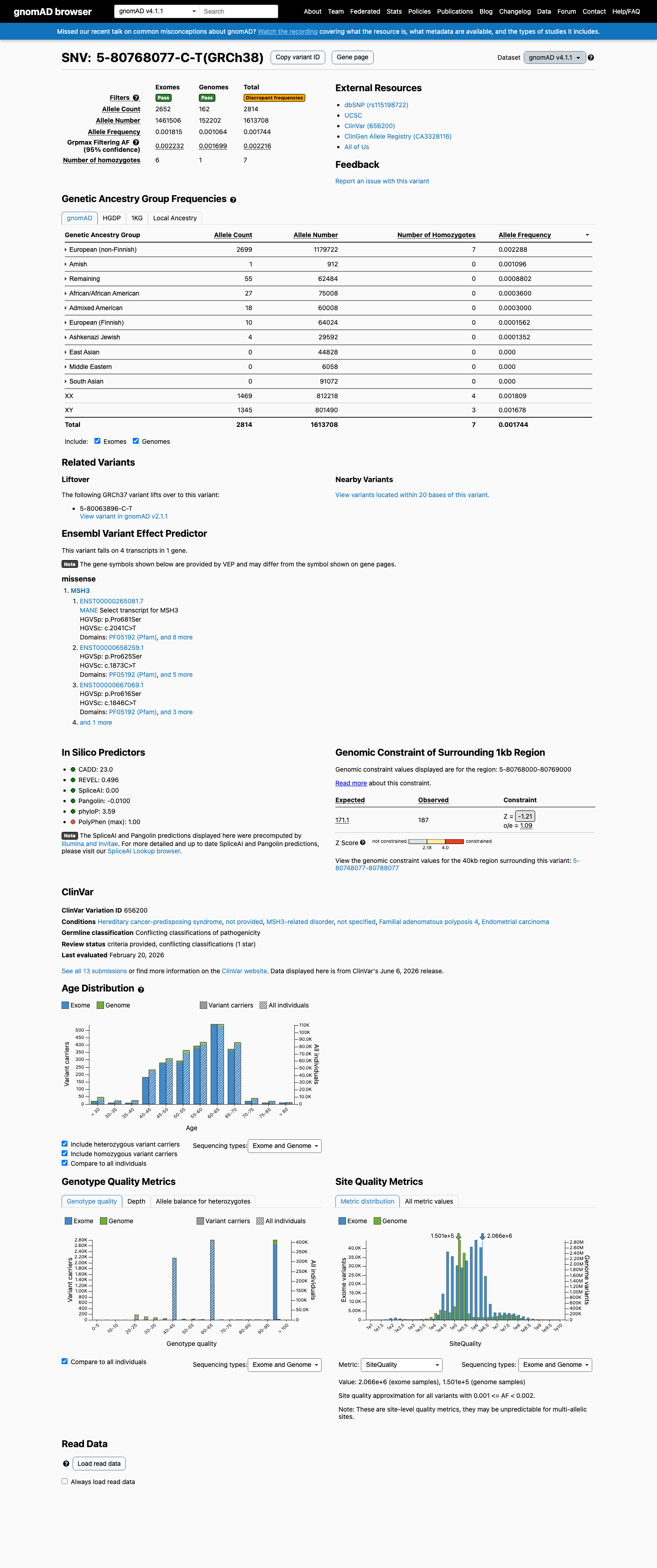
gnomAD v4.1 screenshot
gnomAD v4.1
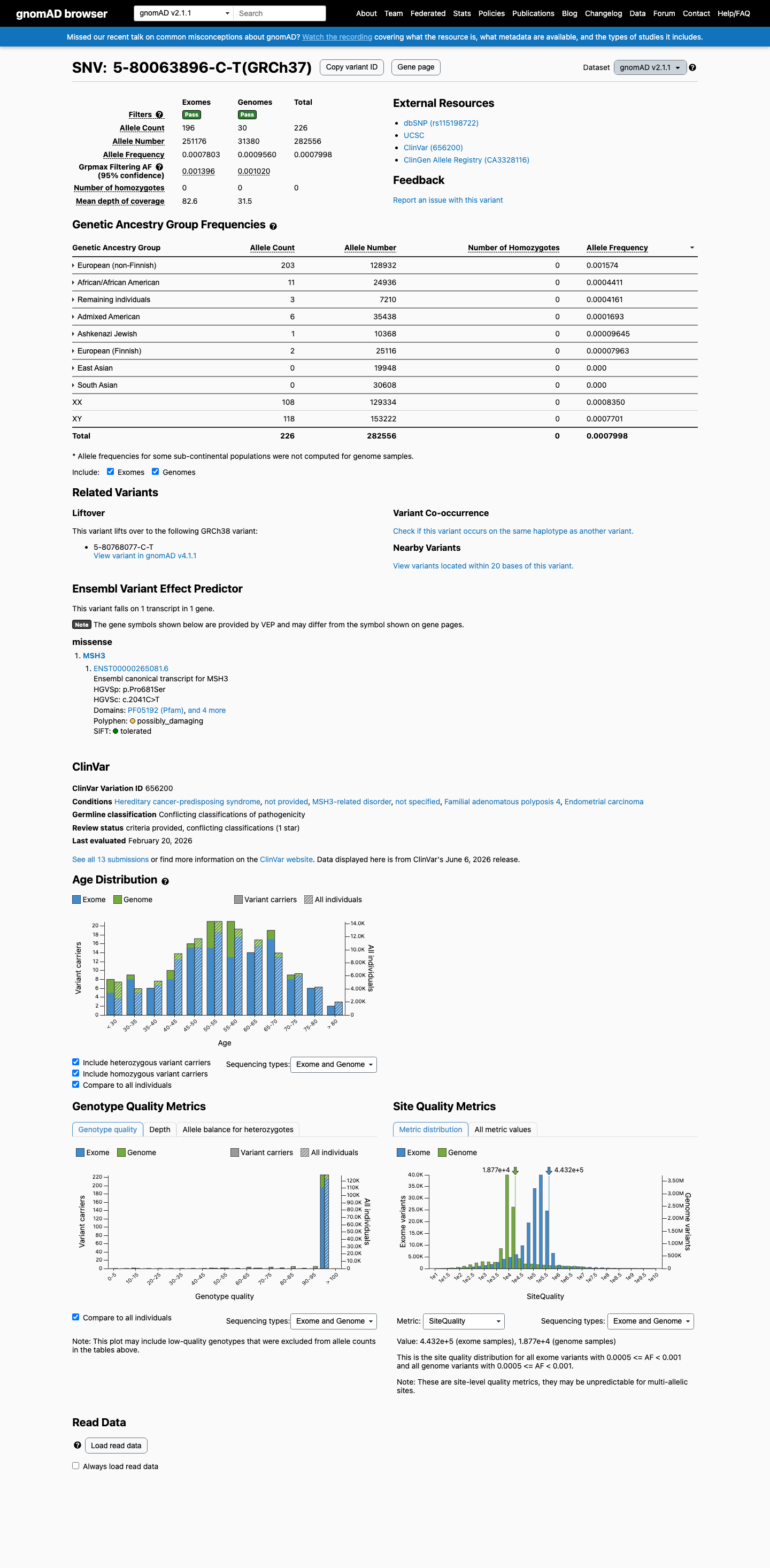
gnomAD v2.1 screenshot
gnomAD v2.1
v4.1
This variant is present in gnomAD v4.1 (AF= 0.00174381; MAF= 0.17438%, 2814/1613708 alleles, homozygotes = 7) and has highest observed frequency in the European (non-Finnish) population (AF= 0.00228783; MAF= 0.22878%, 2699/1179722 alleles, homozygotes = 7); grpmax FAF= 0.00221552.
v2.1
This variant is present in gnomAD v2.1 (AF= 0.000799841; MAF= 0.07998%, 226/282556 alleles, homozygotes = 0) and has highest observed frequency in the European (non-Finnish) population (AF= 0.00157447; MAF= 0.15745%, 203/128932 alleles, homozygotes = 0); grpmax FAF= 0.00139623.
🇨🇦 CA
Not available in gnomAD-Canada v1.0.
Allele frequency by ancestry
three datasets · side by side
gnomAD v4.1
0.17% · 2814 / 1,613,708
7 hom · FAF 0.22%
European (non-Finnish)
2699 / 1,179,722
0.23%
7 hom
Amish
1 / 912
0.11%
Remaining individuals
55 / 62,484
0.088%
African/African American
27 / 75,008
0.036%
Admixed American
18 / 60,008
0.03%
European (Finnish)
10 / 64,024
0.016%
Ashkenazi Jewish
4 / 29,592
0.014%
+ 3 not observed (East Asian, Middle Eastern, South Asian)
gnomAD v2.1
0.08% · 226 / 282,556
0 hom · FAF 0.14%
European (non-Finnish)
203 / 128,932
0.16%
African/African American
11 / 24,936
0.044%
Remaining individuals
3 / 7,210
0.042%
Admixed American
6 / 35,438
0.017%
Ashkenazi Jewish
1 / 10,368
0.0096%
European (Finnish)
2 / 25,116
0.008%
+ 2 not observed (East Asian, South Asian)
gnomAD Canada 🇨🇦
Absent · 0 / ?
0 hom
Not observed in any ancestry group.
ClinVar screenshot
ClinVar
This variant has been reported in ClinVar as Uncertain significance (7 clinical laboratories) and as Likely benign (6 clinical laboratories). (ClinVarID = 656200)
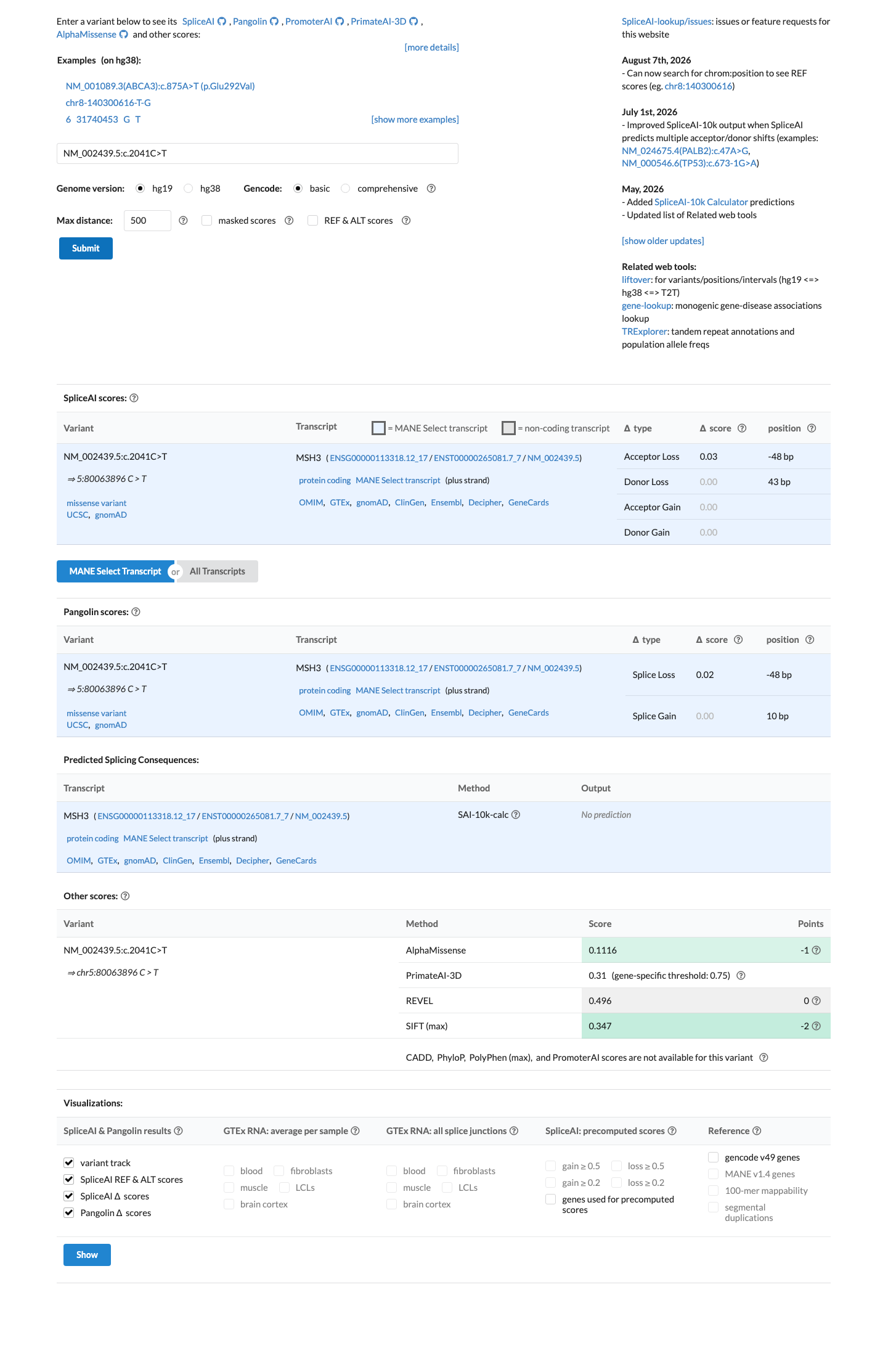
SpliceAI screenshot
In silico
SpliceAI predicts no significant splice impact for this variant (max delta score = 0.03). REVEL score = 0.496. BayesDel score = -0.131816.
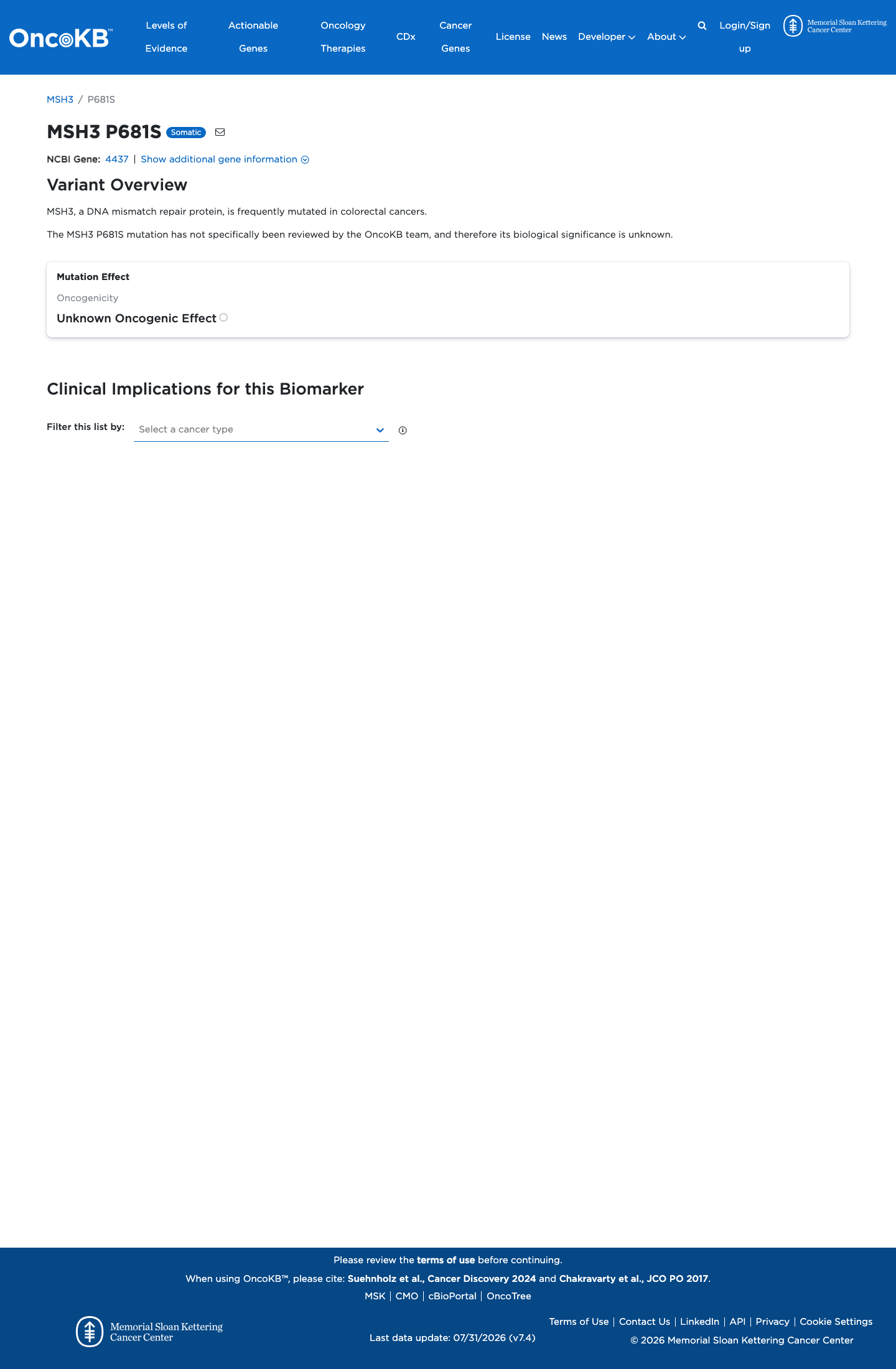
Functional / OncoKB screenshot
Functional Unknown Oncogenic Effect
OncoKB did not identify variant-specific reviewed functional evidence for this variant; gene-level curated context is available for reviewer follow-up. MSH3, a DNA mismatch repair protein, is frequently mutated in colorectal cancers.
OncoKB ↗
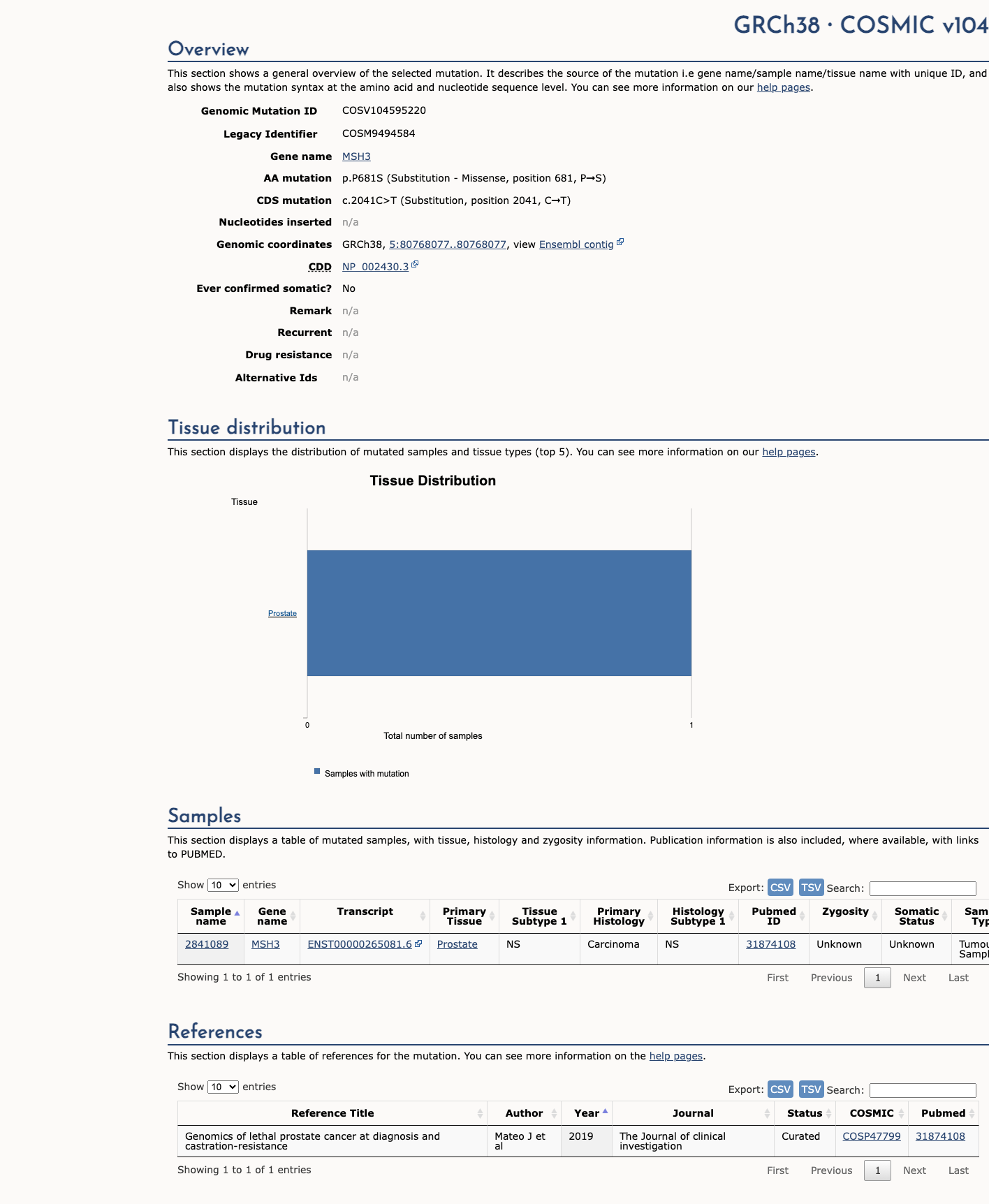
COSMIC screenshot
COSMIC
Cancer hotspots screenshot
Cancer hotspots
Somatic evidence Not in COSMIC / hotspots
COSMIC
This variant does not lie in a statistically significant hotspot. This variant has previously been reported in somatic cancers (COSMIC; COSV104595220, n = 1 times).
Hotspots
This variant does not lie in a statistically significant hotspot.
Literature · how each cited paper was used
2papers cited
Each card is an audit: what was searched, what was found, whether it names the variant, which criteria it fed, and why. 9 further PMIDs triaged but not cited — see Sources & References.
Germline and somatic mutations in hMSH6 and hMSH3 in gastrointestinal cancers of the microsatellite mutator phenotype.
Searched
c.2041C>Tp.Pro681SerPro681Sercodon 681P681
Found
Ohmiya et al. 2001 screened hMSH6 and hMSH3 in gastrointestinal cancers of the microsatellite mutator phenotype (MMP). In section 3.2 (germline variants of hMSH3), colon tumor 440 harbored a germline missense variant Pro-to-Ser at codon 681 - the same amino-acid change as the queried variant - at a residue conserved in the mouse MSH3 homologue; the variant was not detected in 190 tested individuals. The paper reports this as a germline sequence variant and only speculates in general terms that 'some of these germline and somatic missense variants are pathogenic'; it does not classify p.(Pro681Ser) as pathogenic. The paper also documents that hMSH3 tumor alterations are predominantly frameshift mutations in the (A)8 tract (secondary mutator mutations), with biallelic frameshift mutations in some tumors.
Variant
✓ Names this variant — characterised directly
Applied to
BP1 supporting
Documents the frameshift/truncation-predominant mutation spectrum in hMSH3 (recurrent (A)8 frameshift, biallelic frameshifts in tumors), supporting a primarily truncating disease mechanism
Colon tumor 440 harbored a germline missense variant (Pro ! Ser at codon 681), a residue conserved in the mouse MSH3 homologue (Fig. 3). This variant was not detected in 190 individuals, including 66 other MMP +, 15 MMP1/2 and 108 MMP negative tumors.
Location Section 3.2 'Germline variants of hMSH3' (Gene 272 (2001) 301-313, p. 303-304)  ·  Context PCR-SSCP and sequencing of hMSH6 and hMSH3 in gastrointestinal cancers of the microsatellite mutator phenotype (MMP) plus 190 cancer-free/other-cancer control individuals  ·  full text
Targeted sequencing of genes associated with the mismatch repair pathway in patients with endometrial cancer.
Searched
c.2041C>Tp.Pro681SerPro681Sercodon 681P681
Found
Singh et al. 2020 targeted-sequenced 22 mismatch-repair genes (including MSH3) in endometrial cancer patients and reported the exact queried variant, chr5:g.80063896C>T / NM_002439.4:c.2041C>T p.(Pro681Ser) (rs115198722), with a tumor variant allele fraction of 0.48, ClinVar 'NIL', gnomAD 0.0787%, classified class 3 (VUS). In the Results text, the five MSH3 exonic missense variants found in the cohort (Tyr465Cys, Thr282Ile, Arg411His, Ser466Gly, Pro681Ser) are all stated to be class 3. The paper establishes no pathogenic status for p.(Pro681Ser) and reports no alternate variant at codon 681.
Variant
✓ Names this variant — characterised directly
Applied to
BP1 supporting
Uniformly VUS MSH3 missense variants support a primarily truncating/LoF (not missense) disease mechanism for MSH3
In MSH3 (NM_002439.4) variants were c.1394A>G p.(Tyr465Cys), c.845C>T p.(Thr282Ile), c.1232G>A p.(Arg411His), c.1396A>G p.(Ser466Gly), c.2041C>T p.(Pro681Ser).
Location Table 2 (MSH3 row for sample 051330: Chr5:g.80063896C>T, c.2041C>T, p.(Pro681Ser), rs115198722, Class 3) and Results text 'Exonic variants were also found in five other genes; MSH3...' (PLOS ONE 2020;15(7):e0235613)  ·  Context Targeted sequencing of 22 MMR genes (MLH1, MSH2, MSH6, PMS2, MSH3, PMS1, MLH3, EXO1, RFC1-5, PCNA, LIG1, RPA1-3, POLD1) in endometrial cancer patients; variants classified per ACMG/AMP into classes 1-5  ·  full text
Sources & reference links
8Sources
ClinVar
gnomAD v2.1
gnomAD v4.1
gnomAD-Canada
SpliceAI
OncoKB
COSMIC
Cancer hotspots
Triaged references · 9 PMIDs not cited in assessment
20981092 ↗ A map of human genome variation from population-scale sequencing. CLINVAR
25741868 ↗ Standards and guidelines for the interpretation of sequence variants: a joint consensus recommendation of the American College of Medical Genetics and Genomics and the Association for Molecular Pathology. CLINVAR
26467025 ↗ A Standardized DNA Variant Scoring System for Pathogenicity Assessments in Mendelian Disorders. CLINVAR
28944238 ↗ Targeted sequencing of 36 known or putative colorectal cancer susceptibility genes. CLINVAR
24493721 ↗ American Society of Clinical Oncology Expert Statement: collection and use of a cancer family history for oncology providers. CLINVAR
25394175 ↗ A practice guideline from the American College of Medical Genetics and Genomics and the National Society of Genetic Counselors: referral indications for cancer predisposition assessment. CLINVAR
24905773 ↗ Endometrial cancer: a review and current management strategies: part I. CLINVAR
24929052 ↗ Endometrial cancer: a review and current management strategies: part II. CLINVAR
28492532 ↗ Sherloc: a comprehensive refinement of the ACMG-AMP variant classification criteria. CLINVAR