Back
NM_001127500.2:c.737C>T
p.Pro246Leu · MET
ACMG/AMP
0%
complete
Final classification
VUS
PM2BP4
MET
c.737C>T
p.Pro246Leu

MET encodes a receptor tyrosine kinase that serves as the cell-surface receptor for hepatocyte growth factor (HGF). Upon HGF binding, the receptor activates signaling pathways that promote cell growth, survival, movement, and blood vessel formation, and it plays important roles in embryonic development and tissue repair. Mutations in MET are associated with papillary renal cell carcinoma, hepatocellular carcinoma, and various head and neck cancers, and amplification or overexpression of the gene is found in many human cancers, where it can drive tumor growth and spread.

This variant

MET encodes the HGF receptor tyrosine kinase whose germline activating mutations cause hereditary papillary renal cell carcinoma and contribute to multiple cancers, but this specific p.(Pro246Leu) change lacks functional, segregation, or clinical evidence of disease involvement. Though essentially absent from population databases and computationally predicted tolerated, it remains a variant of uncertain significance until functional or familial studies clarify its role.

Transcript
NM_001127500.2
HGVS · transcript:coding
NM_001127500.2:c.737C>T
GRCh38
chr7:116699821 C>T
GRCh37
chr7:116339875 C>T
VUS: one supporting pathogenic-leaning criterion (PM2, gnomAD AF 1.24e-06) and one supporting benign-leaning criterion (BP4, REVEL 0.287) satisfy no ACMG/AMP combination rule, defaulting to VUS.
Classification rationale
PM2 BP4 VUS
MET c.737C>T

PM2 (Supporting): variant essentially absent from population databases — gnomAD v4.1 AF 1.24e-06 (2/1,614,080 alleles, 0 homozygotes); absent from gnomAD v2.1 and gnomAD-Canada v1.0. BP4 (Supporting): REVEL 0.287 falls within the ClinGen SVI-calibrated BP4-supporting interval (0.183-0.290), predicting a benign/tolerated effect; SpliceAI max delta 0.00 corroborates no splice impact. Final classification VUS: the single supporting pathogenic-leaning criterion (PM2) and single supporting benign-leaning criterion (BP4) satisfy no generic ACMG/AMP combination rule, so the result defaults to VUS.

PM2 + BP4 → VUS
LYFE Sciences is an AI system, and it can make mistakes. Criteria may be applied incorrectly, sources may be misread, and a confident-looking classification can still be wrong. Double-check every criterion and its underlying evidence before relying on any call.
Gene diagram · NM_001127500.2 · variants mapped to exon structure
MET NM_001127500.2
Fetching transcript structure from UCSC…
Applied criteria · 2 applied · 21 assessed
MetEvidence satisfies this criterion.
Not metEvaluated against available evidence; threshold not reached.
Not assessedApplies in principle, but no evidence was found to evaluate it.
N/ADoesn't apply to this variant type.
Applied · 2
Strength Supporting Moderate Strong Very strong
PM2 supporting Pathogenic
Met (supporting): essentially absent from population databases — gnomAD v4.1 AF 1.24e-06 (2/1,614,080 alleles, 0 homozygotes); absent from gnomAD v2.1 and gnomAD-Canada v1.0.
gnomAD v4.1 (gnomad_v4): total AF 1.239095955590801e-06 (2/1,614,080 alleles), 0 homozygotes, exome AF 1.3681743491936664e-06, joint grpmax FAF 2.8e-07 - extremely low frequency consistent with PM2 (Richards et al. 2015, PMID 25741868)gnomAD v2.1 (gnomad_v2): variant absentgnomAD-Canada v1.0 (gnomad_canada): variant absent
BP4 supporting Benign
Met (supporting): REVEL 0.287 falls within the ClinGen SVI-calibrated BP4-supporting interval (0.183-0.290); SpliceAI max delta 0.00 corroborates no splice impact.
REVEL score 0.287 for 7-116699821-C-T (local REVEL v1.3 lookup) - within the ClinGen SVI BP4-supporting range 0.183-0.290 per Pejaver et al. 2022 (PMID 36413997); supports BP4 at supporting strength.SpliceAI max delta 0.00 for NM_001127500.2:c.737C>T (SpliceAI Lookup) - below the recommended 0.2 splice-altering threshold per Jaganathan et al. 2019 (PMID 30661751); no predicted splice impact, corroborating BP4 (not summed for strength).BayesDel score -0.254558 (local BayesDel noAF lookup) - not usable: no verified published calibration threshold can be cited for this predictor; treated as not available for BP4.
Assessed · not applied · 10 not met · 11 not assessed
Pathogenic
PS1 Not met: no pathogenic submission for p.(Pro246Leu) exists in ClinVar; the only entry is a single-submitter Uncertain significance record.
PS2 Not assessed: no de novo occurrence with confirmed maternity and paternity has been reported for this variant.
PS3 Not assessed: no well-established functional studies of this variant exist; in silico scores (REVEL 0.287, SpliceAI 0.00) cannot satisfy PS3.
PS4 Not assessed: no case-control or cohort enrichment data exist for this variant; the sole ClinVar entry supplies no affected-case counts.
PM1 Not met: residue 246 is not a statistically significant cancer hotspot (Cancer Hotspots no_result), and no critical functional domain around it could be established.
PM5 Not met: no pathogenic missense variant at a different amino acid at residue 246 is documented (absence-of-evidence determination).
PM6 Not assessed: no de novo report — confirmed or unconfirmed — for this variant exists.
PP1 Not assessed: no family segregation data exist — no affected relatives tested and no meioses observed.
PP2 Not assessed: no gene-level missense constraint metric (e.g., gnomAD missense z-score) is available to evaluate the low-benign-missense-rate prong.
PP3 Not met: REVEL 0.287 is far below the >=0.644 PP3-supporting threshold, and SpliceAI max delta 0.00 predicts no splice impact.
PP4 Not assessed: no proband phenotype, family history, or clinical summary is available to assess specificity for MET-associated disease.
PP5 Not met: no ClinVar expert-panel Pathogenic/Likely pathogenic classification exists for this exact variant; only a single-laboratory Uncertain significance entry.
Benign
BA1 Not met: gnomAD v4.1 AF 1.24e-06 is more than four orders of magnitude below the >5% BA1 threshold.
BS1 Not met: observed frequency (1.24e-06) is orders of magnitude below any plausible expected-frequency threshold for a germline cancer-predisposition disorder.
BS2 Not met: only 2 unconfirmed heterozygous carriers and 0 homozygotes in gnomAD v4.1; no phenotype-verified unaffected controls.
BS3 Not assessed: no well-established functional studies showing no damaging effect are available; in silico predictions alone cannot satisfy BS3.
BS4 Not assessed: no family segregation or non-segregation data exist for this variant.
BP1 Not met: MET disease is not predominantly truncating — germline activating missense variants are an established mechanism (hereditary papillary renal cell carcinoma).
BP2 Not assessed: no phase, co-occurrence, or parental-testing data exist to evaluate trans/cis observations with a pathogenic variant.
BP5 Not assessed: no proband-level molecular workup or alternative genetic diagnosis is available to evaluate an alternative disease cause.
BP6 Not met: no ClinVar expert-panel Benign/Likely benign classification exists for this exact variant.
N/A · 5 PVS1 · PM3 · PM4 · BP3 · BP7
Research & evidence
Population frequency
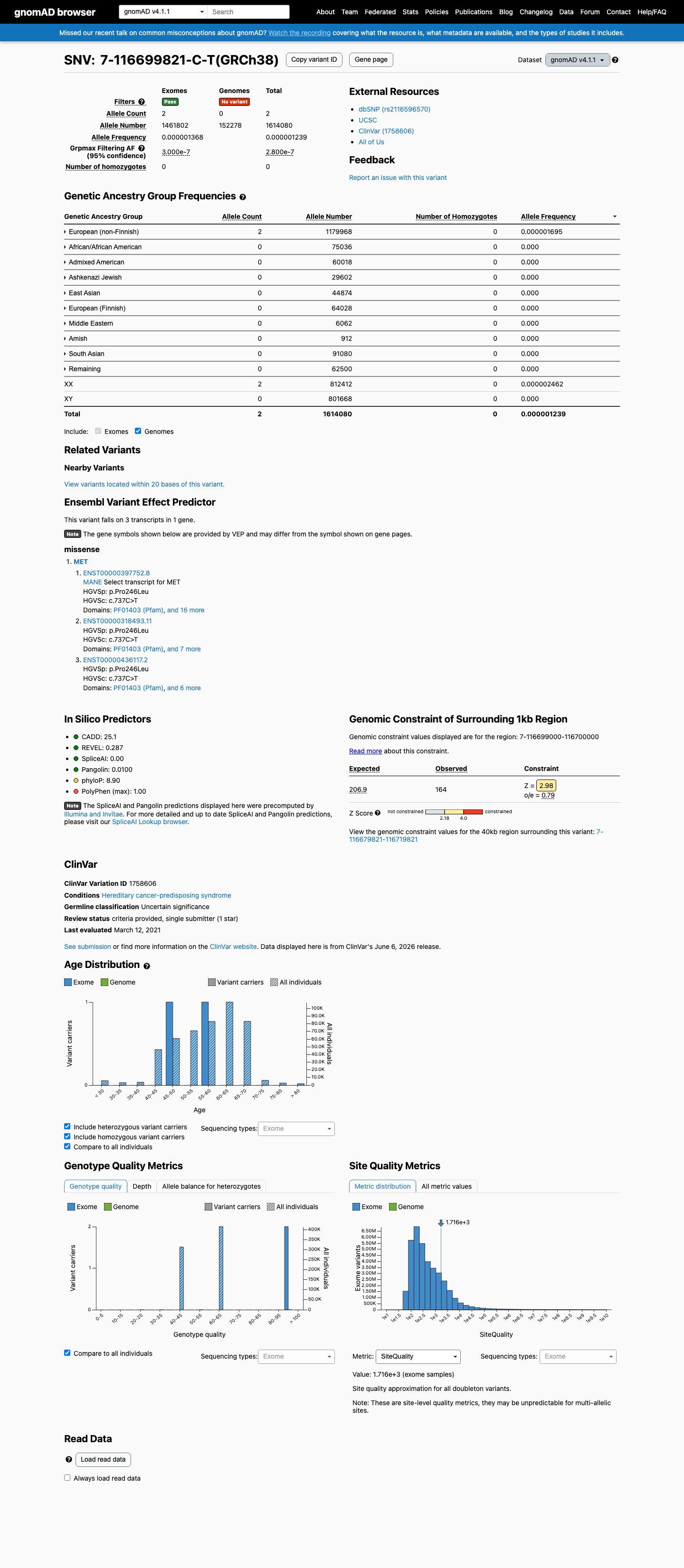
gnomAD v4.1 screenshot
gnomAD v4.1
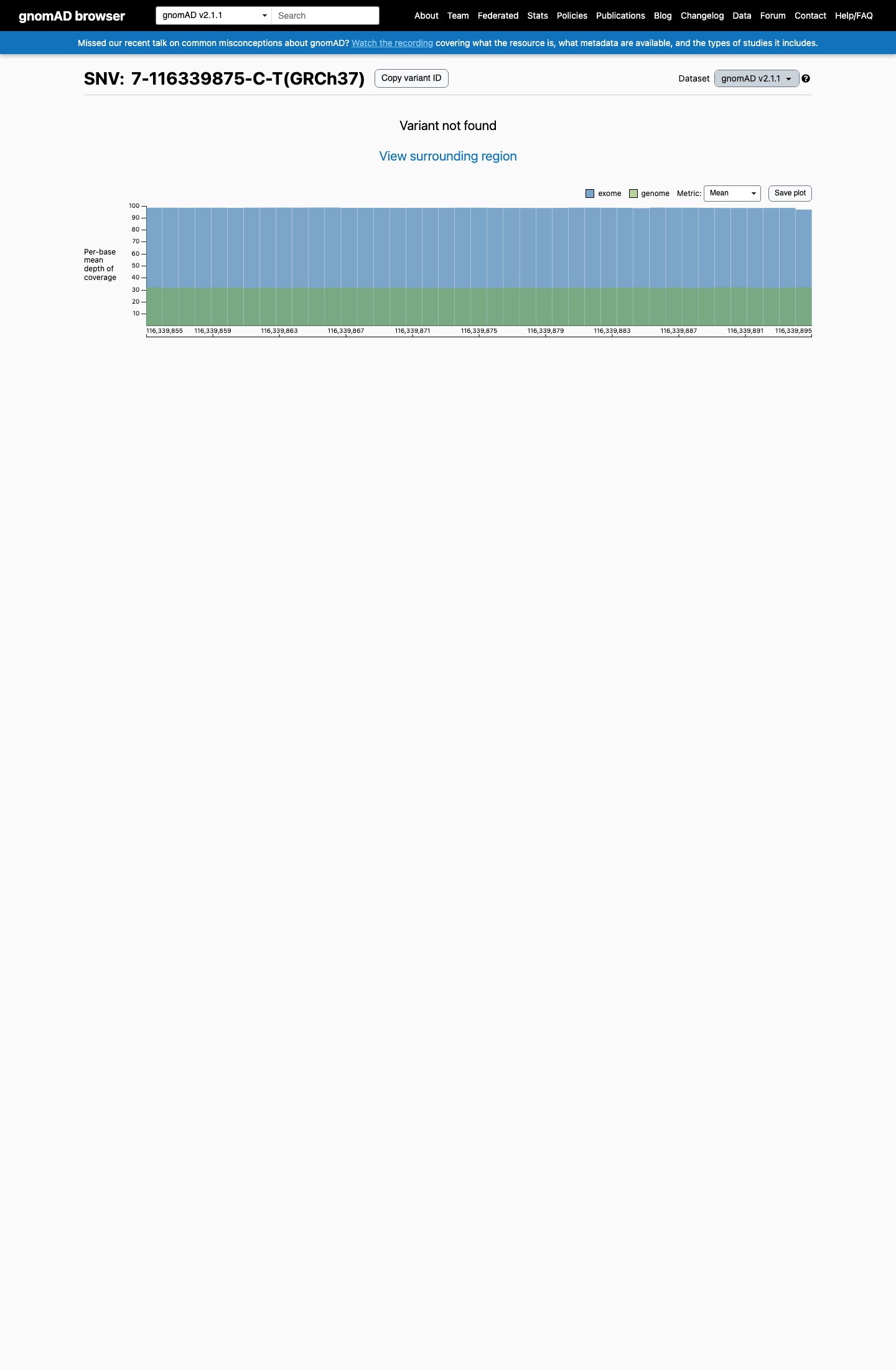
gnomAD v2.1 screenshot
gnomAD v2.1
v4.1
This variant is present in gnomAD v4.1 (AF= 1.2391e-06; MAF= 0.00012%, 2/1614080 alleles, homozygotes = 0) and has highest observed frequency in the European (non-Finnish) population (AF= 1.69496e-06; MAF= 0.00017%, 2/1179968 alleles, homozygotes = 0); grpmax FAF= 2.8e-07.
v2.1
Absent from gnomAD v2.1.
🇨🇦 CA
Absent from gnomAD-Canada v1.0.
Allele frequency by ancestry
three datasets · side by side
gnomAD v4.1
0.00012% · 2 / 1,614,080
0 hom · FAF 2.8e-05%
European (non-Finnish)
2 / 1,179,968
0.00017%
+ 9 not observed (Remaining individuals, Admixed American, European (Finnish), Amish, East Asian, Middle Eastern, South Asian, Ashkenazi Jewish, African/African American)
gnomAD v2.1
Absent · 0 / ?
0 hom
Not observed in any ancestry group.
gnomAD Canada 🇨🇦
Absent · 0 / ?
0 hom
Not observed in any ancestry group.
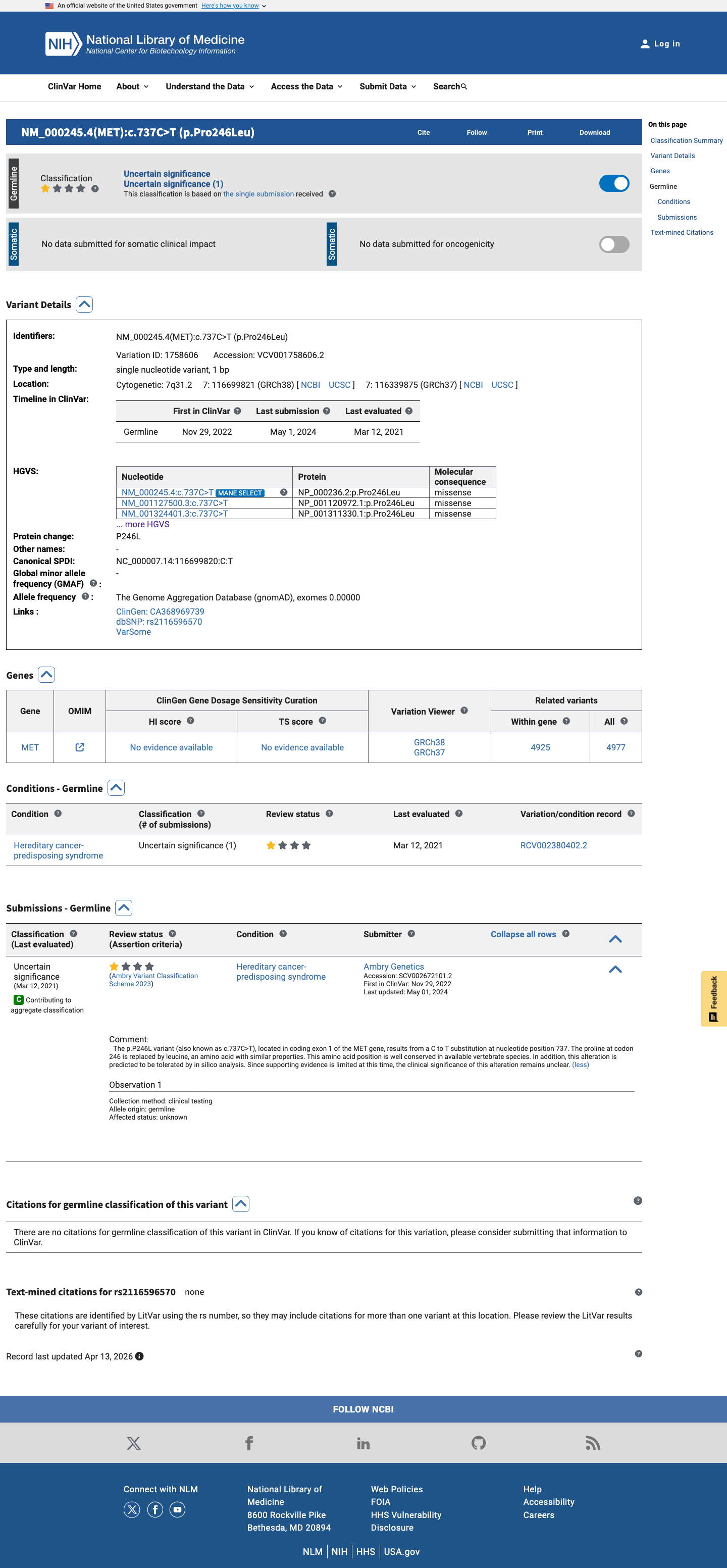
ClinVar screenshot
ClinVar
This variant has been reported in ClinVar as Uncertain significance (1 clinical laboratory). (ClinVarID = 1758606)
SpliceAI screenshot
In silico
SpliceAI predicts no significant splice impact for this variant (max delta score = 0.00). REVEL score = 0.287. BayesDel score = -0.254558.
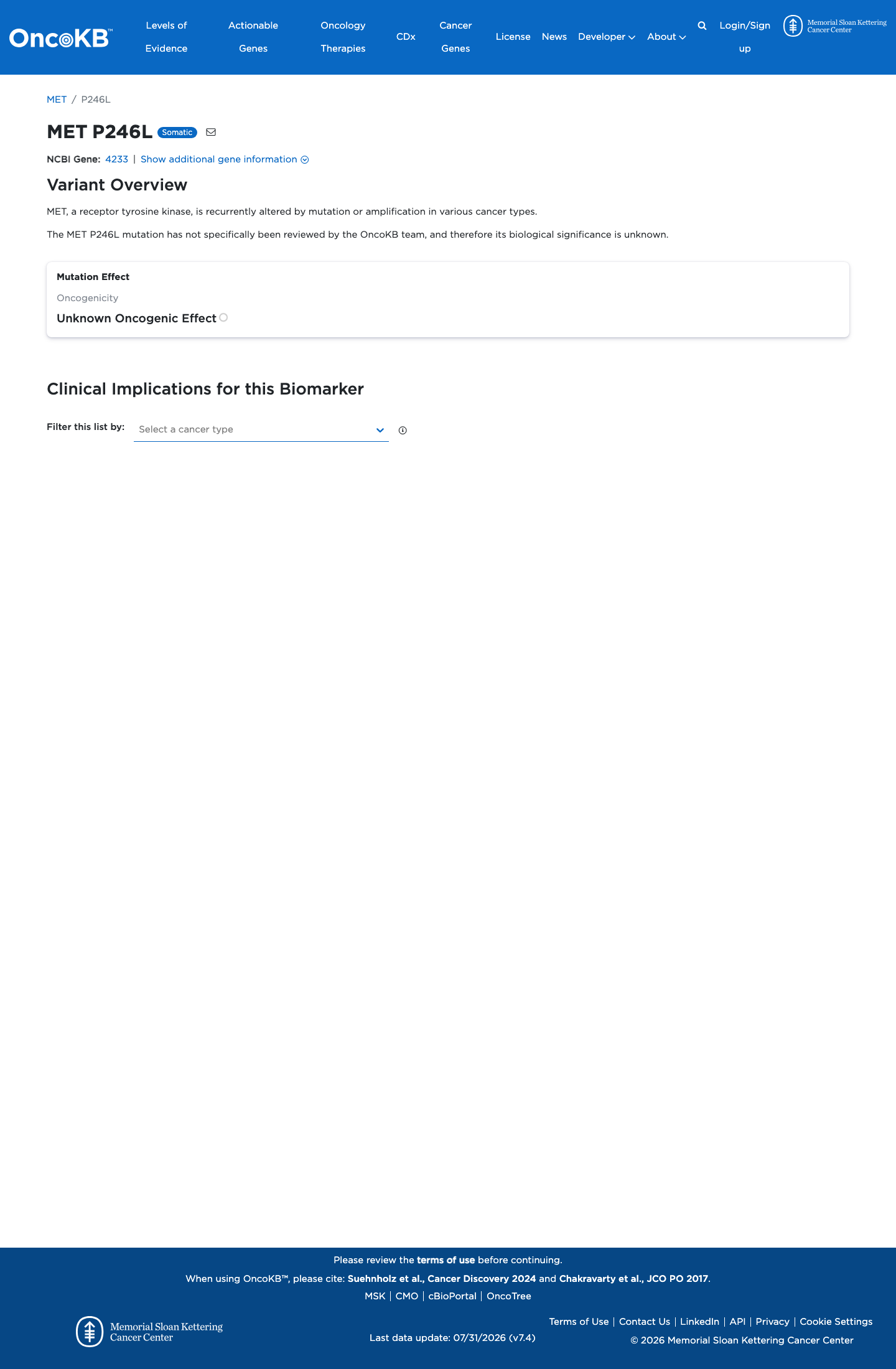
Functional / OncoKB screenshot
Functional Unknown Oncogenic Effect
OncoKB did not identify variant-specific reviewed functional evidence for this variant; gene-level curated context is available for reviewer follow-up. MET, a receptor tyrosine kinase, is recurrently altered by mutation or amplification in various cancer types.
OncoKB ↗
COSMIC screenshot
COSMIC
Cancer hotspots screenshot
Cancer hotspots
Somatic evidence Not in COSMIC / hotspots
COSMIC
This variant does not lie in a statistically significant hotspot. This variant has not previously been reported in somatic cancers (COSMIC).
Hotspots
This variant does not lie in a statistically significant hotspot.
Sources & reference links
8Sources
ClinVar
gnomAD v2.1
gnomAD v4.1
gnomAD-Canada
SpliceAI
OncoKB
COSMIC
Cancer hotspots
Triaged references · 1 PMID not cited in assessment
25394175 ↗ A practice guideline from the American College of Medical Genetics and Genomics and the National Society of Genetic Counselors: referral indications for cancer predisposition assessment. CLINVAR