This variant was interpreted by pipeline
7.1.0.
The current version is
8.0.0.
Re-running queues a fresh interpretation; the result replaces this page when complete.
Re-runs are not free. Blank = draws on today's public interpretation allowance.
With a code = uses 1 of that code's uses.
MLH1 encodes a DNA mismatch repair protein that, together with partners such as PMS2, corrects errors that arise during DNA replication. Loss of this repair function leads to the accumulation of mutations, particularly in repetitive microsatellite sequences, and tumors with defective MLH1 typically show high microsatellite instability. Germline mutations in MLH1 cause Lynch syndrome (hereditary non-polyposis colorectal cancer), which strongly predisposes to colorectal, endometrial, ovarian, and other cancers, while biallelic mutations cause constitutional mismatch repair deficiency (CMMRD). Because it normally protects against cancer by maintaining genomic stability, MLH1 acts as a tumor suppressor, and mismatch-repair-deficient tumors often respond well to immunotherapy.
This variant
MLH1 is a DNA mismatch repair gene whose loss causes Lynch syndrome and microsatellite-unstable tumors. This intronic splice-site variant is a VUS because the only available evidence points in conflicting directions - an extremely low population frequency (pathogenic-supporting) versus no predicted splicing impact (benign-supporting) - and no functional, tumor, or family data exists to resolve it. A VUS means current evidence neither establishes nor excludes Lynch syndrome risk for carriers.
Transcript
NM_000249.4
HGVS · transcript:coding
NM_000249.4:c.1558+4C>T
GRCh38
chr3:37028936 C>T
GRCh37
chr3:37070427 C>T
VUS: only PM2_Supporting (gnomAD AF 2.48e-06 < 0.00002) and BP4_Supporting (SpliceAI max delta 0.00 <= 0.1) are met, and one benign-supporting plus one pathogenic-supporting criterion maps to Uncertain Significance (Rule31).
Classification rationale
PM2BP4VUS
MLH1 c.1558+4C>T
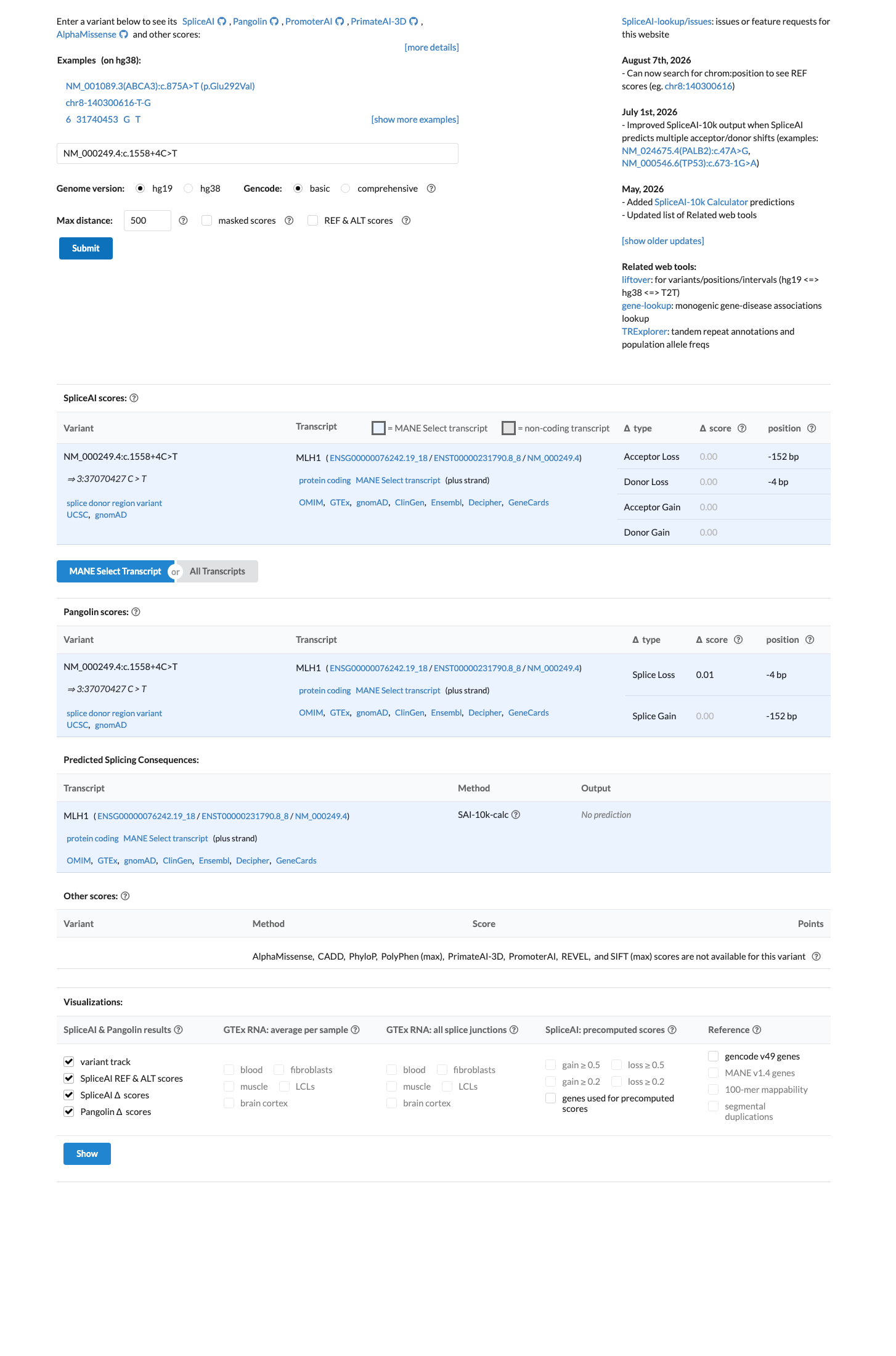
PM2 (Supporting): allele frequency 2.478e-06 in gnomAD v4.1 (4/1,613,954 alleles), below the <0.00002 threshold. BP4 (Supporting): SpliceAI max delta 0.00 is at or below the <=0.1 threshold, predicting no splicing impact for this intronic variant. Overall: VUS (Uncertain Significance - Conflicting Evidence), per Rule31 requiring at least one benign-supporting and one pathogenic-supporting criterion.
PM2 + BP4→VUS
LYFE Sciences is an AI system, and it can make mistakes. Criteria
may be applied incorrectly, sources may be misread, and a confident-looking
classification can still be wrong. Double-check every criterion and
its underlying evidence before relying on any call.
Gene diagram
· NM_000249.4 · variants mapped to exon structure
MLH1NM_000249.4
Fetching transcript structure from UCSC…
Exons
—
Transcript span
—
Strand
—
Variants mapped
—
Source
UCSC ncbiRefSeqCurated
All variants in MLH1—click a row to locate it on the plot · use the link column to open its page
Protein
Location
Classification
Link
Applied criteria · 2 applied · 15 assessed
MetEvidence satisfies this criterion.
Not metEvaluated against available evidence; threshold not reached.
Not assessedApplies in principle, but no evidence was found to evaluate it.
N/ADoesn't apply to this variant type.
Applied · 2
Strength Supporting Moderate Strong Very strong
✓
PM2supportingPathogenic
Met (Supporting): gnomAD v4.1 total allele frequency 2.478e-06 (4/1,613,954 alleles) is below the <0.00002 threshold.
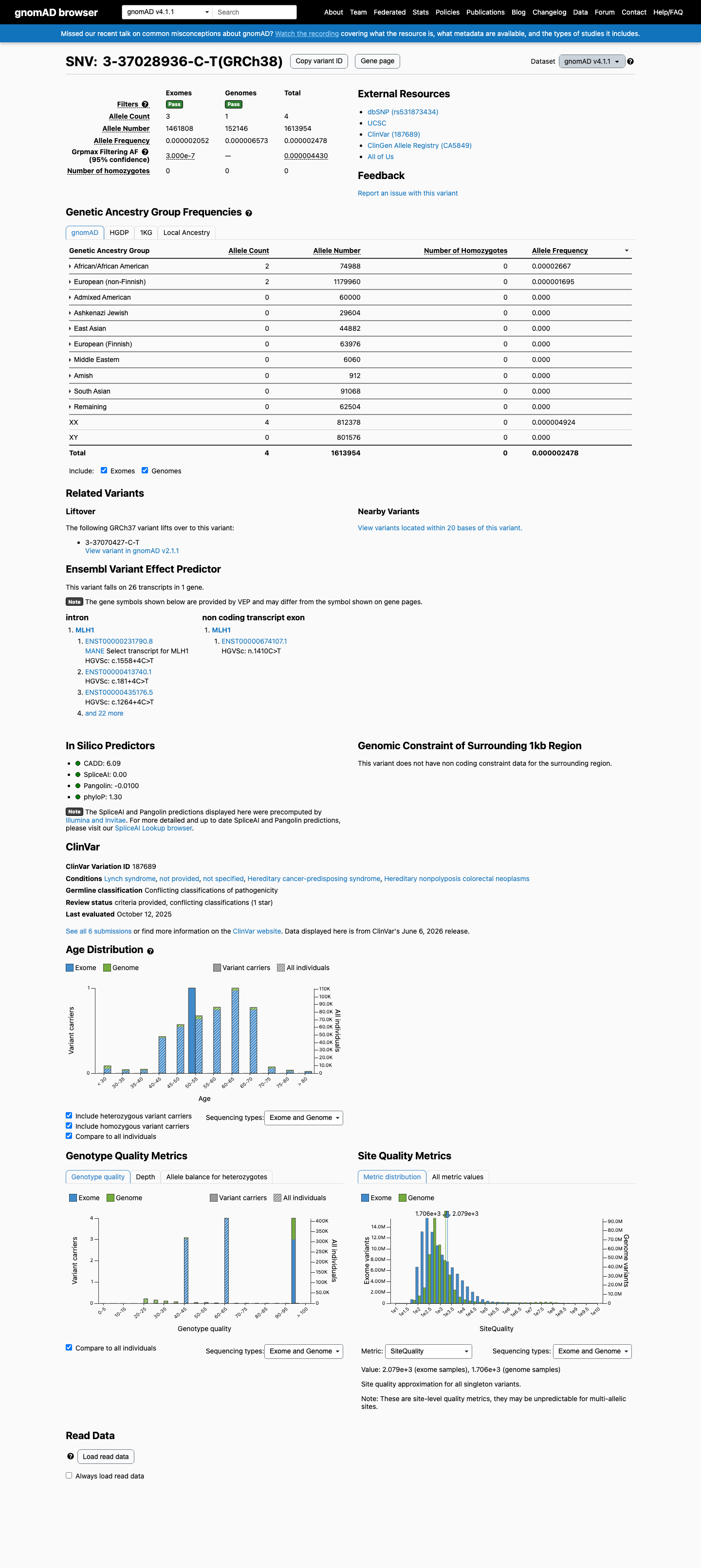
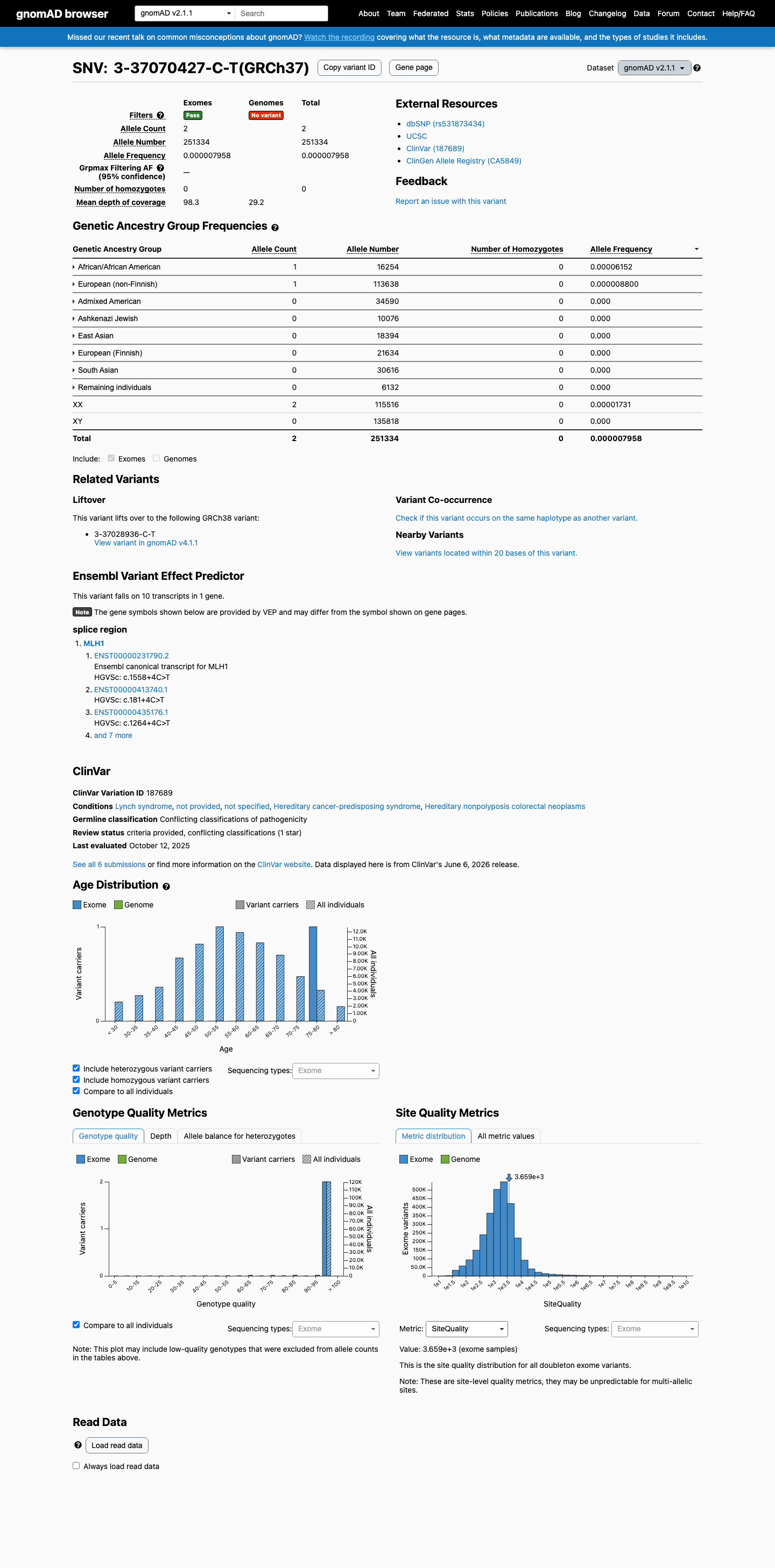
gnomAD v4.1 (gnomad_v4): total AF 2.478e-06 (4/1,613,954 alleles; <1 in 50,000), joint grpmax FAF 4.43e-06, homozygotes 0; AFR subpopulation AF 2.667e-05 (2/74,988)gnomAD v2.1 (gnomad_v2): total AF 7.958e-06 (2/251,334 alleles), homozygotes 0gnomAD-Canada v1.0 (gnomad_canada): variant absent
This variant is present in gnomAD v4.1 (AF= 2.47839e-06; MAF= 0.00025%, 4/1613954 alleles, homozygotes = 0) and has highest observed frequency in the African/African American population (AF= 2.66709e-05; MAF= 0.00267%, 2/74988 alleles, homozygotes = 0); grpmax FAF= 4.43e-06.
v2.1
This variant is present in gnomAD v2.1 (AF= 7.95754e-06; MAF= 0.00080%, 2/251334 alleles, homozygotes = 0) and has highest observed frequency in the African/African American population (AF= 6.15233e-05; MAF= 0.00615%, 1/16254 alleles, homozygotes = 0).
🇨🇦 CA
Absent from gnomAD-Canada v1.0.
Allele frequency by ancestry
three datasets · side by side
gnomAD v4.1
0.00025%
· 4 / 1,613,954
0 hom · FAF 0.00044%
African/African American
2 / 74,988
0.0027%
European (non-Finnish)
2 / 1,179,960
0.00017%
+ 8 not observed (Remaining individuals, Admixed American, European (Finnish), Amish, East Asian, Middle Eastern, South Asian, Ashkenazi Jewish)
gnomAD v2.1
0.0008%
· 2 / 251,334
0 hom
African/African American
1 / 16,254
0.0062%
European (non-Finnish)
1 / 113,638
0.00088%
+ 6 not observed (Admixed American, Ashkenazi Jewish, East Asian, European (Finnish), Remaining individuals, South Asian)
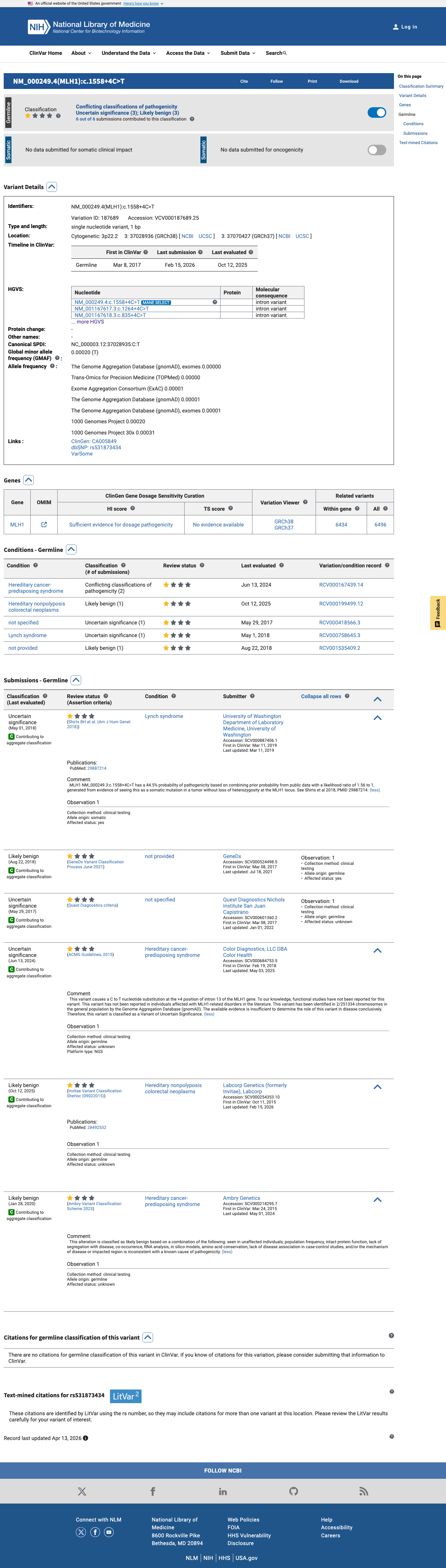
This variant has been reported in ClinVar as Uncertain significance (3 clinical laboratories) and as Likely benign (3 clinical laboratories). (ClinVarID = 187689)
Triaged references · 9 PMIDs not cited in assessment
25645574 ↗ACG clinical guideline: Genetic testing and management of hereditary gastrointestinal cancer syndromes.CLINVAR
25741868 ↗Standards and guidelines for the interpretation of sequence variants: a joint consensus recommendation of the American College of Medical Genetics and Genomics and the Association for Molecular Pathology.CLINVAR
26467025 ↗A Standardized DNA Variant Scoring System for Pathogenicity Assessments in Mendelian Disorders.CLINVAR
29887214 ↗Using Somatic Mutations from Tumors to Classify Variants in Mismatch Repair Genes.CLINVAR
31672839 ↗Management of patients with increased risk for familial pancreatic cancer: updated recommendations from the International Cancer of the Pancreas Screening (CAPS) Consortium.CLINVAR
25394175 ↗A practice guideline from the American College of Medical Genetics and Genomics and the National Society of Genetic Counselors: referral indications for cancer predisposition assessment.CLINVAR
26389505 ↗Genetics of Colorectal Cancer (PDQ®): Health Professional Version.CLINVAR
28492532 ↗Sherloc: a comprehensive refinement of the ACMG-AMP variant classification criteria.CLINVAR