Analysis in progress
Initialising…
0%
complete
This report is still being assembled — sections appear as each stage finishes. It isn't final yet.
MSH2
Final classification
Likely Pathogenic
MSH2 c.2005+1G>A · p.?
MSH2

PVS1 (Strong): canonical +1 splice-donor variant; in-frame exon 12 skipping (SpliceAI delta 1.00) deletes ~82 amino acids encompassing the EXO1-binding and ATP-binding (Walker A) regions, a functionally critical segment.

Gene
MSH2
Transcript
NM_000251.3
HGVS · transcript:coding
NM_000251.3:c.2005+1G>A
Consequence
N/A
GRCh38
chr2:47475271 G>A
GRCh37
chr2:47702410 G>A
Basis Likely Pathogenic under the InSiGHT MSH2 VCEP v2.0: PVS1 strong (canonical +1 donor, in-frame exon 12 skipping) plus PM2, PP4, PP5 supporting satisfies Rule 12 (1 Strong + >=2 Supporting), with no conflicting benign evidence.
Likely Pathogenic under the InSiGHT MSH2 VCEP v2.0: PVS1 strong (canonical +1 donor, in-frame exon 12 skipping) plus PM2, PP4, PP5 supporting satisfies Rule 12 (1 Strong + >=2 Supporting), with no conflicting benign evidence.
Classification rationale
PVS1PM2PP4PP5 Likely Pathogenic
MSH2 c.2005+1G>A

PVS1 (Strong): canonical +1 splice-donor variant; in-frame exon 12 skipping (SpliceAI delta 1.00) deletes ~82 amino acids encompassing the EXO1-binding and ATP-binding (Walker A) regions, a functionally critical segment. PM2 (Supporting): absent from gnomAD v4.1 (AF = 0), below the <0.00002 allele-frequency threshold. PP4 (Supporting): one MSI-H colorectal tumor in a documented carrier (PMID:16142001), within the VCEP's 5-10-marker panel requirement. PP5 (Supporting): ClinVar 3-star InSiGHT expert-panel classification of Likely pathogenic. Combination: Likely Pathogenic by VCEP Rule 12 (1 Pathogenic Strong + 3 Pathogenic Supporting), with no conflicting benign evidence.

PVS1 + PM2 + PP4 + PP5 Likely Pathogenic
Gene diagram · NM_000251.3 · variants mapped to exon structure
MSH2 NM_000251.3
Fetching transcript structure from UCSC…
Applied criteria · 4 applied · 13 assessed
Applied · 4
Strength Supporting Moderate Strong Very strong
PVS1 strong Pathogenic
Met (Strong): canonical +1 splice-donor variant predicted to skip in-frame exon 12 (SpliceAI delta 1.00), deleting a functionally critical ~82-amino-acid region. Not upgraded to Very Strong because no RNA assay confirmed the splice defect.
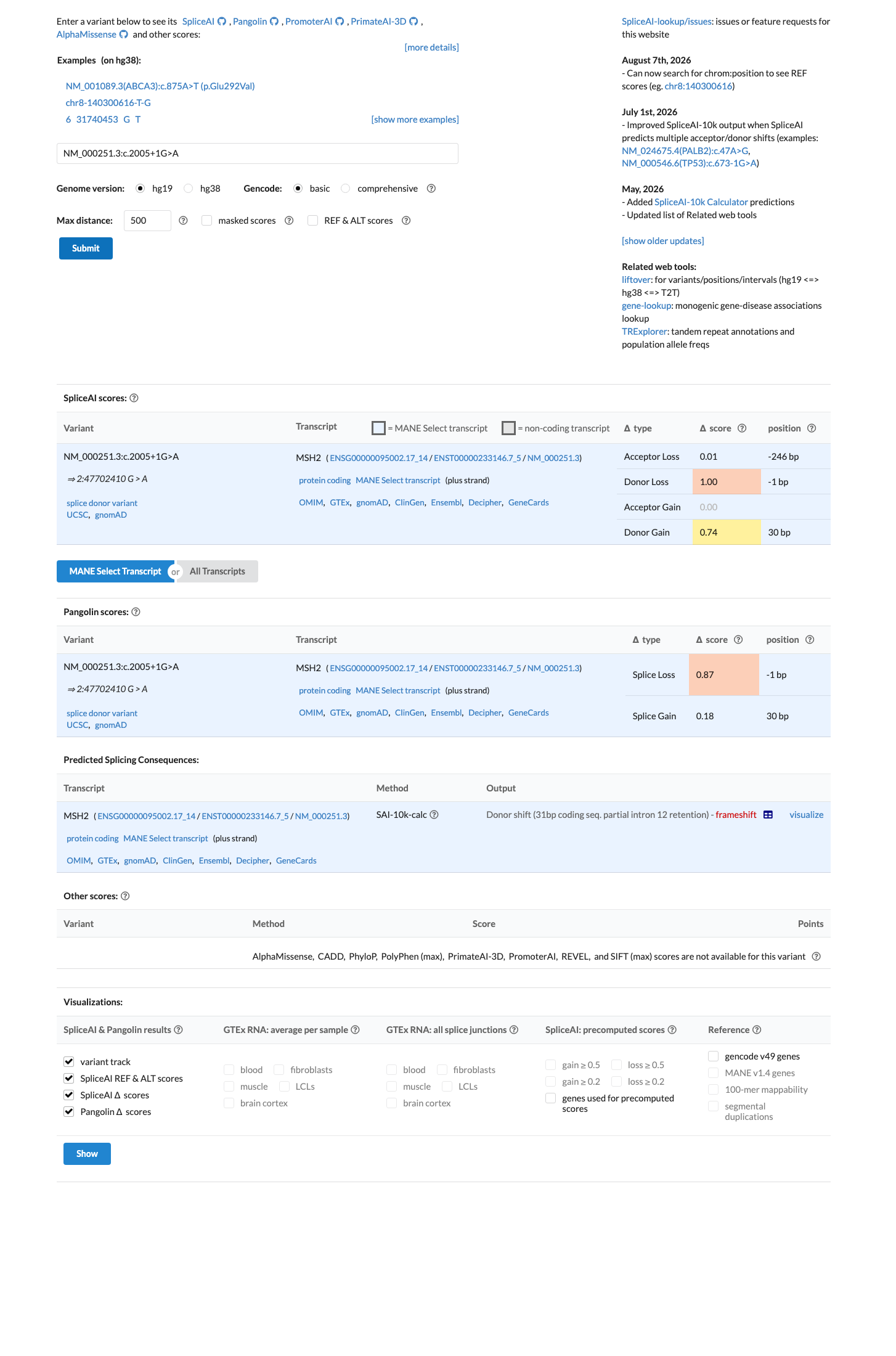
cspec (ClinGen InSiGHT MSH2 VCEP v2.0, doc 1577628936): PVS1 rule for IVS+/-1/IVS+/-2 - exon skipping/cryptic splice that disrupts reading frame with predicted NMD = PVS1; preserves reading frame with critical region = PVS1_Strong; preserves reading frame without critical region = PVS1 not used; confirmed splice defect branch requires patient mRNA assaysspliceai (SpliceAI Lookup for 2-47702410-G-A): max delta 1.00; DS_DL 1.0 (canonical donor loss), DS_DG 0.74 (cryptic donor gain at +30), DS_AL 0.01, DS_AG 0 - predicted consequences are in-frame, no NMDRefSeq NM_000251.3 (NCBI GenBank) exon features: CDS 37..2841 (NP_000242.1, 934 aa); exon 12 = mRNA 1796..2041 = coding c.1760..c.2005, length 246 nt, 246 mod 3 = 0 (in-frame); skipping deletes ~82 residues (~587-669)
PM2 supporting Pathogenic
Met (Supporting): absent from gnomAD v4.1 (AF = 0), below the <1-in-50,000 (<0.00002) allele-frequency threshold.
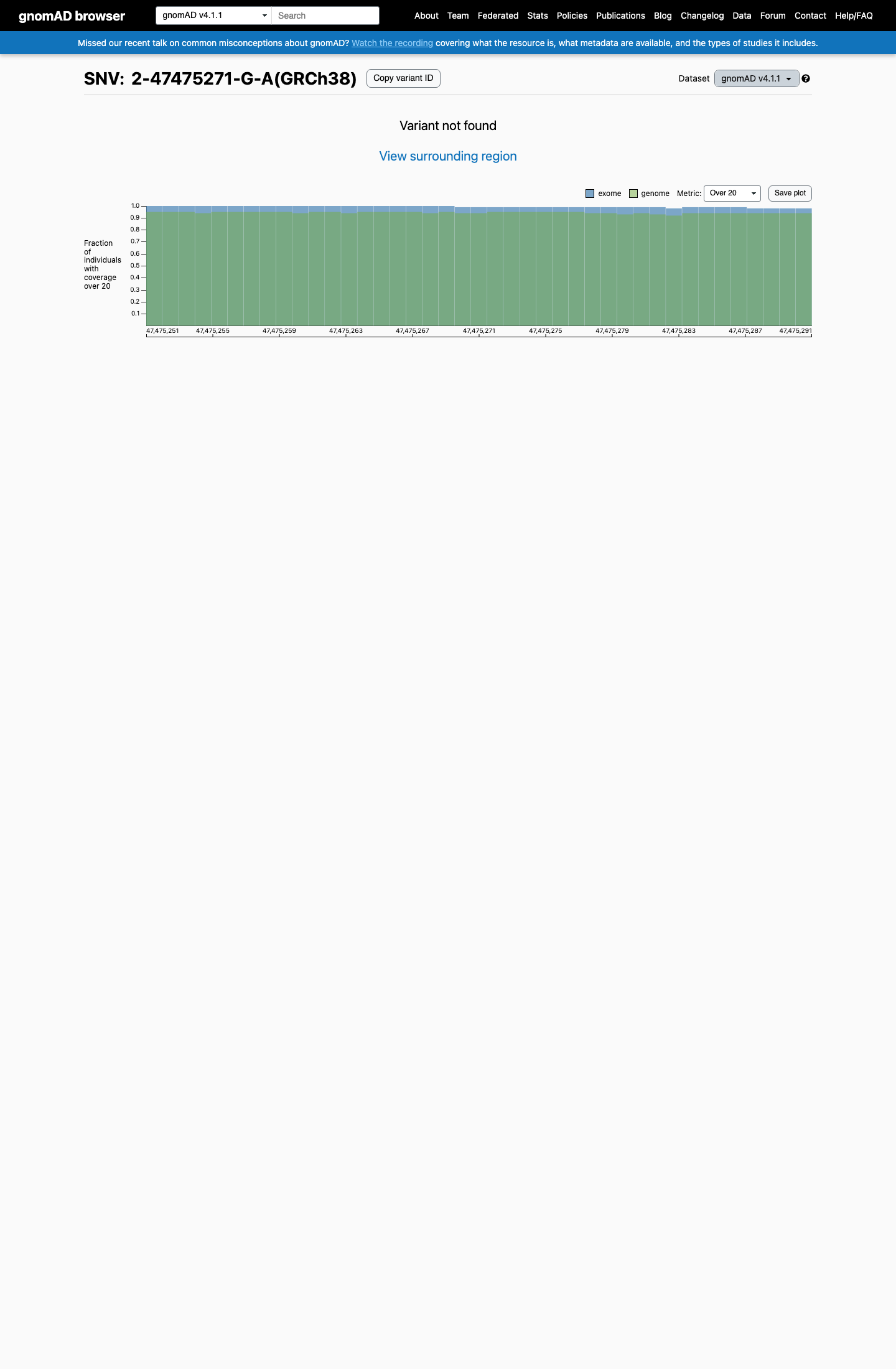
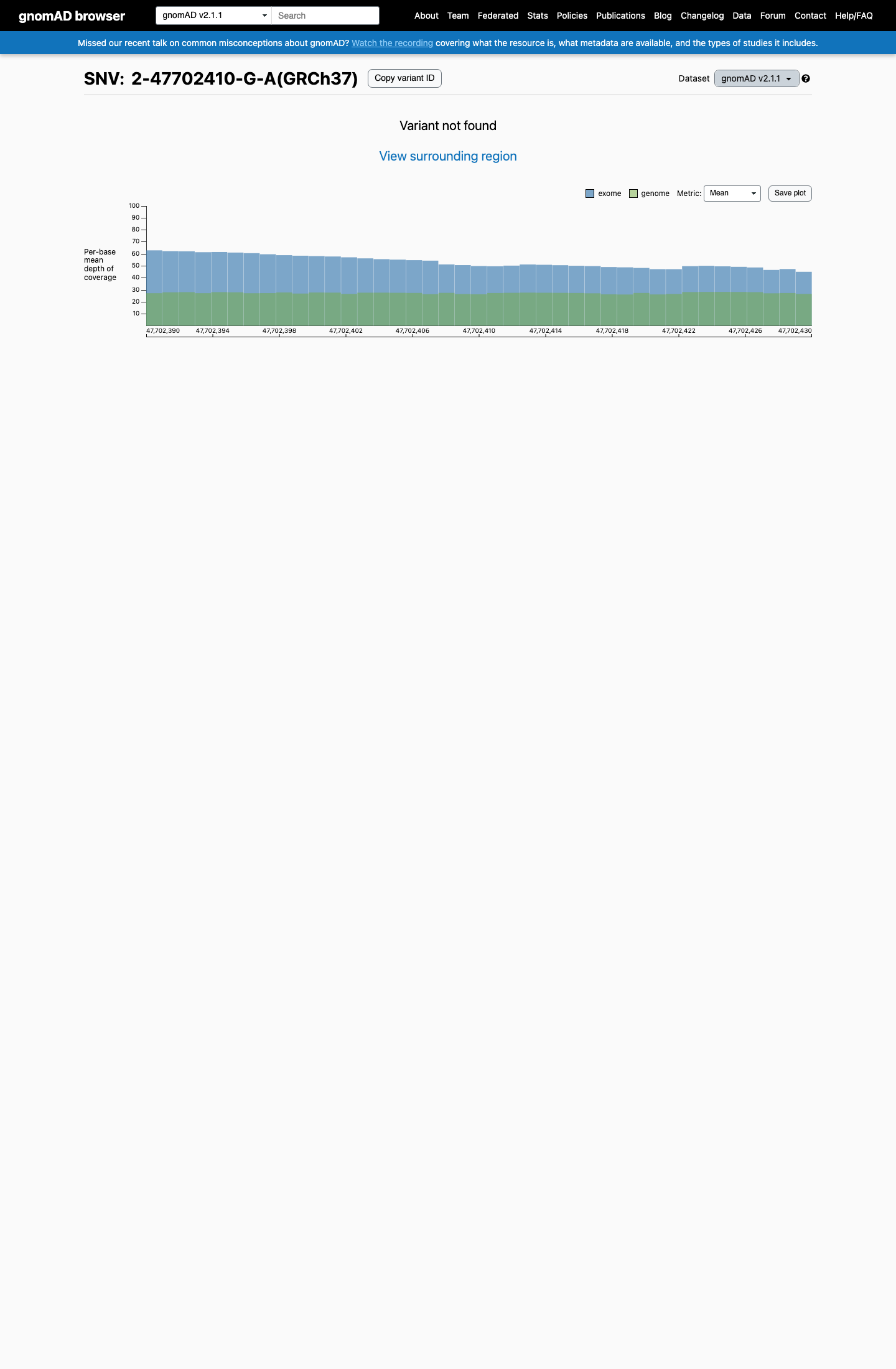
Absent from gnomAD v4.1 (evidence.json GNOMAD_V4_1; chr2-47475271-G-A, gnomad_r4, search_status: absent)Absent from gnomAD v2.1 (evidence.json GNOMAD_V2_1; 2-47702410-G-A, gnomad_r2_1, search_status: absent)Absent from gnomAD-Canada v1.0 (evidence.json GNOMAD_CANADA_V1; 2-47475271-G-A, search_status: absent)
PP4 supporting Pathogenic
Met (Supporting): one MSI-H colorectal tumor in a documented carrier (PMID:16142001, 6-marker panel) satisfies the VCEP PP4_Supporting rule.
PMID:16142001cspec
PP5 supporting Pathogenic
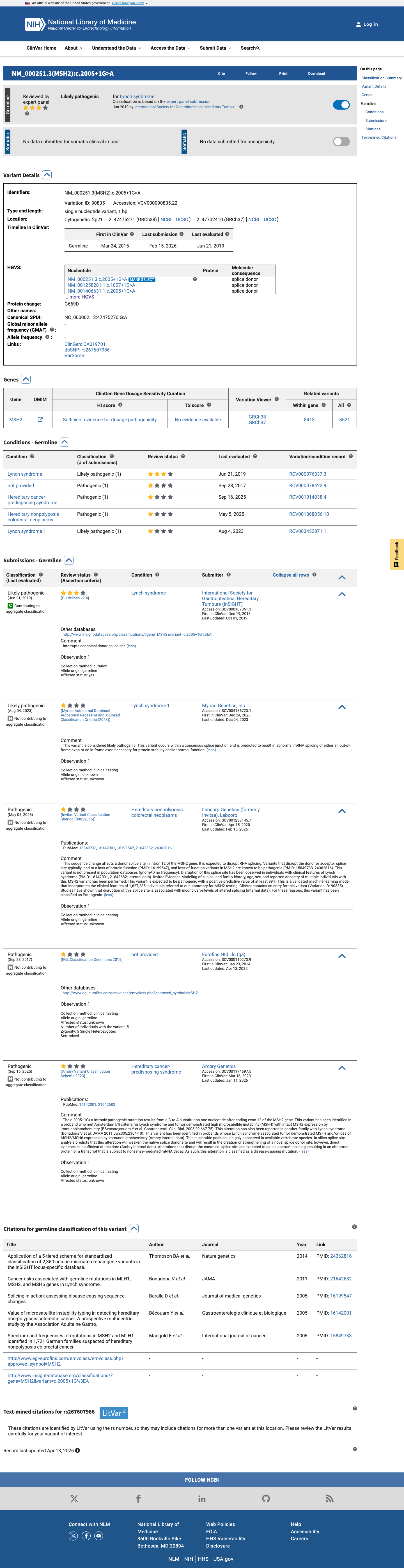
Met (Supporting): ClinVar 3-star InSiGHT expert panel classifies this variant Likely pathogenic.
clinvarClinVar expert panel classification
Assessed · not applied
Pathogenic
PS2 Not assessed: no de novo occurrence or parental testing is reported for this variant in ClinVar or the literature.
PS3 Not assessed: no variant-specific functional assay result exists; the only published report documents an MSI-H tumor, a phenotype observation rather than a functional test.
PM3 Not assessed: no second pathogenic MSH2 variant in trans (or of unknown phase) in a CMMRD-consistent patient is reported for this variant.
PP1 Not assessed: no pedigree or segregation data exist for this variant, so no co-segregation likelihood ratio could be computed.
Benign
BA1 Not met: allele frequency 0 in gnomAD v4, far below the >=0.001 (0.1%) BA1 threshold.
BS1 Not met: absent from gnomAD (AF = 0), below the >=0.0001 (0.01%) lower bound of the BS1 range.
BS2 Not assessed: no proband or family genotype data show in-trans co-occurrence with a known pathogenic MSH2 variant.
BS3 Not assessed: no assay demonstrates normal splicing or normal MMR function; insufficient evidence was available.
BS4 Not assessed: no pedigrees show affected non-carriers or unaffected carriers, so non-segregation could not be scored.
BP4 Not met: SpliceAI max delta 1.00 far exceeds the <=0.1 no-splice-impact threshold.
BP5 Not assessed: no MSS tumors, retained-MMR-IHC results, or BRAF/MLH1 methylation data exist for carriers of this variant.
BP6 Not met: the only expert-panel ClinVar classification (InSiGHT, 3 stars) is Likely pathogenic, not benign.
BP7 Not met: position +1 lies inside the canonical splice region, not at or beyond +7, and SpliceAI predicts strong splice impact.
N/A · 11 PS1 · PS4 · PM1 · PM4 · PM5 · PM6 · PP2 · PP3 · BP1 · BP2 · BP3
Research & evidence
Population frequency · supports pathogenic
gnomAD v4.1 screenshot
gnomAD v4.1
gnomAD v2.1 screenshot
gnomAD v2.1
v4.1
Absent from gnomAD v4.1.
v2.1
Absent from gnomAD v2.1.
🇨🇦 CA
Absent from gnomAD-Canada v1.0.
Allele frequency by ancestry
three datasets · side by side
gnomAD v4.1
Absent · 0 / ?
0 hom
Not observed in any ancestry group.
gnomAD v2.1
Absent · 0 / ?
0 hom
Not observed in any ancestry group.
gnomAD Canada 🇨🇦
Absent · 0 / ?
0 hom
Not observed in any ancestry group.
ClinVar screenshot
ClinVar
This variant has been reported in ClinVar as Pathogenic (3 clinical laboratories) and as Likely pathogenic (1 clinical laboratory) and as Likely pathogenic by International Society for Gastrointestinal Hereditary Tumours (InSiGHT) (expert panel). (ClinVarID = 90835)
SpliceAI screenshot
In silico
SpliceAI predicts possible splice impact for this variant (max delta score = 1.00). BayesDel score = 0.66.
Functional No data
No calibrated functional assay or RNA evidence was identified for this variant.
OncoKB ↗
COSMIC screenshot
COSMIC
Somatic evidence
COSMIC
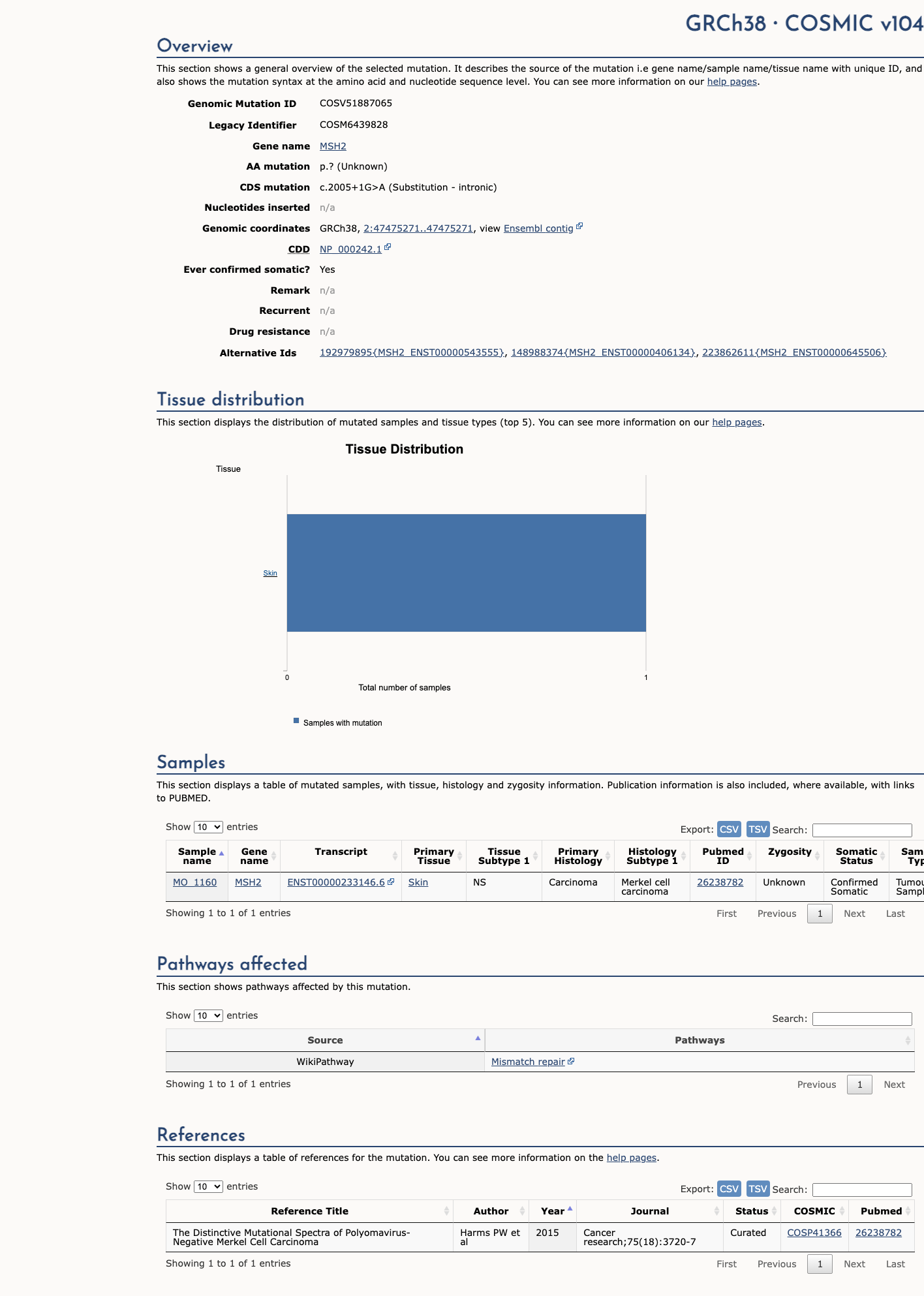
This variant has previously been reported in somatic cancers (COSMIC; COSV51887065, n = 1 times).
Hotspots
This variant does not lie in a statistically significant cancer hotspot.
COSMIC ↗
Literature · how each cited paper was used
2papers cited
Each card is an audit: what was searched, what was found, whether it names the variant, which criteria it fed, and why. 7 further PMIDs triaged but not cited — see Sources & References.
Value of microsatellite instability typing in detecting hereditary non-polyposis colorectal cancer. A prospective multicentric study by the Association Aquitaine Gastro.
Searched
c.2005+1G>AIVS12+12005+1
Found
Prospective multicentric study by the Association Aquitaine Gastro evaluating MSI typing plus immunohistochemistry to select patients for germline MMR mutation analysis. Table II lists the germline mutations identified per patient; the MSH2 intron 12 row reports IVS12+1 G>A (equivalent to NM_000251.3:c.2005+1G>A) in one patient (patient no. 2) whose tumor was MSI-H, for whom immunohistochemistry was not performed, and who had an Amsterdam-positive family history; the predicted consequence is recorded as 'splicing'. The paper performed no RNA/cDNA analysis or in vitro functional assay for this variant — the MSI-H tumor is a tumor phenotype observation, not a variant functional assay. The paper's general statement that observed mutations 'were considered to have a deleterious effect' reflects the authors' clinical judgment, not functional assay evidence.
Variant
✓ Names this variant — characterised directly
Applied to
PP4 supporting
Reports the exact variant MSH2 c.2005+1G>A (IVS12+1 G>A) in a patient with an MSI-H colorectal tumor (>=2 of 6 markers unstable), IHC not performed, Amsterdam criteria - one MSI-H tumor satisfies the InSiGHT VCEP PP4 Supporting rule.
MSH2 | 12 | IVS12+1 | G > A | splicing | 2 | MSI-H | not performed | Amsterdam (Table II row); 'The different types of mutations observed were considered to have a deleterious effect, leading to HNPCC syndrome.'
Location Table II (Tumor microsatellite instability, immunohistochemistry, family history and germline mutations), MSH2 intron 12 row, patient no. 2; extracted text lines 616-624; discussion lines 505-511.  ·  Context Prospective multicentric French study (Association Aquitaine Gastro) of patients selected by clinical criteria (age at onset <50 years or family history of HNPCC tumors) plus tumor MSI typing and MMR immunohistochemistry, followed by germline MMR gene sequencing. Table II tabulates tumor MSI status, IHC, genealogic data and germline mutations per patient.  ·  full text
Rule & framework references · cited for criterion definitions, not variant evidence
15849733 ↗ Spectrum and frequencies of mutations in MSH2 and MLH1 identified in 1,721 German families suspected of hereditary nonpolyposis colorectal cancer.
Sources & reference links
8Sources
CSpec VCEP
ClinVar
gnomAD v2.1
gnomAD v4.1
gnomAD-Canada
SpliceAI
OncoKB
COSMIC
Triaged references · 7 PMIDs not cited in assessment
16199547 ↗ Splicing in action: assessing disease causing sequence changes. CLINVAR
24362816 ↗ Application of a 5-tiered scheme for standardized classification of 2,360 unique mismatch repair gene variants in the InSiGHT locus-specific database. CLINVAR
25645574 ↗ ACG clinical guideline: Genetic testing and management of hereditary gastrointestinal cancer syndromes. CLINVAR
15604628 ↗ Genetic cancer risk assessment and counseling: recommendations of the national society of genetic counselors. CLINVAR
20301390 ↗ Lynch Syndrome. CLINVAR
21642682 ↗ Cancer risks associated with germline mutations in MLH1, MSH2, and MSH6 genes in Lynch syndrome. CLINVAR
28492532 ↗ Sherloc: a comprehensive refinement of the ACMG-AMP variant classification criteria. CLINVAR