Back
NM_198253.2:c.2283C>T
p.Ser761= · TERT
ACMG/AMP
0%
complete
Final classification
VUS
PM2BP4
TERT
c.2283C>T
p.Ser761=
synonymous · exon 6

TERT encodes the catalytic subunit of telomerase, the enzyme that maintains chromosome ends (telomeres) by adding TTAGGG repeat sequences and preserves genomic integrity. Telomerase is normally switched off in adult somatic cells, so telomeres shorten with each cell division, contributing to cellular senescence; reactivation of telomerase can therefore help cells divide indefinitely. Telomerase activity is upregulated in the vast majority of tumors and is thought to drive cancer cell immortality, and TERT alterations — including promoter mutations and gene amplification — are found in cancers such as melanoma, liver, bladder, and brain tumors.

This variant

This synonymous TERT change leaves the telomerase protein sequence unchanged (p.Ser761=), and its very low population frequency (0.0275%) offers no indication of disease relevance. Because TERT alterations are strongly associated with cancer and telomere biology disorders, a definitive interpretation of this VUS would require functional splicing or telomerase-activity studies.

Transcript
NM_198253.2
HGVS · transcript:coding
NM_198253.2:c.2283C>T
GRCh38
chr5:1278644 G>A
GRCh37
chr5:1278759 G>A
Variant of Uncertain Significance: one supporting pathogenic (PM2, gnomAD AF 0.0275%) and one supporting benign (BP4, SpliceAI 0.011) criterion form a conflicting combination matching no classification rule.
Classification rationale
PM2 BP4 VUS
TERT c.2283C>T synonymous · exon 6

PM2 (Supporting): allele frequency 0.0275% is below the 0.1% ceiling with zero homozygotes. BP4 (Supporting): SpliceAI max delta 0.011 predicts no splice impact (below the 0.1 threshold). Overall: Variant of Uncertain Significance - one supporting pathogenic (PM2) and one supporting benign (BP4) criterion conflict and match no ACMG/AMP combination rule.

PM2 + BP4 → VUS
LYFE Sciences is an AI system, and it can make mistakes. Criteria may be applied incorrectly, sources may be misread, and a confident-looking classification can still be wrong. Double-check every criterion and its underlying evidence before relying on any call.
Gene diagram · NM_198253.2 · variants mapped to exon structure
TERT NM_198253.2
Fetching transcript structure from UCSC…
Applied criteria · 2 applied · 18 assessed
MetEvidence satisfies this criterion.
Not metEvaluated against available evidence; threshold not reached.
Not assessedApplies in principle, but no evidence was found to evaluate it.
N/ADoesn't apply to this variant type.
Applied · 2
Strength Supporting Moderate Strong Very strong
PM2 supporting Pathogenic
Met (Supporting): highest observed allele frequency 0.0275% (gnomAD v4.1 NFE) is ~3.6x below the 0.1% ceiling, with zero homozygotes.
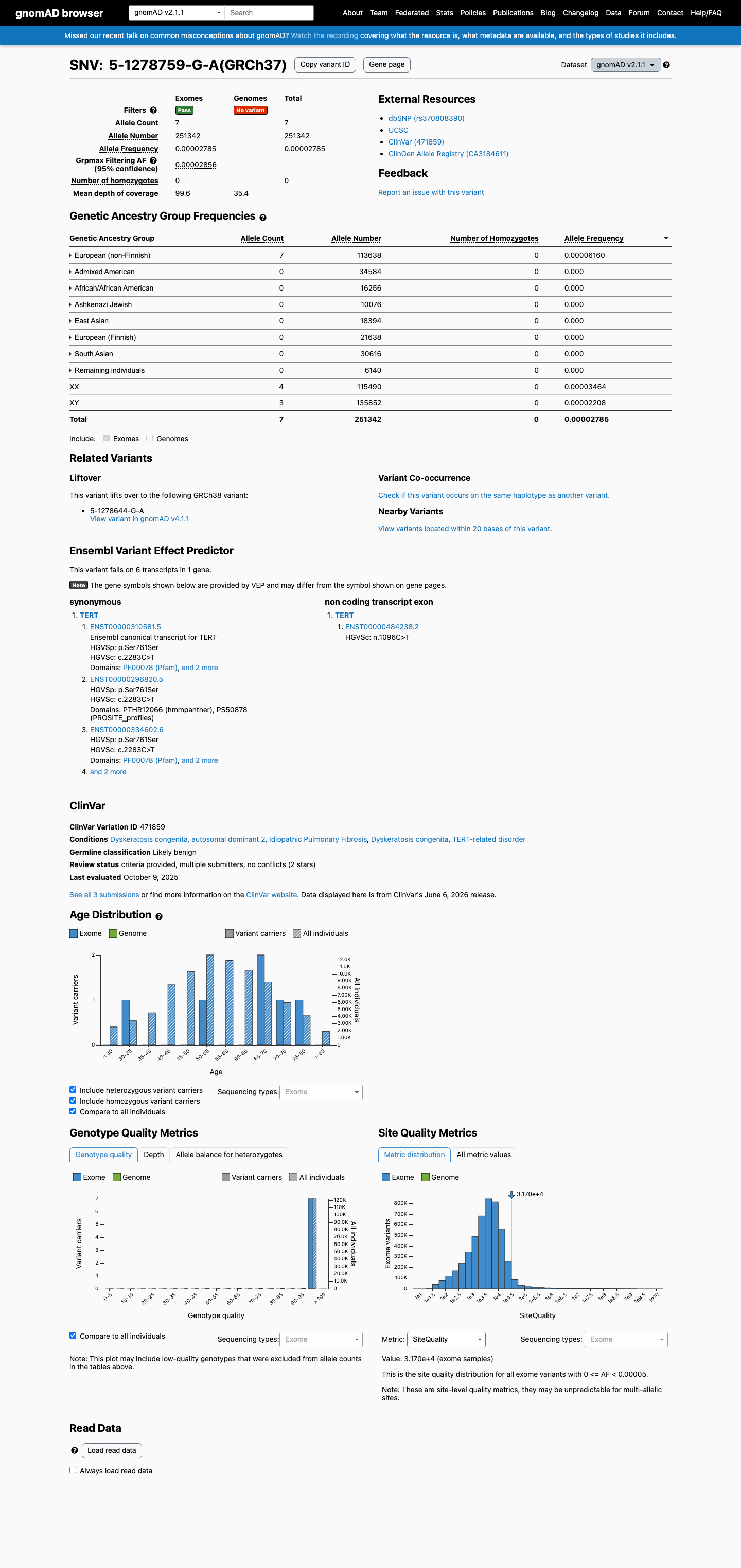
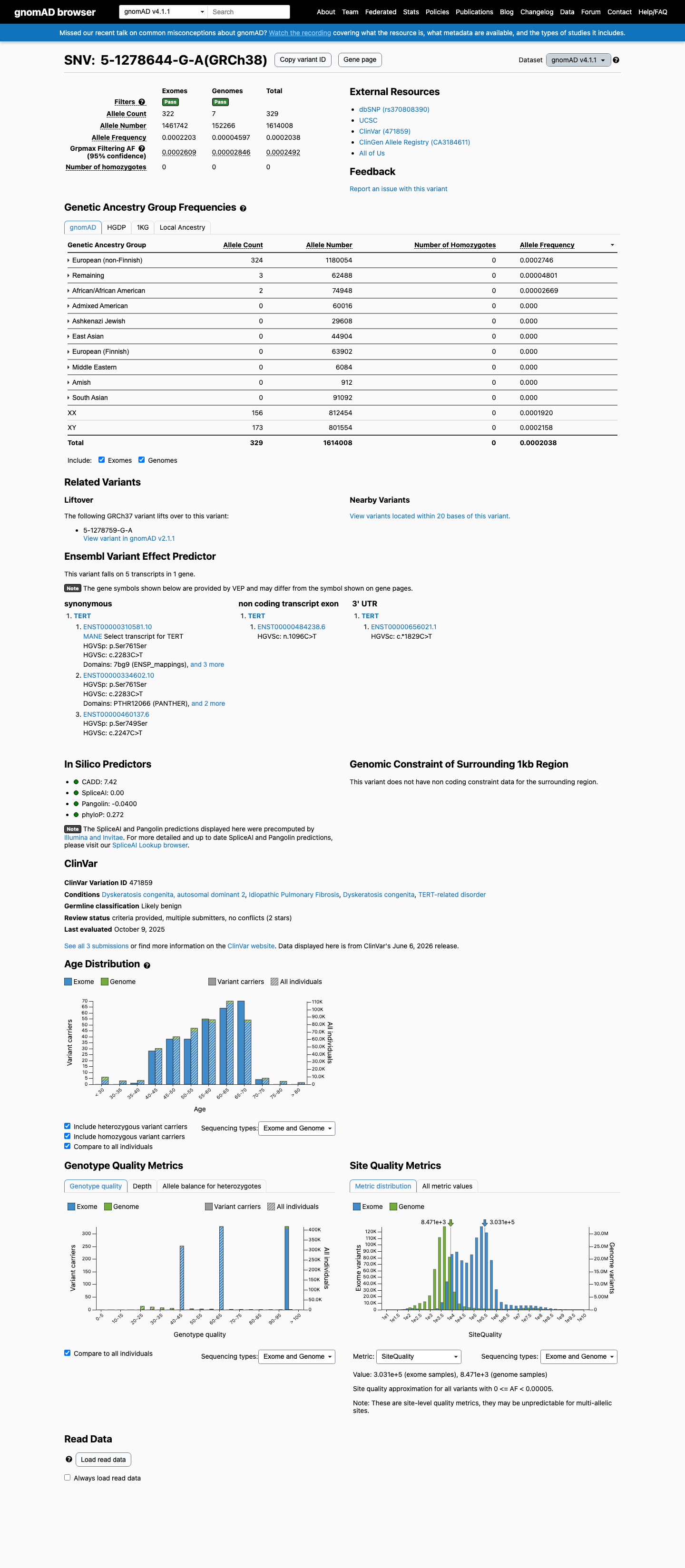
gnomAD v4.1 (largest and most current dataset): total AF 0.00020384 (0.0204%, 329/1,614,008 alleles), NFE AF 0.00027456 (0.0275%, 324/1,180,054), grpmax FAF 0.00024924 (0.0249%), homozygotes 0 — highest population frequency 0.0275% is below the 0.1% PM2 ceiling.gnomAD v2.1: total AF 2.785e-05 (0.00279%, 7/251,342), grpmax FAF 2.856e-05, homozygotes 0 — even lower, consistent with extremely low frequency.gnomAD-Canada v1.0 (HostSeq): AF 0.00010859 (0.0109%, 2/18,418), homozygotes 0.
BP4 supporting Benign
Met (Supporting): SpliceAI max delta 0.011 is below the 0.1 threshold, predicting no impact on splicing for this synonymous variant.
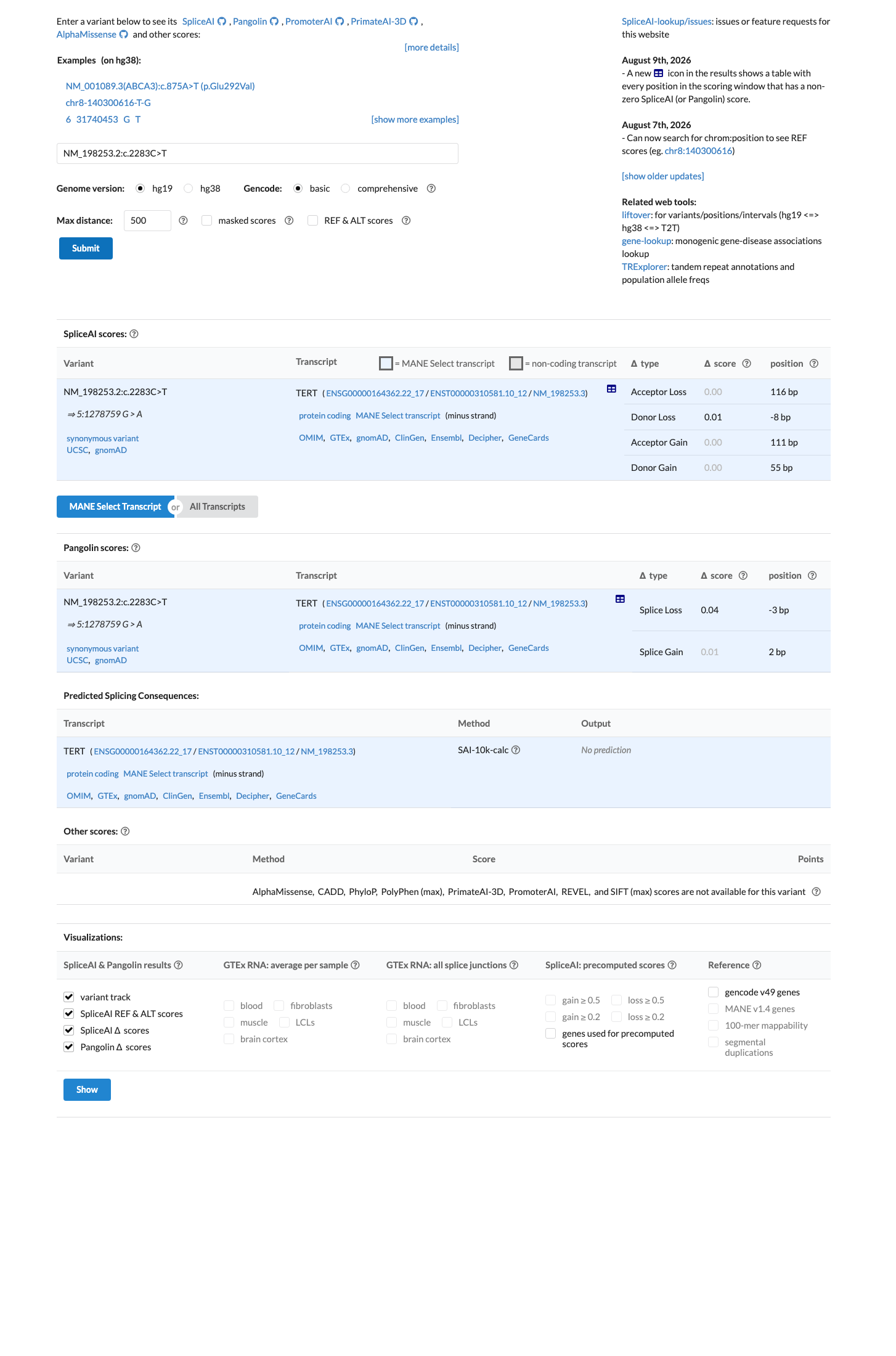
SpliceAI max delta score 0.011 (DS_AG=0.000, DS_AL=0.001, DS_DG=0.002, DS_DL=0.011) is below the 0.1 threshold at which the governing generic framework assigns BP4 (supporting) for synonymous/non-missense variants, and far below the 0.2 splice-altering cutoff from the SpliceAI publication (Jaganathan et al. 2019, PMID 30661751).Governing framework (registry key 'generic_acmg_combination_rules', source basis Richards et al. 2015, PMID 25741868) operating rule for non-VCEP cases: for intronic/synonymous/non-canonical-splice-position variants use SpliceAI only; SpliceAI max delta < 0.1 -> BP4 (supporting); max delta 0.1-0.2 gray zone (neither met).REVEL score not found and BayesDel score not found in case data; aGVGD not present. Per the framework's one-mechanism rule, only the splice path is evaluated for this synonymous variant, so the absent missense predictors do not block the BP4 call.
Assessed · not applied · 6 not met · 12 not assessed
Pathogenic
PS2 Not assessed: no proband or parental genotype data exist to evaluate a de novo occurrence with confirmed parentage.
PS3 Not assessed: no functional assay (e.g., telomerase activity or splicing/minigene analysis) for this exact variant was available.
PS4 Not assessed: no case-control or cohort prevalence data exist for this variant; the single COSMIC occurrence is somatic, not germline.
PM3 Not assessed: no proband, pedigree, or phase data exist to evaluate trans configuration with a pathogenic allele.
PM6 Not assessed: no source reports an assumed (unconfirmed) de novo occurrence of this variant.
PP1 Not assessed: no family or pedigree testing exists, so zero informative meioses can be counted.
PP3 Not met: SpliceAI max delta 0.011 is far below the 0.2 splice-altering cutoff, and no missense predictors apply to this synonymous change.
PP4 Not assessed: no proband phenotype or family-history information exists to evaluate disease specificity.
PP5 Not met: no ClinVar expert-panel pathogenic assertion exists; only three ordinary laboratory submissions, all Likely benign.
Benign
BA1 Not met: highest allele frequency 0.0275% is 36x below the 1% stand-alone benign threshold.
BS1 Not met: highest allele frequency 0.0275% is ~11x below the 0.3% threshold for frequencies exceeding disease expectation.
BS2 Not met: no homozygotes are observed in any population cohort, and TERT disorders are adult-onset with incomplete penetrance.
BS3 Not assessed: no functional study of this variant exists; the SpliceAI no-impact prediction alone is not functional evidence.
BS4 Not assessed: no affected family member tested and found not to carry the variant has been reported.
BP2 Not assessed: no cis/trans phase information with a pathogenic variant exists.
BP5 Not assessed: no proband-level molecular data exist to establish an alternate molecular basis of disease.
BP6 Not met: no ClinVar expert-panel benign classification exists; the Likely benign label comes only from ordinary laboratory submissions.
BP7 Not assessed: no nucleotide conservation score is available, and the splice prediction is already counted under BP4.
N/A · 8 PVS1 · PS1 · PM1 · PM4 · PM5 · PP2 · BP1 · BP3
Research & evidence
Population frequency
gnomAD v4.1 screenshot
gnomAD v4.1
gnomAD v2.1 screenshot
gnomAD v2.1
v4.1
This variant is present in gnomAD v4.1 (AF= 0.00020384; MAF= 0.02038%, 329/1614008 alleles, homozygotes = 0) and has highest observed frequency in the European (non-Finnish) population (AF= 0.000274564; MAF= 0.02746%, 324/1180054 alleles, homozygotes = 0); grpmax FAF= 0.00024924.
v2.1
This variant is present in gnomAD v2.1 (AF= 2.78505e-05; MAF= 0.00279%, 7/251342 alleles, homozygotes = 0) and has highest observed frequency in the European (non-Finnish) population (AF= 6.15991e-05; MAF= 0.00616%, 7/113638 alleles, homozygotes = 0); grpmax FAF= 2.856e-05.
🇨🇦 CA
This variant is present in gnomAD-Canada v1.0 (AF= 0.0001085894233901618, 2/18418 alleles, homozygotes = 0).
Allele frequency by ancestry
three datasets · side by side
gnomAD v4.1
0.02% · 329 / 1,614,008
0 hom · FAF 0.025%
European (non-Finnish)
324 / 1,180,054
0.027%
Remaining individuals
3 / 62,488
0.0048%
African/African American
2 / 74,948
0.0027%
+ 7 not observed (Admixed American, European (Finnish), Amish, East Asian, Middle Eastern, South Asian, Ashkenazi Jewish)
gnomAD v2.1
0.0028% · 7 / 251,342
0 hom · FAF 0.0029%
European (non-Finnish)
7 / 113,638
0.0062%
+ 7 not observed (African/African American, Admixed American, Ashkenazi Jewish, East Asian, European (Finnish), Remaining individuals, South Asian)
gnomAD Canada 🇨🇦
0.011% · 2 / 18,418
0 hom · FAF 0.003%
European (non-Finnish)
2 / 11,742
0.017%
+ 8 not observed (African/African American, Latino/Admixed American, Ashkenazi Jewish, East Asian, European (Finnish), Middle Eastern, Remaining individuals, South Asian)
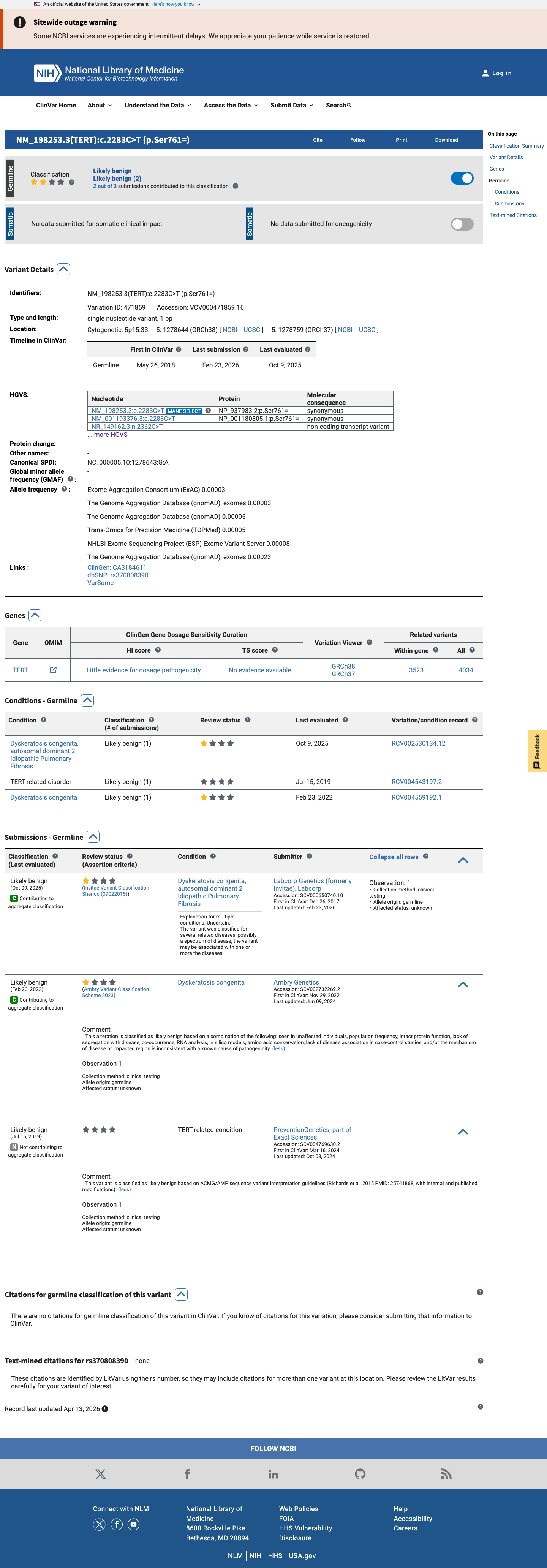
ClinVar screenshot
ClinVar
This variant has been reported in ClinVar as Likely benign (3 clinical laboratories). (ClinVarID = 471859)
SpliceAI screenshot
In silico
SpliceAI predicts no significant splice impact for this variant (max delta score = 0.01).
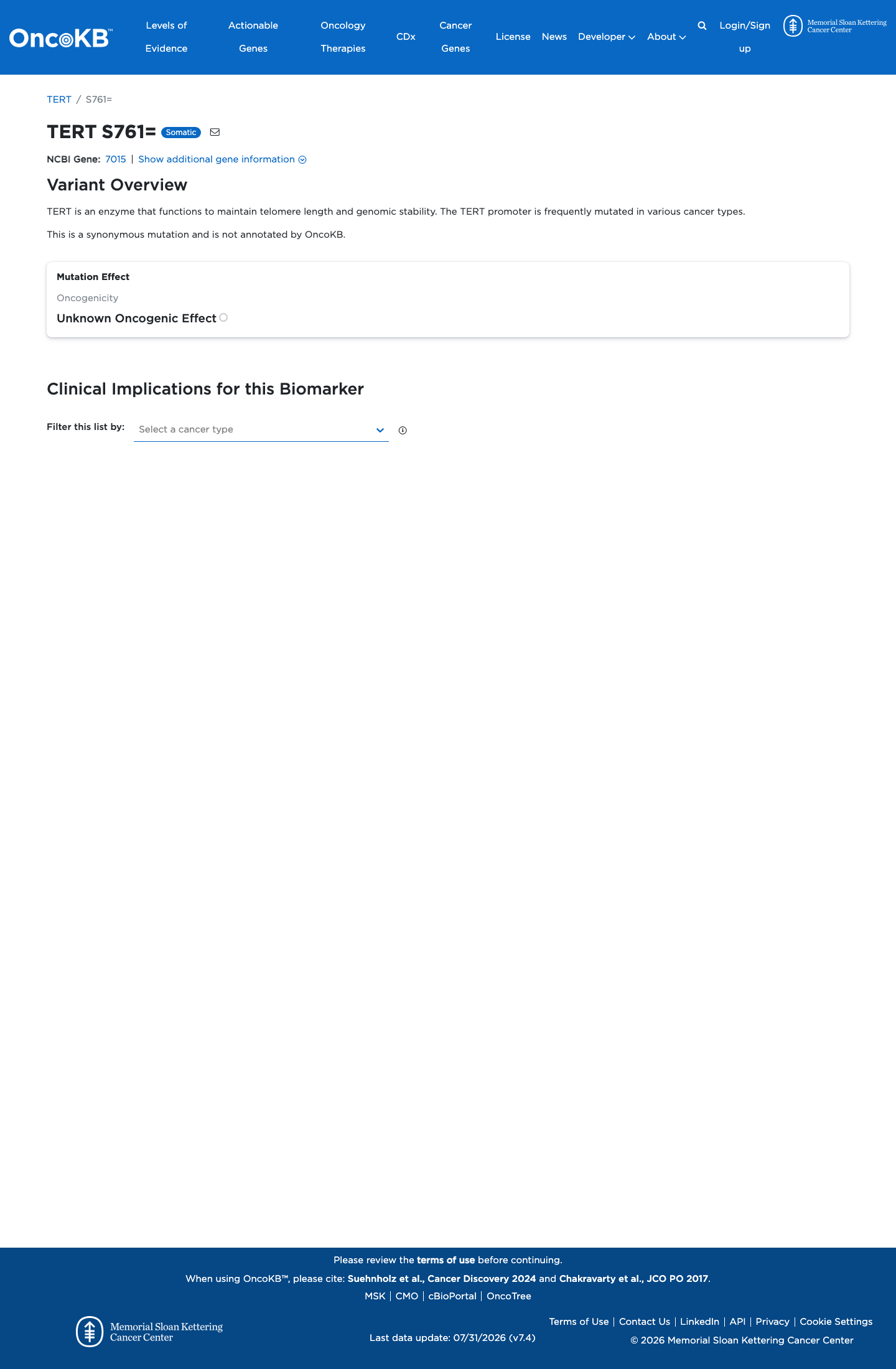
Functional / OncoKB screenshot
Functional Unknown Oncogenic Effect
OncoKB identified curated literature and non-variant-specific oncogenicity context for review; listed oncogenicity label: Unknown Oncogenic Effect.
OncoKB ↗
COSMIC screenshot
COSMIC
Cancer hotspots screenshot
Cancer hotspots
Somatic evidence Not in COSMIC / hotspots
COSMIC
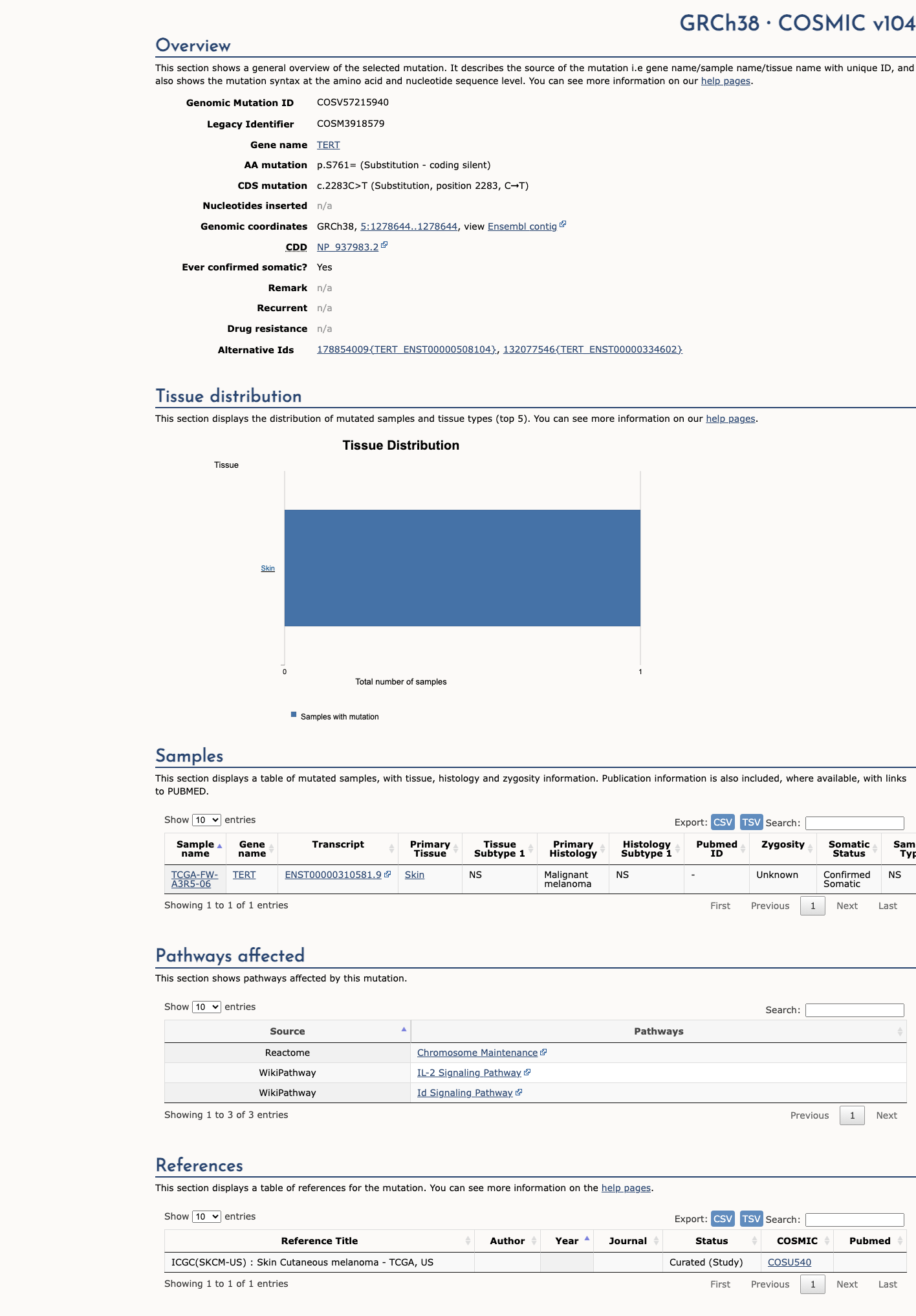
This variant does not lie in a statistically significant hotspot. This variant has previously been reported in somatic cancers (COSMIC; COSV57215940, n = 1 times).
Hotspots
This variant does not lie in a statistically significant hotspot.
Sources & reference links
8Sources
ClinVar
gnomAD v2.1
gnomAD v4.1
gnomAD-Canada
SpliceAI
OncoKB
COSMIC
Cancer hotspots
Triaged references · 4 PMIDs not cited in assessment
20301779 ↗ Dyskeratosis Congenita and Related Telomere Biology Disorders. CLINVAR
26389258 ↗ Cancer Genetics Risk Assessment and Counseling (PDQ®): Health Professional Version. CLINVAR
26389333 ↗ Genetics of Skin Cancer (PDQ®): Health Professional Version. CLINVAR
28492532 ↗ Sherloc: a comprehensive refinement of the ACMG-AMP variant classification criteria. CLINVAR