Back
NM_001202543.1:c.2598_2606dup
p.Ser868_Gly870dup · CUX1
ACMG/AMP
0%
complete
Final classification
Benign
BA1BP3
CUX1
c.2598_2606dup
p.Ser868_Gly870dup
in_frame_indel_unknown · exon 18

CUX1 is a homeodomain transcription factor that regulates gene expression, cell cycle progression, proliferation, migration, and DNA damage repair, and also helps organize higher-order chromatin structure. It is recurrently deleted in uterine leiomyomas, acute myeloid leukemia, and myelodysplastic syndromes, where it typically acts as a haploinsufficient tumor suppressor. While loss of CUX1 function is linked to hematopoietic malignancies, increased expression of the gene has also been associated with poor prognosis in several other cancers.

This variant

CUX1 is a haploinsufficient tumor suppressor recurrently deleted in uterine leiomyomas, acute myeloid leukemia, and myelodysplastic syndromes, where disease stems from loss-of-function alleles. This variant is instead a common in-frame duplication of a low-complexity repeat region (up to 1.99% allele frequency, with homozygotes in gnomAD), which does not disrupt CUX1 protein function, so a benign classification is consistent with the gene's established disease biology.

Transcript
NM_001202543.1
HGVS · transcript:coding
NM_001202543.1:c.2598_2606dup
GRCh38
chr7:102201853 G>GGGCAGCGGT
GRCh37
chr7:101845133 G>GGGCAGCGGT
Benign: BA1 is met at stand-alone strength, with the highest observed population allele frequency 1.99% (gnomAD v4.1, African/African American) exceeding the 1% BA1 threshold.
Classification rationale
BA1BP3 Benign
CUX1 c.2598_2606dup in_frame_indel_unknown · exon 18

BA1 (Stand-alone): highest observed population allele frequency 1.99% in African/African American (gnomAD v4.1) exceeds the 1% BA1 threshold, corroborated by gnomAD v2.1 (1.77%) and gnomAD-Canada (2.55%). BP3 (Supporting): in-frame 9-bp/3-amino-acid duplication p.(Ser868_Gly870dup) lies in a tandem SGG repeat region without known function, outside all CUT/homeodomain DNA-binding domains, with no predicted splice impact (SpliceAI max delta 0.006). Overall classification: Benign, per the generic ACMG/AMP 2015 combination rule '(1 BA1) -> Benign'; no pathogenic criterion is met.

BA1 + BP3 → Benign
LYFE Sciences is an AI system, and it can make mistakes. Criteria may be applied incorrectly, sources may be misread, and a confident-looking classification can still be wrong. Double-check every criterion and its underlying evidence before relying on any call.
Gene diagram · NM_001202543.1 · variants mapped to exon structure
CUX1 NM_001202543.1
Fetching transcript structure from UCSC…
Applied criteria · 2 applied · 18 assessed
MetEvidence satisfies this criterion.
Not metEvaluated against available evidence; threshold not reached.
Not assessedApplies in principle, but no evidence was found to evaluate it.
N/ADoesn't apply to this variant type.
Applied · 2
Strength Supporting Moderate Strong Very strong
BA1 stand-alone Benign
Met (stand-alone benign): highest population allele frequency 1.99% in African/African American (gnomAD v4.1) exceeds the 1% BA1 threshold.
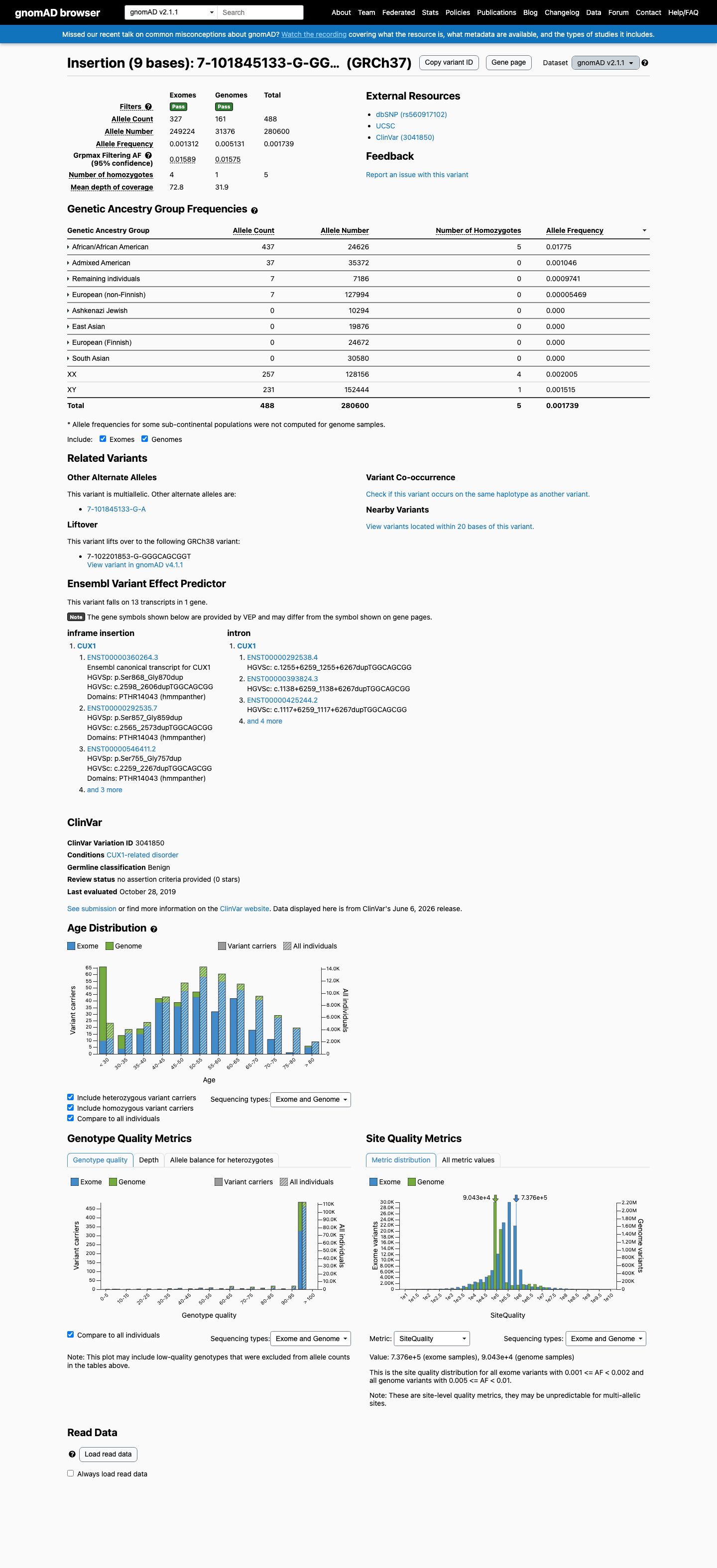
gnomAD v4.1 (GRCh38, joint exome+genome, 1,613,378 alleles): total AF 0.10463% (1688 alleles), highest observed frequency in African/African American at AF 1.99350% (1496/75044 alleles, 12 homozygotes); joint grpmax FAF 0.0190942 (1.91%); NFE AF 0.0014%, AMR AF 0.153%, MID AF 0.0495%, SAS AF 0.0011%, EAS/FIN/ASJ AF 0%.gnomAD v2.1 (GRCh37, exome, 280,600 alleles): total AF 0.17391% (488 alleles, 5 homozygotes), highest observed frequency in African/African American at AF 1.77455% (437/24626 alleles, 5 homozygotes); grpmax FAF 0.0158866 (1.59%).gnomAD-Canada v1.0 (HostSeq, 10,487 genomes, 18,418 alleles): overall AF 0.1466% (27 alleles, 0 homozygotes), highest frequency in African/African American at AF 2.554% (26/1018 alleles); grpmax faf95 0.0179 (1.79%).
BP3 supporting Benign
Met (supporting benign): in-frame 3-amino-acid duplication in a tandem SGG repeat region without known function.
Generic ACMG/AMP 2015 BP3 (Richards et al., PMID 25741868): 'In-frame indels in a repeat region without known function' (supporting benign). No CSPEC/VCEP exists for CUX1 (vcep_materials.json: generic_acmg_fallback), so the generic framework governs.In-frame: 9-bp duplication of 3 codons, NM_001202543.1:c.2598_2606dupTGGCAGCGG, p.(Ser868_Gly870dup) (Mutalyzer and VariantValidator normalization in prefetch.json; gnomAD-Canada VEP most_severe_consequence 'inframe_insertion'); protein length 1517 to 1520 aa; no frameshift, no premature stop, NMD not applicable; exon 18 of 23 in NM_001202543.1. ClinVar (variation 3041850) reports the same change on the MANE transcript NM_181552.4 as c.2565_2573dup, p.(Gly859_Gly860insSerGlyGly), confirming an in-frame Ser-Gly-Gly insertion across transcripts (ClinVar entry has no assertion criteria and is used here only for transcript/protein notation).Repeat region: the duplicated unit SGG (residues 868-870) is a perfect tandem repeat of the immediately upstream unit (residues 865-867; reference 865-870 = SGGSGG); the variant creates three tandem SGG copies (...GKEKGSGGSGGSGGGSQPR...), verified by CDS-level simulation using the NCBI NM_001202543.1 sequence. The region is Gly/Ser-rich low complexity (33.8% G+S in the +/-40 aa window; 70% GC DNA in c.2538-2667 with adjacent homopolymer runs c.2405 CCCCC, c.2418 CCCCC, c.2464 AAAAA). UniProt P39880 (CUX1) annotates the region as intrinsically disordered (residues 815-930) with flanking compositional-bias 'polar residues' stretches (868-877, 887-911); UniProt is not a source_registry key, so this is narrative context.
Assessed · not applied · 9 not met · 9 not assessed
Pathogenic
PS2 Not assessed: no proband-parent trio or parental-confirmation data for this variant was available.
PS3 Not assessed: no well-established functional assay evidence for this variant was available.
PS4 Not assessed: no case-control or case-series evidence exists; the only observation is a single somatic COSMIC entry.
PM2 Not met: gnomAD v4.1 overall allele frequency 0.105% exceeds the 0.1% PM2 ceiling (1.99% in African/African American).
PM3 Not met: no trans observation with a pathogenic variant and no recessive disease model; 12 homozygotes exist in gnomAD v4.1.
PM6 Not assessed: no proband-parent testing data exists, so an assumed de novo occurrence cannot be evaluated.
PP1 Not assessed: no pedigree, affected-family-member genotyping, or segregation data for this variant was available.
PP3 Not met: SpliceAI max delta 0.006 predicts no splice impact, far below the 0.2 cutoff; missense predictors do not apply.
PP4 Not assessed: no proband phenotype or family-history data, and no publication reports this exact variant in an affected patient.
PP5 Not met: no ClinVar expert-panel (3-star) classification exists; the sole submission is a 0-star laboratory Benign label.
Benign
BS1 Not met: the 1.99% frequency exceeds both frequency thresholds but triggers BA1 instead, since BS1 and BA1 are mutually exclusive.
BS2 Not met: 12 homozygotes in gnomAD v4.1, but no established penetrance or inheritance model for CUX1-related germline disease.
BS3 Not assessed: no validated functional study showing no damaging effect on protein function or splicing was available.
BS4 Not assessed: no familial segregation testing data for this variant was available.
BP2 Not met: no observation of this variant in trans or cis with a pathogenic variant exists.
BP4 Not met: a single SpliceAI line (max delta 0.006) does not satisfy BP4's multiple-lines-of-evidence requirement.
BP5 Not assessed: no alternate molecular basis of disease was documented for any case carrying this variant.
BP6 Not met: the ClinVar Benign label is a 0-star laboratory submission, not a 3-star expert-panel assertion.
N/A · 8 PVS1 · PS1 · PM1 · PM4 · PM5 · PP2 · BP1 · BP7
Research & evidence
Population frequency · supports benign
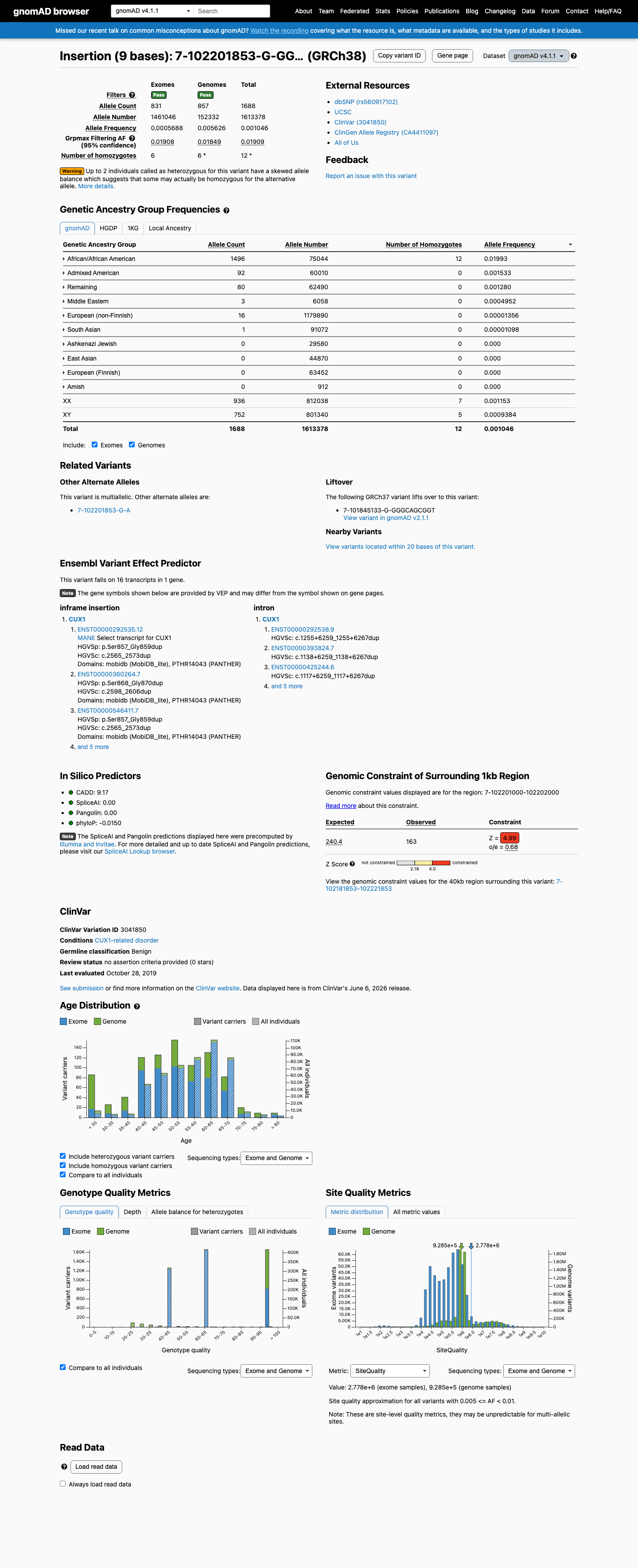
gnomAD v4.1 screenshot
gnomAD v4.1
gnomAD v2.1 screenshot
gnomAD v2.1
v4.1
This variant is present in gnomAD v4.1 (AF= 0.00104625; MAF= 0.10463%, 1688/1613378 alleles, homozygotes = 12) and has highest observed frequency in the African/African American population (AF= 0.019935; MAF= 1.99350%, 1496/75044 alleles, homozygotes = 12); grpmax FAF= 0.0190942.
v2.1
This variant is present in gnomAD v2.1 (AF= 0.00173913; MAF= 0.17391%, 488/280600 alleles, homozygotes = 5) and has highest observed frequency in the African/African American population (AF= 0.0177455; MAF= 1.77455%, 437/24626 alleles, homozygotes = 5); grpmax FAF= 0.0158866.
🇨🇦 CA
This variant is present in gnomAD-Canada v1.0 (AF= 0.0014659572157671842, 27/18418 alleles, homozygotes = 0).
Allele frequency by ancestry
three datasets · side by side
gnomAD v4.1
0.1% · 1688 / 1,613,378
12 hom · FAF 1.9%
African/African American
1496 / 75,044
2%
12 hom
Admixed American
92 / 60,010
0.15%
Remaining individuals
80 / 62,490
0.13%
Middle Eastern
3 / 6,058
0.05%
European (non-Finnish)
16 / 1,179,890
0.0014%
South Asian
1 / 91,072
0.0011%
+ 4 not observed (European (Finnish), Amish, East Asian, Ashkenazi Jewish)
gnomAD v2.1
0.17% · 488 / 280,600
5 hom · FAF 1.6%
African/African American
437 / 24,626
1.8%
5 hom
Admixed American
37 / 35,372
0.1%
Remaining individuals
7 / 7,186
0.097%
European (non-Finnish)
7 / 127,994
0.0055%
+ 4 not observed (Ashkenazi Jewish, East Asian, European (Finnish), South Asian)
gnomAD Canada 🇨🇦
0.15% · 27 / 18,418
0 hom · FAF 1.8%
African/African American
26 / 1,018
2.6%
Remaining individuals
1 / 1,138
0.088%
+ 7 not observed (Latino/Admixed American, Ashkenazi Jewish, East Asian, European (Finnish), Middle Eastern, European (non-Finnish), South Asian)
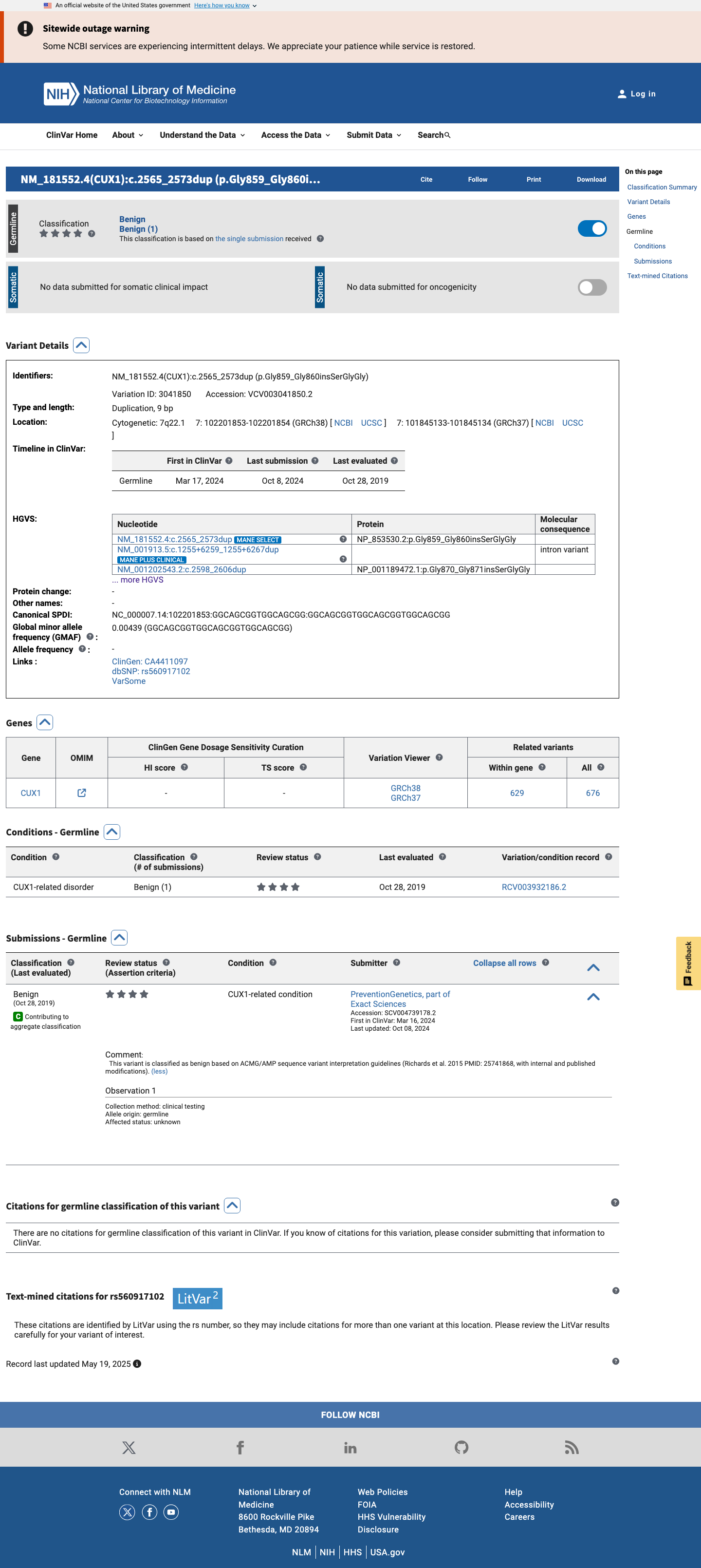
ClinVar screenshot
ClinVar
This variant has been reported in ClinVar as Benign (1 clinical laboratory). (ClinVarID = 3041850)
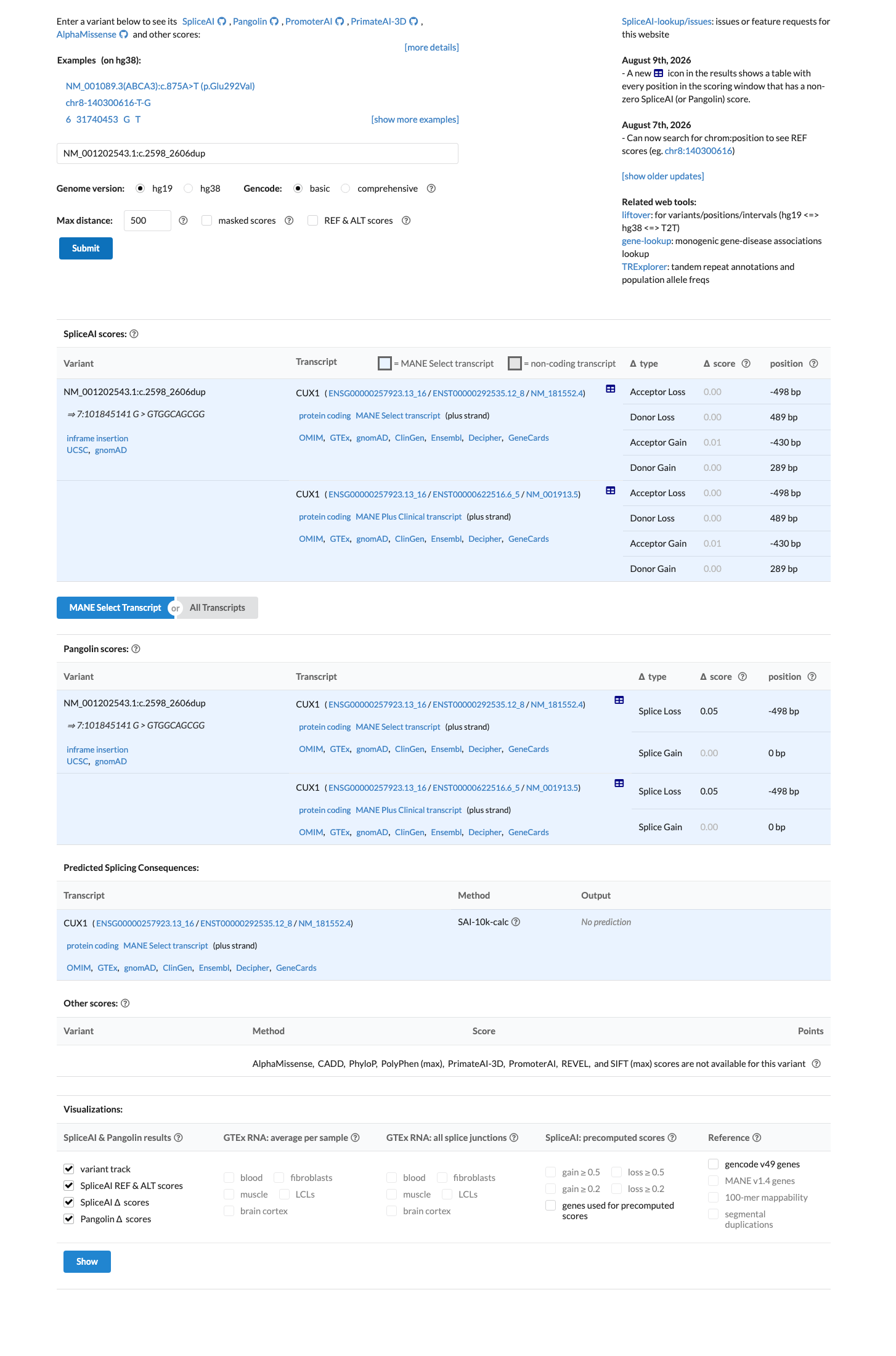
SpliceAI screenshot
In silico
SpliceAI predicts no significant splice impact for this variant (max delta score = 0.01).
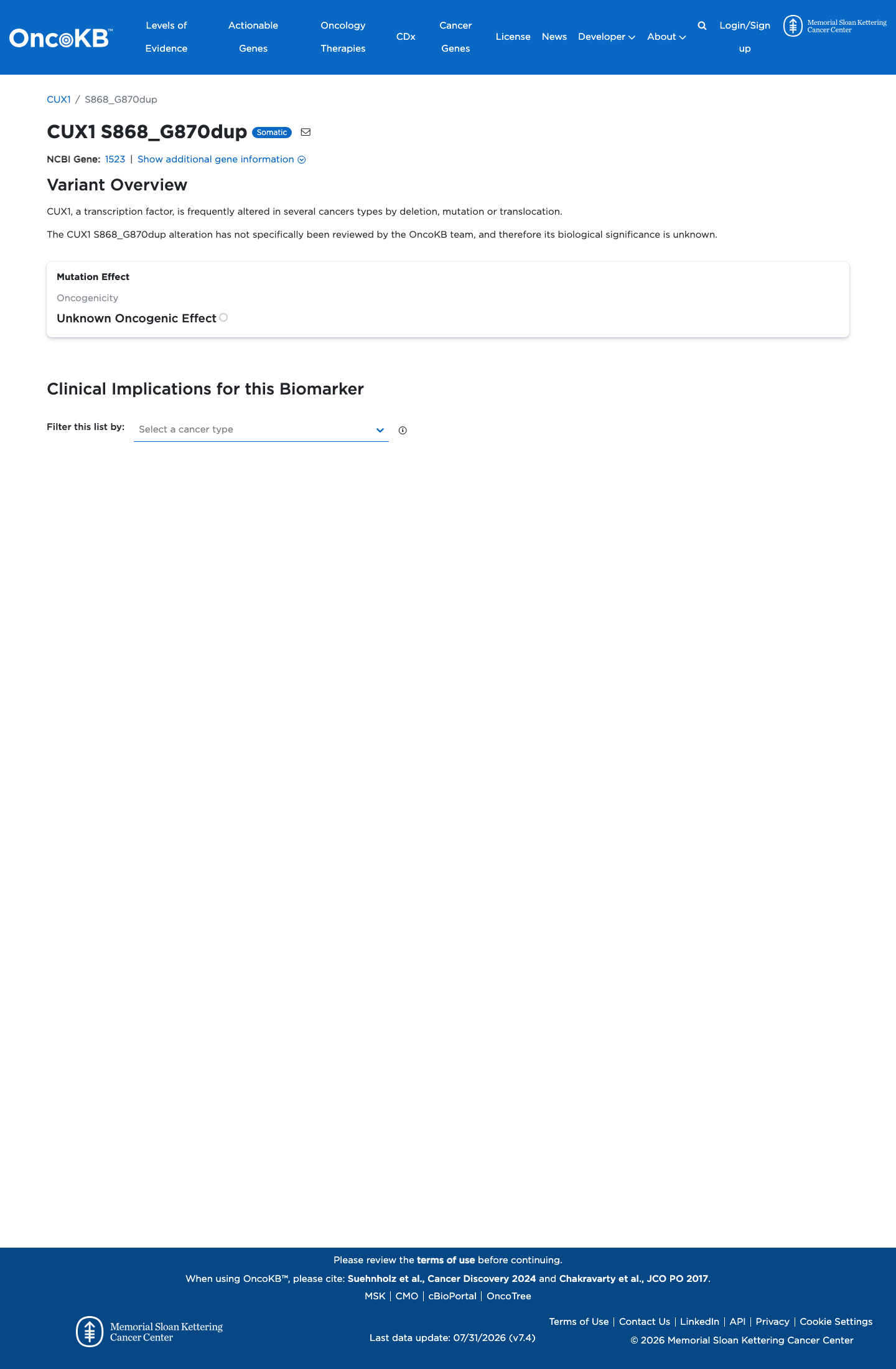
Functional / OncoKB screenshot
Functional Unknown Oncogenic Effect
OncoKB did not identify variant-specific reviewed functional evidence for this variant; gene-level curated context is available for reviewer follow-up. CUX1, a transcription factor, is frequently altered in several cancers types by deletion, mutation or translocation.
OncoKB ↗
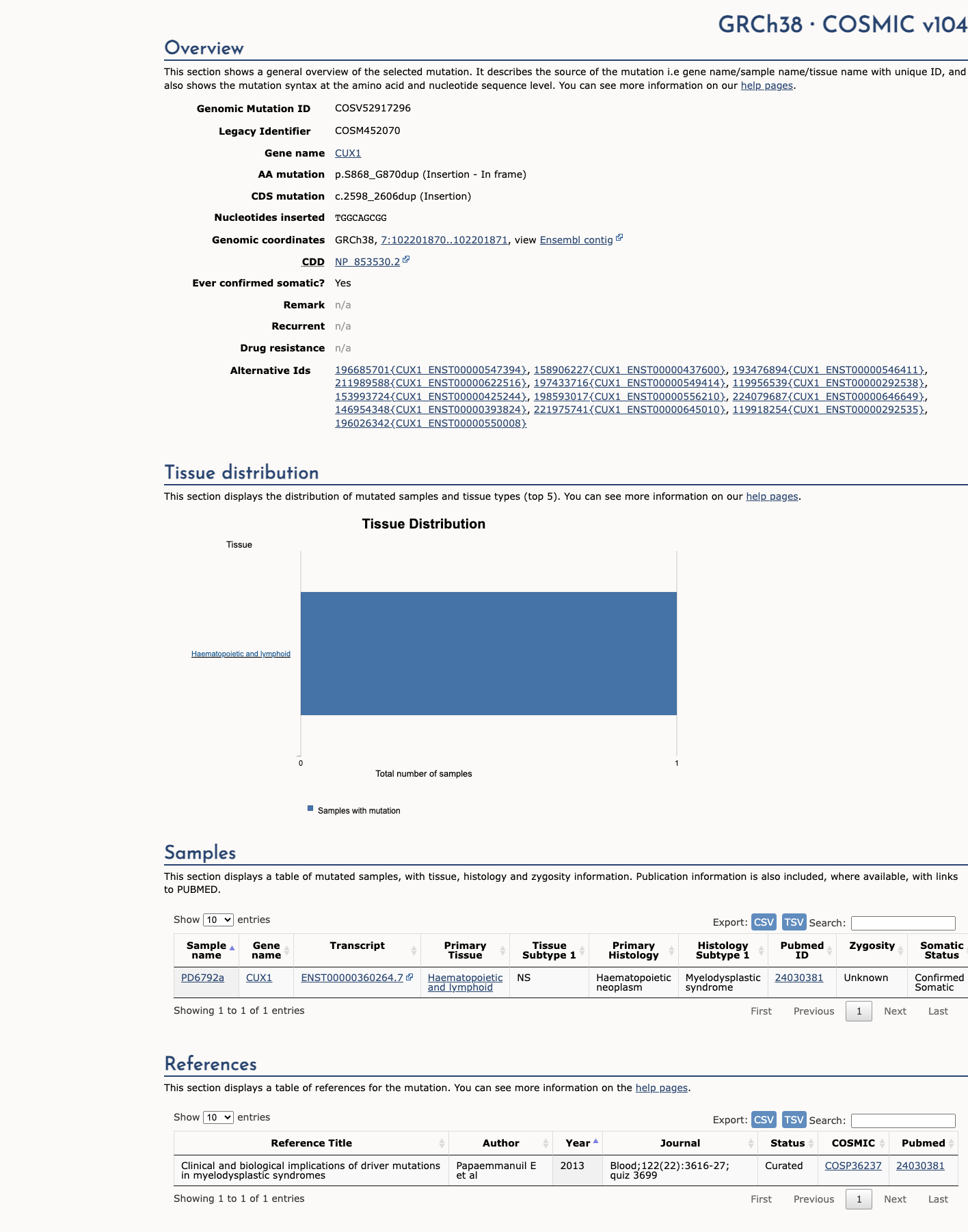
COSMIC screenshot
COSMIC
Cancer hotspots screenshot
Cancer hotspots
Somatic evidence Not in COSMIC / hotspots
COSMIC
This variant does not lie in a statistically significant hotspot. This variant has previously been reported in somatic cancers (COSMIC; COSV52917296, n = 1 times).
Hotspots
This variant does not lie in a statistically significant hotspot.
Sources & reference links
8Sources
ClinVar
gnomAD v2.1
gnomAD v4.1
gnomAD-Canada
SpliceAI
OncoKB
COSMIC
Cancer hotspots