Back
NM_001042492.2:c.2544G>A
p.Gly848= · NF1
0%
complete
Final classification
Benign
BA1BS1BS2BP4
NF1
c.2544G>A
p.Gly848=
synonymous · exon 21

NF1 encodes neurofibromin, a tumor suppressor protein that negatively regulates the RAS signal transduction pathway. As a GTPase-activating protein, it helps switch RAS proteins from their active to inactive state, keeping cell growth in check; loss of NF1 function leaves RAS overactive and drives downstream growth pathways such as MAPK/ERK and PI3K. Inherited changes in NF1 cause the cancer-predisposition syndrome neurofibromatosis type 1, and are also linked to juvenile myelomonocytic leukemia and Watson syndrome. Somatic changes in NF1 are found in many tumor types, including breast cancer, melanoma, and glioma.

This variant

NF1 encodes neurofibromin, a tumor suppressor whose loss leaves RAS overactive and causes neurofibromatosis type 1. This synonymous change does not alter the protein (p.(Gly848=)) and is common in African/African American populations (8.31% allele frequency), indicating a benign polymorphism rather than a disease-causing NF1 alteration.

Transcript
NM_001042492.2
HGVS · transcript:coding
NM_001042492.2:c.2544G>A
GRCh38
chr17:31229159 G>A
GRCh37
chr17:29556177 G>A
Benign: BA1 met as stand-alone evidence — gnomAD v4.1 African/African American allele frequency 8.31% exceeds the >5% threshold — with BS1, BS2, and BP4 also met.
Classification rationale
BA1BS1BS2BP4 Benign
NF1 c.2544G>A synonymous · exon 21

BA1 (Stand-alone): gnomAD v4.1 African/African American allele frequency 8.31% exceeds the >5% threshold. BS1 (Strong): gnomAD v4.1 total allele frequency 0.45% is roughly 10–20-fold the ~0.02–0.05% expected for a pathogenic NF1 allele. BS2 (Strong): 310 homozygotes in gnomAD v4.1 despite NF1's near-complete penetrance by adulthood. BP4 (Supporting): SpliceAI max delta 0.079, below the 0.1 threshold for predicted splice impact. Overall: Benign — BA1 alone is sufficient under the generic ACMG/AMP 2015 rules, with two BS criteria independently satisfied as well.

BA1 + BS1 + BS2 + BP4 → Benign
LYFE Sciences is an AI system, and it can make mistakes. Criteria may be applied incorrectly, sources may be misread, and a confident-looking classification can still be wrong. Double-check every criterion and its underlying evidence before relying on any call.
Gene diagram · NM_001042492.2 · variants mapped to exon structure
NF1 NM_001042492.2
Fetching transcript structure from UCSC…
Applied criteria · 4 applied · 15 assessed
MetEvidence satisfies this criterion.
Not metEvaluated against available evidence; threshold not reached.
Not assessedApplies in principle, but no evidence was found to evaluate it.
N/ADoesn't apply to this variant type.
Applied · 4
Strength Supporting Moderate Strong Very strong
BA1 stand-alone Benign
Met: gnomAD v4.1 African/African American allele frequency 8.31% exceeds the >5% stand-alone benign threshold.
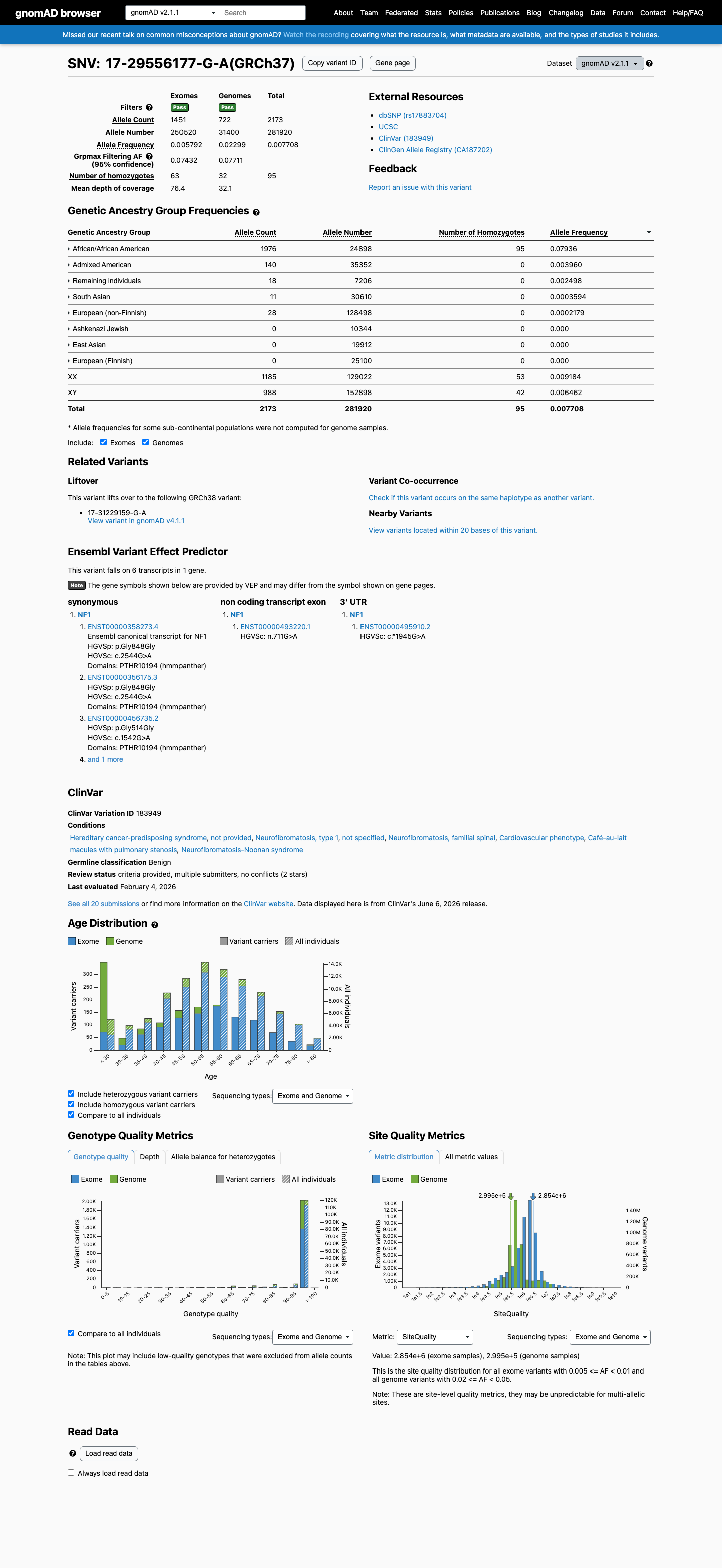
ACMG/AMP 2015 (PMID:25741868): 'In general, an allele frequency in a control population that is greater than expected for the disorder (Table 6) is considered strong support for a benign interpretation for a rare Mendelian disorder (BS1) or if over 5% then it is considered as stand-alone support (BA1).'gnomAD v4.1: AFR AF = 0.0830509 (6225/74954 alleles, 305 homozygotes), joint grpmax FAF = 0.0813264, total AF = 0.00451209 (7273/1611892) — AFR AF and grpmax FAF both exceed the >5% BA1 thresholdgnomAD v2.1: AFR AF = 0.0793638 (1976/24898 alleles, 95 homozygotes), grpmax FAF = 0.0771056, total AF = 0.00770786 (2173/281920) — AFR AF and grpmax FAF both exceed the >5% BA1 threshold
BS1 strong Benign
Met: gnomAD v4.1 total allele frequency 0.45%, far above the ~0.02–0.05% expected for a pathogenic NF1 allele.
ACMG/AMP 2015 (PMID:25741868): 'In general, an allele frequency in a control population that is greater than expected for the disorder (Table 6) is considered strong support for a benign interpretation for a rare Mendelian disorder (BS1) or if over 5% then it is considered as stand-alone support (BA1).'NF1 disease context: autosomal dominant, near-complete penetrance, prevalence ~1/3000 -> expected pathogenic allele frequency ~0.02-0.05%; observed gnomAD v4.1 total AF 0.0045 (0.45%) is ~10-20x expected and AFR AF 0.0831 is hundreds-fold above expectedgnomAD v2.1 total AF 0.0077 (0.77%) and AFR AF 0.0794 likewise far exceed the AF expected for NF1; gnomAD-Canada overall AF 0.0061 (0.61%) and AFR AF 0.10 corroborate
BS2 strong Benign
Met: 310 homozygotes observed in gnomAD v4.1 despite NF1's near-complete penetrance by adulthood.
ACMG/AMP 2015 (PMID:25741868): 'Furthermore, if the disease under investigation is fully penetrant at an early age and the variant is observed in a well-documented healthy adult individual for a recessive (homozygous), dominant (heterozygous), or X-linked (hemizygous) condition then this is considered strong evidence for a benign interpretation (BS2).'gnomAD v4.1: 310 homozygotes total (305 of 74954 AFR alleles), gnomAD v2.1: 95 homozygotes (all in AFR, 1976/24898 alleles), gnomAD-Canada v1.0: 5 homozygotes (112/18418 alleles) — homozygous observation of a fully penetrant dominant-disease allele at this scale strongly supports benignitygnomAD-Canada v1.0 age histogram for homozygotes shows carriers across ages 50-75 (age_hist_hom bins), consistent with healthy adult carriers
BP4 supporting Benign
Met: SpliceAI max delta 0.079, below the 0.1 threshold for predicted splice impact.
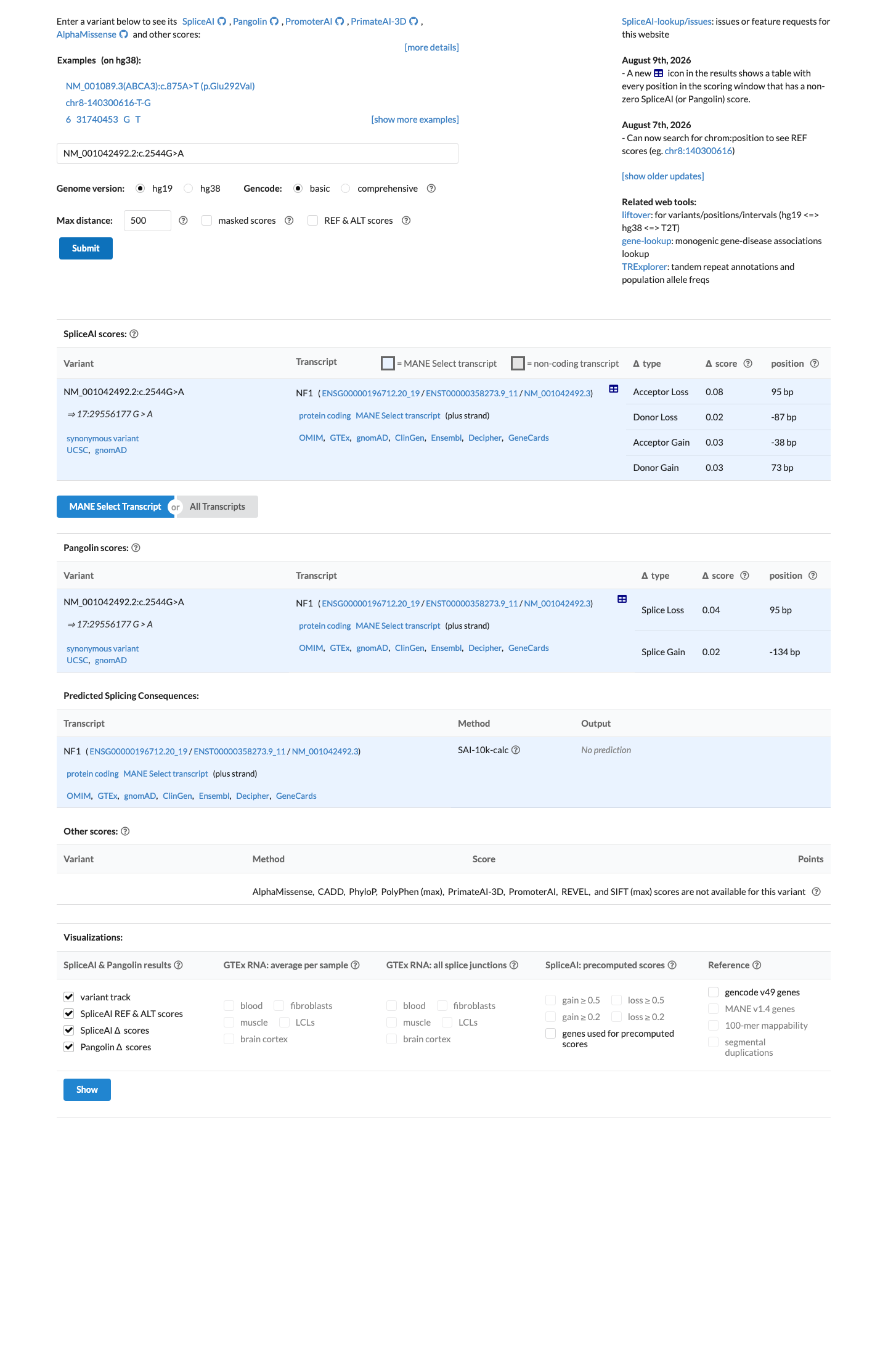
SpliceAI lookup (spliceai): DS_AG 0.029, DS_AL 0.079, DS_DG 0.032, DS_DL 0.016; max delta 0.079, with evidence sentence 'SpliceAI predicts no significant splice impact for this variant (max delta score = 0.08)'.Generic fallback calibration (generic_acmg_combination_rules): for synonymous (non-missense) variants use SpliceAI only; 'SpliceAI max delta < 0.1 -> BP4 (supporting)'. Max delta 0.079 < 0.1, so BP4 (supporting) is met (SVI-recommended thresholds; SpliceAI tool per Jaganathan et al. 2019, PMID 30661751).NF1 VCEP CSPEC (cspec) was consulted and carries no PP3/BP4 rule payload (criteria list empty, framework_complete=false); no gene-specific BP4 assignment overrides the generic calibration.
Assessed · not applied · 4 not met · 11 not assessed
Pathogenic
PS2 Not assessed: no proband or parental genotype data was available to confirm or exclude a de novo occurrence.
PS3 Not assessed: no well-established functional study of this variant was available.
PS4 Not assessed: no affected-versus-control prevalence data was available; control frequencies were high.
PM2 Not met: gnomAD v4.1 total allele frequency 0.45% — the variant is neither absent nor rare.
PM6 Not assessed: no proband or parental testing data was available to assume a de novo event.
PP1 Not assessed: no family, pedigree, or segregation data was available.
PP3 Not met: SpliceAI max delta 0.079 vs the >0.2 PP3 threshold.
PP4 Not assessed: no proband phenotype or family history data was available.
PP5 Not met: no ClinVar expert-panel pathogenic classification exists; all 20 submissions are from ordinary laboratories.
Benign
BS3 Not assessed: no functional assay evidence was available; unconfirmed in silico splice prediction does not qualify.
BS4 Not assessed: no affected family members were tested, so no non-segregation observations exist.
BP2 Not assessed: no cis/trans phase data was available.
BP5 Not assessed: no proband-level data was available to establish an alternate molecular basis.
BP6 Not met: the Benign ClinVar label reflects 20 ordinary laboratory submissions, not an expert panel.
BP7 Not assessed: no conservation score (e.g., PhyloP/GERP) was available to confirm the non-conservation requirement.
N/A · 9 PVS1 · PS1 · PM1 · PM3 · PM4 · PM5 · PP2 · BP1 · BP3
Research & evidence
Population frequency · supports benign
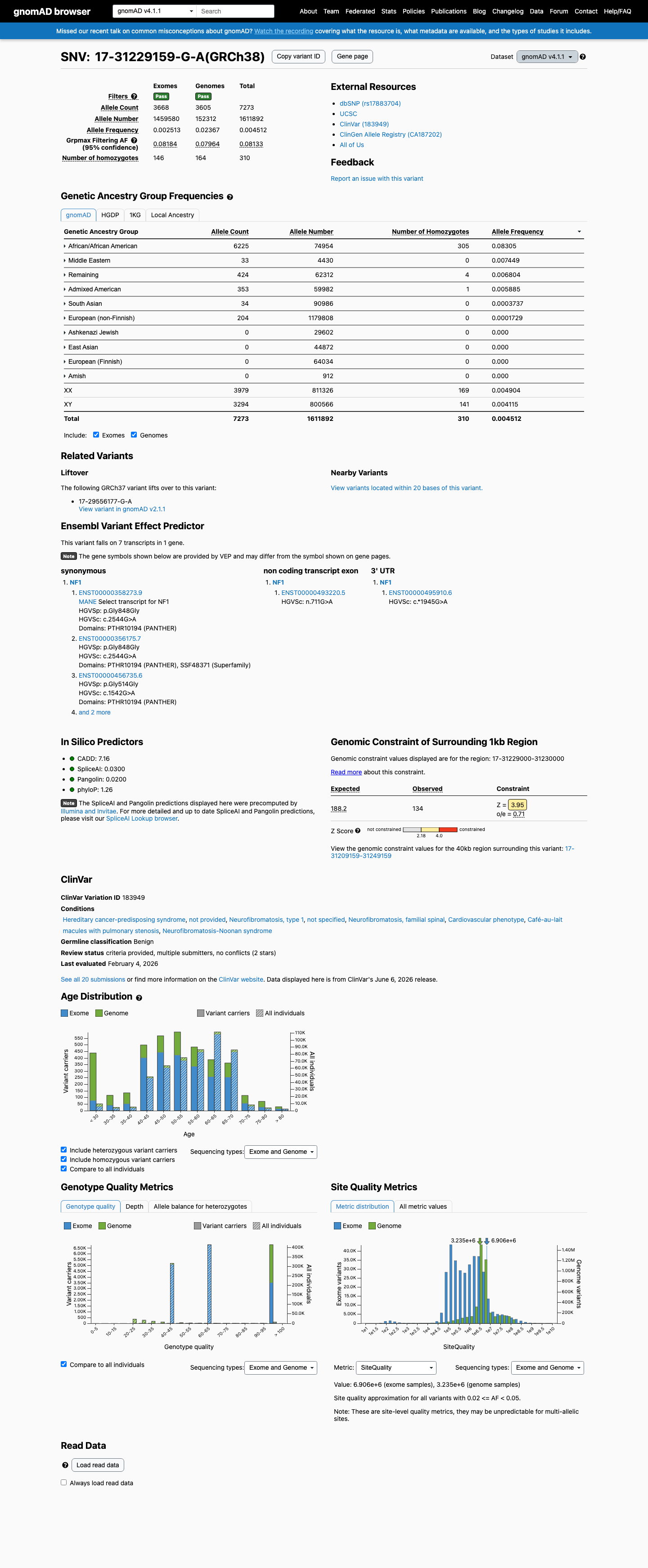
gnomAD v4.1 screenshot
gnomAD v4.1
gnomAD v2.1 screenshot
gnomAD v2.1
v4.1
This variant is present in gnomAD v4.1 (AF= 0.00451209; MAF= 0.45121%, 7273/1611892 alleles, homozygotes = 310) and has highest observed frequency in the African/African American population (AF= 0.0830509; MAF= 8.30509%, 6225/74954 alleles, homozygotes = 305); grpmax FAF= 0.0813264.
v2.1
This variant is present in gnomAD v2.1 (AF= 0.00770786; MAF= 0.77079%, 2173/281920 alleles, homozygotes = 95) and has highest observed frequency in the African/African American population (AF= 0.0793638; MAF= 7.93638%, 1976/24898 alleles, homozygotes = 95); grpmax FAF= 0.0771056.
🇨🇦 CA
This variant is present in gnomAD-Canada v1.0 (AF= 0.006081007709849061, 112/18418 alleles, homozygotes = 5).
Allele frequency by ancestry
three datasets · side by side
gnomAD v4.1
0.45% · 7273 / 1,611,892
310 hom · FAF 8.1%
African/African American
6225 / 74,954
8.3%
305 hom
Middle Eastern
33 / 4,430
0.74%
Remaining individuals
424 / 62,312
0.68%
4 hom
Admixed American
353 / 59,982
0.59%
1 hom
South Asian
34 / 90,986
0.037%
European (non-Finnish)
204 / 1,179,808
0.017%
+ 4 not observed (European (Finnish), Amish, East Asian, Ashkenazi Jewish)
gnomAD v2.1
0.77% · 2173 / 281,920
95 hom · FAF 7.7%
African/African American
1976 / 24,898
7.9%
95 hom
Admixed American
140 / 35,352
0.4%
Remaining individuals
18 / 7,206
0.25%
South Asian
11 / 30,610
0.036%
European (non-Finnish)
28 / 128,498
0.022%
+ 3 not observed (Ashkenazi Jewish, East Asian, European (Finnish))
gnomAD Canada 🇨🇦
0.61% · 112 / 18,418
5 hom · FAF 8.4%
African/African American
102 / 1,020
10%
5 hom
Middle Eastern
1 / 144
0.69%
Remaining individuals
5 / 1,138
0.44%
Latino/Admixed American
3 / 838
0.36%
European (non-Finnish)
1 / 11,740
0.0085%
+ 4 not observed (Ashkenazi Jewish, East Asian, European (Finnish), South Asian)
ClinVar screenshot
ClinVar
This variant has been reported in ClinVar as Benign (20 clinical laboratories). (ClinVarID = 183949)
SpliceAI screenshot
In silico
SpliceAI predicts no significant splice impact for this variant (max delta score = 0.08).
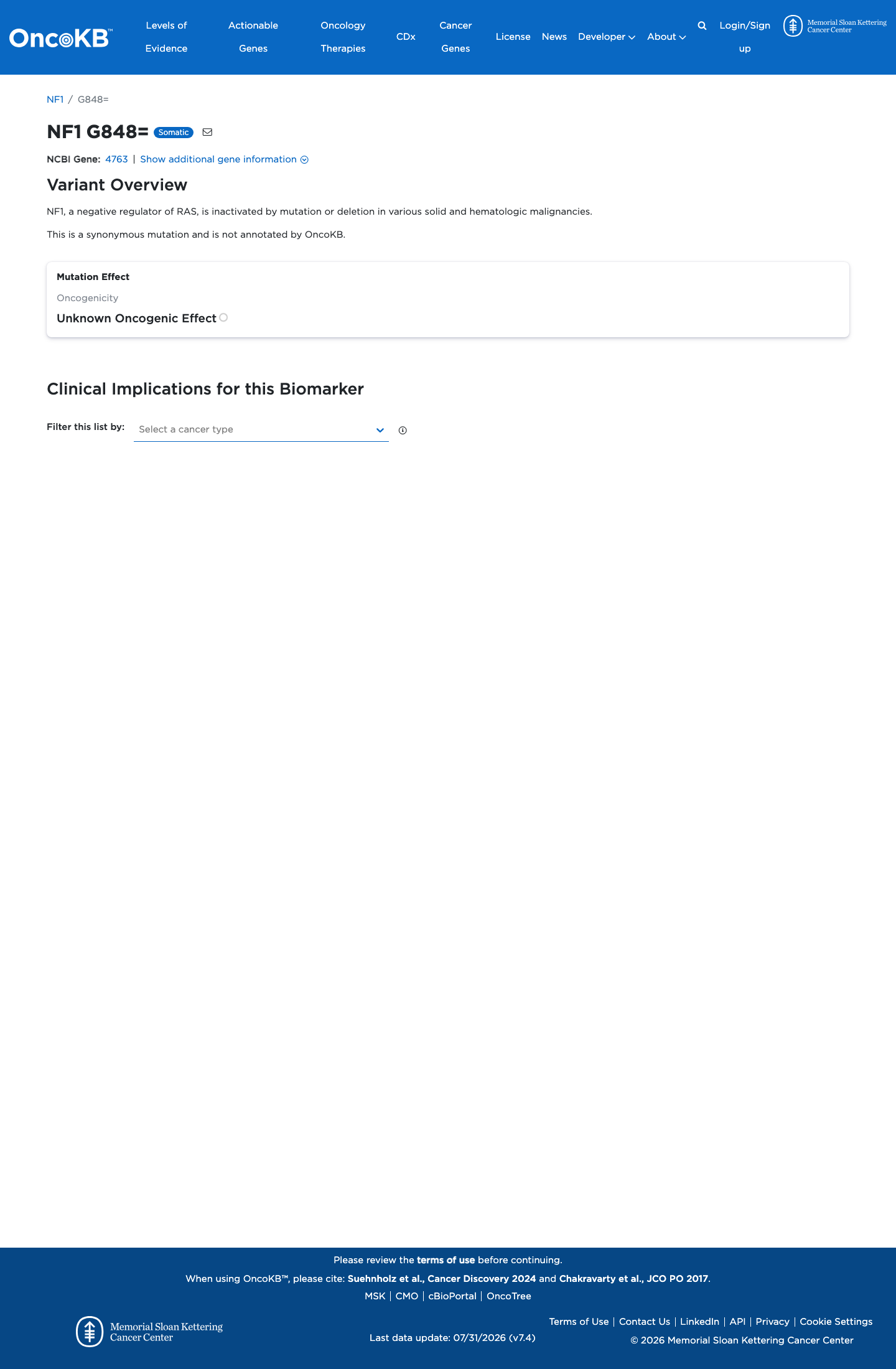
Functional / OncoKB screenshot
Functional Unknown Oncogenic Effect
OncoKB identified curated literature and non-variant-specific oncogenicity context for review; listed oncogenicity label: Unknown Oncogenic Effect.
OncoKB ↗
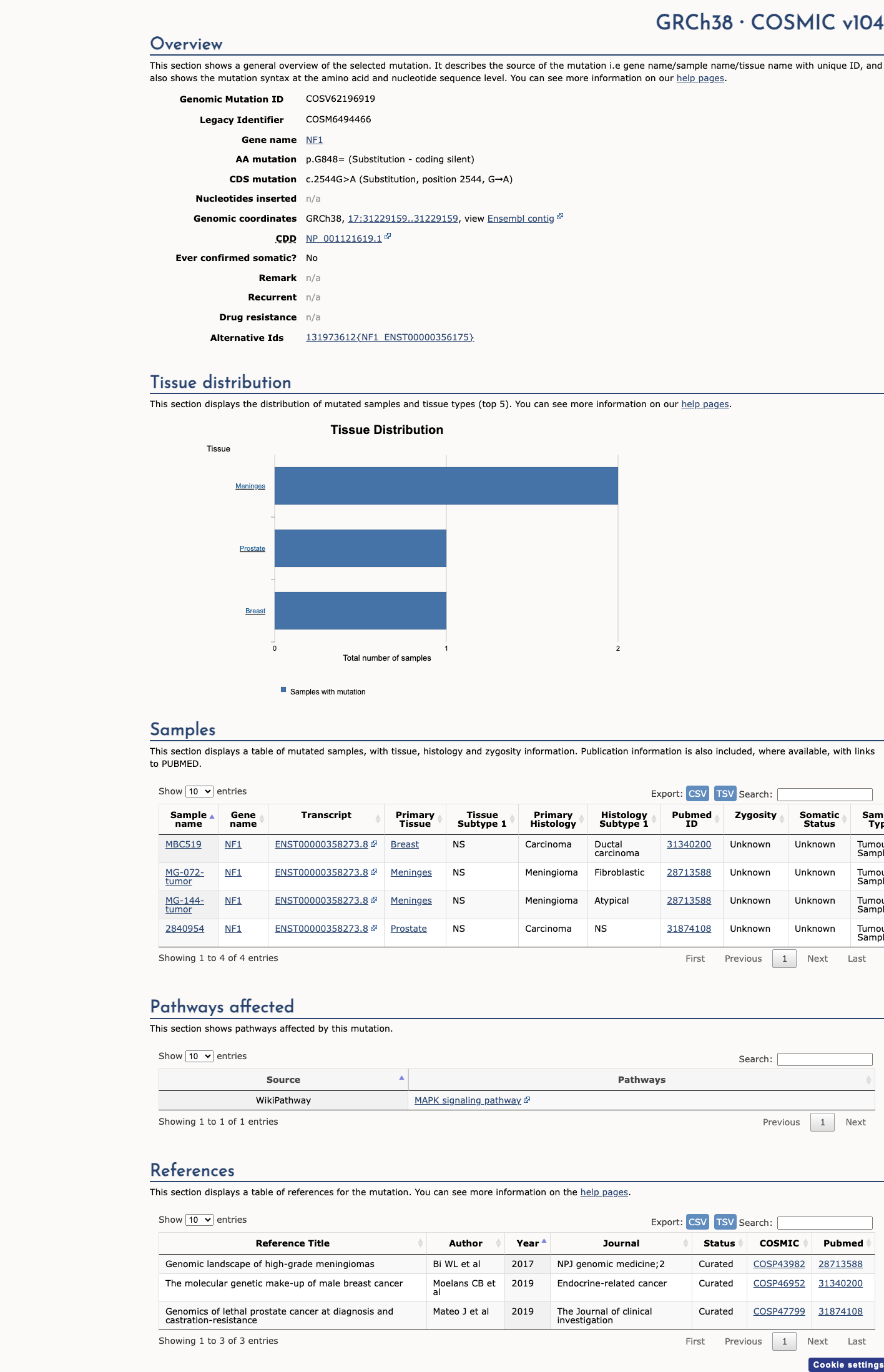
COSMIC screenshot
COSMIC
Cancer hotspots screenshot
Cancer hotspots
Somatic evidence Not in COSMIC / hotspots
COSMIC
This variant does not lie in a statistically significant hotspot. This variant has previously been reported in somatic cancers (COSMIC; COSV62196919, n = 4 times).
Hotspots
This variant does not lie in a statistically significant hotspot.
Literature · how each cited paper was used
1papers cited
Each card is an audit: what was searched, what was found, whether it names the variant, which criteria it fed, and why. 7 further PMIDs triaged but not cited — see Sources & references.
Rule & framework references · cited for criterion definitions, not variant evidence
25741868 ↗ Standards and guidelines for the interpretation of sequence variants: a joint consensus recommendation of the American College of Medical Genetics and Genomics and the Association for Molecular Pathology.
Sources & reference links
9Sources
CSpec VCEP
ClinVar
gnomAD v2.1
gnomAD v4.1
gnomAD-Canada
SpliceAI
OncoKB
COSMIC
Cancer hotspots
Triaged references · 7 PMIDs not cited in assessment
24033266 ↗ A systematic approach to assessing the clinical significance of genetic variants. CLINVAR
17636453 ↗ Neurofibromatosis type 1 in genetic counseling practice: recommendations of the National Society of Genetic Counselors. CLINVAR
25394175 ↗ A practice guideline from the American College of Medical Genetics and Genomics and the National Society of Genetic Counselors: referral indications for cancer predisposition assessment. CLINVAR
32602153 ↗ Genetic Counseling for Neurofibromatosis 1, Neurofibromatosis 2, and Schwannomatosis-Practice Resource of the National Society of Genetic Counselors. CLINVAR
24893135 ↗ Pheochromocytoma and paraganglioma: an endocrine society clinical practice guideline. CLINVAR
28492532 ↗ Sherloc: a comprehensive refinement of the ACMG-AMP variant classification criteria. CLINVAR
33939658 ↗ The North American Neuroendocrine Tumor Society Consensus Guidelines for Surveillance and Management of Metastatic and/or Unresectable Pheochromocytoma and Paraganglioma. CLINVAR