This variant was interpreted by pipeline
7.1.0.
The current version is
8.0.0.
Re-running queues a fresh interpretation; the result replaces this page when complete.
Re-runs are not free. Blank = draws on today's public interpretation allowance.
With a code = uses 1 of that code's uses.
BCOR (BCL6 co-repressor) encodes a transcriptional repressor that silences target genes by working with the BCL6 protein and histone-modifying complexes, helping maintain the correct chromatin state. It is essential for early embryonic development, normal germinal center formation in B cells, blood cell production, and mesenchymal stem cell function. Germline mutations in BCOR cause the inherited oculofaciocardiodental and Lenz microphthalmia syndromes. In cancer, BCOR acts as a tumor suppressor: gene fusions drive certain soft tissue and endometrial stromal sarcomas and acute promyelocytic leukemia, while truncating mutations are found in retinoblastoma, acute myeloid leukemia, and myelodysplastic syndrome.
This variant
BCOR is a tumor suppressor in which truncating mutations drive retinoblastoma, acute myeloid leukemia, and myelodysplastic syndrome, while germline loss of function causes oculofaciocardiodental syndrome. This frameshift truncates the C-terminal PRC1-interaction region and is predicted to trigger nonsense-mediated decay — the same loss-of-function mechanism implicated in these disorders — supporting its Likely Pathogenic classification.
Transcript
NM_017745.5
HGVS · transcript:coding
NM_017745.5:c.3870_3871insC
GRCh38
chrX:40062946 T>TG
GRCh37
chrX:39922199 T>TG
Likely Pathogenic: 1 Very Strong (PVS1) + 1 supporting (PM2) maps to Likely Pathogenic under the ClinGen SVI 2020 PM2-downgrade rule (posterior probability 0.988). The met BP4 (splice-only, supporting) was not counted as benign evidence because it does not apply to this frameshift's loss-of-function consequence.
Classification rationale
PVS1PM2BP4Likely Pathogenic
BCOR c.3870_3871insCframeshift · exon 9
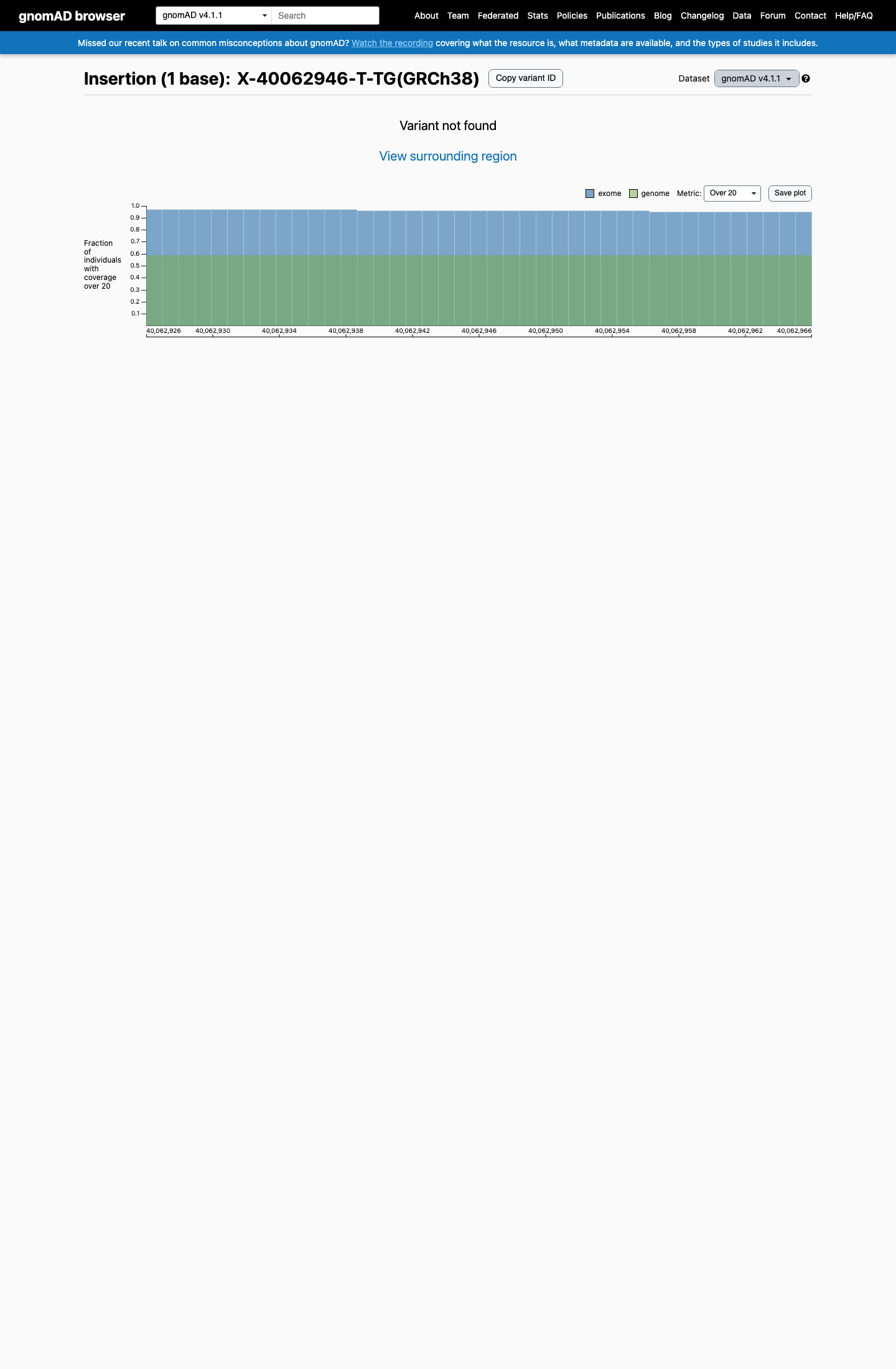
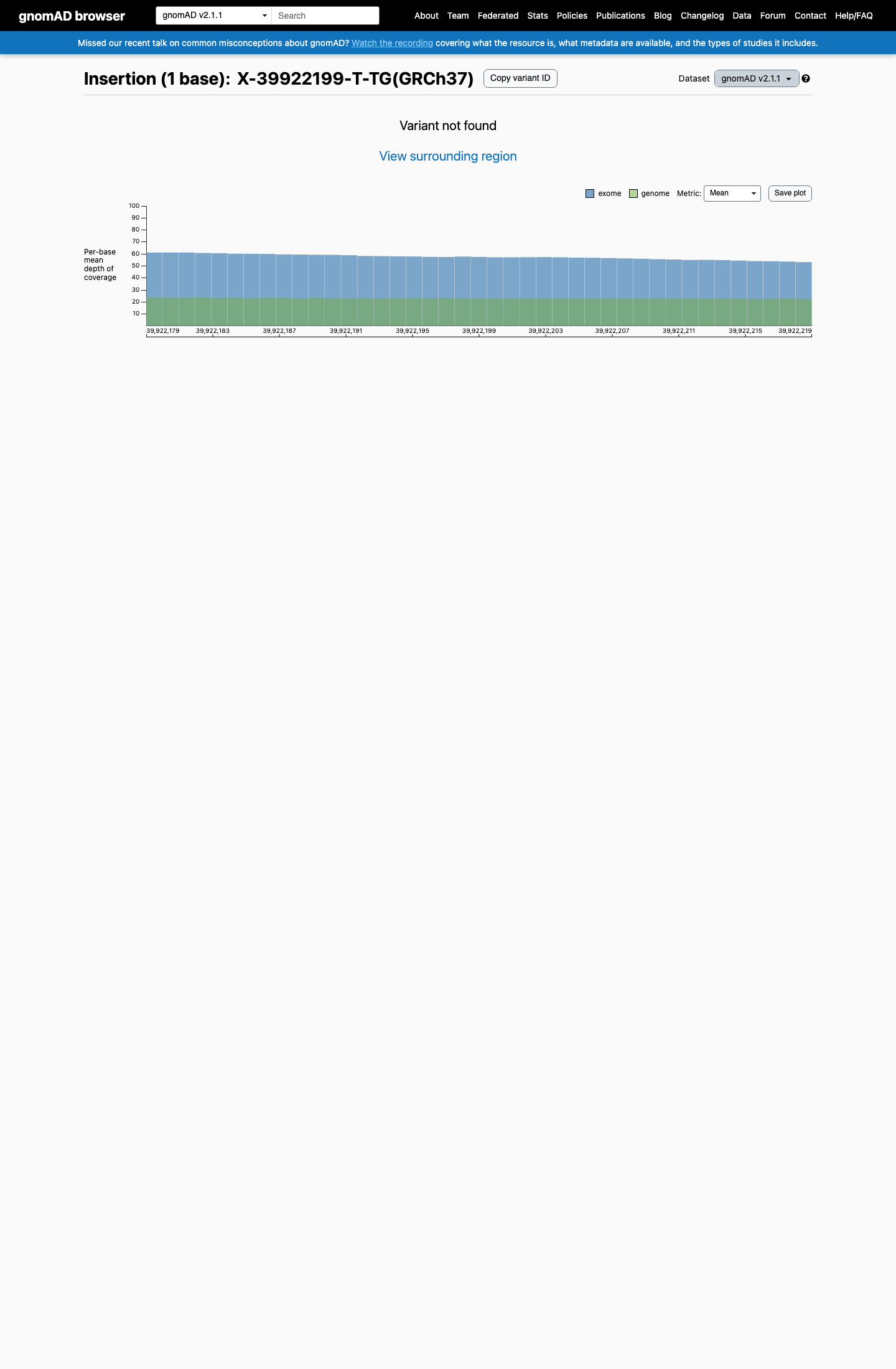
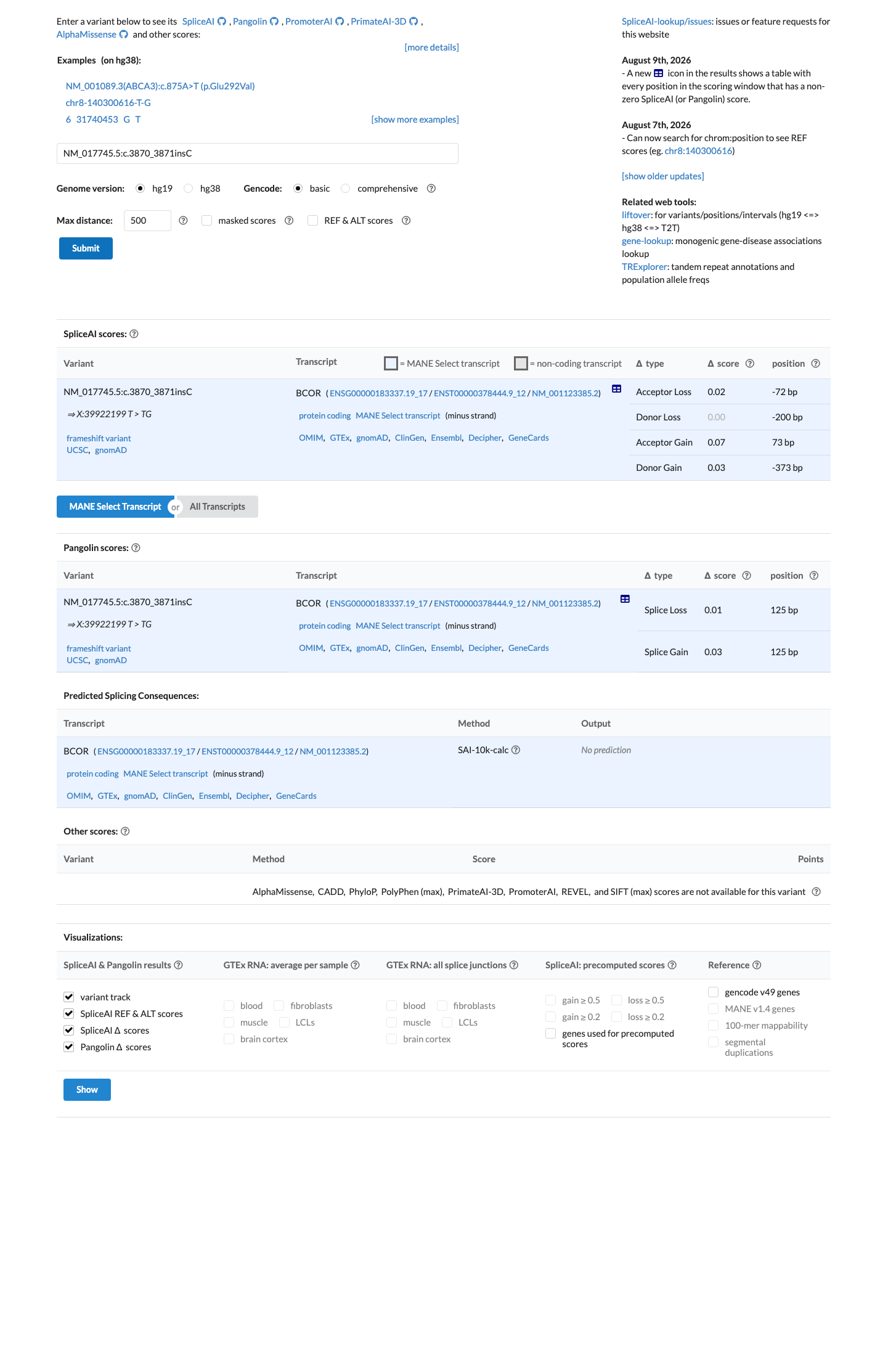
PVS1 (Very Strong): frameshift p.(Lys1291GlnfsTer84) is predicted to trigger nonsense-mediated decay, truncating the BCOR C-terminus. PM2 (Supporting): allele frequency 0 in gnomAD v2.1, v4.1, and gnomAD-Canada, below the 0.1% threshold. BP4 (Supporting, met but not counted): SpliceAI predicts no splice impact (max delta 0.074), but this was excluded from the combination as it does not address the frameshift consequence. Overall: Likely Pathogenic — PVS1 (Very Strong) + PM2 (Supporting) per the ClinGen SVI 2020 combination rule.
PVS1 + PM2 + BP4→Likely Pathogenic
LYFE Sciences is an AI system, and it can make mistakes. Criteria
may be applied incorrectly, sources may be misread, and a confident-looking
classification can still be wrong. Double-check every criterion and
its underlying evidence before relying on any call.
Gene diagram
· NM_017745.5 · variants mapped to exon structure
BCORNM_017745.5
Fetching transcript structure from UCSC…
Exons
—
Transcript span
—
Strand
—
Variants mapped
—
Source
UCSC ncbiRefSeqCurated
All variants in BCOR—click a row to locate it on the plot · use the link column to open its page
Protein
Location
Classification
Link
Applied criteria · 3 applied · 17 assessed
MetEvidence satisfies this criterion.
Not metEvaluated against available evidence; threshold not reached.
Not assessedApplies in principle, but no evidence was found to evaluate it.
N/ADoesn't apply to this variant type.
Applied · 3
Strength Supporting Moderate Strong Very strong
✓
PVS1very strongPathogenic
Met (very strong): the 1-nt insertion creates frameshift p.(Lys1291GlnfsTer84) whose premature stop codon sits 753 nt upstream of the final exon-exon junction, predicted to trigger nonsense-mediated decay.
Frameshift consequence: Mutalyzer/VariantValidator normalization of NM_017745.5:c.3870_3871insC predicts NP_060215.4:p.(Lys1291GlnfsTer84) (wild-type protein 1722 aa; mutant protein 1374 aa with 84 novel out-of-frame residues), i.e., a null-variant class satisfying the first SVI PVS1 prerequisite.NMD prediction: the PTC at p.1374 (~c.4120, exon 10) is 753 nt upstream of the final exon-exon junction (exon 14/15 boundary at c.4875), far exceeding the 50-55 nt NMD threshold; the variant is in exon 9 of 15, not the last exon or the last 50 bp of the penultimate exon, so full-strength PVS1 is not excluded on NMD or location grounds.Gene-level LOF mechanism: pvs1_gene_context gate is 'eligible' (generic fallback; no BCOR CSPEC/VCEP). PMID:26847029 states 'The X-linked BCOR gene is essential for human development. Female patients harboring heterozygous mutations in BCOR develop oculofaciocardiodental (OFCD) syndrome', establishing BCOR LOF as a germline disease mechanism.
Met (supporting): SpliceAI max delta 0.074, below the <0.1 BP4 threshold. Flagged for human review: this reflects splice prediction only and does not contradict the frameshift's loss-of-function consequence.
SpliceAI (source key: spliceai) max delta score 0.074 is < 0.1, meeting the generic ACMG fallback BP4 threshold for non-missense variants (source key: generic_acmg_combination_rules: SpliceAI max delta < 0.1 -> BP4 supporting); the low score is consistent with the low-impact range of the SpliceAI publication (Jaganathan et al., Nat Genet 2019; PMID 30661751).BP4 here reflects only the splice-impact sub-path (no predicted splice disruption); the variant's coding consequence is a frameshift (p.Lys1291GlnfsTer84) evaluated by other groups (PVS1), so this BP4 must not be read as evidence that the gene product is unaffected.No REVEL score is available and none is used: per the generic rule, a non-missense variant has no REVEL score and there is no fallback to the missense-path predictor for the wrong variant type.
Each card is an audit: what was searched, what was found, whether it names the variant, which criteria it fed, and why. 3 further PMIDs triaged but not cited — see Sources & references.
Rule & framework references · cited for criterion definitions, not variant evidence
24047651 ↗BCOR and BCORL1 mutations in myelodysplastic syndromes and related disorders.
26847029 ↗BCOR regulates myeloid cell proliferation and differentiation.
Sources & reference links
8Sources
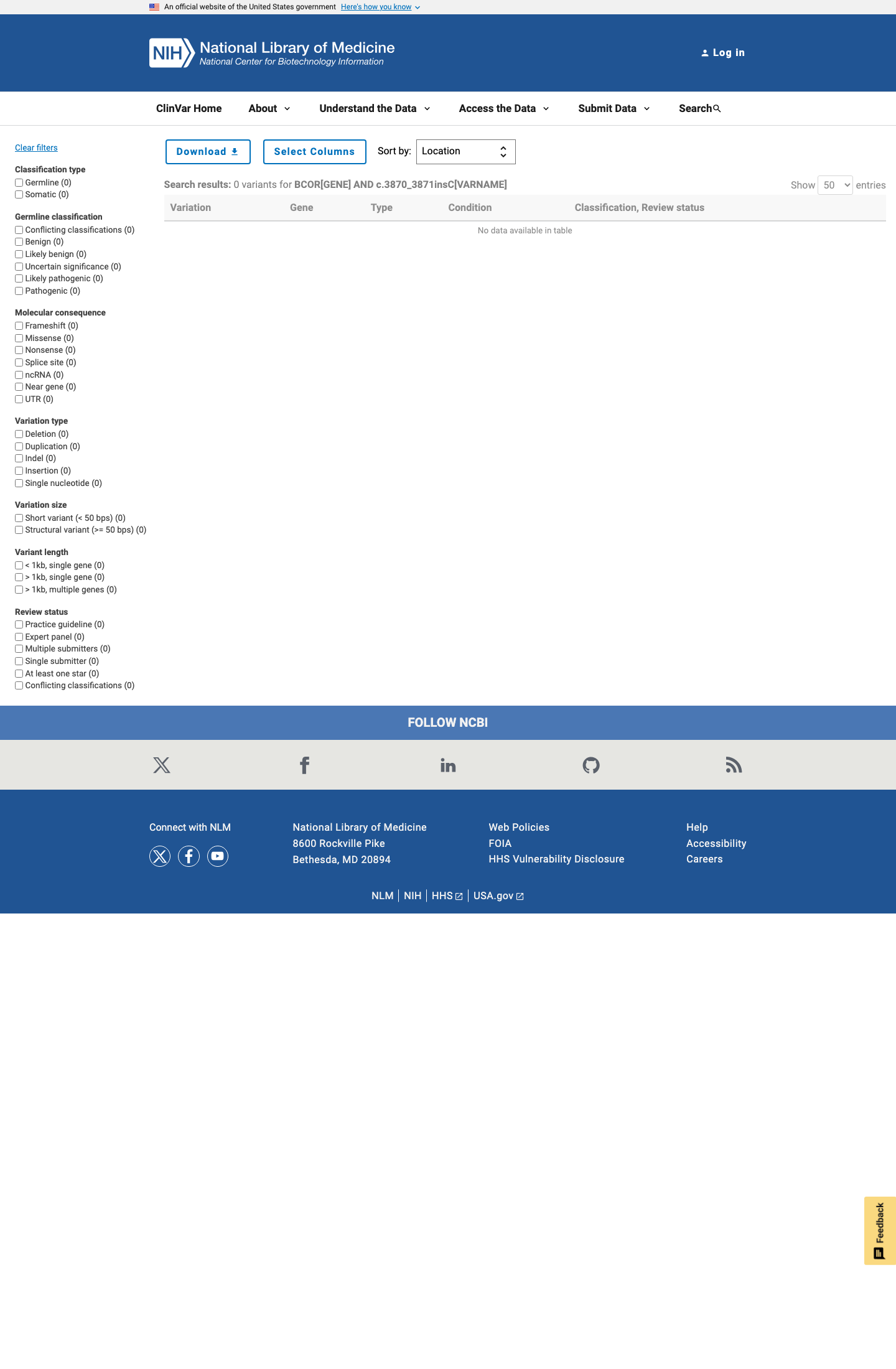
ClinVar
gnomAD v2.1
gnomAD v4.1
gnomAD-Canada
SpliceAI
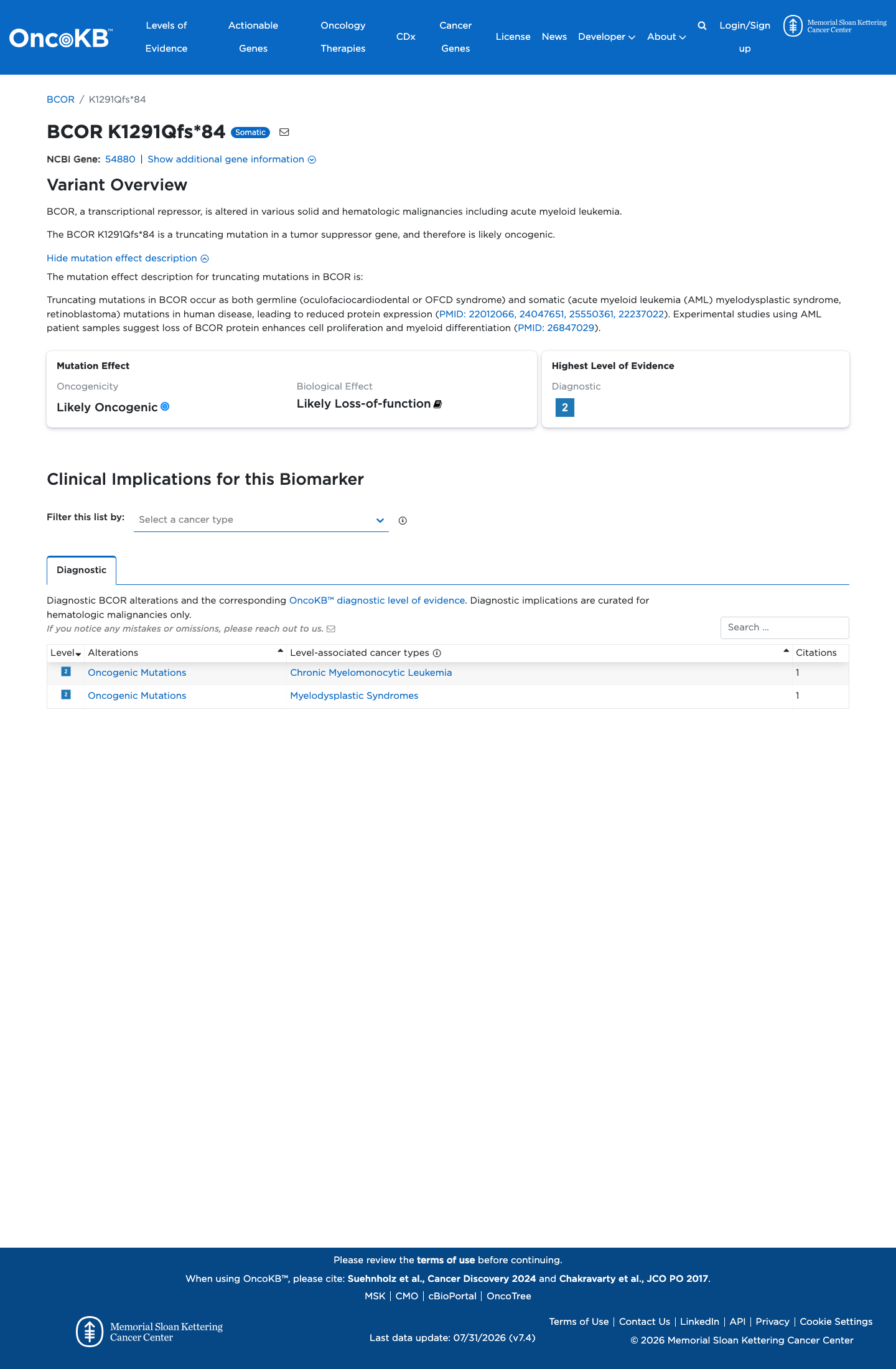
OncoKB
COSMIC
Cancer hotspots
Triaged references · 3 PMIDs not cited in assessment
22012066 ↗Whole-exome sequencing identifies somatic mutations of BCOR in acute myeloid leukemia with normal karyotype.ONCOKB
22237022 ↗A novel retinoblastoma therapy from genomic and epigenetic analyses.ONCOKB
25550361 ↗Acute myeloid leukemia ontogeny is defined by distinct somatic mutations.ONCOKB