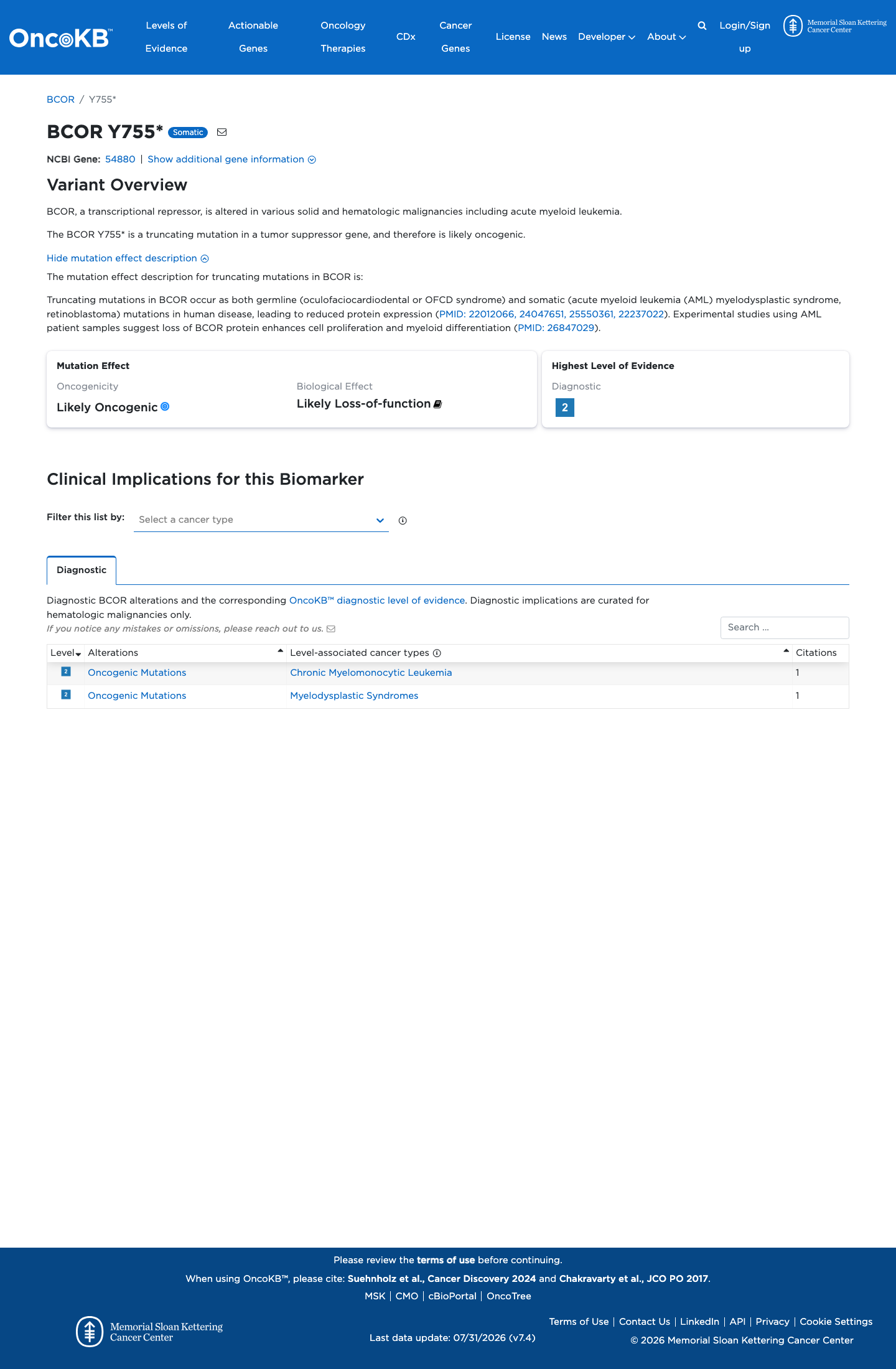
BCOR (BCL6 co-repressor) encodes a transcriptional repressor that silences target genes by working with the BCL6 protein and histone-modifying complexes, helping maintain the correct chromatin state. It is essential for early embryonic development, normal germinal center formation in B cells, blood cell production, and mesenchymal stem cell function. Germline mutations in BCOR cause the inherited oculofaciocardiodental and Lenz microphthalmia syndromes. In cancer, BCOR acts as a tumor suppressor: gene fusions drive certain soft tissue and endometrial stromal sarcomas and acute promyelocytic leukemia, while truncating mutations are found in retinoblastoma, acute myeloid leukemia, and myelodysplastic syndrome.
This variant
BCOR's established disease mechanism is loss of function: germline mutations cause oculofaciocardiodental and Lenz microphthalmia syndromes, and truncating mutations are found in retinoblastoma, AML, and MDS. This nonsense variant (p.Tyr755Ter), predicted to undergo nonsense-mediated decay, produces a non-functional BCOR protein, precisely the loss-of-function mechanism linked to BCOR-related disease.
Transcript
NM_017745.5
HGVS · transcript:coding
NM_017745.5:c.2265C>A
GRCh38
chrX:40073081 G>T
GRCh37
chrX:39932334 G>T
BasisLikely Pathogenic: PVS1 (Very Strong) + PM2 (Supporting) satisfies the ClinGen SVI PVS1-plus-one-supporting combination rule; the lone BP4 does not conflict.▾
Likely Pathogenic: PVS1 (Very Strong) + PM2 (Supporting) satisfies the ClinGen SVI PVS1-plus-one-supporting combination rule; the lone BP4 does not conflict.
Classification rationale
PVS1PM2BP4Likely Pathogenic
BCOR c.2265C>Anonsense · exon 4
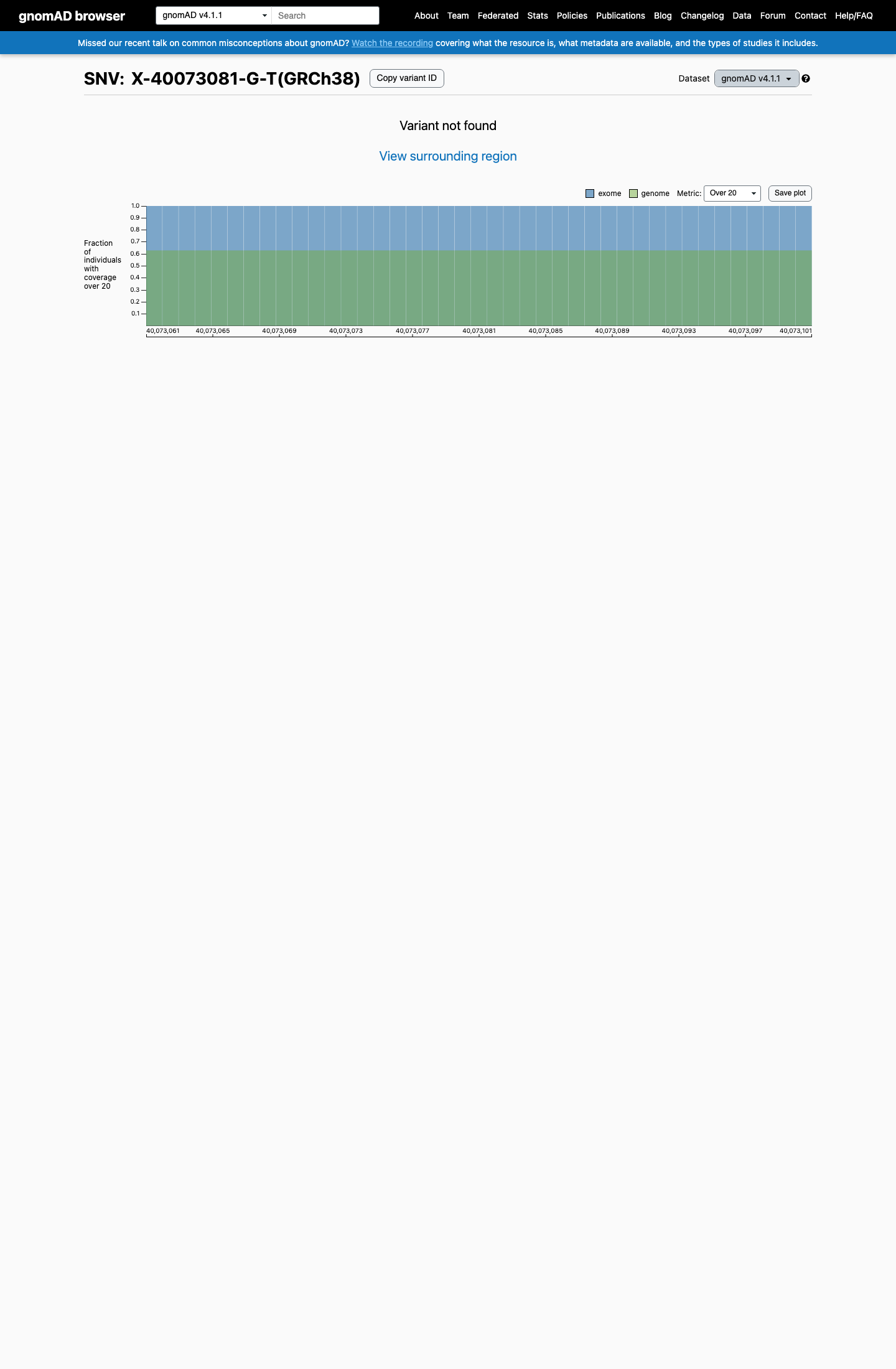
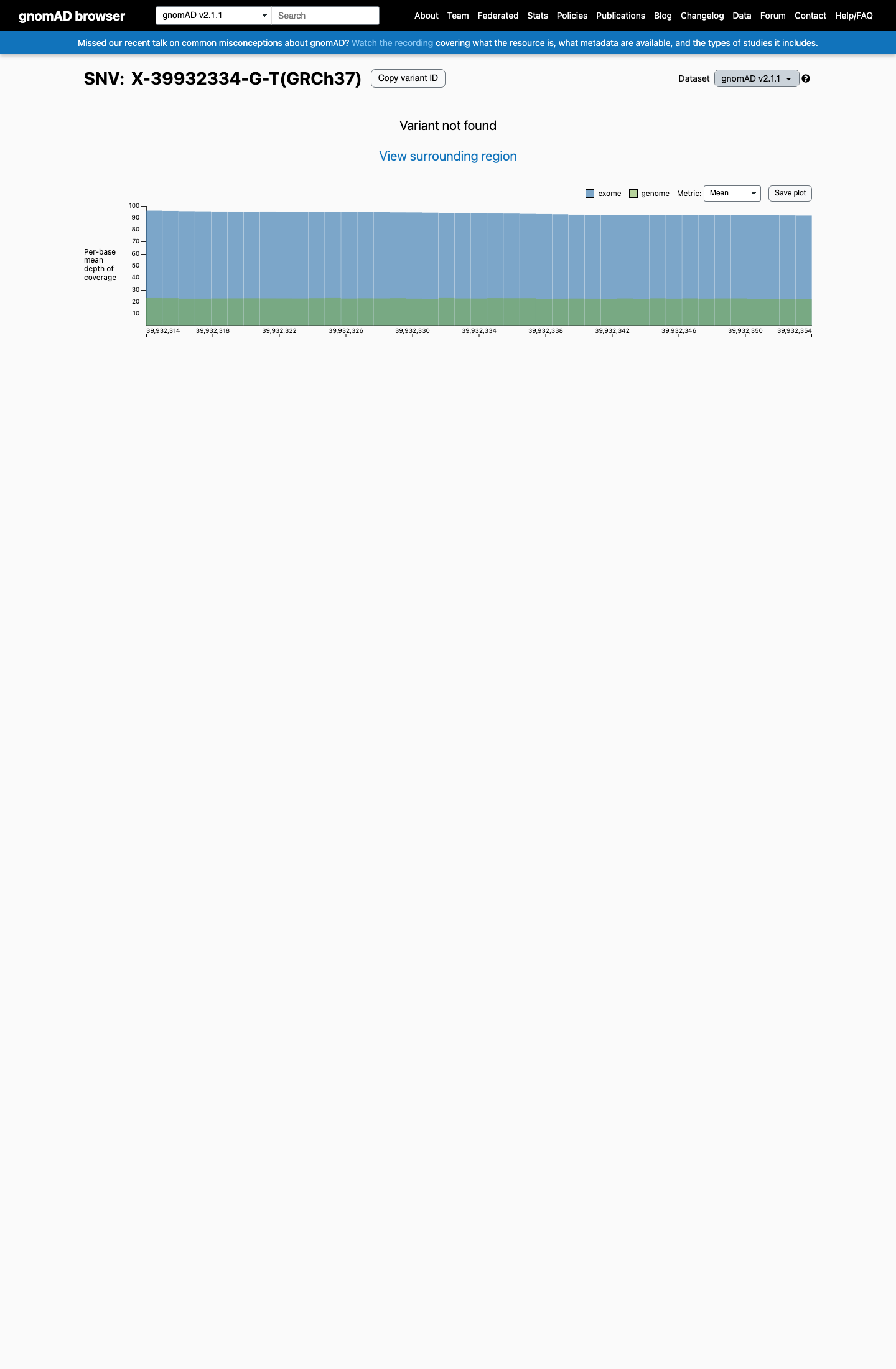
PVS1 (Very Strong): nonsense p.Tyr755Ter predicted to trigger nonsense-mediated decay, truncating the 1722-aa BCOR protein. PM2 (Supporting): absent from gnomAD v2.1, v4.1, and gnomAD-Canada v1.0. BP4 (Supporting): SpliceAI max delta 0.00 predicts no splicing disruption. Synthesis: Likely Pathogenic, per the ClinGen SVI rule that PVS1 (Very Strong) plus one supporting pathogenic criterion (PM2) yields Likely Pathogenic; BP4 does not reach a benign threshold.
PVS1 + PM2 + BP4→Likely Pathogenic
Gene diagram
· NM_017745.5 · variants mapped to exon structure
BCORNM_017745.5
Fetching transcript structure from UCSC…
Exons
—
Transcript span
—
Strand
—
Variants mapped
—
Source
UCSC ncbiRefSeqCurated
All variants in BCOR—click a row to locate it on the plot · use the link column to open its page
Variant ↕
Protein
Location
Classification
Link
Applied criteria · 3 applied · 15 assessed
MetEvidence satisfies this criterion.
Not metEvaluated against available evidence; threshold not reached.
Not assessedApplies in principle, but no evidence was found to evaluate it.
N/ADoesn't apply to this variant type.
Applied · 3
Strength Supporting Moderate Strong Very strong
✓
PVS1very strongreviewPathogenic
Met (Very Strong): nonsense p.Tyr755Ter truncates the 1722-aa protein, with the premature stop >50 nt upstream of the last exon-exon junction, predicting nonsense-mediated decay.
pvs1_variant_assessment.json classifies NM_017745.5:c.2265C>A as consequence_class='nonsense', variant_bucket='nonsense', and recommends the generic PVS1 framework (PMC6185798) with suggested_default_strength='PVS1', subject to confirming NMD prediction and exon importance.prefetch.json exon/CDS coordinate map (selector_short) shows the exon containing c.2265 spans c.166-c.2997, while the terminal exon spans c.4875-*863 (3'UTR); the resulting PTC at c.2265 (p.Tyr755Ter) is far more than 50 nt from the final exon-exon junction, satisfying the ClinGen SVI criterion for NMD-predicted transcripts.prefetch.json predicted reference protein length is 1722 amino acids (position_last_original=1722), confirming the p.Tyr755Ter truncation removes the majority of the protein, consistent with a damaging LOF outcome if NMD were to be escaped.
Met (Supporting): SpliceAI max delta 0.00 vs the >=0.2 splice-altering threshold predicts no splicing disruption.
SpliceAI Lookup result: max_delta_score=0.00 (all four DS_AG/AL/DG/DL = 0.0) for NM_017745.5:c.2265C>A, retrieved from evidence.json/case_summary.json.Widely accepted SpliceAI threshold of delta score >=0.2 to flag a possible splice-altering effect, from Jaganathan KM et al., 'Predicting Splicing from Primary Sequence with Deep Learning', Cell 2019, PMID 30661751; the observed 0.00 score is far below this threshold, supporting no predicted splice disruption.