This variant was interpreted by pipeline
7.1.0.
The current version is
8.0.0.
Re-running queues a fresh interpretation; the result replaces this page when complete.
Re-runs are not free. Blank = draws on today's public interpretation allowance.
With a code = uses 1 of that code's uses.
CREBBP encodes a transcriptional co-activator with intrinsic histone acetyltransferase activity that couples chromatin remodeling to gene transcription and supports normal embryonic development, growth control, and cellular homeostasis. Inherited mutations in this gene cause Rubinstein-Taybi syndrome, a developmental disorder marked by distinctive facial and digit abnormalities along with neurological deficits. CREBBP acts as a tumor suppressor in cancer: it is disrupted by chromosomal translocations in acute myeloid leukemia, and somatic alterations occur across leukemias, lymphomas, and solid tumors such as small-cell lung, bladder, and squamous carcinomas.
This variant
This missense change falls outside the loss-of-function variants that predominantly cause CREBBP-related Rubinstein-Taybi syndrome, and it has no established role in the gene's cancer-related alterations. Its VUS status reflects the absence of functional, segregation, or case-level evidence, so no conclusion can yet be drawn about a link to developmental disease or cancer susceptibility.
Transcript
NM_004380.2
HGVS · transcript:coding
NM_004380.2:c.7299C>A
GRCh38
chr16:3727748 G>T
GRCh37
chr16:3777749 G>T
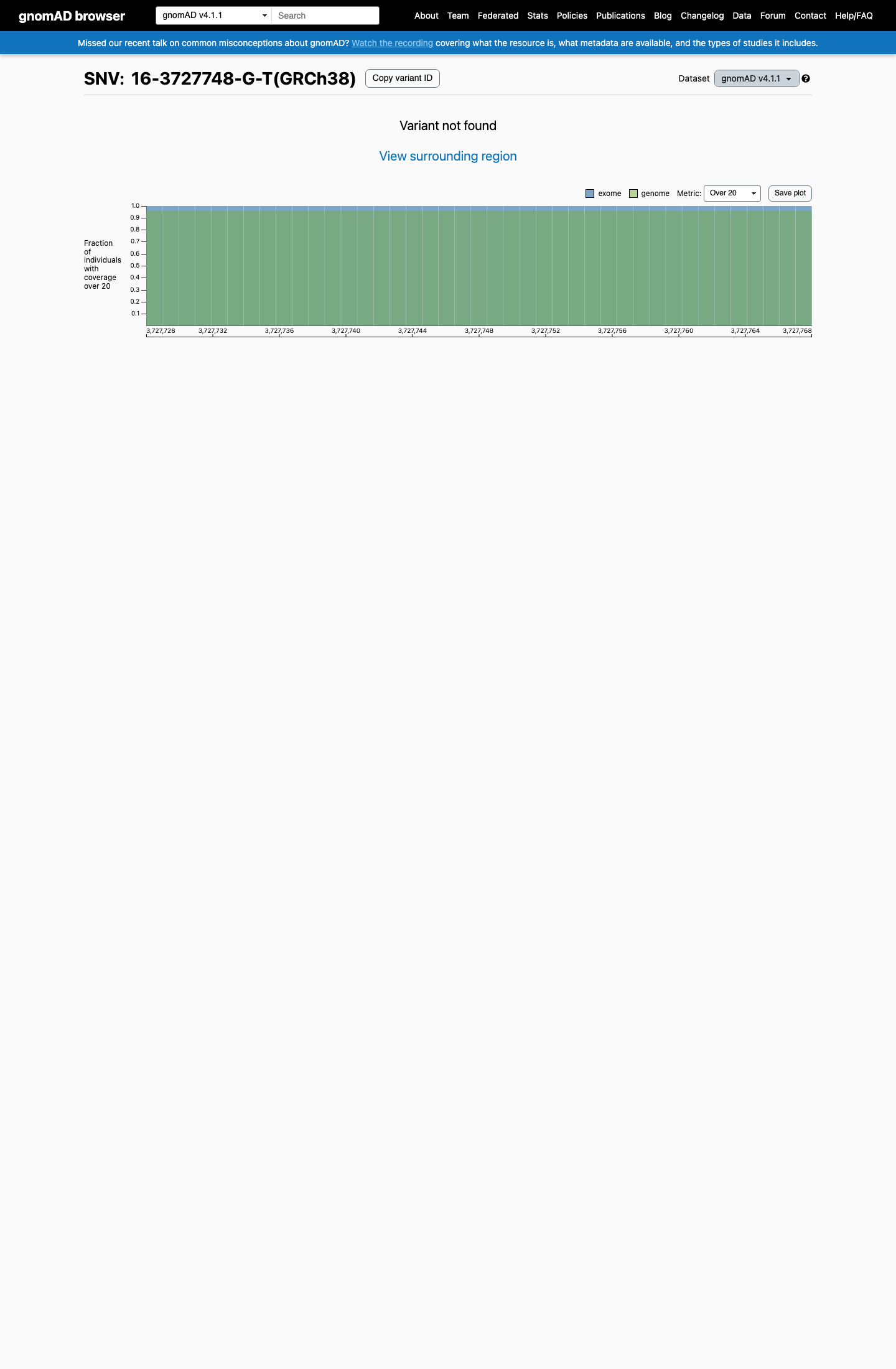
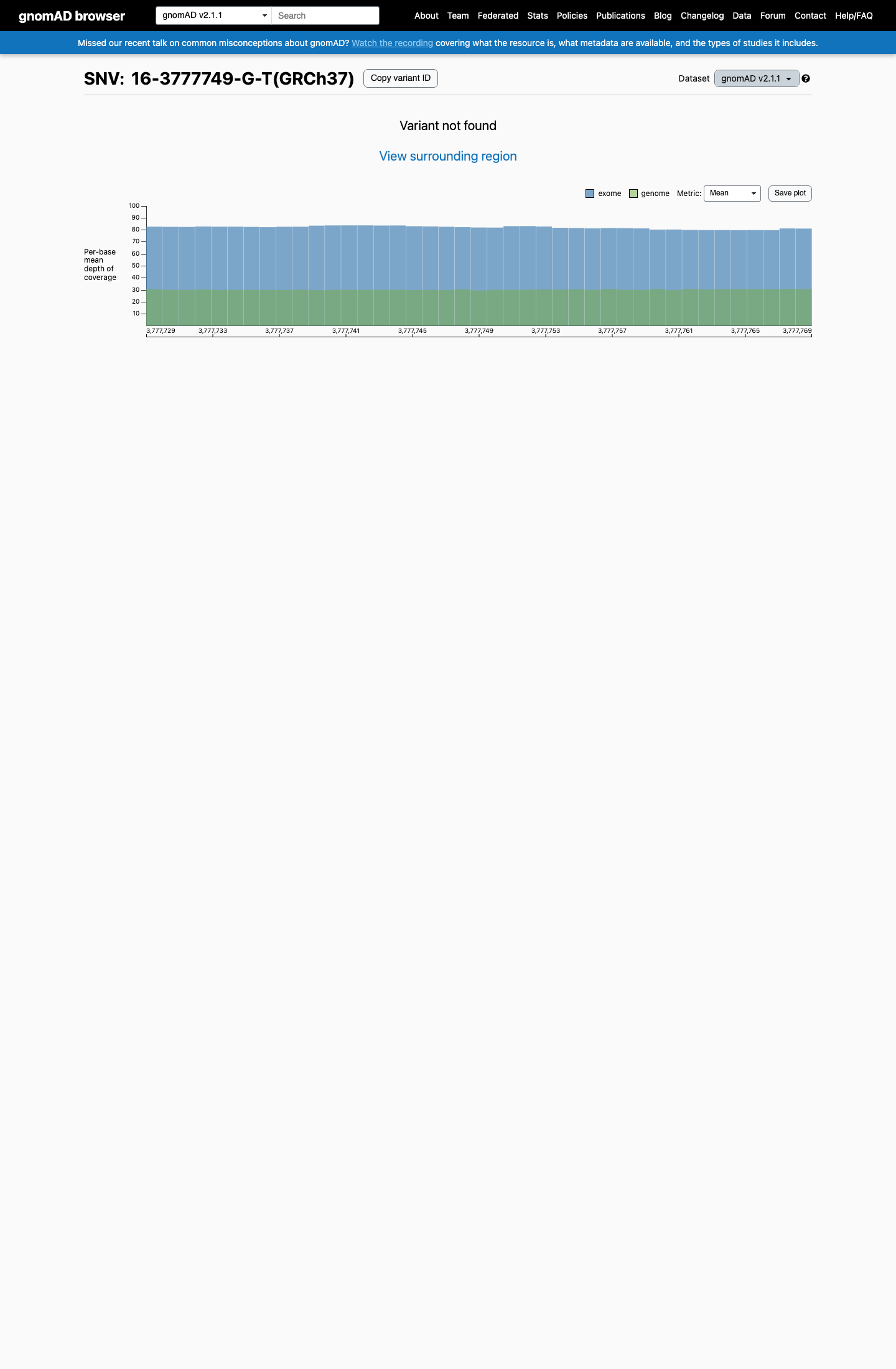
VUS: only PM2 (supporting) was met, based on absence from gnomAD v2.1, v4.1, and gnomAD-Canada; one supporting criterion reaches no pathogenic or benign combination threshold.
Classification rationale
PM2VUS
CREBBP c.7299C>Amissense · exon 31
PM2 (Supporting): variant absent from gnomAD v2.1, gnomAD v4.1, and gnomAD-Canada v1.0. VUS: a single supporting-strength criterion does not reach any pathogenic or benign combination threshold under generic ACMG/AMP 2015 rules.
PM2→VUS
LYFE Sciences is an AI system, and it can make mistakes. Criteria
may be applied incorrectly, sources may be misread, and a confident-looking
classification can still be wrong. Double-check every criterion and
its underlying evidence before relying on any call.
Gene diagram
· NM_004380.2 · variants mapped to exon structure
CREBBPNM_004380.2
Fetching transcript structure from UCSC…
Exons
—
Transcript span
—
Strand
—
Variants mapped
—
Source
UCSC ncbiRefSeqCurated
All variants in CREBBP—click a row to locate it on the plot · use the link column to open its page
Protein
Location
Classification
Link
Applied criteria · 1 applied · 20 assessed
MetEvidence satisfies this criterion.
Not metEvaluated against available evidence; threshold not reached.
Not assessedApplies in principle, but no evidence was found to evaluate it.
N/ADoesn't apply to this variant type.
Applied · 1
Strength Supporting Moderate Strong Very strong
✓
PM2supportingreviewPathogenic
Met (supporting): absent from gnomAD v2.1, gnomAD v4.1, and gnomAD-Canada v1.0.
The case bundle explicitly reports absence of the variant from gnomAD v2.1, gnomAD v4.1, and gnomAD-Canada v1.0.This is population rarity evidence only; no disease prevalence, penetrance estimate, or homozygote observation was supplied to refine the interpretation.Because the bundle provides categorical absence without allele-number and coverage details, PM2 is retained at supporting strength with moderate confidence and human review flagged for population-data audit.
Assessed · not applied
· 4 not met · 16 not assessed
Pathogenic
PS1Not assessed: no known pathogenic variant producing the identical amino acid change p.Asp2433Glu was identified.
PS2Not assessed: no confirmed de novo occurrence with parental testing was documented for the proband.
PS3Not assessed: no functional assay evidence for this variant was available.
PS4Not assessed: no affected-case series or case-control enrichment evidence was available.
PM1Not assessed: no residue-level domain or mutational-hotspot map covering codon 2433 was available.
PM3Not assessed: no pathogenic variant in trans or phase information was available.
PM5Not assessed: no pathogenic missense variant at the same codon (2433) was identified for comparison.
PM6Not assessed: no evidence of an assumed de novo origin was available.
PP1Not assessed: no segregation data in affected or unaffected relatives were available.
PP2Not assessed: CREBBP disease is predominantly loss-of-function, and no missense constraint metric was available to confirm missense as a common mechanism.
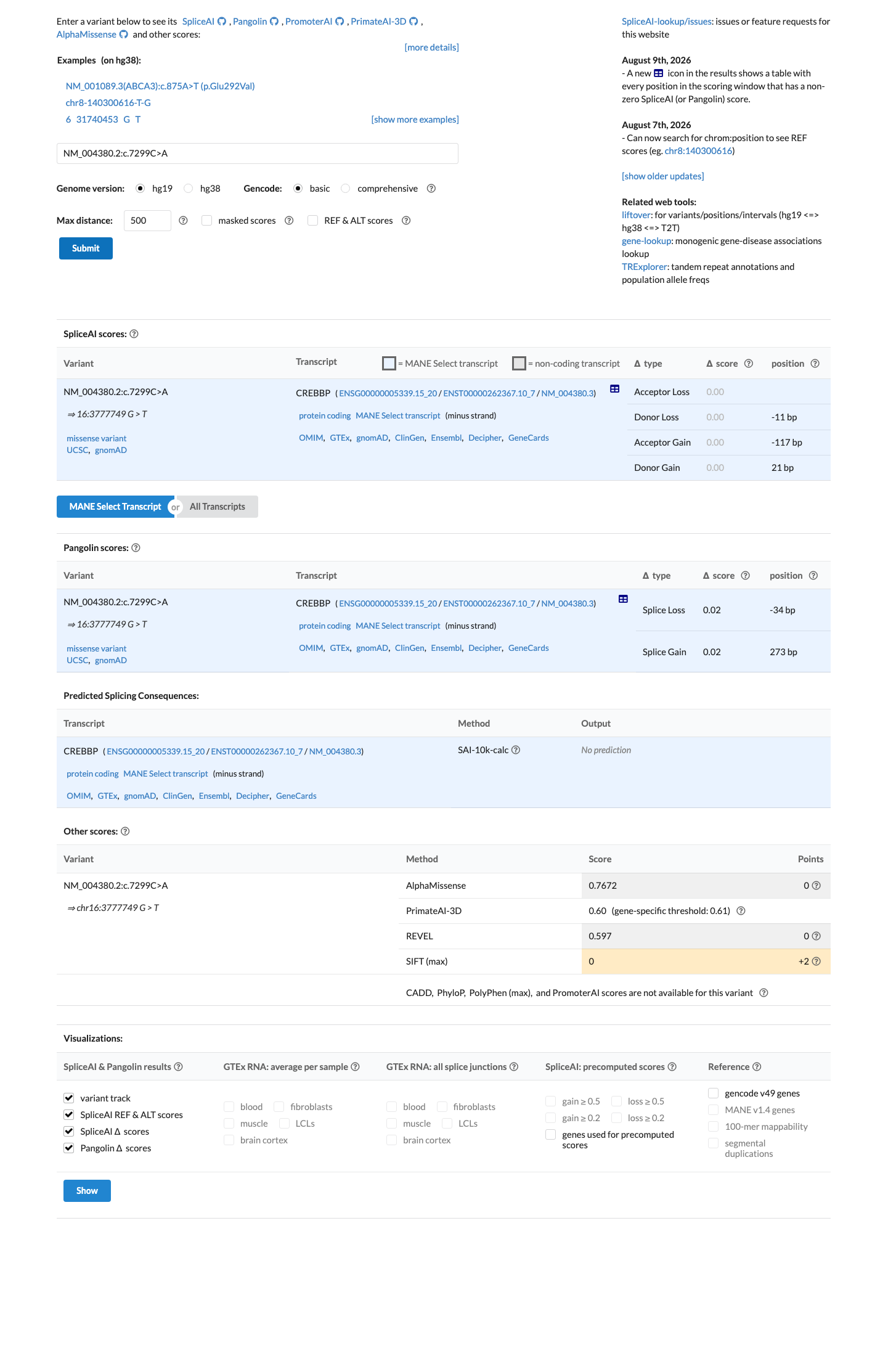
PP3Not met: REVEL score 0.597 falls in the indeterminate zone between the benign-supporting (<=0.290) and pathogenic-supporting (>=0.644) thresholds.
PP4Not assessed: no patient phenotype or disease-specific phenotype comparison was supplied.
Benign
BA1Not met: absent from population databases, so no allele frequency approaches a benign-alone threshold.
BS1Not met: absent from gnomAD v2.1, v4.1, and gnomAD-Canada v1.0, so no frequency exceeds the disease-prevalence threshold.
BS2Not assessed: no observations of unaffected adult carriers or homozygotes were available.
BS3Not assessed: no functional assay demonstrating normal or near-normal function was available.
BS4Not assessed: no unaffected relatives carrying the variant or other non-segregation evidence were available.
BP2Not assessed: no phase information or cis/trans placement relative to a pathogenic variant was available.
BP4Not met: REVEL score 0.597 exceeds the benign-supporting threshold of <=0.290.
BP5Not assessed: no alternative molecular diagnosis explaining the phenotype was available.
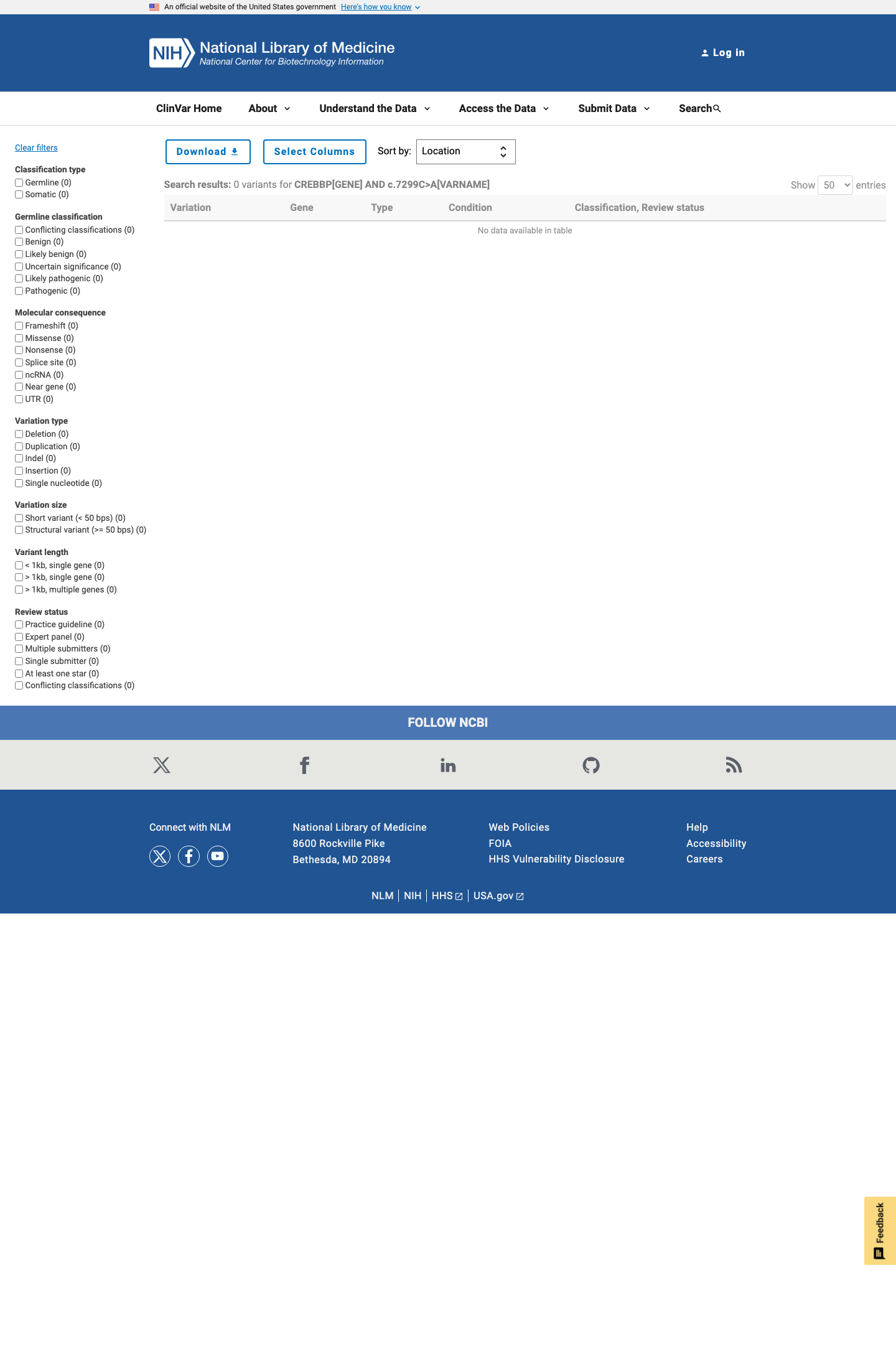
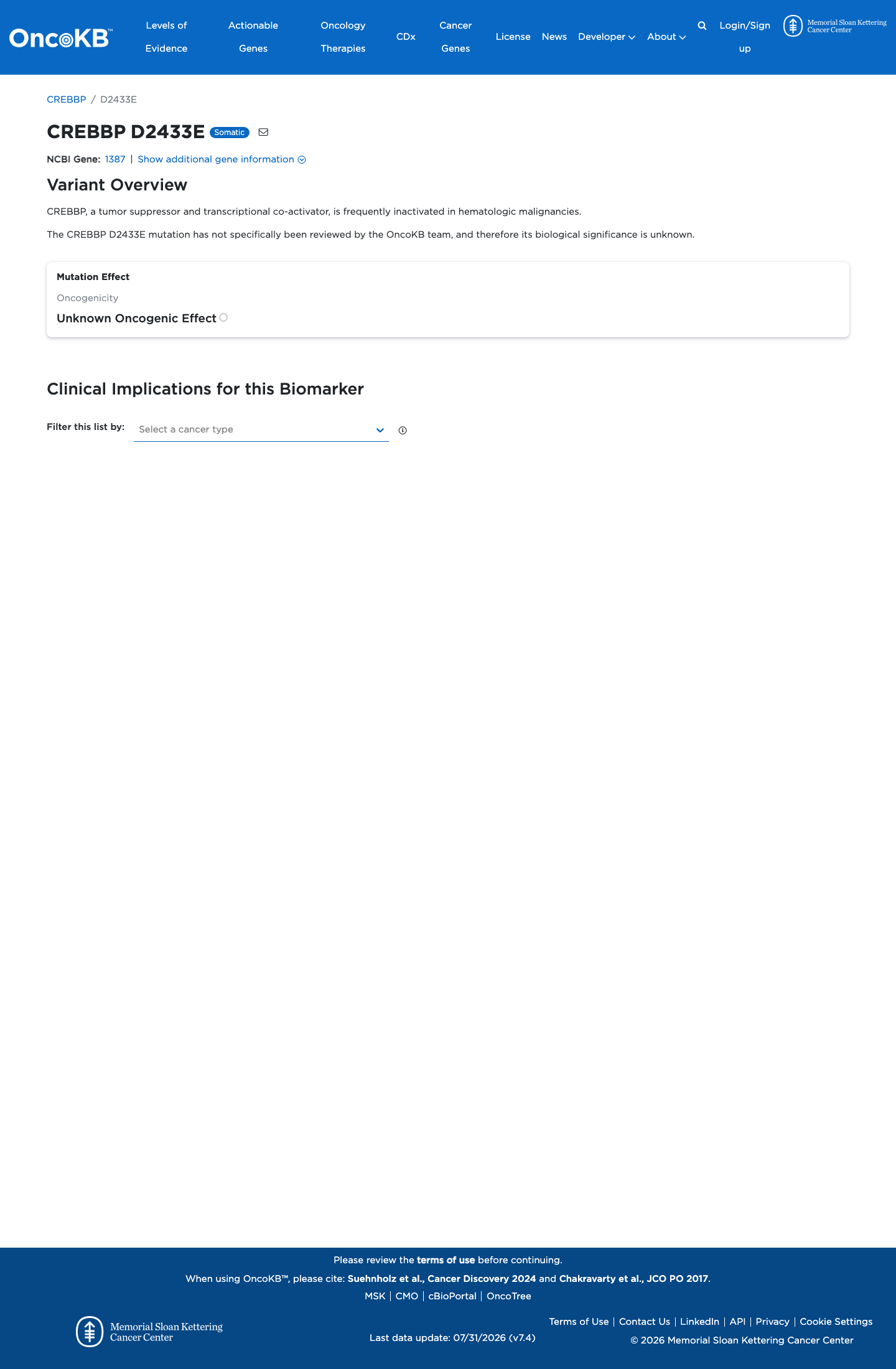
OncoKB did not identify variant-specific reviewed functional evidence for this variant; gene-level curated context is available for reviewer follow-up. CREBBP, a tumor suppressor and transcriptional co-activator, is frequently inactivated in hematologic malignancies.