Analysis in progress
Initialising…
0%
complete
This report is still being assembled — sections appear as each stage finishes. It isn't final yet.
NF2
Final classification
VUS
PVS1PM2BP4
NF2
c.958C>T
p.Gln320Ter
nonsense · exon 10

NF2 encodes Merlin, a scaffolding protein that links the cell's internal skeleton to the cell membrane and helps regulate cell growth, adhesion, and signaling. Loss of its function promotes tumor formation and spread. Germline mutations in this gene cause neurofibromatosis type 2, an inherited condition marked by tumors of the nervous system and skin, along with eye abnormalities. It acts as a tumor suppressor, and the gene is also found mutated in other types of cancer.

This variant

NF2 encodes Merlin, a tumor suppressor whose loss of function promotes tumor formation and causes neurofibromatosis type 2. This variant's premature stop codon (p.Gln320Ter) is predicted to trigger nonsense-mediated decay, the classic loss-of-function mechanism for this gene; it is classified VUS because supporting benign computational evidence conflicts with that truncating effect.

Transcript
NM_000268.3
HGVS · transcript:coding
NM_000268.3:c.958C>T
GRCh38
chr22:29668405 C>T
GRCh37
chr22:30064394 C>T
Basis VUS: with no NF2-specific VCEP, generic ACMG/AMP 2015 rules applied - PVS1 (very strong) plus PM2 (supporting) would reach likely pathogenic, but conflicting BP4 (supporting) benign evidence holds the result at VUS.
VUS: with no NF2-specific VCEP, generic ACMG/AMP 2015 rules applied - PVS1 (very strong) plus PM2 (supporting) would reach likely pathogenic, but conflicting BP4 (supporting) benign evidence holds the result at VUS.
Classification rationale
PVS1PM2 BP4 VUS
NF2 c.958C>T nonsense · exon 10

PVS1 (Very Strong): the p.Gln320Ter premature stop codon lies ~780 nucleotides upstream of the final exon-exon junction, predicting nonsense-mediated decay. PM2 (Supporting): absent from gnomAD v2.1, gnomAD v4.1, and gnomAD-Canada v1.0. BP4 (Supporting): SpliceAI max delta 0.003 predicts no splice disruption. Overall: VUS - PVS1 (very strong) and PM2 (supporting) would reach likely pathogenic, but conflicting BP4 (supporting) holds the result at VUS.

PVS1 + PM2 + BP4 VUS
Gene diagram · NM_000268.3 · variants mapped to exon structure
NF2 NM_000268.3
Fetching transcript structure from UCSC…
Applied criteria · 3 applied · 16 assessed
MetEvidence satisfies this criterion.
Not metEvaluated against available evidence; threshold not reached.
Not assessedApplies in principle, but no evidence was found to evaluate it.
N/ADoesn't apply to this variant type.
Applied · 3
Strength Supporting Moderate Strong Very strong
PVS1 very strong Pathogenic
Met: the p.Gln320Ter premature stop codon lies ~780 nucleotides upstream of the final exon-exon junction, well beyond the ~50-nucleotide threshold for nonsense-mediated decay.
pvs1_variant_assessment: transcript NM_000268.3:c.958C>T, protein NP_000259.1:p.(Gln320Ter), consequence_class=nonsense, variant_bucket=nonsense, generic PVS1 framework applies per PMC6185798 (framework_source https://pmc.ncbi.nlm.nih.gov/articles/PMC6185798/).VariantValidator exon/CDS map (bundle prefetch): exon10 boundaries c.886-999 (variant c.958 falls inside), 16 total coding exons, last exon begins at c.1738, CDS c.1-1788; places the PTC ~780 nt upstream of the final exon-exon junction, well beyond the ~50 nt NMD-escape threshold, so NMD is predicted.VariantValidator protein prediction: position_last_original=596 (full-length merlin), position_last_predicted=320, i.e. the truncation removes 277 of 596 residues (~46%) if NMD were escaped, supporting a clinically significant truncation regardless.
PM2 supporting Pathogenic
Met: the variant is absent from gnomAD v2.1, gnomAD v4.1, and gnomAD-Canada v1.0.
The case bundle reports the exact variant as absent from gnomAD v2.1, gnomAD v4.1, and gnomAD-Canada v1.0.The NF2 clinical and molecular review describes NF2 as a dominantly inherited tumor-prone disorder and states that disease prevalence has risen to around 1 in 60,000; this supports the rare-disease context for evaluating absence from population controls.No population database reported a homozygote or a nonzero ancestry-specific frequency for this variant.
BP4 supporting Benign
Met: SpliceAI max delta 0.003 is far below the ~0.2 splice-altering threshold, predicting no splice impact.
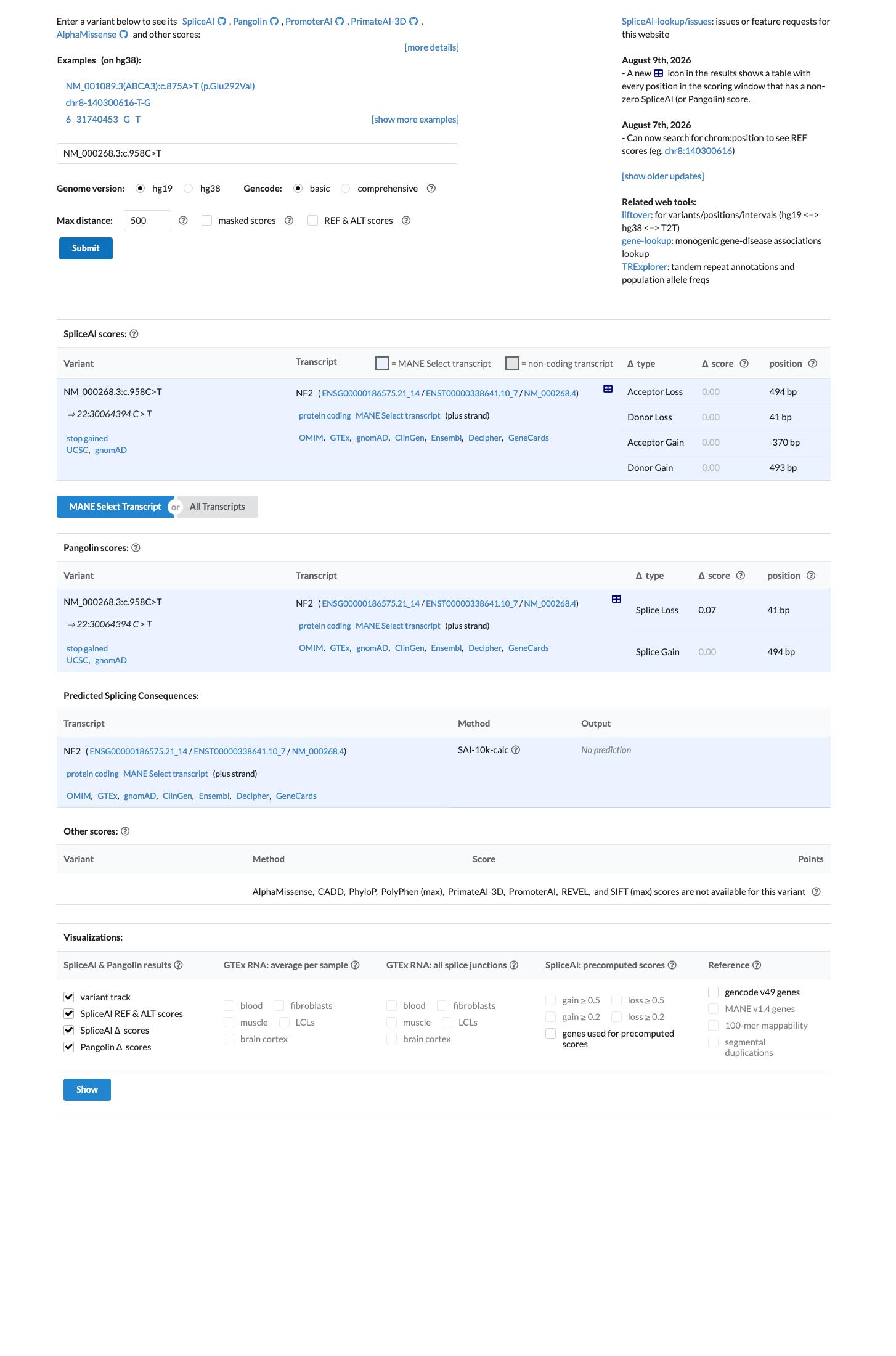
SpliceAI (case_summary.json compact_evidence.spliceai): max delta score = 0.003 (DS_AG=0.001, DS_AL=0.001, DS_DG=0.0, DS_DL=0.003) for NM_000268.3:c.958C>T, below the ~0.2 splice-altering threshold from the original SpliceAI publication (Jaganathan et al. 2019, PMID 30661751), supporting no predicted splicing impact.
Assessed · not applied · 5 not met · 11 not assessed
Pathogenic
PS2 Not assessed: no parental testing results or documented de novo observation were available.
PS3 Not assessed: no functional assay data for this variant were available.
PS4 Not assessed: no case series or case-control comparison demonstrating increased prevalence in affected individuals was available.
PM6 Not assessed: no unconfirmed de novo observation was documented.
PP1 Not assessed: no affected relatives, segregation data, or informative meioses were provided.
PP3 Not met: SpliceAI max delta 0.003 predicts no splice disruption, and no other computational evidence supports a damaging effect.
PP4 Not assessed: no patient-specific phenotype data were available to confirm a highly specific NF2 presentation.
PP5 Not met: no expert-panel ClinVar submission exists for this variant, and laboratory or OMIM classifications cannot trigger PP5.
Benign
BA1 Not met: the variant is absent from population databases, far below any stand-alone benign frequency threshold.
BS1 Not met: the variant is absent from population databases, below the disease-specific maximum credible allele frequency.
BS2 Not assessed: no evidence of occurrence in healthy adults or homozygous individuals was provided.
BS3 Not assessed: no functional assay evidence of normal activity was available.
BS4 Not assessed: no unaffected relatives or non-segregation analysis was reported.
BP2 Not assessed: no second variant or phase determination was available to assess allelic arrangement.
BP5 Not assessed: insufficient evidence linked this variant to an alternate phenotype or disease mechanism.
BP6 Not met: no expert-panel ClinVar classification of Benign or Likely benign exists for this variant.
N/A · 9 PS1 · PM1 · PM3 · PM4 · PM5 · PP2 · BP1 · BP3 · BP7
Research & evidence
Population frequency
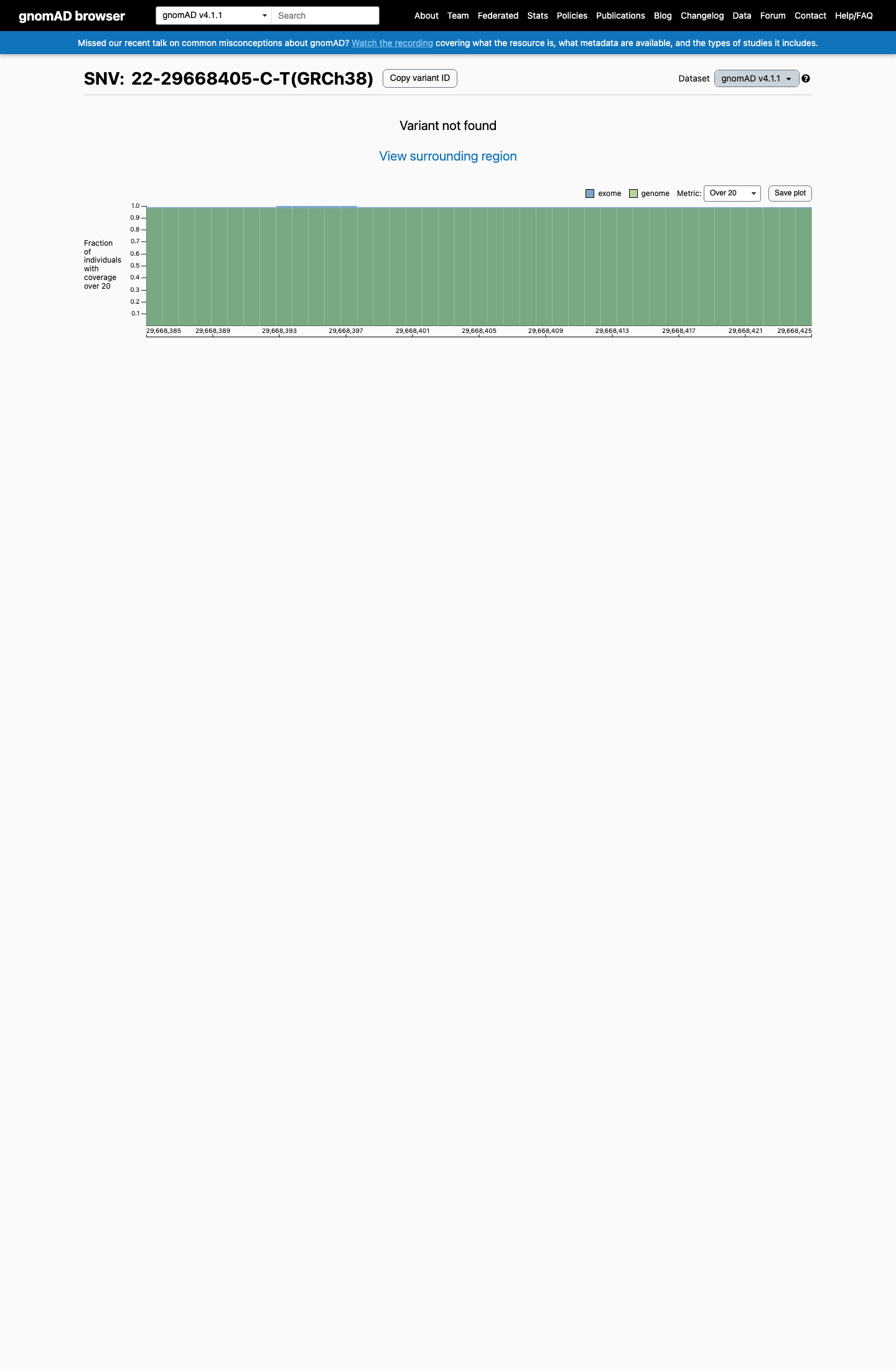
gnomAD v4.1 screenshot
gnomAD v4.1
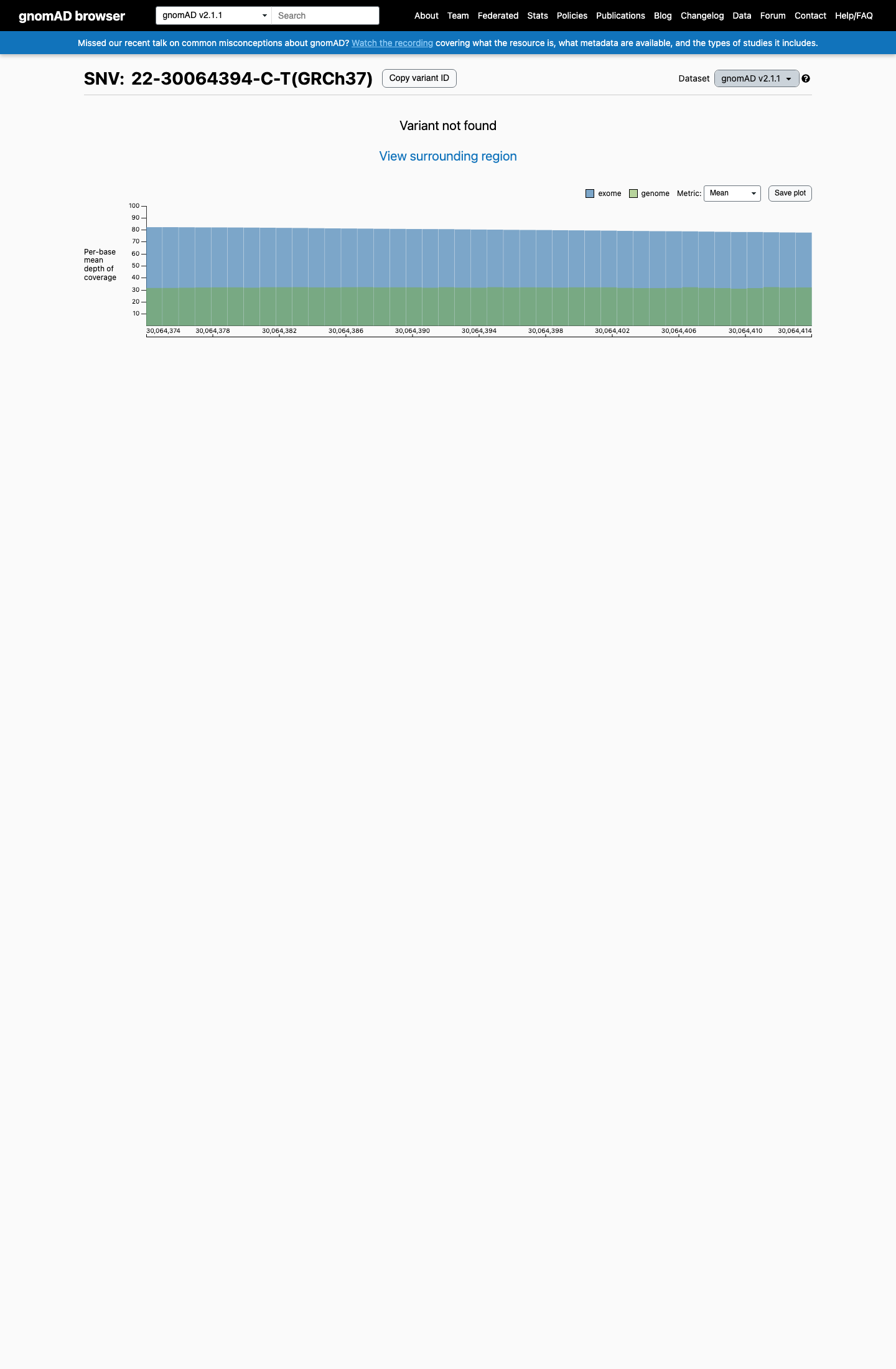
gnomAD v2.1 screenshot
gnomAD v2.1
v4.1
Absent from gnomAD v4.1.
v2.1
Absent from gnomAD v2.1.
🇨🇦 CA
Absent from gnomAD-Canada v1.0.
Allele frequency by ancestry
three datasets · side by side
gnomAD v4.1
Absent · 0 / ?
0 hom
Not observed in any ancestry group.
gnomAD v2.1
Absent · 0 / ?
0 hom
Not observed in any ancestry group.
gnomAD Canada 🇨🇦
Absent · 0 / ?
0 hom
Not observed in any ancestry group.
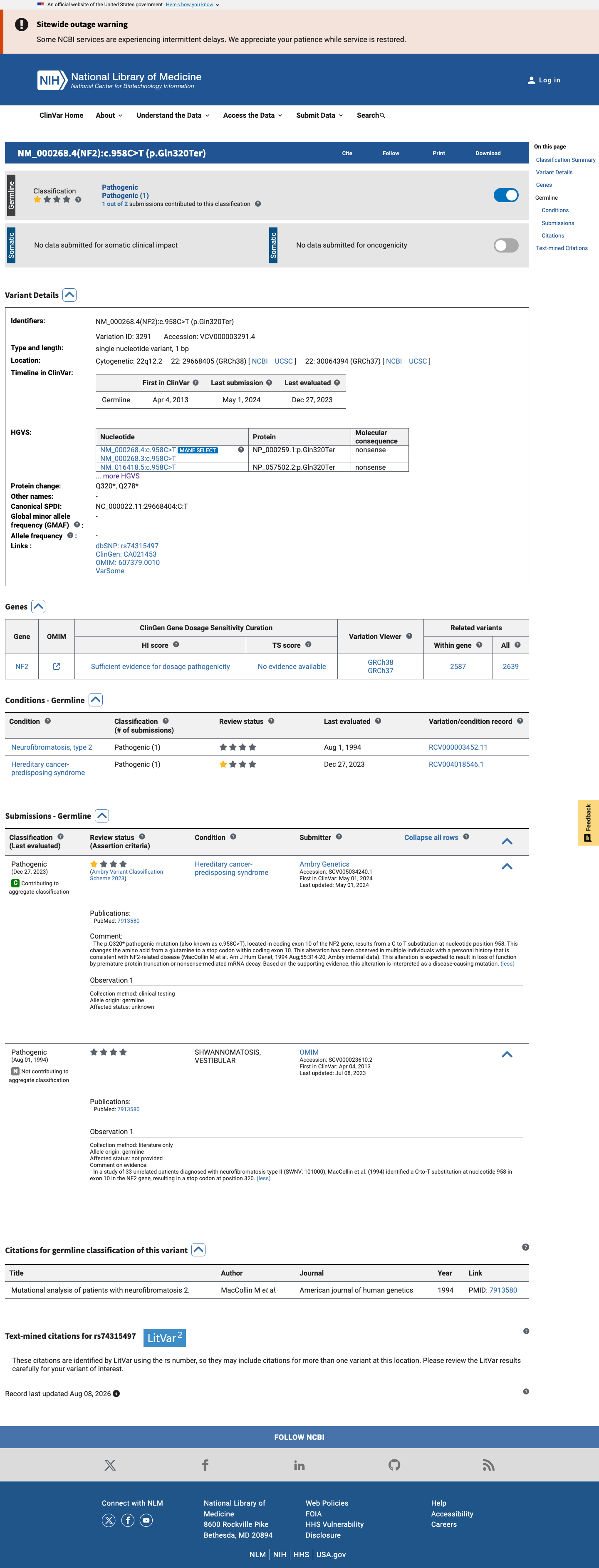
ClinVar screenshot
ClinVar
This variant has been reported in ClinVar as Pathogenic (1 clinical laboratory). (ClinVarID = 3291)
SpliceAI screenshot
In silico
SpliceAI predicts no significant splice impact for this variant (max delta score = 0.00). BayesDel score = 0.66.
Functional / OncoKB screenshot
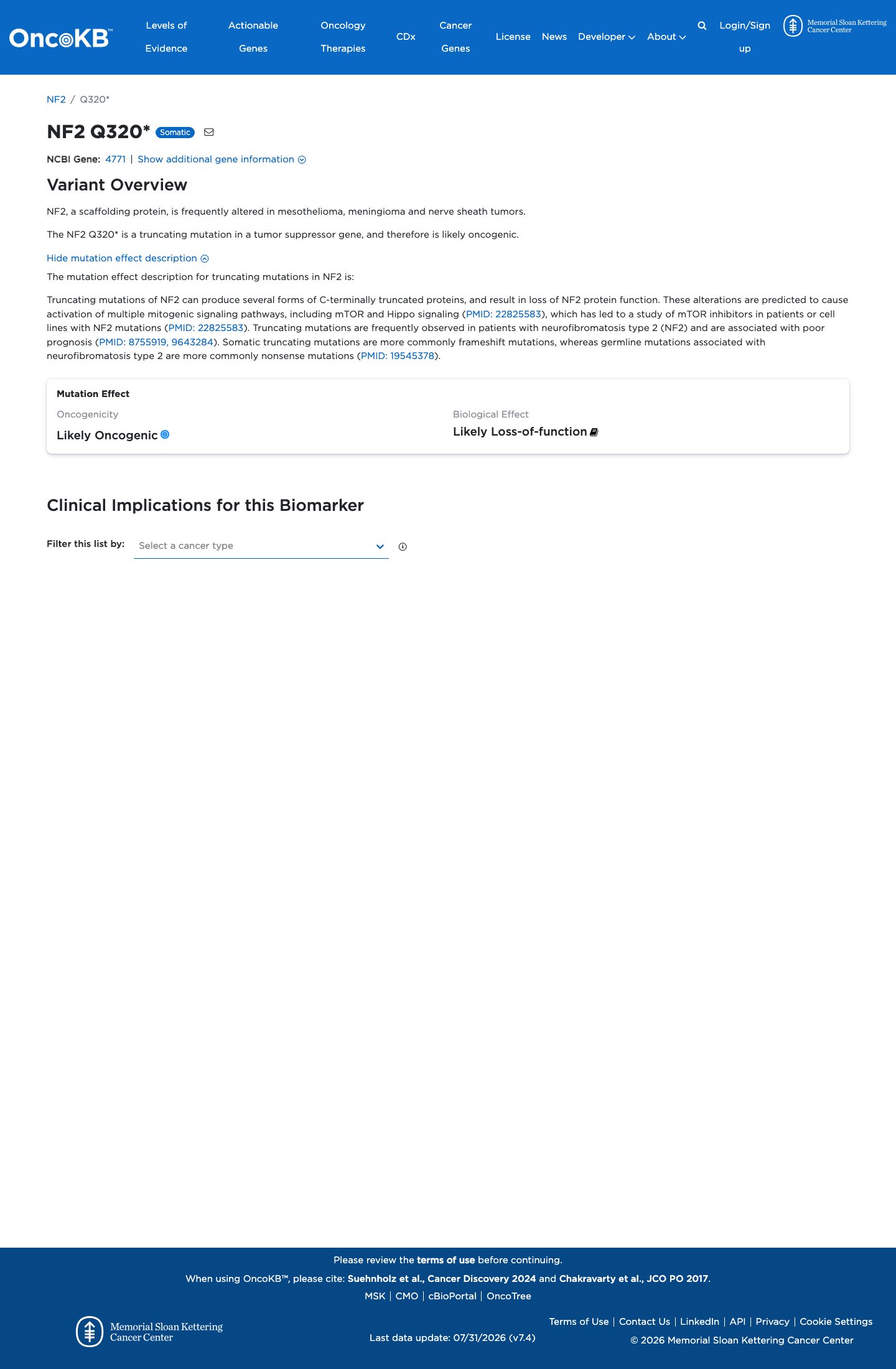
Functional Likely Oncogenic
OncoKB identified variant-specific curated literature and context relevant to functional review; biological-effect context: Likely Loss-of-function; curated oncogenicity label: Likely Oncogenic.
OncoKB ↗
COSMIC screenshot
COSMIC
Cancer hotspots screenshot
Cancer hotspots
Somatic evidence Not in COSMIC / hotspots
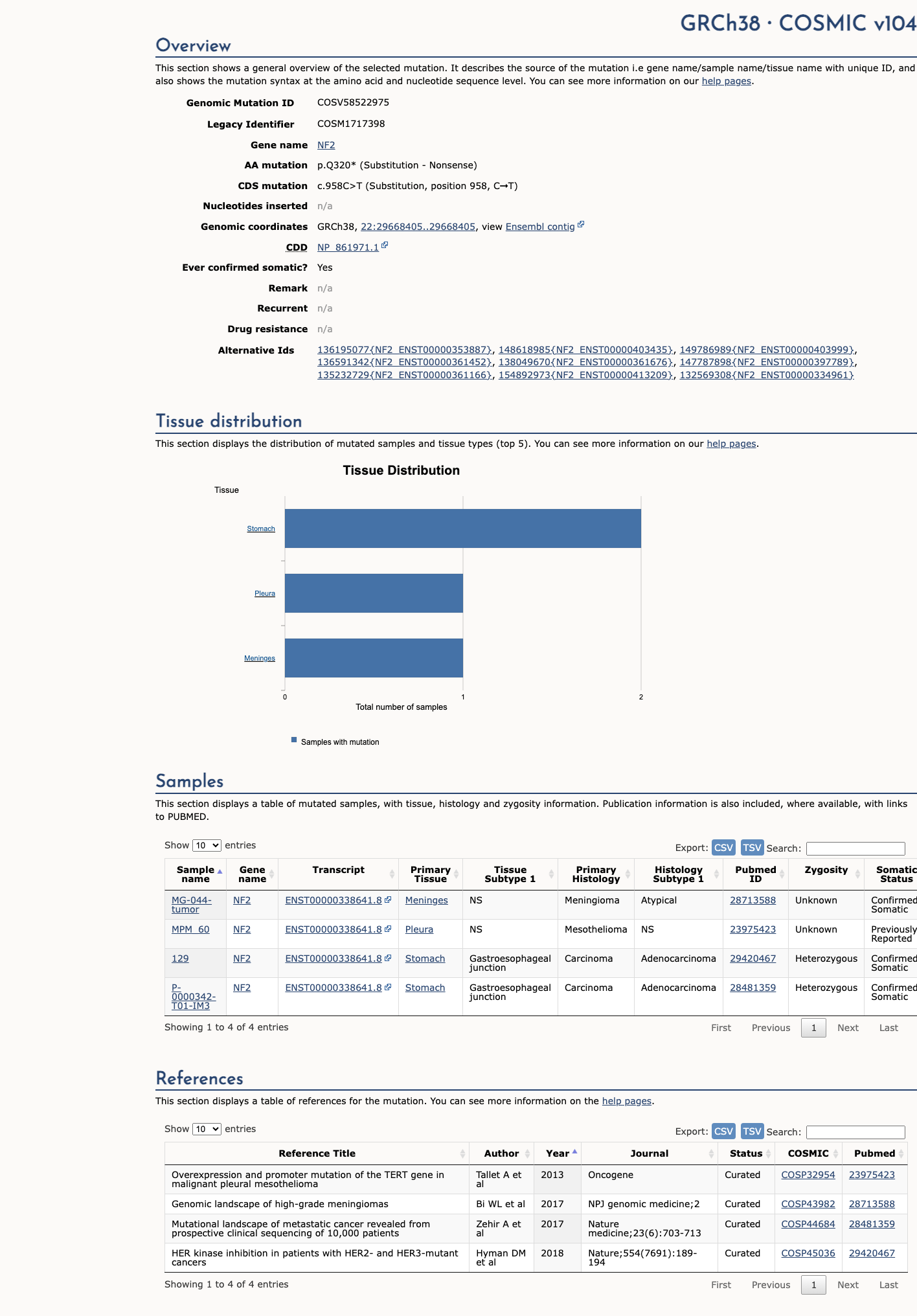
COSMIC
This variant does not lie in a statistically significant hotspot. This variant has previously been reported in somatic cancers (COSMIC; COSV58522975, n = 4 times).
Hotspots
This variant does not lie in a statistically significant hotspot.
Literature · how each cited paper was used
1papers cited
Each card is an audit: what was searched, what was found, whether it names the variant, which criteria it fed, and why. 7 further PMIDs triaged but not cited — see Sources & references.
Rule & framework references · cited for criterion definitions, not variant evidence
19545378 ↗ Neurofibromatosis type 2 (NF2): a clinical and molecular review.
Sources & reference links
8Sources
ClinVar
gnomAD v2.1
gnomAD v4.1
gnomAD-Canada
SpliceAI
OncoKB
COSMIC
Cancer hotspots
Triaged references · 7 PMIDs not cited in assessment
22825583 ↗ New strategies in pleural mesothelioma: BAP1 and NF2 as novel targets for therapeutic development and risk assessment. ONCOKB
8755919 ↗ Type of mutation in the neurofibromatosis type 2 gene (NF2) frequently determines severity of disease. ONCOKB
9643284 ↗ Genotype/phenotype correlations in type 2 neurofibromatosis (NF2): evidence for more severe disease associated with truncating mutations. ONCOKB
7913580 ↗ Mutational analysis of patients with neurofibromatosis 2. CLINVAR
23788249 ↗ ACMG recommendations for reporting of incidental findings in clinical exome and genome sequencing. CLINVAR
25356965 ↗ ACMG policy statement: updated recommendations regarding analysis and reporting of secondary findings in clinical genome-scale sequencing. CLINVAR
25394175 ↗ A practice guideline from the American College of Medical Genetics and Genomics and the National Society of Genetic Counselors: referral indications for cancer predisposition assessment. CLINVAR