This variant was interpreted by pipeline
7.1.0.
The current version is
8.0.0.
Re-running queues a fresh interpretation; the result replaces this page when complete.
Re-runs are not free. Blank = draws on today's public interpretation allowance.
With a code = uses 1 of that code's uses.
BCORL1 encodes a transcriptional corepressor that is tethered to promoter regions by DNA-binding proteins and interacts with class II histone deacetylases to repress gene expression. It also partners with the CtBP corepressor and components of the Polycomb Repressive Complex 1 to shape chromatin state, including repression of E-Cadherin, a gene involved in epithelial-to-mesenchymal transition. Loss-of-function alterations in BCORL1 are found in acute myeloid leukemia, myelodysplastic syndromes, astrocytomas, intracranial germ cell tumors, and age-related clonal blood disorders that can progress to myeloid malignancies, and BCORL1 acts as a tumor suppressor in these settings. The gene has additionally been implicated in resistance to vemurafenib in melanoma.
This variant
BCORL1 acts as a tumor suppressor, with loss-of-function alterations linked to acute myeloid leukemia, myelodysplastic syndromes, and related clonal blood disorders. This synonymous variant (p.(His651=)) is predicted to leave the protein unchanged with no splicing impact, so it shows none of the loss-of-function features that characterize BCORL1's disease-associated alterations. It remains a VUS because the benign evidence is limited to a single supporting criterion.
Transcript
NM_021946.4
HGVS · transcript:coding
NM_021946.4:c.1953C>T
GRCh38
chrX:130014725 C>T
GRCh37
chrX:129148701 C>T
No BCORL1-specific framework exists, so generic ACMG/AMP 2015 rules applied; with only BP7 (supporting) met, the single supporting benign criterion is insufficient to reach Likely Benign, yielding VUS.
Classification rationale
BP7VUS
BCORL1 c.1953C>Tsynonymous · exon 3
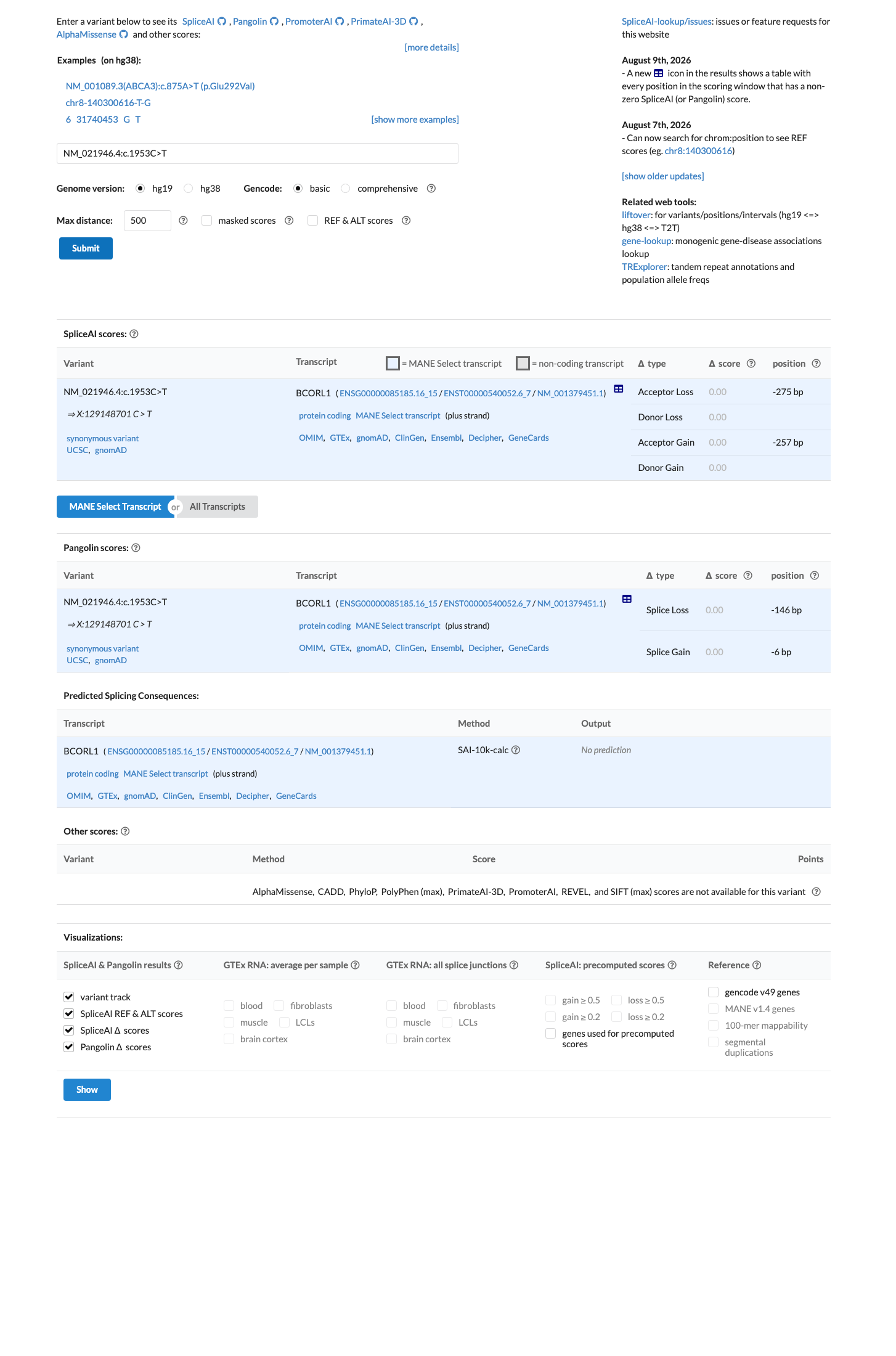
BP7 (Supporting): synonymous change with no predicted splicing impact, SpliceAI maximum delta 0.001, far below the 0.2 flag threshold. Overall classification VUS: a single supporting benign criterion does not reach the Likely Benign threshold under generic ACMG/AMP 2015 combination rules.
BP7→VUS
LYFE Sciences is an AI system, and it can make mistakes. Criteria
may be applied incorrectly, sources may be misread, and a confident-looking
classification can still be wrong. Double-check every criterion and
its underlying evidence before relying on any call.
Gene diagram
· NM_021946.4 · variants mapped to exon structure
BCORL1NM_021946.4
Fetching transcript structure from UCSC…
Exons
—
Transcript span
—
Strand
—
Variants mapped
—
Source
UCSC ncbiRefSeqCurated
All variants in BCORL1—click a row to locate it on the plot · use the link column to open its page
Protein
Location
Classification
Link
Applied criteria · 1 applied · 17 assessed
MetEvidence satisfies this criterion.
Not metEvaluated against available evidence; threshold not reached.
Not assessedApplies in principle, but no evidence was found to evaluate it.
N/ADoesn't apply to this variant type.
Applied · 1
Strength Supporting Moderate Strong Very strong
✓
BP7supportingBenign
Met (supporting): synonymous change with no predicted splicing impact, SpliceAI maximum delta 0.001, far below the 0.2 flag threshold.
Case compact_evidence.gnomad... normalization shows NM_021946.4:c.1953C>T = NP_068765.3:p.(His651=), confirming a synonymous variant.SpliceAI Lookup evidence_sentence: 'SpliceAI predicts no significant splice impact for this variant (max delta score = 0.00).' with underlying scores DS_AG=0.0, DS_AL=0.001, DS_DG=0.0, DS_DL=0.0 (max_delta=0.001), all well below the commonly used 0.2 splice-altering threshold.
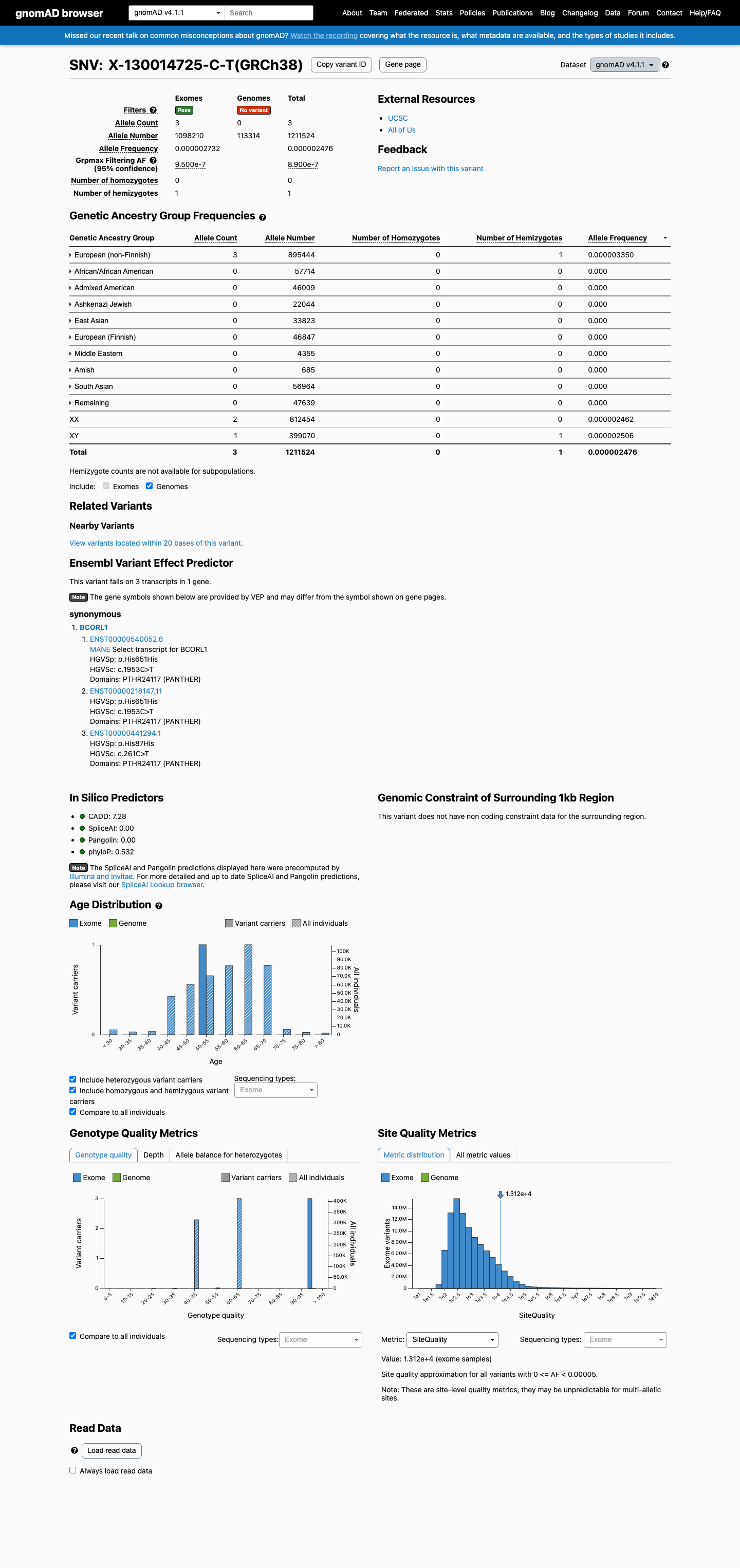
This variant is present in gnomAD v4.1 (AF= 2.47622e-06; MAF= 0.00025%, 3/1211524 alleles, homozygotes = 0) and has highest observed frequency in the European (non-Finnish) population (AF= 3.35029e-06; MAF= 0.00034%, 3/895444 alleles, homozygotes = 0); grpmax FAF= 8.9e-07.
v2.1
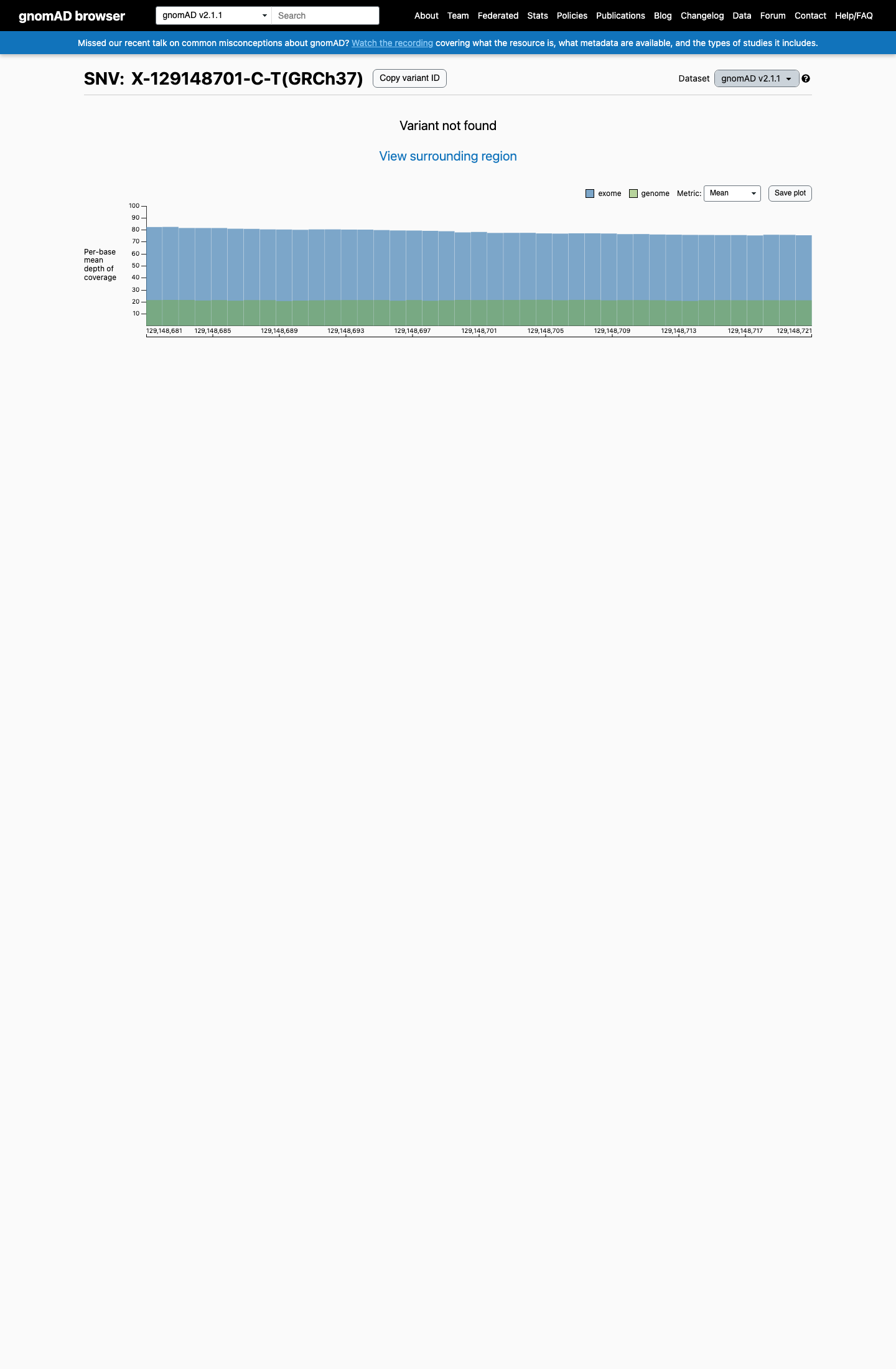
Absent from gnomAD v2.1.
🇨🇦 CA
Absent from gnomAD-Canada v1.0.
Allele frequency by ancestry
three datasets · side by side
gnomAD v4.1
0.00025%
· 3 / 1,211,524
0 hom · FAF 8.9e-05%
European (non-Finnish)
3 / 895,444
0.00034%
+ 9 not observed (Remaining individuals, Admixed American, European (Finnish), Amish, East Asian, Middle Eastern, South Asian, Ashkenazi Jewish, African/African American)