Analysis in progress
Initialising…
0%
complete
This report is still being assembled — sections appear as each stage finishes. It isn't final yet.
PPM1D
Final classification
VUS
BP4
PPM1D
c.1260+4T>C
p.?
unknown · exon 5i

PPM1D encodes a protein phosphatase that normally dampens cellular stress response pathways, including a feedback loop that restrains p53-mediated transcription and apoptosis. It is switched on in a p53-dependent manner in response to environmental stresses such as radiation and oxidative damage. PPM1D is an oncogene: its amplification, overexpression, or mutation has been found in breast, ovarian, pancreatic, liver, and other cancers, and high expression is associated with tumor progression and poorer prognosis in several cancer types.

This variant

Given PPM1D's role as an oncogene implicated in breast, ovarian, and other cancers, splice-region variants in this gene warrant scrutiny. However, this variant shows negligible predicted splicing impact (SpliceAI max delta 0.01) and is present in population databases, so neither a pathogenic nor a benign assertion can be made; it remains a VUS pending functional or family-based evidence.

Transcript
NM_003620.3
HGVS · transcript:coding
NM_003620.3:c.1260+4T>C
GRCh38
chr17:60656845 T>C
GRCh37
chr17:58734206 T>C
Basis With no PPM1D-specific framework available, generic ACMG/AMP 2015 rules apply: only BP4 (supporting) is met, which reaches no Benign or Likely Benign combination threshold, so the variant defaults to Uncertain Significance.
With no PPM1D-specific framework available, generic ACMG/AMP 2015 rules apply: only BP4 (supporting) is met, which reaches no Benign or Likely Benign combination threshold, so the variant defaults to Uncertain Significance.
Classification rationale
BP4 VUS
PPM1D c.1260+4T>C unknown · exon 5i

BP4 (Supporting): SpliceAI max delta 0.01 is below the <0.1 benign-supporting threshold. With only this single supporting benign criterion, no ACMG/AMP combination for Benign or Likely Benign is reached, and no pathogenic-direction criteria are met; the variant is classified as Uncertain Significance (VUS).

BP4 VUS
Gene diagram · NM_003620.3 · variants mapped to exon structure
PPM1D NM_003620.3
Fetching transcript structure from UCSC…
Applied criteria · 1 applied · 19 assessed
MetEvidence satisfies this criterion.
Not metEvaluated against available evidence; threshold not reached.
Not assessedApplies in principle, but no evidence was found to evaluate it.
N/ADoesn't apply to this variant type.
Applied · 1
Strength Supporting Moderate Strong Very strong
BP4 supporting Benign
Met (supporting): SpliceAI max delta 0.01 is below the BP4 supporting threshold of <0.1.
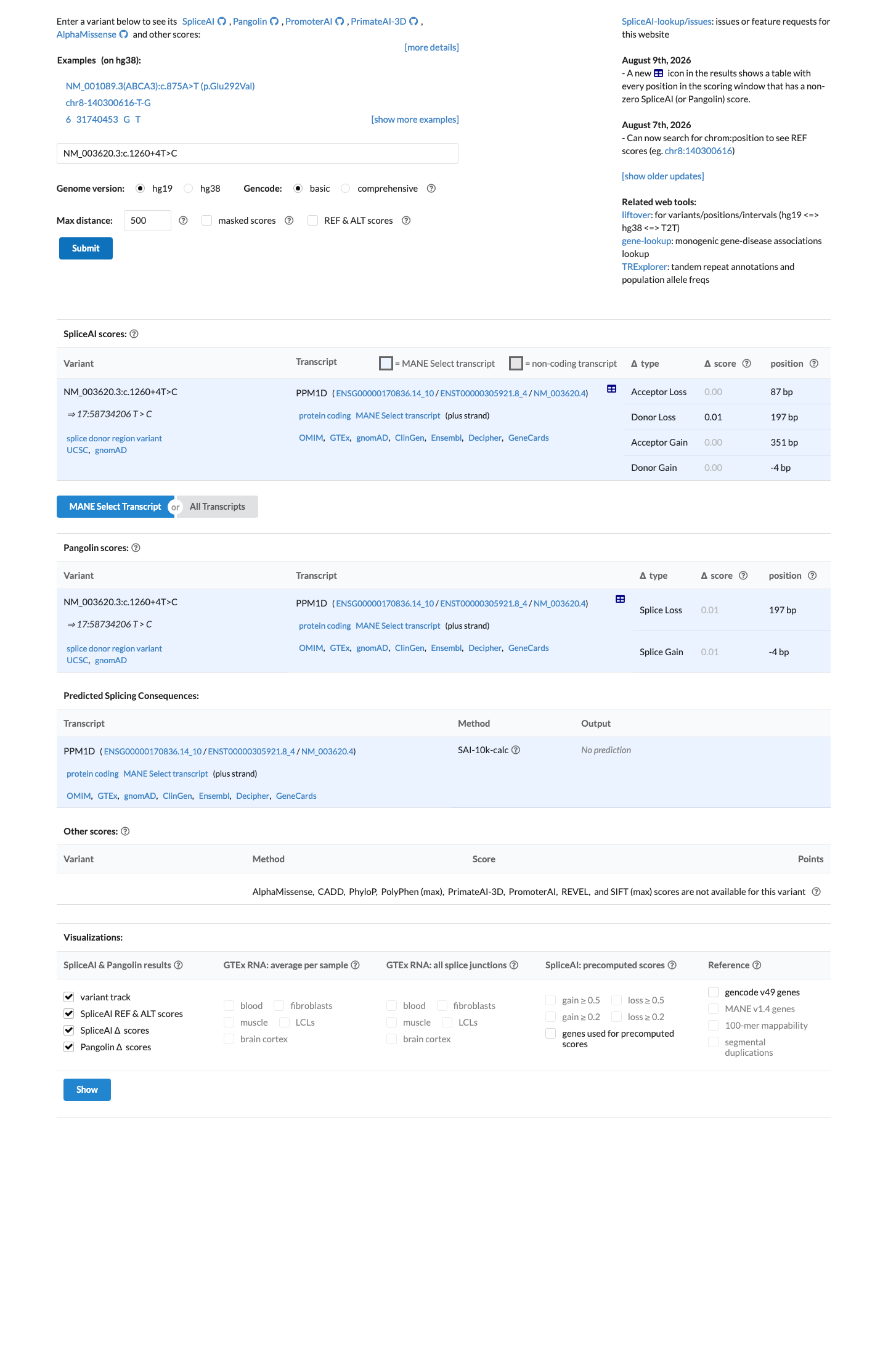
SpliceAI Lookup (NM_003620.3:c.1260+4T>C, hg37): max delta score = 0.01, below the BP4 supporting threshold of <0.1 defined in the lab's generic in-silico calibration rule for intronic/non-canonical-splice-position variants (generic_acmg_classification_rules.md).REVEL and BayesDel were not applicable since this is not a missense variant; in any case BayesDel has no verified published threshold available to this pipeline and would be treated as not_available regardless of variant type.
Assessed · not applied · 6 not met · 13 not assessed
Pathogenic
PVS1 Not met: intronic +4 change sits outside the canonical splice donor, and SpliceAI max delta 0.01 predicts no splicing disruption.
PS2 Not assessed: no proband or parental testing data were available to establish de novo status.
PS3 Not assessed: no functional assay data (e.g., splicing minigene or enzymatic activity) were available for this variant.
PS4 Not assessed: no case-series or case-control enrichment data were available; the single ClinVar record is an uncertain-significance assertion.
PM2 Not met: present in population databases (51/1,613,914 alleles in gnomAD v4.1), so not absent from controls.
PM3 Not assessed: no affected-proband observations, second allele, phase, or segregation data establishing a recessive genotype.
PM6 Not assessed: no evidence of a presumed de novo occurrence without parental confirmation.
PP1 Not assessed: no affected relatives or segregation data were documented.
PP3 Not met: SpliceAI max delta 0.01 is well below the PP3 supporting threshold of >0.2.
PP4 Not assessed: no patient phenotype or disease-specific clinical features were supplied.
PP5 Not met: the exact-variant ClinVar record is uncertain significance from a single submitter, with no expert-panel classification.
Benign
BA1 Not met: allele frequency 0.00316% (51/1,613,914 alleles in gnomAD v4.1) is far below the 5% stand-alone benign threshold.
BS1 Not assessed: no disease-specific prevalence or maximum credible allele-frequency threshold was available to test against.
BS2 Not assessed: zero homozygotes observed, but carrier health status and phenotypes are not established.
BS3 Not assessed: no functional assay evidence demonstrating no damaging effect on splicing or protein function was available.
BS4 Not assessed: no unaffected relatives tested for absence of the variant were reported.
BP2 Not assessed: no observation of the variant in cis with a pathogenic variant or phase information was available.
BP5 Not assessed: no molecularly confirmed alternate genetic etiology was documented.
BP6 Not met: ClinVar classification is uncertain significance from a single laboratory, with no expert-panel benign classification.
N/A · 8 PS1 · PM1 · PM4 · PM5 · PP2 · BP1 · BP3 · BP7
Research & evidence
Population frequency
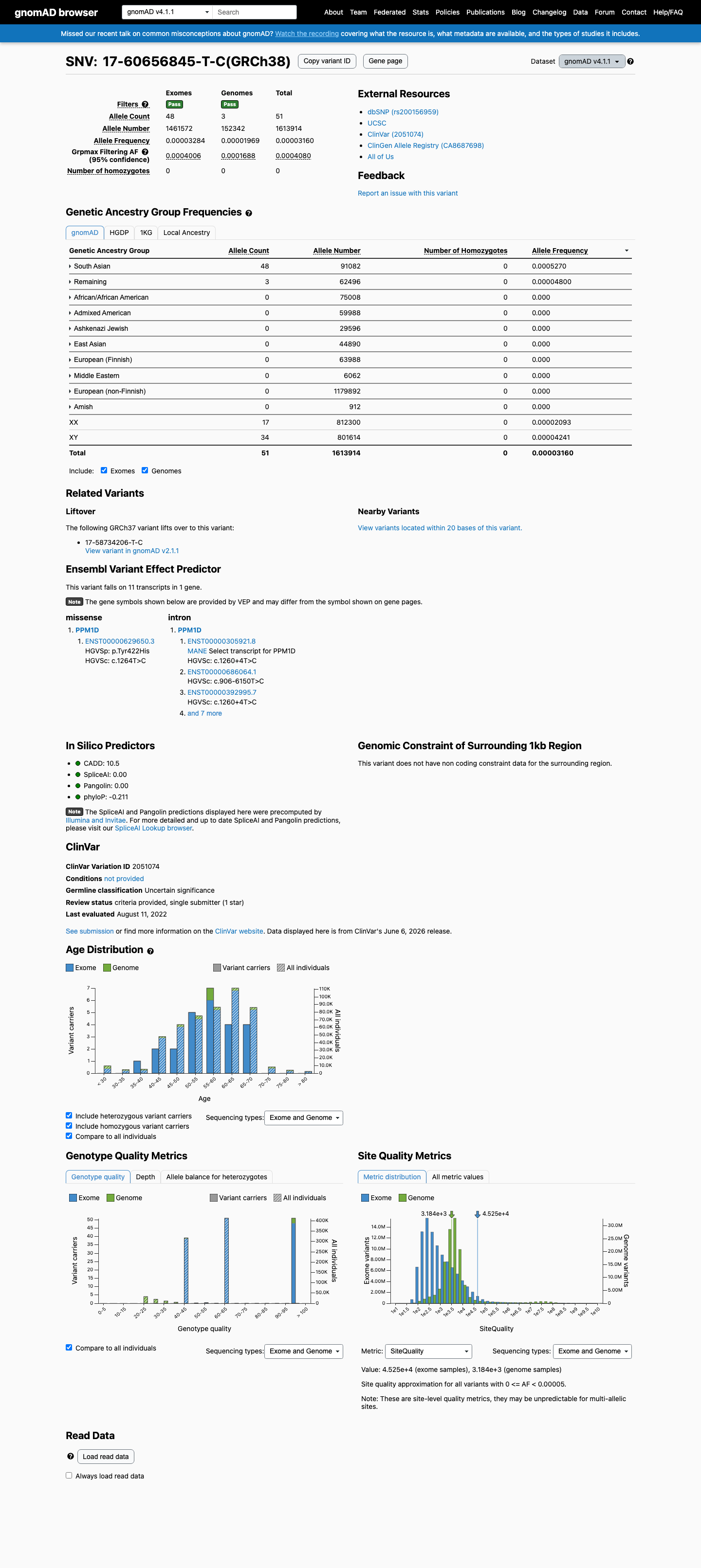
gnomAD v4.1 screenshot
gnomAD v4.1
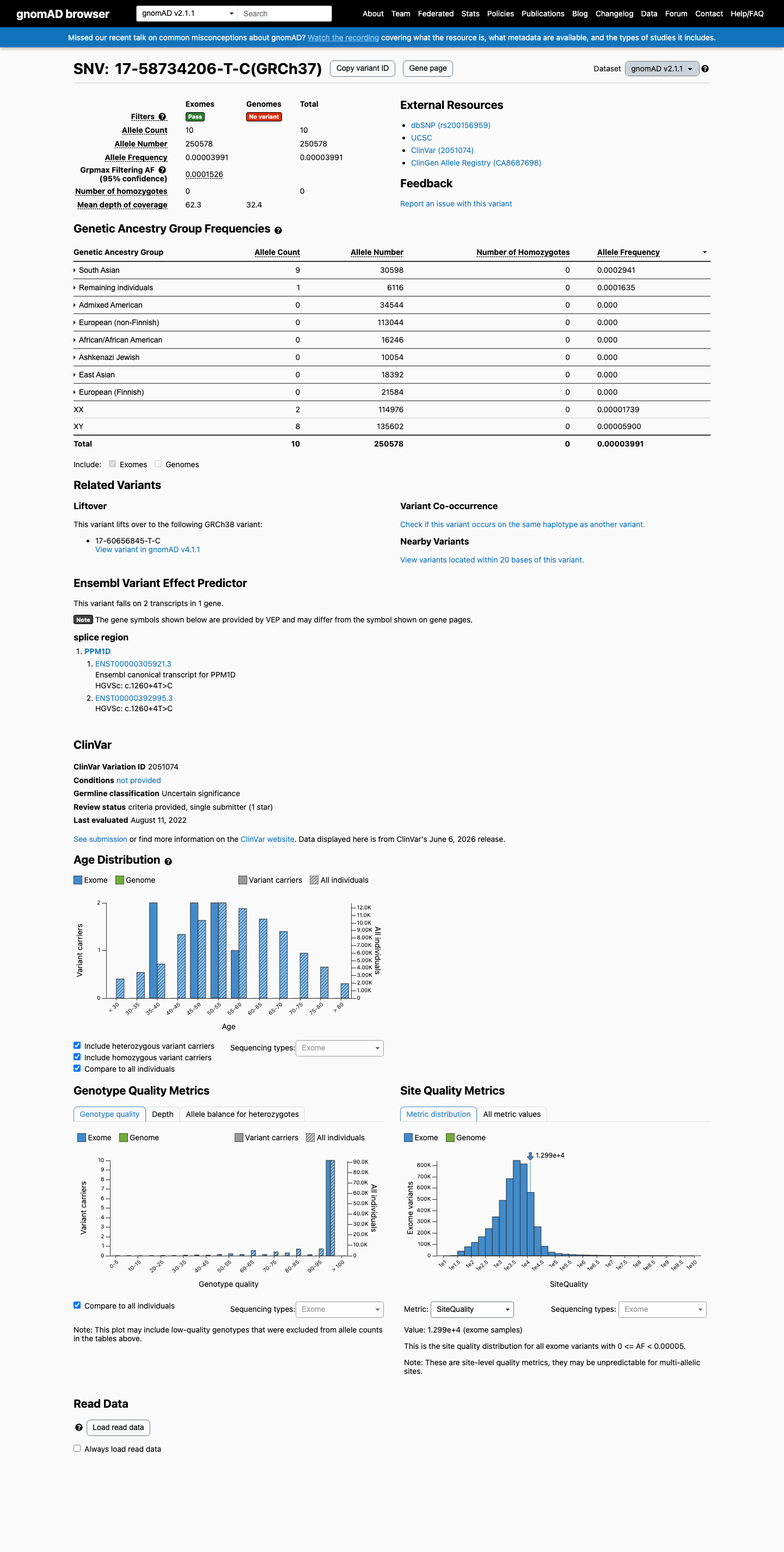
gnomAD v2.1 screenshot
gnomAD v2.1
v4.1
This variant is present in gnomAD v4.1 (AF= 3.16002e-05; MAF= 0.00316%, 51/1613914 alleles, homozygotes = 0) and has highest observed frequency in the South Asian population (AF= 0.000526998; MAF= 0.05270%, 48/91082 alleles, homozygotes = 0); grpmax FAF= 0.000408.
v2.1
This variant is present in gnomAD v2.1 (AF= 3.99077e-05; MAF= 0.00399%, 10/250578 alleles, homozygotes = 0) and has highest observed frequency in the South Asian population (AF= 0.000294137; MAF= 0.02941%, 9/30598 alleles, homozygotes = 0); grpmax FAF= 0.00015263.
🇨🇦 CA
Not available in gnomAD-Canada v1.0.
Allele frequency by ancestry
three datasets · side by side
gnomAD v4.1
0.0032% · 51 / 1,613,914
0 hom · FAF 0.041%
South Asian
48 / 91,082
0.053%
Remaining individuals
3 / 62,496
0.0048%
+ 8 not observed (Admixed American, European (Finnish), Amish, East Asian, Middle Eastern, Ashkenazi Jewish, African/African American, European (non-Finnish))
gnomAD v2.1
0.004% · 10 / 250,578
0 hom · FAF 0.015%
South Asian
9 / 30,598
0.029%
Remaining individuals
1 / 6,116
0.016%
+ 6 not observed (African/African American, Admixed American, Ashkenazi Jewish, East Asian, European (Finnish), European (non-Finnish))
gnomAD Canada 🇨🇦
Absent · 0 / ?
0 hom
Not observed in any ancestry group.
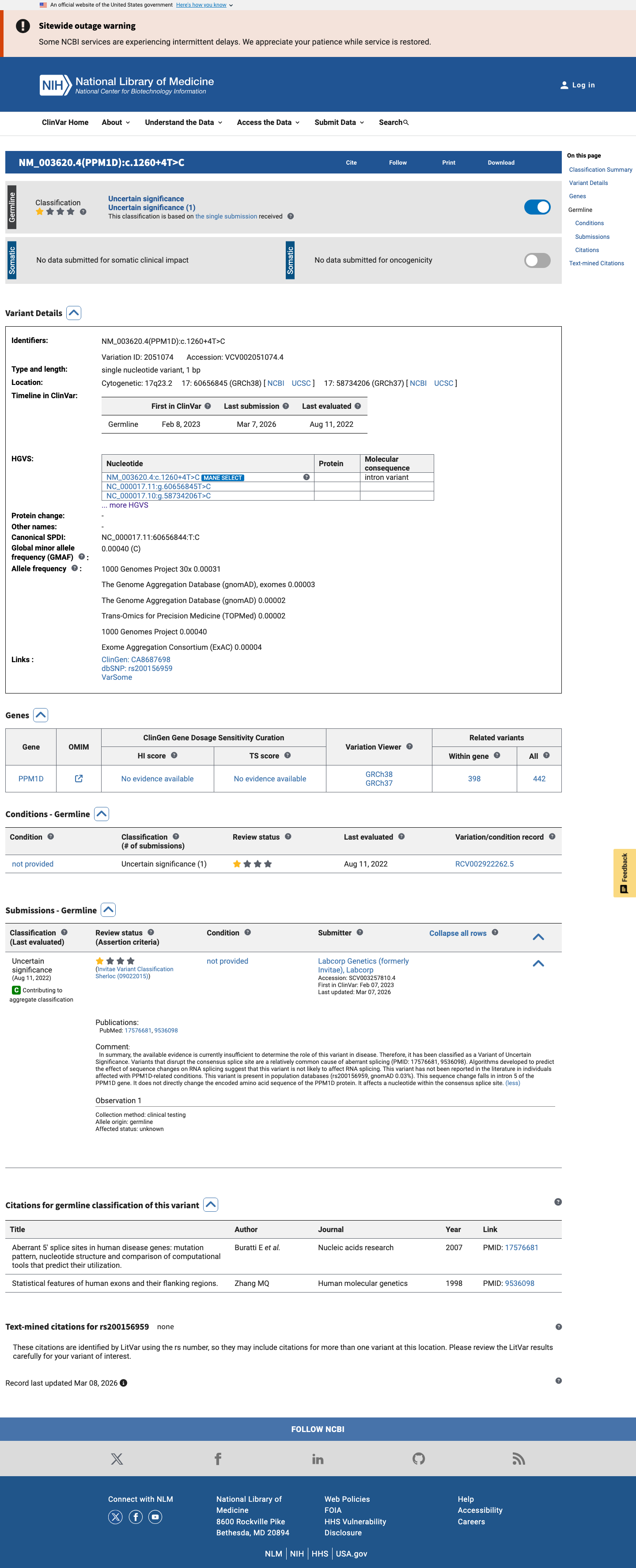
ClinVar screenshot
ClinVar
This variant has been reported in ClinVar as Uncertain significance (1 clinical laboratory). (ClinVarID = 2051074)
SpliceAI screenshot
In silico
SpliceAI predicts no significant splice impact for this variant (max delta score = 0.01).
Functional No data
No calibrated functional assay or RNA evidence was identified for this variant.
OncoKB ↗
COSMIC screenshot
COSMIC
Somatic evidence
COSMIC
This variant has not previously been reported in somatic cancers (COSMIC).
Hotspots
This variant does not lie in a statistically significant cancer hotspot.
COSMIC ↗
Sources & reference links
7Sources
ClinVar
gnomAD v2.1
gnomAD v4.1
gnomAD-Canada
SpliceAI
OncoKB
COSMIC
Triaged references · 2 PMIDs not cited in assessment
17576681 ↗ Aberrant 5' splice sites in human disease genes: mutation pattern, nucleotide structure and comparison of computational tools that predict their utilization. CLINVAR
9536098 ↗ Statistical features of human exons and their flanking regions. CLINVAR