Analysis in progress
Initialising…
0%
complete
This report is still being assembled — sections appear as each stage finishes. It isn't final yet.
SETBP1
Final classification
VUS
BP4
SETBP1
c.575A>G
p.His192Arg
missense · exon 4

SETBP1 encodes a DNA-binding protein that regulates gene expression by recruiting epigenetic complexes that modify chromatin and by interacting with SET domain-containing proteins involved in histone methylation. It also binds the SET protein, an inhibitor of the phosphatase PP2A, and its activity supports cell growth and self-renewal in blood cells. Germline mutations in SETBP1 cause Schinzel-Giedion syndrome, a congenital disorder marked by neurological symptoms and an increased risk of malignancy. Somatic mutations in SETBP1 that disrupt its normal degradation are associated with blood cancers including myeloproliferative neoplasms and atypical chronic myeloid leukemia, indicating a role as an oncogene.

This variant

SETBP1 is associated with Schinzel-Giedion syndrome through gain-of-function missense mutations and with myeloid malignancies through somatic mutations that disrupt its degradation. This variant's p.(His192Arg) missense change falls outside the established mutational hotspot, is present at low frequency in population databases, and shows no predicted splice or in-silico pathogenic impact, leaving its clinical significance uncertain.

Transcript
NM_015559.2
HGVS · transcript:coding
NM_015559.2:c.575A>G
GRCh38
chr18:44949915 A>G
GRCh37
chr18:42529880 A>G
Basis With no SETBP1 VCEP available, generic ACMG/AMP 2015 applies; only BP4 (supporting) is met, no pathogenic criterion reaches threshold, and the variant is classified as VUS.
With no SETBP1 VCEP available, generic ACMG/AMP 2015 applies; only BP4 (supporting) is met, no pathogenic criterion reaches threshold, and the variant is classified as VUS.
Classification rationale
BP4 VUS
SETBP1 c.575A>G missense · exon 4

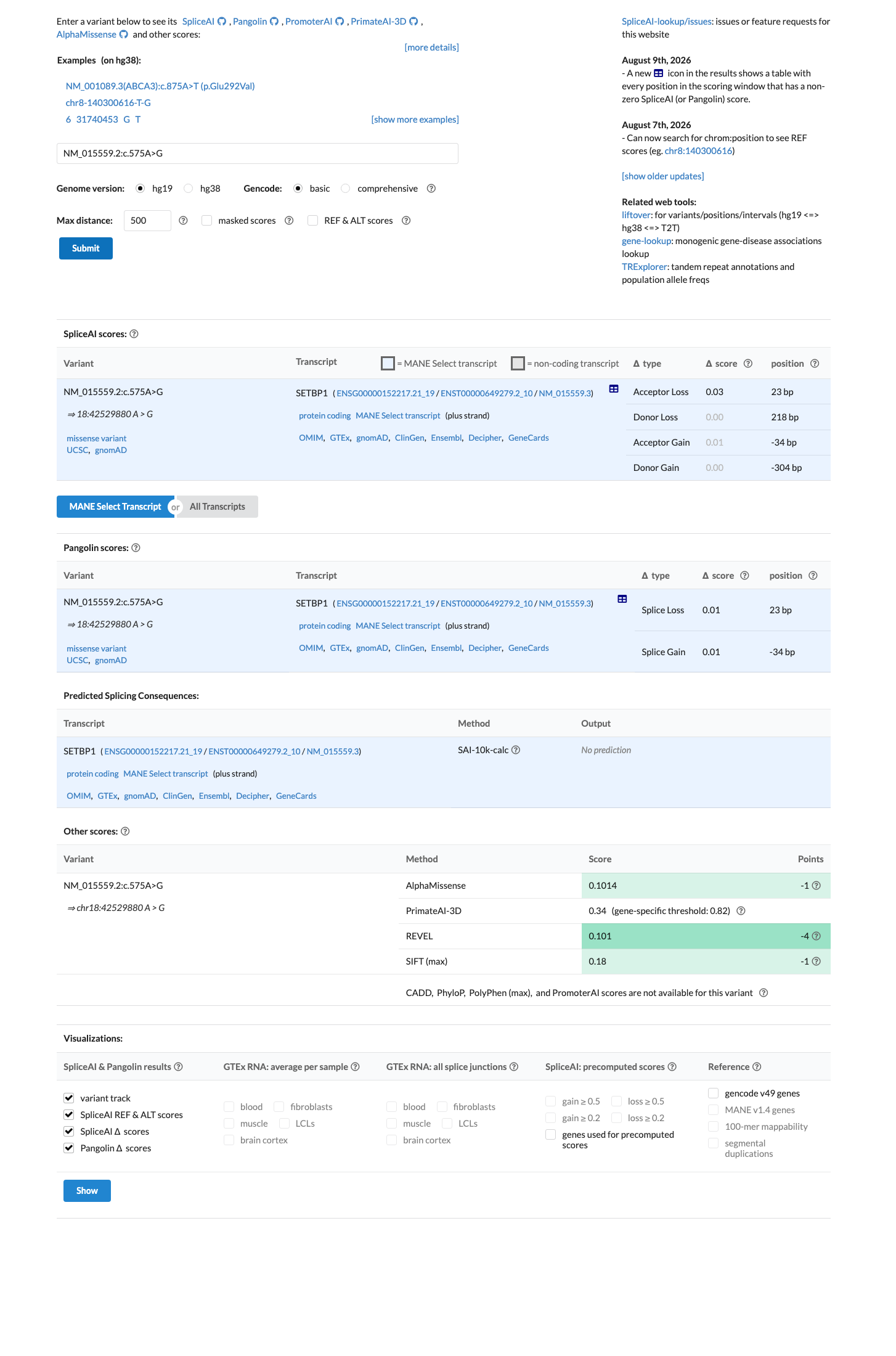
BP4 (Supporting): REVEL 0.101 is below the benign-supporting threshold (<=0.290), and SpliceAI max delta 0.028 predicts no splice disruption. Overall classification: VUS — only one benign-supporting criterion (BP4) is met, and no pathogenic criterion reaches threshold, so the evidence is insufficient to move from uncertain significance.

BP4 VUS
Gene diagram · NM_015559.2 · variants mapped to exon structure
SETBP1 NM_015559.2
Fetching transcript structure from UCSC…
Applied criteria · 1 applied · 23 assessed
MetEvidence satisfies this criterion.
Not metEvaluated against available evidence; threshold not reached.
Not assessedApplies in principle, but no evidence was found to evaluate it.
N/ADoesn't apply to this variant type.
Applied · 1
Strength Supporting Moderate Strong Very strong
BP4 supporting Benign
Met (supporting): REVEL 0.101 is below the benign-supporting threshold (<=0.290), and SpliceAI max delta 0.028 predicts no splice impact.
REVEL score = 0.101 for NM_015559.2:c.575A>G (NP_056374.2:p.His192Arg), local REVEL v1.3 lookup; at or below the ClinGen SVI-calibrated BP4 threshold of <=0.290 (Pejaver et al. 2022, PMID 36413997), supporting BP4.SpliceAI Lookup evidence_sentence: 'SpliceAI predicts no significant splice impact for this variant (max delta score = 0.03)'; source_data.spliceai_scores DS_AG=0.005, DS_AL=0.028, DS_DG=0.004, DS_DL=0.0, well below the 0.2 actionable-splice threshold, supporting no splice disruption and consistent with BP4.BayesDel score = -0.285904 present but not used to support BP4: no verified published threshold/citation available to this pipeline for BayesDel.
Assessed · not applied · 4 not met · 19 not assessed
Pathogenic
PS1 Not assessed: no alternate nucleotide change producing the identical p.(His192Arg) substitution with an established pathogenic classification was identified.
PS2 Not assessed: no de novo observation with confirmed parental testing is documented for this variant.
PS3 Not assessed: no functional assay data for p.(His192Arg) were available.
PS4 Not assessed: no case-control enrichment or phenotype-prevalence data for this variant were available.
PM1 Not met: cancerhotspots.org returned no result for SETBP1 H192, and no functional-domain annotation places residue 192 in a hotspot.
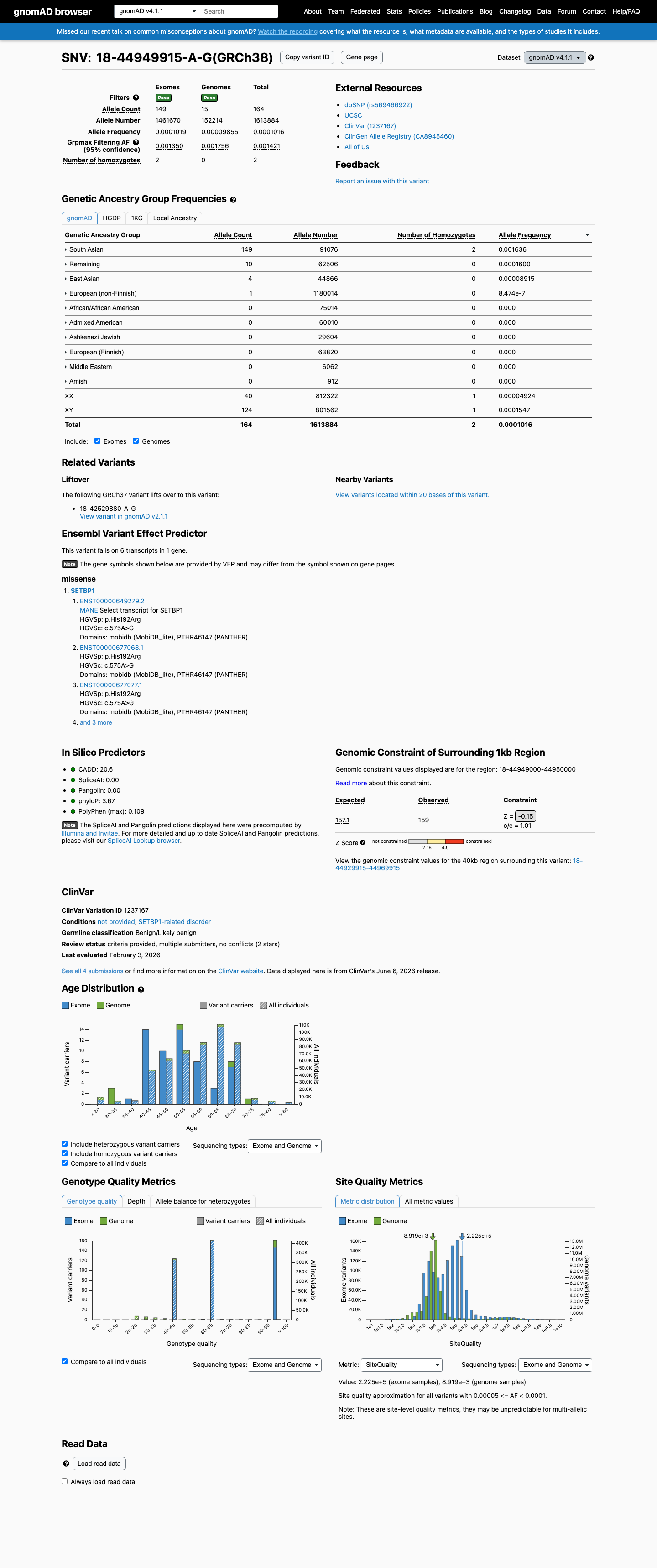
PM2 Not met: variant is present in gnomAD v4.1 (164/1,613,884 alleles; two homozygotes), so it is not absent from controls.
PM3 Not assessed: no affected-proband genotype, phase, or trans observation data were available.
PM5 Not assessed: no alternate pathogenic missense change at codon 192 (same-residue comparator) was identified.
PM6 Not assessed: no de novo occurrence without confirmed parental testing is documented.
PP1 Not assessed: no family history, affected relatives, or segregation data were provided.
PP2 Not assessed: no missense constraint metric (Z-score or o/e ratio) or authoritative gene-level statement was available.
PP3 Not met: REVEL 0.101 is below the pathogenic-supporting threshold (>=0.644), and SpliceAI max delta 0.028 predicts no splice disruption.
PP4 Not assessed: no clinical phenotype findings specific to a SETBP1-related disorder were provided.
PP5 Not assessed: ClinVar contains no expert-panel submissions for this exact variant.
Benign
BA1 Not met: highest subpopulation allele frequency 0.001636 (South Asian, gnomAD v4.1) is far below the 5% stand-alone benign threshold.
BS1 Not assessed: no validated maximum credible allele-frequency threshold is available to judge whether the South Asian frequency (0.001636) is too high.
BS2 Not assessed: two gnomAD homozygotes are reported, but their healthy phenotype and SETBP1 penetrance are not established.
BS3 Not assessed: no functional assay demonstrating normal function for p.(His192Arg) was available.
BS4 Not assessed: no unaffected-carrier or non-segregation data are documented.
BP1 Not assessed: SETBP1 has both loss-of-function and gain-of-function missense disease mechanisms, and the condition under evaluation is unspecified.
BP2 Not assessed: no individual genotype, phase, or inheritance data were available to evaluate.
BP5 Not assessed: no documented alternate molecular diagnosis was available.
BP6 Not assessed: ClinVar has no expert-panel benign/likely-benign classification; only single-submitter laboratory assertions exist.
N/A · 4 PVS1 · PM4 · BP3 · BP7
Research & evidence
Population frequency
gnomAD v4.1 screenshot
gnomAD v4.1
gnomAD v2.1 screenshot
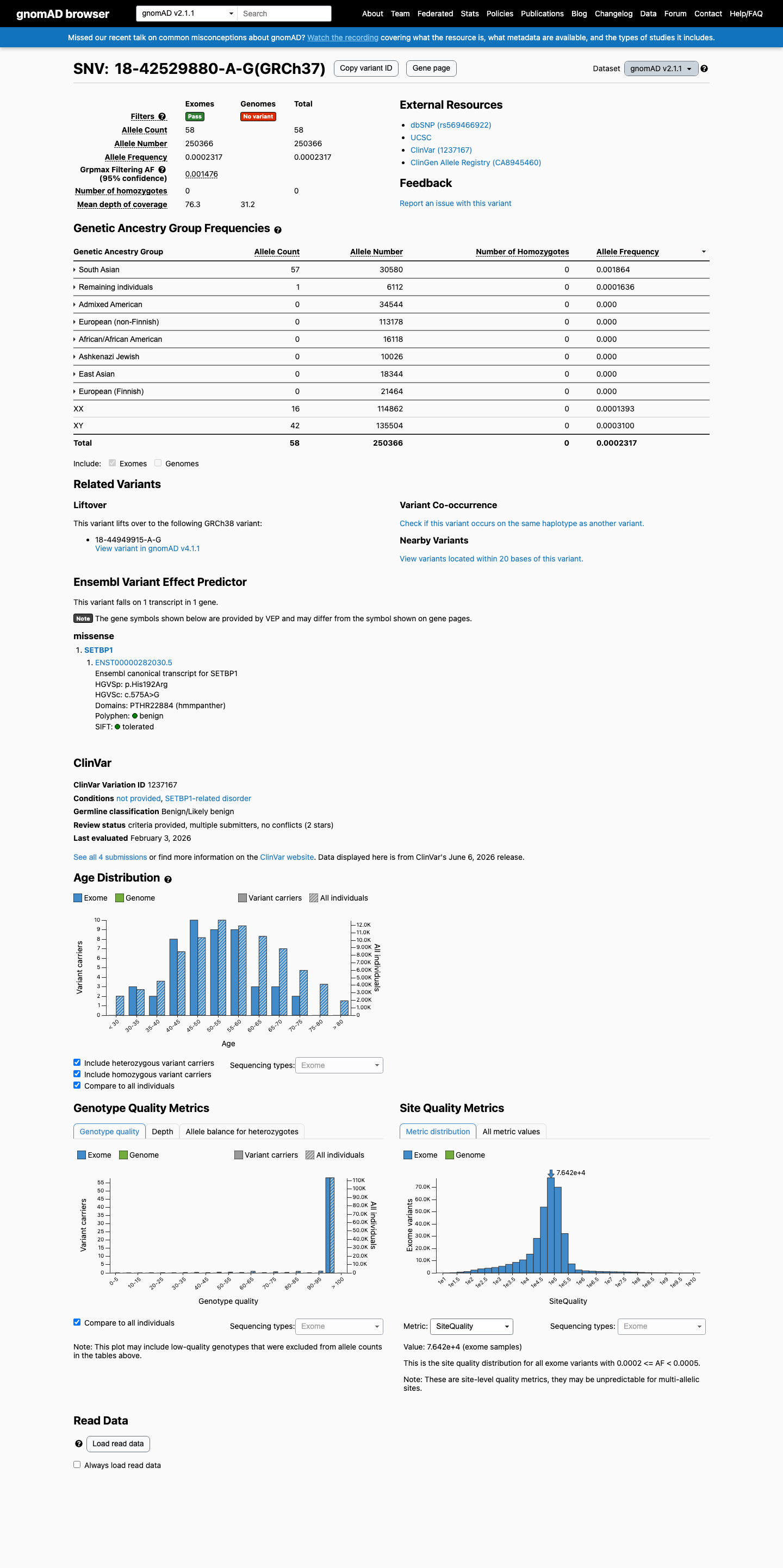
gnomAD v2.1
v4.1
This variant is present in gnomAD v4.1 (AF= 0.000101618; MAF= 0.01016%, 164/1613884 alleles, homozygotes = 2) and has highest observed frequency in the South Asian population (AF= 0.001636; MAF= 0.16360%, 149/91076 alleles, homozygotes = 2); grpmax FAF= 0.00142098.
v2.1
This variant is present in gnomAD v2.1 (AF= 0.000231661; MAF= 0.02317%, 58/250366 alleles, homozygotes = 0) and has highest observed frequency in the South Asian population (AF= 0.00186396; MAF= 0.18640%, 57/30580 alleles, homozygotes = 0); grpmax FAF= 0.00147646.
🇨🇦 CA
This variant is present in gnomAD-Canada v1.0 (AF= 0.00021715526601520088, 4/18420 alleles, homozygotes = 0).
Allele frequency by ancestry
three datasets · side by side
gnomAD v4.1
0.01% · 164 / 1,613,884
2 hom · FAF 0.14%
South Asian
149 / 91,076
0.16%
2 hom
Remaining individuals
10 / 62,506
0.016%
East Asian
4 / 44,866
0.0089%
European (non-Finnish)
1 / 1,180,014
8.5e-05%
+ 6 not observed (Admixed American, European (Finnish), Amish, Middle Eastern, Ashkenazi Jewish, African/African American)
gnomAD v2.1
0.023% · 58 / 250,366
0 hom · FAF 0.15%
South Asian
57 / 30,580
0.19%
Remaining individuals
1 / 6,112
0.016%
+ 6 not observed (African/African American, Admixed American, Ashkenazi Jewish, East Asian, European (Finnish), European (non-Finnish))
gnomAD Canada 🇨🇦
0.022% · 4 / 18,420
0 hom · FAF 0.1%
South Asian
4 / 1,362
0.29%
+ 8 not observed (African/African American, Latino/Admixed American, Ashkenazi Jewish, East Asian, European (Finnish), Middle Eastern, European (non-Finnish), Remaining individuals)
ClinVar screenshot
ClinVar
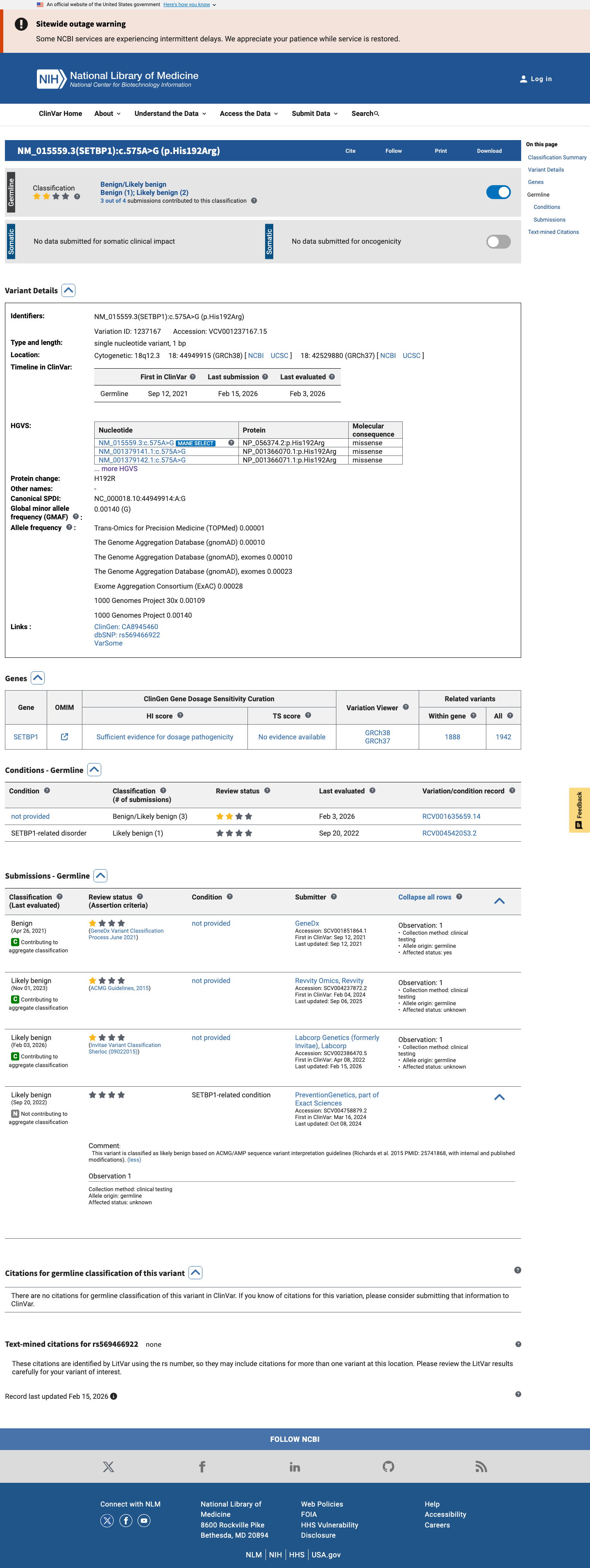
This variant has been reported in ClinVar as Likely benign (3 clinical laboratories) and as Benign (1 clinical laboratory). (ClinVarID = 1237167)
SpliceAI screenshot
In silico
SpliceAI predicts no significant splice impact for this variant (max delta score = 0.03). REVEL score = 0.101. BayesDel score = -0.285904.
Functional / OncoKB screenshot
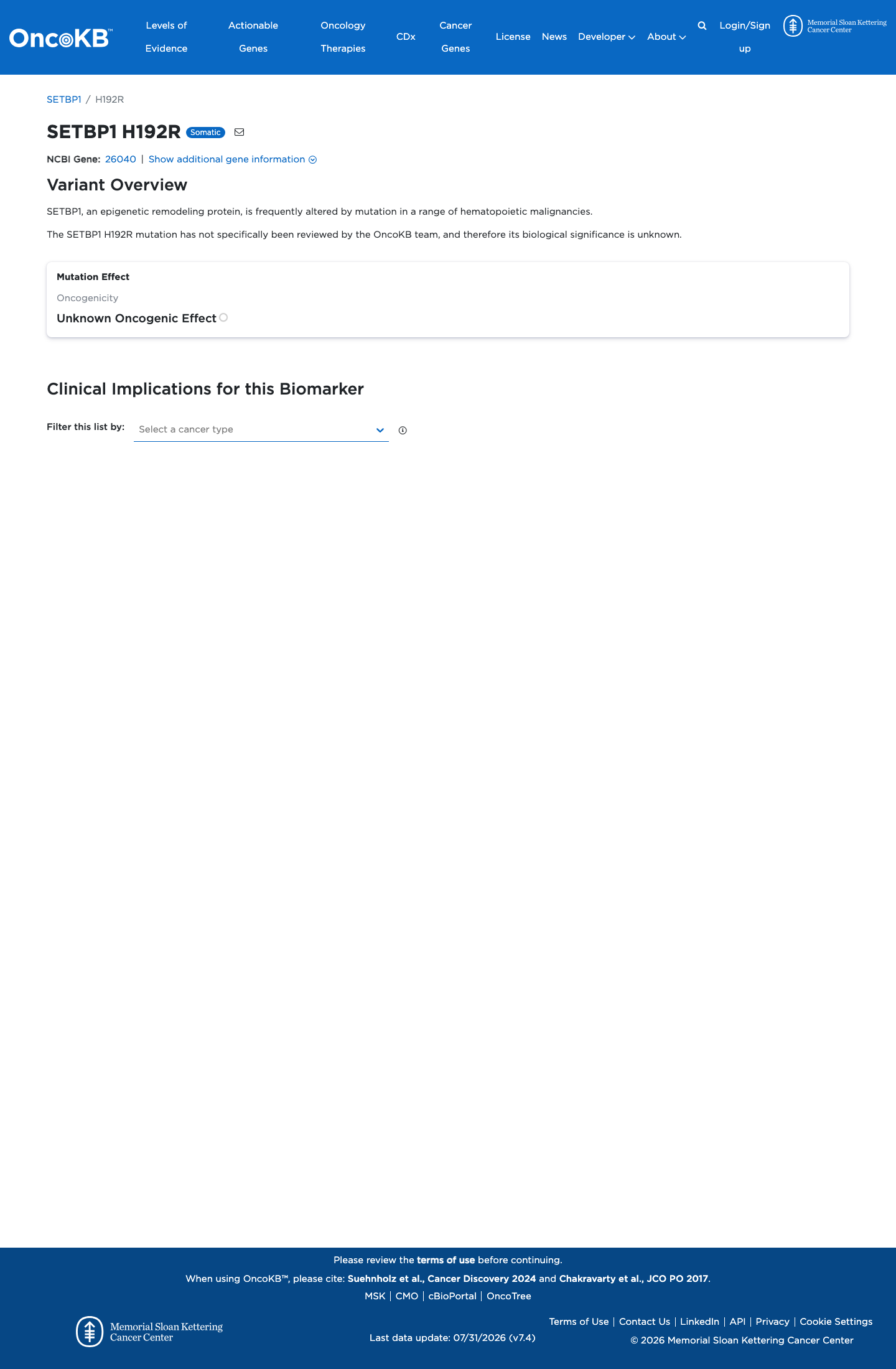
Functional Unknown Oncogenic Effect
OncoKB did not identify variant-specific reviewed functional evidence for this variant; gene-level curated context is available for reviewer follow-up. SETBP1, an epigenetic remodeling protein, is frequently altered by mutation in a range of hematopoietic malignancies.
OncoKB ↗
COSMIC screenshot
COSMIC
Cancer hotspots screenshot
Cancer hotspots
Somatic evidence Not in COSMIC / hotspots
COSMIC
This variant does not lie in a statistically significant hotspot. This variant has not previously been reported in somatic cancers (COSMIC).
Hotspots
This variant does not lie in a statistically significant hotspot.
Sources & reference links
8Sources
ClinVar
gnomAD v2.1
gnomAD v4.1
gnomAD-Canada
SpliceAI
OncoKB
COSMIC
Cancer hotspots
Triaged references · 2 PMIDs not cited in assessment
25741868 ↗ Standards and guidelines for the interpretation of sequence variants: a joint consensus recommendation of the American College of Medical Genetics and Genomics and the Association for Molecular Pathology. CLINVAR
28492532 ↗ Sherloc: a comprehensive refinement of the ACMG-AMP variant classification criteria. CLINVAR