Analysis in progress
Initialising…
0%
complete
This report is still being assembled — sections appear as each stage finishes. It isn't final yet.
PRPF8
Final classification
VUS
PM2BP7
PRPF8
c.3081A>T
p.Ser1027=
synonymous · exon 21

PRPF8 encodes a core component of the spliceosome, the cellular machinery that removes introns from pre-mRNA during gene expression; it is essential for the catalytic second step of pre-mRNA splicing and helps assemble splicing complexes through its WD repeat domains. Mutations in PRPF8 are a known cause of autosomal dominant retinitis pigmentosa, an inherited form of progressive vision loss. In cancer, altered PRPF8 splicing disrupts the proofreading function of the spliceosome and is often found alongside TP53 loss-of-function mutations, implicating it in tumor development as a tumor suppressor.

This variant

PRPF8 is essential for the spliceosome's catalytic second step, and its mutations cause autosomal dominant retinitis pigmentosa and are implicated in tumor development alongside TP53 loss. This synonymous variant is predicted to leave the protein unchanged (p.(Ser1027=)) with no predicted splice impact, so it does not appear to impair PRPF8's splicing function; the VUS classification reflects insufficient evidence rather than evidence of pathogenicity.

Transcript
NM_006445.3
HGVS · transcript:coding
NM_006445.3:c.3081A>T
GRCh38
chr17:1674660 T>A
GRCh37
chr17:1577954 T>A
Basis VUS: only PM2 (supporting) and BP7 (supporting) are met, and one supporting pathogenic plus one supporting benign criterion satisfy no ACMG/AMP combination rule.
VUS: only PM2 (supporting) and BP7 (supporting) are met, and one supporting pathogenic plus one supporting benign criterion satisfy no ACMG/AMP combination rule.
Classification rationale
PM2 BP7 VUS
PRPF8 c.3081A>T synonymous · exon 21

PM2 (Supporting): gnomAD v4.1 overall allele frequency 0.00775% (below 0.1%) with no homozygotes. BP7 (Supporting): SpliceAI max delta score 0.005 (below 0.1), indicating no significant splice impact. VUS: one supporting pathogenic and one supporting benign criterion conflict; no ACMG/AMP 2015 combination rule is satisfied.

PM2 + BP7 VUS
Gene diagram · NM_006445.3 · variants mapped to exon structure
PRPF8 NM_006445.3
Fetching transcript structure from UCSC…
Applied criteria · 2 applied · 17 assessed
MetEvidence satisfies this criterion.
Not metEvaluated against available evidence; threshold not reached.
Not assessedApplies in principle, but no evidence was found to evaluate it.
N/ADoesn't apply to this variant type.
Applied · 2
Strength Supporting Moderate Strong Very strong
PM2 supporting Pathogenic
Met (supporting): gnomAD v4.1 overall allele frequency 0.00775%, below the 0.1% threshold, with no homozygotes.
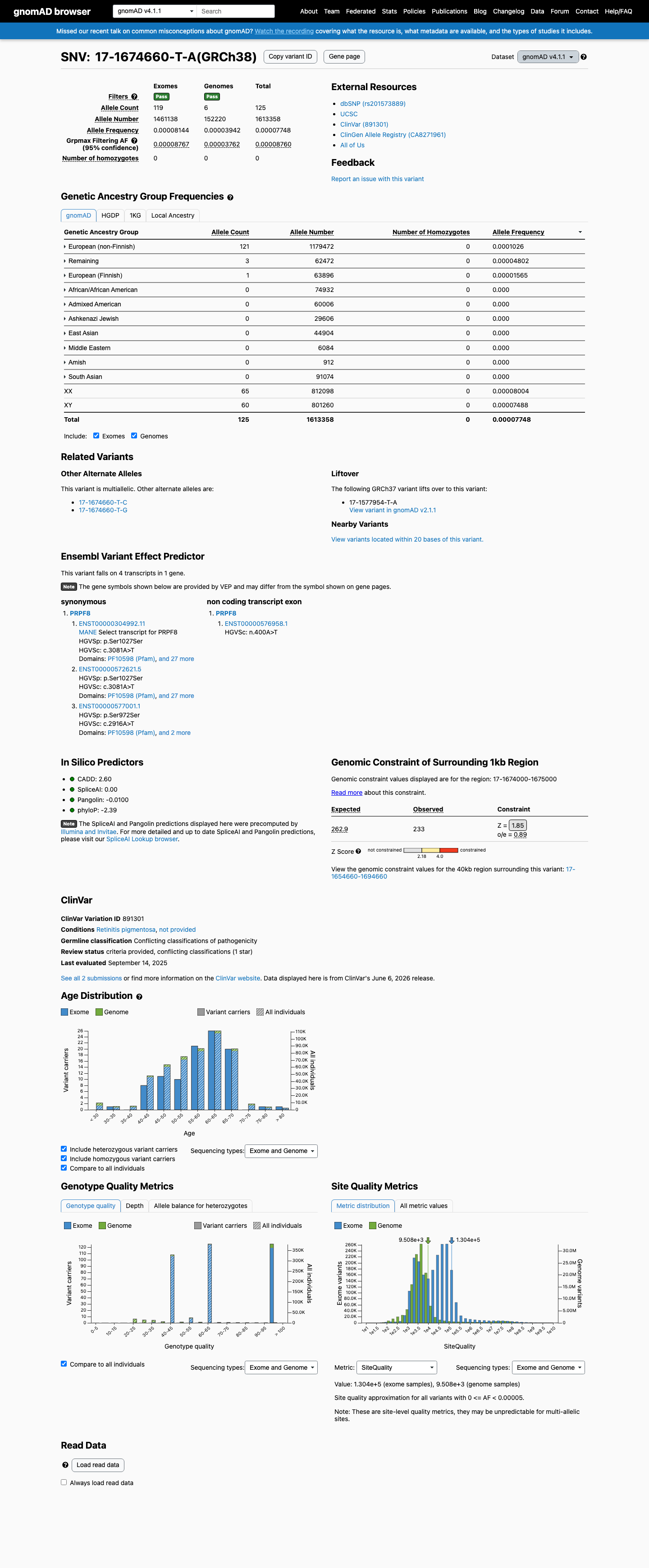
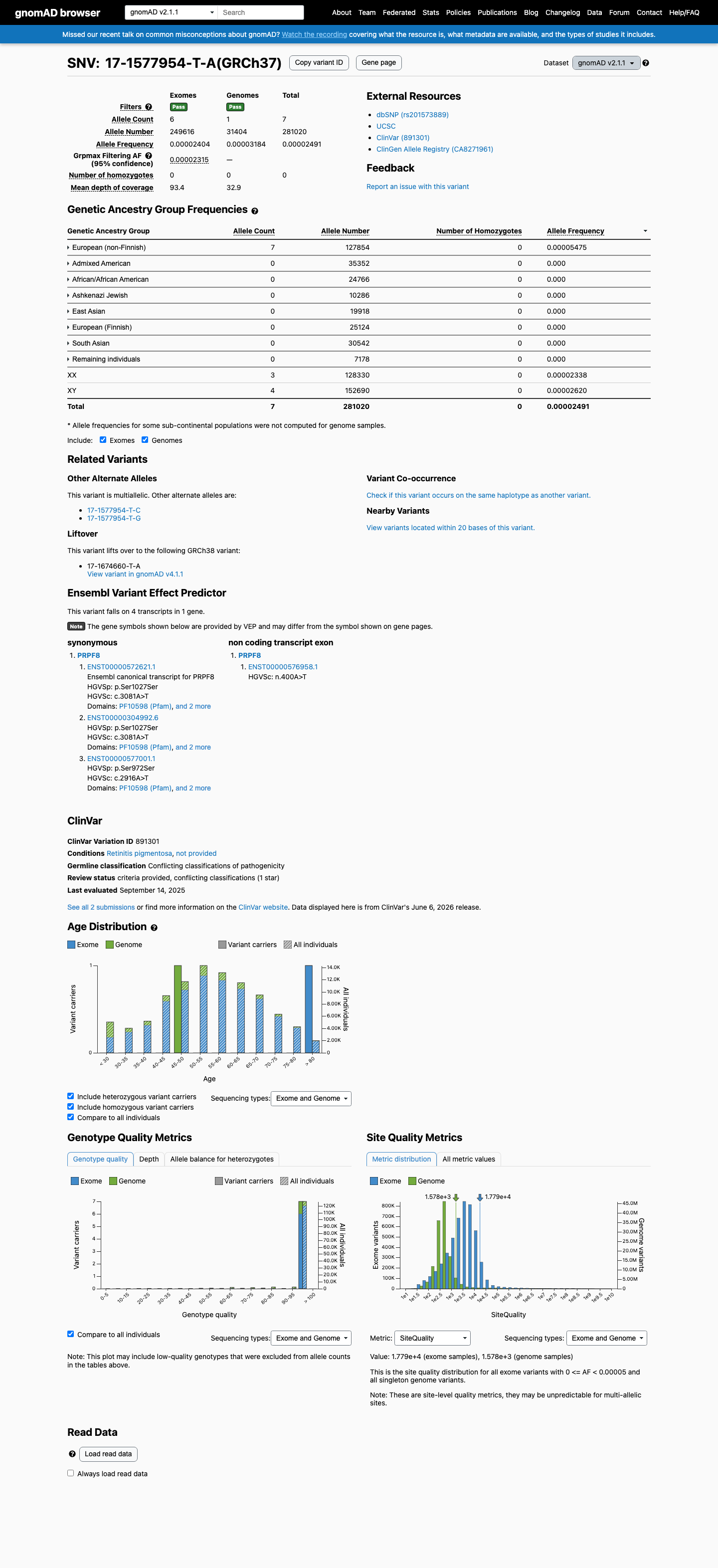
gnomAD v4.1 reports 125/1,613,358 alleles, overall AF 7.74782e-05 (0.00775%), maximum subgroup AF 0.000102588 (0.01026%), and 0 homozygotes.gnomAD v2.1 reports 7/281,020 alleles, overall AF 2.49093e-05 (0.00249%), maximum subgroup AF 5.47499e-05 (0.00547%), and 0 homozygotes.The variant is absent from gnomAD-Canada v1.0.
BP7 supporting Benign
Met (supporting): SpliceAI max delta score 0.005, below the 0.1 threshold, indicating no significant splice impact.
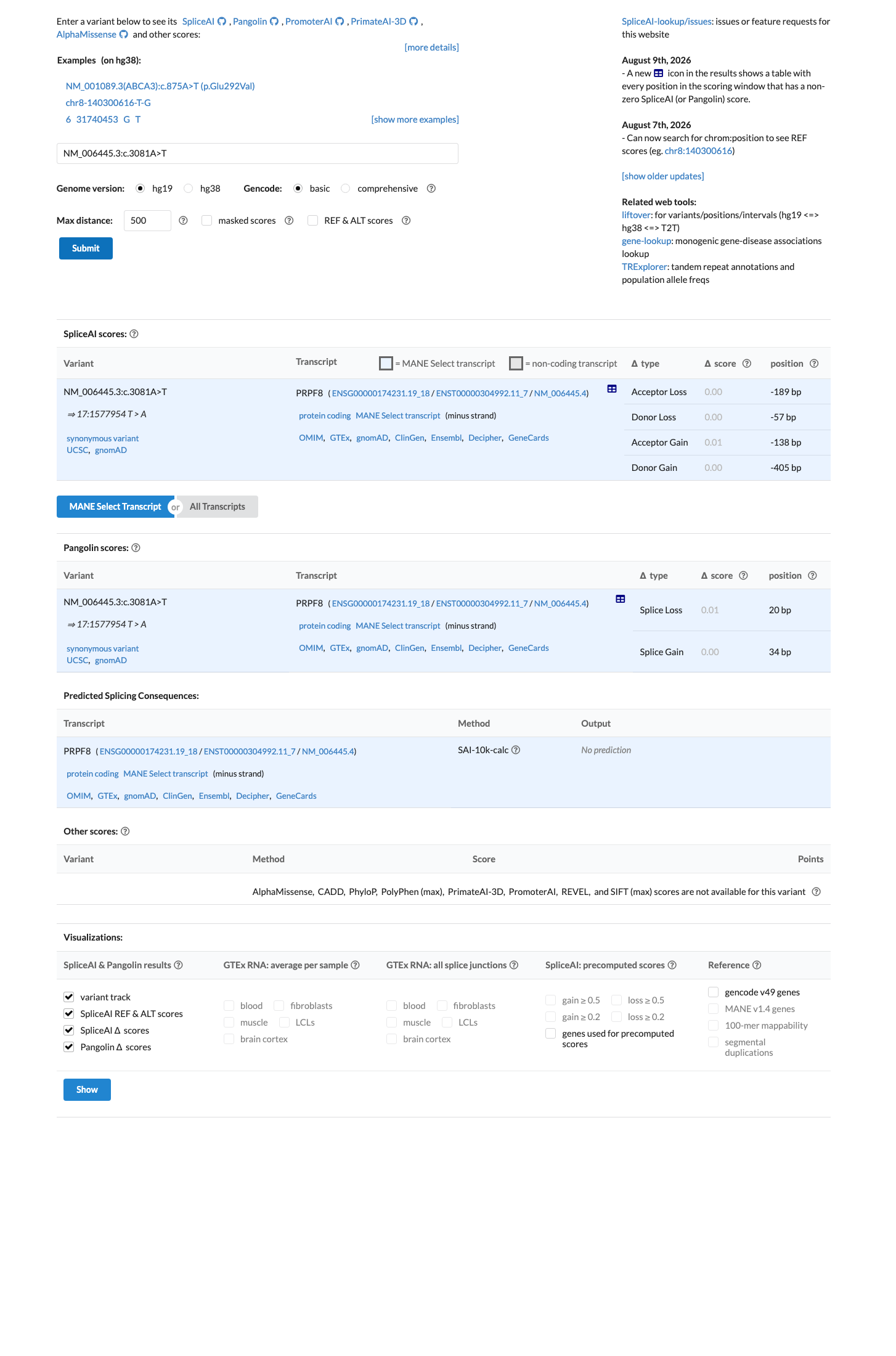
SpliceAI predicts no significant splice impact for this variant (max delta score = 0.005; DS_AG 0.005, DS_AL 0.001, DS_DG 0.0, DS_DL 0.001), below the BP4/BP7-supporting threshold of <0.1 in this lab's generic PP3/BP4 in-silico calibration (used here for BP7 since the variant is synonymous).Variant is synonymous (p.(Ser1027=)), the variant class this criterion is intended to cover; canonical_splice_consensus flag is false, consistent with SpliceAI's no-impact prediction.
Assessed · not applied · 5 not met · 12 not assessed
Pathogenic
PS2 Not assessed: no parental testing or de novo confirmation for this variant was available.
PS3 Not assessed: no wet-lab functional assay for this specific variant was available; only in silico SpliceAI data.
PS4 Not assessed: no case-control enrichment or affected-case series for this exact variant was identified.
PM3 Not assessed: no data on a second allele, phase, or inheritance for this variant was available.
PM6 Not assessed: no clinical record documents a presumed de novo occurrence of this variant.
PP1 Not assessed: no family pedigree or cosegregation data was available for this variant.
PP3 Not met: SpliceAI max delta score 0.005, well below the >0.2 PP3 threshold.
PP4 Not assessed: no phenotype description for an individual carrying this exact variant was available.
PP5 Not met: ClinVar entry 891301 shows conflicting single-submitter classifications with no expert-panel submission.
Benign
BA1 Not met: highest population frequency 0.01026%, far below the >1% BA1 threshold.
BS1 Not met: highest population frequency 0.01026%, below the >0.3% BS1 threshold.
BS2 Not assessed: no documented observation of the variant in healthy adults with an age-appropriate phenotype.
BS3 Not assessed: no wet-lab functional study showing absence of a damaging effect was available.
BS4 Not assessed: no affected or unaffected relatives tested for the variant were available for segregation.
BP2 Not assessed: no evidence of the variant in trans or cis with a pathogenic variant was available.
BP5 Not assessed: no alternate molecular diagnosis explaining the patient's phenotype was documented.
BP6 Not met: the ClinVar likely-benign submission is from a single laboratory, not an expert panel.
N/A · 9 PVS1 · PS1 · PM1 · PM4 · PM5 · PP2 · BP1 · BP3 · BP4
Research & evidence
Population frequency
gnomAD v4.1 screenshot
gnomAD v4.1
gnomAD v2.1 screenshot
gnomAD v2.1
v4.1
This variant is present in gnomAD v4.1 (AF= 7.74782e-05; MAF= 0.00775%, 125/1613358 alleles, homozygotes = 0) and has highest observed frequency in the European (non-Finnish) population (AF= 0.000102588; MAF= 0.01026%, 121/1179472 alleles, homozygotes = 0); grpmax FAF= 8.76e-05.
v2.1
This variant is present in gnomAD v2.1 (AF= 2.49093e-05; MAF= 0.00249%, 7/281020 alleles, homozygotes = 0) and has highest observed frequency in the European (non-Finnish) population (AF= 5.47499e-05; MAF= 0.00547%, 7/127854 alleles, homozygotes = 0); grpmax FAF= 2.315e-05.
🇨🇦 CA
Absent from gnomAD-Canada v1.0.
Allele frequency by ancestry
three datasets · side by side
gnomAD v4.1
0.0077% · 125 / 1,613,358
0 hom · FAF 0.0088%
European (non-Finnish)
121 / 1,179,472
0.01%
Remaining individuals
3 / 62,472
0.0048%
European (Finnish)
1 / 63,896
0.0016%
+ 7 not observed (Admixed American, Amish, East Asian, Middle Eastern, South Asian, Ashkenazi Jewish, African/African American)
gnomAD v2.1
0.0025% · 7 / 281,020
0 hom · FAF 0.0023%
European (non-Finnish)
7 / 127,854
0.0055%
+ 7 not observed (African/African American, Admixed American, Ashkenazi Jewish, East Asian, European (Finnish), Remaining individuals, South Asian)
gnomAD Canada 🇨🇦
Absent · 0 / ?
0 hom
Not observed in any ancestry group.
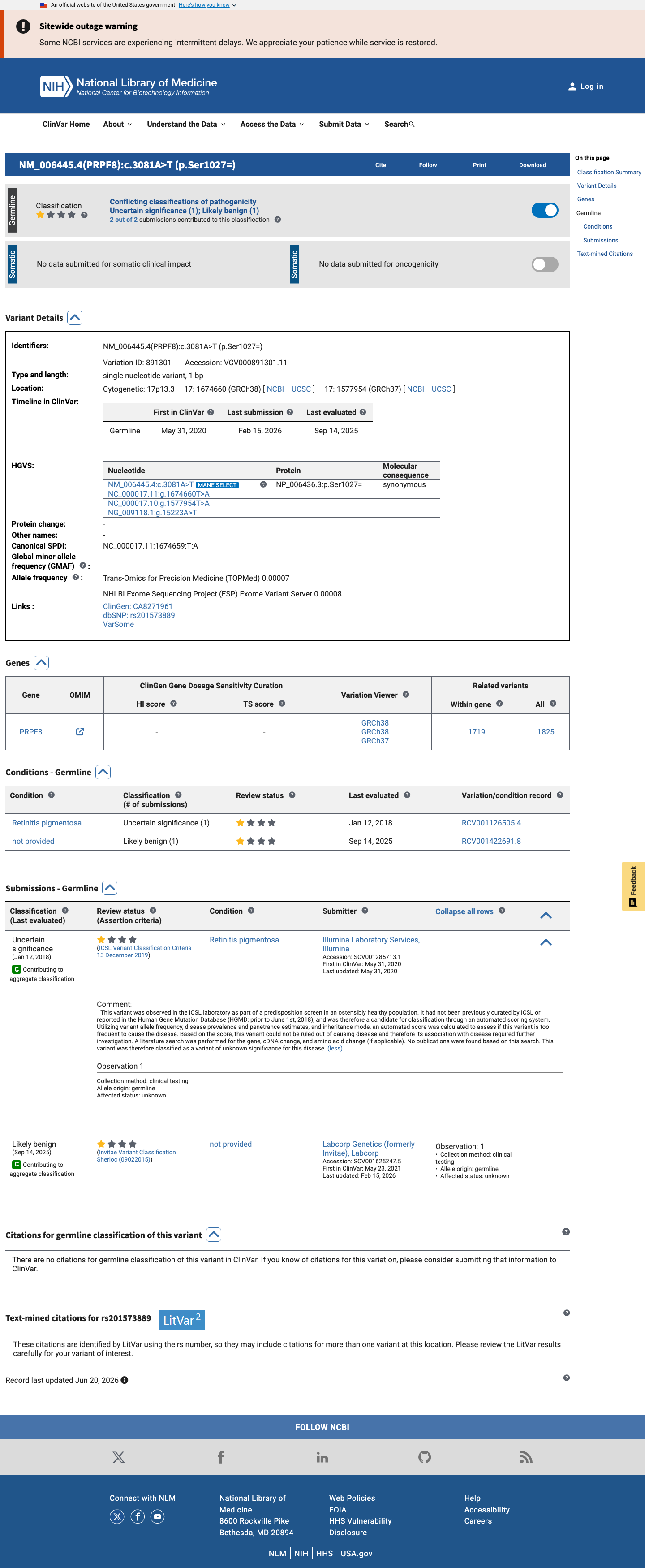
ClinVar screenshot
ClinVar
This variant has been reported in ClinVar as Uncertain significance (1 clinical laboratory) and as Likely benign (1 clinical laboratory). (ClinVarID = 891301)
SpliceAI screenshot
In silico
SpliceAI predicts no significant splice impact for this variant (max delta score = 0.01).
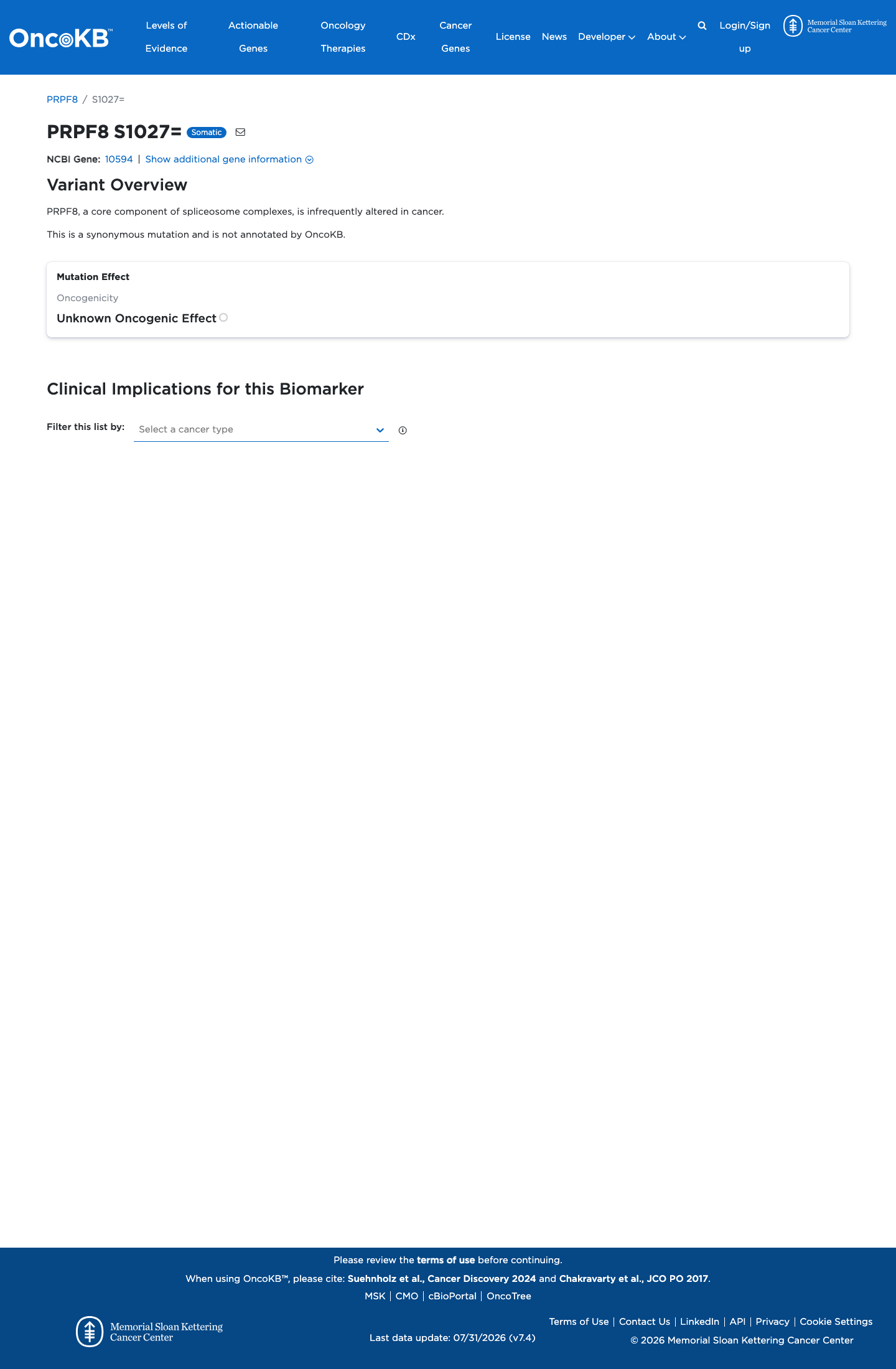
Functional / OncoKB screenshot
Functional Unknown Oncogenic Effect
OncoKB identified curated literature and non-variant-specific oncogenicity context for review; listed oncogenicity label: Unknown Oncogenic Effect.
OncoKB ↗
COSMIC screenshot
COSMIC
Cancer hotspots screenshot
Cancer hotspots
Somatic evidence Not in COSMIC / hotspots
COSMIC
This variant does not lie in a statistically significant hotspot. This variant has not previously been reported in somatic cancers (COSMIC).
Hotspots
This variant does not lie in a statistically significant hotspot.
Sources & reference links
8Sources
ClinVar
gnomAD v2.1
gnomAD v4.1
gnomAD-Canada
SpliceAI
OncoKB
COSMIC
Cancer hotspots
Triaged references · 4 PMIDs not cited in assessment
26666451 ↗ In Vivo CRISPR/Cas9 Gene Editing Corrects Retinal Dystrophy in the S334ter-3 Rat Model of Autosomal Dominant Retinitis Pigmentosa. CLINVAR
20301590 ↗ Nonsyndromic Retinitis Pigmentosa Overview. CLINVAR
22234150 ↗ Clinical utility gene card for: BEST1-related dystrophies (Bestrophinopathies). CLINVAR
28492532 ↗ Sherloc: a comprehensive refinement of the ACMG-AMP variant classification criteria. CLINVAR