Analysis in progress
Initialising…
0%
complete
This report is still being assembled — sections appear as each stage finishes. It isn't final yet.
PPM1D
Final classification
VUS
PM2
PPM1D
c.1570del
p.Gln524LysfsTer15
frameshift · exon 6

PPM1D encodes a protein phosphatase that normally dampens cellular stress response pathways, including a feedback loop that restrains p53-mediated transcription and apoptosis. It is switched on in a p53-dependent manner in response to environmental stresses such as radiation and oxidative damage. PPM1D is an oncogene: its amplification, overexpression, or mutation has been found in breast, ovarian, pancreatic, liver, and other cancers, and high expression is associated with tumor progression and poorer prognosis in several cancer types.

This variant

PPM1D is an oncogene whose terminal-exon truncating variants such as this one are proposed to act as gain-of-function alleles that stabilize the phosphatase and dampen the DNA-damage response in cancer. This variant is such a terminal-exon frameshift, yet for this exact change the only available evidence is extreme population rarity. It therefore remains a VUS: current data neither establish nor exclude a contributory role in PPM1D-associated cancer.

Transcript
NM_003620.3
HGVS · transcript:coding
NM_003620.3:c.1570del
GRCh38
chr17:60663301 GC>G
GRCh37
chr17:58740662 GC>G
Basis No PPM1D VCEP or gene-specific framework exists, so generic ACMG/AMP 2015 rules were applied; only PM2 (supporting) is met, with all other criteria not applicable or not assessed.
No PPM1D VCEP or gene-specific framework exists, so generic ACMG/AMP 2015 rules were applied; only PM2 (supporting) is met, with all other criteria not applicable or not assessed.
Classification rationale
PM2 VUS
PPM1D c.1570del frameshift · exon 6

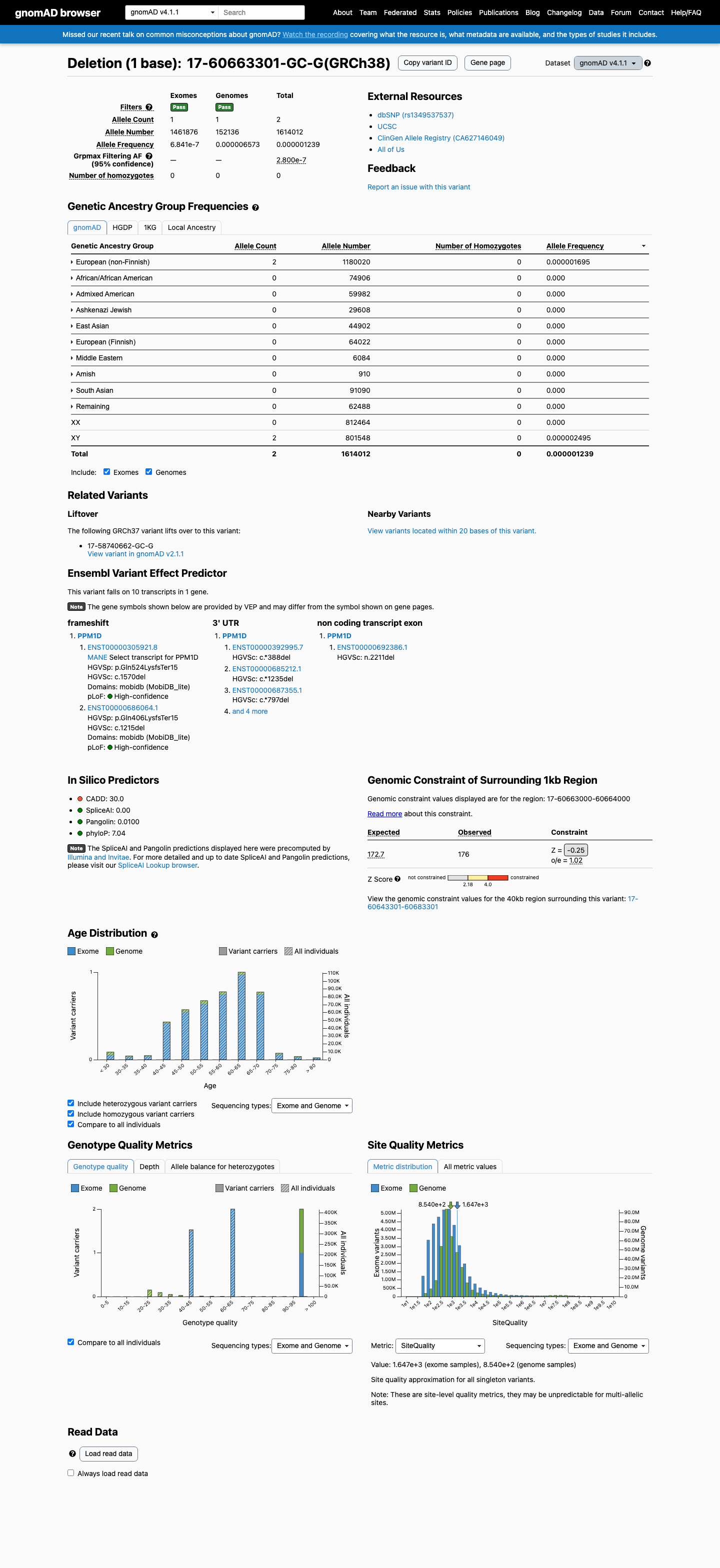
PM2 (Supporting): extremely rare in population databases - 2/1,614,012 gnomAD v4.1 alleles (AF 1.24e-06) and absent from gnomAD-Canada. Overall: VUS - a single supporting pathogenic criterion (PM2) is insufficient to reach likely pathogenic under the generic ACMG/AMP 2015 combination rules.

PM2 VUS
Gene diagram · NM_003620.3 · variants mapped to exon structure
PPM1D NM_003620.3
Fetching transcript structure from UCSC…
Applied criteria · 1 applied · 16 assessed
MetEvidence satisfies this criterion.
Not metEvaluated against available evidence; threshold not reached.
Not assessedApplies in principle, but no evidence was found to evaluate it.
N/ADoesn't apply to this variant type.
Applied · 1
Strength Supporting Moderate Strong Very strong
PM2 supporting Pathogenic
Met (supporting): present in only 2/1,614,012 gnomAD v4.1 alleles (AF 1.24e-06) and absent from gnomAD-Canada.
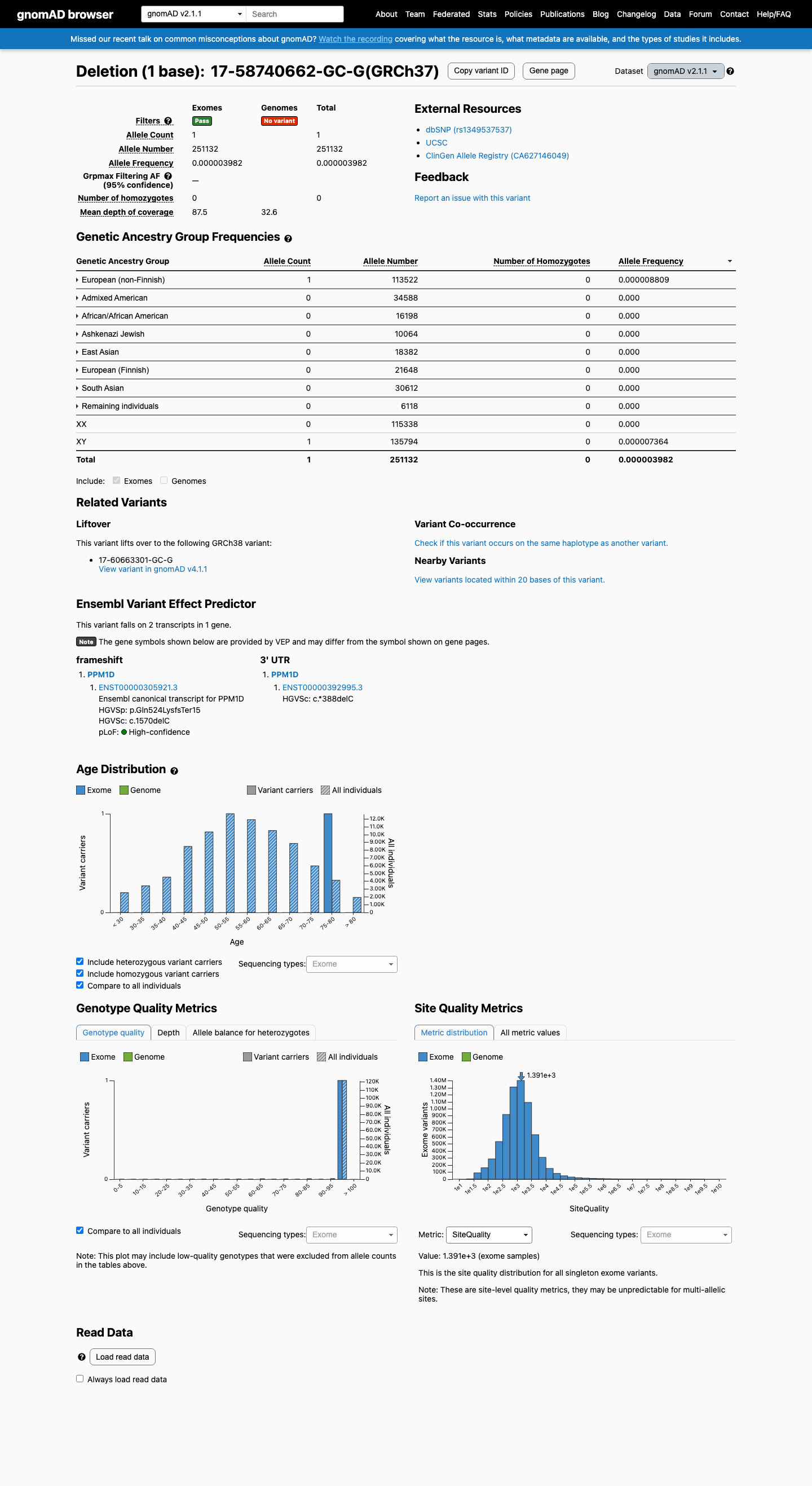
gnomAD v4.1: variant present at AF 1.23915e-06 (2/1,614,012 alleles), highest observed population AF 1.69489e-06 in European non-Finnish individuals, group maximum FAF 2.8e-07, homozygotes 0.gnomAD v2.1: variant present at AF 3.98197e-06 (1/251,132 alleles), highest observed population AF 8.80887e-06 in European non-Finnish individuals, homozygotes 0.gnomAD-Canada v1.0: variant absent.
Assessed · not applied · 4 not met · 12 not assessed
Pathogenic
PS2 Not assessed: no parental testing or documented absence of the variant in both parents was available to support a de novo assertion.
PS3 Not assessed: no functional study of this exact variant exists; five PPM1D papers cover the truncation class but never test c.1570del.
PS4 Not assessed: no case-control data or statistically significant enrichment of this exact variant in affected individuals was identified.
PM3 Not assessed: no proband genotype data, no second pathogenic variant, and no phase information were available for trans testing.
PM6 Not assessed: no case or publication documents a presumed de novo occurrence of this variant without parental testing.
PP1 Not assessed: no familial segregation data or informative meioses were available to support cosegregation.
PP4 Not assessed: no patient-level phenotype for a carrier of this exact variant was available to compare with the PPM1D disease spectrum.
PP5 Not met: the exact variant is absent from ClinVar, and OncoKB's oncogenicity label is not an expert-panel assertion.
Benign
BA1 Not met: gnomAD v4.1 allele frequency 1.24e-06 is far below the >1% BA1 threshold.
BS1 Not met: gnomAD allele frequency 1.24e-06 is far below the >0.3% BS1 threshold.
BS2 Not assessed: no documented observations of this variant in healthy adults; absence of homozygotes is not positive evidence.
BS3 Not assessed: no functional study shows this exact variant is functionally neutral; available literature describes this truncation class as gain-of-function.
BS4 Not assessed: no tested unaffected relatives or non-segregation observations were documented.
BP2 Not assessed: no second pathogenic variant, phase information, or inheritance model was available to evaluate allelic configuration.
BP5 Not assessed: no carrier with a clearly established alternative molecular cause of their phenotype was documented.
BP6 Not met: the exact variant is absent from ClinVar, so no expert-panel benign classification exists.
N/A · 11 PVS1 · PS1 · PM1 · PM4 · PM5 · PP2 · PP3 · BP1 · BP3 · BP4 · BP7
Research & evidence
Population frequency
gnomAD v4.1 screenshot
gnomAD v4.1
gnomAD v2.1 screenshot
gnomAD v2.1
v4.1
This variant is present in gnomAD v4.1 (AF= 1.23915e-06; MAF= 0.00012%, 2/1614012 alleles, homozygotes = 0) and has highest observed frequency in the European (non-Finnish) population (AF= 1.69489e-06; MAF= 0.00017%, 2/1180020 alleles, homozygotes = 0); grpmax FAF= 2.8e-07.
v2.1
This variant is present in gnomAD v2.1 (AF= 3.98197e-06; MAF= 0.00040%, 1/251132 alleles, homozygotes = 0) and has highest observed frequency in the European (non-Finnish) population (AF= 8.80887e-06; MAF= 0.00088%, 1/113522 alleles, homozygotes = 0).
🇨🇦 CA
Absent from gnomAD-Canada v1.0.
Allele frequency by ancestry
three datasets · side by side
gnomAD v4.1
0.00012% · 2 / 1,614,012
0 hom · FAF 2.8e-05%
European (non-Finnish)
2 / 1,180,020
0.00017%
+ 9 not observed (Remaining individuals, Admixed American, European (Finnish), Amish, East Asian, Middle Eastern, South Asian, Ashkenazi Jewish, African/African American)
gnomAD v2.1
0.0004% · 1 / 251,132
0 hom
European (non-Finnish)
1 / 113,522
0.00088%
+ 7 not observed (African/African American, Admixed American, Ashkenazi Jewish, East Asian, European (Finnish), Remaining individuals, South Asian)
gnomAD Canada 🇨🇦
Absent · 0 / ?
0 hom
Not observed in any ancestry group.
ClinVar screenshot
ClinVar
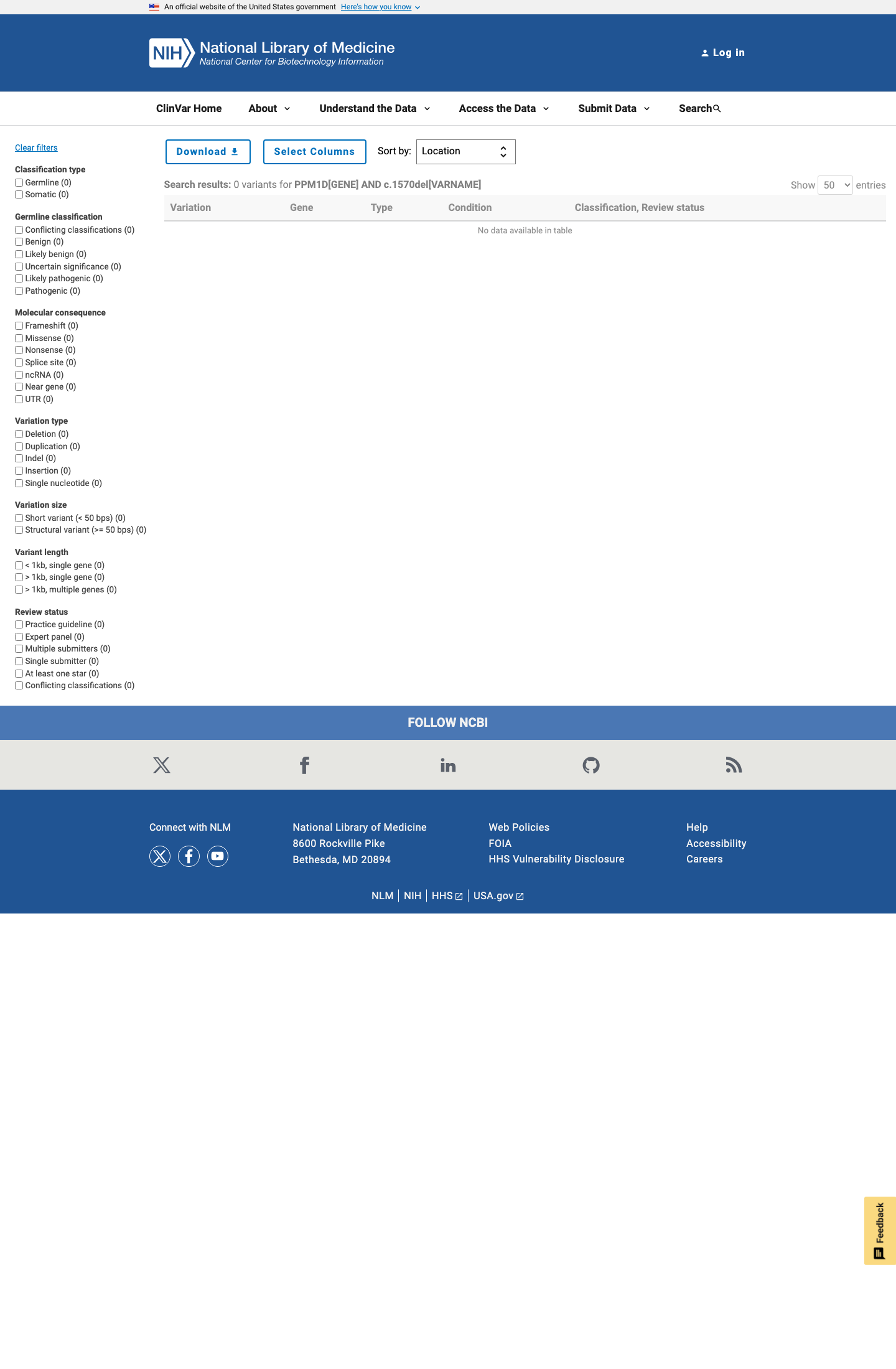
This variant is absent from ClinVar.
SpliceAI screenshot
In silico
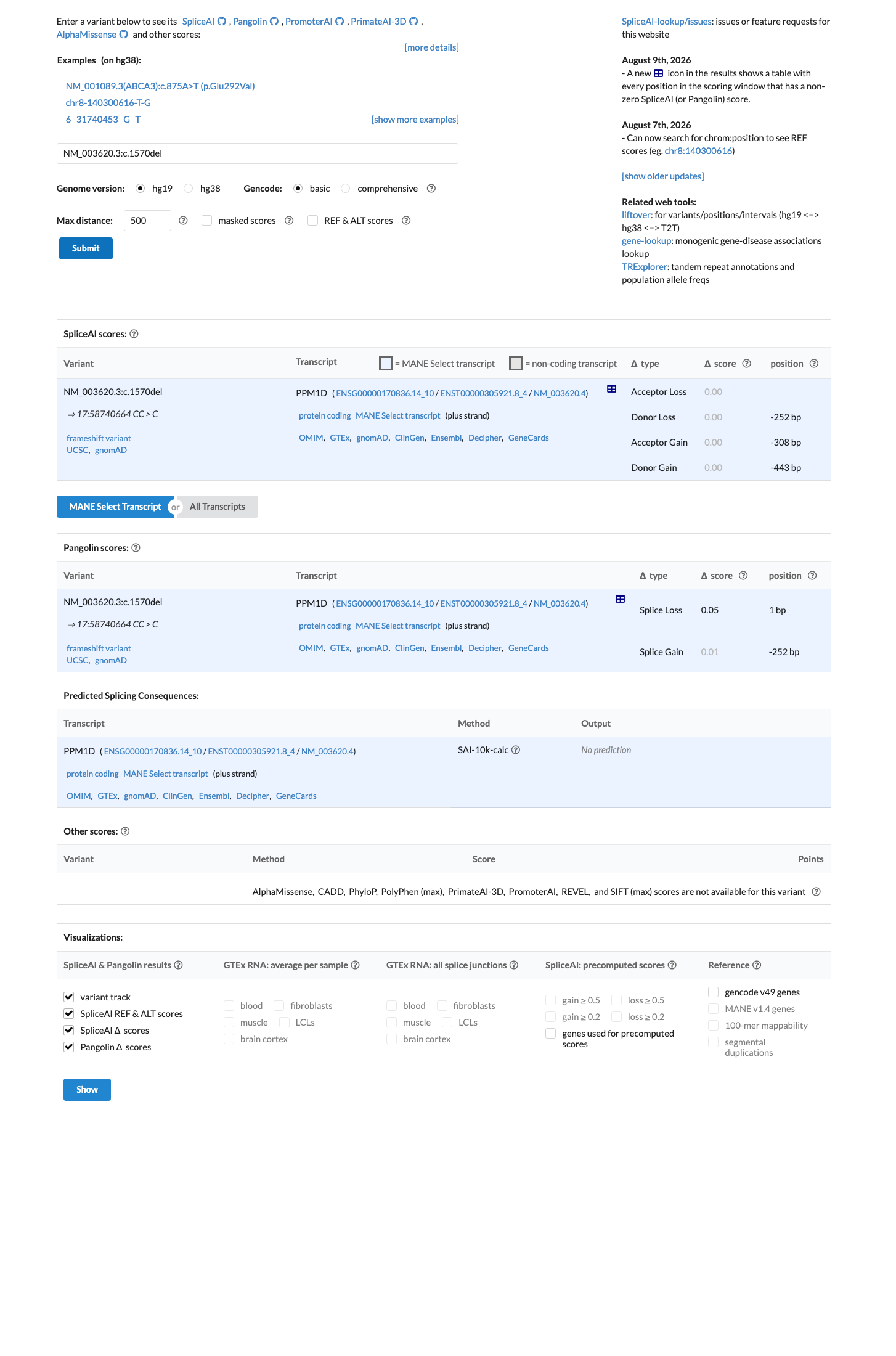
SpliceAI predicts no significant splice impact for this variant (max delta score = 0.00).
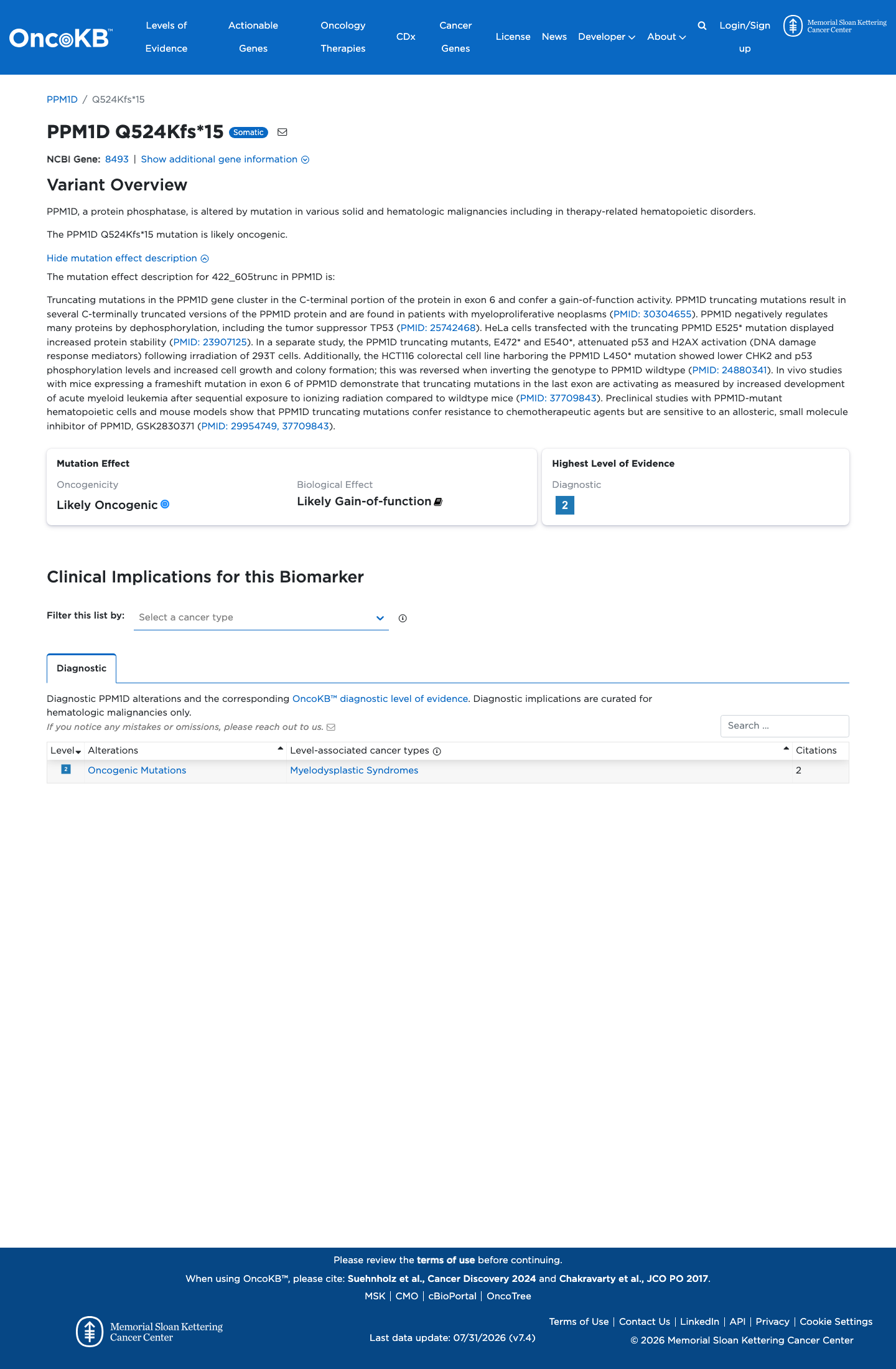
Functional / OncoKB screenshot
Functional Likely Oncogenic
OncoKB identified variant-specific curated literature and context relevant to functional review; biological-effect context: Likely Gain-of-function; curated oncogenicity label: Likely Oncogenic.
OncoKB ↗
COSMIC screenshot
COSMIC
Cancer hotspots screenshot
Cancer hotspots
Somatic evidence Not in COSMIC / hotspots
COSMIC
This variant does not lie in a statistically significant hotspot. This variant has not previously been reported in somatic cancers (COSMIC).
Hotspots
This variant does not lie in a statistically significant hotspot.
Sources & reference links
8Sources
ClinVar
gnomAD v2.1
gnomAD v4.1
gnomAD-Canada
SpliceAI
OncoKB
COSMIC
Cancer hotspots
Triaged references · 5 PMIDs not cited in assessment
23907125 ↗ Genetic variants and mutations of PPM1D control the response to DNA damage. ONCOKB
24880341 ↗ Exome sequencing identifies somatic gain-of-function PPM1D mutations in brainstem gliomas. ONCOKB
25742468 ↗ Truncating mutations of PPM1D are found in blood DNA samples of lung cancer patients. ONCOKB
29954749 ↗ PPM1D-truncating mutations confer resistance to chemotherapy and sensitivity to PPM1D inhibition in hematopoietic cells. ONCOKB
30304655 ↗ Classification and Personalized Prognosis in Myeloproliferative Neoplasms. ONCOKB