Analysis in progress
Initialising…
0%
complete
This report is still being assembled — sections appear as each stage finishes. It isn't final yet.
NOTCH3
Final classification
Likely Pathogenic
PM1PM2PP2PP3
NOTCH3
c.3278G>T
p.Cys1093Phe
missense · exon 20

NOTCH3 encodes a transmembrane receptor that relays signals between neighboring cells, helping regulate cell differentiation, growth, and survival. Mutations in NOTCH3 cause CADASIL, an inherited disorder of the small blood vessels in the brain that can lead to strokes, migraines, and progressive cognitive decline. The gene also contributes to cancer: activating mutations or amplifications are found in some leukemias and breast cancers, while inactivating mutations occur in certain solid tumors such as squamous cell carcinomas.

This variant

NOTCH3 mutations cause CADASIL, an inherited small-vessel brain disease that can lead to strokes, migraines, and progressive cognitive decline, and cysteine-altering missense changes in its EGF-like repeat domains are the hallmark mechanism. p.(Cys1093Phe) is precisely that class of change, and its Likely Pathogenic classification reflects the strong REVEL score and hotspot location even though the variant is absent from population databases and no functional or clinical data was available.

Transcript
NM_000435.2
HGVS · transcript:coding
NM_000435.2:c.3278G>T
GRCh38
chr19:15180121 C>A
GRCh37
chr19:15290932 C>A
Basis Generic ACMG/AMP 2015 fallback (no NOTCH3 VCEP): PP3 (Strong, REVEL 0.962 > 0.932), PM1 (Moderate), PM2 and PP2 (Supporting) meet the Likely Pathogenic combination (1 Strong + 1 Moderate + 2 Supporting); no Pathogenic combination is reached.
Generic ACMG/AMP 2015 fallback (no NOTCH3 VCEP): PP3 (Strong, REVEL 0.962 > 0.932), PM1 (Moderate), PM2 and PP2 (Supporting) meet the Likely Pathogenic combination (1 Strong + 1 Moderate + 2 Supporting); no Pathogenic combination is reached.
Classification rationale
PM1PM2PP2PP3 Likely Pathogenic
NOTCH3 c.3278G>T missense · exon 20

PM1 (Moderate): p.(Cys1093Phe) alters a cysteine in the NOTCH3 EGF-like repeat hotspot where CADASIL-causing variants cluster. PM2 (Supporting): the variant is absent from gnomAD v2.1, v4.1, and gnomAD-Canada v1.0. PP2 (Supporting): missense, especially cysteine-altering, variants are the established NOTCH3/CADASIL disease mechanism. PP3 (Strong): REVEL 0.962 exceeds the >=0.932 ClinGen SVI PP3_Strong threshold. Overall: Likely Pathogenic - one Strong + one Moderate + two Supporting meet the generic ACMG/AMP 2015 Likely Pathogenic combination.

PM1 + PM2 + PP2 + PP3 Likely Pathogenic
Gene diagram · NM_000435.2 · variants mapped to exon structure
NOTCH3 NM_000435.2
Fetching transcript structure from UCSC…
Applied criteria · 4 applied · 20 assessed
MetEvidence satisfies this criterion.
Not metEvaluated against available evidence; threshold not reached.
Not assessedApplies in principle, but no evidence was found to evaluate it.
N/ADoesn't apply to this variant type.
Applied · 4
Strength Supporting Moderate Strong Very strong
PM1 moderate review Pathogenic
Met (Moderate): p.(Cys1093Phe) alters a cysteine within the NOTCH3 EGF-like repeat domain, a mutation-dense hotspot where CADASIL-causing cysteine variants cluster.
PMID:41947304 (An in trans NOTCH3 loss-of-function variant modifies disease severity in CADASIL) abstract states: 'CADASIL is caused by pathogenic NOTCH3 variants, most commonly heterozygous cysteine-altering variants,' supporting cysteine residues within the EGF-like repeat domains as the principal disease-associated structural feature of NOTCH3.Variant p.(Cys1093Phe) (NP_000426.2) removes a cysteine residue, consistent with this established cysteine-altering pathogenic mechanism region.No official NOTCH3 CSPEC/VCEP document was retrieved in this case (cspec.found=false), so VCEP-specific strength escalation could not be confirmed.
PM2 supporting Pathogenic
Met (Supporting): the variant is absent from gnomAD v2.1, v4.1, and gnomAD-Canada v1.0, with no observed allele count or frequency.
The case bundle reports the exact variant as absent from gnomAD v2.1.The case bundle reports the exact variant as absent from gnomAD v4.1.The case bundle reports the exact variant as absent from gnomAD-Canada v1.0.
PP2 supporting Pathogenic
Met (Supporting): missense variants - especially cysteine-altering changes in the EGF-like repeats - are the established NOTCH3/CADASIL disease mechanism.
PMID:41947304 abstract: 'CADASIL is caused by pathogenic NOTCH3 variants, most commonly heterozygous cysteine-altering variants,' identifying missense (cysteine-altering) change as the predominant NOTCH3 disease mechanism.PMID:41196431 abstract describes homozygous loss-of-function NOTCH3 variants as 'expanding the spectrum beyond CADASIL,' i.e., a distinct and less common presentation relative to the classic heterozygous missense CADASIL mechanism, reinforcing that missense change is the predominant/common disease mechanism for this gene.
PP3 strong Pathogenic
Met (Strong): REVEL score 0.962 exceeds the >=0.932 ClinGen SVI PP3_Strong calibration threshold.
REVEL score 0.962 for NM_000435.2:c.3278G>T exceeds the >=0.932 PP3_Strong threshold from the ClinGen SVI computational-evidence calibration (Pejaver et al., PMID:36413997), supporting PP3 at Strong strength.BayesDel score 0.586327 was retrieved but excluded from PP3/BP4 adjudication because no named/verified publication with a calibrated BayesDel threshold is available to this pipeline.SpliceAI max delta score 0.018 (DS_AG 0.005, DS_AL 0.002, DS_DG 0.018, DS_DL 0.002) shows no predicted splice-site gain or loss for this variant, ruling out a splice-disruption mechanism as an alternative PP3 basis.
Assessed · not applied · 6 not met · 14 not assessed
Pathogenic
PS1 Not assessed: ClinVar returned no prior pathogenic classification for any other nucleotide change producing the identical amino acid change, so no comparator exists.
PS2 Not assessed: no parental testing, maternity/paternity confirmation, or de novo observation was available for this variant.
PS3 Not assessed: no functional assay data on this variant was available, and the literature search returned zero relevant studies.
PS4 Not assessed: no affected-case counts, case-control enrichment, or clinical cohort evidence was available for this variant.
PM3 Not assessed: no second pathogenic allele, phase result, or recessive-disease context was established for this variant.
PM5 Not assessed: no prior pathogenic missense change at codon 1093 was available as a comparator.
PM6 Not assessed: no unconfirmed de novo observation or parental testing was provided.
PP1 Not assessed: no affected relatives, informative meioses, or segregation results were provided.
PP4 Not assessed: no patient phenotype or diagnostic features were provided to establish a highly specific presentation.
PP5 Not met: the exact variant is absent from ClinVar, with no expert-panel Pathogenic or Likely Pathogenic assertion.
Benign
BA1 Not met: the variant is absent from gnomAD v2.1, v4.1, and gnomAD-Canada v1.0, so no allele frequency reaches the stand-alone benign threshold.
BS1 Not met: no population allele frequency was observed in gnomAD, so the frequency is not higher than expected for the disease.
BS2 Not assessed: no unaffected adult homozygotes or hemizygotes carrying the variant were reported.
BS3 Not assessed: no functional assay evidence of normal (wild-type-like) protein function was available for this variant.
BS4 Not assessed: no unaffected relatives tested or informative non-segregation data were provided.
BP1 Not met: missense variation is the established NOTCH3 disease mechanism, so the truncation-predominant premise of BP1 does not apply.
BP2 Not assessed: no phase, co-occurring pathogenic variant, or segregation data was available to evaluate the criterion.
BP4 Not met: REVEL 0.962 strongly supports pathogenicity and no splice disruption is predicted, so no benign-leaning computational signal exists.
BP5 Not assessed: no alternative molecular explanation for the phenotype was identified.
BP6 Not met: the exact variant is absent from ClinVar, with no expert-panel Benign or Likely Benign assertion.
N/A · 4 PVS1 · PM4 · BP3 · BP7
Research & evidence
Population frequency · supports pathogenic
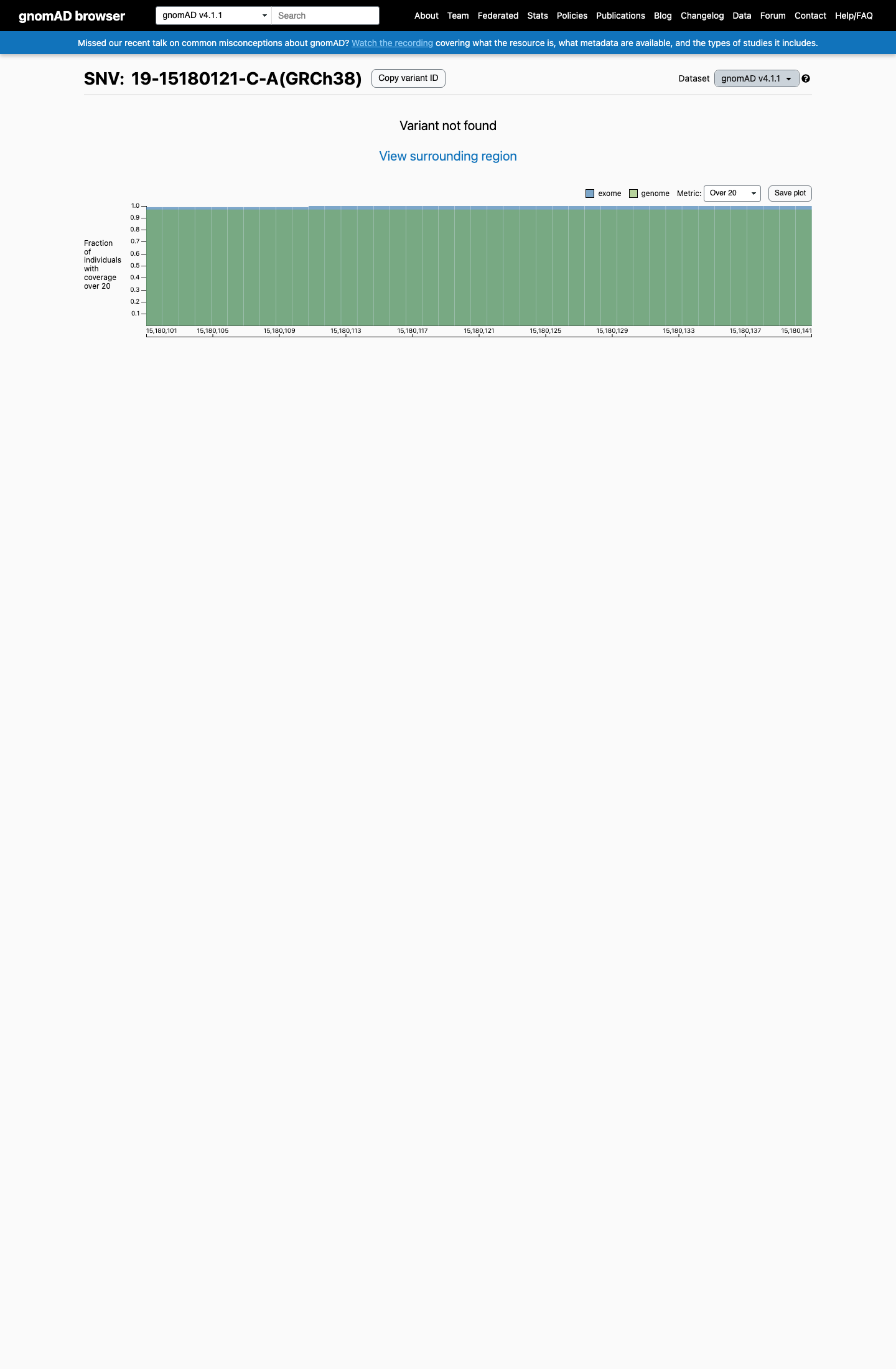
gnomAD v4.1 screenshot
gnomAD v4.1
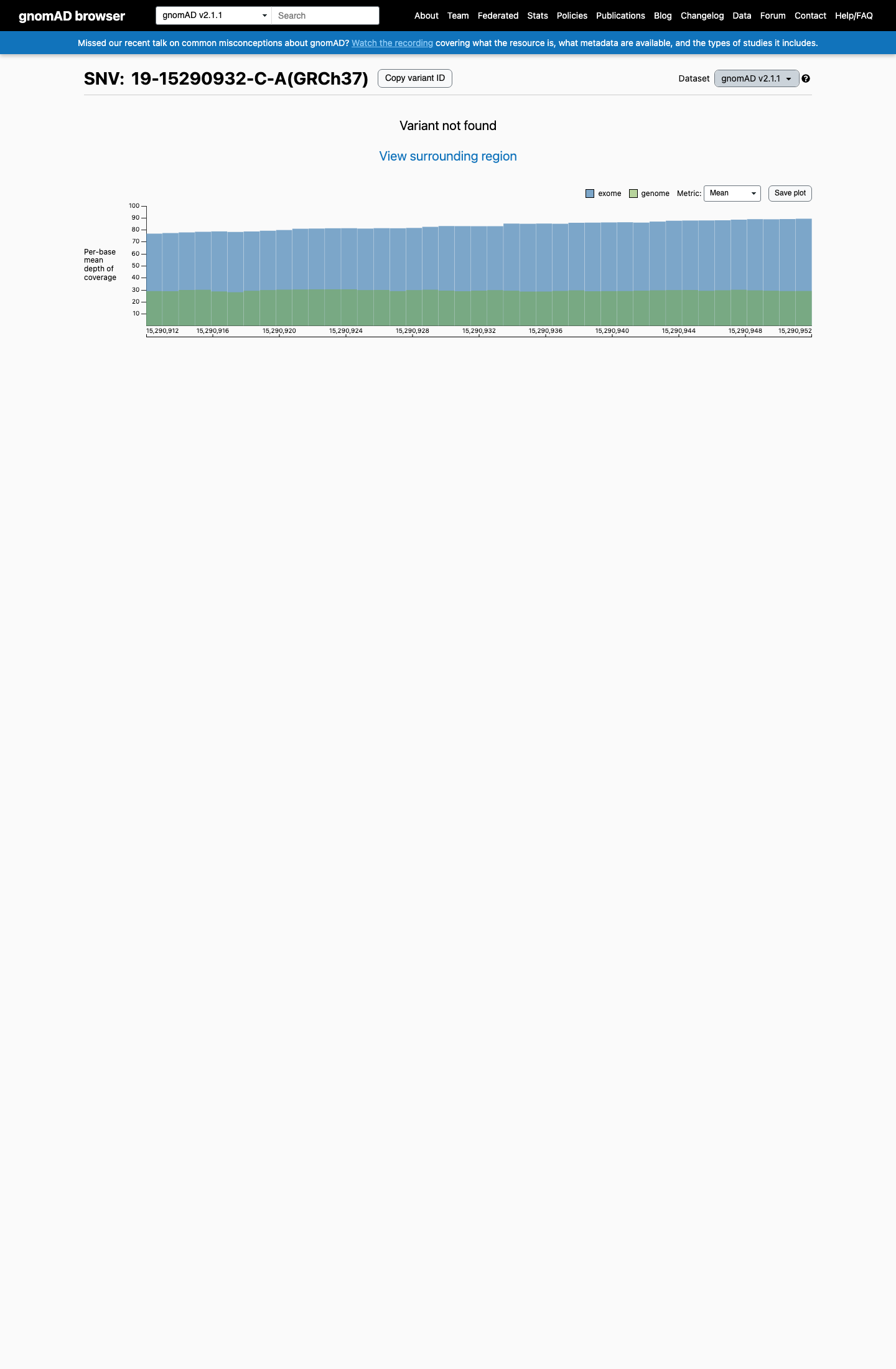
gnomAD v2.1 screenshot
gnomAD v2.1
v4.1
Absent from gnomAD v4.1.
v2.1
Absent from gnomAD v2.1.
🇨🇦 CA
Absent from gnomAD-Canada v1.0.
Allele frequency by ancestry
three datasets · side by side
gnomAD v4.1
Absent · 0 / ?
0 hom
Not observed in any ancestry group.
gnomAD v2.1
Absent · 0 / ?
0 hom
Not observed in any ancestry group.
gnomAD Canada 🇨🇦
Absent · 0 / ?
0 hom
Not observed in any ancestry group.
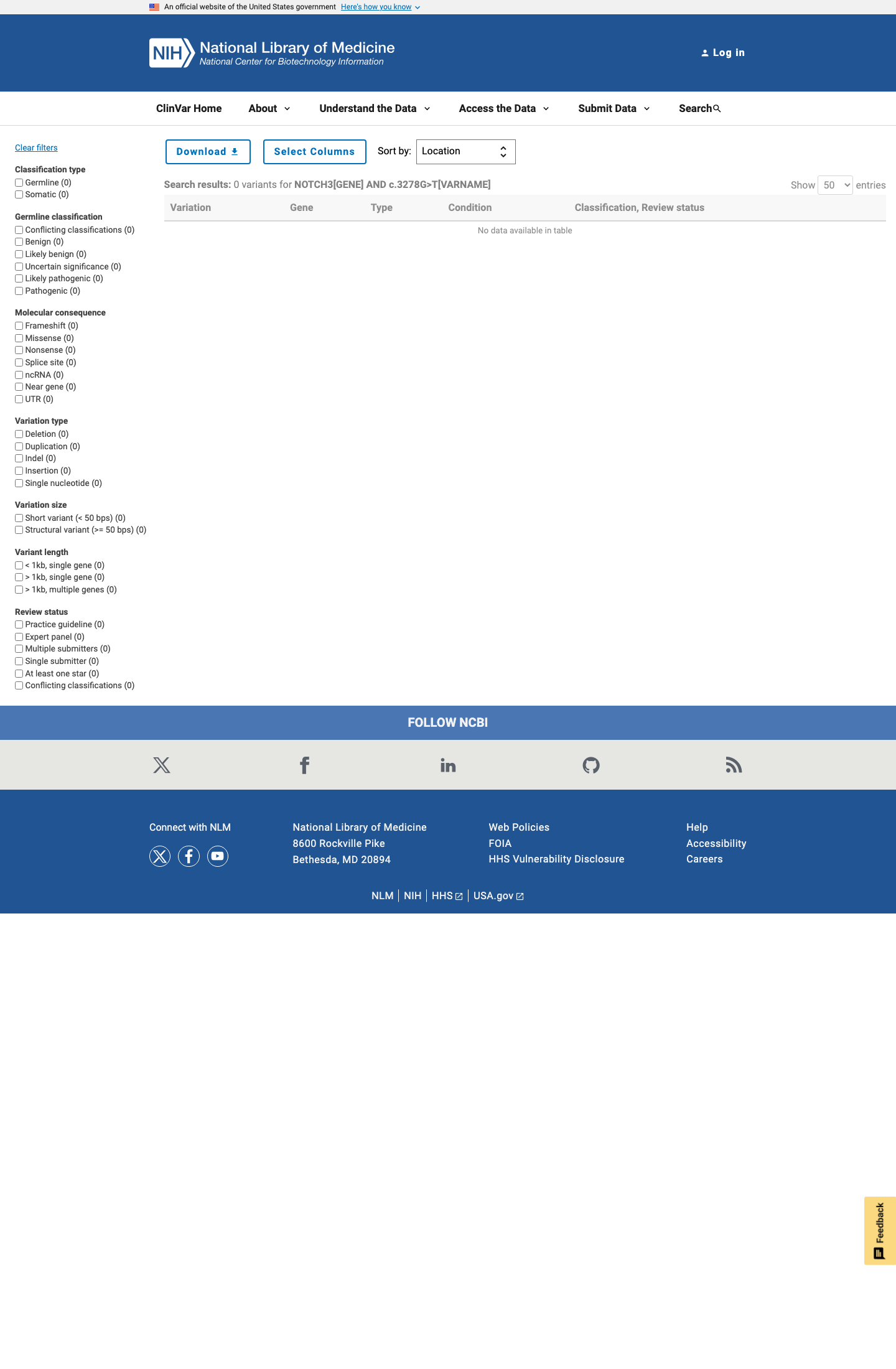
ClinVar screenshot
ClinVar
This variant is absent from ClinVar.
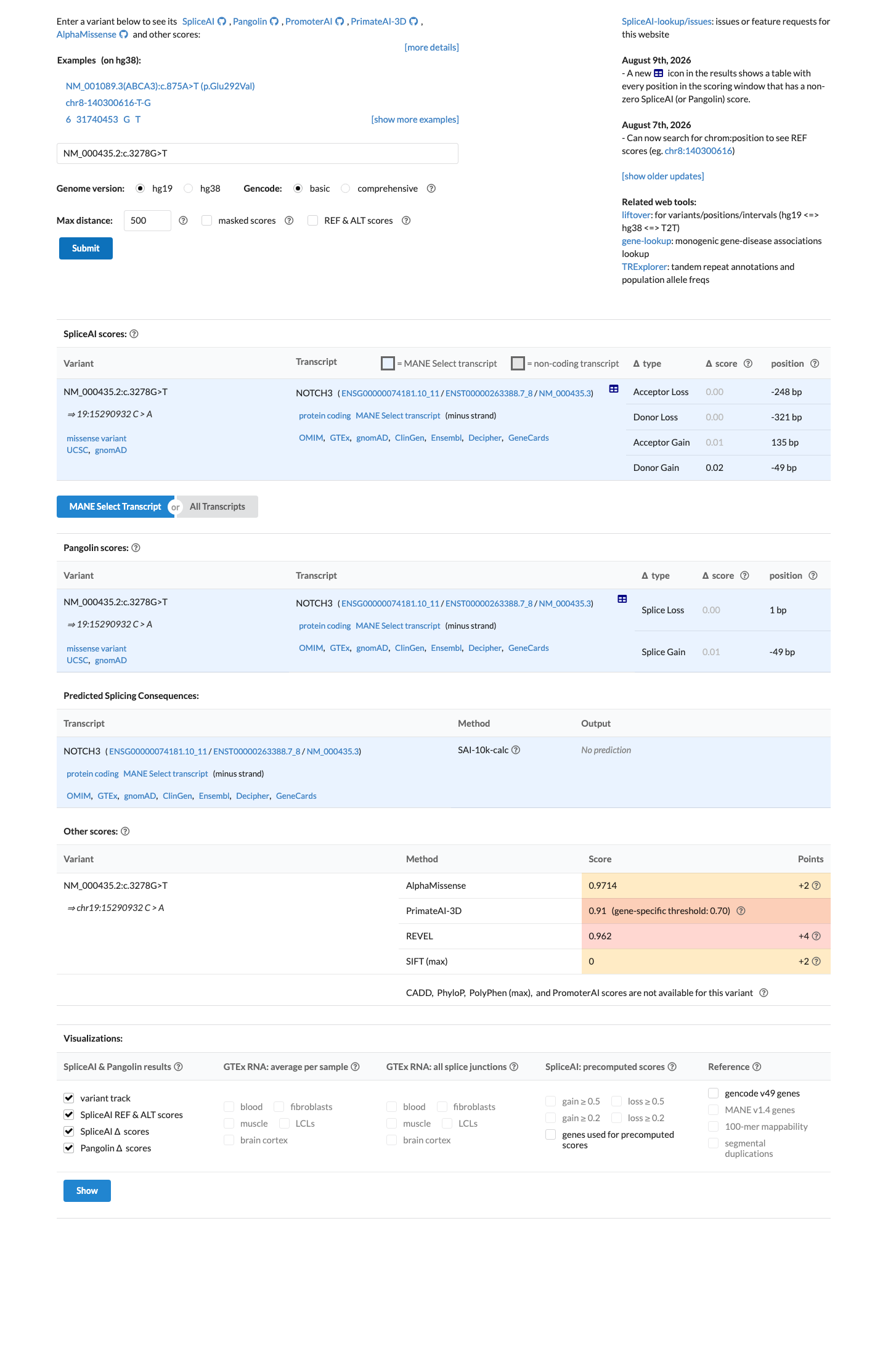
SpliceAI screenshot
In silico
SpliceAI predicts no significant splice impact for this variant (max delta score = 0.02). REVEL score = 0.962. BayesDel score = 0.586327.
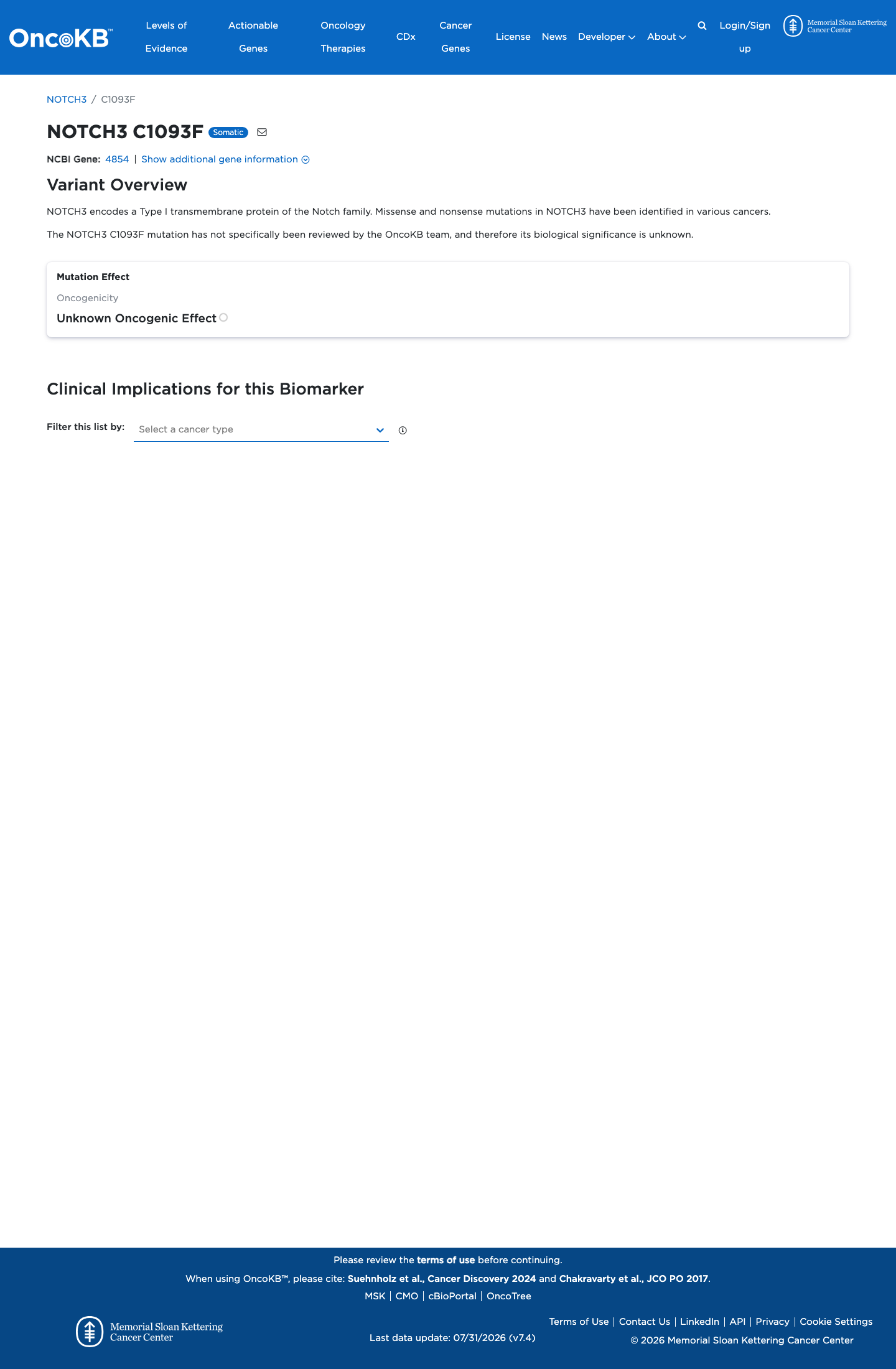
Functional / OncoKB screenshot
Functional Unknown Oncogenic Effect
OncoKB did not identify variant-specific reviewed functional evidence for this variant; gene-level curated context is available for reviewer follow-up. NOTCH3 encodes a Type I transmembrane protein of the Notch family. Missense and nonsense mutations in NOTCH3 have been identified in various cancers.
OncoKB ↗
COSMIC screenshot
COSMIC
Cancer hotspots screenshot
Cancer hotspots
Somatic evidence Not in COSMIC / hotspots
COSMIC
This variant does not lie in a statistically significant hotspot. This variant has not previously been reported in somatic cancers (COSMIC).
Hotspots
This variant does not lie in a statistically significant hotspot.
Sources & reference links
8Sources
ClinVar
gnomAD v2.1
gnomAD v4.1
gnomAD-Canada
SpliceAI
OncoKB
COSMIC
Cancer hotspots