This variant was interpreted by pipeline
7.1.0.
The current version is
8.0.0.
Re-running queues a fresh interpretation; the result replaces this page when complete.
Re-runs are not free. Blank = draws on today's public interpretation allowance.
With a code = uses 1 of that code's uses.
FGFR2 encodes a receptor tyrosine kinase in the fibroblast growth factor receptor family that binds fibroblast growth factors and activates signaling pathways (including PI3K/AKT and MAPK) that promote cell growth, division, and differentiation. Germline mutations in FGFR2 cause several inherited craniosynostosis syndromes — including Apert, Crouzon, Pfeiffer, Jackson-Weiss, Beare-Stevenson, and Saethre-Chotzen syndromes — in which the bones of the skull fuse prematurely. FGFR2 also plays an oncogenic role in cancer: somatic mutations, fusions, and amplifications of the gene have been found in endometrial, gastric, and breast cancers and ameloblastomas, and FGFR inhibitors are used as cancer therapies.
This variant
FGFR2 germline mutations cause inherited craniosynostosis syndromes such as Apert and Crouzon, and somatic changes drive several cancers, yet this missense variant (p.Asp795Asn) is classified as a variant of uncertain significance (VUS). It is absent from population databases but falls in no known mutational hotspot, and no functional or clinical evidence currently links it to FGFR2-associated disease, so its role remains undetermined.
Transcript
NM_000141.4
HGVS · transcript:coding
NM_000141.4:c.2383G>A
GRCh38
chr10:121479940 C>T
GRCh37
chr10:123239454 C>T
No ClinGen VCEP framework is available for FGFR2, so generic ACMG/AMP 2015 combination rules were applied; only PM2 (supporting) of 28 criteria is met, which satisfies no Pathogenic or Benign rule.
Classification rationale
PM2VUS
FGFR2 c.2383G>Amissense · exon 18
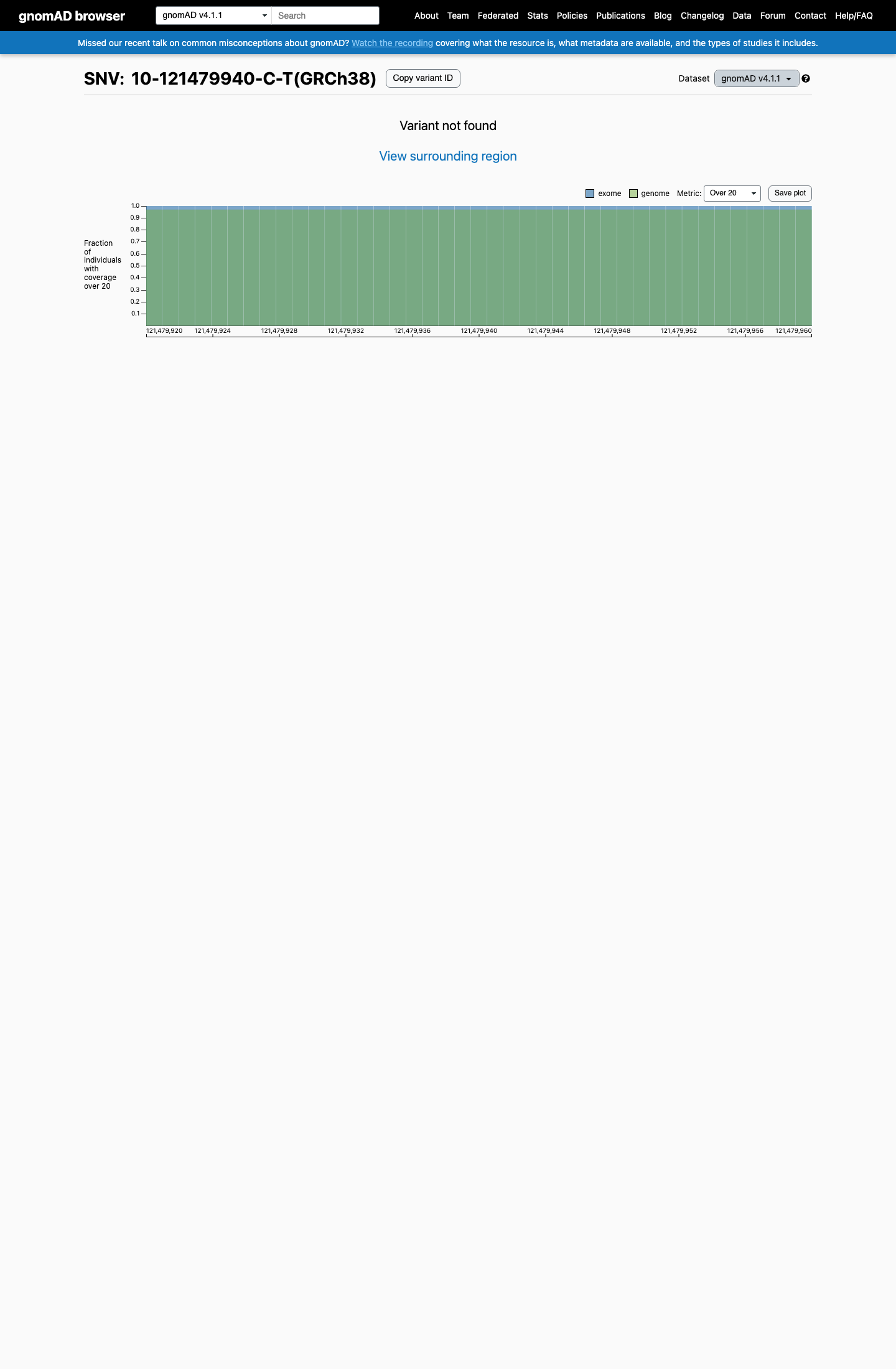
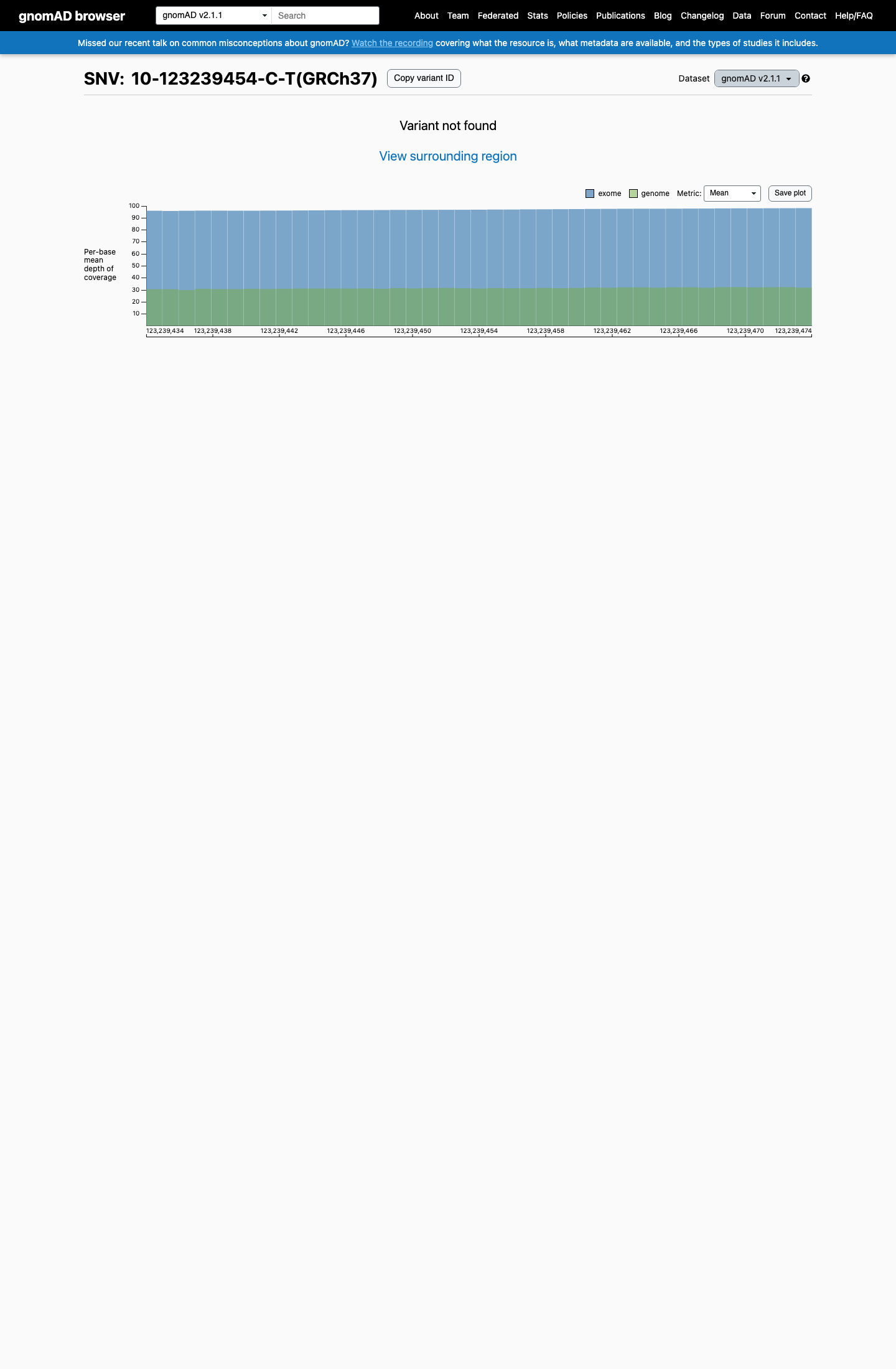
PM2 (Supporting): variant absent from gnomAD v2.1, v4.1, and gnomAD-Canada, with no reported allele frequency or homozygotes. Overall: VUS — the single supporting-strength criterion (PM2) does not satisfy any Pathogenic, Likely Pathogenic, Benign, or Likely Benign combination rule under generic ACMG/AMP 2015.
PM2→VUS
LYFE Sciences is an AI system, and it can make mistakes. Criteria
may be applied incorrectly, sources may be misread, and a confident-looking
classification can still be wrong. Double-check every criterion and
its underlying evidence before relying on any call.
Gene diagram
· NM_000141.4 · variants mapped to exon structure
FGFR2NM_000141.4
Fetching transcript structure from UCSC…
Exons
—
Transcript span
—
Strand
—
Variants mapped
—
Source
UCSC ncbiRefSeqCurated
All variants in FGFR2—click a row to locate it on the plot · use the link column to open its page
Protein
Location
Classification
Link
Applied criteria · 1 applied · 22 assessed
MetEvidence satisfies this criterion.
Not metEvaluated against available evidence; threshold not reached.
Not assessedApplies in principle, but no evidence was found to evaluate it.
N/ADoesn't apply to this variant type.
Applied · 1
Strength Supporting Moderate Strong Very strong
✓
PM2supportingPathogenic
Met (supporting): absent from gnomAD v2.1, v4.1, and gnomAD-Canada, with no reported allele frequency or homozygotes.
The case evidence bundle reports NM_000141.4:c.2383G>A as absent from gnomAD v2.1, gnomAD v4.1, and gnomAD-Canada v1.0.No alternate allele frequency or homozygote count is reported for the variant in the available population datasets.Generic PM2 supports a variant that is absent from or nearly absent from population databases; no FGFR2-specific population rule was retrieved.
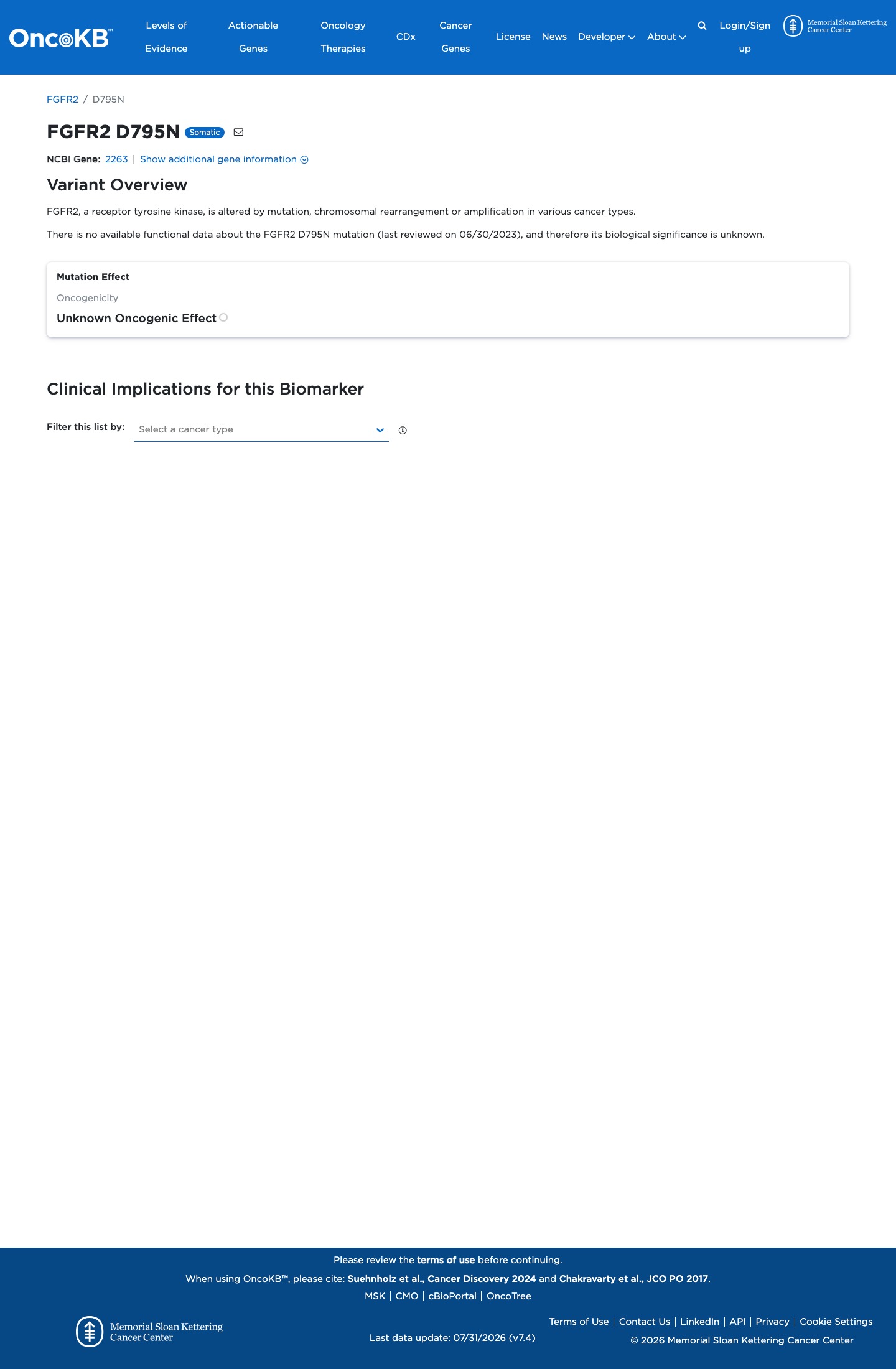
OncoKB did not identify variant-specific reviewed functional evidence for this variant; gene-level curated context is available for reviewer follow-up. FGFR2, a receptor tyrosine kinase, is altered by mutation, chromosomal rearrangement or amplification in various cancer types.