MSH6 encodes a protein in the DNA mismatch repair system, which fixes errors made during DNA replication. Partnering with MSH2, it forms a complex that recognizes and helps correct mismatched DNA bases, keeping the genetic code stable. Inherited mutations in MSH6 cause Lynch syndrome (hereditary nonpolyposis colorectal cancer), raising the risk of colorectal, endometrial, ovarian, and other cancers, while mutations in both copies lead to constitutional mismatch repair deficiency. Because faulty mismatch repair drives tumor development and produces microsatellite instability, MSH6 acts as a tumor suppressor, and cancers with such repair defects often respond well to immune checkpoint inhibitor therapy.
This variant
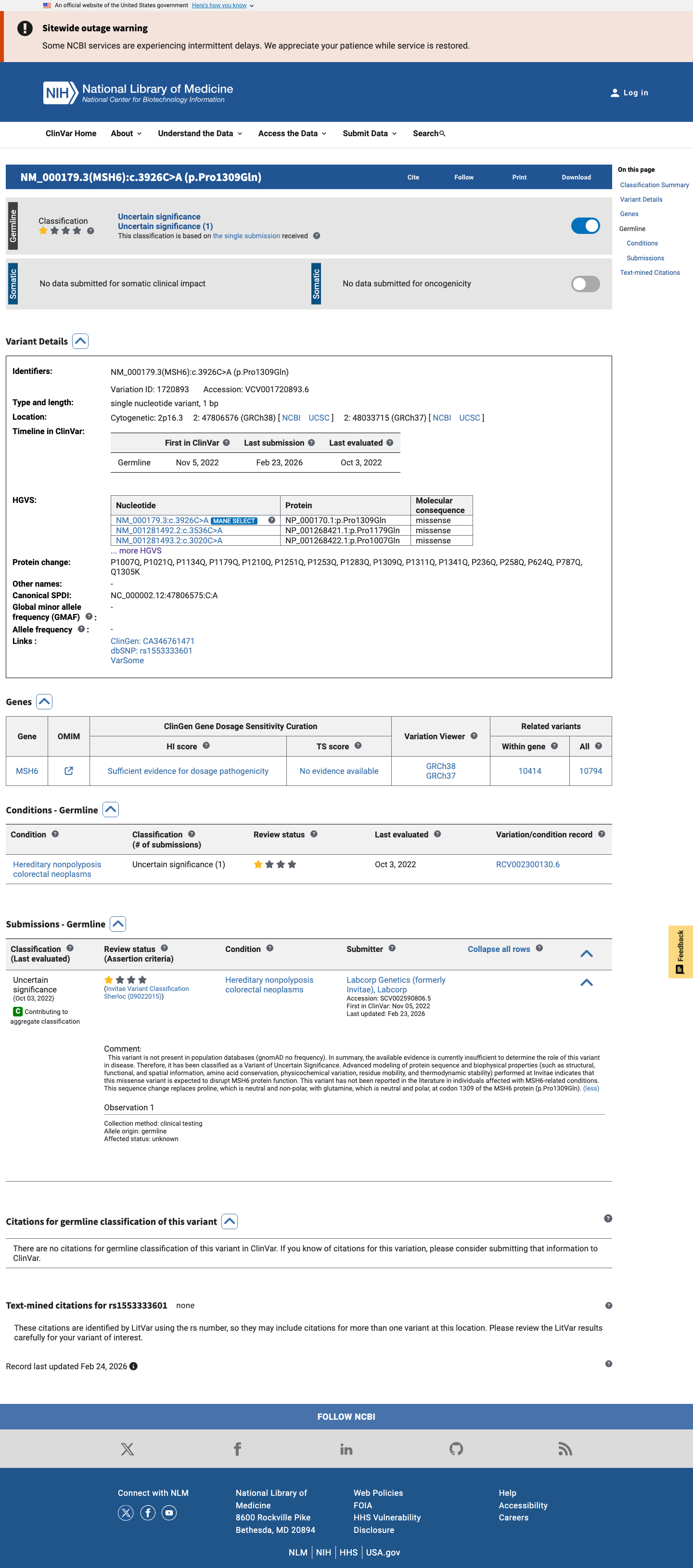
MSH6 variants are associated with Lynch syndrome and elevated colorectal, endometrial, and ovarian cancer risk, so a pathogenic classification would directly inform cancer screening. This variant, however, remains a variant of uncertain significance: extreme rarity and a moderate computational pathogenicity signal are not enough to confirm or exclude Lynch syndrome, so it should not yet guide clinical decisions.
Transcript
NM_000179.2
HGVS · transcript:coding
NM_000179.2:c.3926C>A
GRCh38
chr2:47806576 C>A
GRCh37
chr2:48033715 C>A
BasisOnly PM2 (Supporting) and PP3 (Moderate) were met; together they satisfy no Pathogenic or Benign combination rule, so the overall classification is VUS.▾
Only PM2 (Supporting) and PP3 (Moderate) were met; together they satisfy no Pathogenic or Benign combination rule, so the overall classification is VUS.
Classification rationale
PM2PP3VUS
MSH6 c.3926C>Amissense · exon 9
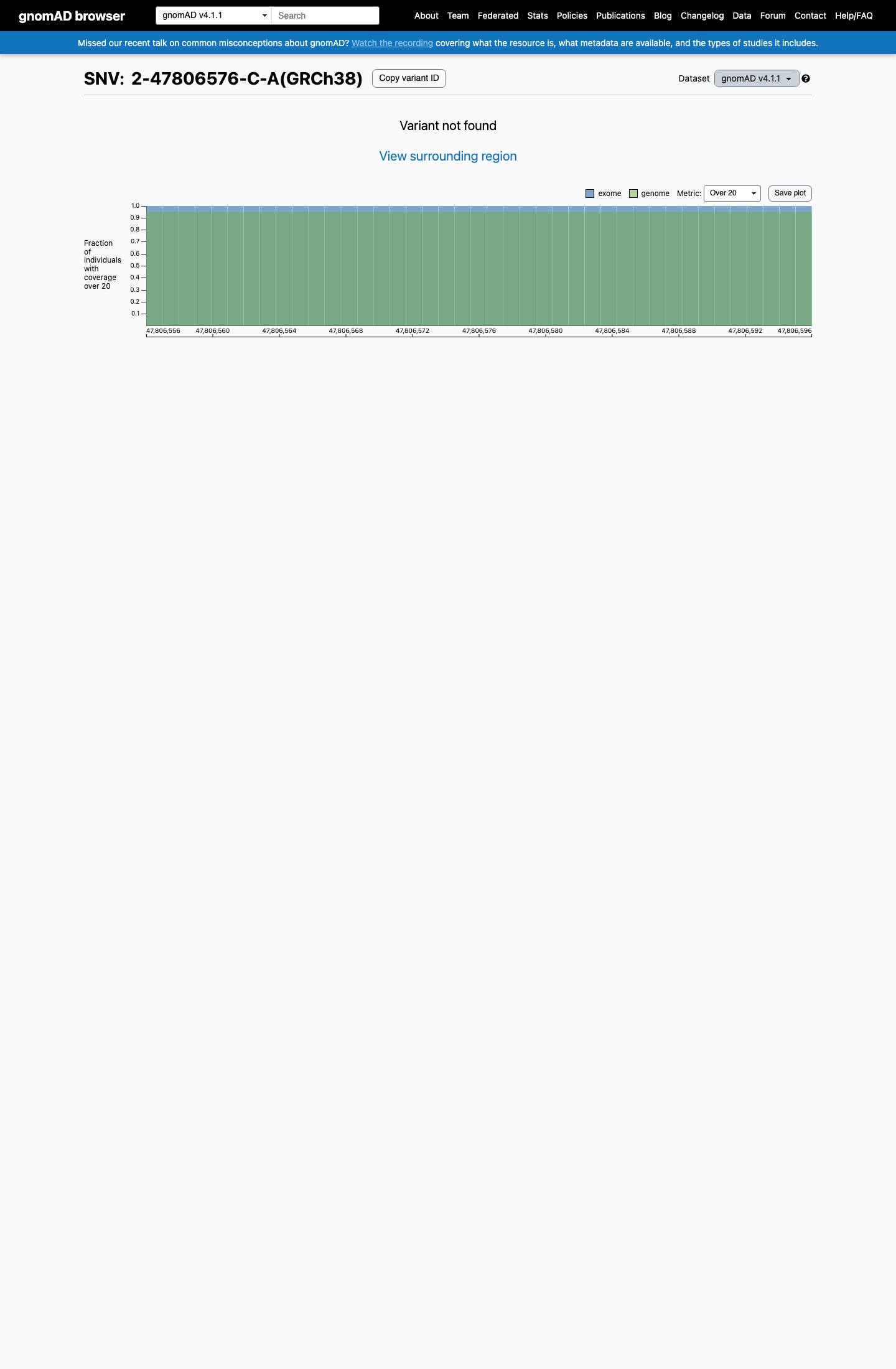
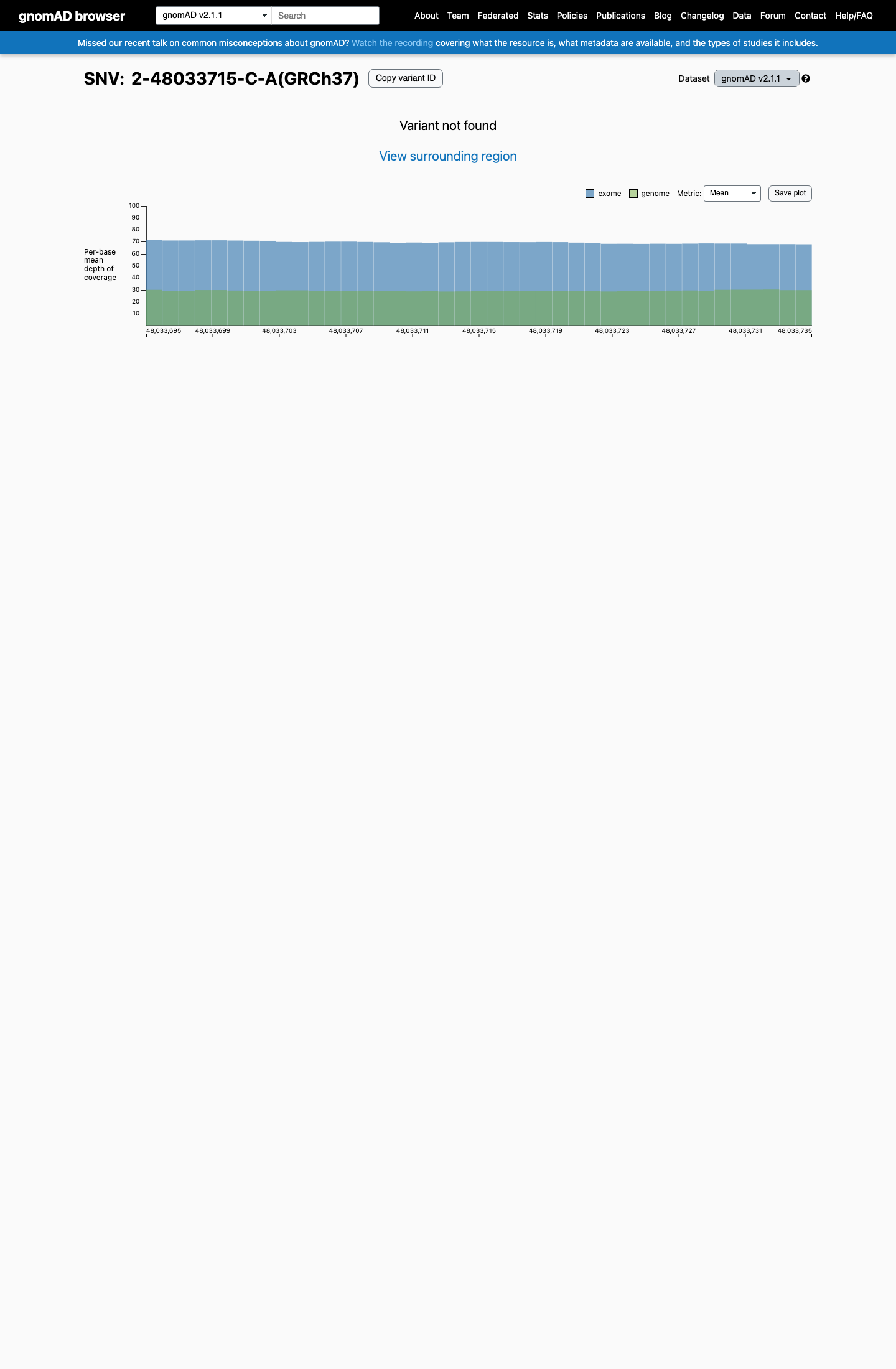
PM2 (Supporting): absent from gnomAD v4.1 population databases, meeting the VCEP's extreme rarity threshold (<1 in 50,000 alleles). PP3 (Moderate): HCI prior probability of pathogenicity 0.823 exceeds the >0.81 threshold for moderate strength. Overall classification: VUS — PM2 (Supporting) plus PP3 (Moderate) meets no VCEP rule for Pathogenic or Benign.
PM2 + PP3→VUS
Gene diagram
· NM_000179.2 · variants mapped to exon structure
MSH6NM_000179.2
Fetching transcript structure from UCSC…
Exons
—
Transcript span
—
Strand
—
Variants mapped
—
Source
UCSC ncbiRefSeqCurated
All variants in MSH6—click a row to locate it on the plot · use the link column to open its page
Variant ↕
Protein
Location
Classification
Link
Applied criteria · 2 applied · 14 assessed
MetEvidence satisfies this criterion.
Not metEvaluated against available evidence; threshold not reached.
Not assessedApplies in principle, but no evidence was found to evaluate it.
N/ADoesn't apply to this variant type.
Applied · 2
Strength Supporting Moderate Strong Very strong
✓
PM2supportingPathogenic
Met (Supporting): absent from gnomAD v4.1 population databases, meeting the VCEP's extreme rarity threshold (<1 in 50,000 alleles).
The MSH6 VCEP PM2 rule is absent/extremely rare allele frequency <0.00002 (<1 in 50,000 alleles) in the gnomAD v4 dataset.NM_000179.2:c.3926C>A (MSH6 p.Pro1309Gln) was reported absent from gnomAD v4.1, meeting the VCEP's absent/extremely rare population-frequency requirement.
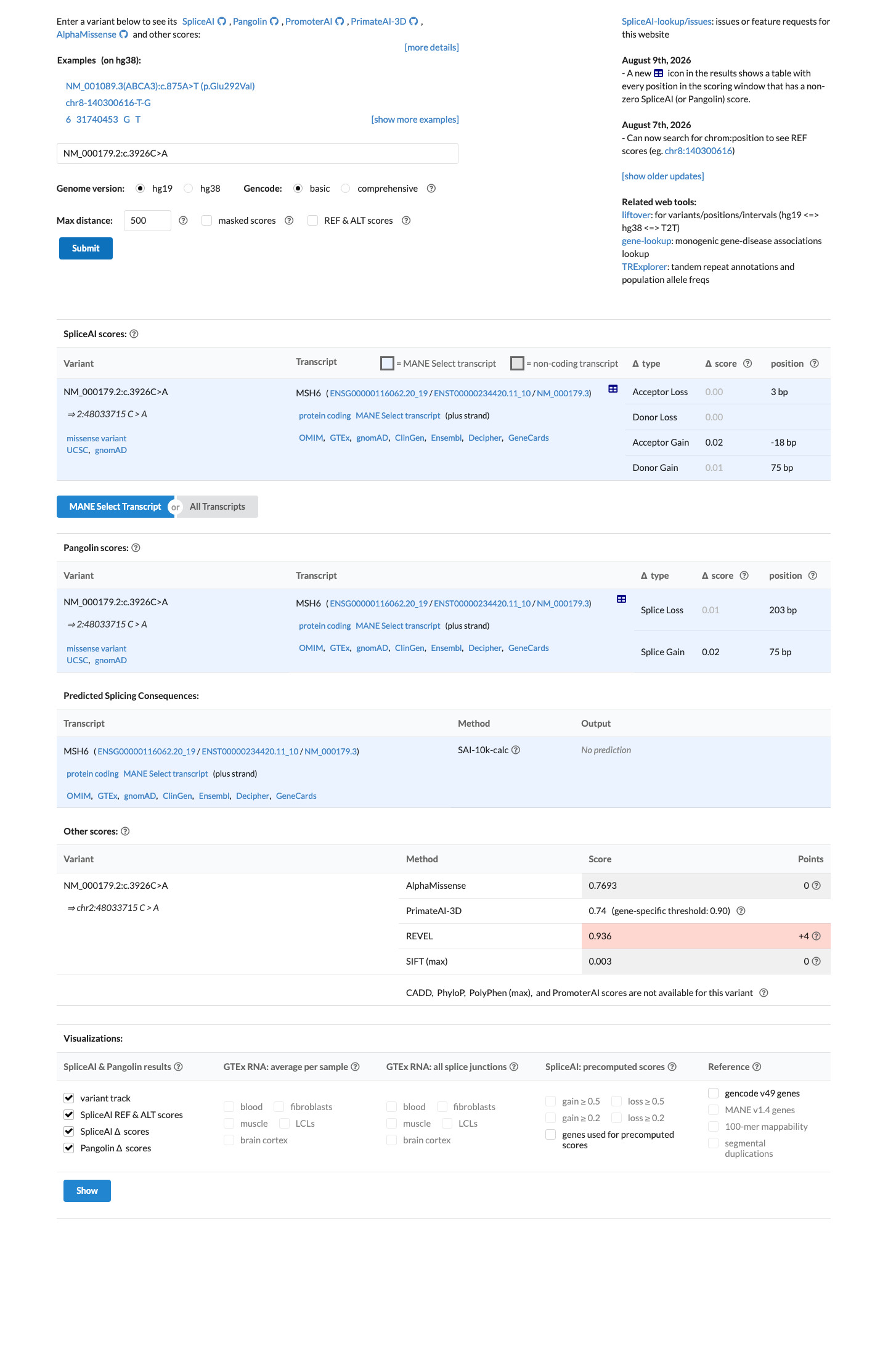
Met (Moderate): HCI prior probability of pathogenicity 0.823 exceeds the >0.81 PP3_Moderate threshold.
VCEP PP3 rule (MSH6 InSiGHT CSpec v2.0): 'Missense variant with HCI prior probability for pathogenicity >0.81 as per https://hci-priors.hci.utah.edu/PRIORS' assigns PP3 at Moderate strength.HCI-PRIORS-MSH6 local lookup table entry for c.3926C>A (p.P1309Q, dbid MSH6_08617): hci_prior_probability = 0.823, which is >0.81, meeting the VCEP's PP3_Moderate threshold.SpliceAI lookup for NM_000179.2:c.3926C>A shows max delta score = 0.00 (no significant predicted splice impact); this variant is a missense substitution, not a non-canonical splice nucleotide variant, so the SpliceAI-based PP3 clause of the VCEP rule does not apply and only the HCI-prior missense path is used.
Assessed · not applied
· 3 not met · 11 not assessed
Pathogenic
PS1Not assessed: no previously classified pathogenic variant encoding the same p.Pro1309Gln change via an alternate nucleotide was available for comparison.
PS2Not assessed: no de novo observation with parental confirmation was documented for this variant.
PS3Not assessed: no functional assay results for this variant (e.g., cell-based mismatch-repair activity) were available.
PM3Not assessed: no second pathogenic MSH6 variant or co-occurrence observation was available to evaluate.
PM5Not assessed: no previously classified pathogenic variant at residue 1309 could be confirmed for the same-residue comparison.
PP1Not assessed: no family segregation data or likelihood ratio was available for this variant.
PP4Not assessed: no tumor microsatellite-instability or immunohistochemistry results were available.
Benign
BA1Not met: the variant is absent from gnomAD v4.1, below the 0.22% BA1 frequency threshold.
BS1Not met: absent from gnomAD v4.1, below the 0.022% BS1 frequency threshold.
BS2Not assessed: no qualifying in-trans co-occurrence with a known pathogenic variant was documented.
BS3Not assessed: no functional assay evidence of proficient mismatch-repair function was available for this variant.
BS4Not assessed: no family data demonstrating lack of segregation was available.
BP4Not met: HCI prior probability 0.823 is far above the 0.11 BP4 threshold.
BP5Not assessed: no tumor data establishing an alternate molecular cause (e.g., BRAF V600E or MLH1 methylation) was available.
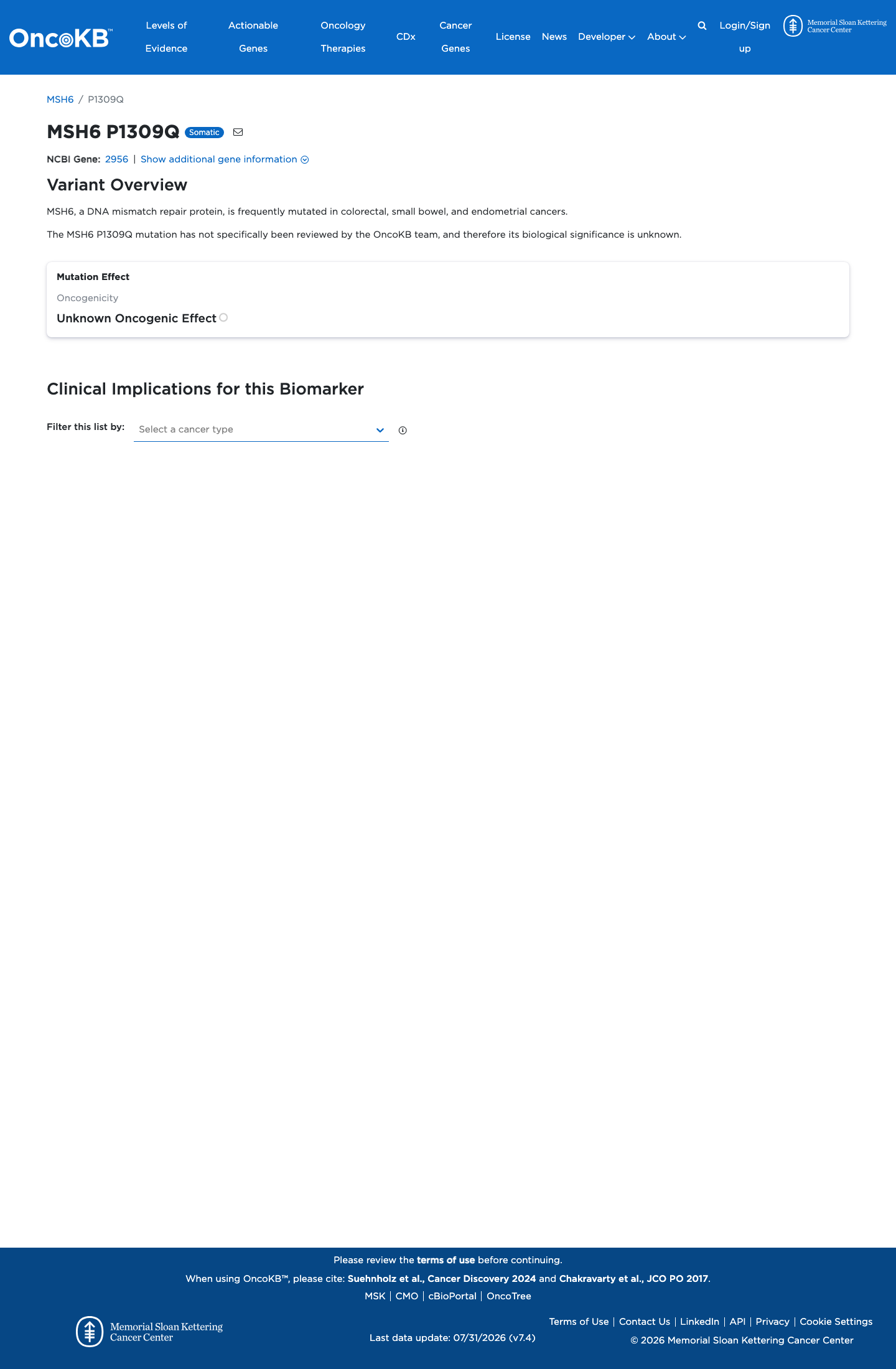
OncoKB did not identify variant-specific reviewed functional evidence for this variant; gene-level curated context is available for reviewer follow-up. MSH6, a DNA mismatch repair protein, is frequently mutated in colorectal, small bowel, and endometrial cancers.