Analysis in progress
Initialising…
0%
complete
This report is still being assembled — sections appear as each stage finishes. It isn't final yet.
MYCN
Final classification
VUS
PM2BP4
MYCN
c.868A>G
p.Asn290Asp
missense · exon 3

MYCN is a transcription factor that controls the expression of genes involved in cell growth, division, survival, and metabolism. It is normally active mainly during embryonic development and is largely restricted to cells of the nervous system and a few other tissues. Amplification of MYCN drives cancer, most notably neuroblastoma, and is also seen in medulloblastoma, glioblastoma, and other solid tumors such as breast and small cell lung cancers.

This variant

MYCN is best known for cancer-driving amplification in neuroblastoma, and germline alterations cause autosomal-dominant developmental conditions such as Feingold syndrome type 1. This missense variant is classified as a variant of uncertain significance: it is extremely rare in population databases and computationally predicted to have no damaging effect, but no disease, segregation, or functional evidence ties it to any MYCN-related condition, so its clinical meaning remains unknown.

Transcript
NM_005378.5
HGVS · transcript:coding
NM_005378.5:c.868A>G
GRCh38
chr2:15945570 A>G
GRCh37
chr2:16085692 A>G
Basis Uncertain significance: one supporting pathogenic criterion (PM2) and one supporting benign criterion (BP4) do not reach any classification threshold under generic ACMG/AMP 2015 rules.
Uncertain significance: one supporting pathogenic criterion (PM2) and one supporting benign criterion (BP4) do not reach any classification threshold under generic ACMG/AMP 2015 rules.
Classification rationale
PM2 BP4 VUS
MYCN c.868A>G missense · exon 3

PM2 (Supporting): variant is ultra-rare in gnomAD (max allele frequency 8.8e-06, below the 0.1% threshold) and absent from gnomAD-Canada, with no homozygotes. BP4 (Supporting): REVEL 0.05 and SpliceAI max delta 0.006 both fall below calibrated benign-supporting thresholds, predicting no damaging effect. One supporting pathogenic (PM2) and one supporting benign (BP4) criterion do not meet any Pathogenic, Likely Pathogenic, Benign, or Likely Benign threshold, yielding Uncertain Significance under generic ACMG/AMP 2015 combination rules.

PM2 + BP4 VUS
Gene diagram · NM_005378.5 · variants mapped to exon structure
MYCN NM_005378.5
Fetching transcript structure from UCSC…
Applied criteria · 2 applied · 21 assessed
MetEvidence satisfies this criterion.
Not metEvaluated against available evidence; threshold not reached.
Not assessedApplies in principle, but no evidence was found to evaluate it.
N/ADoesn't apply to this variant type.
Applied · 2
Strength Supporting Moderate Strong Very strong
PM2 supporting Pathogenic
Met (supporting): absent from gnomAD-Canada with maximum allele frequency 8.8e-06, far below the 0.1% threshold, and no homozygotes.
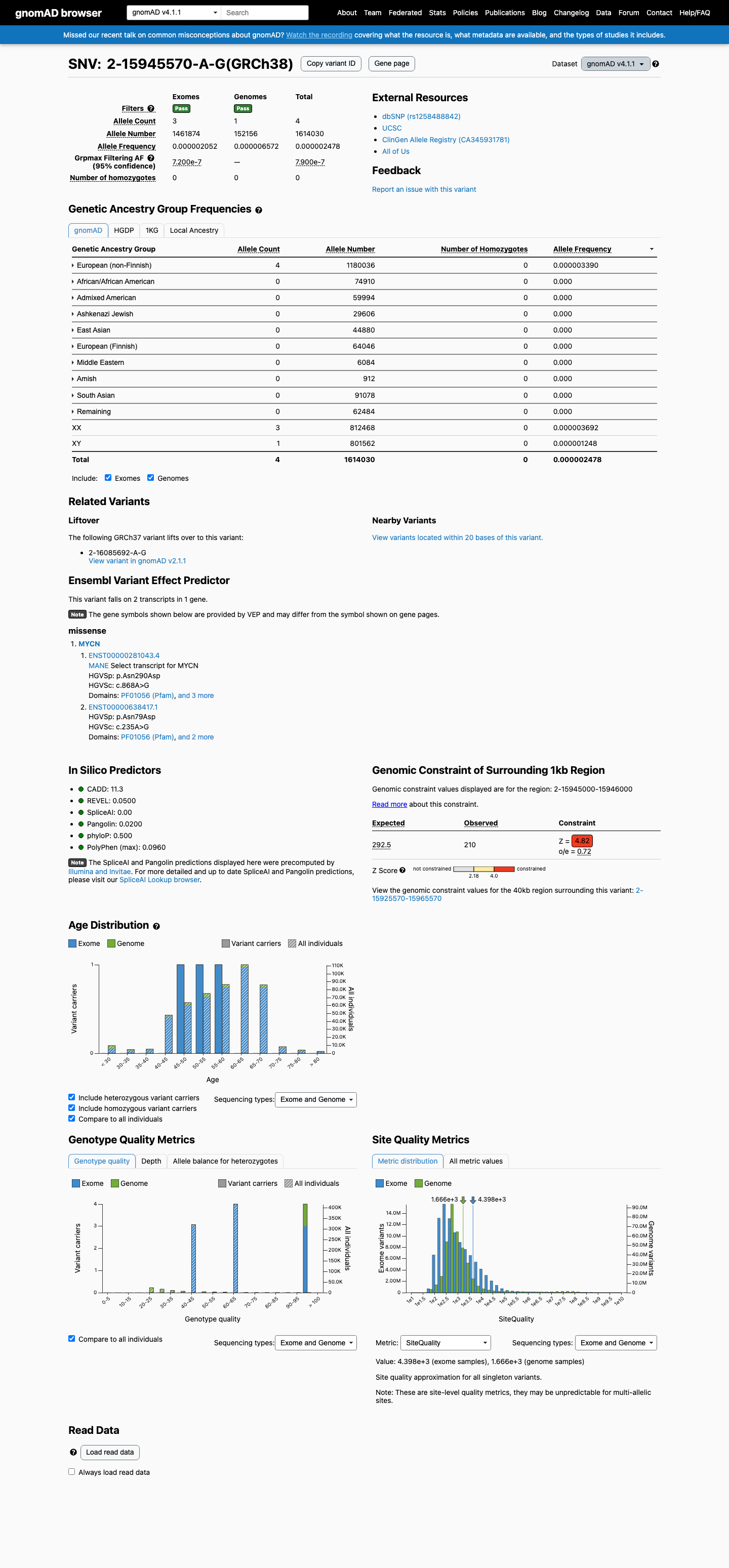
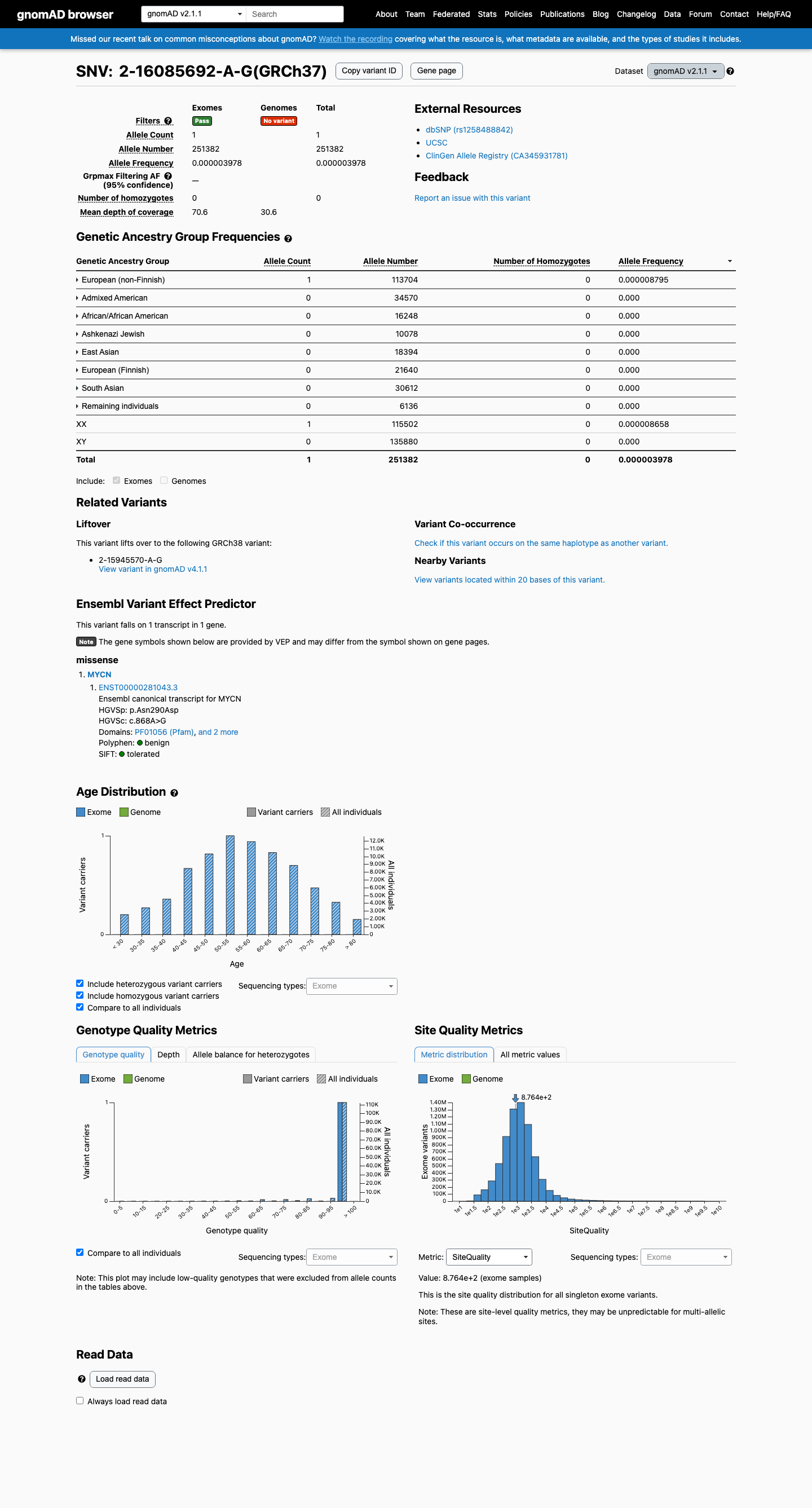
gnomAD v4.1 reports 4 of 1,614,030 alleles, no homozygotes, total AF 2.47827e-06, maximum population AF 3.38973e-06, and group maximum FAF 7.9e-07.gnomAD v2.1 reports 1 of 251,382 alleles, no homozygotes, total AF 3.97801e-06, and maximum population AF 8.79477e-06.The variant is absent from gnomAD-Canada v1.0.
BP4 supporting Benign
Met (supporting): REVEL 0.05 (below the 0.183 threshold) and SpliceAI max delta 0.006 (below 0.2) both predict no damaging effect.
REVEL score = 0.05 (source_registry key: revel) falls below the ClinGen SVI-calibrated BP4_Supporting threshold of <=0.183 for REVEL (Pejaver et al. 2022, PMID:36413997), consistent with a benign prediction.SpliceAI max delta score = 0.006 (DS_AG=0.00, DS_AL=0.006, DS_DG=0.001, DS_DL=0.00) is well below the 0.2 threshold for splice-altering variants established by Jaganathan et al. 2019 (PMID:30661751), indicating no predicted splice disruption.BayesDel score (-0.75139) was retrieved but not used as supporting evidence because no verified published threshold/publication for BayesDel is available to this pipeline.
Assessed · not applied · 6 not met · 15 not assessed
Pathogenic
PS1 Not assessed: no alternate nucleotide change producing p.(Asn290Asp) with a pathogenic ClinVar classification was available.
PS2 Not assessed: no parental testing, trio results, or other de novo evidence for this variant was available.
PS3 Not assessed: no validated functional assay data for this variant was available.
PS4 Not assessed: no case-control or disease-cohort evidence for this variant was available.
PM1 Not met: a dedicated hotspot lookup found residue 290 does not lie in a statistically significant hotspot.
PM5 Not assessed: no different missense change at residue 290 previously classified pathogenic was identified.
PM6 Not assessed: no report of this variant as presumed de novo was available.
PP1 Not assessed: no family segregation data or relative genotype results were available.
PP2 Not assessed: no missense constraint metric or evidence on MYCN's missense disease mechanism was available.
PP3 Not met: REVEL 0.05 is well below the 0.644 damaging-prediction threshold, and SpliceAI predicts no splice impact.
PP4 Not assessed: no patient phenotype or clinical diagnosis data was provided.
PP5 Not met: the exact variant is absent from ClinVar, so no expert-panel pathogenic classification exists.
Benign
BA1 Not met: the highest population allele frequency is 3.4e-06, far below the >1% stand-alone benign threshold.
BS1 Not met: observed allele frequencies are ultra-rare, well below the threshold for a benign frequency in a rare Mendelian disorder.
BS2 Not assessed: zero homozygotes were observed, but no phenotype-annotated healthy-carrier dataset was available.
BS3 Not assessed: no assay data demonstrating normal protein function for this variant was available.
BS4 Not assessed: no unaffected relatives with confirmed absence of the variant were documented.
BP1 Not assessed: no evidence on whether missense variants are a common cause of MYCN germline disease was available.
BP2 Not assessed: no trans/cis genotype or phase information was available.
BP5 Not assessed: no evidence of an alternate molecular cause for the phenotype was available.
BP6 Not met: the exact variant is absent from ClinVar, so no expert-panel benign classification exists.
N/A · 5 PVS1 · PM3 · PM4 · BP3 · BP7
Research & evidence
Population frequency
gnomAD v4.1 screenshot
gnomAD v4.1
gnomAD v2.1 screenshot
gnomAD v2.1
v4.1
This variant is present in gnomAD v4.1 (AF= 2.47827e-06; MAF= 0.00025%, 4/1614030 alleles, homozygotes = 0) and has highest observed frequency in the European (non-Finnish) population (AF= 3.38973e-06; MAF= 0.00034%, 4/1180036 alleles, homozygotes = 0); grpmax FAF= 7.9e-07.
v2.1
This variant is present in gnomAD v2.1 (AF= 3.97801e-06; MAF= 0.00040%, 1/251382 alleles, homozygotes = 0) and has highest observed frequency in the European (non-Finnish) population (AF= 8.79477e-06; MAF= 0.00088%, 1/113704 alleles, homozygotes = 0).
🇨🇦 CA
Absent from gnomAD-Canada v1.0.
Allele frequency by ancestry
three datasets · side by side
gnomAD v4.1
0.00025% · 4 / 1,614,030
0 hom · FAF 7.9e-05%
European (non-Finnish)
4 / 1,180,036
0.00034%
+ 9 not observed (Remaining individuals, Admixed American, European (Finnish), Amish, East Asian, Middle Eastern, South Asian, Ashkenazi Jewish, African/African American)
gnomAD v2.1
0.0004% · 1 / 251,382
0 hom
European (non-Finnish)
1 / 113,704
0.00088%
+ 7 not observed (African/African American, Admixed American, Ashkenazi Jewish, East Asian, European (Finnish), Remaining individuals, South Asian)
gnomAD Canada 🇨🇦
Absent · 0 / ?
0 hom
Not observed in any ancestry group.
ClinVar screenshot
ClinVar
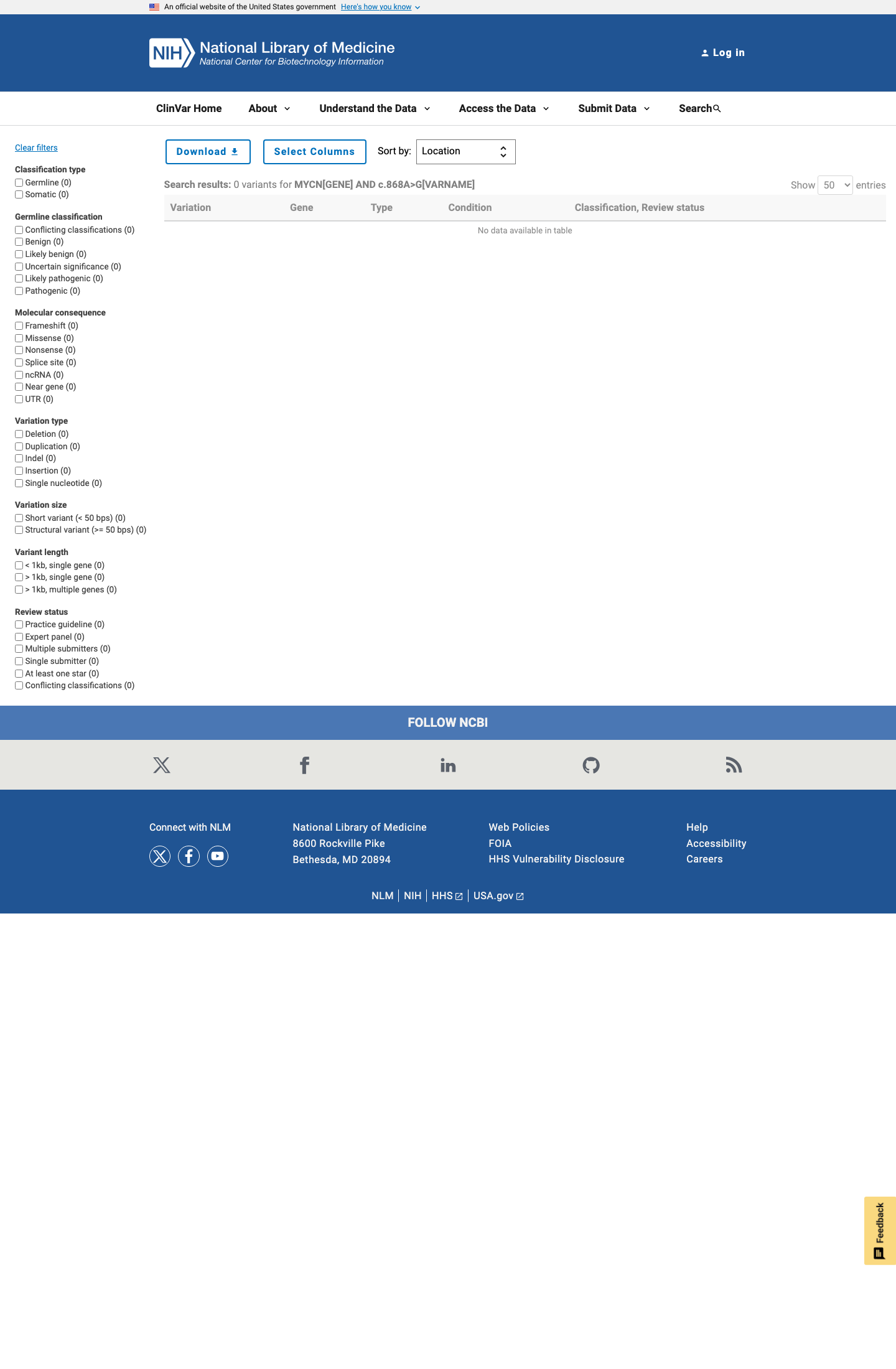
This variant is absent from ClinVar.
SpliceAI screenshot
In silico
SpliceAI predicts no significant splice impact for this variant (max delta score = 0.01). REVEL score = 0.05. BayesDel score = -0.75139.
Functional / OncoKB screenshot
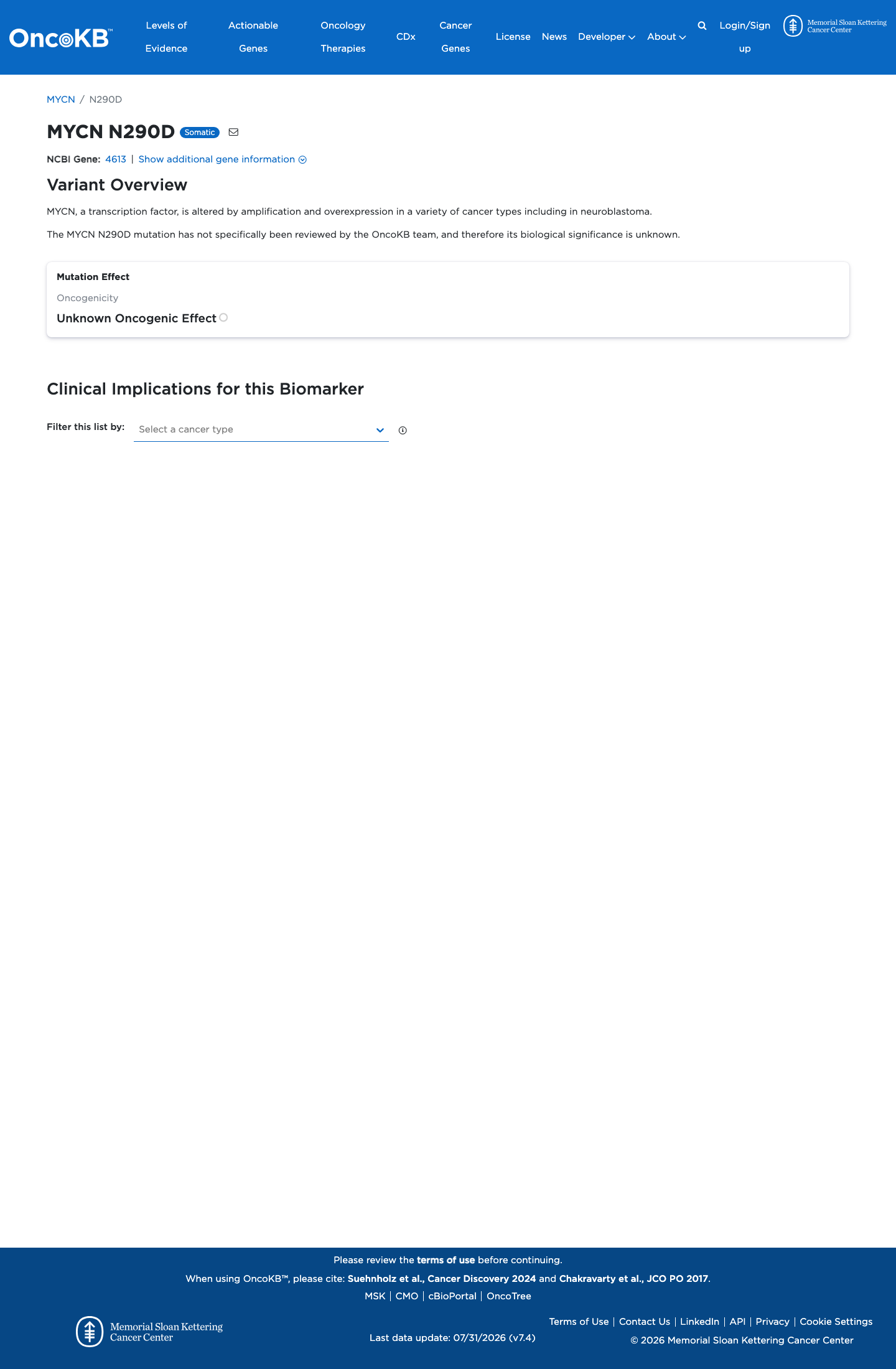
Functional Unknown Oncogenic Effect
OncoKB did not identify variant-specific reviewed functional evidence for this variant; gene-level curated context is available for reviewer follow-up. MYCN, a transcription factor, is altered by amplification and overexpression in a variety of cancer types including in neuroblastoma.
OncoKB ↗
COSMIC screenshot
COSMIC
Cancer hotspots screenshot
Cancer hotspots
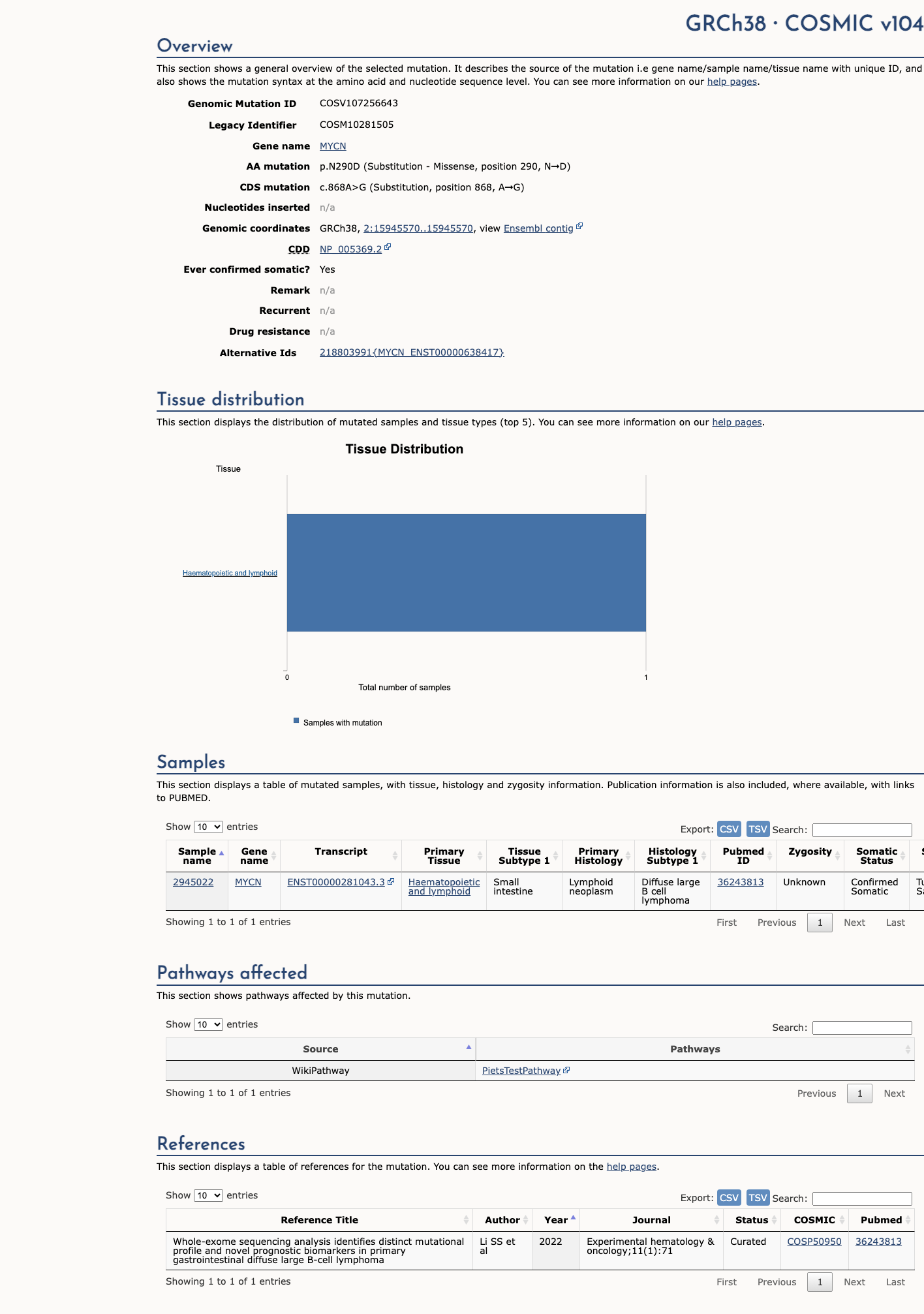
Somatic evidence Not in COSMIC / hotspots
COSMIC
This variant does not lie in a statistically significant hotspot. This variant has previously been reported in somatic cancers (COSMIC; COSV107256643, n = 1 times).
Hotspots
This variant does not lie in a statistically significant hotspot.
Sources & reference links
8Sources
ClinVar
gnomAD v2.1
gnomAD v4.1
gnomAD-Canada
SpliceAI
OncoKB
COSMIC
Cancer hotspots