Analysis in progress
Initialising…
0%
complete
This report is still being assembled — sections appear as each stage finishes. It isn't final yet.
MSH6
Final classification
VUS
PM2BP4
MSH6
c.4002-16_4002-10del
p.?
unknown · exon 9i

MSH6 encodes a protein in the DNA mismatch repair system, which fixes errors made during DNA replication. Partnering with MSH2, it forms a complex that recognizes and helps correct mismatched DNA bases, keeping the genetic code stable. Inherited mutations in MSH6 cause Lynch syndrome (hereditary nonpolyposis colorectal cancer), raising the risk of colorectal, endometrial, ovarian, and other cancers, while mutations in both copies lead to constitutional mismatch repair deficiency. Because faulty mismatch repair drives tumor development and produces microsatellite instability, MSH6 acts as a tumor suppressor, and cancers with such repair defects often respond well to immune checkpoint inhibitor therapy.

This variant

This deep intronic deletion in MSH6 is classified as a variant of uncertain significance: current evidence neither supports nor rules out a role in Lynch syndrome. It is extremely rare and predicted not to disrupt splicing, but without functional or clinical data its impact on DNA mismatch repair and cancer risk remains unknown.

Transcript
NM_000179.3
HGVS · transcript:coding
NM_000179.3:c.4002-16_4002-10del
GRCh38
chr2:47806751 CTTTTTTT>C
GRCh37
chr2:48033890 CTTTTTTT>C
Basis PM2 Supporting (gnomAD v4 Grpmax FAF 5.02e-06 < 0.00002) plus BP4 Supporting (SpliceAI max delta 0.00 <= 0.1) trigger Rule31: Uncertain Significance with conflicting evidence.
PM2 Supporting (gnomAD v4 Grpmax FAF 5.02e-06 < 0.00002) plus BP4 Supporting (SpliceAI max delta 0.00 <= 0.1) trigger Rule31: Uncertain Significance with conflicting evidence.
Classification rationale
PM2 BP4 VUS
MSH6 c.4002-16_4002-10del unknown · exon 9i

PM2 (Supporting): absent or extremely rare in gnomAD v4, with Grpmax FAF 5.02e-06 below the <0.00002 threshold. BP4 (Supporting): SpliceAI predicts no splice impact (max delta 0.00), below the <=0.1 threshold for intronic variants. Combined under Rule31 (at least one pathogenic-supporting and one benign-supporting criterion), the final classification is Uncertain Significance due to conflicting evidence.

PM2 + BP4 VUS
Gene diagram · NM_000179.3 · variants mapped to exon structure
MSH6 NM_000179.3
Fetching transcript structure from UCSC…
Applied criteria · 2 applied · 14 assessed
MetEvidence satisfies this criterion.
Not metEvaluated against available evidence; threshold not reached.
Not assessedApplies in principle, but no evidence was found to evaluate it.
N/ADoesn't apply to this variant type.
Applied · 2
Strength Supporting Moderate Strong Very strong
PM2 supporting Pathogenic
Met (Supporting): gnomAD v4 Grpmax FAF of 5.02e-06 is below the <0.00002 rarity threshold.
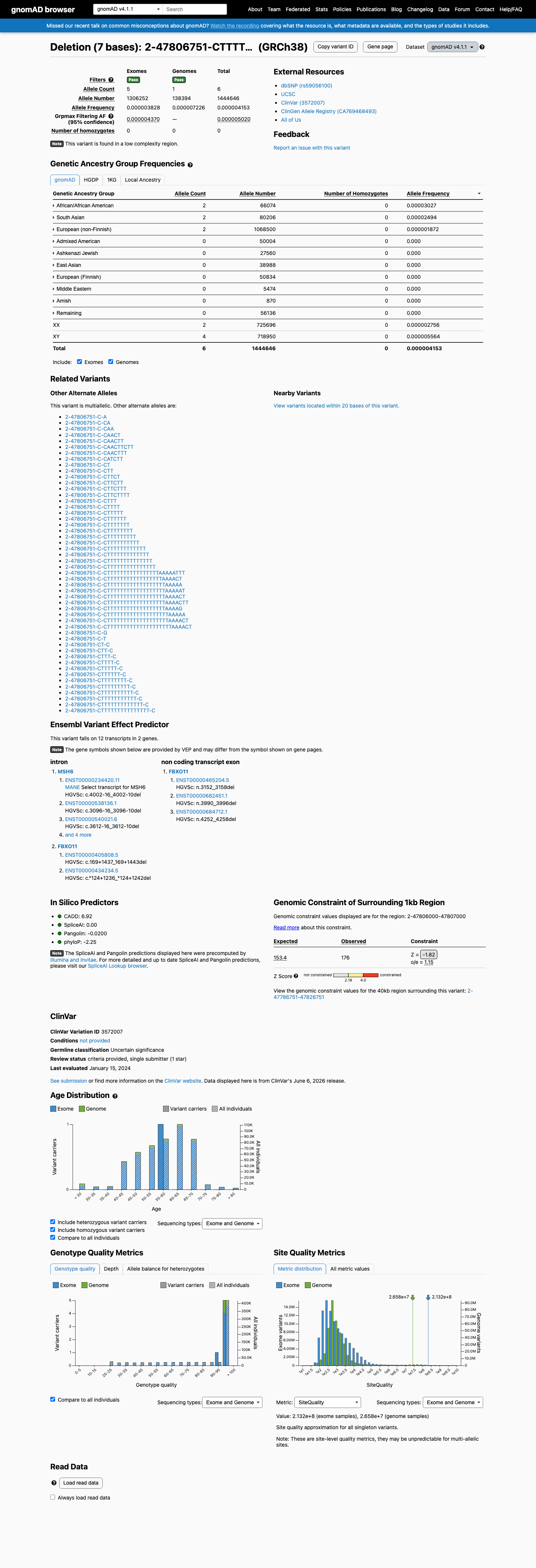
The applicable MSH6 VCEP PM2 rule is absent/extremely rare allele frequency <0.00002 in gnomAD v4 and assigns the criterion Supporting strength.gnomAD v4.1 reports Grpmax FAF 5.02e-06 and total AF 4.15327e-06 (6/1,444,646 alleles), with zero observed homozygotes. The highest population AF is 3.02691e-05 in African/African American individuals, while the VCEP rule uses Grpmax FAF; the qualifying Grpmax value is below 0.00002.
BP4 supporting Benign
Met (Supporting): SpliceAI max delta 0.00, below the <=0.1 no-splice-impact threshold for intronic variants.
SpliceAI Lookup for NM_000179.3:c.4002-16_4002-10del: max delta score = 0.00, satisfying the VCEP BP4 splice-impact threshold of <=0.1.InSiGHT MMR VCEP (MSH6) cspec BP4 rule: 'For intronic and synonymous variants: SpliceAI predicts no splicing impact with delta score <= 0.1 as per Walker et al 2023.'
Assessed · not applied · 5 not met · 9 not assessed
Pathogenic
PS1 Not met: a deep intronic deletion with unknown protein consequence cannot match a known pathogenic missense at the same residue.
PS2 Not assessed: no de novo observation, parental testing, or qualifying tumor evidence was available.
PS3 Not assessed: no variant-specific functional assay or mRNA expression data was available.
PM3 Not assessed: no second MSH6 variant, phase, or family-testing evidence was available.
PP1 Not assessed: no pedigree or cosegregation data was available to quantify a Bayes likelihood ratio.
PP3 Not met: SpliceAI max delta 0.00 versus the >=0.2 splice-impact threshold.
PP4 Not assessed: no patient or family phenotype, MSI tumor, or MMR protein-expression data was available.
Benign
BA1 Not met: gnomAD v4 Grpmax FAF 5.02e-06 (0.000502%) versus the >=0.0022 (0.22%) BA1 threshold.
BS1 Not met: gnomAD v4 Grpmax FAF 5.02e-06 falls below the required 0.00022-0.0022 range.
BS2 Not assessed: no clinical co-occurrence, phase, or age evidence was available.
BS3 Not assessed: no calibrated wet-lab functional or mRNA assay data was available; computational SpliceAI predictions do not qualify.
BS4 Not assessed: no pedigree or segregation observations were available to demonstrate lack of cosegregation.
BP5 Not assessed: no qualifying tumor observations (MSI, MMR expression, BRAF/MLH1 methylation) were available.
BP7 Not met: the intronic deletion at -16 to -10 lies closer to the exon than the required -21 boundary.
N/A · 12 PVS1 · PS4 · PM1 · PM4 · PM5 · PM6 · PP2 · PP5 · BP1 · BP2 · BP3 · BP6
Research & evidence
Population frequency
gnomAD v4.1 screenshot
gnomAD v4.1
gnomAD v2.1 screenshot
gnomAD v2.1
v4.1
This variant is present in gnomAD v4.1 (AF= 4.15327e-06; MAF= 0.00042%, 6/1444646 alleles, homozygotes = 0) and has highest observed frequency in the African/African American population (AF= 3.02691e-05; MAF= 0.00303%, 2/66074 alleles, homozygotes = 0); grpmax FAF= 5.02e-06.
v2.1
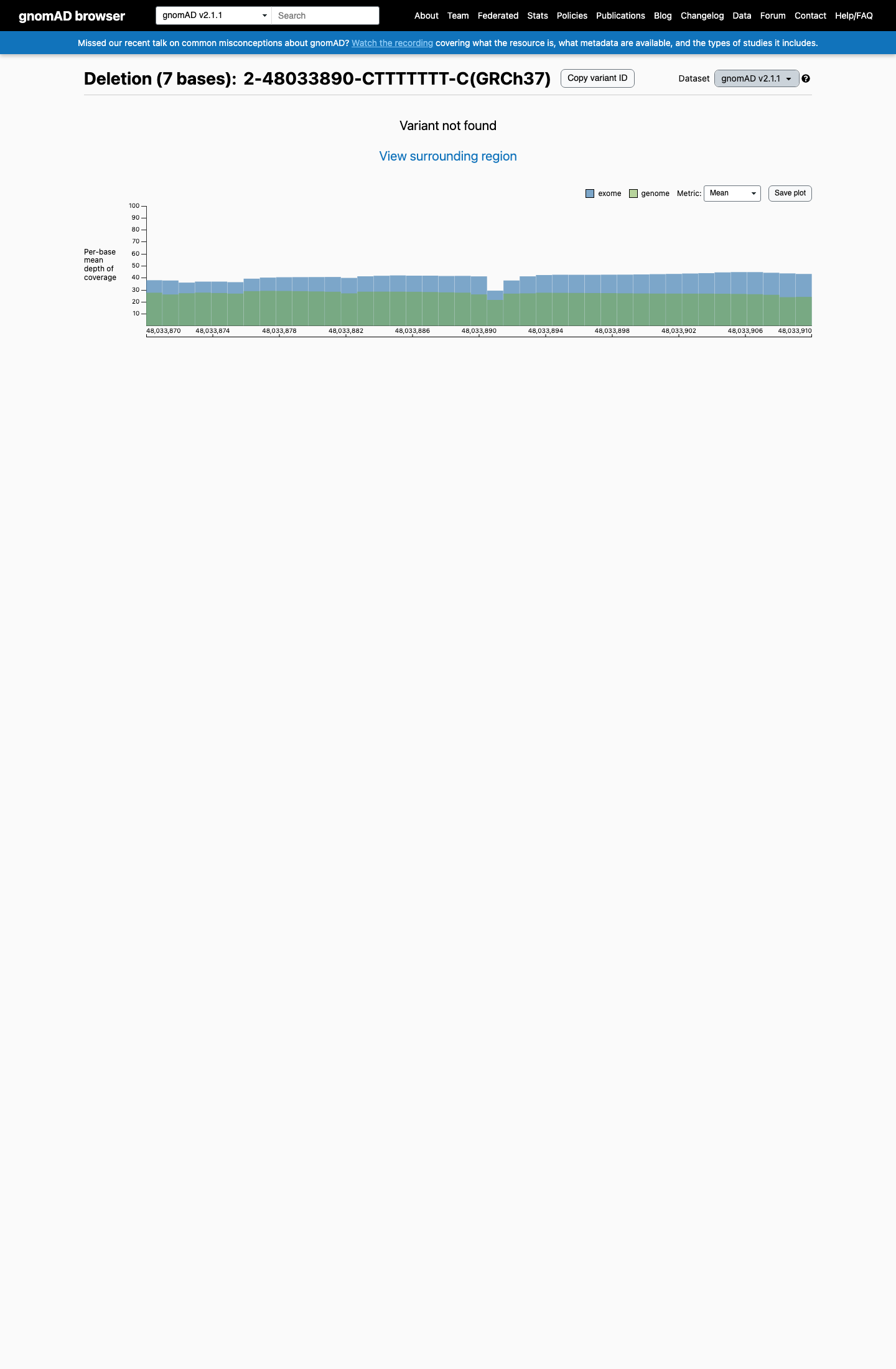
Absent from gnomAD v2.1.
🇨🇦 CA
Absent from gnomAD-Canada v1.0.
Allele frequency by ancestry
three datasets · side by side
gnomAD v4.1
0.00042% · 6 / 1,444,646
0 hom · FAF 0.0005%
African/African American
2 / 66,074
0.003%
South Asian
2 / 80,206
0.0025%
European (non-Finnish)
2 / 1,068,500
0.00019%
+ 7 not observed (Remaining individuals, Admixed American, European (Finnish), Amish, East Asian, Middle Eastern, Ashkenazi Jewish)
gnomAD v2.1
Absent · 0 / ?
0 hom
Not observed in any ancestry group.
gnomAD Canada 🇨🇦
Absent · 0 / ?
0 hom
Not observed in any ancestry group.
ClinVar screenshot
ClinVar
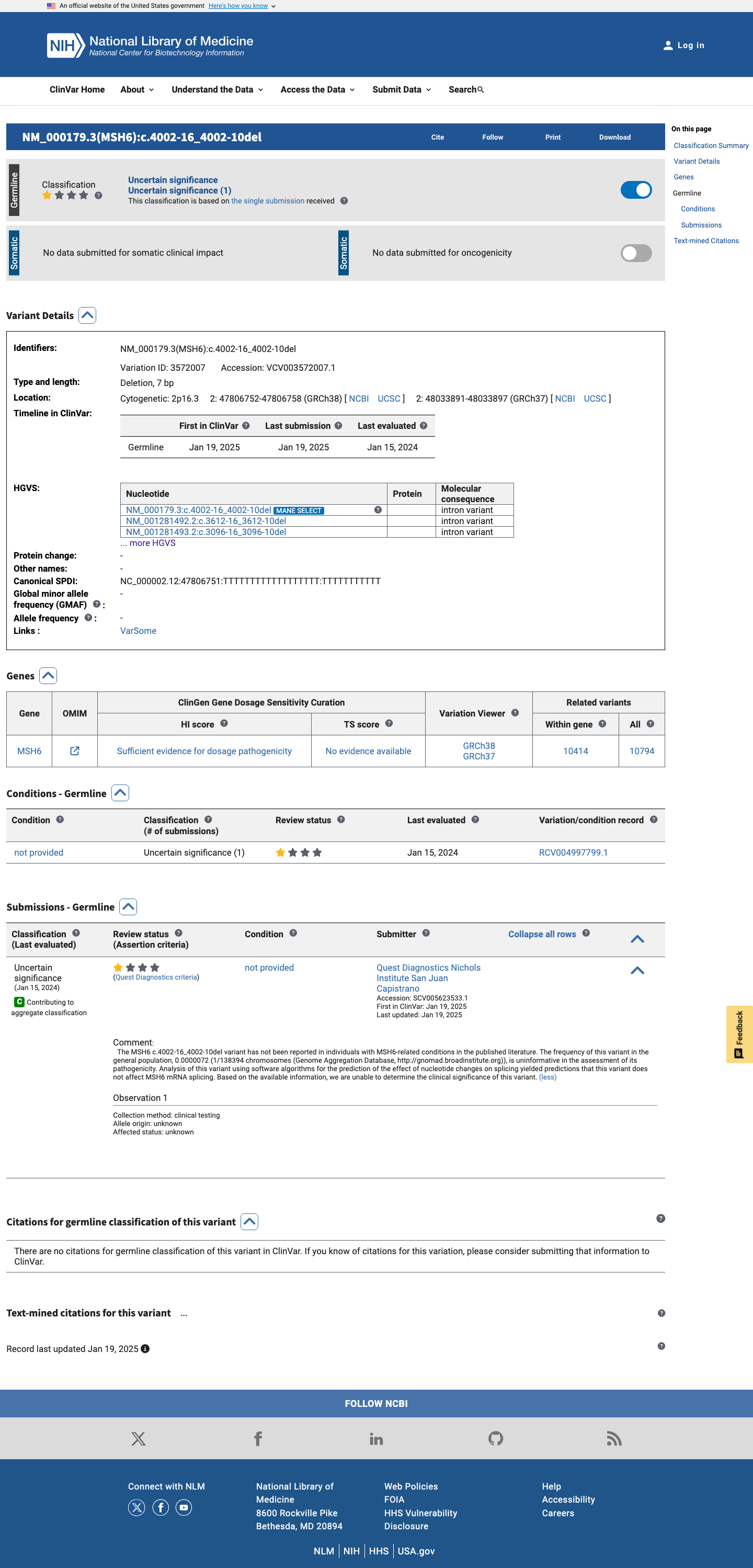
This variant has been reported in ClinVar as Uncertain significance (1 clinical laboratory). (ClinVarID = 3572007)
SpliceAI screenshot
In silico
SpliceAI predicts no significant splice impact for this variant (max delta score = 0.00).
Functional No data
No calibrated functional assay or RNA evidence was identified for this variant.
OncoKB ↗
COSMIC screenshot
COSMIC
Somatic evidence
COSMIC
This variant has not previously been reported in somatic cancers (COSMIC).
Hotspots
This variant does not lie in a statistically significant cancer hotspot.
COSMIC ↗
Sources & reference links
8Sources
CSpec VCEP
ClinVar
gnomAD v2.1
gnomAD v4.1
gnomAD-Canada
SpliceAI
OncoKB
COSMIC
Triaged references · 1 PMID not cited in assessment
26467025 ↗ A Standardized DNA Variant Scoring System for Pathogenicity Assessments in Mendelian Disorders. CLINVAR