Analysis in progress
Initialising…
0%
complete
This report is still being assembled — sections appear as each stage finishes. It isn't final yet.
ARID1A
Final classification
Likely Pathogenic
PVS1PM2
ARID1A
c.1217_1229dup
p.Pro411ThrfsTer216
frameshift · exon 2

ARID1A encodes a component of the SWI/SNF chromatin-remodeling complex, which regulates gene expression by altering chromatin structure around target genes. It binds AT-rich DNA sequences and helps recruit the remodeling complex to its targets. Germline mutations in ARID1A cause Coffin-Siris syndrome, a condition marked by developmental delay and coarse facial features. ARID1A also acts as a tumor suppressor in several cancer types, including gynecologic cancers, ovarian clear cell carcinomas, and endometrial cancers.

This variant

This likely pathogenic frameshift is predicted to eliminate one functional copy of ARID1A, matching the haploinsufficiency mechanism that underlies Coffin-Siris syndrome and consistent with ARID1A's tumor-suppressor role in gynecologic, ovarian clear cell, and endometrial cancers. The classification therefore supports a loss-of-function disease mechanism for this variant.

Transcript
NM_006015.5
HGVS · transcript:coding
NM_006015.5:c.1217_1229dup
GRCh38
chr1:26729725 A>ACAGGGACCTCCGT
GRCh37
chr1:27056216 A>ACAGGGACCTCCGT
Basis Likely Pathogenic: PVS1 very strong (frameshift predicted to trigger NMD; established LOF mechanism) plus PM2 supporting (absent from gnomAD v2.1, v4.1, and gnomAD-Canada).
Likely Pathogenic: PVS1 very strong (frameshift predicted to trigger NMD; established LOF mechanism) plus PM2 supporting (absent from gnomAD v2.1, v4.1, and gnomAD-Canada).
Classification rationale
PVS1PM2 Likely Pathogenic
ARID1A c.1217_1229dup frameshift · exon 2

PVS1 (Very Strong): the 13-bp frameshift is predicted to trigger nonsense-mediated decay, and loss of function is an established ARID1A disease mechanism. PM2 (Supporting): the exact 13-bp duplication is absent from gnomAD v2.1, v4.1, and gnomAD-Canada. Overall: Likely Pathogenic under generic ACMG/AMP 2015 combination rules (PVS1 very strong + PM2 supporting).

PVS1 + PM2 Likely Pathogenic
Gene diagram · NM_006015.5 · variants mapped to exon structure
ARID1A NM_006015.5
Fetching transcript structure from UCSC…
Applied criteria · 2 applied · 18 assessed
MetEvidence satisfies this criterion.
Not metEvaluated against available evidence; threshold not reached.
Not assessedApplies in principle, but no evidence was found to evaluate it.
N/ADoesn't apply to this variant type.
Applied · 2
Strength Supporting Moderate Strong Very strong
PVS1 very strong Pathogenic
Met (Very Strong): the 13-bp frameshift creates a premature stop at codon 626 predicted to trigger nonsense-mediated decay.
pvs1_variant_assessment classifies the variant as consequence_class=frameshift, variant_bucket=frameshift, with suggested_default_strength=PVS1 and apply_generic_pvs1_framework=true under the PMC6185798 framework.pvs1_gene_context reports pvs1_gene_gate=eligible and lof_mechanism_supported=true, citing germline disease-focused literature (including ARID1A gene variants and fetal hydrocephalus / BAFopathy spectrum, PMID:40962111) as evidence that ARID1A loss-of-function is an established germline disease mechanism.Mutalyzer/VariantValidator exon and CDS coordinate maps (prefetch.json) place the c.1217_1229 duplication in exon 2 (c.1138-1350) and the resulting premature stop (~codon 626, ~c.1876) far upstream of the final exon (beginning c.5125) and outside the terminal 50 bp of the penultimate exon, consistent with NMD-predicted transcript decay rather than protein truncation/elongation escape.
PM2 supporting review Pathogenic
Met (Supporting): the exact 13-bp duplication is absent from gnomAD v2.1, v4.1, and gnomAD-Canada.
gnomAD v2.1 reports the exact variant as absent.gnomAD v4.1 reports the exact variant as absent.gnomAD-Canada v1.0 reports the exact variant as absent.
Assessed · not applied · 4 not met · 14 not assessed
Pathogenic
PS2 Not assessed: parental genotypes confirming a de novo occurrence are unavailable.
PS3 Not assessed: no functional assay evidence specific to this variant was available.
PS4 Not assessed: no case-control or affected-cohort data for this exact variant were available.
PM3 Not assessed: no phase data, in-trans pathogenic variant, or affected-proband observations were available.
PM6 Not assessed: parental testing documenting a presumed de novo occurrence is unavailable.
PP1 Not assessed: no segregation data from affected relatives were available.
PP3 Not met: SpliceAI max delta 0.108 falls in the gray zone (0.1-0.2), meeting neither PP3 nor BP4.
PP4 Not assessed: no phenotype evidence indicating an ARID1A-specific presentation was available.
PP5 Not assessed: no ClinVar expert-panel pathogenic classification exists for this exact variant.
Benign
BA1 Not met: the variant is absent from gnomAD v2.1, v4.1, and gnomAD-Canada, so no stand-alone benign frequency threshold is reached.
BS1 Not met: absent from population databases, so no allele frequency above the disease-prevalence threshold is available.
BS2 Not assessed: no healthy homozygous individuals or genotype-quality data were available.
BS3 Not assessed: no functional assay showing no damaging effect for this variant was available.
BS4 Not assessed: no unaffected relatives or non-segregation analysis were available.
BP2 Not assessed: no phase-resolved allelic observations were available.
BP4 Not met: SpliceAI max delta 0.108 exceeds the BP4 threshold of <0.1 and falls in the indeterminate gray zone.
BP5 Not assessed: no alternative molecular etiology or phenotype information was available.
BP6 Not assessed: no ClinVar expert-panel benign classification exists for this exact variant.
N/A · 8 PS1 · PM1 · PM4 · PM5 · PP2 · BP1 · BP3 · BP7
Research & evidence
Population frequency · supports pathogenic
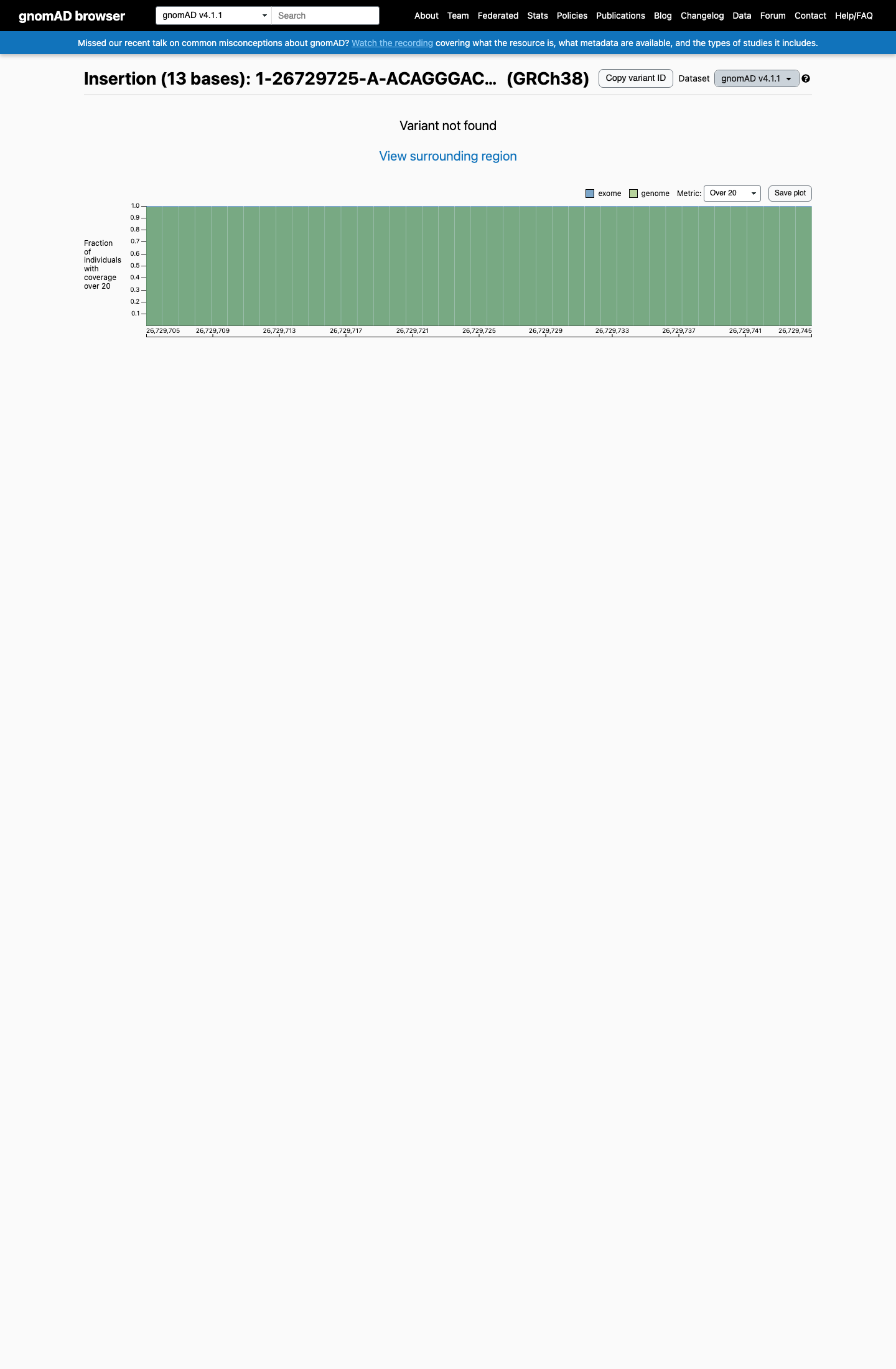
gnomAD v4.1 screenshot
gnomAD v4.1
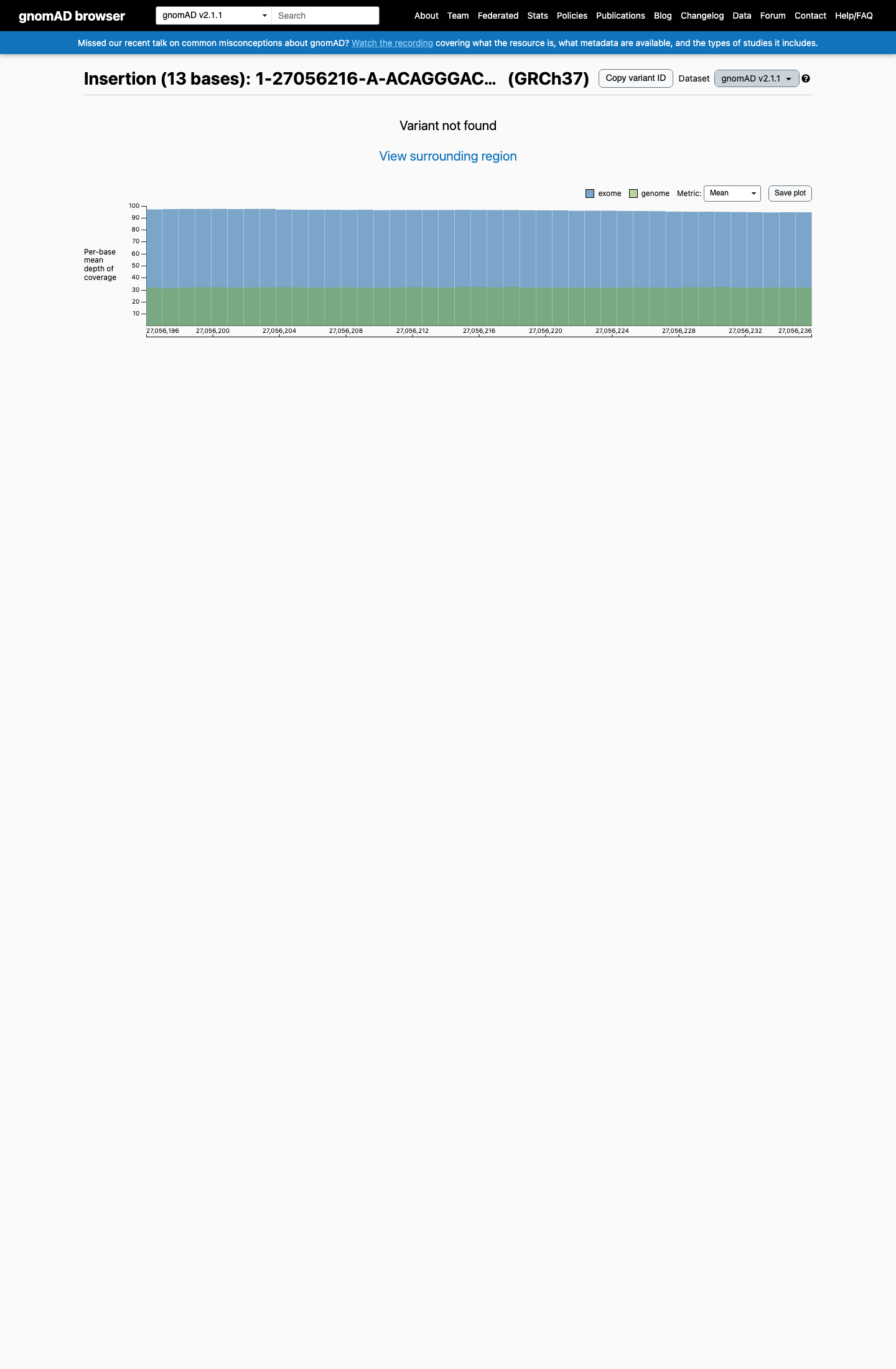
gnomAD v2.1 screenshot
gnomAD v2.1
v4.1
Absent from gnomAD v4.1.
v2.1
Absent from gnomAD v2.1.
🇨🇦 CA
Absent from gnomAD-Canada v1.0.
Allele frequency by ancestry
three datasets · side by side
gnomAD v4.1
Absent · 0 / ?
0 hom
Not observed in any ancestry group.
gnomAD v2.1
Absent · 0 / ?
0 hom
Not observed in any ancestry group.
gnomAD Canada 🇨🇦
Absent · 0 / ?
0 hom
Not observed in any ancestry group.
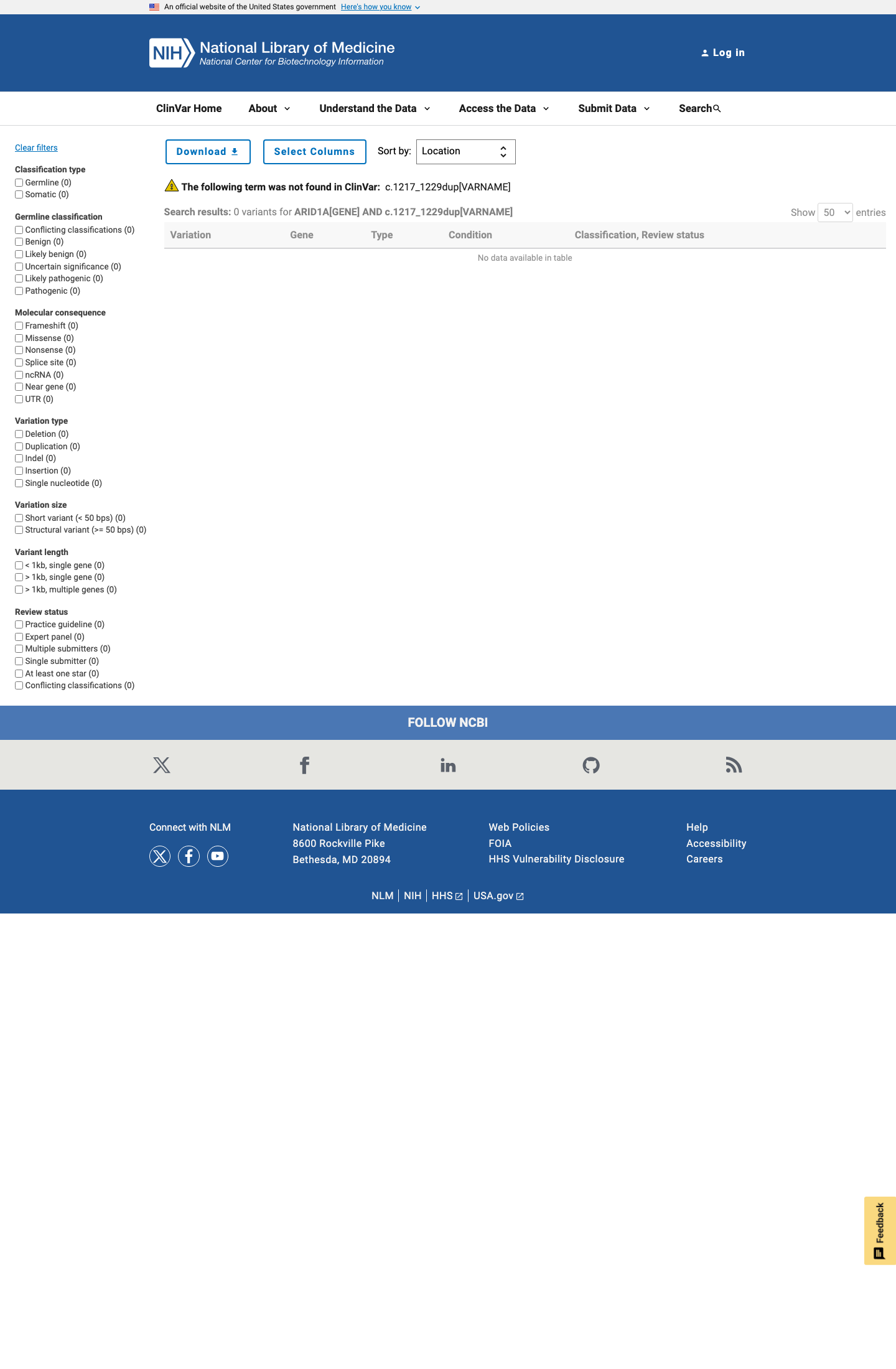
ClinVar screenshot
ClinVar
This variant is absent from ClinVar.
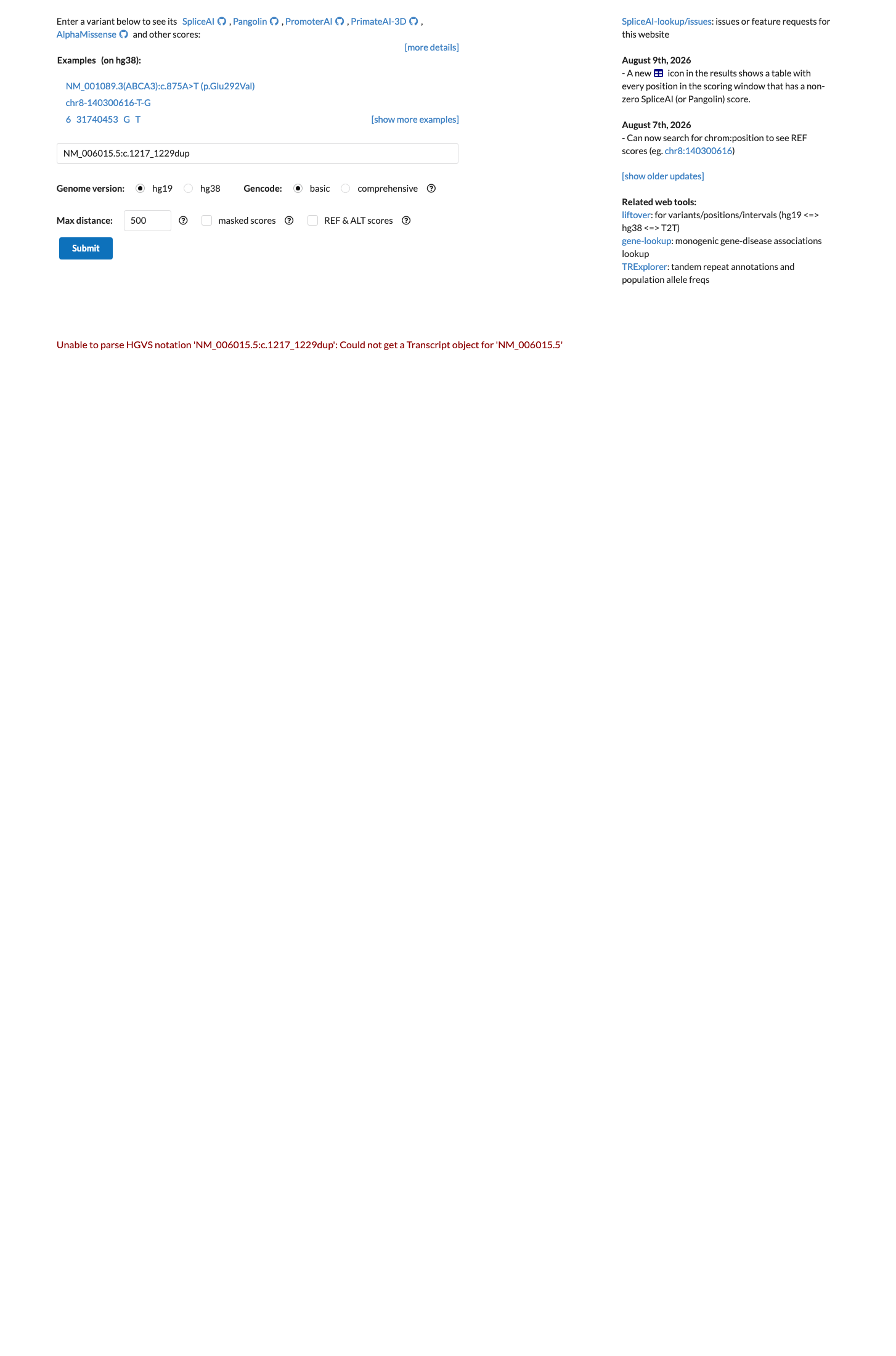
SpliceAI screenshot
In silico
SpliceAI predicts no significant splice impact for this variant (max delta score = 0.11).
Functional / OncoKB screenshot
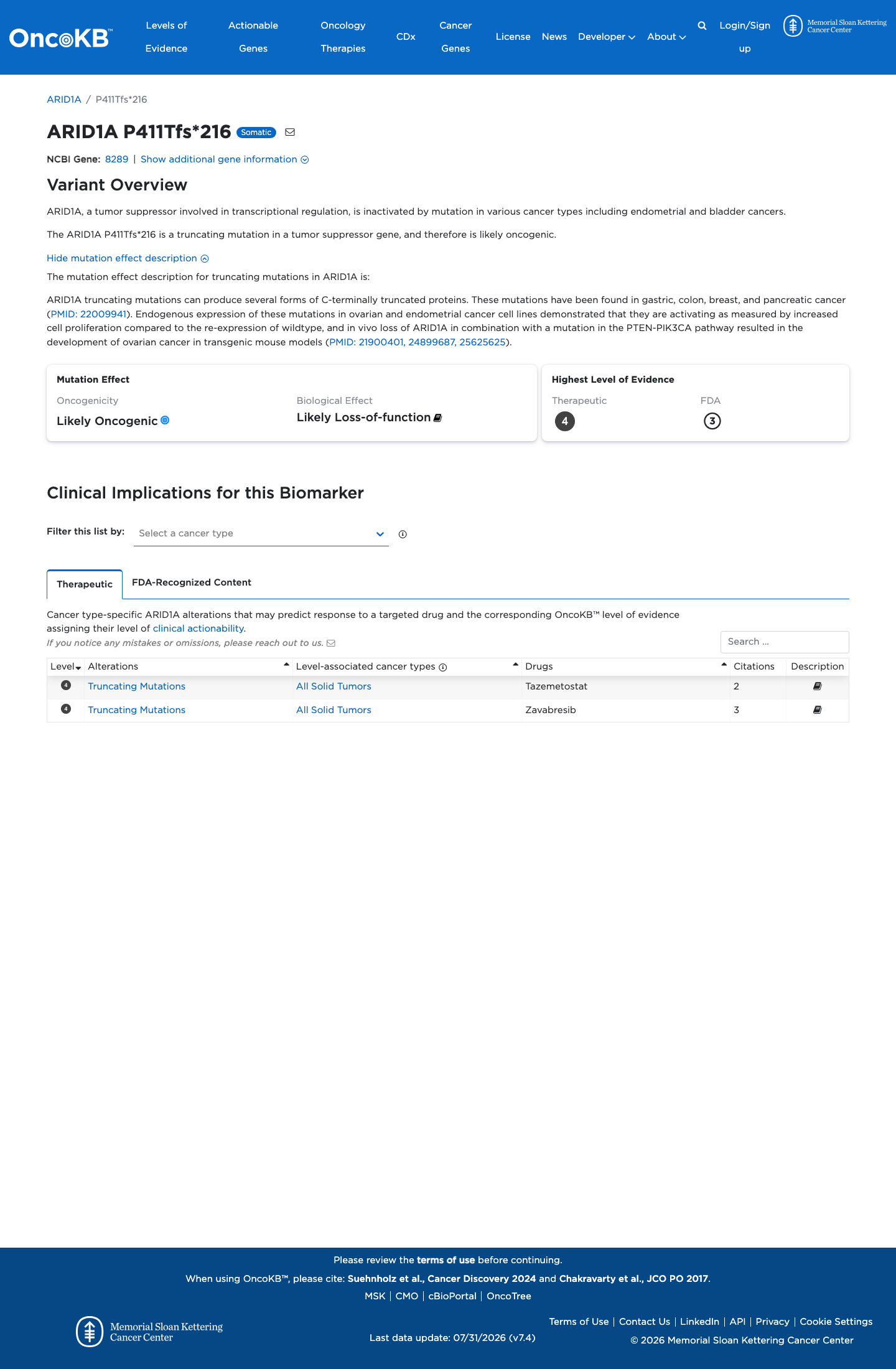
Functional Likely Oncogenic
OncoKB identified variant-specific curated literature and context relevant to functional review; biological-effect context: Likely Loss-of-function; curated oncogenicity label: Likely Oncogenic.
OncoKB ↗
COSMIC screenshot
COSMIC
Cancer hotspots screenshot
Cancer hotspots
Somatic evidence Not in COSMIC / hotspots
COSMIC
This variant does not lie in a statistically significant hotspot. This variant has not previously been reported in somatic cancers (COSMIC).
Hotspots
This variant does not lie in a statistically significant hotspot.
Sources & reference links
8Sources
ClinVar
gnomAD v2.1
gnomAD v4.1
gnomAD-Canada
SpliceAI
OncoKB
COSMIC
Cancer hotspots
Triaged references · 4 PMIDs not cited in assessment
21900401 ↗ ARID1A, a factor that promotes formation of SWI/SNF-mediated chromatin remodeling, is a tumor suppressor in gynecologic cancers. ONCOKB
22009941 ↗ Somatic mutations in the chromatin remodeling gene ARID1A occur in several tumor types. ONCOKB
24899687 ↗ Roles of deletion of Arid1a, a tumor suppressor, in mouse ovarian tumorigenesis. ONCOKB
25625625 ↗ Coexistent ARID1A-PIK3CA mutations promote ovarian clear-cell tumorigenesis through pro-tumorigenic inflammatory cytokine signalling. ONCOKB