Analysis in progress
Initialising…
0%
complete
This report is still being assembled — sections appear as each stage finishes. It isn't final yet.
EZHIP
Final classification
VUS
EZHIP
c.1379C>G
p.Ser460Cys
missense · exon 1

EZHIP is a protein-coding gene on the X chromosome that plays a role in epigenetic regulation: it inhibits histone methyltransferases and interacts with the Polycomb Repressive Complex 2, which adds a chemical mark (H3K27me3) that helps silence gene expression. The gene is considered an oncogene, and its dysregulation has been linked to cancer: chromosomal rearrangements involving EZHIP are seen in low-grade endometrial stromal sarcomas, and activating changes have been found in posterior fossa ependymoma, a brain tumor. The protein is most highly expressed in normal oocytes (egg cells) and may also act as a cancer testis antigen that helps the immune system recognize lung adenocarcinoma cells.

This variant

EZHIP is an oncogene whose dysregulation is linked to endometrial stromal sarcoma and posterior fossa ependymoma, but no evidence currently ties this specific p.(Ser460Cys) change to those cancers. The VUS classification reflects the absence of supporting or refuting data; functional studies would be needed to determine whether this substitution alters EZHIP's epigenetic regulatory function.

Transcript
NM_203407.3
HGVS · transcript:coding
NM_203407.3:c.1379C>G
GRCh38
chrX:51408395 C>G
GRCh37
chrX:51151247 C>G
Basis No gene-specific framework exists for EZHIP, and none of the 28 ACMG/AMP criteria were met, so no combination rule is satisfied and the variant is classified VUS.
No gene-specific framework exists for EZHIP, and none of the 28 ACMG/AMP criteria were met, so no combination rule is satisfied and the variant is classified VUS.
Classification rationale
VUS
EZHIP c.1379C>G missense · exon 1

Final classification VUS: no ACMG/AMP criterion was met, so no pathogenic or benign combination rule was satisfied under the generic ACMG/AMP 2015 framework.

Gene diagram · NM_203407.3 · variants mapped to exon structure
EZHIP NM_203407.3
Fetching transcript structure from UCSC…
Applied criteria · 0 applied · 24 assessed
MetEvidence satisfies this criterion.
Not metEvaluated against available evidence; threshold not reached.
Not assessedApplies in principle, but no evidence was found to evaluate it.
N/ADoesn't apply to this variant type.
Applied · 0

No criteria were applied for this variant.

Assessed · not applied · 6 not met · 18 not assessed
Pathogenic
PS1 Not assessed: no evidence was available that this exact amino acid change has been previously established as pathogenic.
PS2 Not assessed: no de novo occurrence in an affected proband with confirmed maternity and paternity was documented.
PS3 Not assessed: no validated functional assay data demonstrating an abnormal effect for this exact variant (p.Ser460Cys) was available.
PS4 Not assessed: no case series or case-control comparison showing enrichment of this variant in affected individuals was available.
PM1 Not assessed: insufficient evidence was available to establish whether the variant falls in a mutational hotspot or critical functional domain.
PM2 Not met: the highest population allele frequency is 0.2014% (gnomAD-Canada South Asian), exceeding the <0.1% rarity threshold.
PM3 Not assessed: no evidence was available that this variant is in trans with a pathogenic variant in a recessive disorder.
PM5 Not assessed: no evidence was available of a different pathogenic missense change at the same amino acid residue.
PM6 Not assessed: no presumed de novo occurrence in an affected individual was documented.
PP1 Not assessed: no segregation data from affected relatives were available.
PP2 Not assessed: insufficient evidence was available to establish EZHIP's rate of benign missense variation.
PP3 Not assessed: no calibrated in-silico predictor score was available for this missense variant; REVEL is unavailable at this position and BayesDel has no verified threshold.
PP4 Not assessed: no patient phenotype or highly specific clinical findings were provided to match against EZHIP-associated disease.
PP5 Not met: the variant is absent from ClinVar, with no expert-panel pathogenic classification on record.
Benign
BA1 Not met: the highest population allele frequency is 0.2014%, far below the >1% BA1 threshold.
BS1 Not met: the highest population allele frequency is 0.2014%, below the >0.3% BS1 threshold.
BS2 Not met: no homozygous or hemizygous individuals carrying this variant are reported in population datasets.
BS3 Not assessed: no validated assay evidence of normal protein function for this variant was available.
BS4 Not assessed: no unaffected carriers of the variant within affected families were documented.
BP1 Not assessed: insufficient evidence was available to establish whether EZHIP disease is caused only by truncating variants.
BP2 Not assessed: no phase-resolved evidence of the variant's arrangement relative to a pathogenic variant was available.
BP4 Not assessed: no calibrated in-silico predictor score was available to evaluate a benign effect.
BP5 Not assessed: no alternative molecular diagnosis clearly explaining the patient's phenotype was documented.
BP6 Not met: the variant is absent from ClinVar, with no expert-panel benign classification on record.
N/A · 4 PVS1 · PM4 · BP3 · BP7
Research & evidence
Population frequency
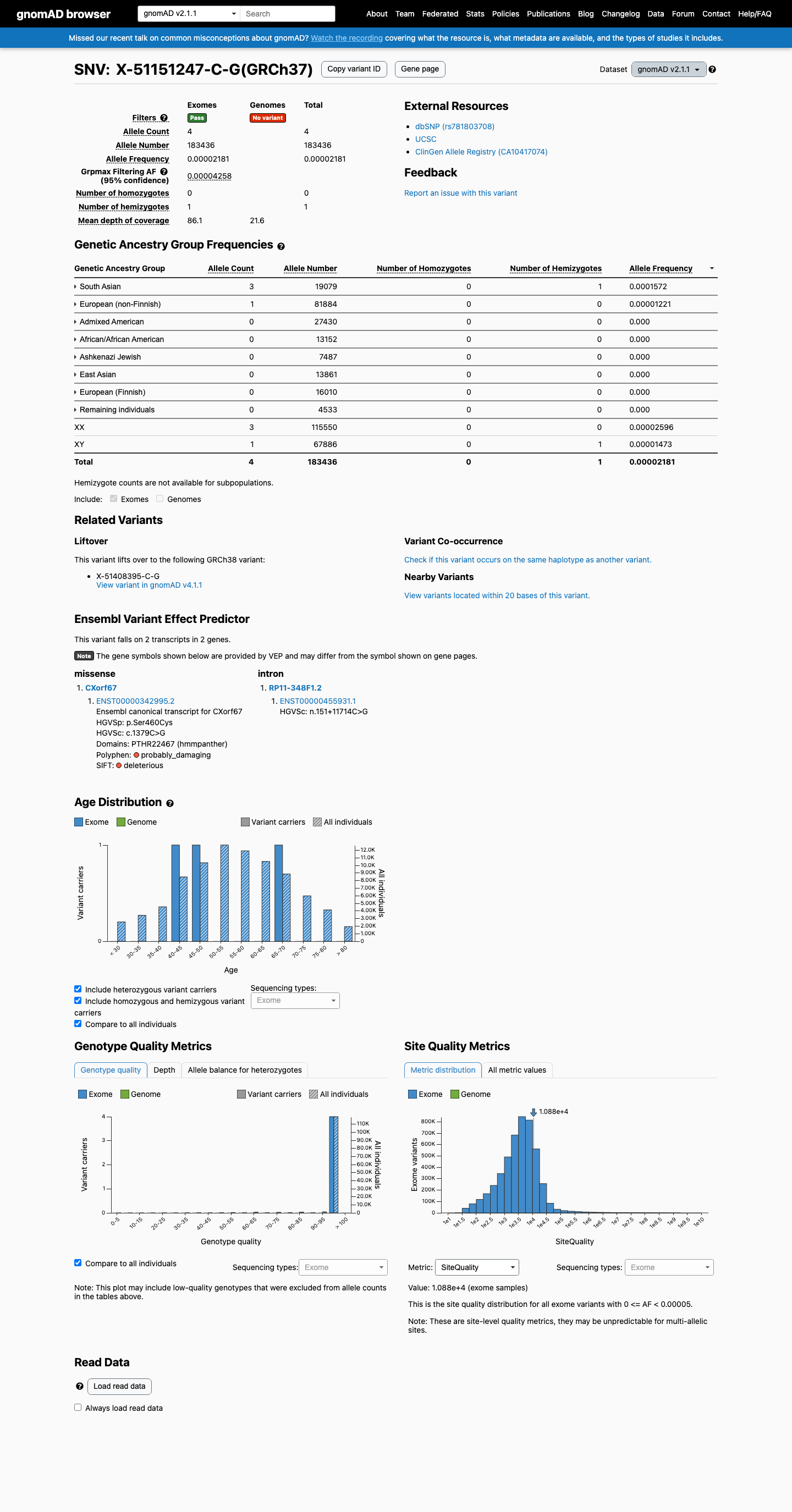
gnomAD v4.1 screenshot
gnomAD v4.1
gnomAD v2.1 screenshot
gnomAD v2.1
v4.1
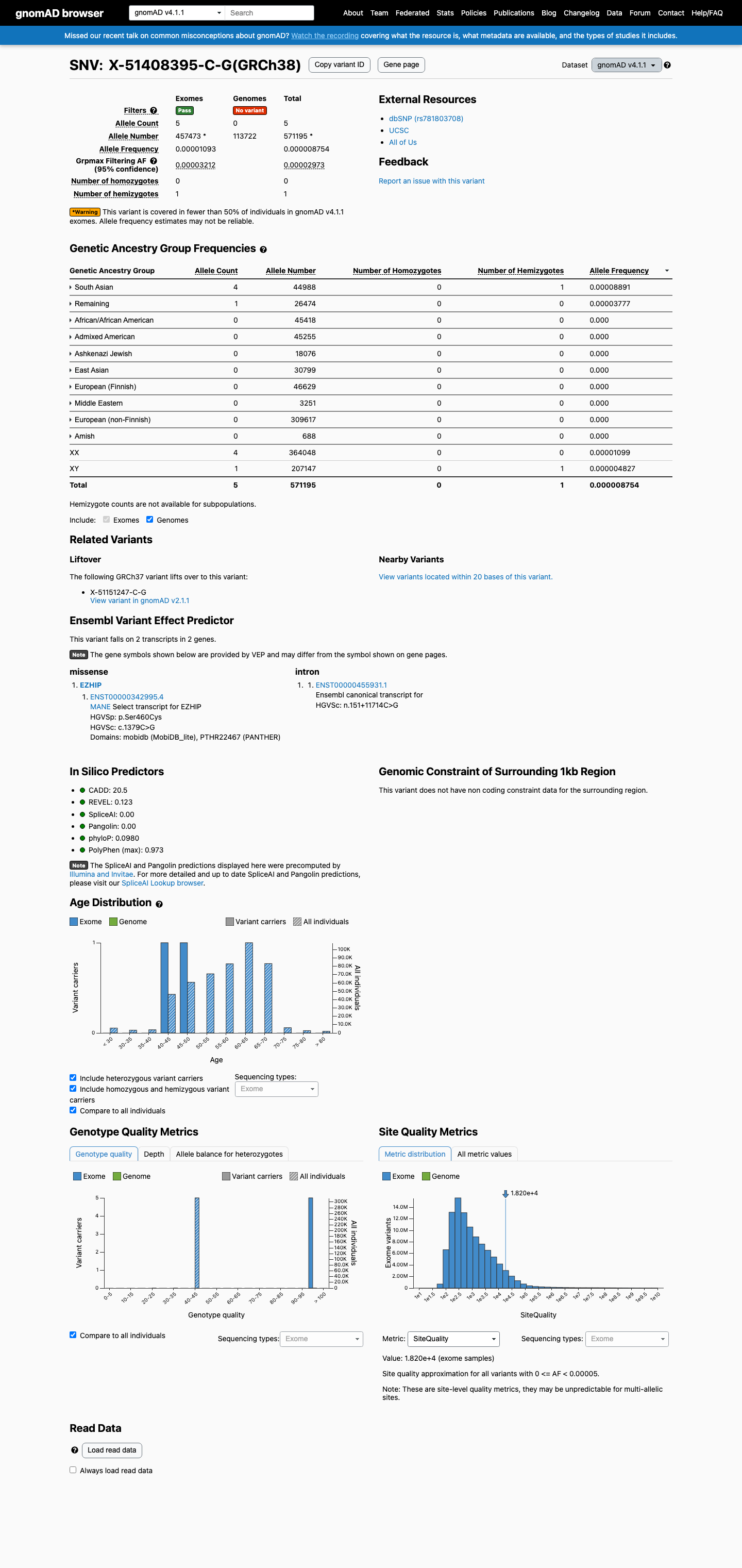
This variant is present in gnomAD v4.1 (AF= 8.75358e-06; MAF= 0.00088%, 5/571195 alleles, homozygotes = 0) and has highest observed frequency in the South Asian population (AF= 8.89126e-05; MAF= 0.00889%, 4/44988 alleles, homozygotes = 0); grpmax FAF= 2.973e-05.
v2.1
This variant is present in gnomAD v2.1 (AF= 2.1806e-05; MAF= 0.00218%, 4/183436 alleles, homozygotes = 0) and has highest observed frequency in the South Asian population (AF= 0.000157241; MAF= 0.01572%, 3/19079 alleles, homozygotes = 0); grpmax FAF= 4.258e-05.
🇨🇦 CA
This variant is present in gnomAD-Canada v1.0 (AF= 0.00013808340237503452, 2/14484 alleles, homozygotes = 0).
Allele frequency by ancestry
three datasets · side by side
gnomAD v4.1
0.00088% · 5 / 571,195
0 hom · FAF 0.003%
South Asian
4 / 44,988
0.0089%
Remaining individuals
1 / 26,474
0.0038%
+ 8 not observed (Admixed American, European (Finnish), Amish, East Asian, Middle Eastern, Ashkenazi Jewish, African/African American, European (non-Finnish))
gnomAD v2.1
0.0022% · 4 / 183,436
0 hom · FAF 0.0043%
South Asian
3 / 19,079
0.016%
European (non-Finnish)
1 / 81,884
0.0012%
+ 6 not observed (African/African American, Admixed American, Ashkenazi Jewish, East Asian, European (Finnish), Remaining individuals)
gnomAD Canada 🇨🇦
0.014% · 2 / 14,484
0 hom · FAF 0.036%
South Asian
2 / 993
0.2%
+ 8 not observed (African/African American, Latino/Admixed American, Ashkenazi Jewish, East Asian, European (Finnish), Middle Eastern, European (non-Finnish), Remaining individuals)
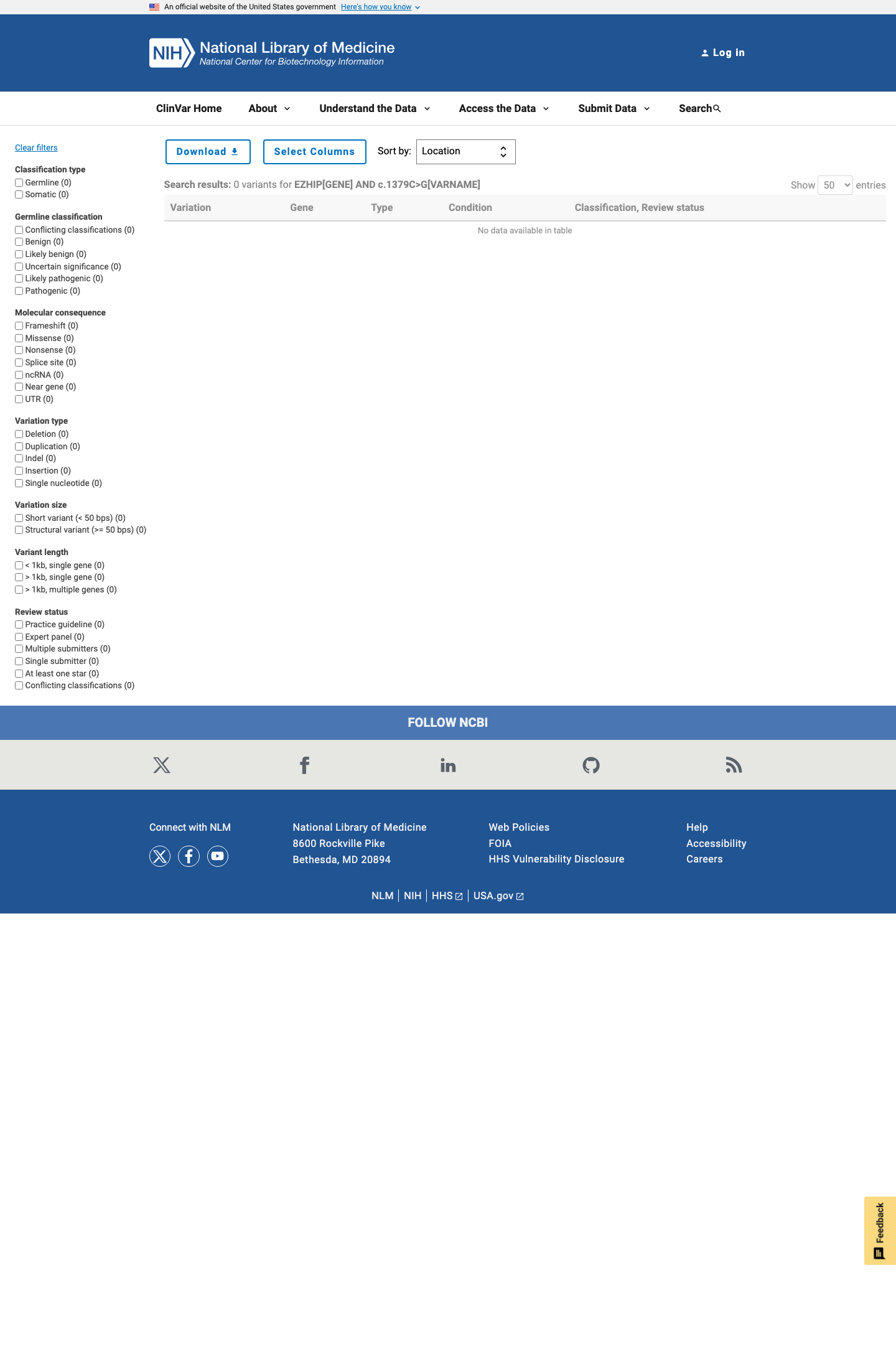
ClinVar screenshot
ClinVar
This variant is absent from ClinVar.
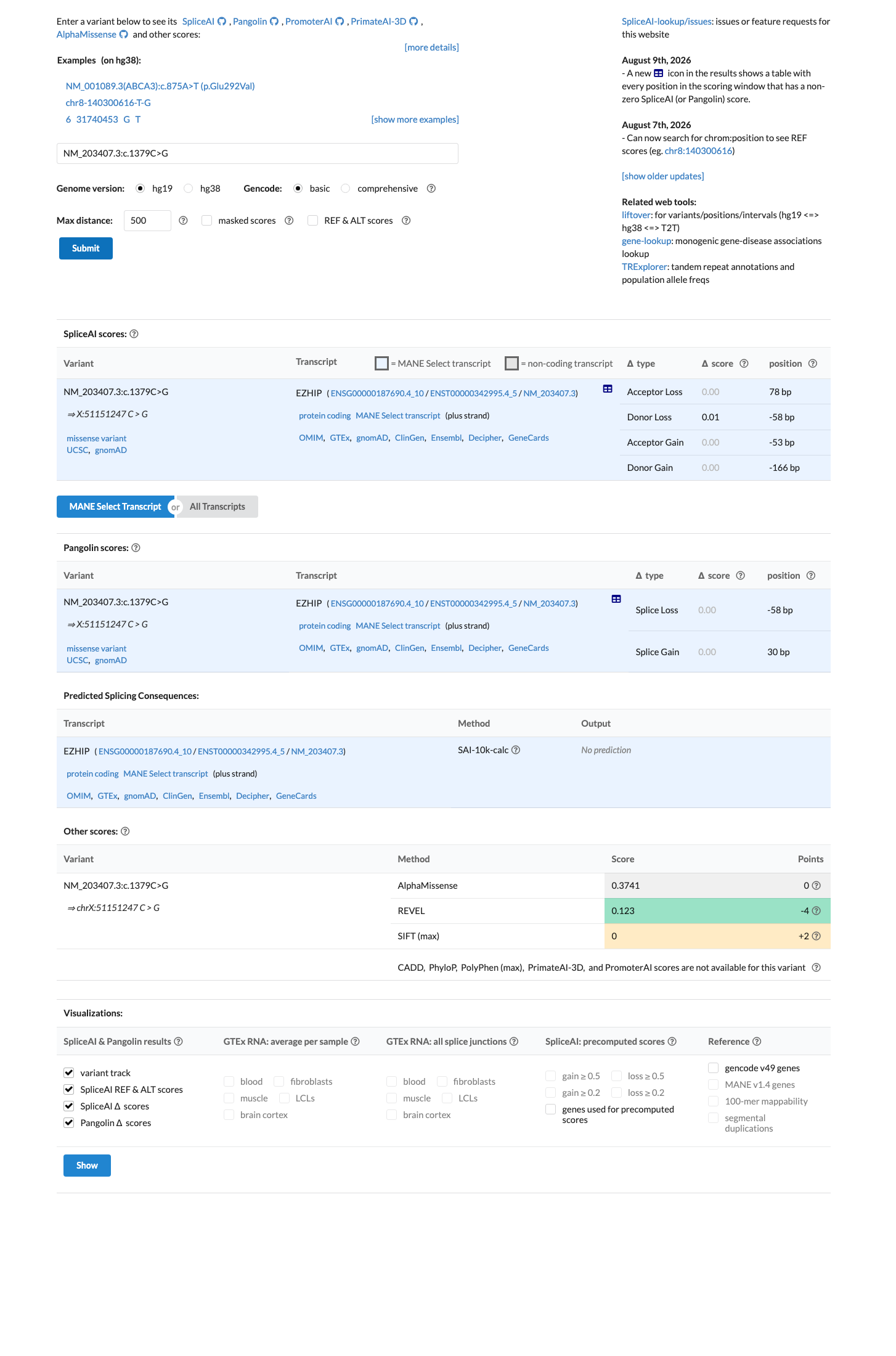
SpliceAI screenshot
In silico
SpliceAI predicts no significant splice impact for this variant (max delta score = 0.01). BayesDel score = -0.514238.
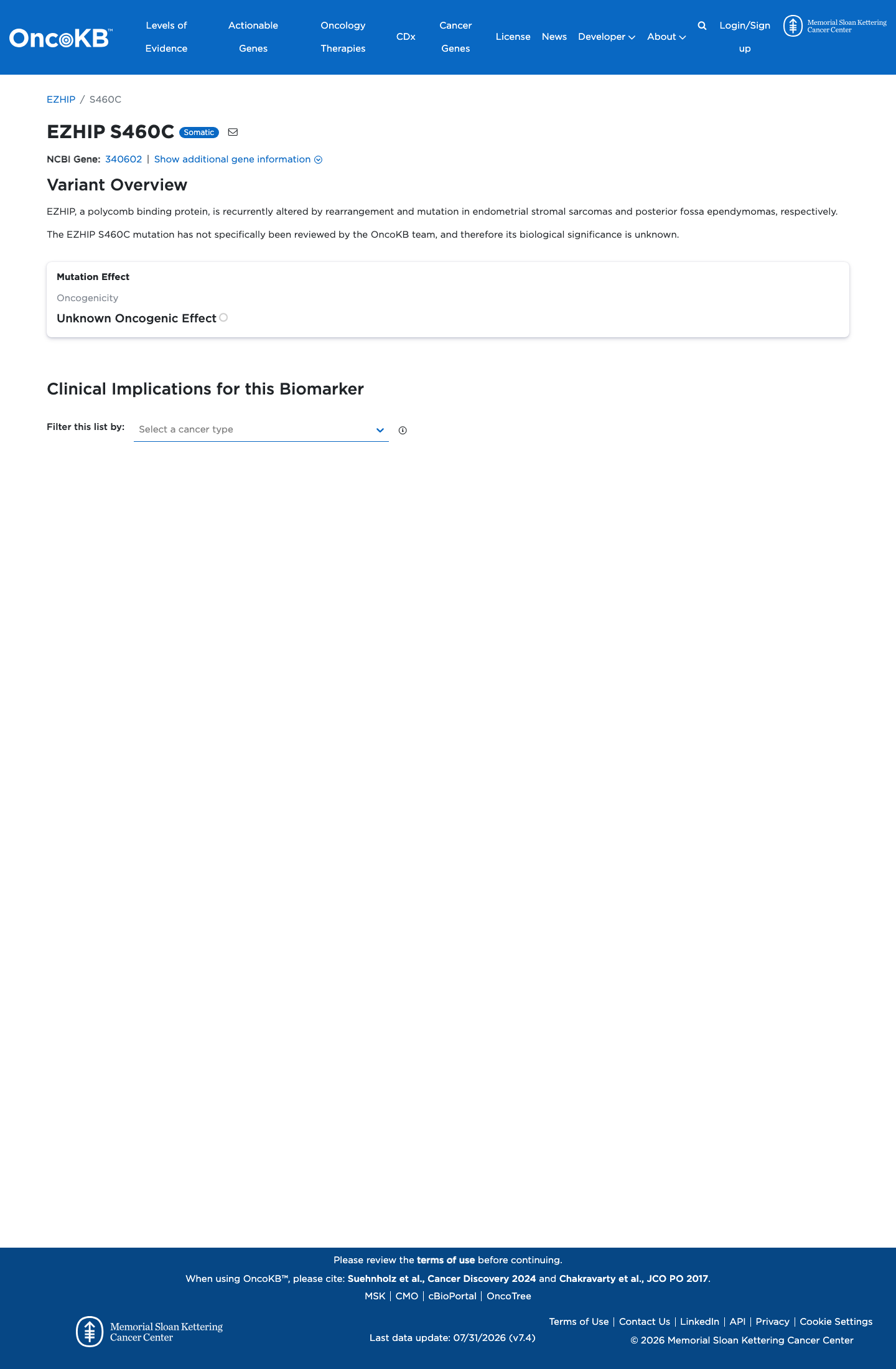
Functional / OncoKB screenshot
Functional Unknown Oncogenic Effect
OncoKB did not identify variant-specific reviewed functional evidence for this variant; gene-level curated context is available for reviewer follow-up. EZHIP, a polycomb binding protein, is recurrently altered by rearrangement and mutation in endometrial stromal sarcomas and posterior fossa ependymoma
OncoKB ↗
COSMIC screenshot
COSMIC
Cancer hotspots screenshot
Cancer hotspots
Somatic evidence Not in COSMIC / hotspots
COSMIC
This variant does not lie in a statistically significant hotspot. This variant has not previously been reported in somatic cancers (COSMIC).
Hotspots
This variant does not lie in a statistically significant hotspot.
Sources & reference links
8Sources
ClinVar
gnomAD v2.1
gnomAD v4.1
gnomAD-Canada
SpliceAI
OncoKB
COSMIC
Cancer hotspots