Analysis in progress
Initialising…
0%
complete
This report is still being assembled — sections appear as each stage finishes. It isn't final yet.
ESR1
Final classification
Likely Pathogenic
PM2PP3
ESR1
c.1163T>A
p.Met388Lys
missense · exon 6

ESR1 encodes estrogen receptor alpha (ERα), a nuclear receptor and ligand-activated transcription factor that regulates estrogen-inducible genes involved in growth, metabolism, sexual development, and reproduction. It plays a key role in breast cancer, endometrial cancer, and osteoporosis, and functions as an oncogene whose signaling promotes tumorigenesis. Constitutive receptor activity is a common driver of acquired resistance to estrogen-deprivation therapies in hormone-resistant metastatic breast cancer.

This variant

ESR1 encodes estrogen receptor alpha, whose constitutive signaling drives resistance to estrogen-deprivation therapy in hormone-resistant metastatic breast cancer. This Likely Pathogenic missense change (p.Met388Lys) therefore points to altered receptor function at a residue relevant to the gene's oncogenic role in breast and endometrial cancer.

Transcript
NM_001122740.1
HGVS · transcript:coding
NM_001122740.1:c.1163T>A
GRCh38
chr6:152011722 T>A
GRCh37
chr6:152332857 T>A
Basis Likely Pathogenic: one strong criterion (PP3, REVEL 0.977 >= 0.932) plus one moderate criterion (PM2, absent from gnomAD v2.1/v4.1), with no benign evidence, under generic ACMG/AMP rules.
Likely Pathogenic: one strong criterion (PP3, REVEL 0.977 >= 0.932) plus one moderate criterion (PM2, absent from gnomAD v2.1/v4.1), with no benign evidence, under generic ACMG/AMP rules.
Classification rationale
PM2PP3 Likely Pathogenic
ESR1 c.1163T>A missense · exon 6

PM2 (Moderate): the variant is absent from gnomAD v2.1 and v4.1, supporting extreme rarity in population databases. PP3 (Strong): REVEL score 0.977 exceeds the strong pathogenic threshold of >=0.932. Combining one strong and one moderate pathogenic criterion with no benign evidence yields Likely Pathogenic under the generic ACMG/AMP framework.

PM2 + PP3 Likely Pathogenic
Gene diagram · NM_001122740.1 · variants mapped to exon structure
ESR1 NM_001122740.1
Fetching transcript structure from UCSC…
Applied criteria · 2 applied · 22 assessed
MetEvidence satisfies this criterion.
Not metEvaluated against available evidence; threshold not reached.
Not assessedApplies in principle, but no evidence was found to evaluate it.
N/ADoesn't apply to this variant type.
Applied · 2
Strength Supporting Moderate Strong Very strong
PM2 moderate review Pathogenic
Met (moderate): absent from gnomAD v2.1 and v4.1, supporting extreme rarity in population databases. Flagged for human review: callable coverage at this locus is not yet confirmed.
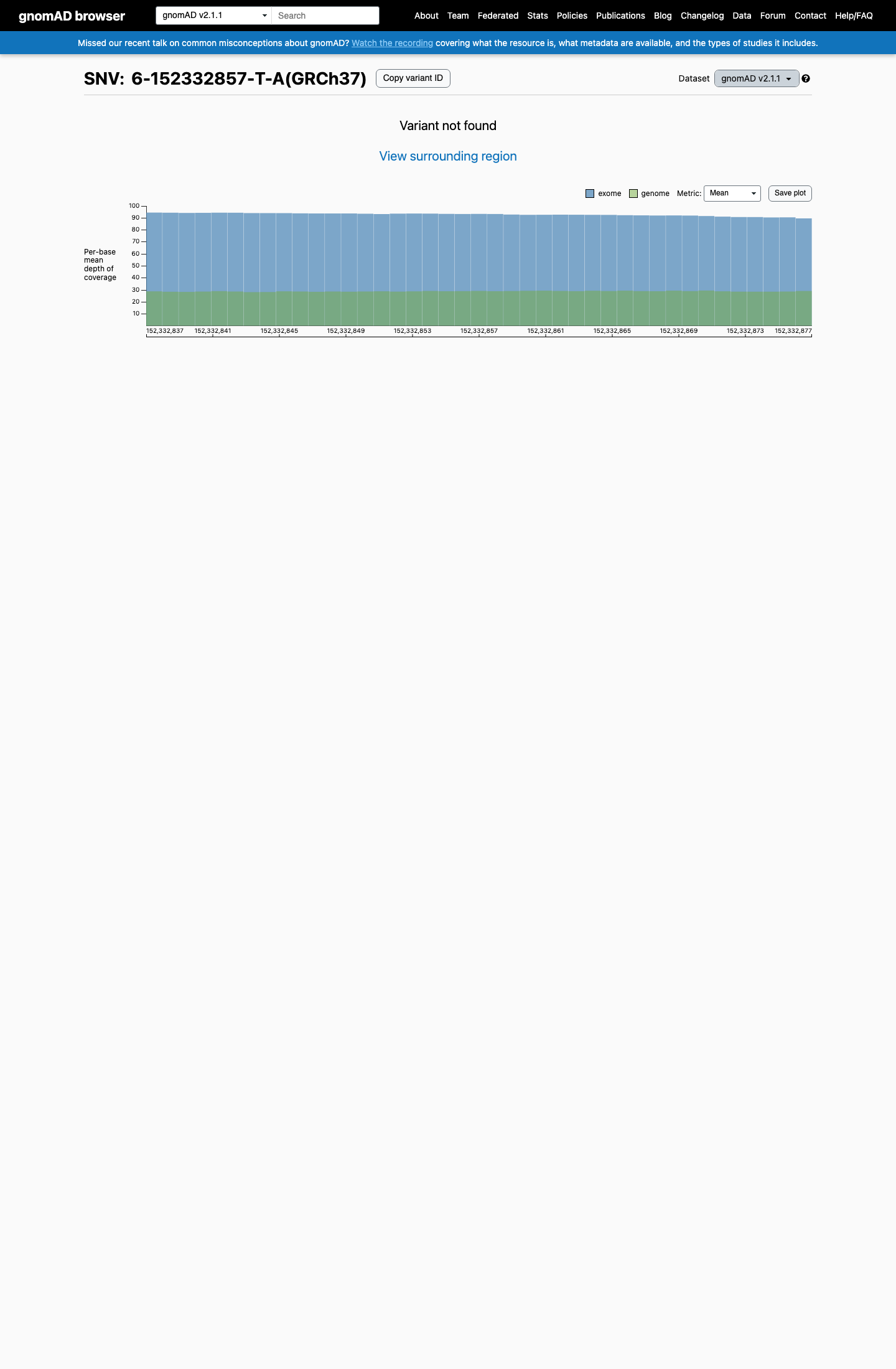
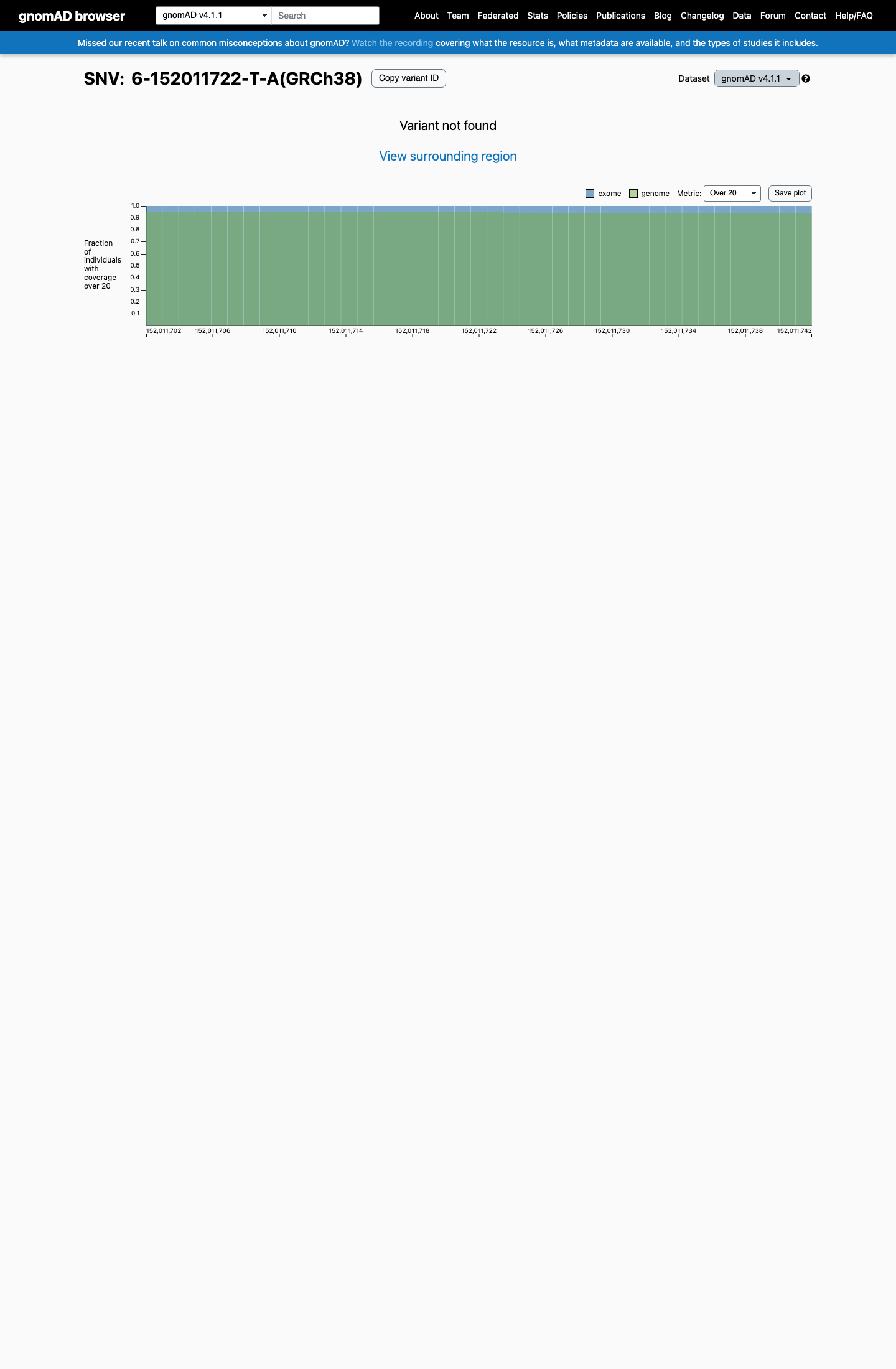
gnomAD v2.1 reports the variant as absent.gnomAD v4.1 reports the variant as absent.gnomAD-Canada v1.0 reports the variant as absent, but allele number is 0, so it cannot serve as a reliable denominator for rarity.
PP3 strong Pathogenic
Met (strong): REVEL score 0.977 exceeds the strong pathogenic threshold of >=0.932.
REVEL score = 0.977 for NM_001122740.1:c.1163T>A (NP_001116212.1:p.(Met388Lys)), exceeding the >=0.932 strong-pathogenic threshold from the ClinGen SVI REVEL recalibration (PMID:36413997, Pejaver et al. 2022, Am J Hum Genet), supporting PP3_Strong.No CSPEC/VCEP-specific PP3/BP4 lookup table was found for ESR1 (cspec.found=false), so generic ACMG missense in-silico calibration was applied.BayesDel score (0.524984) was retrieved but withheld from PP3 scoring because no citable published threshold/table for BayesDel is verified for this pipeline.
Assessed · not applied · 5 not met · 17 not assessed
Pathogenic
PS1 Not assessed: insufficient evidence was available to evaluate whether the same amino-acid change has an established pathogenic designation.
PS2 Not assessed: no proband de novo occurrence, parental genotypes, or maternity/paternity confirmation were available.
PS3 Not assessed: no functional assay data for p.Met388Lys were identified in the literature or curated databases.
PS4 Not assessed: no variant-specific affected case series or case-control comparison was available.
PM1 Not assessed: insufficient evidence was available to evaluate whether the variant lies in a mutational hotspot or critical functional domain.
PM3 Not assessed: no affected-proband observations or phase information with pathogenic comparators in trans or cis were available.
PM5 Not assessed: insufficient evidence was available to evaluate whether a pathogenic missense change is established at the same residue.
PM6 Not assessed: no unconfirmed de novo observation with pedigree or parental details was available.
PP1 Not assessed: no segregation data (affected or unaffected relatives, meioses, pedigree structure) were available.
PP2 Not assessed: insufficient evidence was available to evaluate the gene's rate of benign missense variation.
PP4 Not assessed: no patient phenotype or disease-specific clinical profile was provided.
PP5 Not met: the exact variant is absent from ClinVar, with no expert-panel Pathogenic or Likely Pathogenic assertion.
Benign
BA1 Not met: no population allele frequency was reported in gnomAD v2.1 or v4.1 to meet the stand-alone benign threshold.
BS1 Not met: the variant is absent from gnomAD v2.1 and v4.1, with no frequency exceeding an expected disorder threshold.
BS2 Not assessed: no unaffected-carrier, homozygous, or hemizygous observations were available.
BS3 Not assessed: no functional assay data for this variant were available to demonstrate a benign effect.
BS4 Not assessed: no non-segregation evidence (unaffected carriers or affected relatives lacking the variant) was available.
BP1 Not assessed: insufficient evidence was available to determine whether missense variants are benign for this gene's disease mechanism.
BP2 Not assessed: no observation of the variant in trans or cis with a pathogenic variant, and no phase information, was available.
BP4 Not met: REVEL 0.977 predicts a pathogenic effect, well above the benign range, so no benign in-silico signal applies.
BP5 Not assessed: no affected individual or independent pathogenic molecular explanation was provided.
BP6 Not met: the exact variant is absent from ClinVar, with no expert-panel Benign or Likely Benign assertion.
N/A · 4 PVS1 · PM4 · BP3 · BP7
Research & evidence
Population frequency · supports pathogenic
gnomAD v4.1 screenshot
gnomAD v4.1
gnomAD v2.1 screenshot
gnomAD v2.1
v4.1
Absent from gnomAD v4.1.
v2.1
Absent from gnomAD v2.1.
🇨🇦 CA
Absent from gnomAD-Canada v1.0.
Allele frequency by ancestry
three datasets · side by side
gnomAD v4.1
Absent · 0 / ?
0 hom
Not observed in any ancestry group.
gnomAD v2.1
Absent · 0 / ?
0 hom
Not observed in any ancestry group.
gnomAD Canada 🇨🇦
Absent · 0 / ?
0 hom
Not observed in any ancestry group.
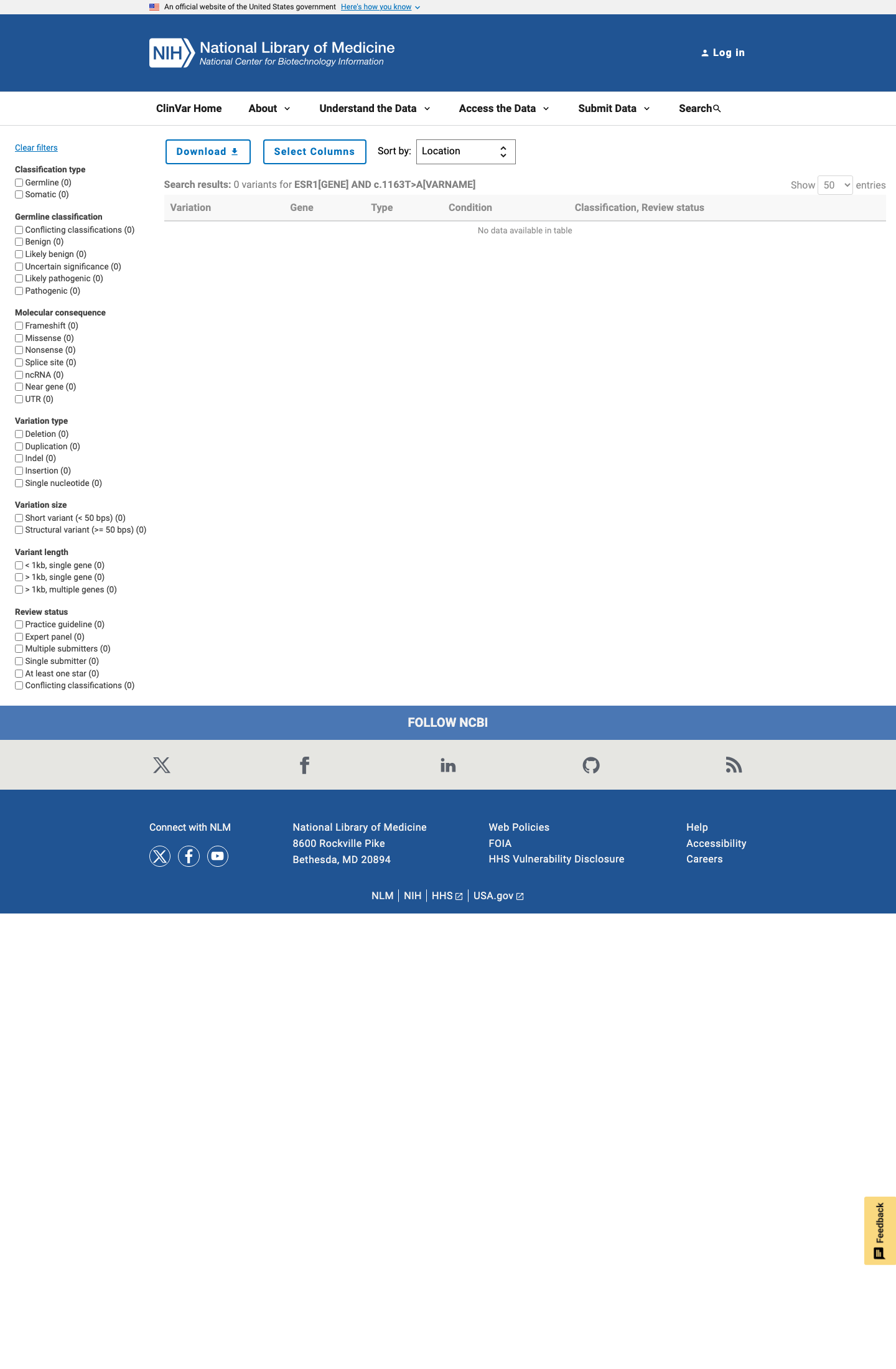
ClinVar screenshot
ClinVar
This variant is absent from ClinVar.
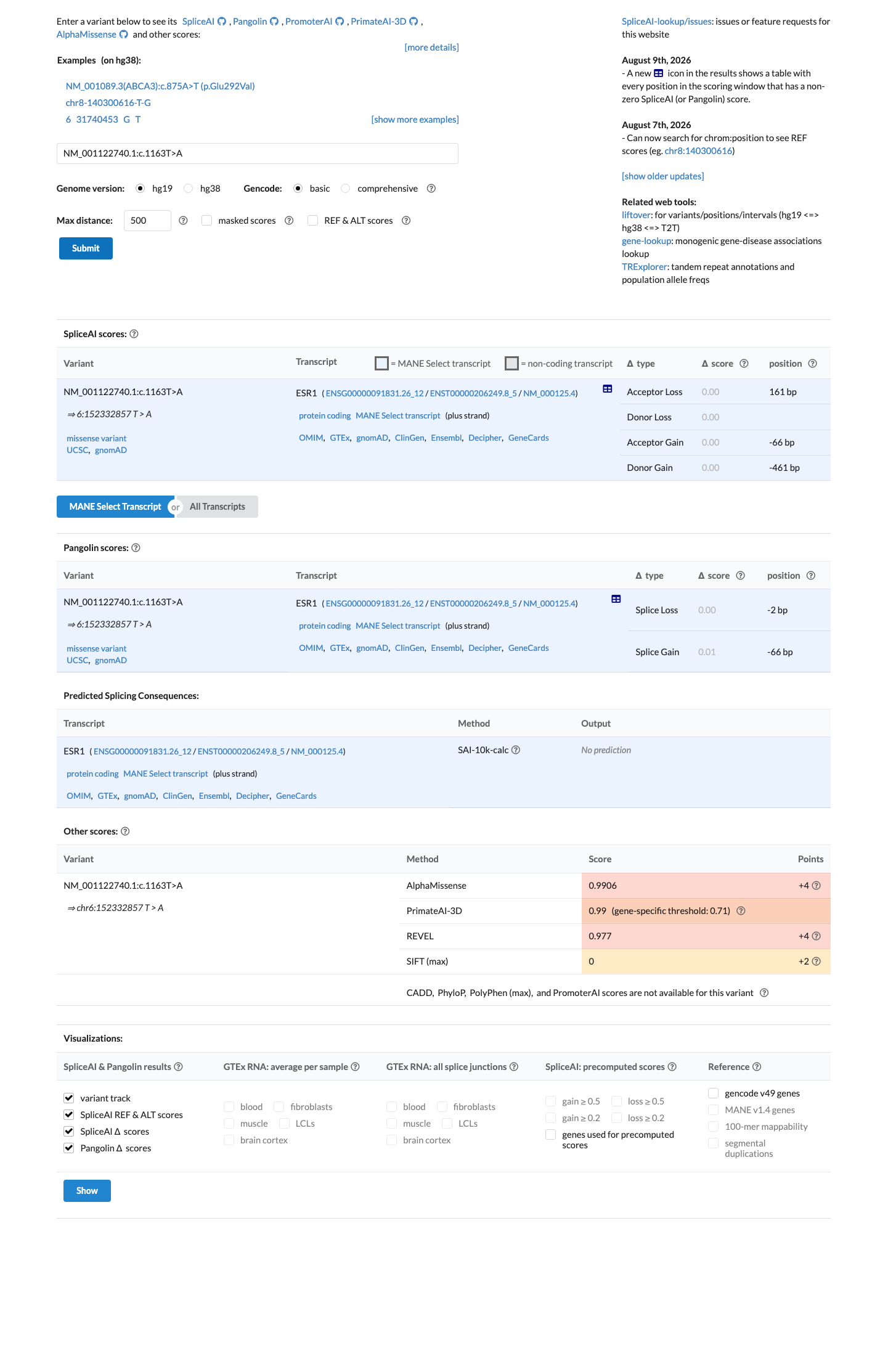
SpliceAI screenshot
In silico
SpliceAI predicts no significant splice impact for this variant (max delta score = 0.00). REVEL score = 0.977. BayesDel score = 0.524984.
Functional / OncoKB screenshot
Functional Unknown Oncogenic Effect
OncoKB did not identify variant-specific reviewed functional evidence for this variant; gene-level curated context is available for reviewer follow-up. ESR1 (estrogen receptor alpha) is a transcription factor that is frequently mutated in hormone-resistant metastatic breast cancers.
OncoKB ↗
COSMIC screenshot
COSMIC
Cancer hotspots screenshot
Cancer hotspots
Somatic evidence Not in COSMIC / hotspots
COSMIC
This variant does not lie in a statistically significant hotspot. This variant has not previously been reported in somatic cancers (COSMIC).
Hotspots
This variant does not lie in a statistically significant hotspot.
Sources & reference links
8Sources
ClinVar
gnomAD v2.1
gnomAD v4.1
gnomAD-Canada
SpliceAI
OncoKB
COSMIC
Cancer hotspots