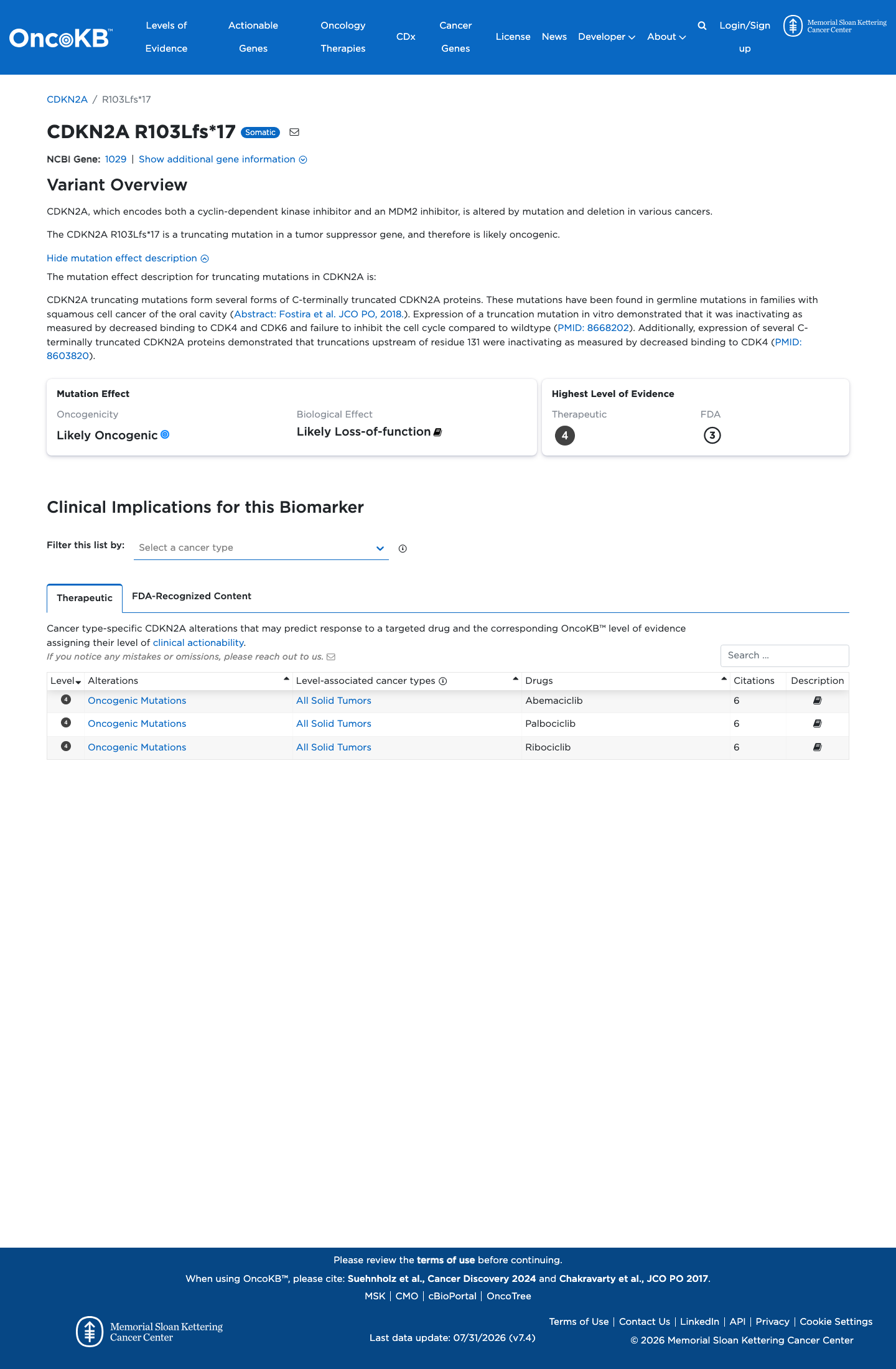
CDKN2A encodes two key proteins, p16(INK4a) and p14(ARF), that help control cell division. p16 blocks the cell cycle by inhibiting CDK4 and CDK6, preventing progression from the G1 to S phase, while p14 stabilizes the tumor suppressor p53 by preventing its degradation. CDKN2A is an important tumor suppressor: it is frequently mutated, deleted, or silenced in many cancers, including melanoma, lymphoma, and pancreatic and lung cancer, and inherited changes in the gene can predispose people to familial melanoma and pancreatic cancer.
This variant
CDKN2A is a tumor suppressor whose inherited loss predisposes to familial melanoma and pancreatic cancer, and this frameshift is predicted to destroy p16(INK4a) function through a premature stop that triggers nonsense-mediated decay. The Likely Pathogenic classification therefore indicates this variant probably contributes to the cancer-predisposition risk associated with this gene, rather than representing a benign population variant.
Transcript
NM_000077.4
HGVS · transcript:coding
NM_000077.4:c.307_308insT
GRCh38
chr9:21971051 C>CA
GRCh37
chr9:21971050 C>CA
BasisWith no CDKN2A ClinGen VCEP available, generic ACMG/AMP 2015 rules combine PVS1 (very strong) and PM2 (moderate) to Likely Pathogenic; splice-only BP4 does not offset them.▾
With no CDKN2A ClinGen VCEP available, generic ACMG/AMP 2015 rules combine PVS1 (very strong) and PM2 (moderate) to Likely Pathogenic; splice-only BP4 does not offset them.
Classification rationale
PVS1PM2BP4Likely Pathogenic
CDKN2A c.307_308insTframeshift · exon 2
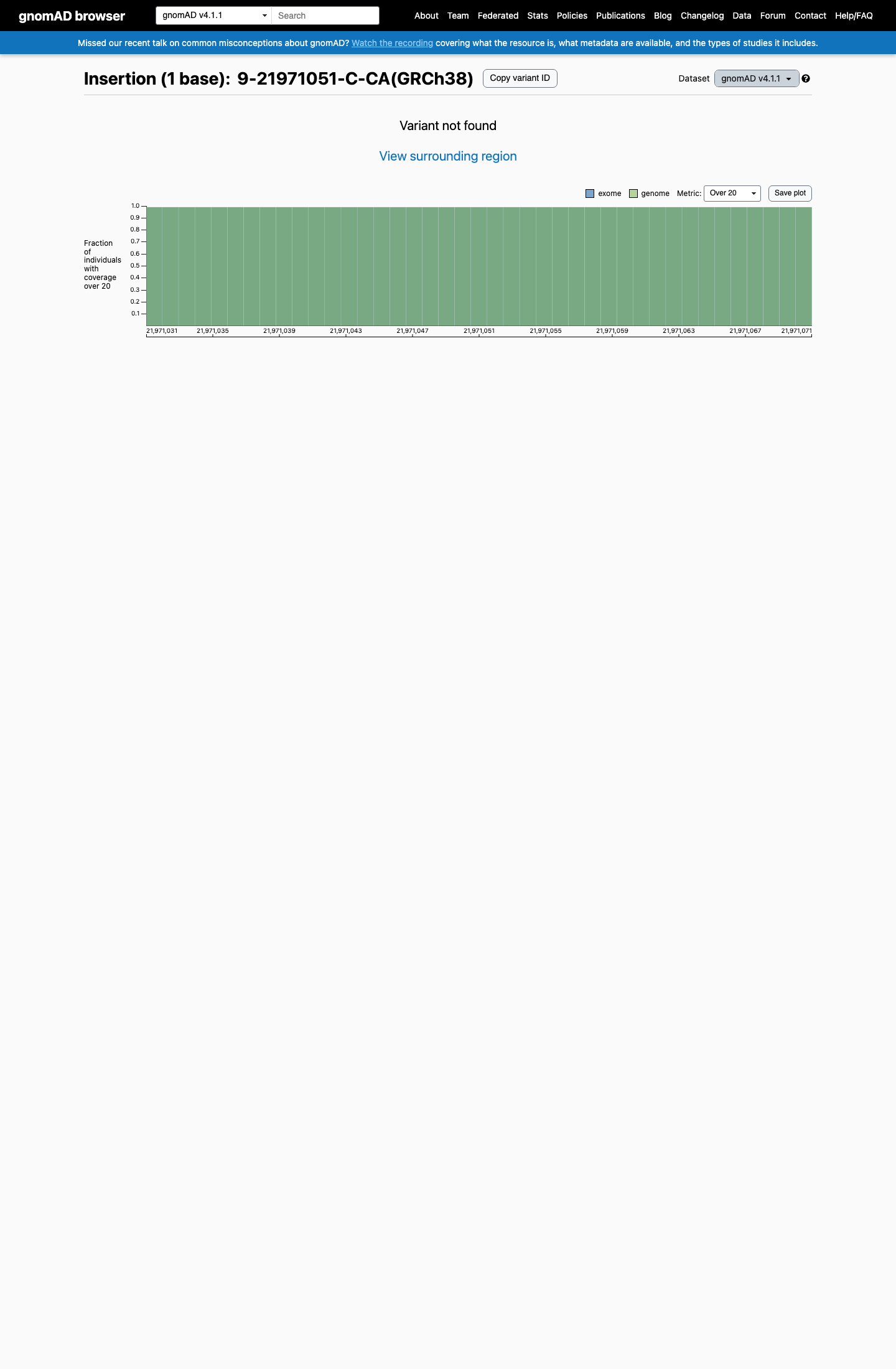
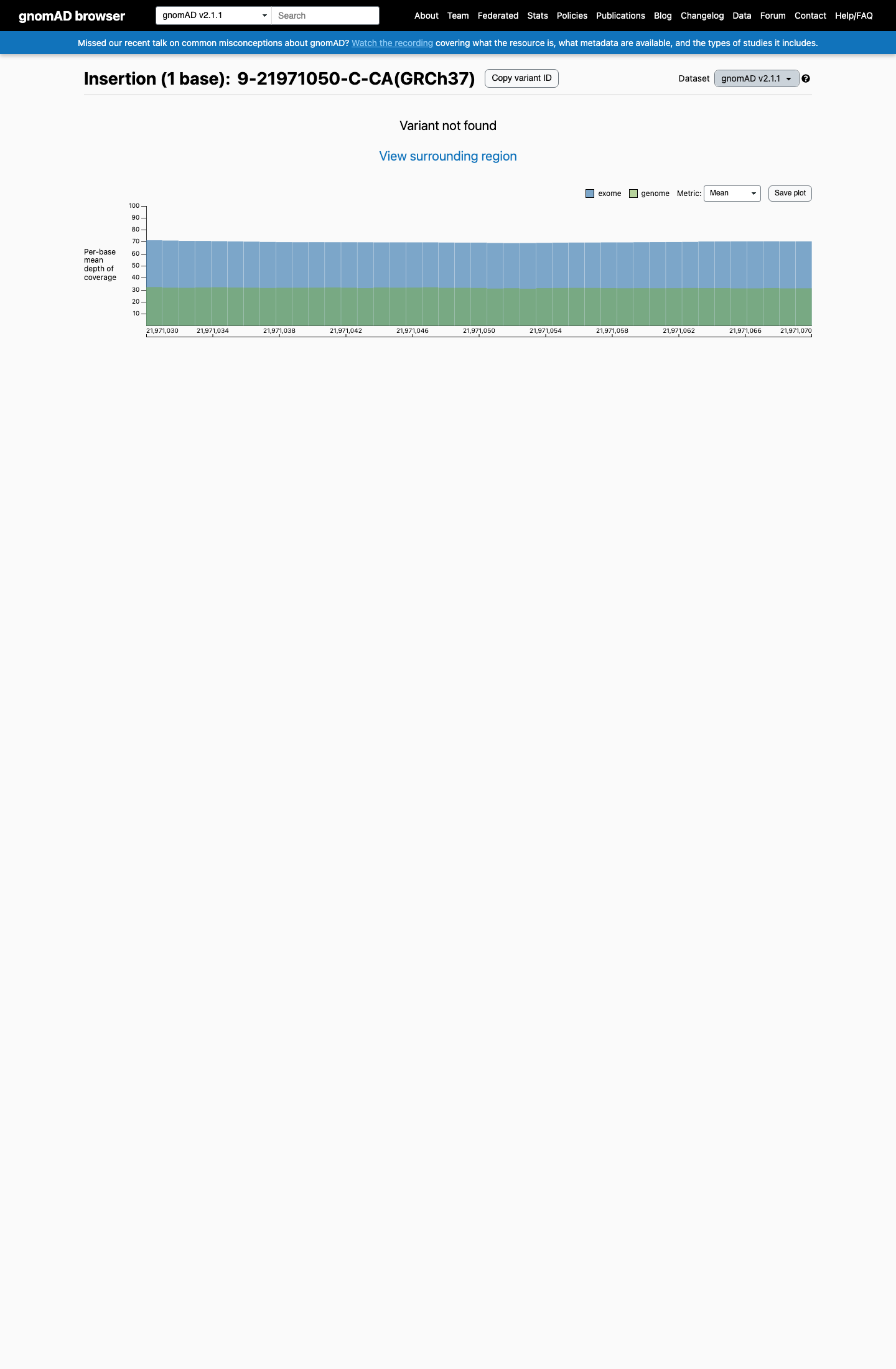
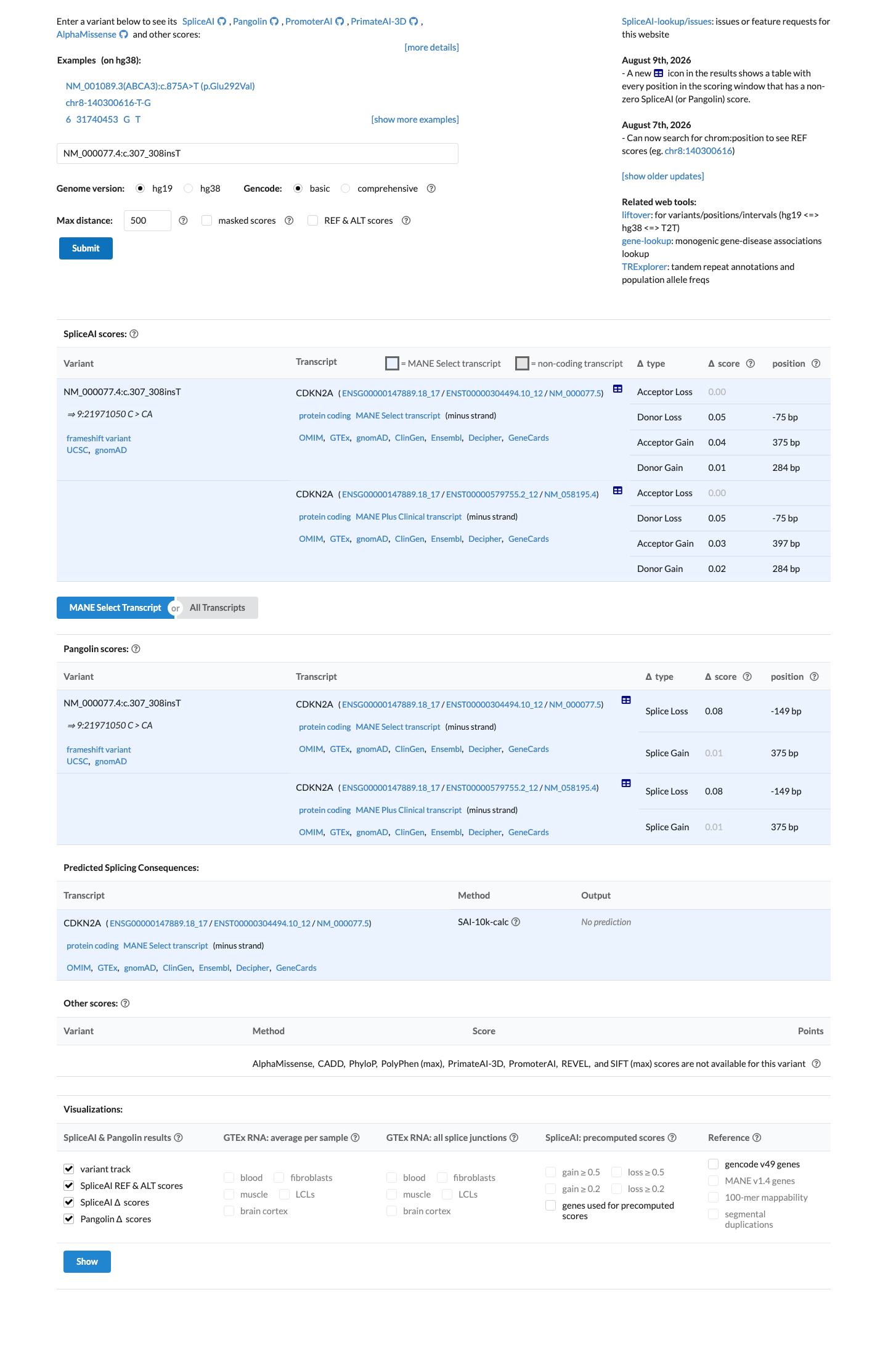
PVS1 (Very Strong): frameshift predicted to trigger nonsense-mediated decay, a loss-of-function mechanism established in CDKN2A. PM2 (Moderate): variant absent from gnomAD v2.1, gnomAD v4.1, and gnomAD-Canada population databases. BP4 (Supporting): no splice-altering effect predicted (SpliceAI/Pangolin max delta 0.00); applies to splicing only. Combining PVS1 (very strong) plus PM2 (moderate) under generic ACMG/AMP 2015 rules yields Likely Pathogenic.
PVS1 + PM2 + BP4→Likely Pathogenic
Gene diagram
· NM_000077.4 · variants mapped to exon structure
CDKN2ANM_000077.4
Fetching transcript structure from UCSC…
Exons
—
Transcript span
—
Strand
—
Variants mapped
—
Source
UCSC ncbiRefSeqCurated
All variants in CDKN2A—click a row to locate it on the plot · use the link column to open its page
Variant ↕
Protein
Location
Classification
Link
Applied criteria · 3 applied · 17 assessed
MetEvidence satisfies this criterion.
Not metEvaluated against available evidence; threshold not reached.
Not assessedApplies in principle, but no evidence was found to evaluate it.
N/ADoesn't apply to this variant type.
Applied · 3
Strength Supporting Moderate Strong Very strong
✓
PVS1very strongPathogenic
Met at very strong: the frameshift creates a premature stop 17 codons after residue 103, predicted to trigger nonsense-mediated decay.
pvs1_variant_assessment.json classifies the variant consequence as frameshift, transcript NM_000077.4:c.307_308insT, protein NP_000068.1:p.(Arg103LeufsTer17), and flags apply_generic_pvs1_framework=true with suggested_default_strength=PVS1, framework PMC6185798.pvs1_gene_context.json establishes pvs1_gene_gate=eligible: germline loss-of-function is a supported CDKN2A disease mechanism (lof_mechanism_supported=true), based on targeted germline literature review of CDKN2A-related melanoma predisposition; no official CSPEC/VCEP PVS1 framework exists for this gene so the generic fallback per PMC6185798 was directed.Applying the ClinGen SVI PVS1 decision tree (PMC6185798) to a frameshift variant: the resulting premature stop codon (p.Arg103LeufsTer17, terminating around codon 119 of the 156-aa p16INK4a protein) falls within exon 2, which is not the terminal exon and is well upstream of the final exon-exon junction, predicting NMD and truncation/loss of the C-terminal ankyrin-repeat region required for CDK4/CDK6 inhibitory function.
Met at moderate: the variant is absent from gnomAD v2.1, gnomAD v4.1, and gnomAD-Canada population databases.
The evidence bundle reports this exact normalized allele absent from gnomAD v2.1 (GRCh37 9-21971050-C-CA), gnomAD v4.1 (GRCh38 9-21971051-C-CA), and gnomAD-Canada v1.0.No CDKN2A VCEP/CSPEC population-frequency framework was available in the case materials; generic ACMG/AMP is the designated fallback.
Met at supporting: SpliceAI/Pangolin max delta score 0.00, below the ~0.1 threshold, so no splice-altering effect is predicted. Flagged for human review: this covers splicing only and should not be read as broad benign support.
prefetch.json/evidence.json: SpliceAI max_delta_score = 0.00 (pangolin_SG 0.003, pangolin_SL -0.068) for NM_000077.4:c.307_308insT; evidence_sentence: 'SpliceAI predicts no significant splice impact for this variant (max delta score = 0.00).'Jaganathan et al. 2019 (PMID 30661751) established the SpliceAI delta-score framework; scores near 0.00, well under the ~0.1 low-confidence threshold, are conventionally used as benign-supporting (BP4) evidence against a splice-altering effect.prefetch.json: revel and bayesdel both skipped ('not snv or no coords'), confirming missense in-silico predictors are not_available for this frameshift insertion and cannot independently drive BP4.