Analysis in progress
Initialising…
0%
complete
This report is still being assembled — sections appear as each stage finishes. It isn't final yet.
SETD2
Final classification
Likely Pathogenic
PVS1PM2BP4
SETD2
c.4260del
p.Glu1420AspfsTer12
frameshift · exon 3

SETD2 is a tumor suppressor gene that encodes a histone methyltransferase which adds trimethyl marks to lysine-36 of histone H3 (H3K36me3), a modification that promotes active chromatin and helps regulate gene expression during transcription. It was originally identified as a huntingtin-interacting protein, linking it to Huntington's disease. SETD2 activity also supports DNA mismatch repair, so its loss leads to genetic instability and can drive cancer; SETD2 inactivation is especially common in kidney (renal cell) cancers, where it contributes to defective p53-mediated DNA damage repair.

This variant

SETD2 is a tumor suppressor whose loss drives genomic instability and cancer, with germline loss-of-function variants causing overgrowth/Sotos-like syndrome. This frameshift, predicted to eliminate SETD2 function via nonsense-mediated decay, fits that established loss-of-function mechanism, supporting its Likely Pathogenic classification.

Transcript
NM_014159.6
HGVS · transcript:coding
NM_014159.6:c.4260del
GRCh38
chr3:47120375 GC>G
GRCh37
chr3:47161865 GC>G
Basis PVS1 (Very Strong) plus PM2 (Supporting) gives Likely Pathogenic under generic ACMG/AMP 2015 combination rules; the single supporting BP4 does not reach a benign threshold.
PVS1 (Very Strong) plus PM2 (Supporting) gives Likely Pathogenic under generic ACMG/AMP 2015 combination rules; the single supporting BP4 does not reach a benign threshold.
Classification rationale
PVS1PM2 BP4 Likely Pathogenic
SETD2 c.4260del frameshift · exon 3

PVS1 (Very Strong): frameshift p.(Glu1420AspfsTer12) introduces a premature stop 12 residues downstream, predicted to trigger nonsense-mediated decay. PM2 (Supporting): the deletion is absent from gnomAD v2.1, v4.1, and gnomAD-Canada. BP4 (Supporting): SpliceAI max delta 0.014 indicates no splice impact, but a single benign-supporting criterion does not override the pathogenic combination. PVS1 (Very Strong) + PM2 (Supporting) = Likely Pathogenic under generic ACMG/AMP 2015 rules.

PVS1 + PM2 + BP4 Likely Pathogenic
Gene diagram · NM_014159.6 · variants mapped to exon structure
SETD2 NM_014159.6
Fetching transcript structure from UCSC…
Applied criteria · 3 applied · 17 assessed
MetEvidence satisfies this criterion.
Not metEvaluated against available evidence; threshold not reached.
Not assessedApplies in principle, but no evidence was found to evaluate it.
N/ADoesn't apply to this variant type.
Applied · 3
Strength Supporting Moderate Strong Very strong
PVS1 very strong Pathogenic
Met (Very Strong): the single-nucleotide deletion creates frameshift p.(Glu1420AspfsTer12), with a premature stop 12 residues downstream predicted to trigger nonsense-mediated decay.
case_summary.json normalization: NM_014159.6:c.4260del produces NP_054878.5:p.(Glu1420AspfsTer12), a frameshift consequence (consequence_class=frameshift, variant_bucket=frameshift).pvs1_variant_assessment.json: framework_source is ClinGen SVI PVS1 recommendations (PMC6185798); apply_generic_pvs1_framework=true; suggested_default_strength=PVS1; rationale confirms frameshift variants are evaluated with the generic PVS1 framework once germline LoF is established for the gene.pvs1_gene_context.json: germline_disease_context_found=true; lof_mechanism_supported=true; pvs1_gene_gate=eligible; mechanism_rationale states targeted germline literature review identified disease-focused publications supporting SETD2 loss of function as a germline disease mechanism (SETD2-related overgrowth condition/Sotos-like syndrome, citing PMID 24852293 and PMID 31643139 among supporting_sources), so generic PVS1 framework assessment is eligible.
PM2 supporting Pathogenic
Met (Supporting): the deletion is absent from gnomAD v2.1, v4.1, and gnomAD-Canada.
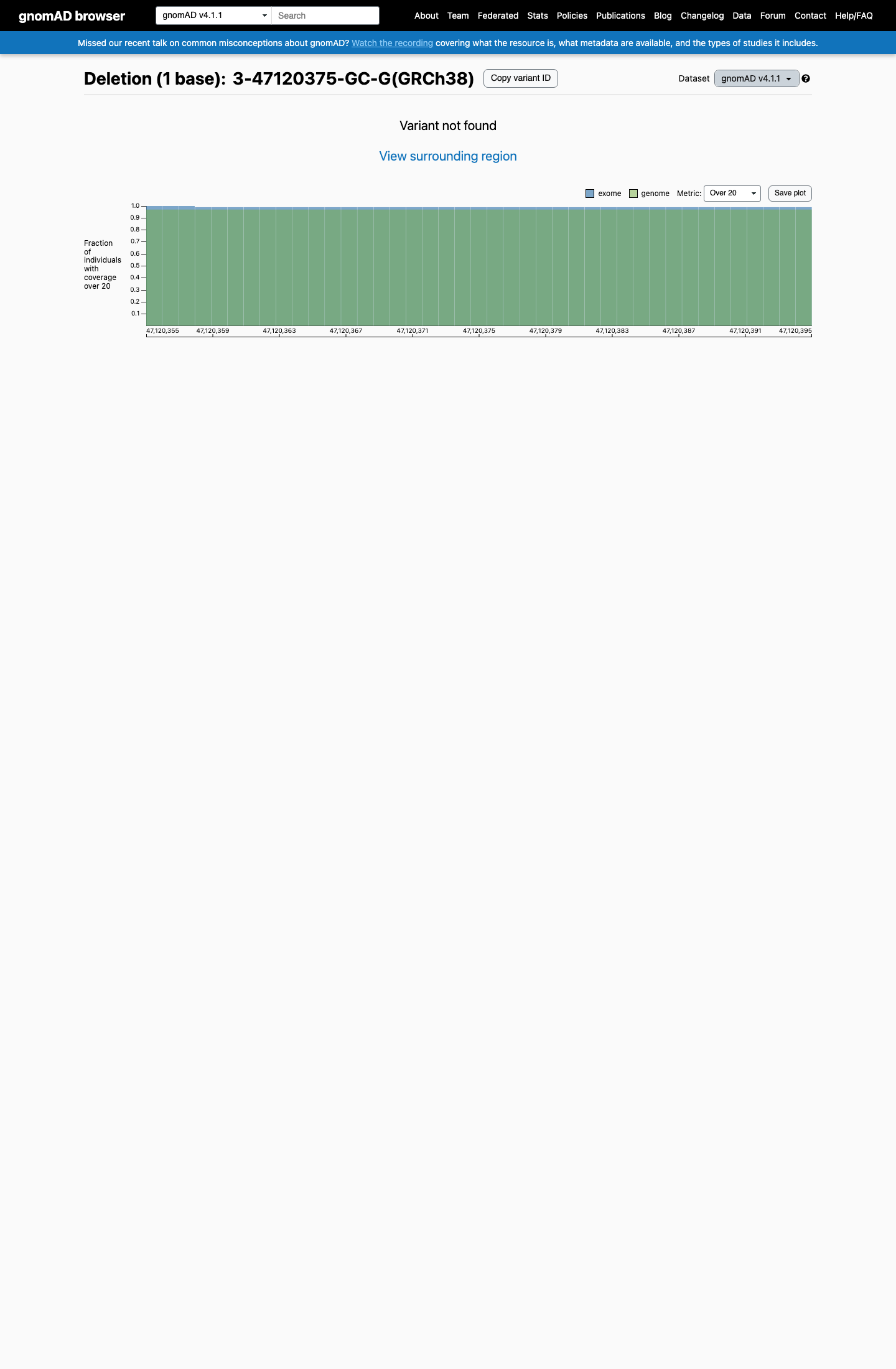
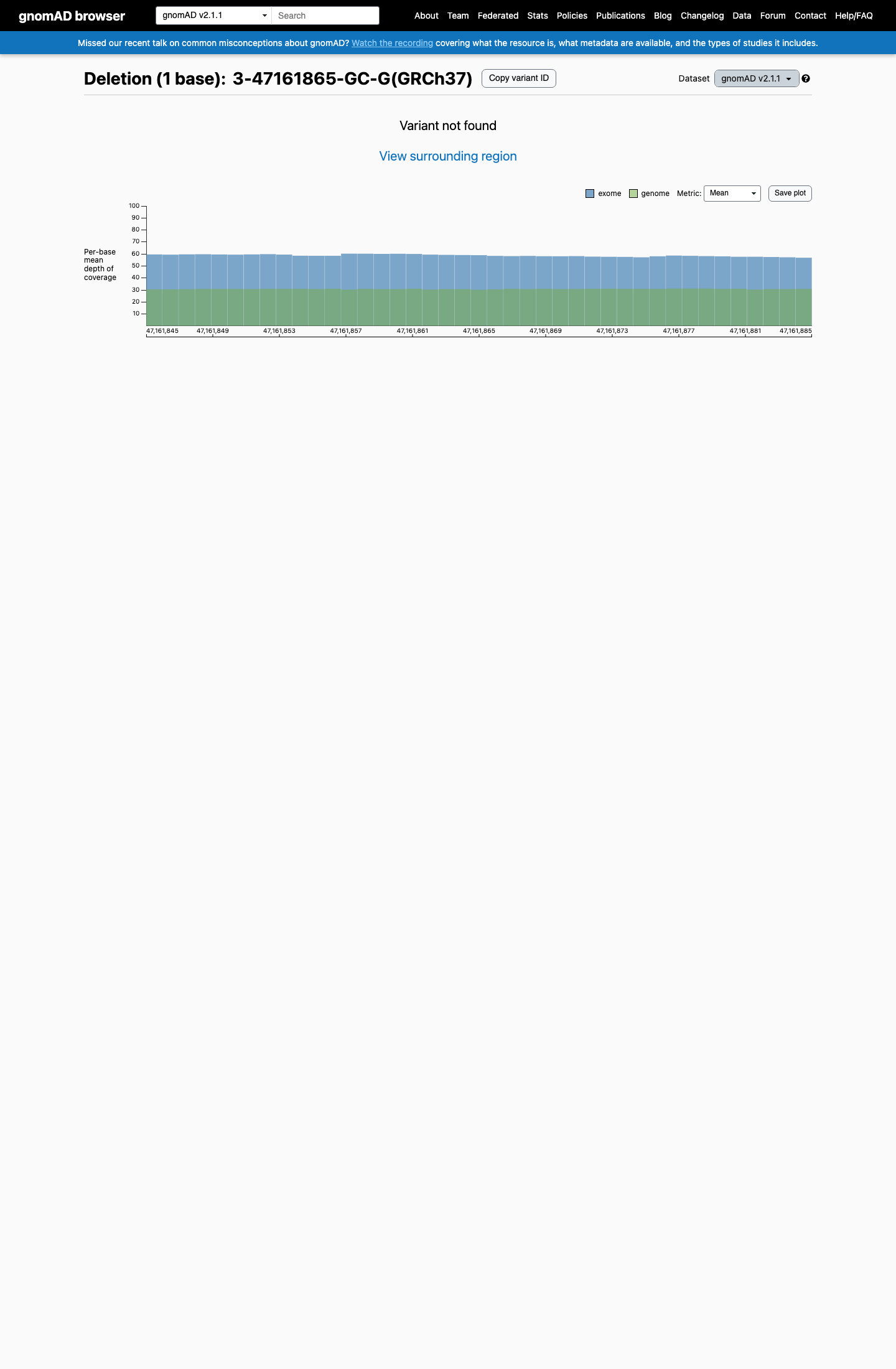
The exact normalized deletion was queried in gnomAD v2.1 (GRCh37), gnomAD v4.1 (GRCh38), and gnomAD-Canada v1.0 (GRCh38); each source reported the variant as absent.
BP4 supporting Benign
Met (Supporting): SpliceAI max delta 0.014 is well below the ~0.2 threshold for a splice-altering effect.
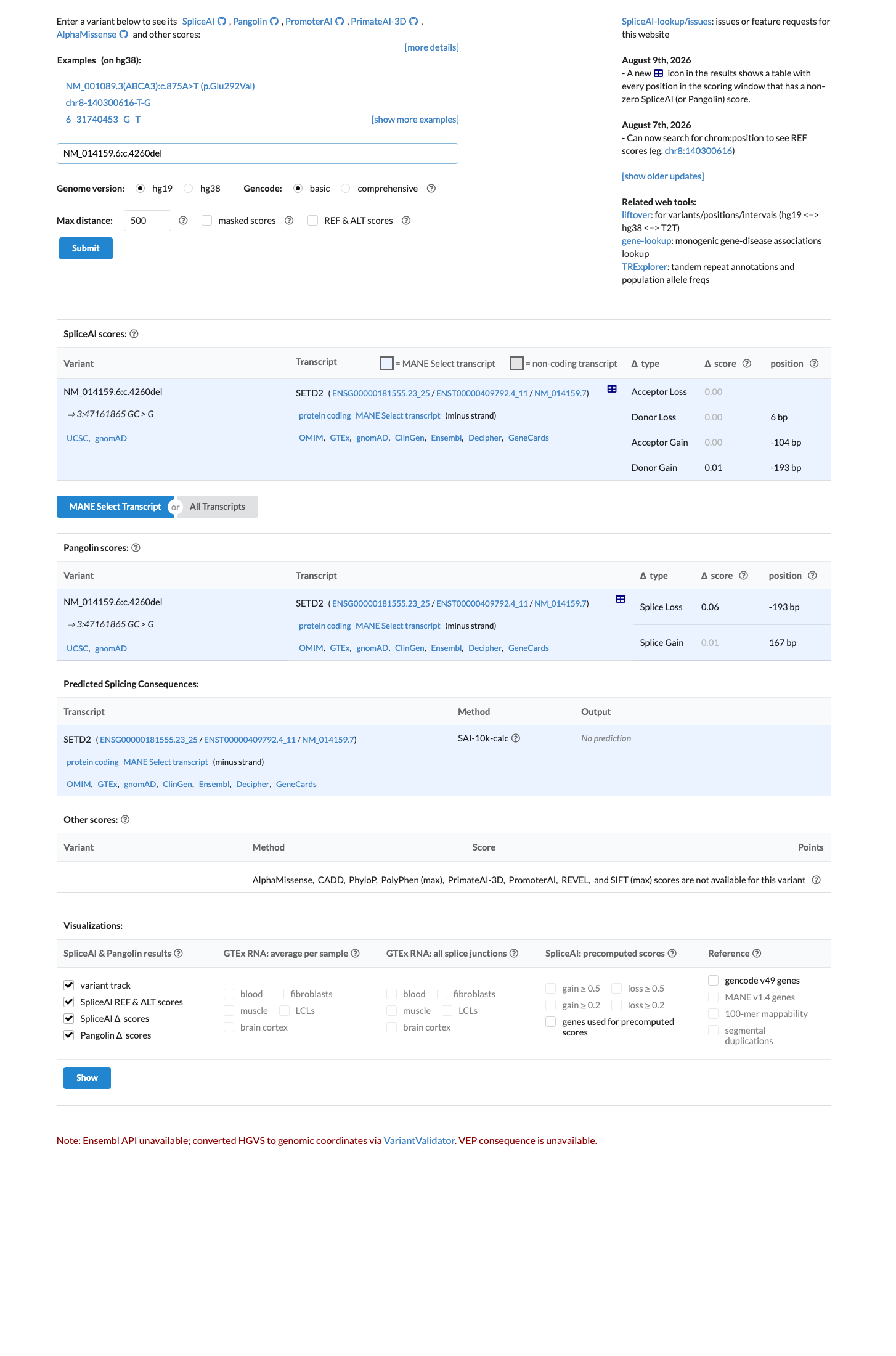
case_summary.compact_evidence.spliceai.evidence_sentence: 'SpliceAI predicts no significant splice impact for this variant (max delta score = 0.01).' with scores DS_AG=0.0, DS_AL=0.0, DS_DG=0.014, DS_DL=0.001, DP values all indicating distant/low-confidence positions, max_delta=0.014.SpliceAI delta score of 0.014 falls well below the ~0.2 threshold band associated with likely splice-altering variants described in the original SpliceAI publication (Jaganathan et al. 2019, Cell, PMID:30661751), supporting a benign/no-impact splicing prediction at supporting strength.
Assessed · not applied · 5 not met · 12 not assessed
Pathogenic
PS2 Not assessed: no parental testing or confirmed de novo occurrence was available.
PS3 Not assessed: no validated functional assay performed on this exact variant was available.
PS4 Not assessed: no case-control or variant-enrichment data were identified.
PM3 Not assessed: no proband carrying a second pathogenic SETD2 variant in trans was observed.
PM6 Not assessed: no de novo occurrence without confirmed parentage was reported.
PP1 Not assessed: no family pedigree or segregation data were provided.
PP3 Not met: SpliceAI max delta 0.014 is far below thresholds supporting a deleterious splice effect.
PP4 Not assessed: no proband phenotype or diagnosis information was available.
PP5 Not met: the variant is absent from ClinVar, so no expert-panel pathogenic assertion exists.
Benign
BA1 Not met: the variant is absent from gnomAD, providing no allele frequency that could satisfy BA1.
BS1 Not met: the variant is absent from gnomAD, with no frequency exceeding a benign-population threshold.
BS2 Not assessed: absence from population sources provides no adult or homozygous observations.
BS3 Not assessed: no functional assay data for this exact variant were available.
BS4 Not assessed: no non-segregation observations, unaffected carriers, or affected non-carriers were available.
BP2 Not assessed: no cis/trans co-occurrence or inheritance data were available.
BP5 Not assessed: no individual-level phenotype or alternative causal diagnosis was provided.
BP6 Not met: the variant is absent from ClinVar, so no expert-panel benign assertion exists.
N/A · 8 PS1 · PM1 · PM4 · PM5 · PP2 · BP1 · BP3 · BP7
Research & evidence
Population frequency · supports pathogenic
gnomAD v4.1 screenshot
gnomAD v4.1
gnomAD v2.1 screenshot
gnomAD v2.1
v4.1
Absent from gnomAD v4.1.
v2.1
Absent from gnomAD v2.1.
🇨🇦 CA
Absent from gnomAD-Canada v1.0.
Allele frequency by ancestry
three datasets · side by side
gnomAD v4.1
Absent · 0 / ?
0 hom
Not observed in any ancestry group.
gnomAD v2.1
Absent · 0 / ?
0 hom
Not observed in any ancestry group.
gnomAD Canada 🇨🇦
Absent · 0 / ?
0 hom
Not observed in any ancestry group.
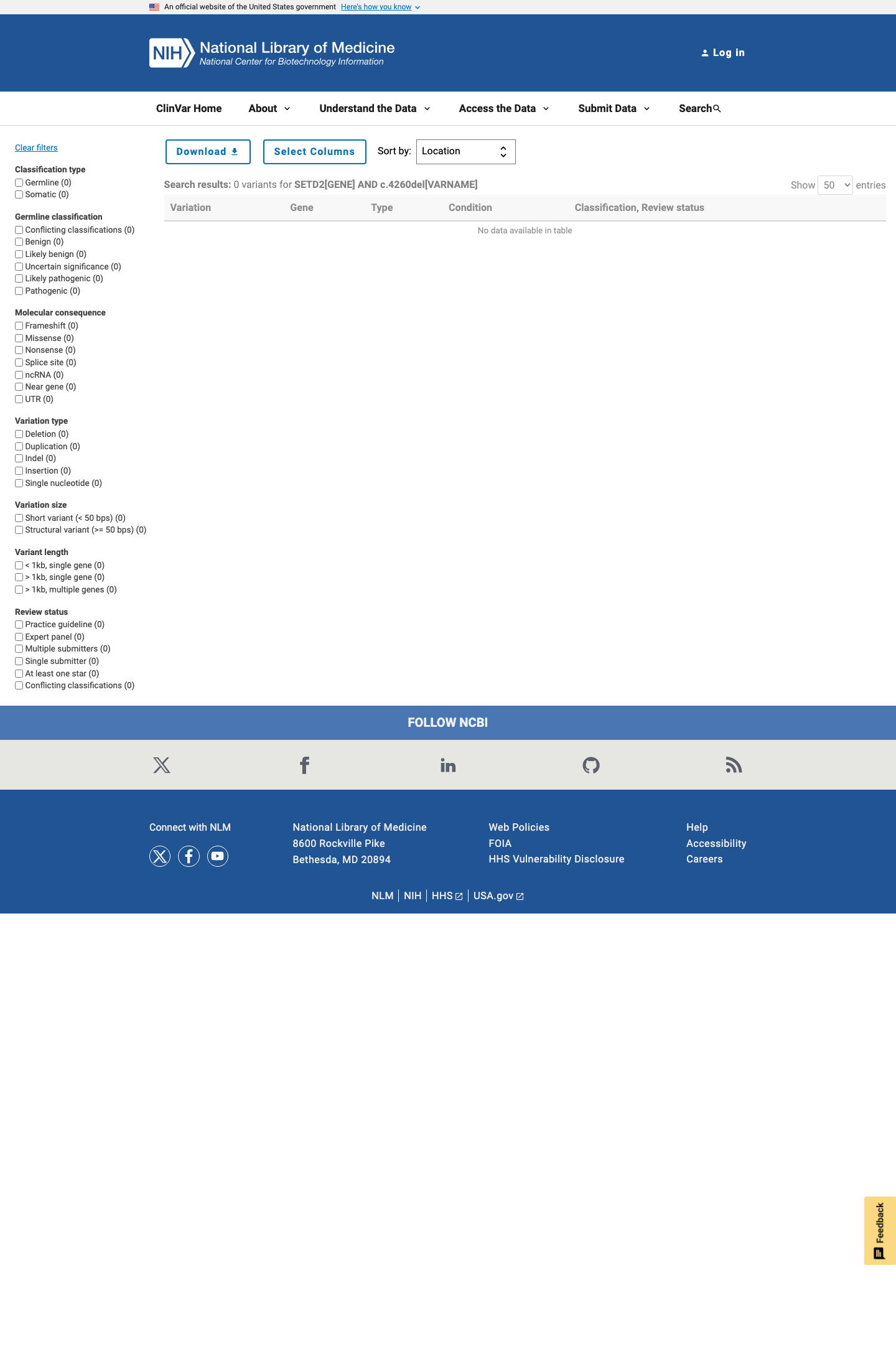
ClinVar screenshot
ClinVar
This variant is absent from ClinVar.
SpliceAI screenshot
In silico
SpliceAI predicts no significant splice impact for this variant (max delta score = 0.01).
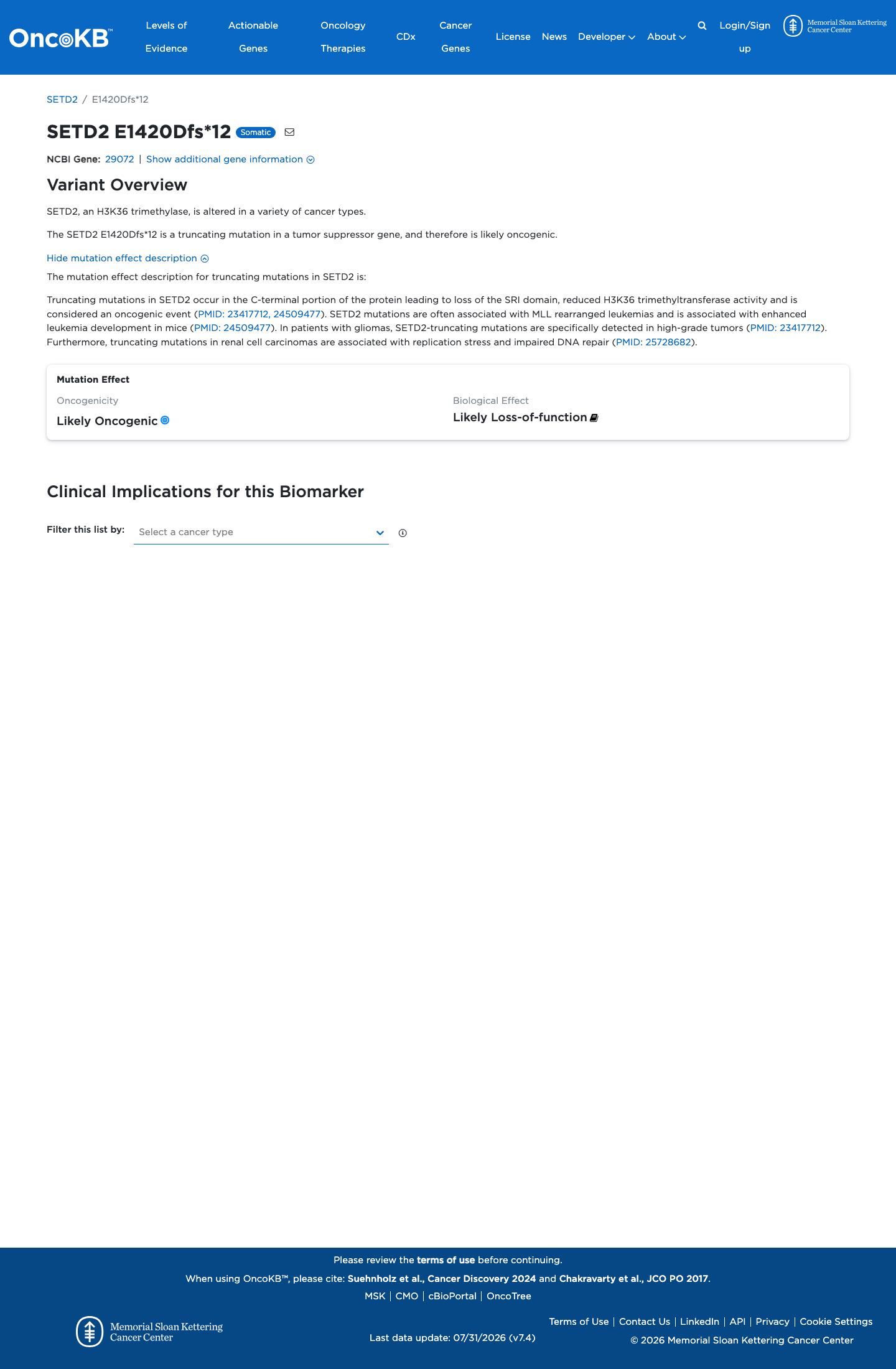
Functional / OncoKB screenshot
Functional Likely Oncogenic
OncoKB identified variant-specific curated literature and context relevant to functional review; biological-effect context: Likely Loss-of-function; curated oncogenicity label: Likely Oncogenic.
OncoKB ↗
COSMIC screenshot
COSMIC
Cancer hotspots screenshot
Cancer hotspots
Somatic evidence Not in COSMIC / hotspots
COSMIC
This variant does not lie in a statistically significant hotspot. This variant has not previously been reported in somatic cancers (COSMIC).
Hotspots
This variant does not lie in a statistically significant hotspot.
Sources & reference links
8Sources
ClinVar
gnomAD v2.1
gnomAD v4.1
gnomAD-Canada
SpliceAI
OncoKB
COSMIC
Cancer hotspots
Triaged references · 3 PMIDs not cited in assessment
23417712 ↗ Mutations in SETD2 and genes affecting histone H3K36 methylation target hemispheric high-grade gliomas. ONCOKB
24509477 ↗ Identification of functional cooperative mutations of SETD2 in human acute leukemia. ONCOKB
25728682 ↗ SETD2 loss-of-function promotes renal cancer branched evolution through replication stress and impaired DNA repair. ONCOKB