Analysis in progress
Initialising…
0%
complete
This report is still being assembled — sections appear as each stage finishes. It isn't final yet.
NTHL1
Final classification
VUS
PM2BP4
NTHL1
c.31C>T
p.Arg11Trp
missense · exon 1

NTHL1 encodes a DNA repair enzyme that recognizes and removes oxidized DNA bases, an early step in the base excision repair pathway that protects the genome from oxidative damage. Germline mutations in NTHL1 cause an inherited predisposition to colorectal tumors and other cancers, and the gene acts as a tumor suppressor. Its role in cancer is complex: while it normally guards against DNA damage, it can also generate lethal double-strand breaks in irradiated cells, and the gene is amplified in a subset of breast and pancreatic tumors.

This variant

NTHL1 encodes a DNA repair enzyme whose biallelic loss-of-function predisposes to colorectal and other tumors; c.31C>T (p.Arg11Trp) is a rare missense change classified as Uncertain Significance, meaning current evidence neither establishes nor rules out a damaging effect on this DNA-repair function.

Transcript
NM_002528.7
HGVS · transcript:coding
NM_002528.7:c.31C>T
GRCh38
chr16:2047793 G>A
GRCh37
chr16:2097794 G>A
Basis No NTHL1-specific ClinGen VCEP/CSPEC framework was available, so generic ACMG/AMP 2015 rules were applied; only PM2 and BP4 (both supporting) were met, satisfying no combination rule and yielding Uncertain Significance.
No NTHL1-specific ClinGen VCEP/CSPEC framework was available, so generic ACMG/AMP 2015 rules were applied; only PM2 and BP4 (both supporting) were met, satisfying no combination rule and yielding Uncertain Significance.
Classification rationale
PM2 BP4 VUS
NTHL1 c.31C>T missense · exon 1

PM2 (Supporting): gnomAD v4.1 allele frequency 0.00528% overall (maximum 0.01472%), below the 0.1% rarity threshold. BP4 (Supporting): REVEL score 0.196 falls below the 0.250 threshold, predicting a benign protein-level effect. Overall classification: Uncertain Significance - one supporting pathogenic criterion (PM2) and one supporting benign criterion (BP4) satisfy no ACMG/AMP 2015 combination rule.

PM2 + BP4 VUS
Gene diagram · NM_002528.7 · variants mapped to exon structure
NTHL1 NM_002528.7
Fetching transcript structure from UCSC…
Applied criteria · 2 applied · 22 assessed
MetEvidence satisfies this criterion.
Not metEvaluated against available evidence; threshold not reached.
Not assessedApplies in principle, but no evidence was found to evaluate it.
N/ADoesn't apply to this variant type.
Applied · 2
Strength Supporting Moderate Strong Very strong
PM2 supporting Pathogenic
Met (supporting): gnomAD v4.1 allele frequency 0.00528% overall (maximum 0.01472%), below the 0.1% PM2 rarity threshold.
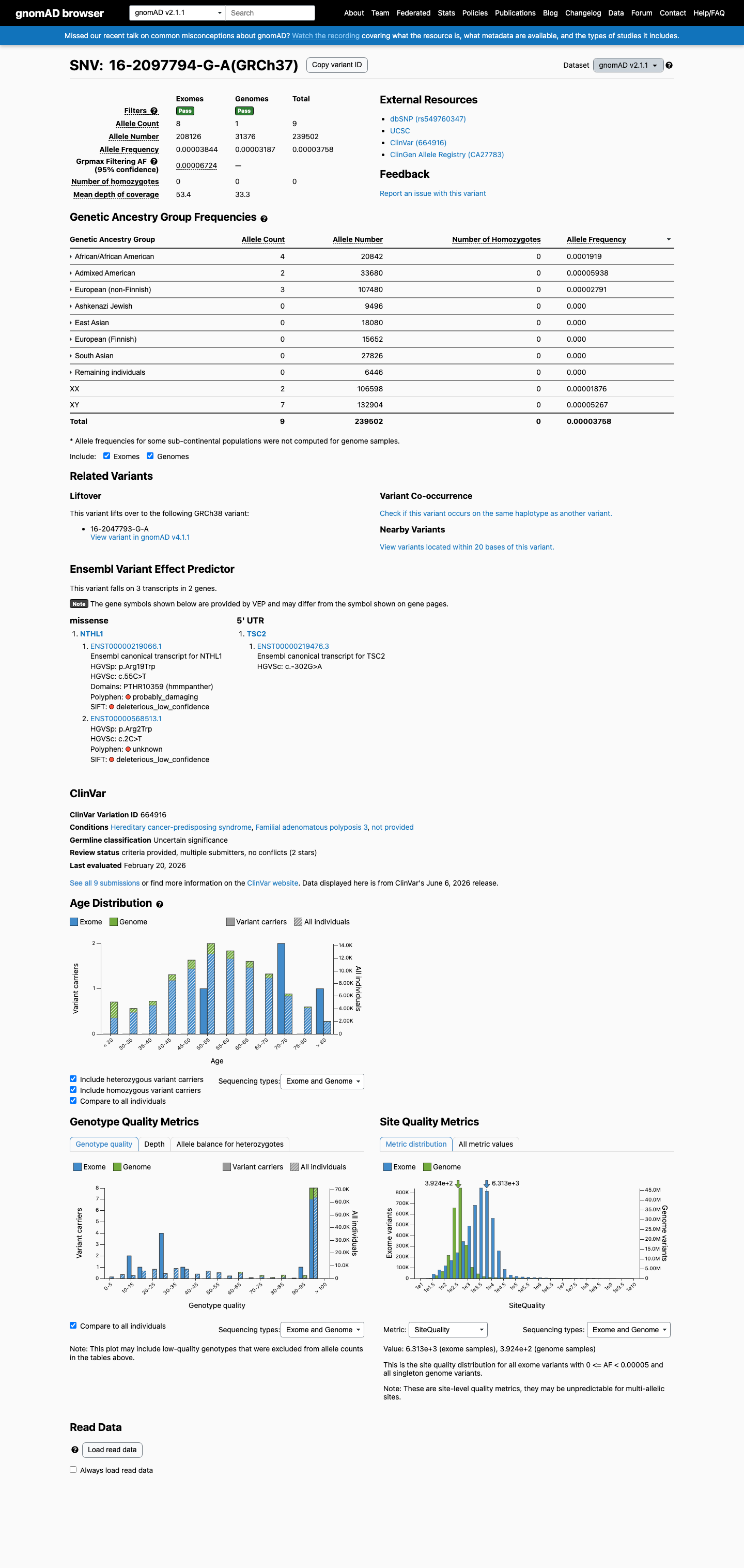
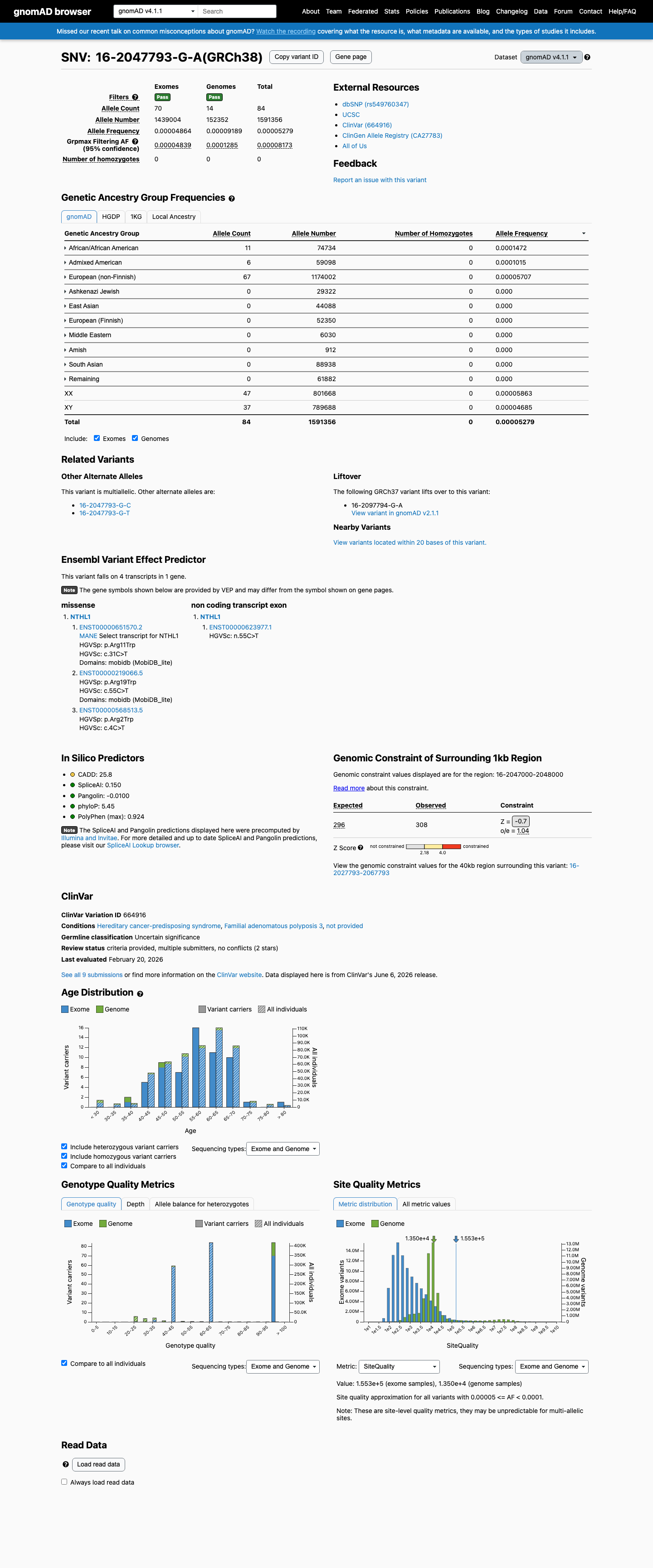
gnomAD v4.1 reports 84/1,591,356 alleles (AF 0.00528%), African/African American 11/74,734 (AF 0.01472%), grpmax filtering AF 0.008173%, and 0 homozygotes.gnomAD v2.1 reports 9/239,502 alleles (AF 0.00376%), African/African American 4/20,842 (AF 0.01919%), grpmax filtering AF 0.006724%, and 0 homozygotes.The v4.1 and v2.1 maximum AFs are both below 0.1%; sparse ancestry counts do not create a threshold artifact that would negate PM2.
BP4 supporting Benign
Met (supporting): REVEL score 0.196 falls below the 0.250 BP4 threshold, predicting a benign protein-level effect.
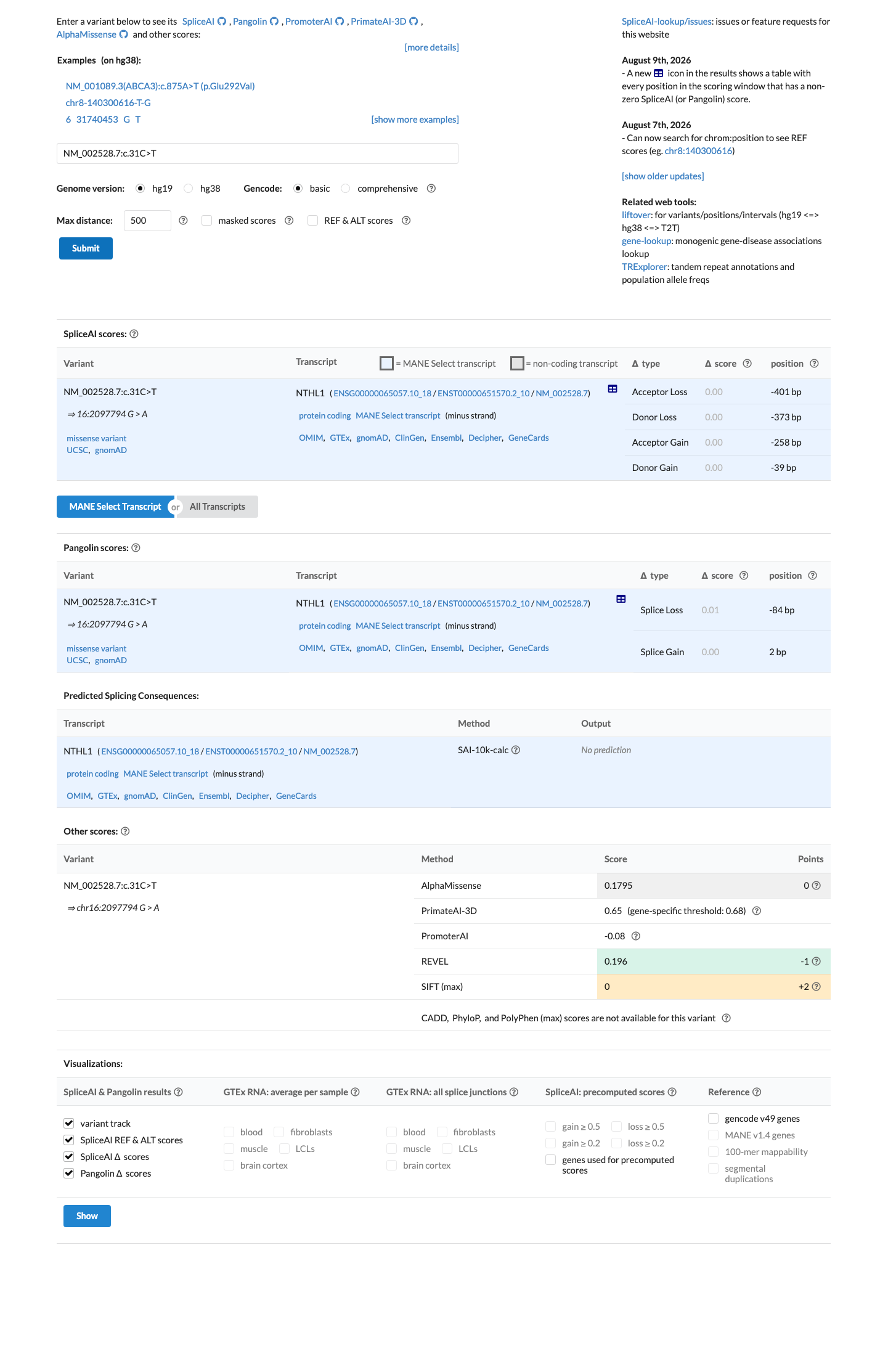
REVEL score = 0.196 (source_registry 'revel', local REVEL v1.3 lookup) for NM_002528.7:c.31C>T (p.Arg11Trp), below the generic ACMG/AMP fallback BP4 threshold of <0.250 for missense variants.generic_acmg_classification_rules.md PP3/BP4 in-silico calibration section specifies REVEL-only assessment for missense variants and instructs not to combine or substitute a splice-path score for a missense variant.SpliceAI max delta score = 0.00 noted in prefetch data as supplementary context only; not independently applied for BP4 because the variant type is missense, per calibration rule restricting SpliceAI use to non-missense variant types.
Assessed · not applied · 6 not met · 16 not assessed
Pathogenic
PS1 Not assessed: no alternate codon producing p.Arg11Trp with an established pathogenic classification was identified.
PS2 Not assessed: no parental genotypes, parentage confirmation, or de novo observations for p.Arg11Trp were available.
PS3 Not assessed: no functional assay results (e.g., glycosylase activity or DNA repair assays) for p.Arg11Trp were available.
PS4 Not assessed: no case-control counts, odds ratio, or affected-case series for p.Arg11Trp were available.
PM1 Not assessed: no NTHL1 domain-boundary or hotspot annotation was available, and CancerHotspots reported no significant hotspot at residue 11.
PM3 Not assessed: no affected individual with p.Arg11Trp in trans with a pathogenic NTHL1 variant was reported.
PM5 Not assessed: no alternate missense change at Arg11 with an established pathogenic classification was identified.
PM6 Not assessed: no de novo occurrence with unconfirmed parental testing was reported.
PP1 Not assessed: no pedigree or affected-relative genotype data were available to evaluate co-segregation.
PP2 Not assessed: NTHL1 disease is driven by biallelic loss-of-function variants, and no missense-constraint metric was available to assess benign missense rate.
PP3 Not met: REVEL score 0.196 falls below the 0.250 BP4 threshold, not above the 0.750 PP3 threshold.
PP4 Not assessed: no individual-level phenotype or tumor data were provided.
PP5 Not met: ClinVar holds only non-expert Uncertain significance submissions, with no expert-panel Pathogenic or Likely pathogenic assertion.
Benign
BA1 Not met: highest population allele frequency is 0.01472% (gnomAD v4.1), far below the 1% BA1 threshold.
BS1 Not met: highest population allele frequency 0.01472% (gnomAD v4.1) is below the 0.3% BS1 threshold.
BS2 Not met: gnomAD v4.1 (84 alleles) and v2.1 (9 alleles) report zero homozygotes, so no benign homozygous observation is documented.
BS3 Not assessed: no functional assay results demonstrating normal (wild-type-like) activity for p.Arg11Trp were available.
BS4 Not assessed: no family data showing the variant failing to track with disease were available.
BP1 Not assessed: NTHL1 disease is loss-of-function driven, but no gene-specific statistic or VCEP rule establishes missense variants as benign.
BP2 Not assessed: no co-occurrence or phase data with a pathogenic variant were available, and gnomAD v4.1 (84 alleles) shows no homozygotes.
BP5 Not assessed: no affected individual, phenotype, or alternate molecular diagnosis was provided.
BP6 Not met: ClinVar holds only non-expert Uncertain significance submissions, with no expert-panel Benign or Likely benign assertion.
N/A · 4 PVS1 · PM4 · BP3 · BP7
Research & evidence
Population frequency
gnomAD v4.1 screenshot
gnomAD v4.1
gnomAD v2.1 screenshot
gnomAD v2.1
v4.1
This variant is present in gnomAD v4.1 (AF= 5.27852e-05; MAF= 0.00528%, 84/1591356 alleles, homozygotes = 0) and has highest observed frequency in the African/African American population (AF= 0.000147189; MAF= 0.01472%, 11/74734 alleles, homozygotes = 0); grpmax FAF= 8.173e-05.
v2.1
This variant is present in gnomAD v2.1 (AF= 3.7578e-05; MAF= 0.00376%, 9/239502 alleles, homozygotes = 0) and has highest observed frequency in the African/African American population (AF= 0.00019192; MAF= 0.01919%, 4/20842 alleles, homozygotes = 0); grpmax FAF= 6.724e-05.
🇨🇦 CA
Not available in gnomAD-Canada v1.0.
Allele frequency by ancestry
three datasets · side by side
gnomAD v4.1
0.0053% · 84 / 1,591,356
0 hom · FAF 0.0082%
African/African American
11 / 74,734
0.015%
Admixed American
6 / 59,098
0.01%
European (non-Finnish)
67 / 1,174,002
0.0057%
+ 7 not observed (Remaining individuals, European (Finnish), Amish, East Asian, Middle Eastern, South Asian, Ashkenazi Jewish)
gnomAD v2.1
0.0038% · 9 / 239,502
0 hom · FAF 0.0067%
African/African American
4 / 20,842
0.019%
Admixed American
2 / 33,680
0.0059%
European (non-Finnish)
3 / 107,480
0.0028%
+ 5 not observed (Ashkenazi Jewish, East Asian, European (Finnish), Remaining individuals, South Asian)
gnomAD Canada 🇨🇦
Absent · 0 / ?
0 hom
Not observed in any ancestry group.
ClinVar screenshot
ClinVar
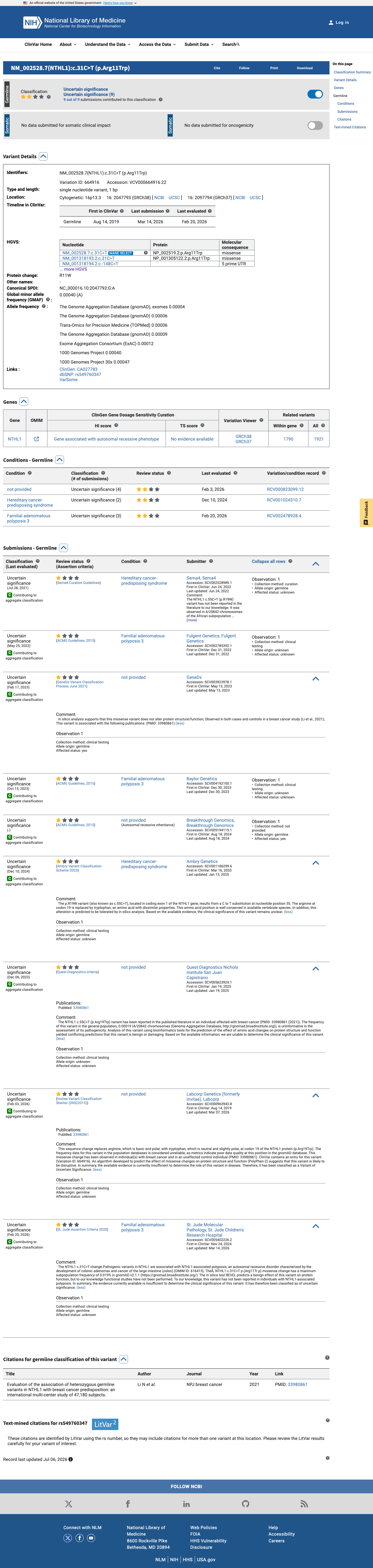
This variant has been reported in ClinVar as Uncertain significance (7 clinical laboratories). (ClinVarID = 664916)
SpliceAI screenshot
In silico
SpliceAI predicts no significant splice impact for this variant (max delta score = 0.00). REVEL score = 0.196. BayesDel score = -0.229484.
Functional / OncoKB screenshot
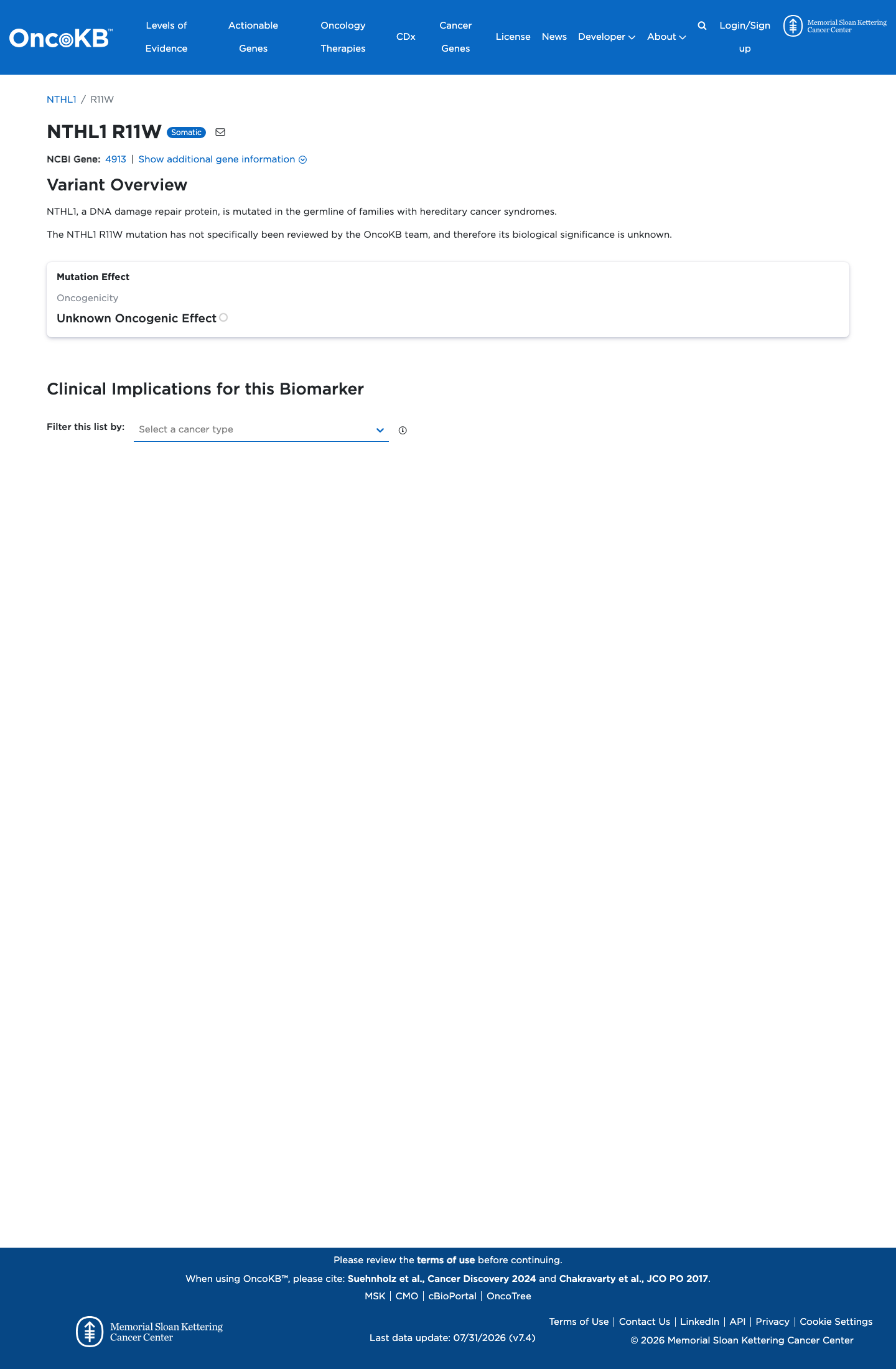
Functional Unknown Oncogenic Effect
OncoKB did not identify variant-specific reviewed functional evidence for this variant; gene-level curated context is available for reviewer follow-up. NTHL1, a DNA damage repair protein, is mutated in the germline of families with hereditary cancer syndromes.
OncoKB ↗
COSMIC screenshot
COSMIC
Cancer hotspots screenshot
Cancer hotspots
Somatic evidence Not in COSMIC / hotspots
COSMIC
This variant does not lie in a statistically significant hotspot. This variant has not previously been reported in somatic cancers (COSMIC).
Hotspots
This variant does not lie in a statistically significant hotspot.
Literature · how each cited paper was used
1papers cited
Each card is an audit: what was searched, what was found, whether it names the variant, which criteria it fed, and why. 4 further PMIDs triaged but not cited — see Sources & references.
Rule & framework references · cited for criterion definitions, not variant evidence
25741868 ↗ Standards and guidelines for the interpretation of sequence variants: a joint consensus recommendation of the American College of Medical Genetics and Genomics and the Association for Molecular Pathology.
Sources & reference links
8Sources
ClinVar
gnomAD v2.1
gnomAD v4.1
gnomAD-Canada
SpliceAI
OncoKB
COSMIC
Cancer hotspots
Triaged references · 4 PMIDs not cited in assessment
26467025 ↗ A Standardized DNA Variant Scoring System for Pathogenicity Assessments in Mendelian Disorders. CLINVAR
33980861 ↗ Evaluation of the association of heterozygous germline variants in NTHL1 with breast cancer predisposition: an international multi-center study of 47,180 subjects. CLINVAR
25394175 ↗ A practice guideline from the American College of Medical Genetics and Genomics and the National Society of Genetic Counselors: referral indications for cancer predisposition assessment. CLINVAR
32239880 ↗ NTHL1 Tumor Syndrome. CLINVAR