FANCD2 encodes a DNA repair protein that works together with its partner FANCI to coordinate the cellular response to DNA damage and maintain genome stability. Inherited mutations in FANCD2 cause Fanconi anemia, a rare disorder characterized by congenital defects, bone marrow failure, and an elevated risk of cancer. FANCD2 acts as a tumor suppressor: loss of its function impairs DNA repair and can promote cancer development, and altered FANCD2 activity has been observed in several tumor types, including leukemias, breast cancer, melanoma, and colorectal cancer.
This variant
FANCD2 is a DNA-repair tumor suppressor whose loss of function causes Fanconi anemia and can promote cancer, so missense changes such as p.Ile752Thr warrant careful evaluation. However, this variant is extremely rare and lacks functional, segregation, or case-level evidence, and its in-silico prediction is inconclusive. The VUS designation reflects that neither a pathogenic nor a benign role could be established for this variant.
Transcript
NM_033084.4
HGVS · transcript:coding
NM_033084.4:c.2255T>C
GRCh38
chr3:10065480 T>C
GRCh37
chr3:10107164 T>C
BasisWith no FANCD2 ClinGen VCEP framework, generic ACMG/AMP 2015 rules applied; only PM2 (moderate) is met of 28 criteria, so no Pathogenic, Likely Pathogenic, Benign, or Likely Benign combination rule is satisfied - leaving a VUS.▾
With no FANCD2 ClinGen VCEP framework, generic ACMG/AMP 2015 rules applied; only PM2 (moderate) is met of 28 criteria, so no Pathogenic, Likely Pathogenic, Benign, or Likely Benign combination rule is satisfied - leaving a VUS.
Classification rationale
PM2VUS
FANCD2 c.2255T>Cmissense · exon 24
PM2 (Moderate): the allele is extremely rare in population databases (overall AF 4.35e-06, max ancestry-specific AF 2.23e-05, no homozygotes), meeting the PM2 moderate threshold. With only this single moderate criterion met, no ACMG/AMP 2015 combination rule is satisfied, and the variant is classified as a variant of uncertain significance (VUS).
PM2→VUS
Gene diagram
· NM_033084.4 · variants mapped to exon structure
FANCD2NM_033084.4
Fetching transcript structure from UCSC…
Exons
—
Transcript span
—
Strand
—
Variants mapped
—
Source
UCSC ncbiRefSeqCurated
All variants in FANCD2—click a row to locate it on the plot · use the link column to open its page
Variant ↕
Protein
Location
Classification
Link
Applied criteria · 1 applied · 23 assessed
MetEvidence satisfies this criterion.
Not metEvaluated against available evidence; threshold not reached.
Not assessedApplies in principle, but no evidence was found to evaluate it.
N/ADoesn't apply to this variant type.
Applied · 1
Strength Supporting Moderate Strong Very strong
✓
PM2moderatePathogenic
Met (Moderate): allele extremely rare in population databases (overall AF 4.35e-06; max ancestry-specific 2.23e-05), absent from gnomAD v2.1, with no homozygotes.
No FANCD2-specific VCEP/CSPEC was available; the generic ACMG/AMP framework applies.gnomAD v4.1 reports 7/1,608,286 alleles (AF 4.35246e-06), no homozygotes, a maximum observed East Asian AF of 2.22896e-05 (1/44,864 alleles), and grpmax FAF 8e-07.The matched variant is absent from gnomAD v2.1 and gnomAD-Canada v1.0.
Assessed · not applied
· 7 not met · 16 not assessed
Pathogenic
PS1Not assessed: no established pathogenic variant producing the identical amino-acid change (p.Ile752Thr) was identified.
PS2Not assessed: no parental testing or confirmed de novo observation is available for this variant.
PS3Not assessed: no functional or experimental studies of p.Ile752Thr were available.
PS4Not assessed: no case-control study or affected-case counts for this variant were provided.
PM1Not assessed: no well-established mutational hotspot or functional-domain annotation covering residue 752 was available.
PM3Not assessed: no affected-proband observation with a pathogenic FANCD2 variant or phase information was available.
PM5Not assessed: no different missense change at residue 752 with an established pathogenic classification was identified.
PM6Not assessed: no de novo occurrence without confirmed parentage was reported for this variant.
PP1Not assessed: no informative family segregation data were available.
PP2Not assessed: no missense-constraint metric (e.g., gnomAD missense Z-score) was available to assess FANCD2's tolerance to missense variation.
PP3Not met: REVEL score 0.578 falls in the gray zone (0.250-0.750), below the PP3 threshold.
PP4Not assessed: no phenotype or clinical findings for a carrier of this variant were provided.
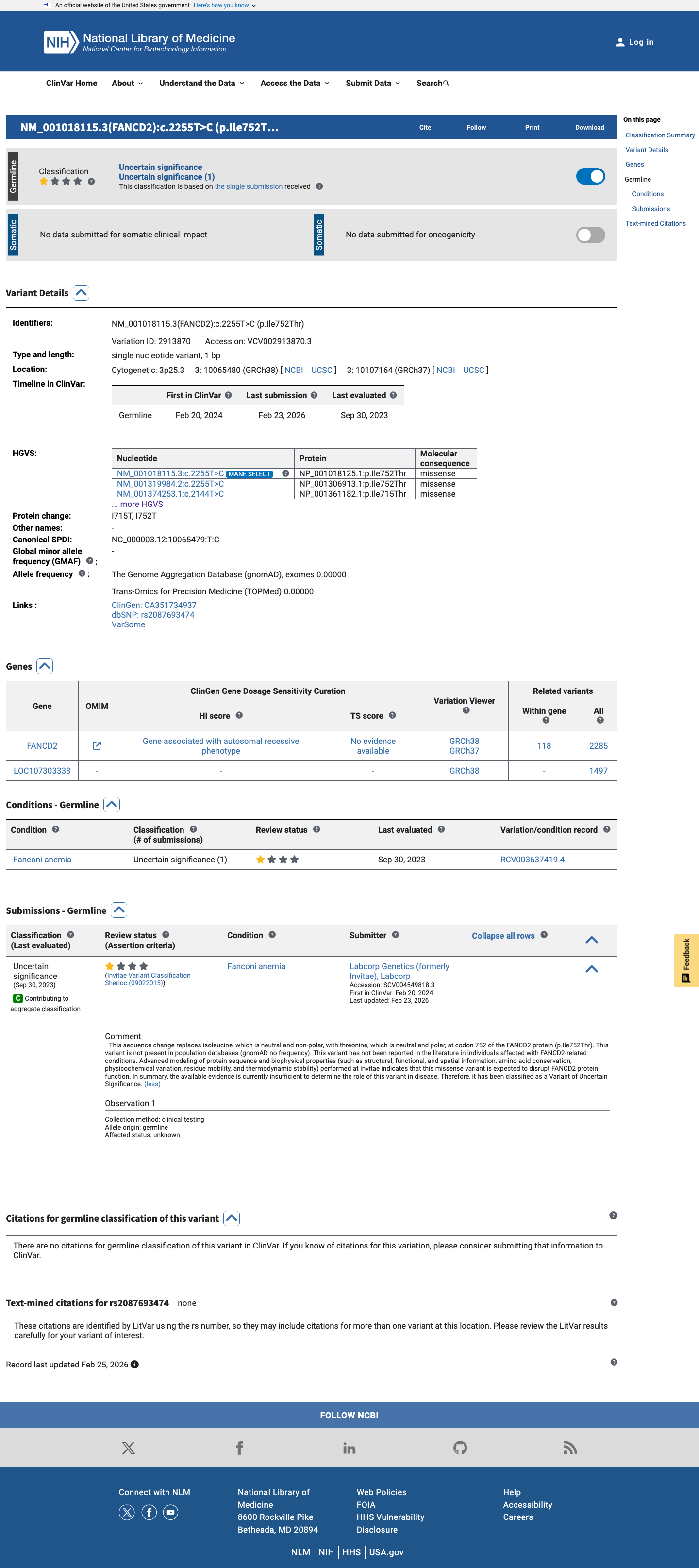
PP5Not met: the sole ClinVar submission is classified as uncertain significance, with no expert-panel assertion.
Benign
BA1Not met: highest observed population allele frequency is 4.35e-05, far below the stand-alone benign threshold.
BS1Not met: observed population allele frequencies (max 2.23e-05) are far too low to support a benign classification.
BS2Not met: no homozygotes are observed in gnomAD v4.1, so no unaffected-individual observations support BS2.
BS3Not assessed: no functional studies were available to show a validated assay detected no damaging effect.
BS4Not assessed: no non-segregation evidence is available for this variant.
BP1Not assessed: available evidence could not establish that FANCD2 disease is caused primarily by truncating variants.
BP2Not assessed: no cis or trans observation with a pathogenic FANCD2 variant was documented.
BP4Not met: REVEL score 0.578 is above the BP4 threshold (REVEL < 0.250).
BP5Not assessed: no alternative molecular cause explaining the phenotype was documented.
BP6Not met: the sole ClinVar submission is uncertain significance, with no expert-panel benign assertion.
N/A · 4PVS1 · PM4 · BP3 · BP7
Research & evidence
Population frequency
gnomAD v4.1
gnomAD v2.1
v4.1
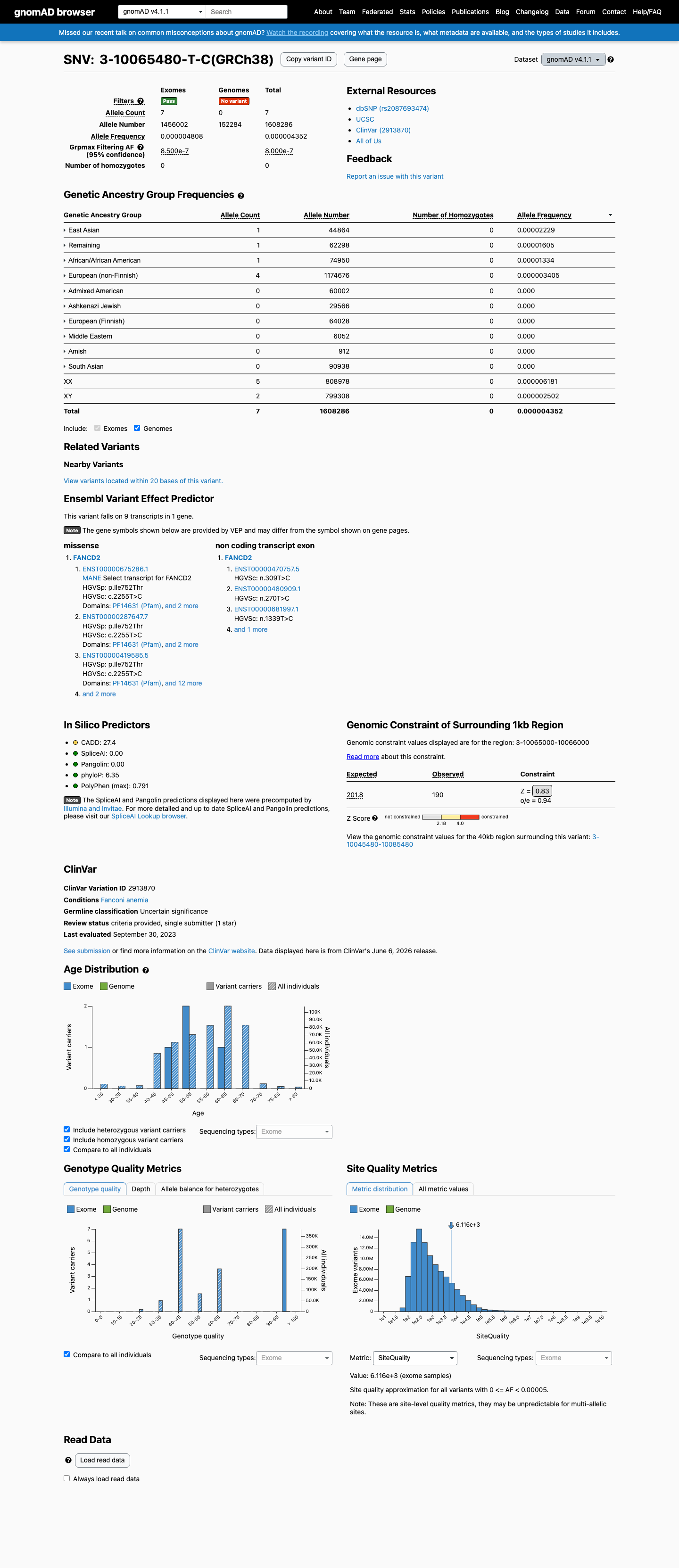
This variant is present in gnomAD v4.1 (AF= 4.35246e-06; MAF= 0.00044%, 7/1608286 alleles, homozygotes = 0) and has highest observed frequency in the East Asian population (AF= 2.22896e-05; MAF= 0.00223%, 1/44864 alleles, homozygotes = 0); grpmax FAF= 8e-07.
v2.1
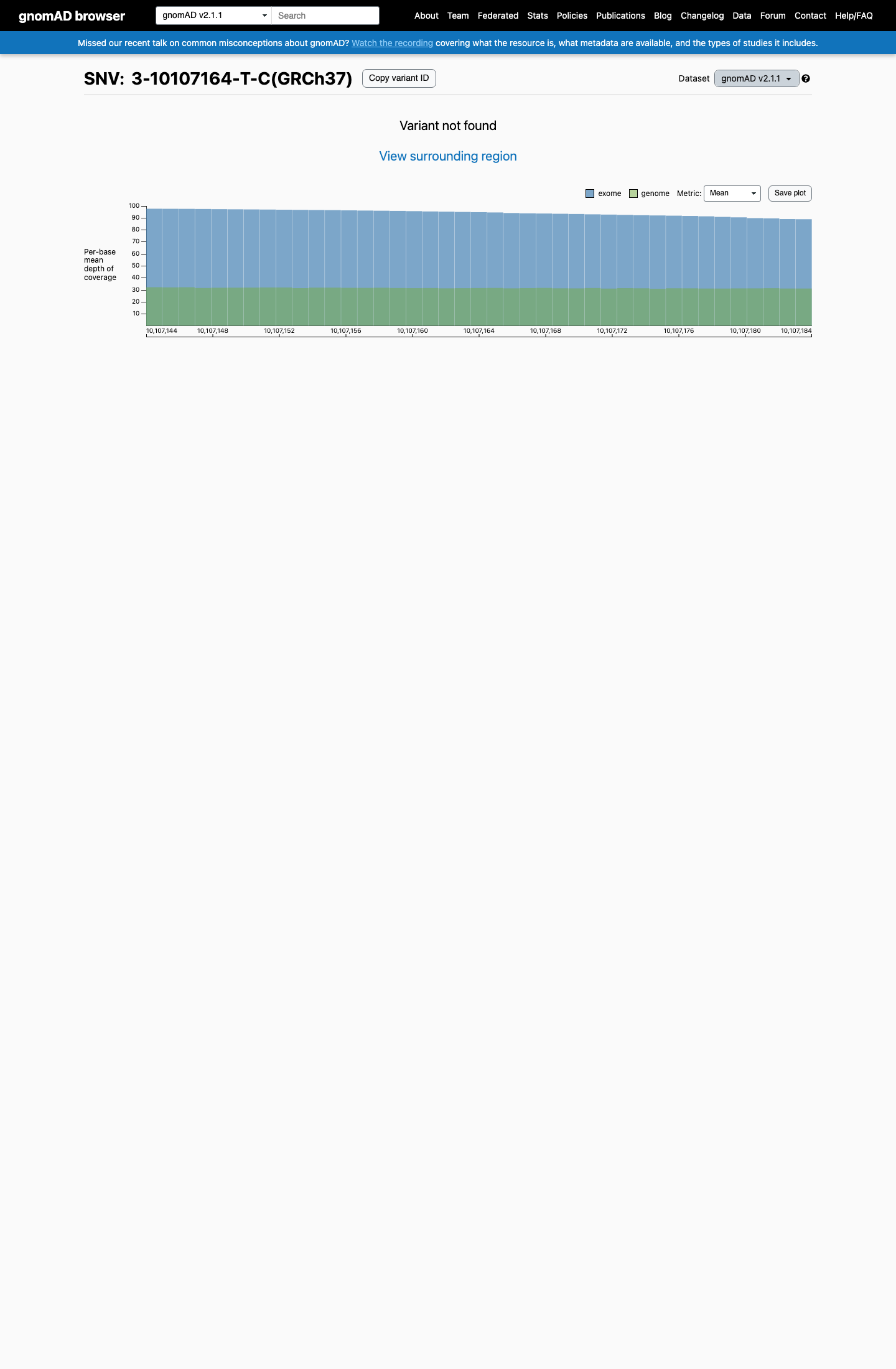
Absent from gnomAD v2.1.
🇨🇦 CA
Absent from gnomAD-Canada v1.0.
Allele frequency by ancestry
three datasets · side by side
gnomAD v4.1
0.00044%
· 7 / 1,608,286
0 hom · FAF 8e-05%
East Asian
1 / 44,864
0.0022%
Remaining individuals
1 / 62,298
0.0016%
African/African American
1 / 74,950
0.0013%
European (non-Finnish)
4 / 1,174,676
0.00034%
+ 6 not observed (Admixed American, European (Finnish), Amish, Middle Eastern, South Asian, Ashkenazi Jewish)
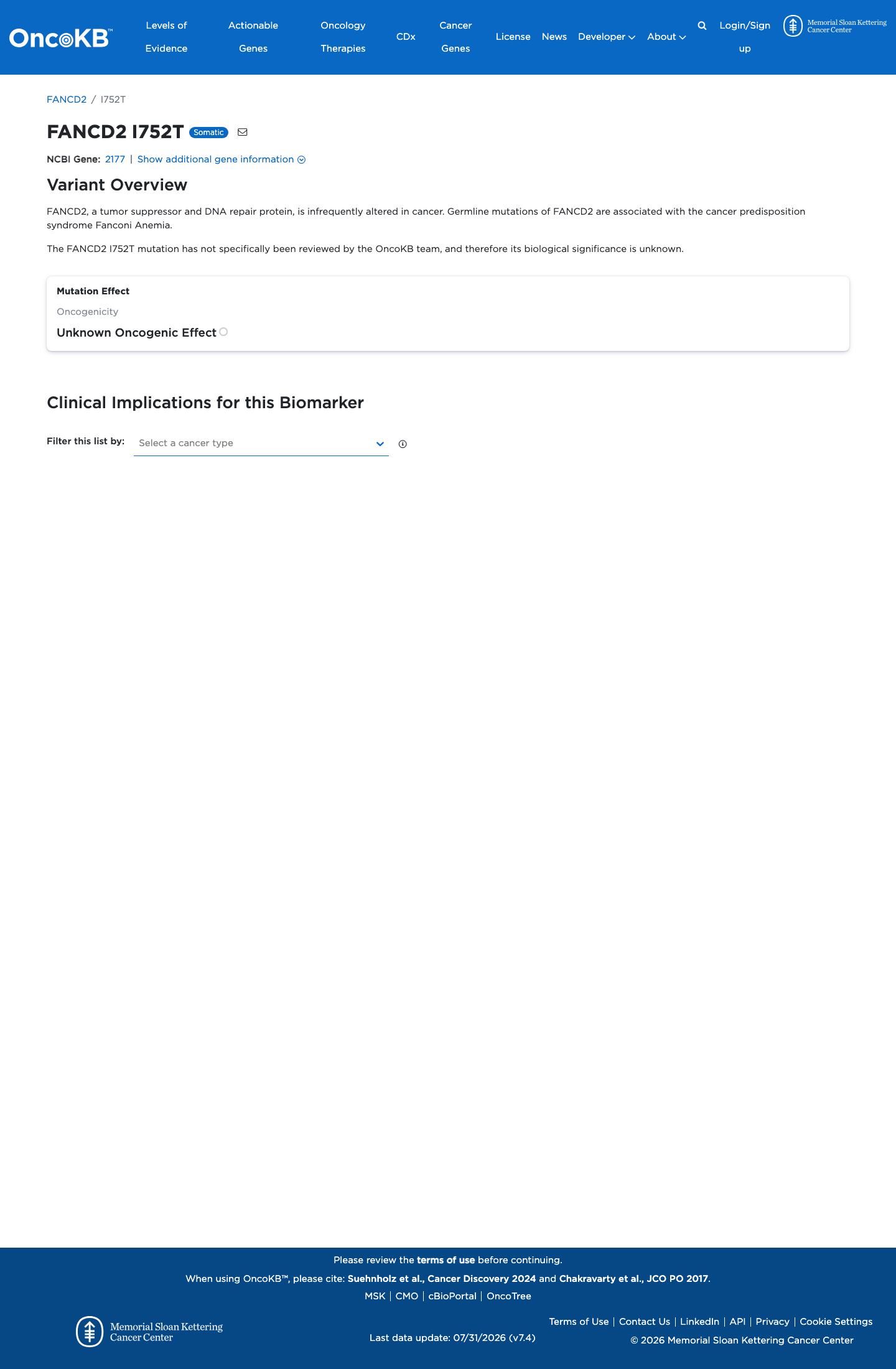
OncoKB did not identify variant-specific reviewed functional evidence for this variant; gene-level curated context is available for reviewer follow-up. FANCD2, a tumor suppressor and DNA repair protein, is infrequently altered in cancer. Germline mutations of FANCD2 are associated with the cancer pred
Triaged references · 5 PMIDs not cited in assessment
19888064 ↗ACOG Committee Opinion No. 442: Preconception and prenatal carrier screening for genetic diseases in individuals of Eastern European Jewish descent.CLINVAR