ETV6 encodes an ETS-family transcription factor that is essential for hematopoiesis and for maintenance of the developing vascular network. It contains an N-terminal pointed (PNT) domain for protein-protein interactions and a C-terminal DNA-binding domain. ETV6 acts as a tumor suppressor: its rearrangements are among the most common alterations in hematologic malignancies and are also linked to congenital fibrosarcoma, while germline mutations predispose to blood cancers such as acute lymphoblastic leukemia. It can also promote tumorigenesis through fusions that alter the activity of partner genes or nearby proto-oncogenes.
This variant
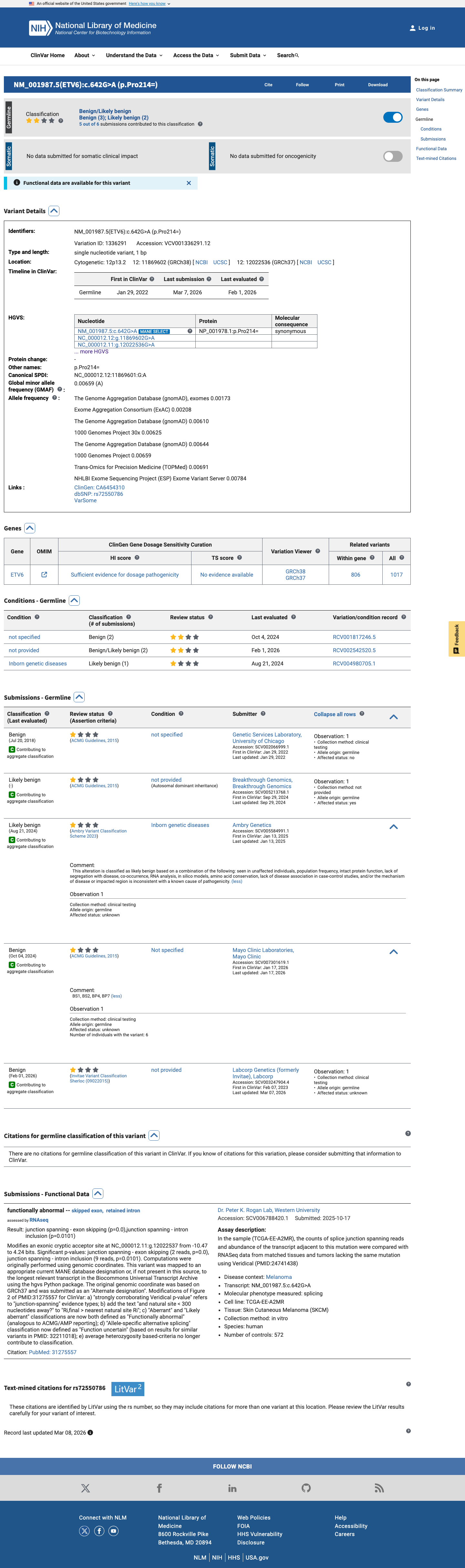
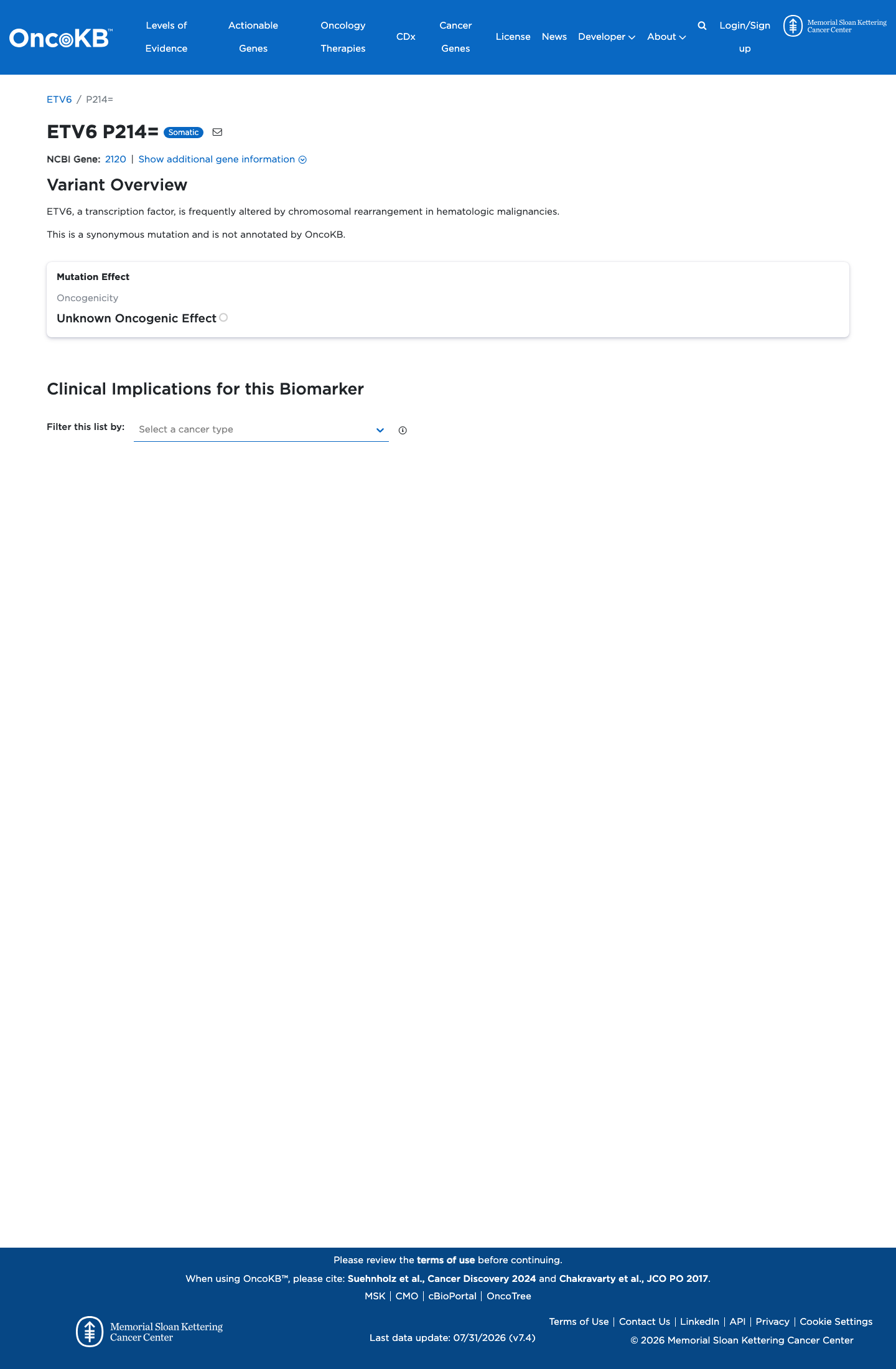
ETV6 is a tumor suppressor whose germline mutations predispose to hematologic malignancies such as acute lymphoblastic leukemia, so establishing that a variant is benign matters clinically. This synonymous variant (p.(Pro214=)) is classified Benign: it leaves the ETV6 protein unchanged, shows no predicted splicing disruption, and is too common in the general population (2.13% African/African American allele frequency) to be a leukemia-predisposing mutation.
Transcript
NM_001987.4
HGVS · transcript:coding
NM_001987.4:c.642G>A
GRCh38
chr12:11869602 G>A
GRCh37
chr12:12022536 G>A
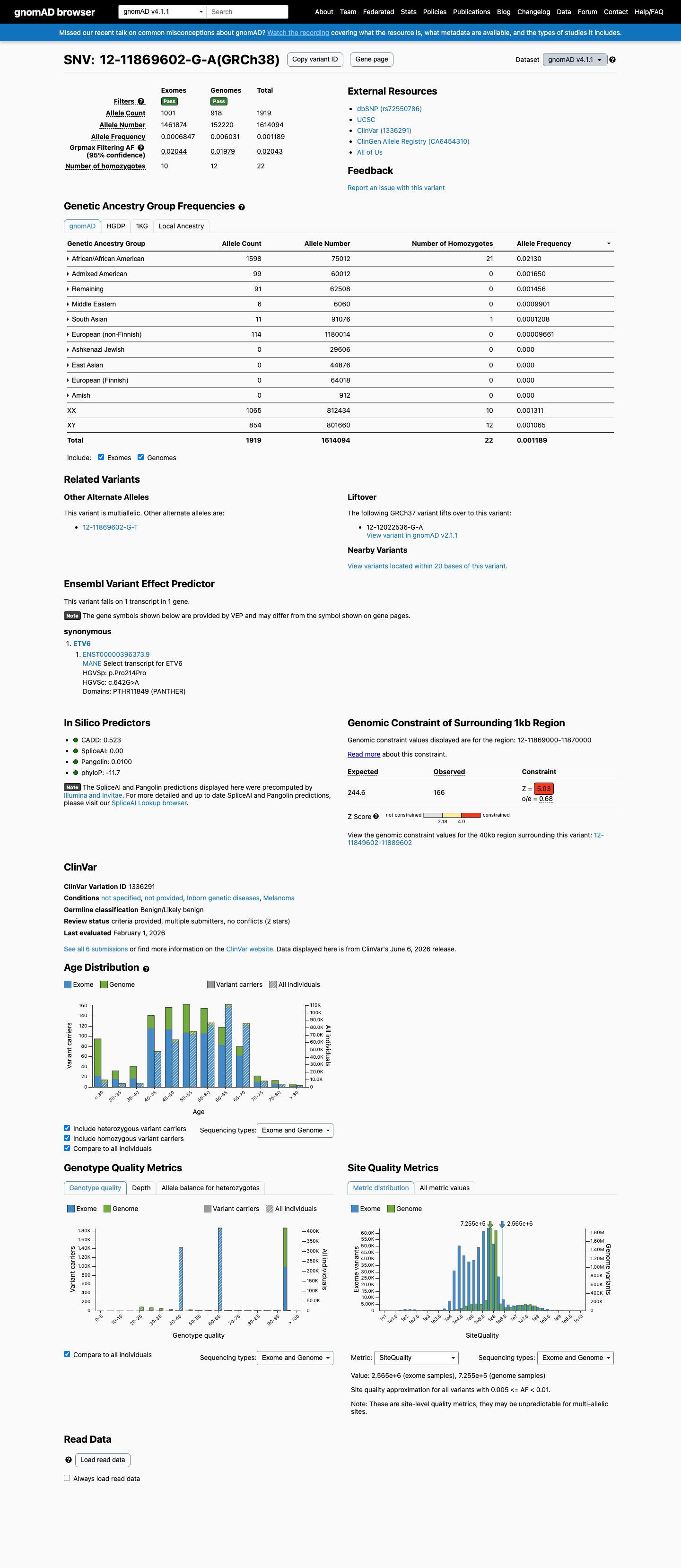
BasisBenign: no ETV6 VCEP exists, so generic ACMG/AMP 2015 rules apply; BA1 met at stand-alone (gnomAD v4.1 AF 2.13033% > 1% threshold) and BP7 supporting (SpliceAI max delta 0.003).▾
Benign: no ETV6 VCEP exists, so generic ACMG/AMP 2015 rules apply; BA1 met at stand-alone (gnomAD v4.1 AF 2.13033% > 1% threshold) and BP7 supporting (SpliceAI max delta 0.003).
Classification rationale
BA1BP7Benign
ETV6 c.642G>Asynonymous · exon 5
BA1 (Stand-alone Benign): gnomAD v4.1 African/African American allele frequency 2.13033% (1598/75012 alleles, 21 homozygotes) exceeds the 1% BA1 threshold. BP7 (Supporting): synonymous variant (p.(Pro214=)) with no predicted splice impact (SpliceAI max delta 0.003). Overall classification: Benign — BA1 at stand-alone strength under generic ACMG/AMP 2015 combination rules (no ETV6 VCEP available), with no pathogenic-direction criteria met.
BA1 + BP7→Benign
Gene diagram
· NM_001987.4 · variants mapped to exon structure
ETV6NM_001987.4
Fetching transcript structure from UCSC…
Exons
—
Transcript span
—
Strand
—
Variants mapped
—
Source
UCSC ncbiRefSeqCurated
All variants in ETV6—click a row to locate it on the plot · use the link column to open its page
Variant ↕
Protein
Location
Classification
Link
Applied criteria · 2 applied · 15 assessed
MetEvidence satisfies this criterion.
Not metEvaluated against available evidence; threshold not reached.
Not assessedApplies in principle, but no evidence was found to evaluate it.
N/ADoesn't apply to this variant type.
Applied · 2
Strength Supporting Moderate Strong Very strong
✓
BA1stand-aloneBenign
Met (stand-alone benign): gnomAD v4.1 African/African American allele frequency 2.13033% (1598/75012 alleles) exceeds the 1% BA1 threshold.
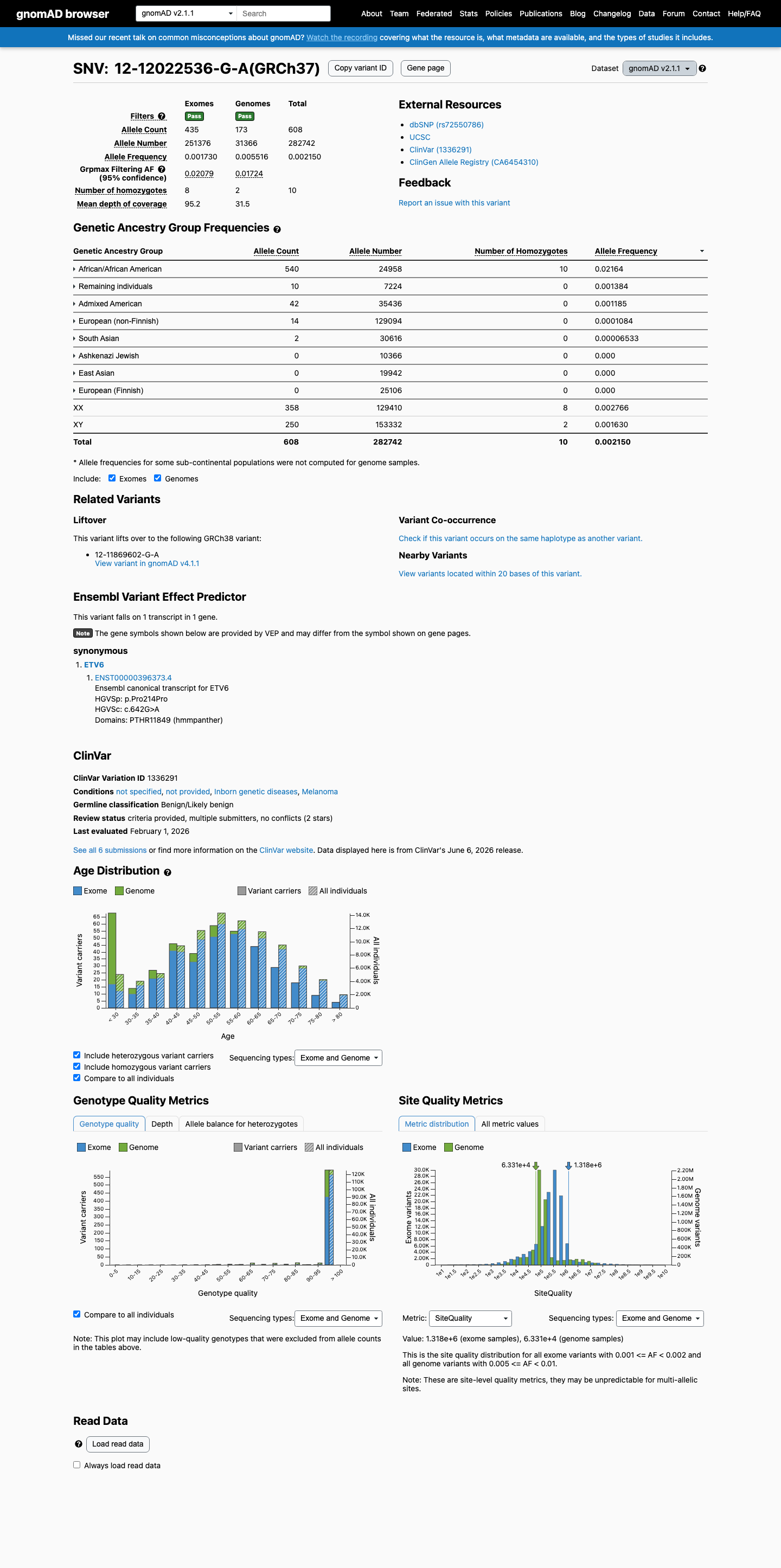
No ETV6 ClinGen VCEP specification was retrieved; generic ACMG/AMP population-frequency operating thresholds apply.gnomAD v4.1: African/African American AF 0.0213033 (1598/75012), 21 homozygotes, and grpmax FAF 0.0204335.The independent gnomAD v2.1 dataset is concordant: African/African American AF 0.0216363 (540/24958), 10 homozygotes, and grpmax FAF 0.0207937.
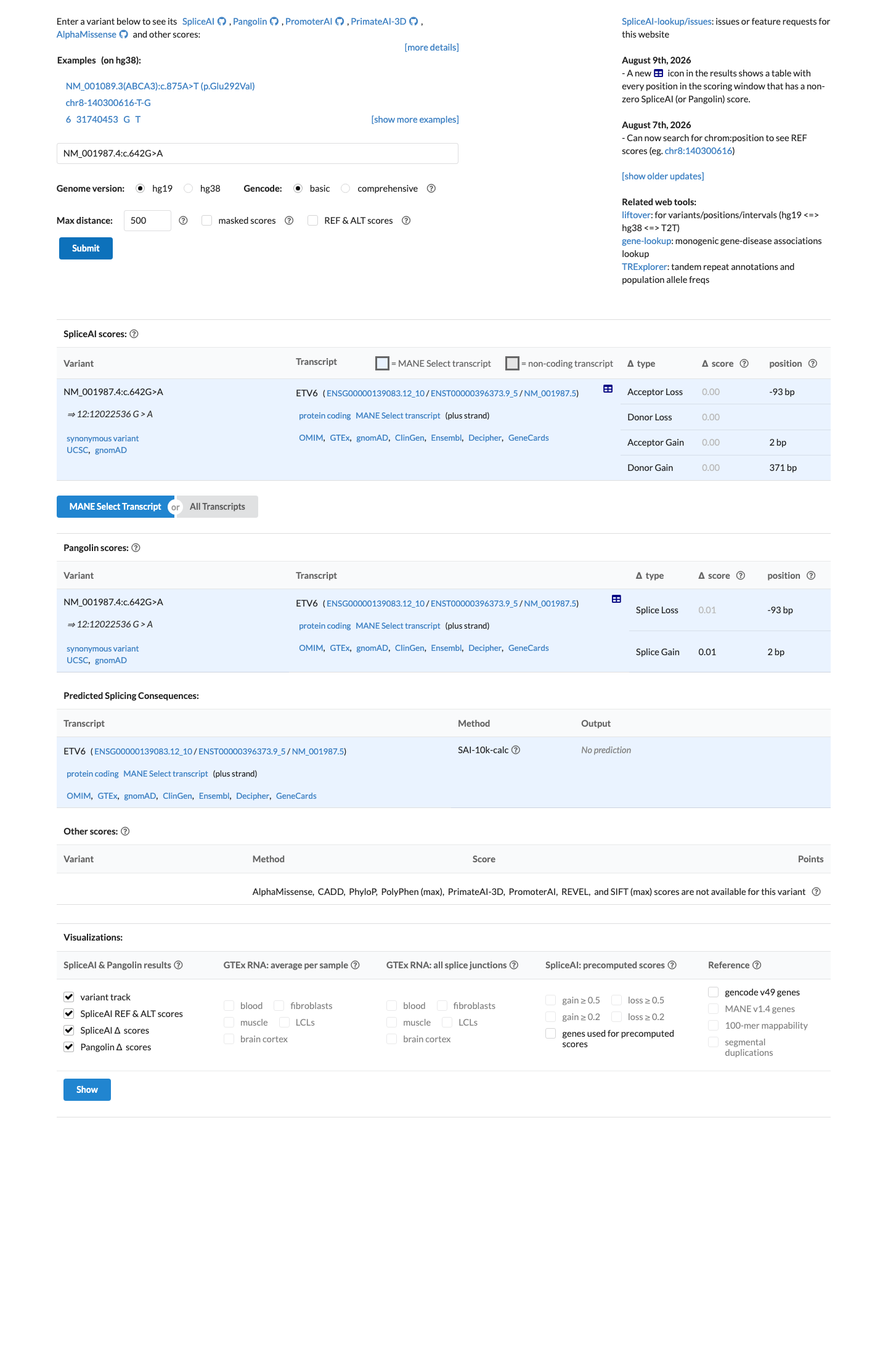
Met (supporting): synonymous variant with SpliceAI max delta 0.003, indicating no predicted splice impact.
SpliceAI Lookup (source_registry key 'spliceai') for NM_001987.4:c.642G>A: max delta score = 0.003, described as 'SpliceAI predicts no significant splice impact for this variant (max delta score = 0.00)' (evidence_brief.json spliceai.sentence); no acceptor/donor gain or loss scores were flagged as significant.Variant is synonymous at the protein level: NP_001978.1:p.(Pro214=) / p.(P214=) per case_summary.json normalization, confirming BP7 (silent variant) applicability rather than a missense change.
This variant is present in gnomAD v4.1 (AF= 0.0011889; MAF= 0.11889%, 1919/1614094 alleles, homozygotes = 22) and has highest observed frequency in the African/African American population (AF= 0.0213033; MAF= 2.13033%, 1598/75012 alleles, homozygotes = 21); grpmax FAF= 0.0204335.
v2.1
This variant is present in gnomAD v2.1 (AF= 0.00215037; MAF= 0.21504%, 608/282742 alleles, homozygotes = 10) and has highest observed frequency in the African/African American population (AF= 0.0216363; MAF= 2.16363%, 540/24958 alleles, homozygotes = 10); grpmax FAF= 0.0207937.
🇨🇦 CA
This variant is present in gnomAD-Canada v1.0 (AF= 0.0017376194613379669, 32/18416 alleles, homozygotes = 0).
Allele frequency by ancestry
three datasets · side by side
gnomAD v4.1
0.12%
· 1919 / 1,614,094
22 hom · FAF 2%
African/African American
1598 / 75,012
2.1%
21 hom
Admixed American
99 / 60,012
0.16%
Remaining individuals
91 / 62,508
0.15%
Middle Eastern
6 / 6,060
0.099%
South Asian
11 / 91,076
0.012%
1 hom
European (non-Finnish)
114 / 1,180,014
0.0097%
+ 4 not observed (European (Finnish), Amish, East Asian, Ashkenazi Jewish)
gnomAD v2.1
0.22%
· 608 / 282,742
10 hom · FAF 2.1%
African/African American
540 / 24,958
2.2%
10 hom
Remaining individuals
10 / 7,224
0.14%
Admixed American
42 / 35,436
0.12%
European (non-Finnish)
14 / 129,094
0.011%
South Asian
2 / 30,616
0.0065%
+ 3 not observed (Ashkenazi Jewish, East Asian, European (Finnish))
gnomAD Canada 🇨🇦
0.17%
· 32 / 18,416
0 hom · FAF 1.7%
African/African American
25 / 1,020
2.5%
Latino/Admixed American
2 / 838
0.24%
Remaining individuals
2 / 1,138
0.18%
East Asian
1 / 1,338
0.075%
European (non-Finnish)
2 / 11,736
0.017%
+ 4 not observed (Ashkenazi Jewish, European (Finnish), Middle Eastern, South Asian)
Triaged references · 7 PMIDs not cited in assessment
25741868 ↗Standards and guidelines for the interpretation of sequence variants: a joint consensus recommendation of the American College of Medical Genetics and Genomics and the Association for Molecular Pathology.CLINVAR
31275557 ↗Pan-cancer repository of validated natural and cryptic mRNA splicing mutations.CLINVAR
24121147 ↗Appropriateness of newborn screening for α1-antitrypsin deficiency.CLINVAR
22947299 ↗Specific guidelines for assessing and improving the methodological quality of economic evaluations of newborn screening.CLINVAR
23037933 ↗Including the initial newborn screening bloodspot collection device serial number on birth certificates: basis and recommendations from the Secretary of Health and Human Services' Advisory Committee on Heritable Disorders in Newborns and Children.CLINVAR
24394680 ↗Parental permission for pilot newborn screening research: guidelines from the NBSTRN.CLINVAR
28492532 ↗Sherloc: a comprehensive refinement of the ACMG-AMP variant classification criteria.CLINVAR