Analysis in progress
Initialising…
0%
complete
This report is still being assembled — sections appear as each stage finishes. It isn't final yet.
ZRSR2
Final classification
VUS
PM2PM4BP4
ZRSR2
c.983_984insGAA
p.Phe328delinsLeuAsn
in_frame_indel_unknown · exon 11

ZRSR2 encodes an essential splicing factor that helps the spliceosome recognize the 3' splice site during pre-mRNA splicing, working together with the U2 auxiliary factor heterodimer. Mutations in this gene disrupt normal splicing, causing mis-splicing and retention of U12-type introns, and are found in myelodysplastic syndrome, secondary acute myeloid leukemia, and other myeloid disorders, where targeting the spliceosome is being explored as a treatment strategy. ZRSR2 is not clearly established as an oncogene or tumor suppressor, but its recurrent mutations in myeloid cancers point to disrupted RNA splicing as a contributor to disease.

This variant

ZRSR2 is an essential splicing factor whose mutations are recurrent in myelodysplastic syndrome, secondary acute myeloid leukemia, and other myeloid disorders. This in-frame insertion in the CCCH zinc-finger domain is absent from population databases but lacks functional or case-level evidence, so its clinical significance remains uncertain pending further data.

Transcript
NM_005089.3
HGVS · transcript:coding
NM_005089.3:c.983_984insGAA
GRCh38
chrX:15822776 T>TGAA
GRCh37
chrX:15840899 T>TGAA
Basis VUS: the met criteria PM2 (supporting), PM4 (moderate), and BP4 (supporting) do not combine to reach any pathogenic or benign threshold under generic ACMG/AMP rules.
VUS: the met criteria PM2 (supporting), PM4 (moderate), and BP4 (supporting) do not combine to reach any pathogenic or benign threshold under generic ACMG/AMP rules.
Classification rationale
PM2PM4 BP4 VUS
ZRSR2 c.983_984insGAA in_frame_indel_unknown · exon 11

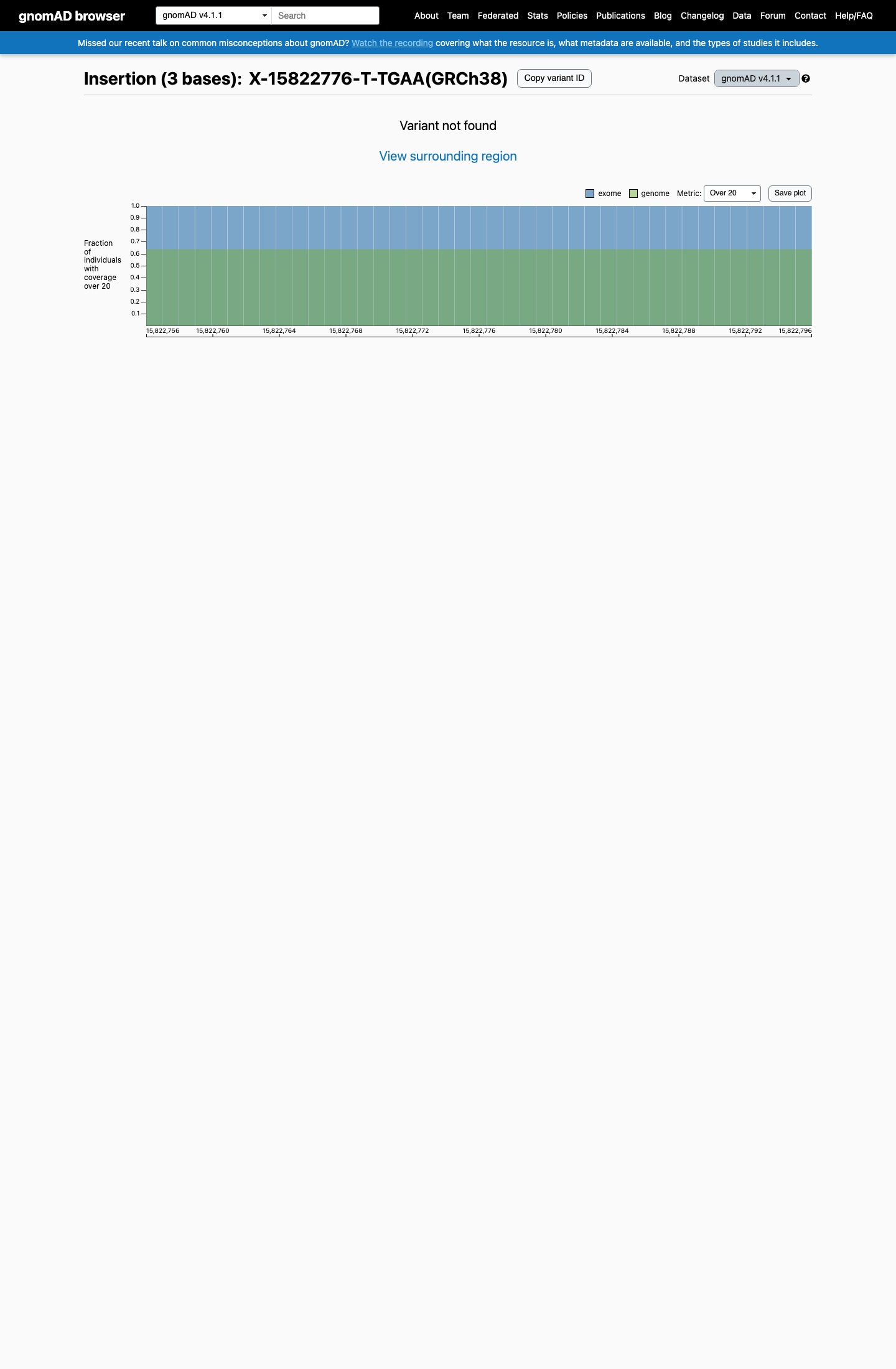
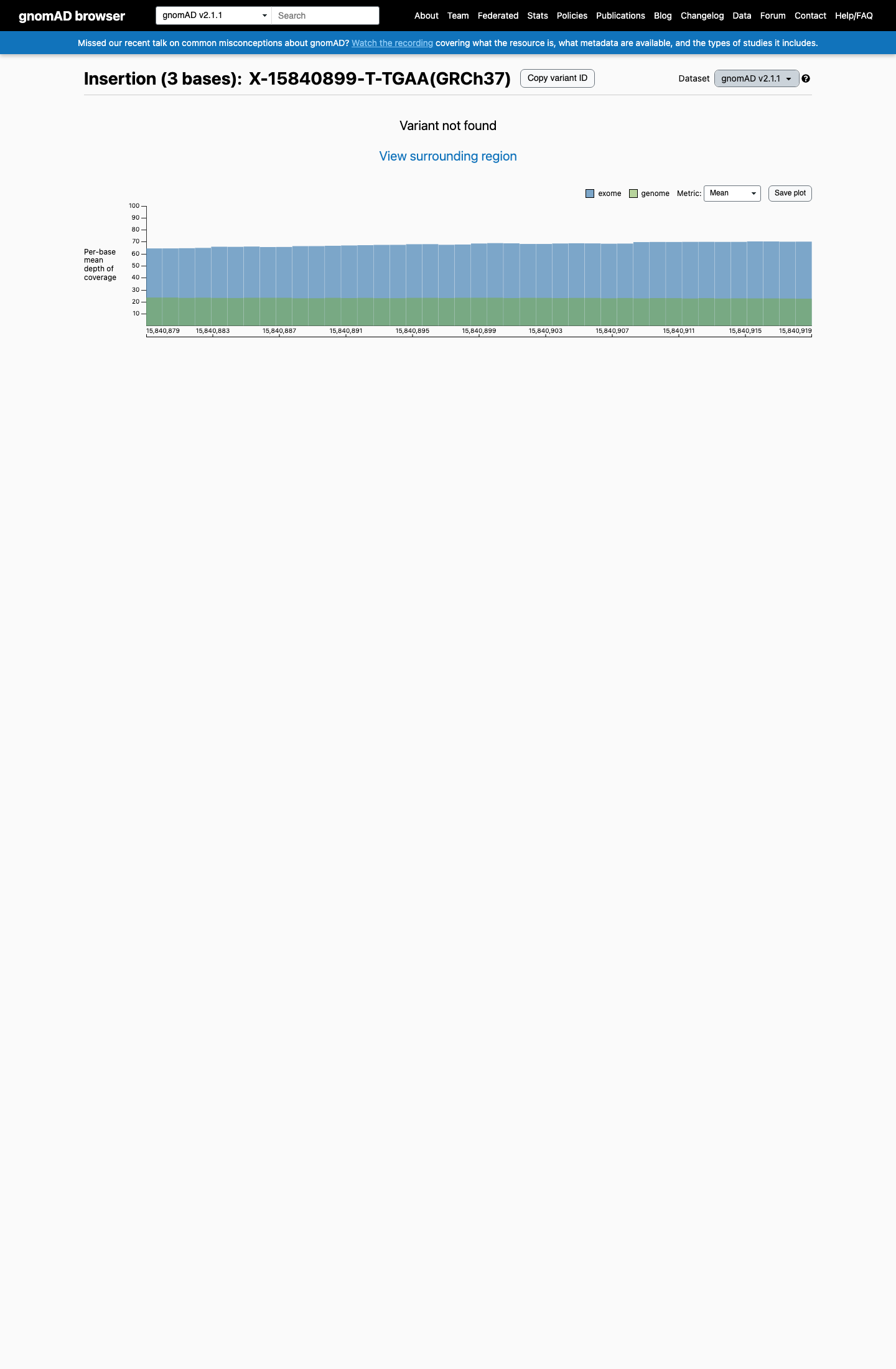
PM2 (Supporting): absent from gnomAD v2.1, gnomAD v4.1, and gnomAD-Canada population databases. PM4 (Moderate): in-frame insertion p.(Phe328delinsLeuAsn) changes protein length in the conserved, non-repeat CCCH zinc-finger region. BP4 (Supporting): SpliceAI max delta 0.05 predicts no splice impact, well below the 0.2 threshold. Together these criteria reach no ACMG/AMP classification threshold, yielding a final classification of Uncertain Significance (VUS).

PM2 + PM4 + BP4 VUS
Gene diagram · NM_005089.3 · variants mapped to exon structure
ZRSR2 NM_005089.3
Fetching transcript structure from UCSC…
Applied criteria · 3 applied · 18 assessed
MetEvidence satisfies this criterion.
Not metEvaluated against available evidence; threshold not reached.
Not assessedApplies in principle, but no evidence was found to evaluate it.
N/ADoesn't apply to this variant type.
Applied · 3
Strength Supporting Moderate Strong Very strong
PM2 supporting Pathogenic
Met (supporting): absent from the gnomAD v2.1, gnomAD v4.1, and gnomAD-Canada population datasets.
gnomAD v2.1 queried X-15840899-T-TGAA and found it absent.gnomAD v4.1 and gnomAD-Canada v1.0 queried X-15822776-T-TGAA and found it absent.No ZRSR2 ClinGen VCEP or gene-specific population-frequency specification was retrieved for this case; the case framework specifies generic ACMG/AMP fallback.
PM4 moderate Pathogenic
Met (moderate): in-frame insertion p.(Phe328delinsLeuAsn) changes protein length (+1 residue) in the non-repeat CCCH zinc-finger region.
Variant normalization (Mutalyzer and VariantValidator, recorded in prefetch/case_summary): NM_005089.3:c.983_984insGAA is an in-frame 3-nucleotide insertion predicting NP_005080.1:p.(Phe328delinsLeuAsn), i.e., Phe328 replaced by Leu-Asn with a net protein length change of +1 residue (reference 483 aa to predicted 484 aa).Exon context: the variant maps to exon 11, the terminal exon of NM_005089.3 (VariantValidator variant_exonic_positions), so the in-frame transcript is not subject to NMD and the predicted protein-level change is expressed.SpliceAI Lookup reports max delta score 0.05 for this variant, predicting no significant splice impact; this supports the in-frame protein length change as the operative consequence rather than aberrant splicing.
BP4 supporting Benign
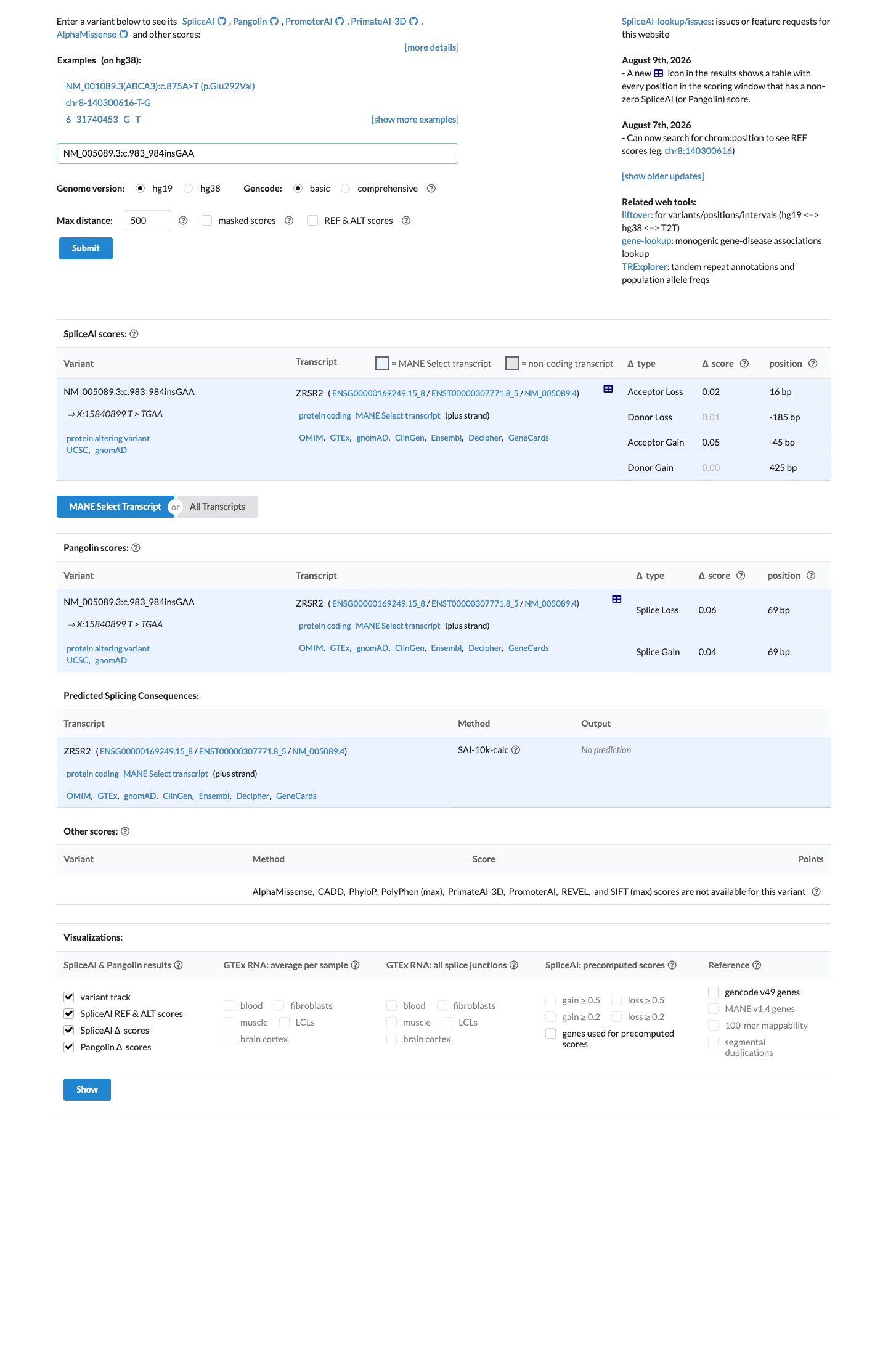
Met (supporting): SpliceAI max delta 0.05, well below the 0.2 splice-altering threshold, predicts no splice impact.
SpliceAI evidence_sentence: 'SpliceAI predicts no significant splice impact for this variant (max delta score = 0.05).' (source: spliceai)SpliceAI raw scores: DS_AG=0.05, DS_AL=0.016, DS_DG=0.0, DS_DL=0.008, max_delta_score=0.05, well below the 0.2 pathogenic-supporting cutoff (source: spliceai)Jaganathan KK et al., 'Predicting Splicing from Primary Sequence with Deep Learning', Cell 2019, PMID 30661751 -- source of the 0.2/0.5/0.8 SpliceAI delta-score calibration thresholds used to interpret the max delta of 0.05 as non-significant
Assessed · not applied · 6 not met · 12 not assessed
Pathogenic
PS2 Insufficient evidence: no proband phenotype or parental testing data were available to establish a de novo occurrence.
PS3 Insufficient evidence: no validated functional assay data for this specific variant were available.
PS4 Insufficient evidence: no affected-case series, case-control, or enrichment data for this exact variant were retrieved.
PM3 Insufficient evidence: no affected proband with a second pathogenic variant or recessive disease context was documented.
PM6 Insufficient evidence: no proband or parental testing data were available to assume a de novo occurrence.
PP1 Insufficient evidence: no pedigree or relative genotypes were available to evaluate cosegregation.
PP3 Not met: SpliceAI max delta 0.05 is far below the 0.2 pathogenic-supporting threshold, with no other computational signal.
PP4 Insufficient evidence: no proband phenotype or disease indication was supplied to assess phenotype specificity.
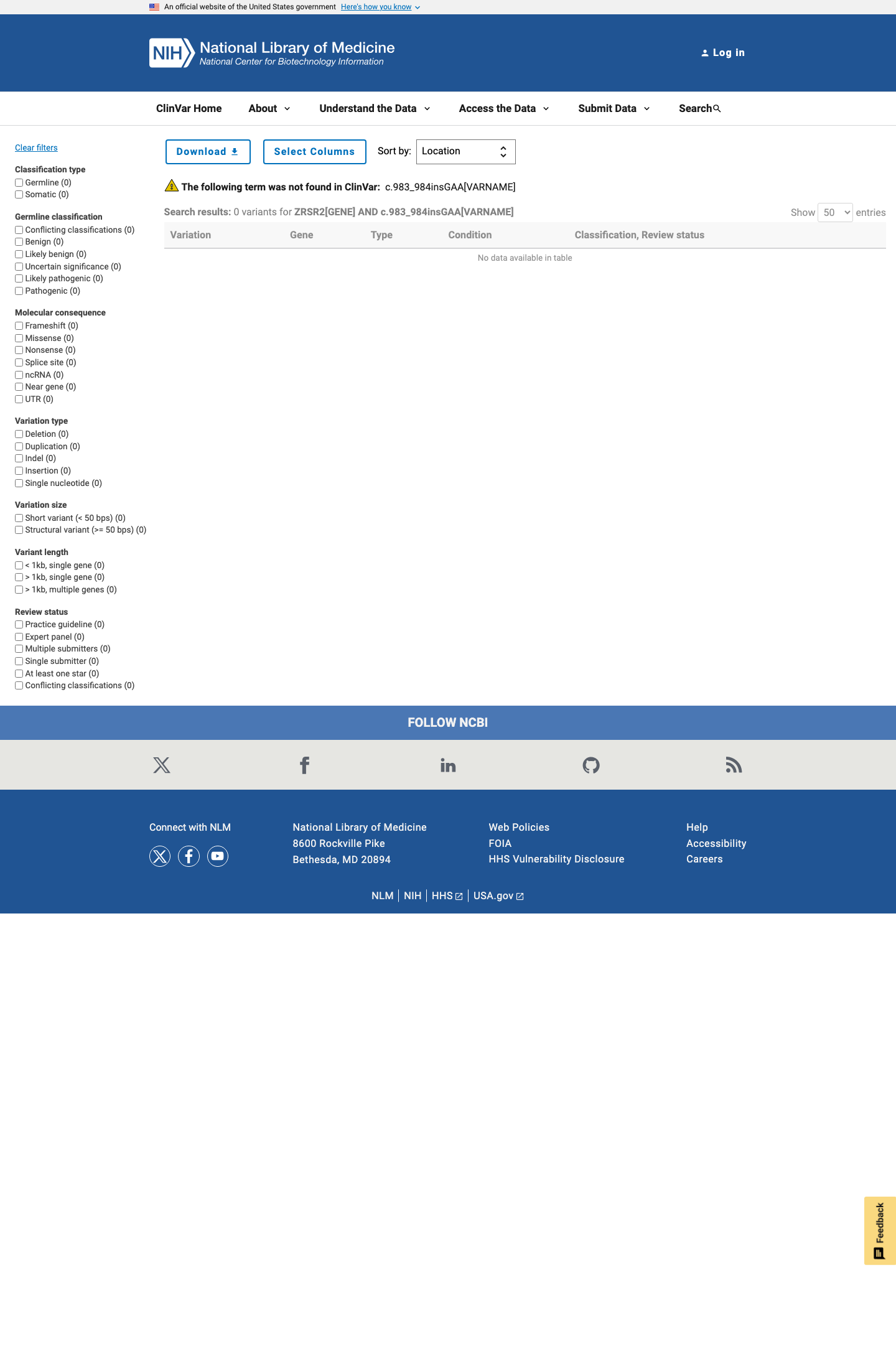
PP5 Not met: the exact variant is absent from ClinVar, so no expert-panel pathogenic assertion exists.
Benign
BA1 Not met: absent from all queried population databases, so the stand-alone benign frequency threshold is not reached.
BS1 Not met: the variant is absent from population databases, so no allele frequency exceeds the benign threshold.
BS2 Insufficient evidence: population databases report no observations in unaffected adults from which to assess.
BS3 Insufficient evidence: no functional assay data showing normal function for this variant were available.
BS4 Insufficient evidence: no affected non-carriers or unaffected carriers were documented to evaluate lack of segregation.
BP2 Insufficient evidence: no confirmed in-cis co-occurrence with a pathogenic variant was documented.
BP3 Not met: the variant lies in the functional CCCH zinc-finger domain, not a repeat region without known function.
BP5 Insufficient evidence: no molecular testing results were supplied to determine whether an alternate cause explains the phenotype.
BP6 Not met: the exact variant is absent from ClinVar, so no expert-panel benign assertion exists.
N/A · 7 PVS1 · PS1 · PM1 · PM5 · PP2 · BP1 · BP7
Research & evidence
Population frequency
gnomAD v4.1 screenshot
gnomAD v4.1
gnomAD v2.1 screenshot
gnomAD v2.1
v4.1
Absent from gnomAD v4.1.
v2.1
Absent from gnomAD v2.1.
🇨🇦 CA
Absent from gnomAD-Canada v1.0.
Allele frequency by ancestry
three datasets · side by side
gnomAD v4.1
Absent · 0 / ?
0 hom
Not observed in any ancestry group.
gnomAD v2.1
Absent · 0 / ?
0 hom
Not observed in any ancestry group.
gnomAD Canada 🇨🇦
Absent · 0 / ?
0 hom
Not observed in any ancestry group.
ClinVar screenshot
ClinVar
This variant is absent from ClinVar.
SpliceAI screenshot
In silico
SpliceAI predicts no significant splice impact for this variant (max delta score = 0.05).
Functional / OncoKB screenshot
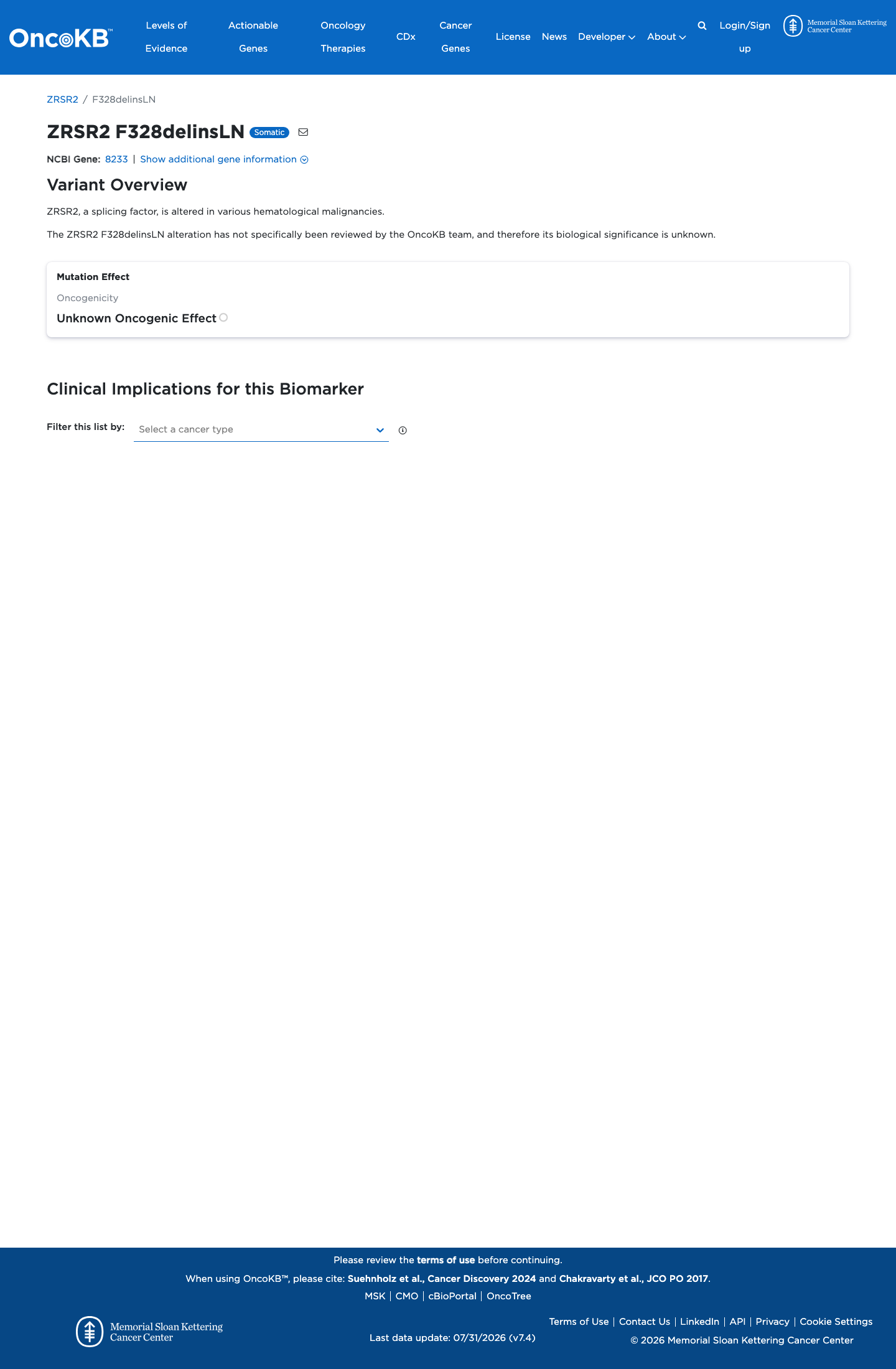
Functional Unknown Oncogenic Effect
OncoKB did not identify variant-specific reviewed functional evidence for this variant; gene-level curated context is available for reviewer follow-up. ZRSR2, a splicing factor, is altered in various hematological malignancies.
OncoKB ↗
COSMIC screenshot
COSMIC
Cancer hotspots screenshot
Cancer hotspots
Somatic evidence Not in COSMIC / hotspots
COSMIC
This variant does not lie in a statistically significant hotspot. This variant has not previously been reported in somatic cancers (COSMIC).
Hotspots
This variant does not lie in a statistically significant hotspot.
Sources & reference links
8Sources
ClinVar
gnomAD v2.1
gnomAD v4.1
gnomAD-Canada
SpliceAI
OncoKB
COSMIC
Cancer hotspots