Analysis in progress
Initialising…
0%
complete
This report is still being assembled — sections appear as each stage finishes. It isn't final yet.
ETV6
Final classification
VUS
PM2PP3
ETV6
c.1204T>G
p.Tyr402Asp
missense · exon 7

ETV6 encodes an ETS-family transcription factor that is essential for hematopoiesis and for maintenance of the developing vascular network. It contains an N-terminal pointed (PNT) domain for protein-protein interactions and a C-terminal DNA-binding domain. ETV6 acts as a tumor suppressor: its rearrangements are among the most common alterations in hematologic malignancies and are also linked to congenital fibrosarcoma, while germline mutations predispose to blood cancers such as acute lymphoblastic leukemia. It can also promote tumorigenesis through fusions that alter the activity of partner genes or nearby proto-oncogenes.

This variant

ETV6 is a tumor-suppressor transcription factor essential for hematopoiesis, and germline mutations predispose to blood cancers such as acute lymphoblastic leukemia. This missense change (p.Tyr402Asp) is predicted to be deleterious (REVEL 0.855) yet is absent from population databases, with no clinical, functional, or segregation evidence available. It therefore remains a variant of uncertain significance until such evidence emerges.

Transcript
NM_001987.4
HGVS · transcript:coding
NM_001987.4:c.1204T>G
GRCh38
chr12:11885977 T>G
GRCh37
chr12:12038911 T>G
Basis No ETV6-specific ClinGen VCEP/CSPEC or local framework was available, so generic ACMG/AMP 2015 rules were applied; only PM2 and PP3 (both supporting) were met, yielding a VUS.
No ETV6-specific ClinGen VCEP/CSPEC or local framework was available, so generic ACMG/AMP 2015 rules were applied; only PM2 and PP3 (both supporting) were met, yielding a VUS.
Classification rationale
PM2PP3 VUS
ETV6 c.1204T>G missense · exon 7

PM2 (Supporting): absent from gnomAD v2.1, v4.1, and gnomAD-Canada v1.0, indicating extreme rarity in population databases. PP3 (Supporting): REVEL score 0.855 exceeds the ~0.7 pathogenic-supporting threshold, indicating a deleterious missense effect. With only two supporting-strength criteria (PM2, PP3) and no benign criteria met, the variant is classified as a variant of uncertain significance under the generic ACMG/AMP 2015 combination rules.

PM2 + PP3 VUS
Gene diagram · NM_001987.4 · variants mapped to exon structure
ETV6 NM_001987.4
Fetching transcript structure from UCSC…
Applied criteria · 2 applied · 22 assessed
MetEvidence satisfies this criterion.
Not metEvaluated against available evidence; threshold not reached.
Not assessedApplies in principle, but no evidence was found to evaluate it.
N/ADoesn't apply to this variant type.
Applied · 2
Strength Supporting Moderate Strong Very strong
PM2 supporting Pathogenic
Met (supporting): absent from gnomAD v2.1, v4.1, and gnomAD-Canada v1.0, indicating extreme rarity.
No ETV6 ClinGen VCEP specification or local gene-specific framework was retrieved for this case; generic ACMG/AMP population-evidence interpretation was used.The queried variant was reported absent from gnomAD v2.1, gnomAD v4.1, and gnomAD-Canada v1.0 across the queried builds.Under the generic ACMG/AMP framework, absence from population controls supports PM2 at supporting strength; no ancestry-specific enrichment, homozygote, or frequency artifact was reported because the variant was absent.
PP3 supporting Pathogenic
Met (supporting): REVEL score 0.855 exceeds the ~0.7 pathogenic-supporting threshold, supporting a deleterious missense effect.
REVEL score = 0.855 for NM_001987.4:c.1204T>G (source_registry key 'revel'), exceeding the commonly applied pathogenic-supporting REVEL threshold (~0.7) from the REVEL calibration literature, PMID 36413997.SpliceAI max delta score = 0.041 (DS_AG 0.041, DS_AL 0.0, DS_DG 0.007, DS_DL 0.001) indicates no predicted splice impact, consistent with a missense (non-splicing) mechanism for this variant; this does not independently satisfy or negate PP3/BP4 for this missense variant.Variant is missense (NP_001978.1:p.(Tyr402Asp)); canonical_splice_consensus=false, so the splice-impact pathway is not the operative mechanism here.
Assessed · not applied · 5 not met · 17 not assessed
Pathogenic
PS1 Not met: no ClinVar record or other nucleotide change producing the same p.Tyr402Asp amino acid with an established pathogenic classification was found.
PS2 Not assessed: no proband phenotype or parental genotype data were provided, so de novo occurrence cannot be established.
PS3 Not assessed: no functional assay data (e.g., DNA-binding or transcriptional assays) for this variant were available.
PS4 Not assessed: no case-control or case-enrichment data for this variant were available.
PM1 Not assessed: no citable mutational-hotspot or functional-domain boundary evidence for residue 402 was available.
PM3 Not assessed: no second ETV6 variant or phase information was available to establish a pathogenic variant in trans.
PM5 Not assessed: no alternate amino acid substitution at codon 402 with an established pathogenic ClinVar classification was found.
PM6 Not assessed: no reported de novo occurrence or parental testing was provided.
PP1 Not assessed: no pedigree or segregation data (informative meioses) were provided.
PP2 Not assessed: no gene-level missense constraint metric (e.g., gnomAD Z-score) was available for ETV6.
PP4 Not assessed: no proband phenotype or variant-specific clinical report was provided.
PP5 Not assessed: ClinVar holds no record for this exact variant.
Benign
BA1 Not met: the variant is absent from population databases, so no allele frequency approaches a stand-alone benign threshold.
BS1 Not met: no allele frequency above the ETV6-disease threshold was observed in population databases.
BS2 Not met: no homozygotes or unaffected adult carriers were observed in population databases.
BS3 Not assessed: no functional assay data showing normal activity for this variant were available.
BS4 Not assessed: no relative genotype-phenotype observations were provided from which non-segregation could be shown.
BP1 Not assessed: no evidence established that missense variants are depleted among pathogenic ETV6 alleles.
BP2 Not assessed: no observation of this variant in cis with a pathogenic ETV6 variant, or homozygous in an unaffected individual.
BP4 Not met: REVEL score 0.855 predicts a deleterious effect, the opposite of the benign prediction BP4 requires.
BP5 Not assessed: no independent molecular diagnosis was provided to assess an alternative disease cause.
BP6 Not assessed: ClinVar holds no record for this exact variant.
N/A · 4 PVS1 · PM4 · BP3 · BP7
Research & evidence
Population frequency
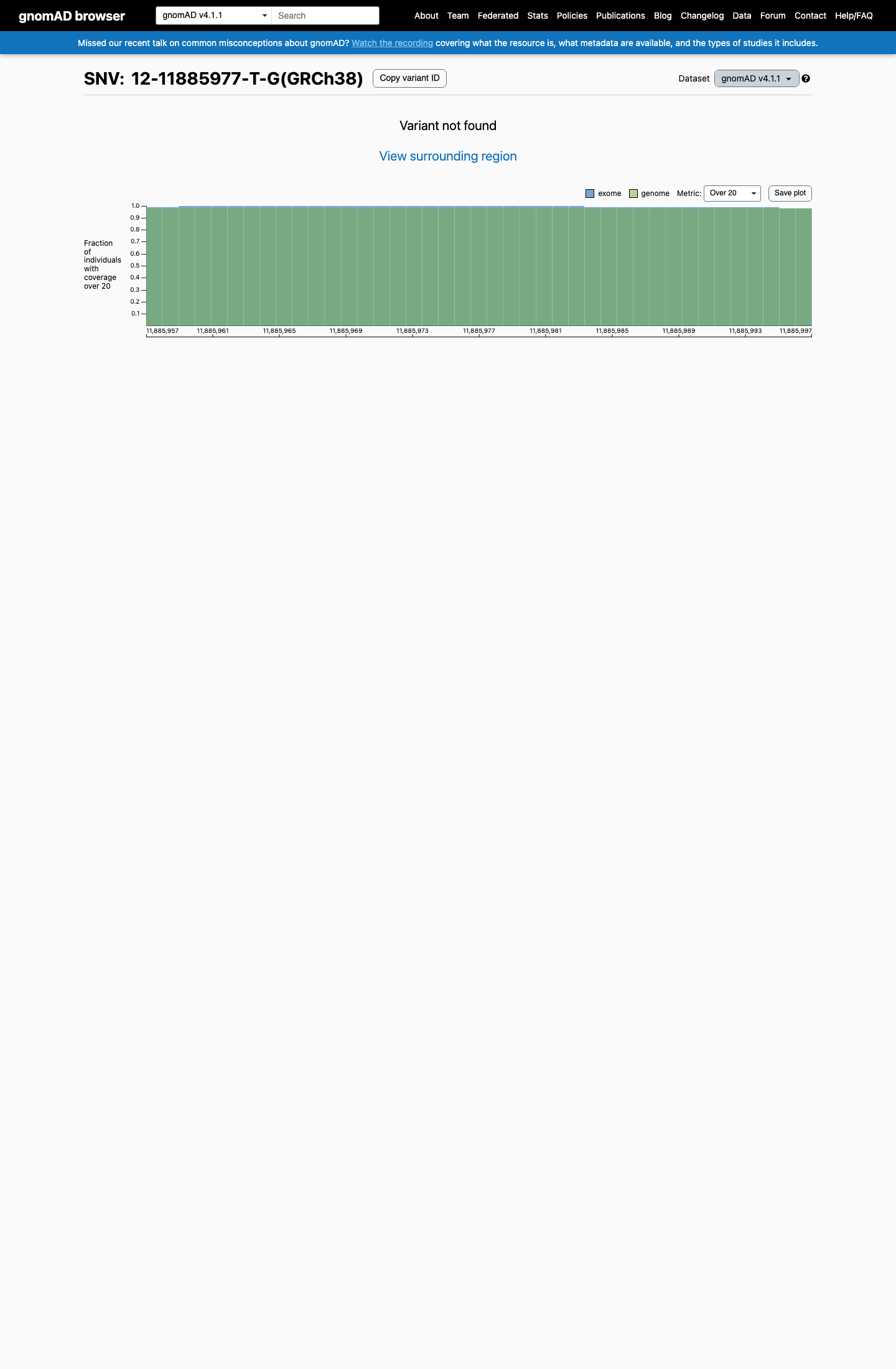
gnomAD v4.1 screenshot
gnomAD v4.1
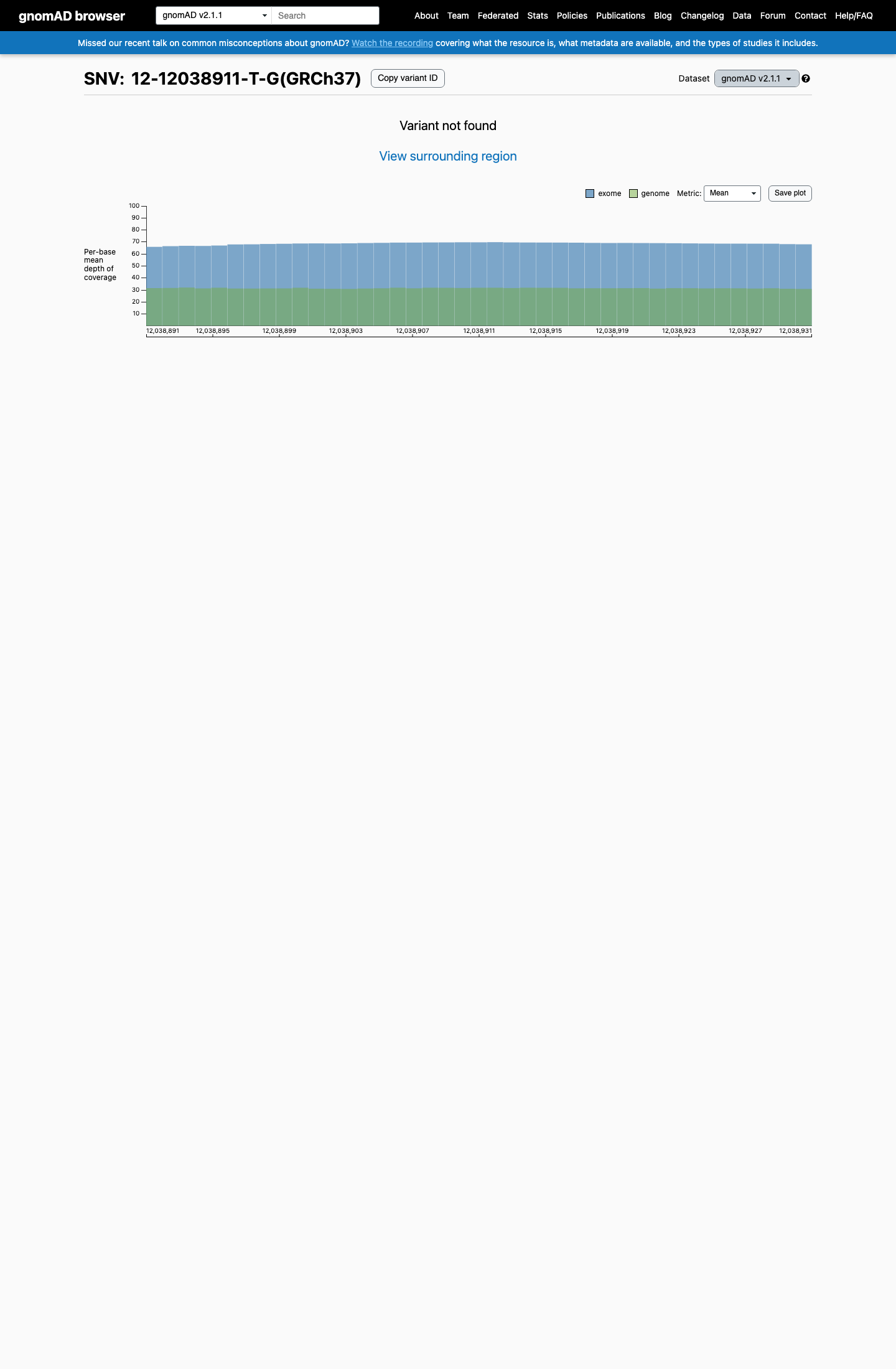
gnomAD v2.1 screenshot
gnomAD v2.1
v4.1
Absent from gnomAD v4.1.
v2.1
Absent from gnomAD v2.1.
🇨🇦 CA
Absent from gnomAD-Canada v1.0.
Allele frequency by ancestry
three datasets · side by side
gnomAD v4.1
Absent · 0 / ?
0 hom
Not observed in any ancestry group.
gnomAD v2.1
Absent · 0 / ?
0 hom
Not observed in any ancestry group.
gnomAD Canada 🇨🇦
Absent · 0 / ?
0 hom
Not observed in any ancestry group.
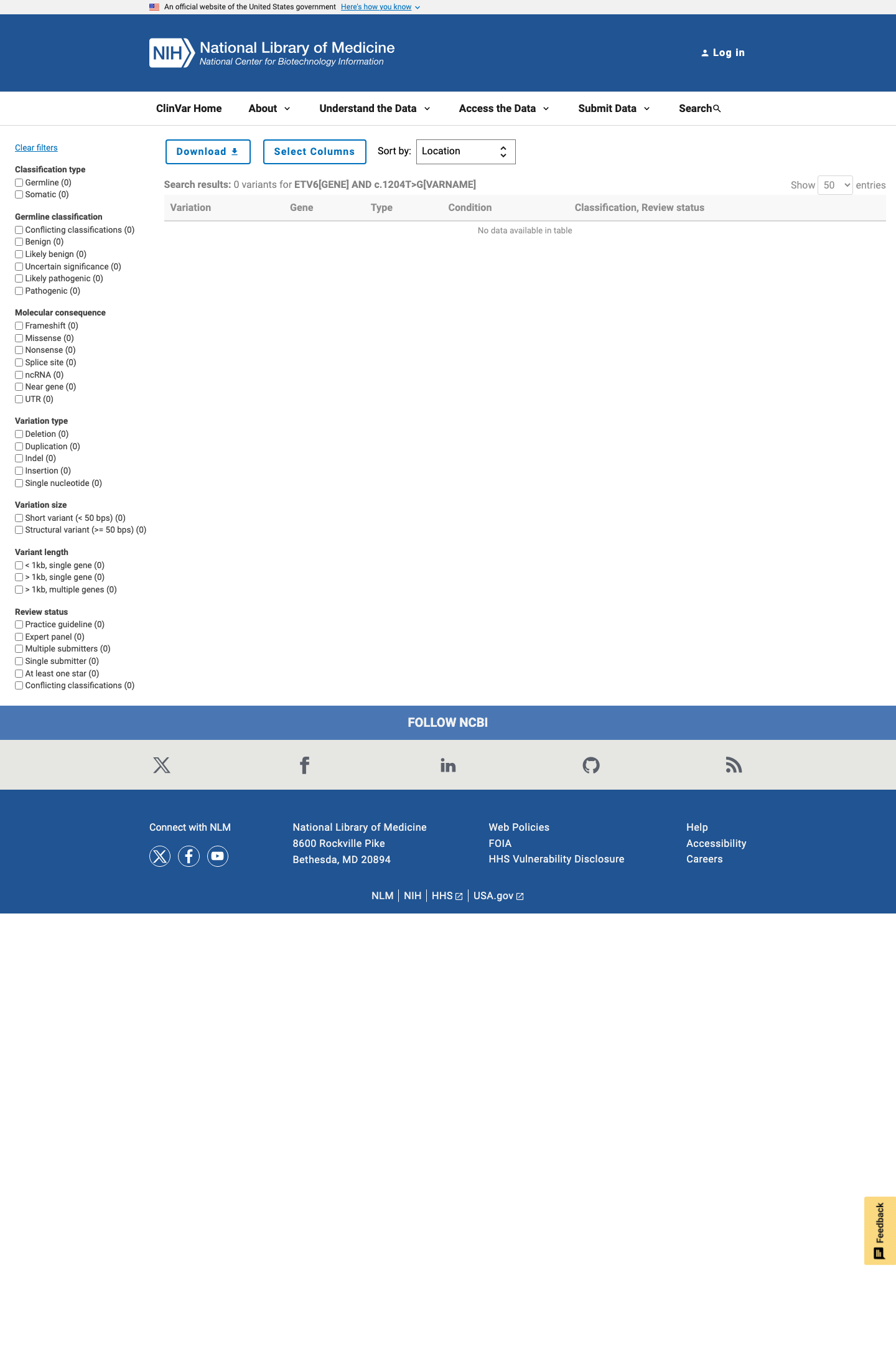
ClinVar screenshot
ClinVar
This variant is absent from ClinVar.
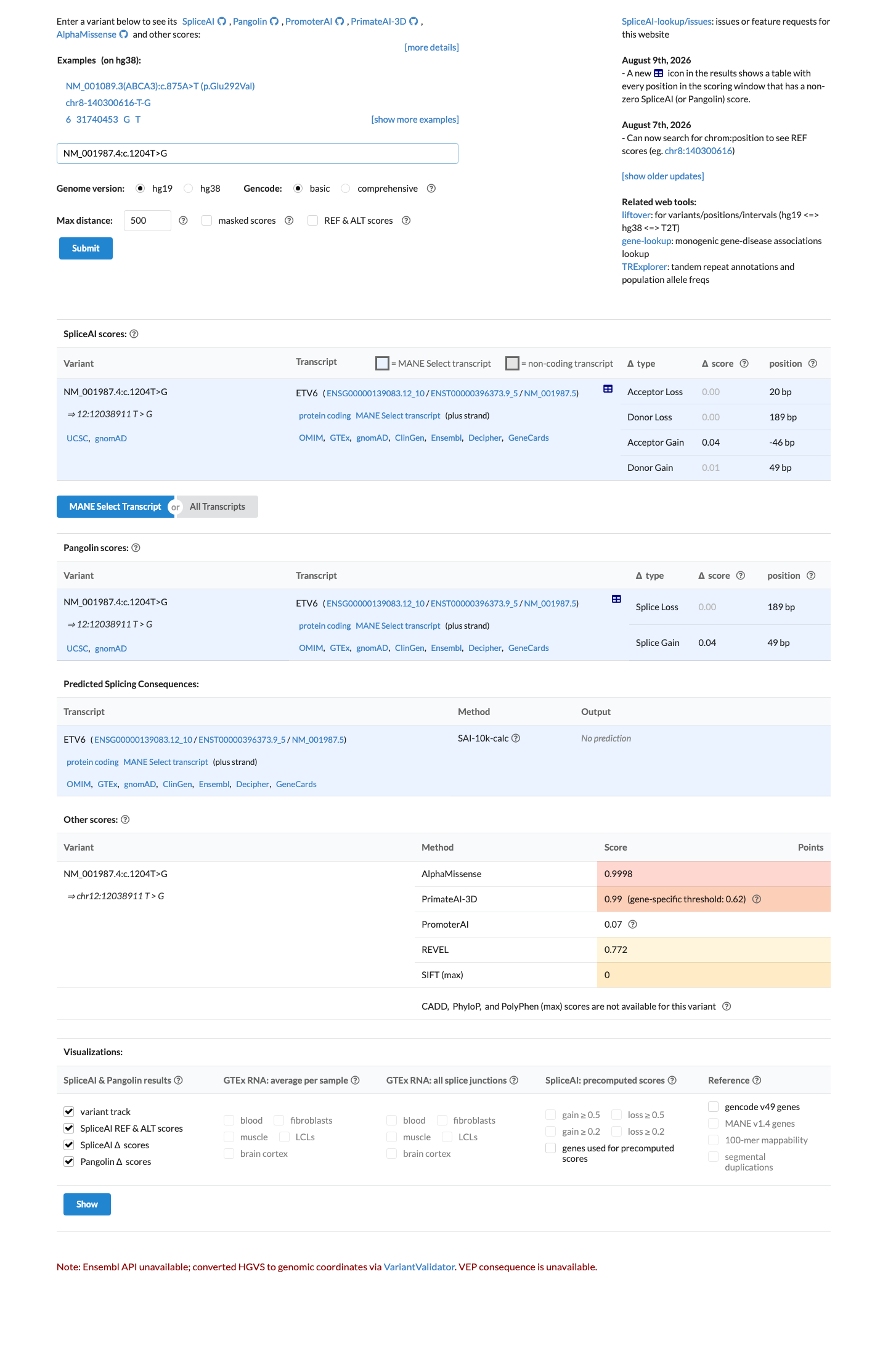
SpliceAI screenshot
In silico
SpliceAI predicts no significant splice impact for this variant (max delta score = 0.04). REVEL score = 0.855. BayesDel score = 0.187716.
Functional No data
No calibrated functional assay or RNA evidence was identified for this variant.
OncoKB ↗
COSMIC screenshot
COSMIC
Cancer hotspots screenshot
Cancer hotspots
Somatic evidence Not in COSMIC / hotspots
COSMIC
This variant does not lie in a statistically significant hotspot. This variant has not previously been reported in somatic cancers (COSMIC).
Hotspots
This variant does not lie in a statistically significant hotspot.
Sources & reference links
8Sources
ClinVar
gnomAD v2.1
gnomAD v4.1
gnomAD-Canada
SpliceAI
OncoKB
COSMIC
Cancer hotspots