Analysis in progress
Initialising…
0%
complete
This report is still being assembled — sections appear as each stage finishes. It isn't final yet.
NF1
Final classification
Benign
BA1BP4
NF1
c.*4T>C
p.?
unknown · exon 58

NF1 encodes neurofibromin, a tumor suppressor protein that negatively regulates the RAS signal transduction pathway. As a GTPase-activating protein, it helps switch RAS proteins from their active to inactive state, keeping cell growth in check; loss of NF1 function leaves RAS overactive and drives downstream growth pathways such as MAPK/ERK and PI3K. Inherited changes in NF1 cause the cancer-predisposition syndrome neurofibromatosis type 1, and are also linked to juvenile myelomonocytic leukemia and Watson syndrome. Somatic changes in NF1 are found in many tumor types, including breast cancer, melanoma, and glioma.

This variant

NF1 is a tumor suppressor whose loss leaves RAS overactive and predisposes to neurofibromatosis type 1 and several cancers. This variant sits in the gene's 3' UTR and is common in the general population, so the benign classification indicates it does not impair neurofibromin's tumor-suppressor function or raise NF1-related disease risk.

Transcript
NM_001042492.2
HGVS · transcript:coding
NM_001042492.2:c.*4T>C
GRCh38
chr17:31374159 T>C
GRCh37
chr17:29701177 T>C
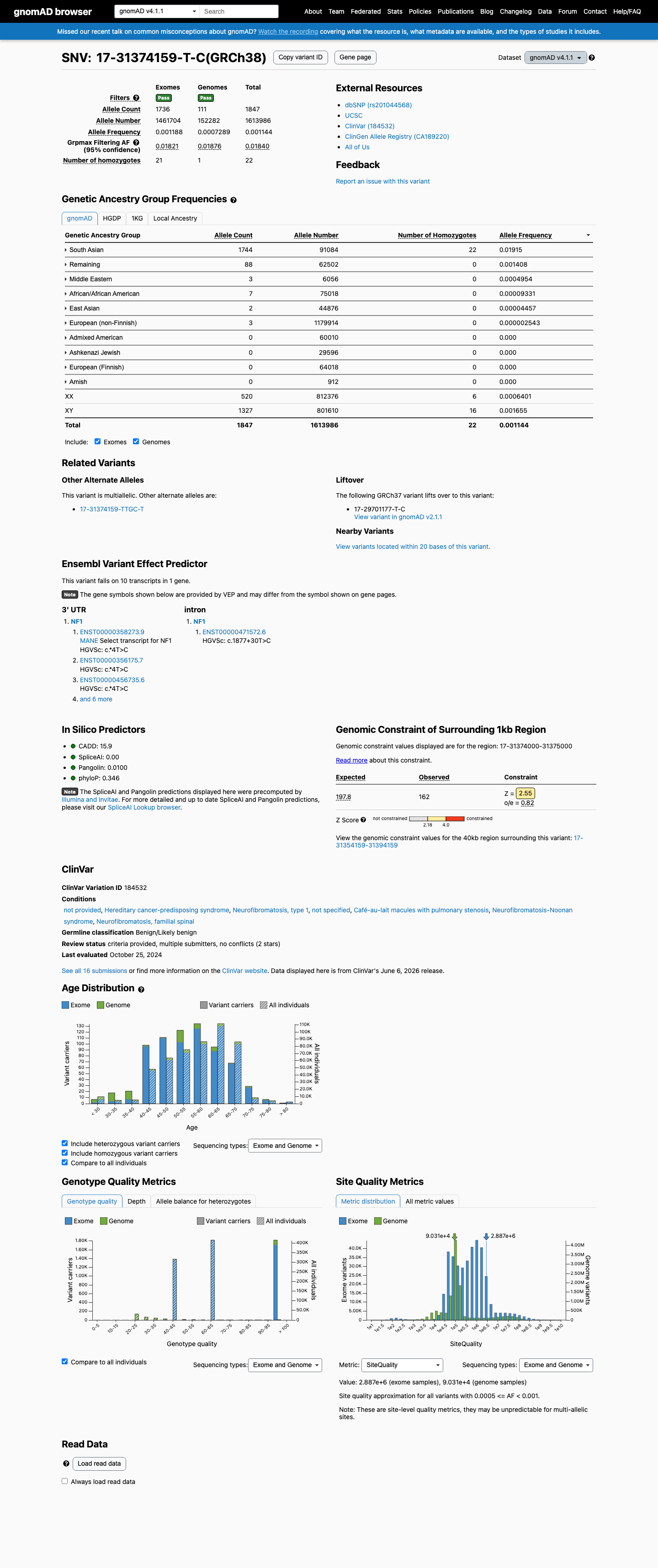
Basis Benign: South Asian allele frequency ~1.91% in gnomAD v4.1 meets BA1 at stand-alone strength; SpliceAI max delta 0.004 adds BP4 supporting.
Benign: South Asian allele frequency ~1.91% in gnomAD v4.1 meets BA1 at stand-alone strength; SpliceAI max delta 0.004 adds BP4 supporting.
Classification rationale
BA1BP4 Benign
NF1 c.*4T>C unknown · exon 58

BA1 (stand-alone benign): the allele is far too common for a pathogenic NF1 allele, at ~1.9-2.0% South Asian frequency in gnomAD. BP4 (supporting): SpliceAI predicts no splice impact for this 3' UTR variant (max delta 0.004). Overall: Benign, combining stand-alone BA1 with supporting BP4 under the generic ACMG/AMP 2015 framework.

BA1 + BP4 Benign
Gene diagram · NM_001042492.2 · variants mapped to exon structure
NF1 NM_001042492.2
Fetching transcript structure from UCSC…
Applied criteria · 2 applied · 15 assessed
MetEvidence satisfies this criterion.
Not metEvaluated against available evidence; threshold not reached.
Not assessedApplies in principle, but no evidence was found to evaluate it.
N/ADoesn't apply to this variant type.
Applied · 2
Strength Supporting Moderate Strong Very strong
BA1 stand-alone Benign
Met (stand-alone benign): South Asian allele frequency 1.91% in gnomAD v4.1 (2.01% in v2.1) is far too common for a pathogenic NF1 allele.
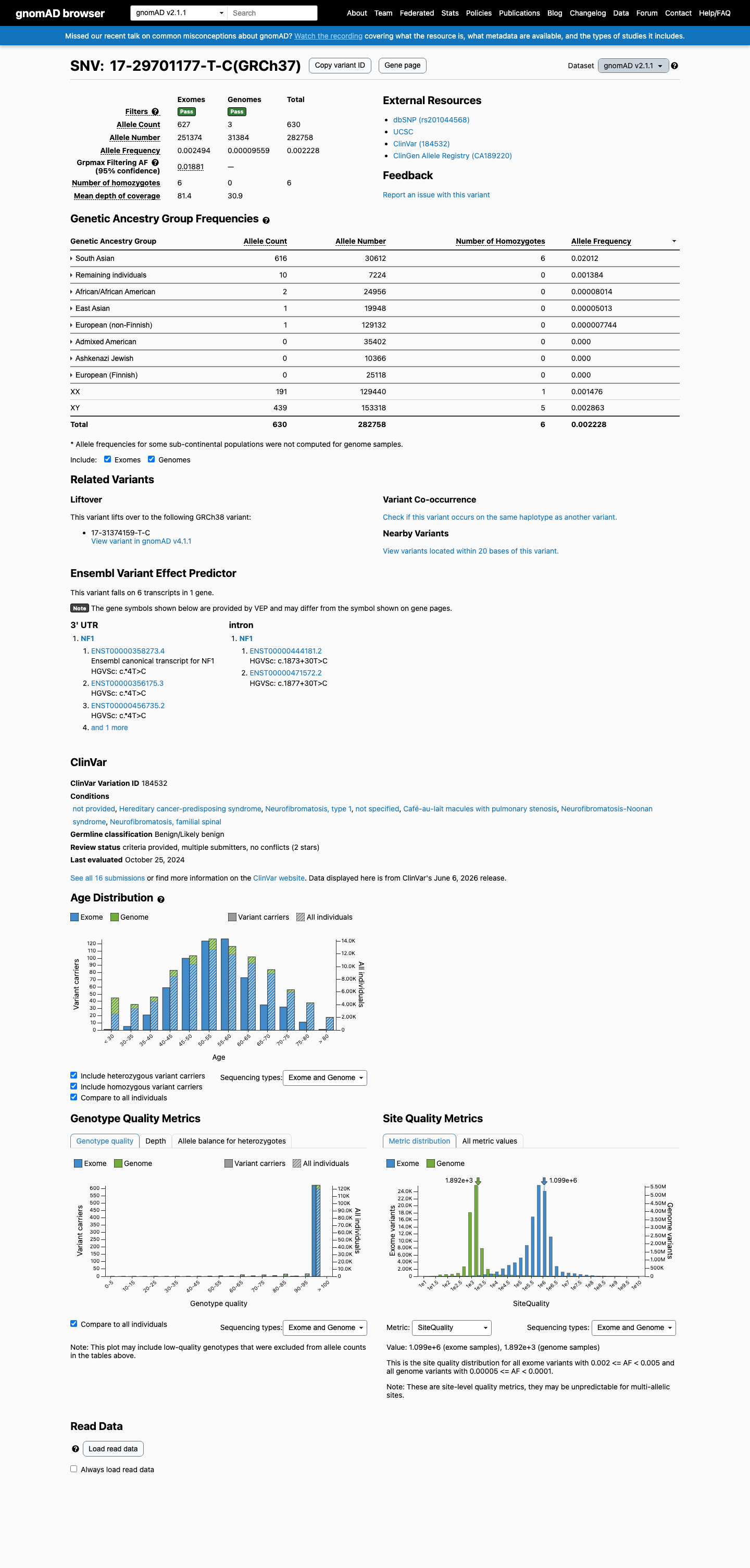
The applicable framework is ClinGen Neurofibromatosis and Schwannomatosis Expert Panel NF1 specification version 1.0.gnomAD v4.1: overall AF 0.1144% (1,847/1,613,986), South Asian AF 1.9147% (1,744/91,084), 22 South Asian homozygotes, and South Asian grpmax FAF 1.8399%.gnomAD v2.1 independently reports South Asian AF 2.0123% (616/30,612), 6 South Asian homozygotes, and grpmax FAF 1.8808%.
BP4 supporting Benign
Met (supporting): SpliceAI predicts no splice impact, with max delta score 0.004, consistent with a benign effect.
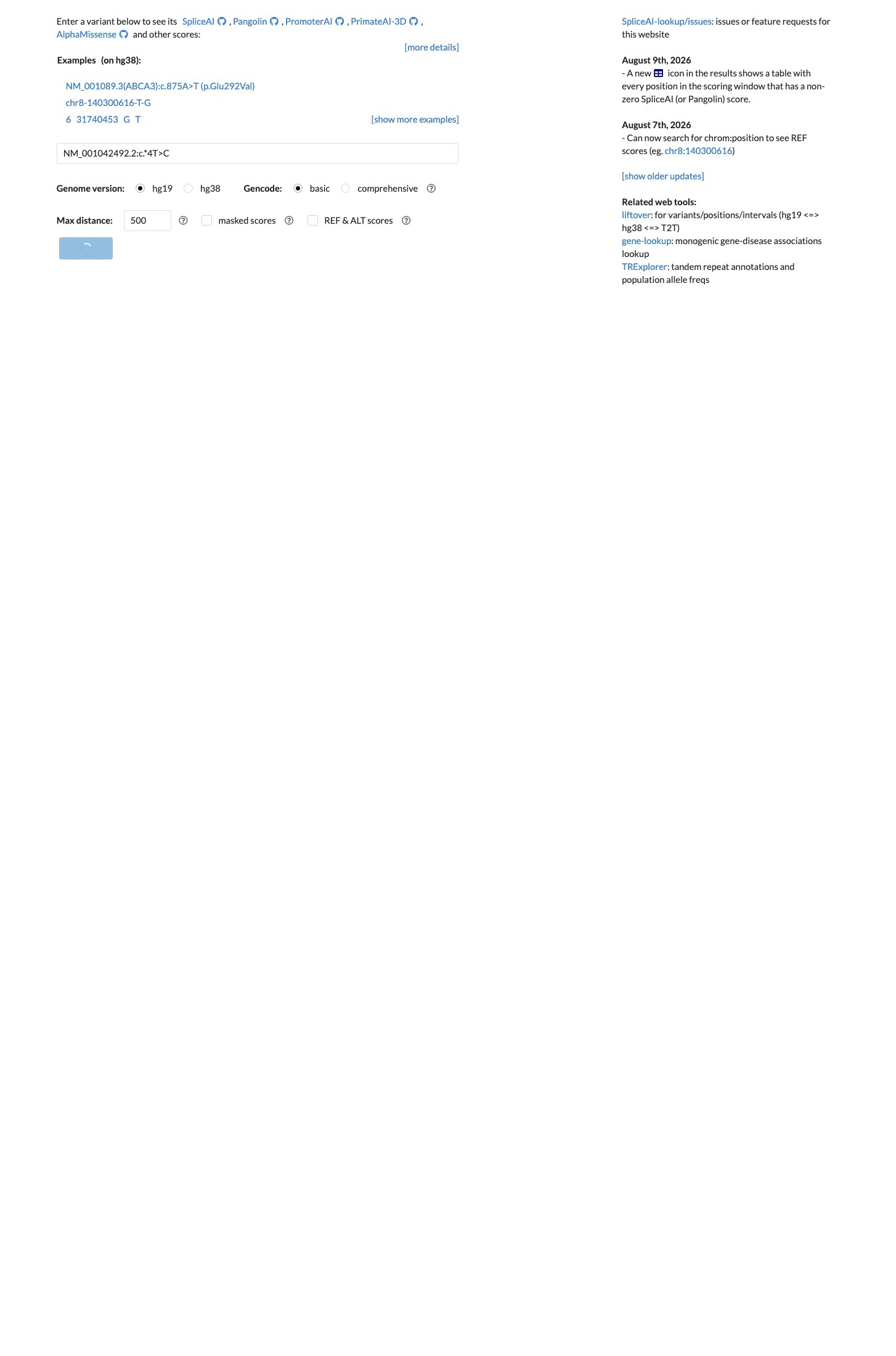
SpliceAI Lookup: DS_AG=0.00, DS_AL=0.001, DS_DG=0.00, DS_DL=0.004, max delta=0.004 for NM_001042492.2:c.*4T>C, indicating no predicted disruption of splice donor/acceptor sites.Variant lies in the 3' UTR, 4 nt beyond the stop codon; no missense change is created, so REVEL/BayesDel/aGVGD computational missense evidence does not apply here.
Assessed · not applied · 2 not met · 13 not assessed
Pathogenic
PS2 Not assessed: no de novo occurrence with parental confirmation or proband phenotype data was reported.
PS3 Not assessed: no functional assay data (splicing, RNA, or protein) for this variant were available.
PS4 Not assessed: no case-control or affected-series enrichment data for this exact variant were available.
PM2 Not met: the allele is common in population databases, with South Asian gnomAD v4.1 frequency 1.91%.
PM6 Not assessed: no presumed de novo occurrence in an affected individual was reported.
PP1 Not assessed: no family segregation data, affected-relative genotypes, or meiosis counts were available.
PP3 Not met: SpliceAI max delta 0.004, far below the ~0.2 threshold used to flag splice impact.
PP4 Not assessed: no NF1-specific proband phenotype data were provided.
PP5 Not assessed: no expert-panel record classifies this exact variant as pathogenic or likely pathogenic.
Benign
BS2 Not assessed: the 22 reported homozygotes were not confirmed as comprehensively phenotyped and unaffected.
BS3 Not assessed: no functional assay data refuting a damaging effect for this variant were available.
BS4 Not assessed: no unaffected-carrier or affected-non-carrier genotypes or pedigree data were available.
BP2 Not assessed: no individual-level co-occurrence or phased trans observations were available.
BP5 Not assessed: no evidence of an alternate cause of the phenotype was available.
BP6 Not assessed: no expert-panel record classifies this exact variant as benign or likely benign.
N/A · 11 PVS1 · PS1 · PM1 · PM3 · PM4 · PM5 · PP2 · BS1 · BP1 · BP3 · BP7
Research & evidence
Population frequency · supports benign
gnomAD v4.1 screenshot
gnomAD v4.1
gnomAD v2.1 screenshot
gnomAD v2.1
v4.1
This variant is present in gnomAD v4.1 (AF= 0.00114437; MAF= 0.11444%, 1847/1613986 alleles, homozygotes = 22) and has highest observed frequency in the South Asian population (AF= 0.0191472; MAF= 1.91472%, 1744/91084 alleles, homozygotes = 22); grpmax FAF= 0.0183991.
v2.1
This variant is present in gnomAD v2.1 (AF= 0.00222805; MAF= 0.22281%, 630/282758 alleles, homozygotes = 6) and has highest observed frequency in the South Asian population (AF= 0.0201228; MAF= 2.01228%, 616/30612 alleles, homozygotes = 6); grpmax FAF= 0.0188075.
🇨🇦 CA
This variant is present in gnomAD-Canada v1.0 (AF= 0.001954185213331886, 36/18422 alleles, homozygotes = 0).
Allele frequency by ancestry
three datasets · side by side
gnomAD v4.1
0.11% · 1847 / 1,613,986
22 hom · FAF 1.8%
South Asian
1744 / 91,084
1.9%
22 hom
Remaining individuals
88 / 62,502
0.14%
Middle Eastern
3 / 6,056
0.05%
African/African American
7 / 75,018
0.0093%
East Asian
2 / 44,876
0.0045%
European (non-Finnish)
3 / 1,179,914
0.00025%
+ 4 not observed (Admixed American, European (Finnish), Amish, Ashkenazi Jewish)
gnomAD v2.1
0.22% · 630 / 282,758
6 hom · FAF 1.9%
South Asian
616 / 30,612
2%
6 hom
Remaining individuals
10 / 7,224
0.14%
African/African American
2 / 24,956
0.008%
East Asian
1 / 19,948
0.005%
European (non-Finnish)
1 / 129,132
0.00077%
+ 3 not observed (Admixed American, Ashkenazi Jewish, European (Finnish))
gnomAD Canada 🇨🇦
0.2% · 36 / 18,422
0 hom · FAF 1.9%
South Asian
35 / 1,362
2.6%
Remaining individuals
1 / 1,138
0.088%
+ 7 not observed (African/African American, Latino/Admixed American, Ashkenazi Jewish, East Asian, European (Finnish), Middle Eastern, European (non-Finnish))
ClinVar screenshot
ClinVar
This variant has been reported in ClinVar as Benign (10 clinical laboratories) and as Likely benign (6 clinical laboratories). (ClinVarID = 184532)
SpliceAI screenshot
In silico
SpliceAI predicts no significant splice impact for this variant (max delta score = 0.00).
Functional No data
No calibrated functional assay or RNA evidence was identified for this variant.
OncoKB ↗
Somatic evidence
COSMIC
This variant has not previously been reported in somatic cancers (COSMIC).
Hotspots
This variant does not lie in a statistically significant cancer hotspot.
Sources & reference links
7Sources
CSpec VCEP
ClinVar
gnomAD v2.1
gnomAD v4.1
gnomAD-Canada
SpliceAI
OncoKB
Triaged references · 11 PMIDs not cited in assessment
23460398 ↗ Neurofibromatosis-1 gene deletions and mutations in de novo adult acute myeloid leukemia. CLINVAR
24033266 ↗ A systematic approach to assessing the clinical significance of genetic variants. CLINVAR
25741868 ↗ Standards and guidelines for the interpretation of sequence variants: a joint consensus recommendation of the American College of Medical Genetics and Genomics and the Association for Molecular Pathology. CLINVAR
10678181 ↗ Nf1 and Gmcsf interact in myeloid leukemogenesis. CLINVAR
15604628 ↗ Genetic cancer risk assessment and counseling: recommendations of the national society of genetic counselors. CLINVAR
17636453 ↗ Neurofibromatosis type 1 in genetic counseling practice: recommendations of the National Society of Genetic Counselors. CLINVAR
25394175 ↗ A practice guideline from the American College of Medical Genetics and Genomics and the National Society of Genetic Counselors: referral indications for cancer predisposition assessment. CLINVAR
26324357 ↗ American Society of Clinical Oncology Policy Statement Update: Genetic and Genomic Testing for Cancer Susceptibility. CLINVAR
26140447 ↗ Points to Consider: Ethical, Legal, and Psychosocial Implications of Genetic Testing in Children and Adolescents. CLINVAR
27069254 ↗ The 2016 revision to the World Health Organization classification of myeloid neoplasms and acute leukemia. CLINVAR
28492532 ↗ Sherloc: a comprehensive refinement of the ACMG-AMP variant classification criteria. CLINVAR