Analysis in progress
Initialising…
0%
complete
This report is still being assembled — sections appear as each stage finishes. It isn't final yet.
BRCA2
Final classification
Likely Benign
BP1BP6
BRCA2
c.7317A>G
p.Gly2439=
synonymous · exon 14

BRCA2 encodes a DNA repair protein that maintains genome stability by repairing double-strand breaks through homologous recombination and by protecting DNA replication forks. It acts as a tumor suppressor, and inherited loss-of-function changes cause hereditary breast and ovarian cancer syndrome, with elevated lifetime risks of breast, ovarian, prostate, and pancreatic cancers; biallelic changes cause Fanconi anemia complementation group D1. Reduced or altered BRCA2 activity is implicated in multiple tumor types, and PARP inhibitors are an approved treatment for BRCA2-associated ovarian and breast cancers.

This variant

BRCA2 loss-of-function causes hereditary breast and ovarian cancer syndrome with elevated breast, ovarian, prostate, and pancreatic cancer risks, but this synonymous change (p.(Gly2439=)) leaves the protein sequence unaltered, lies outside the PALB2-binding and DNA-binding domains, has no predicted splice impact, and is classified Likely benign by the ENIGMA expert panel. It is therefore not expected to carry the cancer risks associated with BRCA2 loss-of-function.

Transcript
NM_000059.4
HGVS · transcript:coding
NM_000059.4:c.7317A>G
GRCh38
chr13:32355170 A>G
GRCh37
chr13:32929307 A>G
Basis Only BP1 (Strong) and BP6 (Supporting) are met, both benign-direction, with no pathogenic-direction evidence, yielding Likely Benign under the ENIGMA BRCA1/BRCA2 CSPEC v1.2 Table 3 combination rules.
Only BP1 (Strong) and BP6 (Supporting) are met, both benign-direction, with no pathogenic-direction evidence, yielding Likely Benign under the ENIGMA BRCA1/BRCA2 CSPEC v1.2 Table 3 combination rules.
Classification rationale
BP1BP6 Likely Benign
BRCA2 c.7317A>G synonymous · exon 14

BP1 (Strong): synonymous change at codon 2439, outside the PALB2-binding and DNA-binding domains, with no predicted splice impact (SpliceAI max delta 0.012). BP6 (Supporting): ENIGMA expert panel classified this exact variant Likely benign (ClinVar SCV000579037). Likely Benign: ENIGMA CSPEC v1.2 Table 3 combines BP1 (Strong) with BP6 (Supporting), both benign-direction, with no pathogenic criteria met.

BP1 + BP6 Likely Benign
Gene diagram · NM_000059.4 · variants mapped to exon structure
BRCA2 NM_000059.4
Fetching transcript structure from UCSC…
Applied criteria · 2 applied · 16 assessed
MetEvidence satisfies this criterion.
Not metEvaluated against available evidence; threshold not reached.
Not assessedApplies in principle, but no evidence was found to evaluate it.
N/ADoesn't apply to this variant type.
Applied · 2
Strength Supporting Moderate Strong Very strong
BP1 strong review Benign
Met (Strong): silent change at codon 2439, outside the PALB2-binding (aa10-40) and DNA-binding (aa2481-3186) domains, with SpliceAI max delta 0.012 ≤ 0.1.
ENIGMA BRCA1/BRCA2 CSPEC v1.2 BP1 rule: 'Apply BP1_Strong for silent substitution, missense or in-frame insertion, deletion or delins variants outside a (potentially) clinically important functional domain AND no splicing predicted (SpliceAI ≤0.1). ... clinically important functional domains are defined as: BRCA2 PALB2 binding domain aa 10-40; BRCA2 DNA binding aa 2481-3186.'Variant normalizes to NP_000050.3:p.(Gly2439=), residue 2439, which lies outside both the PALB2-binding domain (aa 10-40) and the DNA-binding domain (aa 2481-3186).SpliceAI predicts no significant splice impact for this variant (max delta score = 0.012 / 0.01), from case prefetch/evidence data, satisfying the SpliceAI ≤0.1 requirement.
BP6 supporting Benign
Met (Supporting): ENIGMA expert panel classified this exact variant Likely benign (ClinVar SCV000579037).
ClinVar Variation ID 135813 is an exact transcript-HGVS match for NM_000059.4:c.7317A>G (p.Gly2439=).The exact-match audit identifies ENIGMA submission SCV000579037 as an expert-panel assertion with classification Likely benign.ClinVar expert panel classification
Assessed · not applied · 7 not met · 9 not assessed
Pathogenic
PS3 Insufficient evidence: no functional assay result (minigene, saturation genome editing, or protein-based) for this variant was available.
PS4 Insufficient evidence: no case-control enrichment study reporting this exact variant was available.
PM2 Not met: the variant is present in gnomAD v2.1 (7/251,214 alleles; AF 2.8e-05), so the PM2 absence-from-controls requirement is not satisfied.
PM3 Insufficient evidence: no Fanconi anemia phenotype, second BRCA2 variant, or inheritance data were available to assess PM3.
PP1 Insufficient evidence: no family segregation data or quantitative co-segregation likelihood ratio were available.
PP3 Not met: SpliceAI max delta 0.012 is far below the ≥0.2 PP3 splice-impact threshold for silent variants.
PP4 Insufficient evidence: no ENIGMA multifactorial clinical-history likelihood ratio for this variant was available.
PP5 Not met: the sole ClinVar expert-panel entry is ENIGMA Likely benign, not Pathogenic or Likely pathogenic.
Benign
BA1 Not met: maximum gnomAD non-founder FAF is 1.687e-05, far below the >0.001 BA1 threshold.
BS1 Not met: gnomAD v2.1 maximum population FAF 1.687e-05 falls below the BS1 Supporting lower bound of 0.00002.
BS2 Insufficient evidence: no identifiable healthy adult probands or co-occurrence variables were available to assign BS2 points.
BS3 Insufficient evidence: no functional assay demonstrating a benign effect for this variant was available.
BS4 Insufficient evidence: no family testing showing lack of segregation with disease was available.
BP4 Not met: SpliceAI is benign (max delta 0.012 ≤ 0.1), but BP4's silent-variant rule requires a position inside a functional domain; codon 2439 lies outside both.
BP5 Insufficient evidence: no ENIGMA likelihood ratio against pathogenicity for this variant was available.
BP7 Not met: BP7 requires a silent variant inside a functional domain with BP4 met; codon 2439 lies outside both domains.
N/A · 10 PVS1 · PS1 · PS2 · PM1 · PM4 · PM5 · PM6 · PP2 · BP2 · BP3
Research & evidence
Population frequency · supports benign
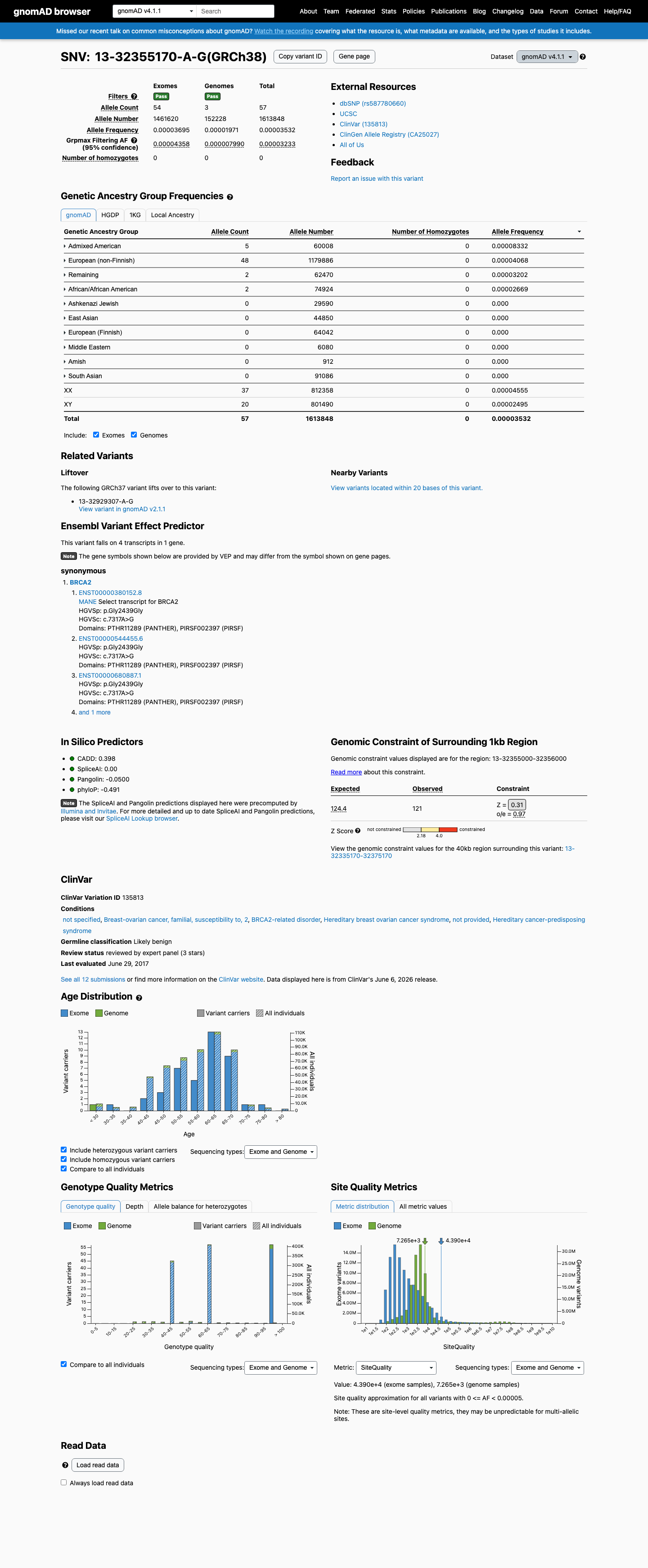
gnomAD v4.1 screenshot
gnomAD v4.1
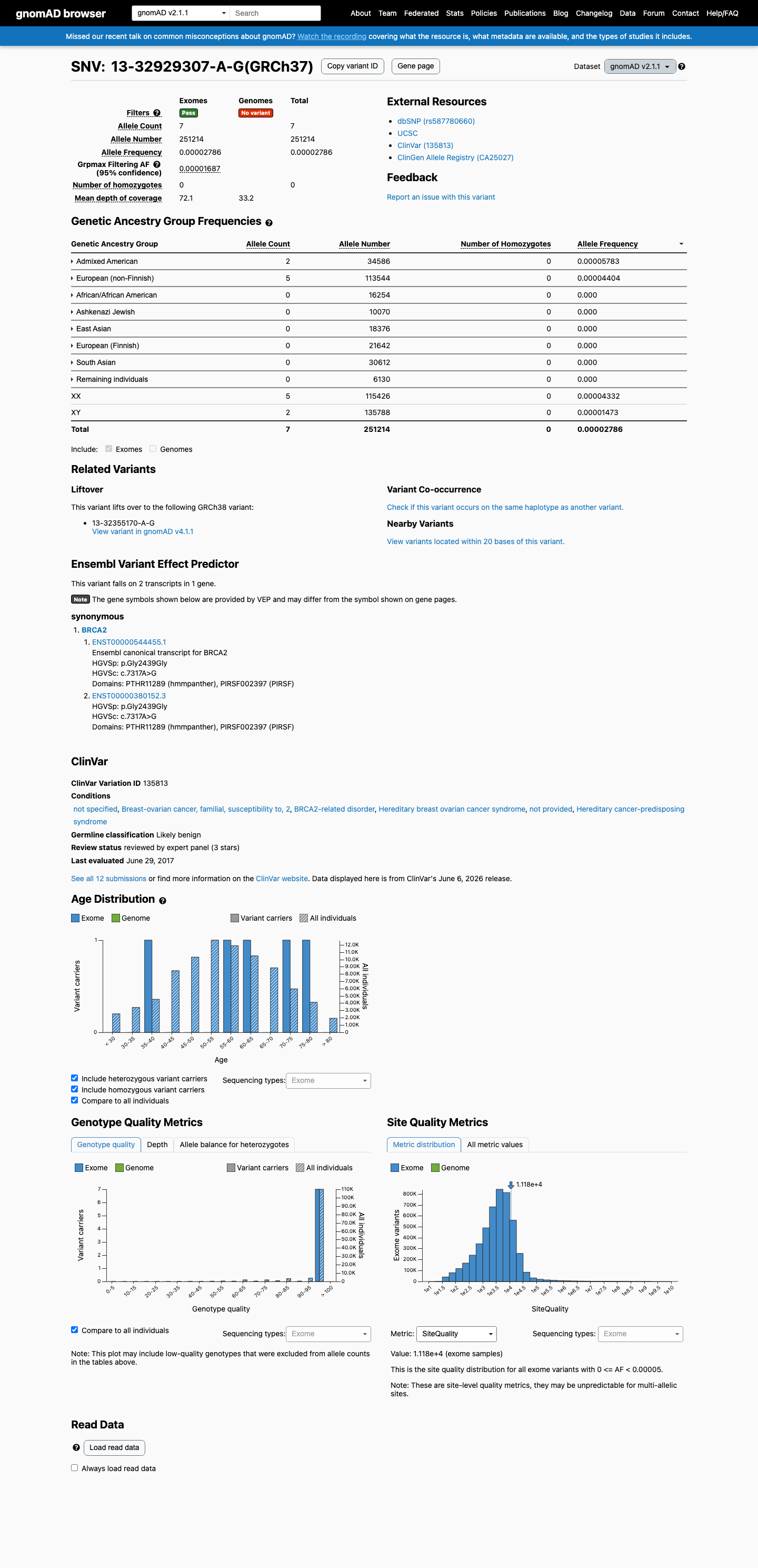
gnomAD v2.1 screenshot
gnomAD v2.1
v4.1
This variant is present in gnomAD v4.1 (AF= 3.53193e-05; MAF= 0.00353%, 57/1613848 alleles, homozygotes = 0) and has highest observed frequency in the Admixed American population (AF= 8.33222e-05; MAF= 0.00833%, 5/60008 alleles, homozygotes = 0); grpmax FAF= 3.233e-05.
v2.1
This variant is present in gnomAD v2.1 (AF= 2.78647e-05; MAF= 0.00279%, 7/251214 alleles, homozygotes = 0) and has highest observed frequency in the Admixed American population (AF= 5.78269e-05; MAF= 0.00578%, 2/34586 alleles, homozygotes = 0); grpmax FAF= 1.687e-05.
🇨🇦 CA
Absent from gnomAD-Canada v1.0.
Allele frequency by ancestry
three datasets · side by side
gnomAD v4.1
0.0035% · 57 / 1,613,848
0 hom · FAF 0.0032%
Admixed American
5 / 60,008
0.0083%
European (non-Finnish)
48 / 1,179,886
0.0041%
Remaining individuals
2 / 62,470
0.0032%
African/African American
2 / 74,924
0.0027%
+ 6 not observed (European (Finnish), Amish, East Asian, Middle Eastern, South Asian, Ashkenazi Jewish)
gnomAD v2.1
0.0028% · 7 / 251,214
0 hom · FAF 0.0017%
Admixed American
2 / 34,586
0.0058%
European (non-Finnish)
5 / 113,544
0.0044%
+ 6 not observed (African/African American, Ashkenazi Jewish, East Asian, European (Finnish), Remaining individuals, South Asian)
gnomAD Canada 🇨🇦
Absent · 0 / ?
0 hom
Not observed in any ancestry group.
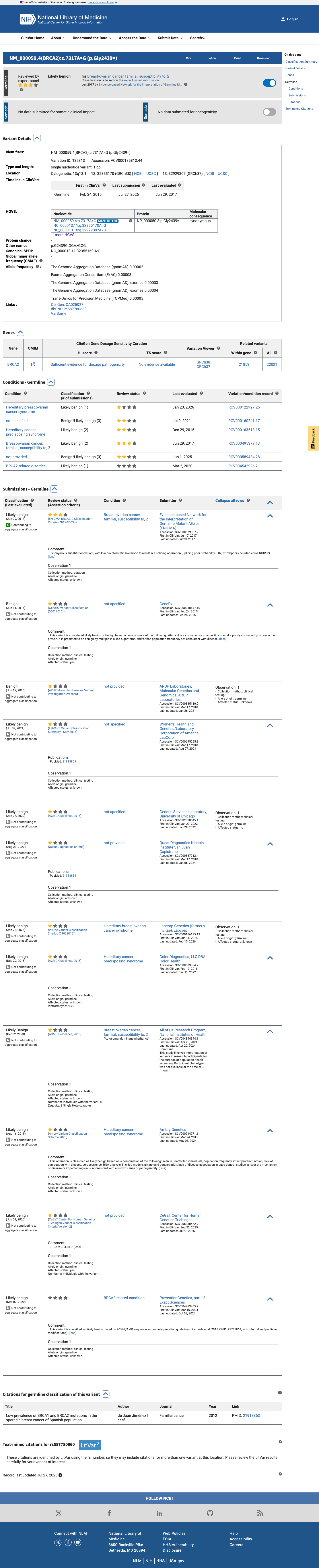
ClinVar screenshot
ClinVar
This variant has been reported in ClinVar as Likely benign (8 clinical laboratories) and as Benign (2 clinical laboratories) and as Likely Benign (1 clinical laboratory) and as Likely benign by Evidence-based Network for the Interpretation of Germline Mutant Alleles (ENIGMA) (expert panel). (ClinVarID = 135813)
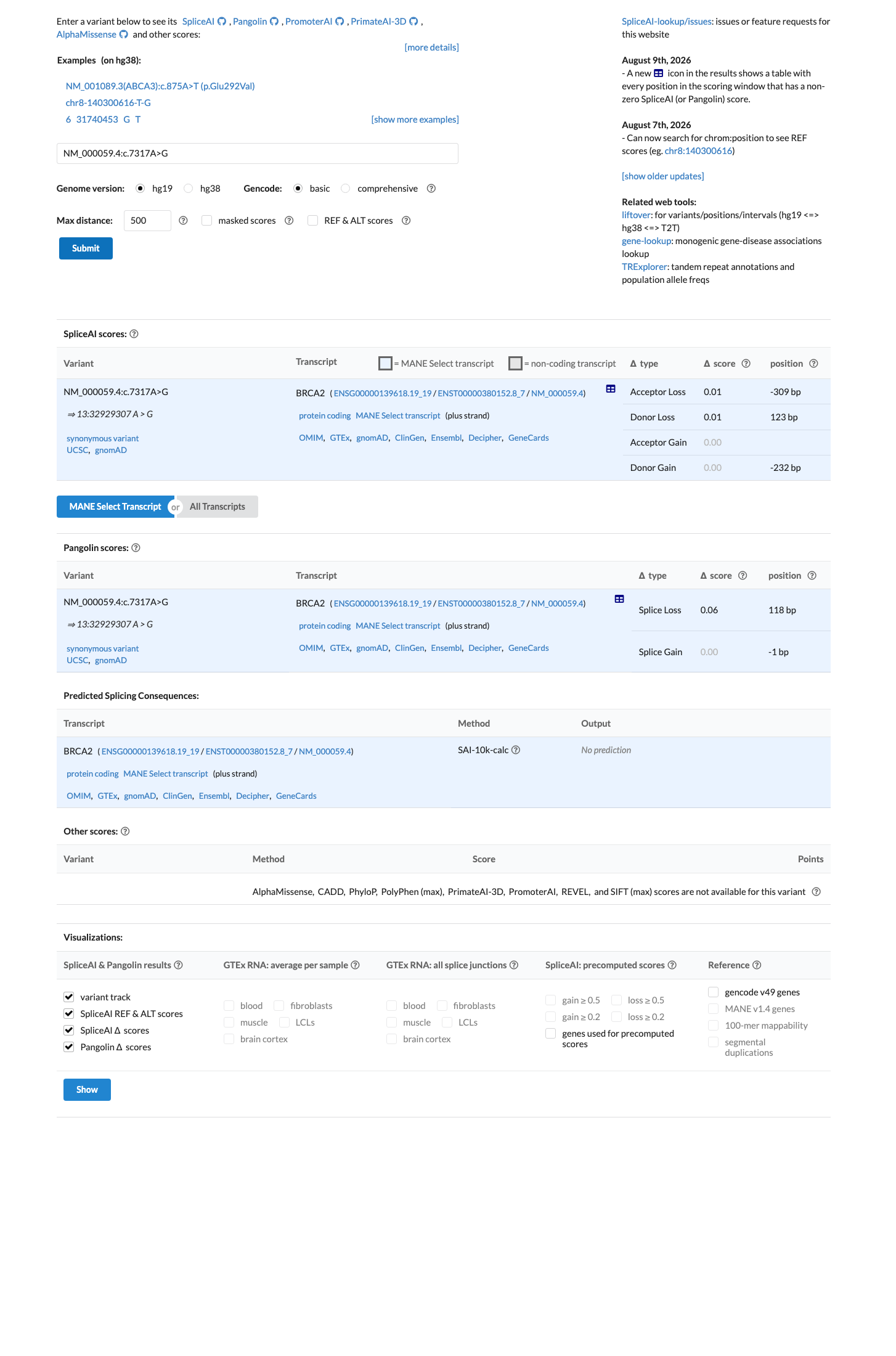
SpliceAI screenshot
In silico
SpliceAI predicts no significant splice impact for this variant (max delta score = 0.01).
Functional / OncoKB screenshot
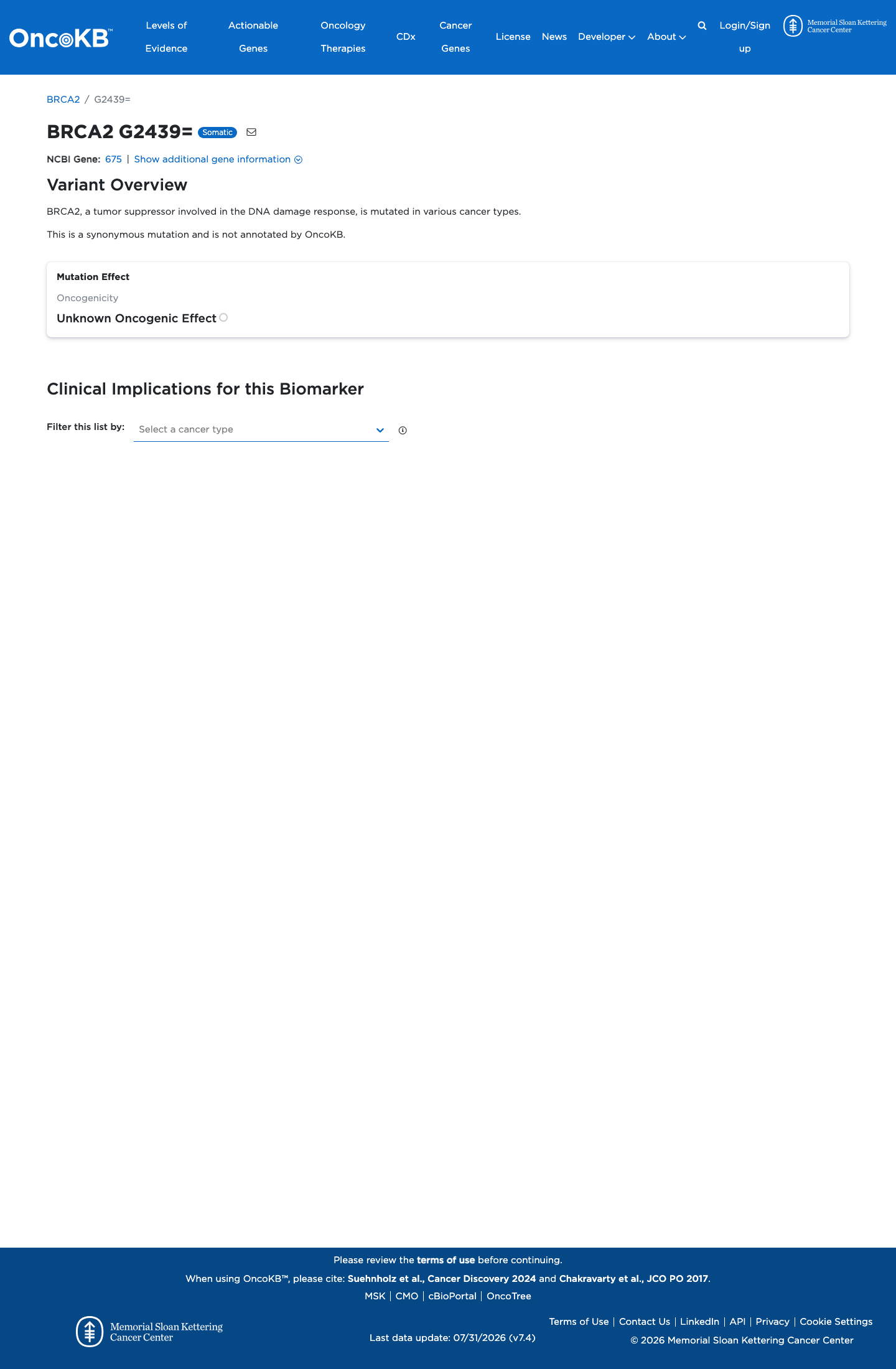
Functional Unknown Oncogenic Effect
OncoKB identified curated literature and non-variant-specific oncogenicity context for review; listed oncogenicity label: Unknown Oncogenic Effect.
OncoKB ↗
COSMIC screenshot
COSMIC
Cancer hotspots screenshot
Cancer hotspots
Somatic evidence Not in COSMIC / hotspots
COSMIC
This variant does not lie in a statistically significant hotspot. This variant has not previously been reported in somatic cancers (COSMIC).
Hotspots
This variant does not lie in a statistically significant hotspot.
Sources & reference links
9Sources
CSpec VCEP
ClinVar
gnomAD v2.1
gnomAD v4.1
gnomAD-Canada
SpliceAI
OncoKB
COSMIC
Cancer hotspots
Triaged references · 9 PMIDs not cited in assessment
23918944 ↗ Tamoxifen and risk of contralateral breast cancer for BRCA1 and BRCA2 mutation carriers. CLINVAR
25741868 ↗ Standards and guidelines for the interpretation of sequence variants: a joint consensus recommendation of the American College of Medical Genetics and Genomics and the Association for Molecular Pathology. CLINVAR
26467025 ↗ A Standardized DNA Variant Scoring System for Pathogenicity Assessments in Mendelian Disorders. CLINVAR
18163131 ↗ The emerging landscape of breast cancer susceptibility. CLINVAR
21918853 ↗ Low prevalence of BRCA1 and BRCA2 mutations in the sporadic breast cancer of Spanish population. CLINVAR
24493721 ↗ American Society of Clinical Oncology Expert Statement: collection and use of a cancer family history for oncology providers. CLINVAR
26389258 ↗ Cancer Genetics Risk Assessment and Counseling (PDQ®): Health Professional Versi CLINVAR
31429903 ↗ Risk Assessment, Genetic Counseling, and Genetic Testing for BRCA-Related Cancer: US Preventive Services Task Force Recommendation Statement. CLINVAR
28492532 ↗ Sherloc: a comprehensive refinement of the ACMG-AMP variant classification criteria. CLINVAR