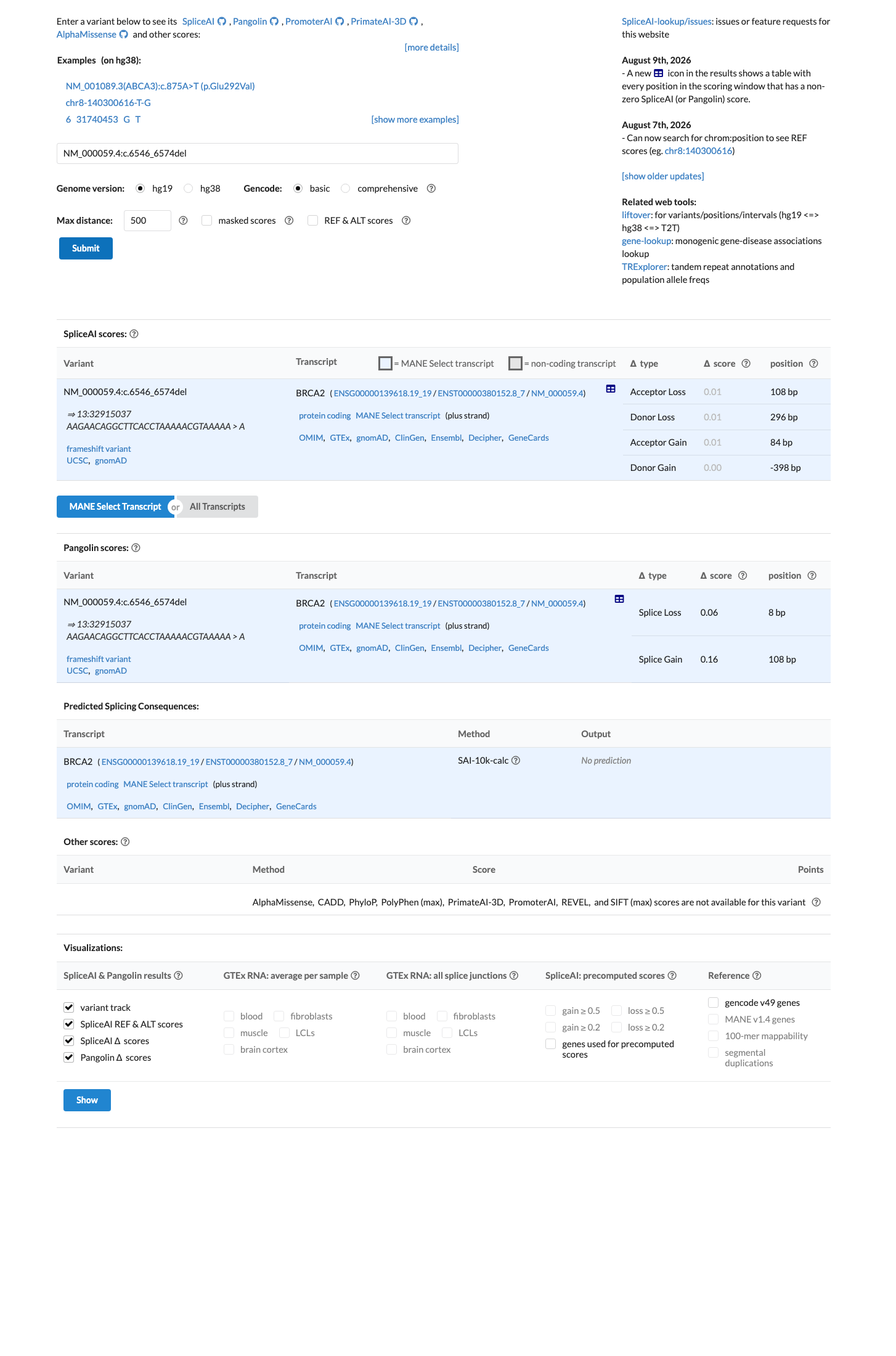
PVS1 is met at Very Strong strength: this is a frameshift deletion in BRCA2 exon 11 predicted to truncate the protein at residue 2186 of 3418, well upstream of the final exon, in a gene where the ENIGMA CSPEC establishes germline loss of function as the disease mechanism and applies PVS1 at default Very Strong strength for such null variants, with no bundle evidence of NMD escape, exon-skip rescue, or exclusion for this exon. PM4 and BP3 are both not_applicable: the governing ENIGMA BRCA1/BRCA2 VCEP Specification v1.2 explicitly excludes both criteria for BRCA2 gene-wide, and independently this frameshift variant does not fit either criterion's underlying variant-type requirements (in-frame length change / in-frame repeat-region indel). NM_000059.4:c.6546_6574del is a frameshift/PTC-producing 29-bp deletion (p.(K2182Nfs*5)) in BRCA2 exon 11, not a missense or in-frame variant, which removes it from the scope of the classic residue/domain criteria as written in the governing ENIGMA BRCA1/BRCA2 CSPEC v1.2. PM1 and PP2 are globally marked 'Not Applicable' for BRCA2 in the ENIGMA CSPEC v1.2, independent of variant type. PS1 and BP1 are scoped by the CSPEC to missense/silent/in-frame or splicing-impact variants and do not apply to this out-of-frame frameshift deletion. PM5 is repurposed by the CSPEC into a PM5_PTC exon-based rule; exon 11 is confirmed PM5_PTC-eligible (not on the BRCA2 PM5_N/A exon list of E6/E12/E27), but the case bundle's Table 4 excerpt does not resolve the specific per-exon strength code or a comparator previously-proven pathogenic PTC variant, so PM5 is left not_assessed pending review of the full Specifications Table 4 spreadsheet. Variant NM_000059.4:c.6546_6574del / NP_000050.3:p.(Lys2182AsnfsTer5) is a 29 bp frameshift deletion in BRCA2 exon 11, a null/PTC-generating variant type. The ENIGMA ClinGen BRCA1/2 v1.2 specification's PS3/BS3 functional-assay track (Specifications Table 9) is explicitly scoped to missense and synonymous variants and mRNA-transcript (splicing) assays; it does not cover frameshift/deletion null variants, whose loss-of-function status is instead assessed via PVS1 (handled outside this group). No calibrated protein-function or mRNA/minigene assay result specific to this exact deletion was found in Specifications_Table9_V1.2_2024-11-18, HUMU-40-1557-s001 (Parsons 2019), or any fetched full-text publication in this case bundle. Both PS3 and BS3 are therefore returned as not_assessed rather than not_applicable, since the ENIGMA framework does in principle allow functional evidence for null variants via the mRNA-assay/PVS1(RNA) pathway — that pathway simply has no variant-specific data available in this case. NM_000059.4:c.6546_6574del is a 29-bp coding deletion (not a multiple of 3) producing a frameshift, NP_000050.3:p.(Lys2182AsnfsTer5) / p.(K2182Nfs*5), per case_summary.json normalization. The governing ClinGen ENIGMA BRCA1/BRCA2 v1.2 specification (cspec) scopes its PP3/BP4/BP7 bioinformatic-code rules to specific variant categories only: missense or in-frame insertion/deletion/delins inside a functional domain (BayesDel no-AF thresholds), silent variants (SpliceAI thresholds), and intronic variants outside the canonical +/-1,2 splice positions (SpliceAI thresholds). A frameshift-causing out-of-frame exonic deletion is not among these categories and instead falls under the PVS1 null-variant pathway (assessed by a different criteria group), so PP3, BP4, and BP7 are all not_applicable for this variant. SpliceAI was independently checked as a sanity check: max delta score = 0.009 (all four delta scores <=0.009), indicating no significant predicted splicing perturbation even if a splicing-based path had been eligible. REVEL and BayesDel scores were not computed/available for this variant in evidence.json (both null), and per pipeline policy BayesDel lacks a verified published calibration threshold regardless, so neither could support PP3/BP4 even under a hypothetical missense/in-frame-indel framing. No literature (paper_extracts.json) discusses this specific variant's splicing or in-silico predictions; the five full-text papers reviewed are gene-level functional/mechanism papers that do not mention c.6546_6574del.
Final classification
Unclassified
PVS1
BRCA2
c.6546_6574del
p.Lys2182AsnfsTer5
· exon NC_000013.10
Gene context
In progress — evidence not uploaded yet.
This variant
In progress — evidence not uploaded yet.
Classification rationale
PVS1
Unclassified
BRCA2 c.6546_6574del
· exon NC_000013.10
PVS1
→
Unclassified
LYFE Sciences is an AI system, and it can make mistakes. Criteria
may be applied incorrectly, sources may be misread, and a confident-looking
classification can still be wrong. Double-check every criterion and
its underlying evidence before relying on any call.
Gene diagram
· NM_000059.4 · variants mapped to exon structure
BRCA2
NM_000059.4
Fetching transcript structure from UCSC…
Applied criteria · 1 applied · 15 assessed
MetEvidence satisfies this criterion.
Not metEvaluated against available evidence; threshold not reached.
Not assessedApplies in principle, but no evidence was found to evaluate it.
N/ADoesn't apply to this variant type.
Applied · 1
Strength
Supporting
Moderate
Strong
Very strong
PVS1
very strong
Pathogenic
NM_000059.4:c.6546_6574del is a 29-bp deletion producing a frameshift, NP_000050.3:p.(Lys2182AsnfsTer5). Mutalyzer prediction places the deletion within c.1910_6841, the ENIGMA-defined coordinate span of BRCA2 exon 11 (the large mid-gene coding exon), well upstream of the final exon (exon 27) and far from the 3' terminus, so the transcript is expected to undergo nonsense-mediated decay and/or produce a severely truncated, non-functional protein (predicted stop at residue 2186 of a 3418-aa reference protein, removing ~36% of the C-terminal coding sequence including the DNA-binding domain aa 2481-3186 and the C-terminal nuclear localization signals/RAD51-binding region). The ClinGen ENIGMA BRCA1/BRCA2 VCEP specification (v1.2) lists PVS1 as applicable with default strength Pathogenic Very Strong for null variants (frameshift, nonsense, canonical splice, initiation codon, single/multi-exon deletion) in BRCA2, a gene with an established germline loss-of-function disease mechanism per the same CSPEC document (pvs1_gene_gate: eligible). BRCA2 exon 11 is not among the exons the ENIGMA Table 4 PVS1 decision table treats as PVS1_N/A, and there is no evidence in this bundle of an alternative in-frame rescue transcript, an exon-skipping mechanism, or escape from NMD for this position, so no downgrade from Very Strong is indicated. Full-text papers retrieved in this case bundle (PMID:10570174, PMID:11239455, PMID:20878484, PMID:22193408, PMID:24312913) do not mention this exact variant and are cited here only for general BRCA2 loss-of-function mechanism context (C-terminal NLS/RAD51-domain truncation causing cytoplasmic mislocalization and HR deficiency), not as variant-specific evidence.
case_summary.json compact_evidence.normalization: NM_000059.4:c.6546_6574del predicts NP_000050.3:p.(Lys2182AsnfsTer5), a frameshift.prefetch.json mutalyzer protein prediction: position_first=2181, position_last_original=3419, position_last_predicted=2186, i.e. truncation well before the native C-terminus.prefetch.json selector_short coding-exon coordinate map places c.6546_6574 within the c.1910_6841 exon span, corresponding to BRCA2 exon 11.
Assessed · not applied
· 4 not met · 11 not assessed
Pathogenic
PS3
NM_000059.4:c.6546_6574del is a 29 bp deletion in BRCA2 exon 11 predicted to cause a frameshift, NP_000050.3:p.(Lys2182AsnfsTer5) — a null/PVS1-type variant, not a missense or synonymous substitution.
PS4
PS4 cannot be assessed because no ethnicity- and country-matched case-control study, variant-specific odds ratio, confidence interval, or p-value was provided for NM_000059.4:c.6546_6574del.
PM2
The variant is reported absent from gnomAD v2.1 and gnomAD v4.1, but the ENIGMA BRCA2 PM2 Supporting rule specifically requires absence from both gnomAD v2.1 non-cancer exome and gnomAD v3.1 non-cancer, plus an average read depth of at least 25 around the variant.
PM3
The ENIGMA BRCA2 v1.2 specification permits PM3 only for a patient with a phenotype consistent with BRCA1/2-related Fanconi anemia and a co-occurrent pathogenic or likely pathogenic variant in BRCA2, with strength assigned from the Table 6 point total.
PM5
Under ENIGMA BRCA1/BRCA2 CSPEC v1.2, PM5 is repurposed away from classic same-residue missense logic (this variant is a frameshift/PTC, not a missense substitution) into a PM5_PTC rule: additional weight for a PTC variant in an exon where a different proven pathogenic PTC variant has already been observed, with exon-specific strength defined in Specifications Table 4.
PP1
No case-level segregation data are provided for the BRCA2 variant NM_000059.4:c.6546_6574del.
PP4
PP4 cannot be assessed because no combined multifactorial clinical LR is available for NM_000059.4:c.6546_6574del.
PP5
PP5 is not met because ClinVar has no exact-variant record and therefore no exact-variant pathogenic or likely pathogenic expert-panel assertion.
Benign
BA1
The variant is absent from gnomAD v2.1 and gnomAD v4.1.
BS1
The variant is absent from gnomAD v2.1 and gnomAD v4.1.
BS2
The ENIGMA BRCA2 BS2 rule requires case-level evidence concerning absence of Fanconi Anemia features and point-based assessment under Specification Table 8.
BS3
For the same reasons as PS3: c.6546_6574del is a frameshift deletion outside the missense/synonymous scope of the ENIGMA BS3 functional-assay track (Specifications Table 9), and no calibrated protein-function or mRNA-transcript assay result for this specific variant is present anywhere in the case bundle.
BS4
No case-level non-segregation data are provided for the BRCA2 variant NM_000059.4:c.6546_6574del.
BP5
BP5 cannot be assessed because no combined multifactorial clinical LR against pathogenicity is available for NM_000059.4:c.6546_6574del.
BP6
BP6 is not met because ClinVar has no exact-variant record and therefore no exact-variant benign or likely benign expert-panel assertion.
N/A · 12
PS1 · PS2 · PM1 · PM4 · PM6 · PP2 · PP3 · BP1 · BP2 · BP3 · BP4 · BP7
Research & evidence
Population frequency
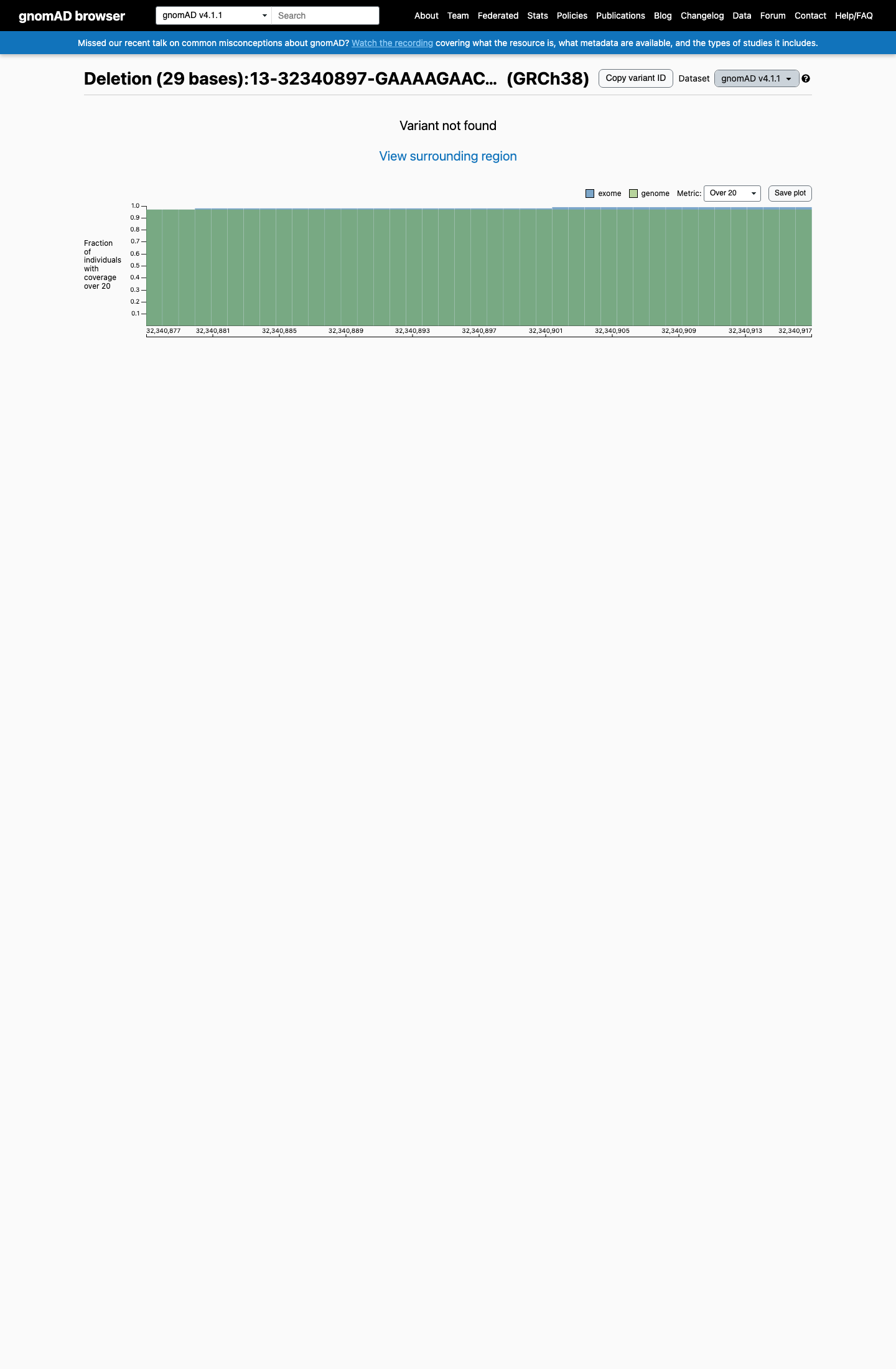
gnomAD v4.1
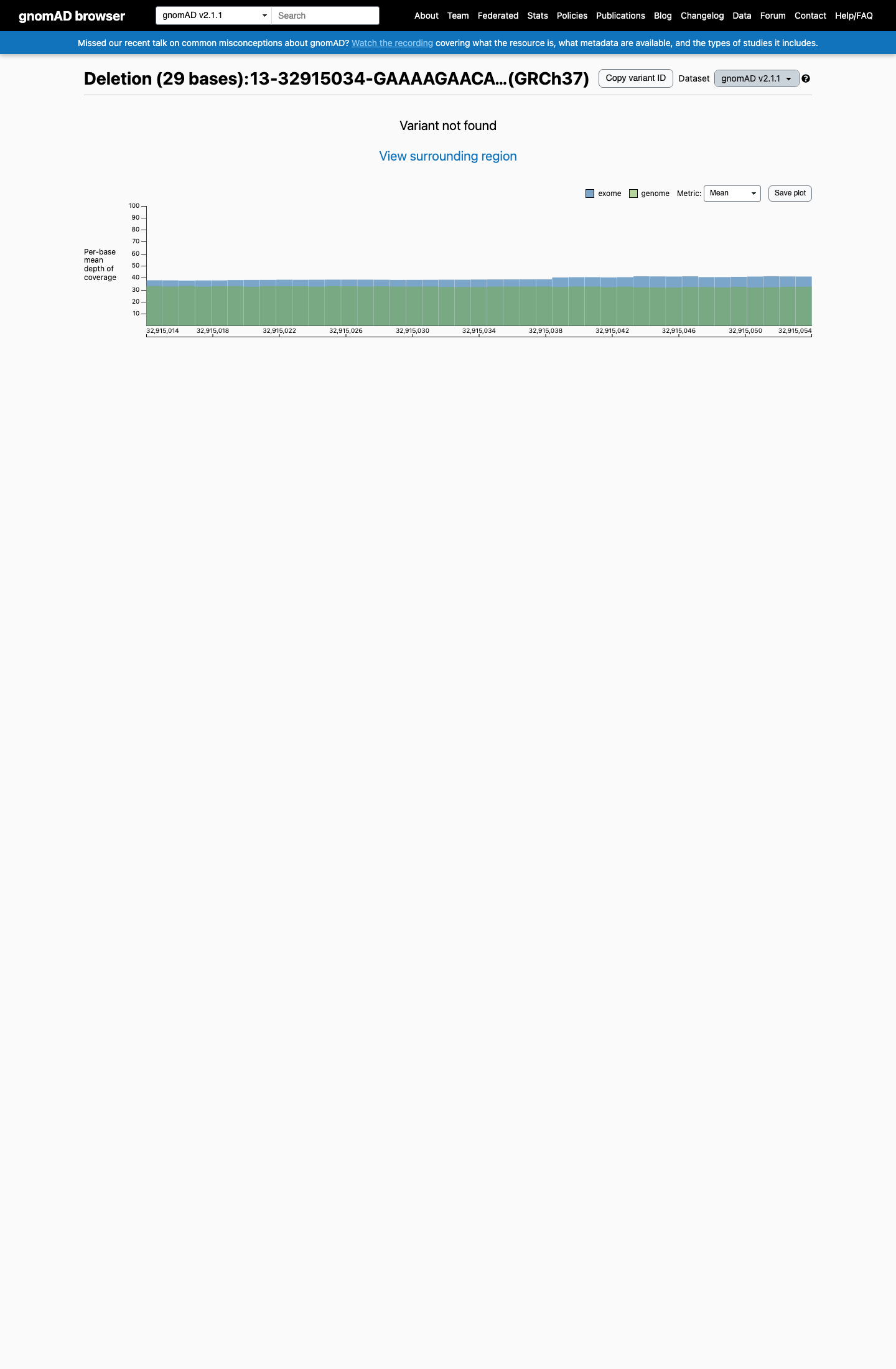
gnomAD v2.1
v4.1
Absent from gnomAD v4.1.
v2.1
Absent from gnomAD v2.1.
🇨🇦 CA
Absent from gnomAD-Canada v1.0.
Allele frequency by ancestry
three datasets · side by side
gnomAD v4.1
Absent
· 0 / ?
0 hom
0 hom
Not observed in any ancestry group.
gnomAD v2.1
Absent
· 0 / ?
0 hom
0 hom
Not observed in any ancestry group.
gnomAD Canada 🇨🇦
Absent
· 0 / ?
0 hom
0 hom
Not observed in any ancestry group.
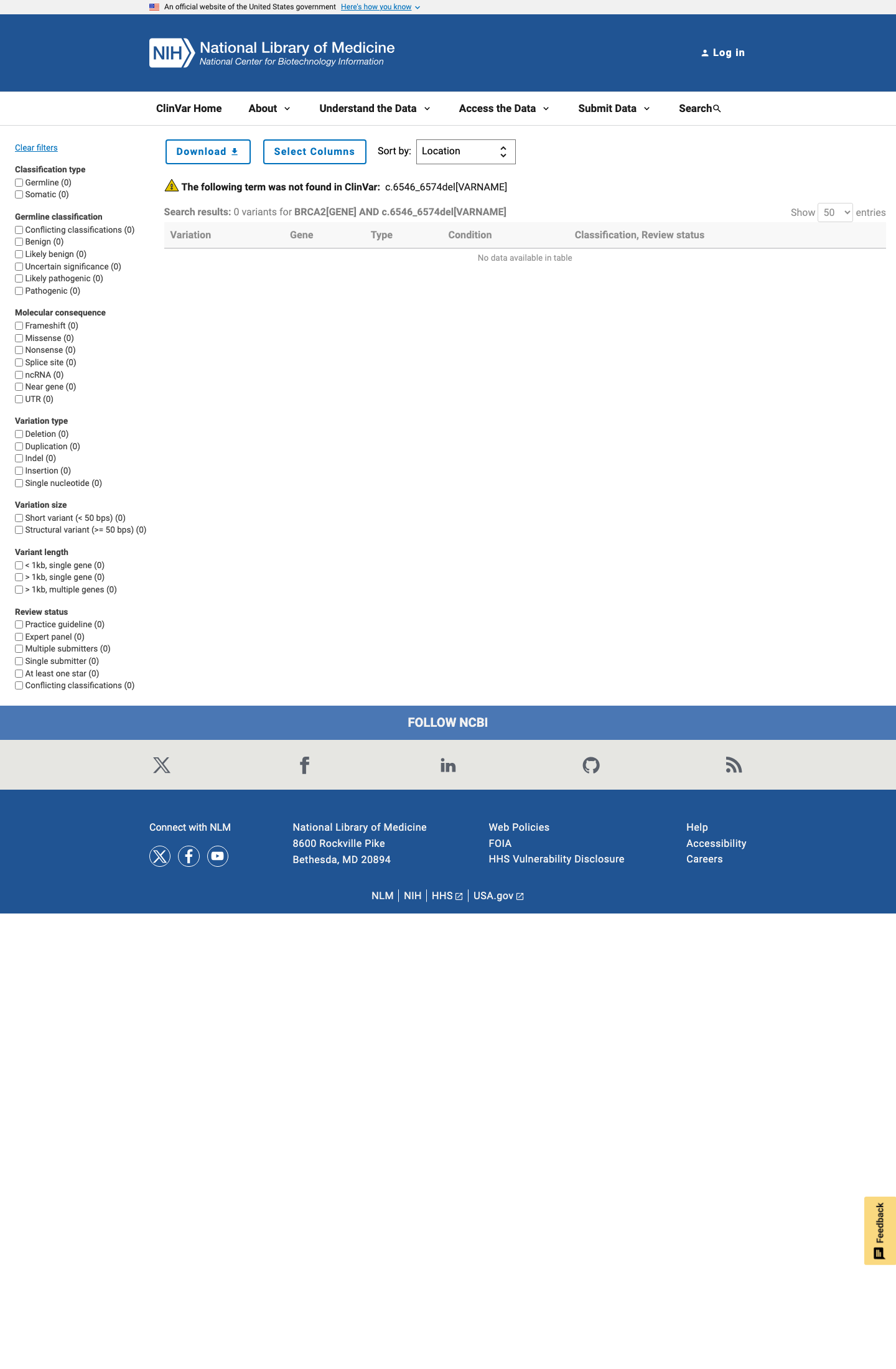
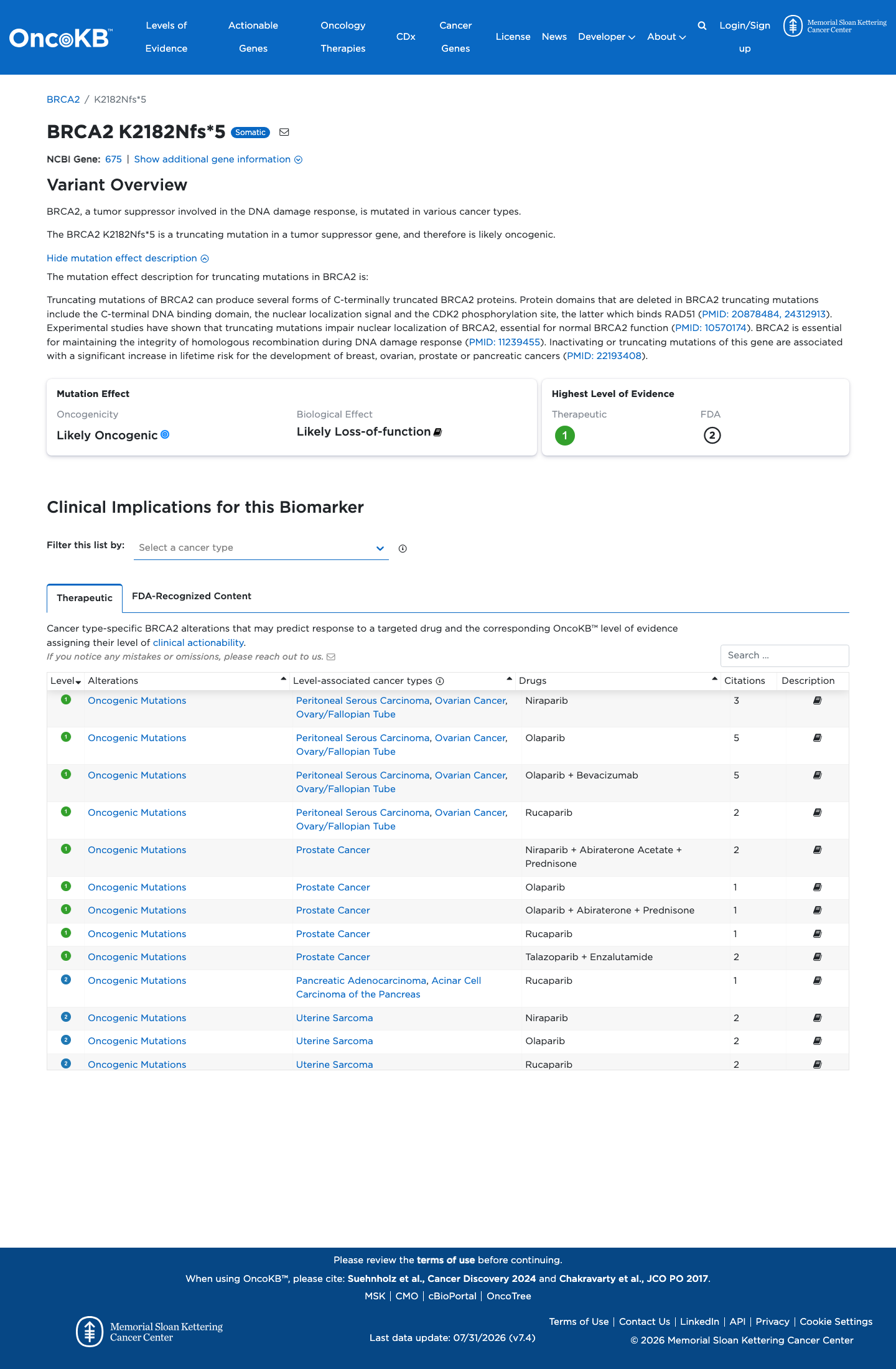

COSMIC

Cancer hotspots
Somatic evidence
Not in COSMIC / hotspots
COSMIC
In progress — evidence not uploaded yet.
Hotspots
This variant does not lie in a statistically significant hotspot.
Literature · how each cited paper was used
5papers cited
Each card is an audit: what was searched, what was found, whether it names the variant, which criteria it fed, and why.
Truncated BRCA2 is cytoplasmic: implications for cancer-linked mutations.
Found
reports that BRCA2 truncations removing the C-terminal 156 aa (containing NLS1/NLS3) fail to localize to the nucleus and are non-functional, supporting the general BRCA2 LOF-via-truncation mechanism, though this exact variant is not mentioned.
Applied to
→PVS1
very strong
BRCA2 is required for homology-directed repair of chromosomal breaks.
Found
reports BRCA2 C-terminal truncating mutations severely impair homology-directed repair, supporting the LOF mechanism generally;
Applied to
→PVS1
very strong
A new mutation of BRCA2 gene in an Italian healthy woman with familial breast cancer history.
Found
, PMID:22193408, PMID:24312913 (full text) provide general BRCA2 truncation/LOF mechanistic context but do not mention this exact variant;
Applied to
→PVS1
very strong
BRCA1 and BRCA2: different roles in a common pathway of genome protection.
Found
, PMID:22193408, PMID:24312913 (full text) provide general BRCA2 truncation/LOF mechanistic context but do not mention this exact variant;
Applied to
→PVS1
very strong
A comprehensive focus on global spectrum of BRCA1 and BRCA2 mutations in breast cancer.
Found
, PMID:22193408, PMID:24312913 (full text) provide general BRCA2 truncation/LOF mechanistic context but do not mention this exact variant;
Applied to
→PVS1
very strong
Sources & reference links